
Ch 15 Firearms I 3 Basic Types of
Ch. 15 Firearms

I. 3 Basic Types of Firearms A. Hand Guns 1. Revolver a. Typically has 6 rounds (“six shooter”) b. Large variety of bullet size c. Caliber: size of bullet (ex: . 22, . 38, . 44)
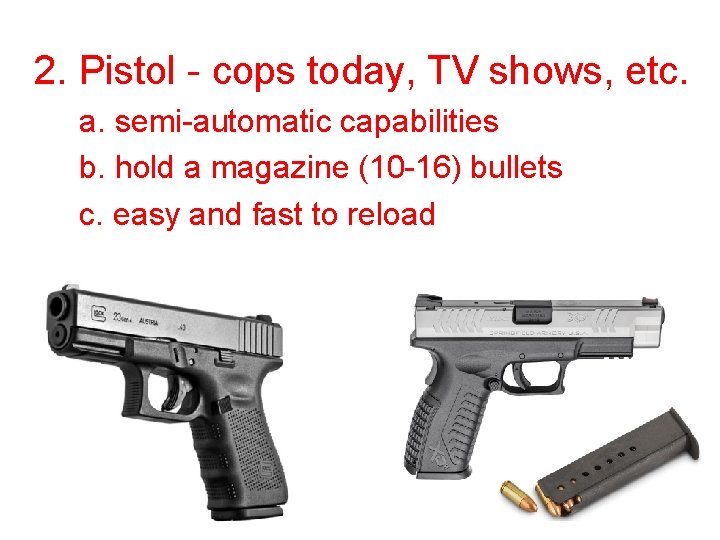
2. Pistol - cops today, TV shows, etc. a. semi-automatic capabilities b. hold a magazine (10 -16) bullets c. easy and fast to reload

B. Rifles 1. Bolt-Action Rifle-soldiers in WWII a. typically hold 5 cartridges b. reload is slow (hunting, target shooting) c. weapon of choice for snipers
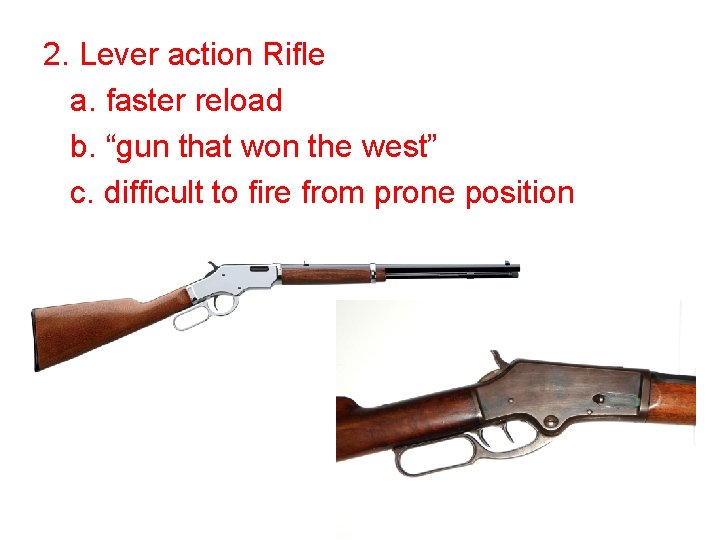
2. Lever action Rifle a. faster reload b. “gun that won the west” c. difficult to fire from prone position
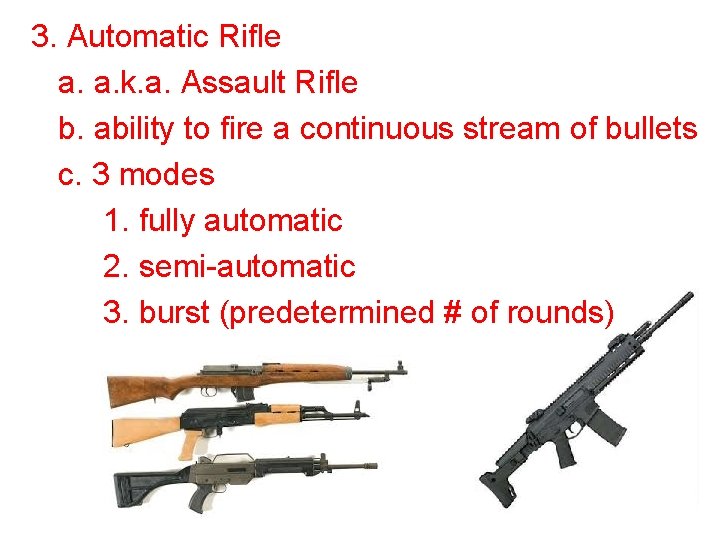
3. Automatic Rifle a. a. k. a. Assault Rifle b. ability to fire a continuous stream of bullets c. 3 modes 1. fully automatic 2. semi-automatic 3. burst (predetermined # of rounds)
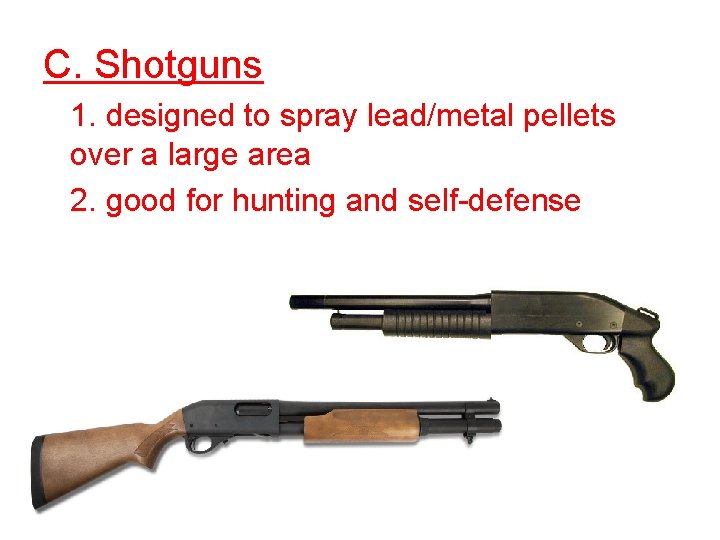
C. Shotguns 1. designed to spray lead/metal pellets over a large area 2. good for hunting and self-defense
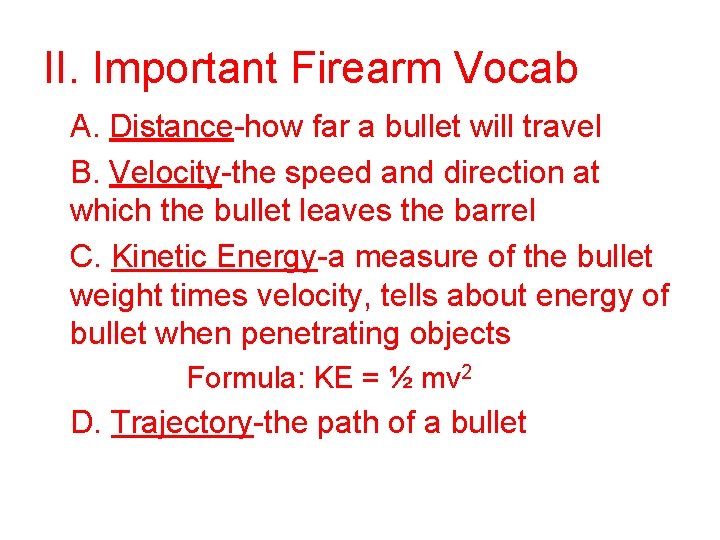
II. Important Firearm Vocab A. Distance-how far a bullet will travel B. Velocity-the speed and direction at which the bullet leaves the barrel C. Kinetic Energy-a measure of the bullet weight times velocity, tells about energy of bullet when penetrating objects Formula: KE = ½ mv 2 D. Trajectory-the path of a bullet
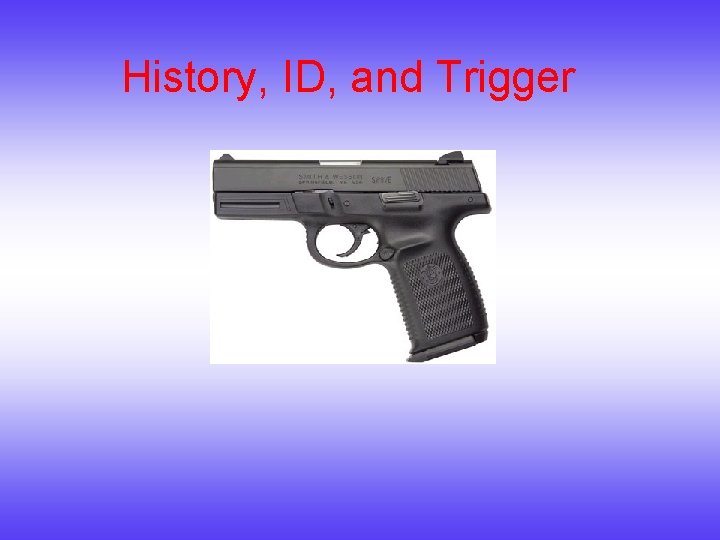
History, ID, and Trigger
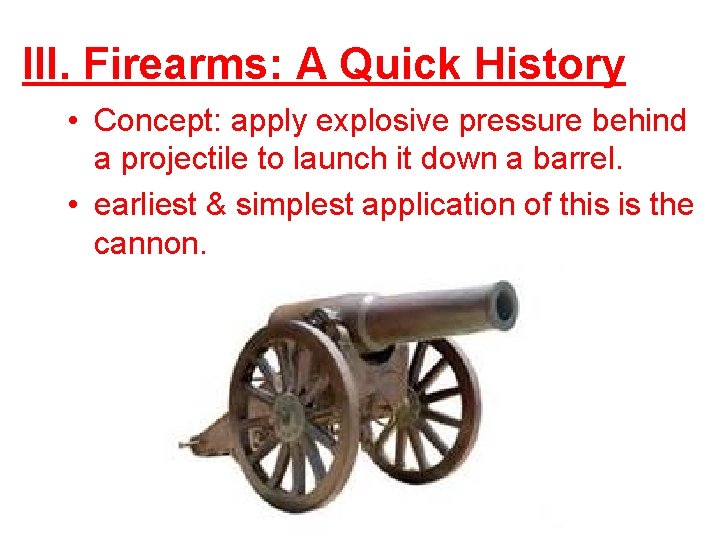
III. Firearms: A Quick History • Concept: apply explosive pressure behind a projectile to launch it down a barrel. • earliest & simplest application of this is the cannon.
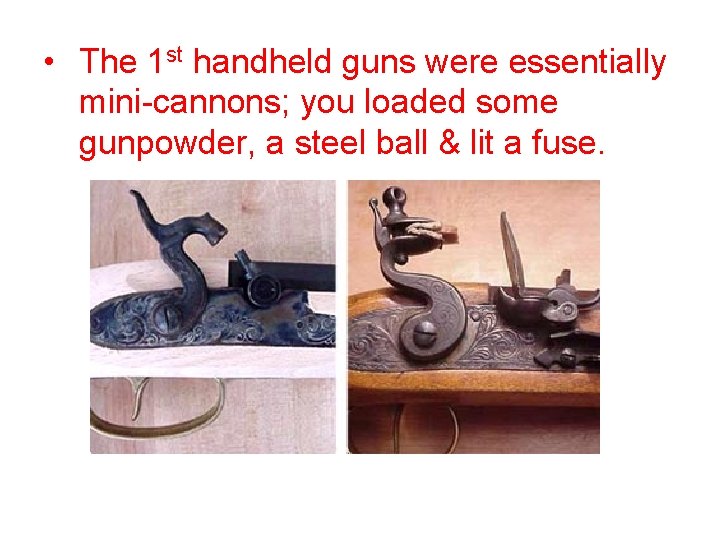
• The 1 st handheld guns were essentially mini-cannons; you loaded some gunpowder, a steel ball & lit a fuse.
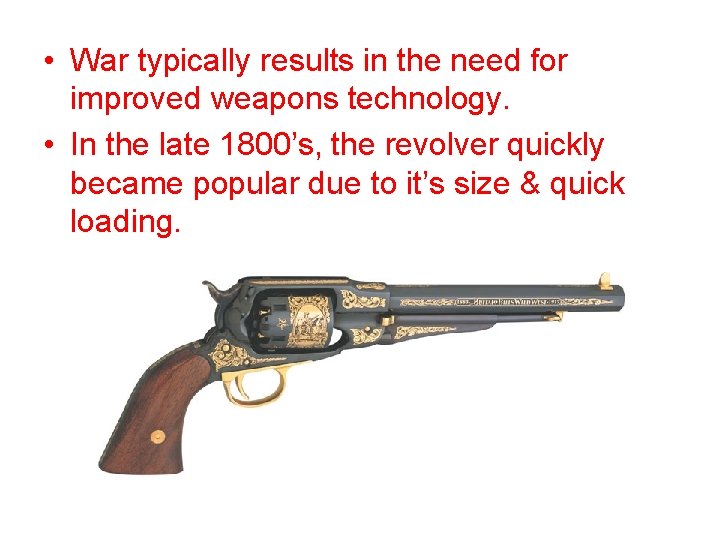
• War typically results in the need for improved weapons technology. • In the late 1800’s, the revolver quickly became popular due to it’s size & quick loading.
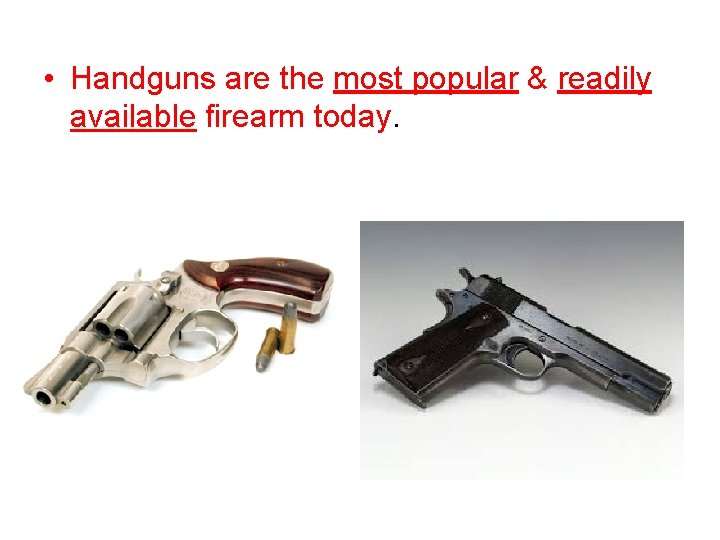
• Handguns are the most popular & readily available firearm today.

IV. Firearms Identification • Often confused with the term ballistics A. Ballistics: the study of a projectile in motion. 1. Inside the firearm 2. After it leaves the firearm 3. When it impacts the target
Firearms Identification (cont. ) B. Basic idea of Firearms ID: – A harder object marks a softer one & transfers small irregularities to that object.
C. Forensic Firearms Expert Job 1. Was this firearm used in the crime? 2. Did these bullets come from that gun? 3. Was it really self-defense? 4. Is this a case of suicide, or is foul play involved?
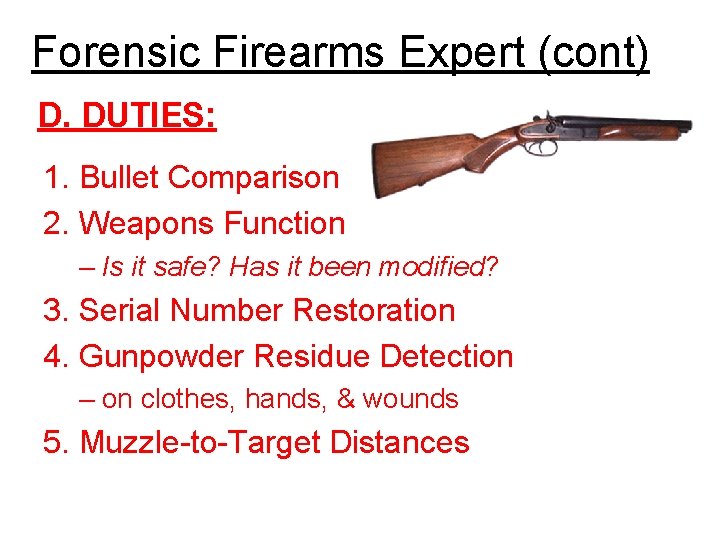
Forensic Firearms Expert (cont) D. DUTIES: 1. Bullet Comparison 2. Weapons Function – Is it safe? Has it been modified? 3. Serial Number Restoration 4. Gunpowder Residue Detection – on clothes, hands, & wounds 5. Muzzle-to-Target Distances
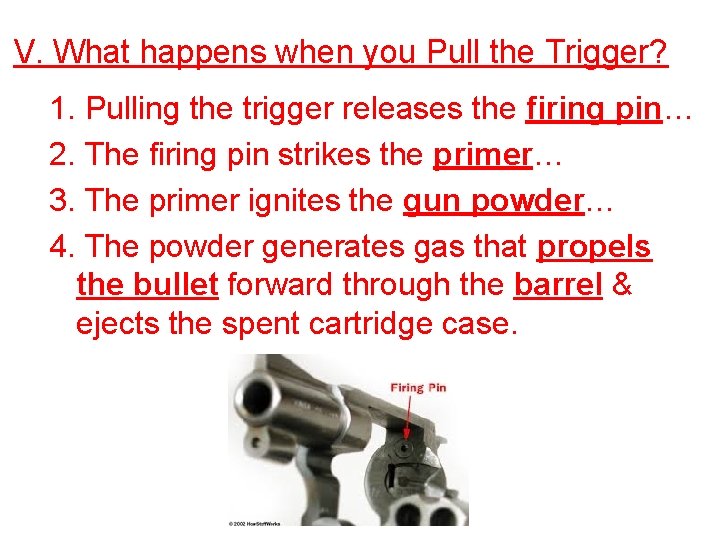
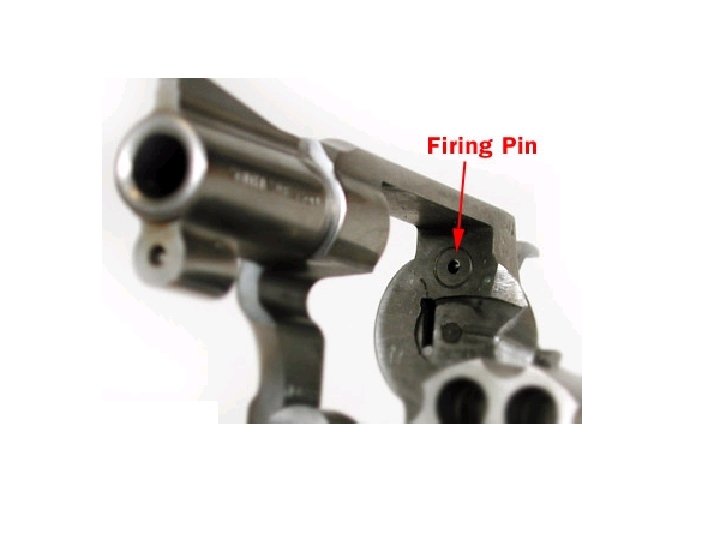
V. What happens when you Pull the Trigger? 1. Pulling the trigger releases the firing pin… 2. The firing pin strikes the primer… 3. The primer ignites the gun powder… 4. The powder generates gas that propels the bullet forward through the barrel & ejects the spent cartridge case.
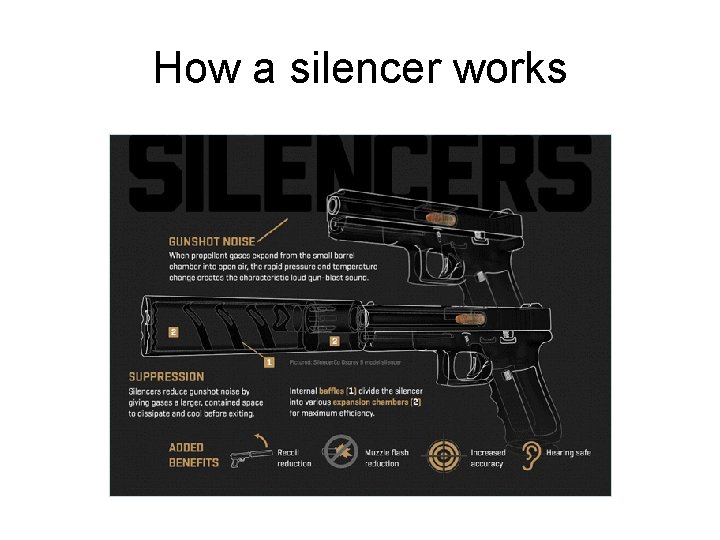
How a silencer works
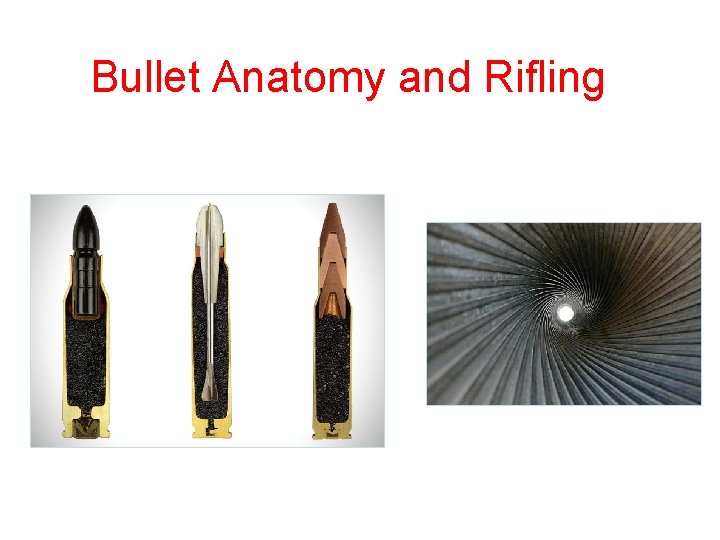
Bullet Anatomy and Rifling
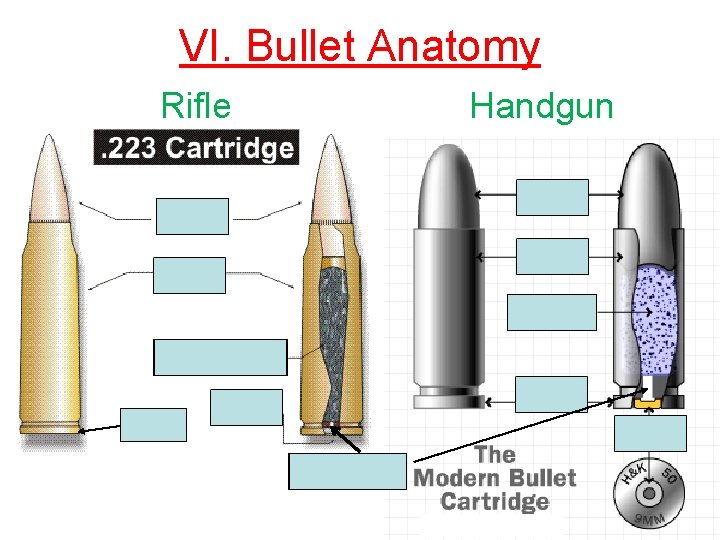
VI. Bullet Anatomy Handgun Rifle Rim Flash Hole
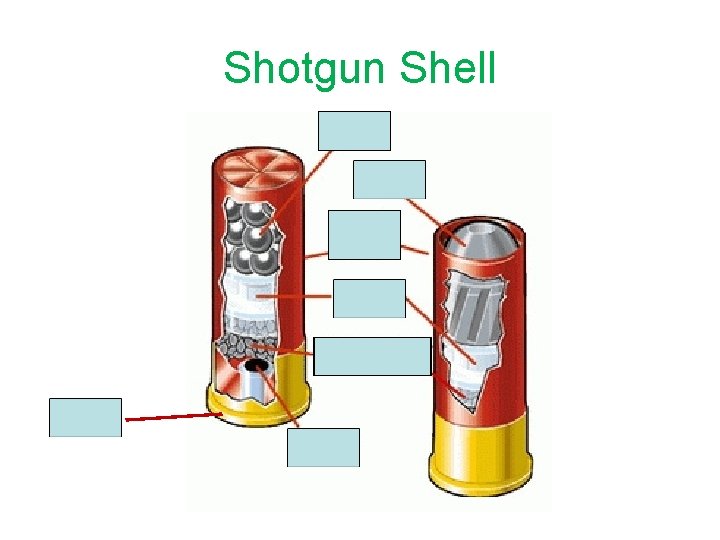
Shotgun Shell rim
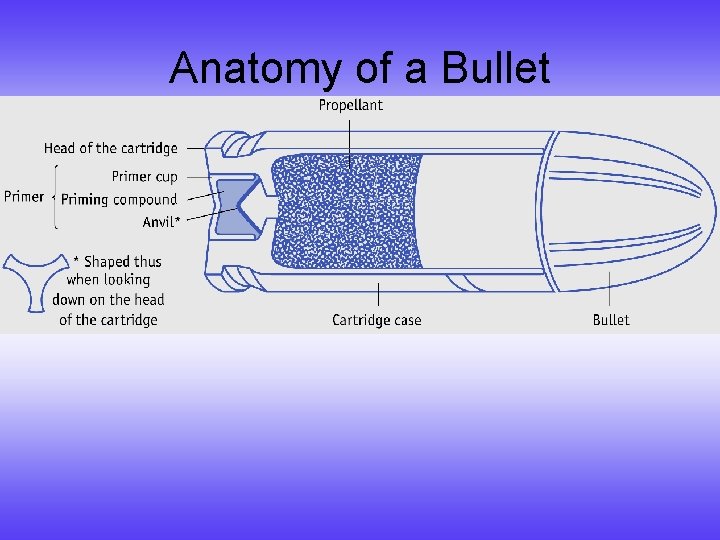
Anatomy of a Bullet
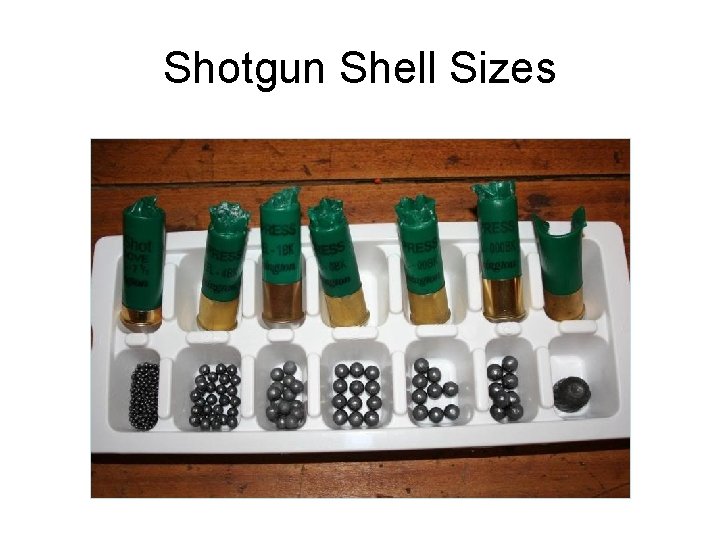
Shotgun Shell Sizes
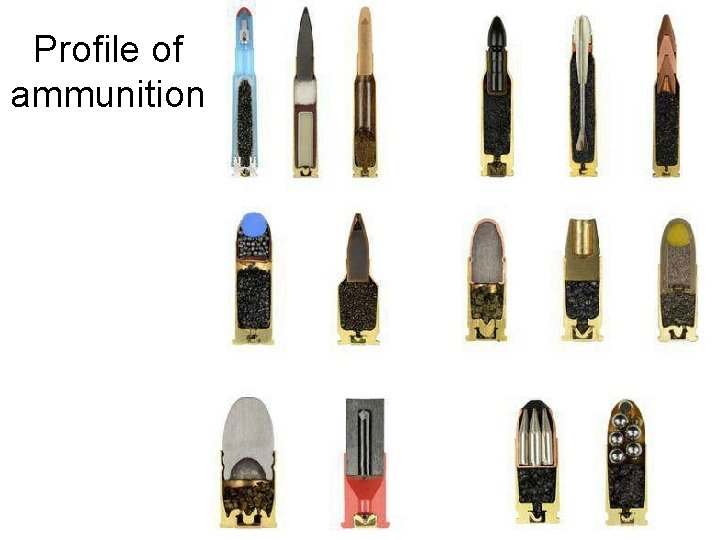
Profile of ammunition
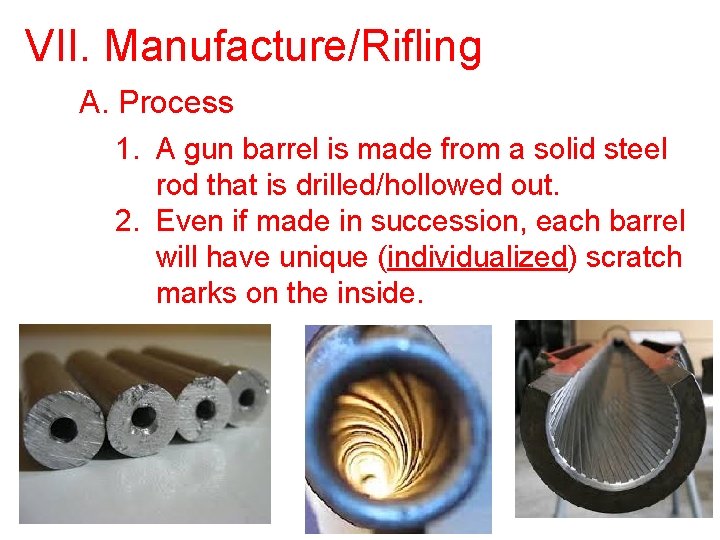
VII. Manufacture/Rifling A. Process 1. A gun barrel is made from a solid steel rod that is drilled/hollowed out. 2. Even if made in succession, each barrel will have unique (individualized) scratch marks on the inside.
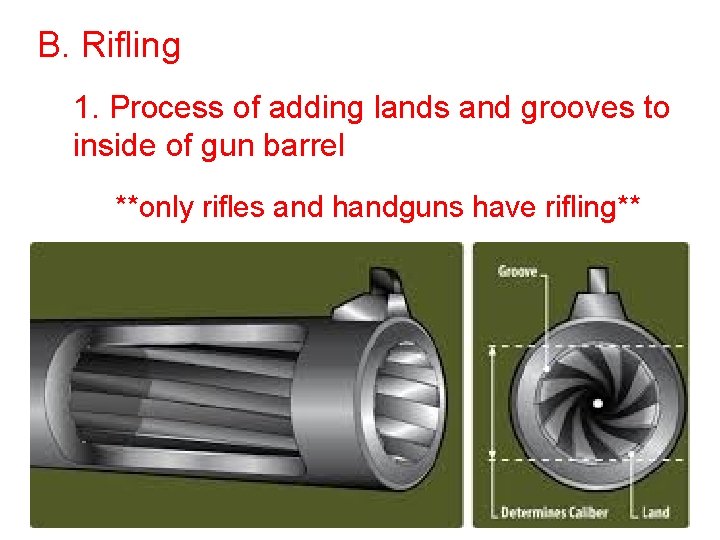
B. Rifling 1. Process of adding lands and grooves to inside of gun barrel **only rifles and handguns have rifling**
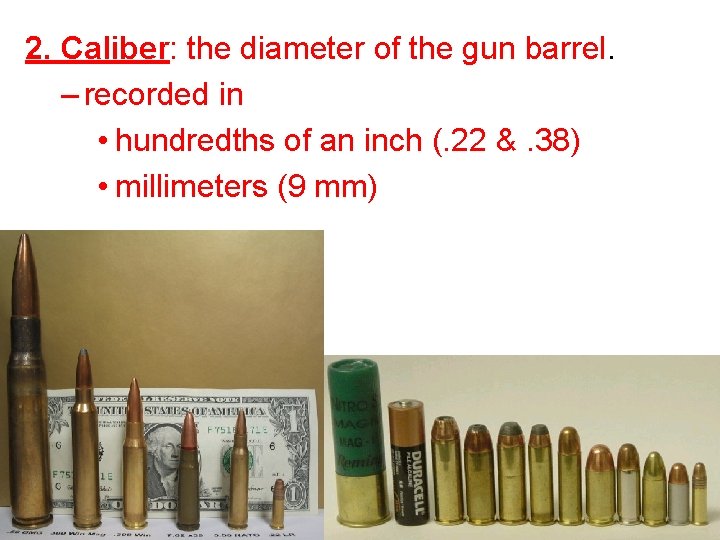
2. Caliber: the diameter of the gun barrel. – recorded in • hundredths of an inch (. 22 &. 38) • millimeters (9 mm)
VIII. Class Characteristics A. Def: Can be associated with a group B. Each brand of gun has particular, consistent rifling process 1. Lands & Grooves are the same for a model. –. 32 caliber Smith & Wesson-5 lands & grooves twisting right. –. 32 caliber Colt - 6 lands & grooves twisting left. 2. Class characteristics can eliminate certain makes but are not enough to ID a particular gun.
IX. Individualized Characteristics A. Def: are unintentional, random, and unique features of that object that distinguish it from other objects B. Imperfections in manufacturing make each barrel unique: • no identical striations (scratch-like marks) exist
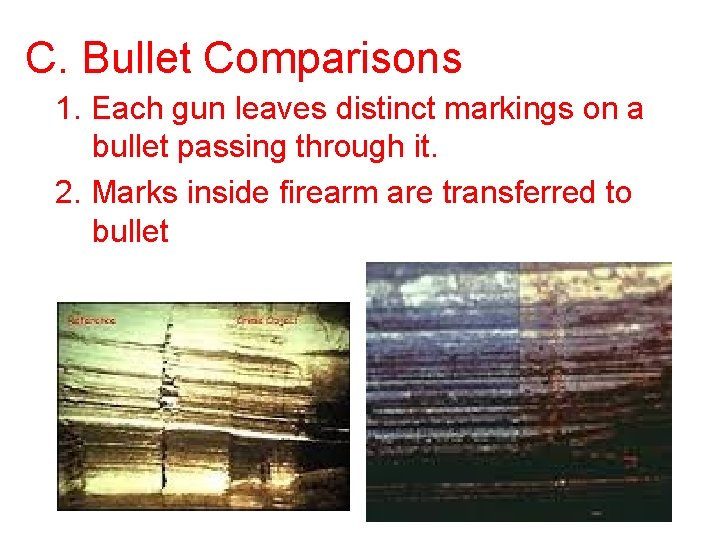
C. Bullet Comparisons 1. Each gun leaves distinct markings on a bullet passing through it. 2. Marks inside firearm are transferred to bullet
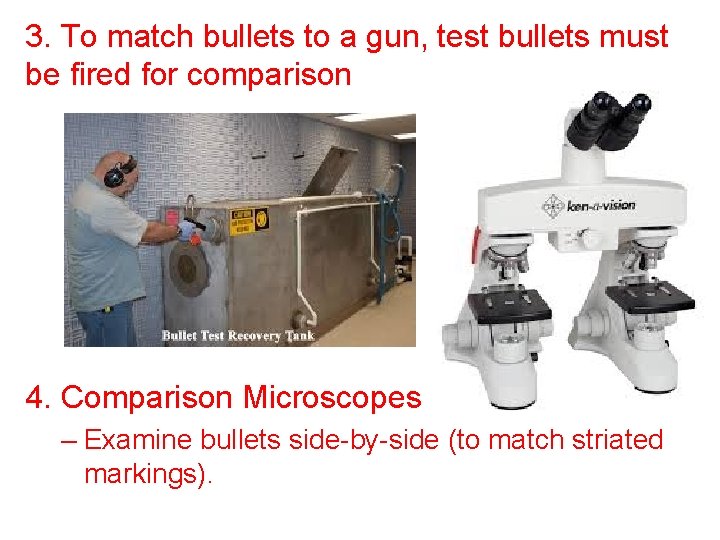
3. To match bullets to a gun, test bullets must be fired for comparison 4. Comparison Microscopes – Examine bullets side-by-side (to match striated markings).
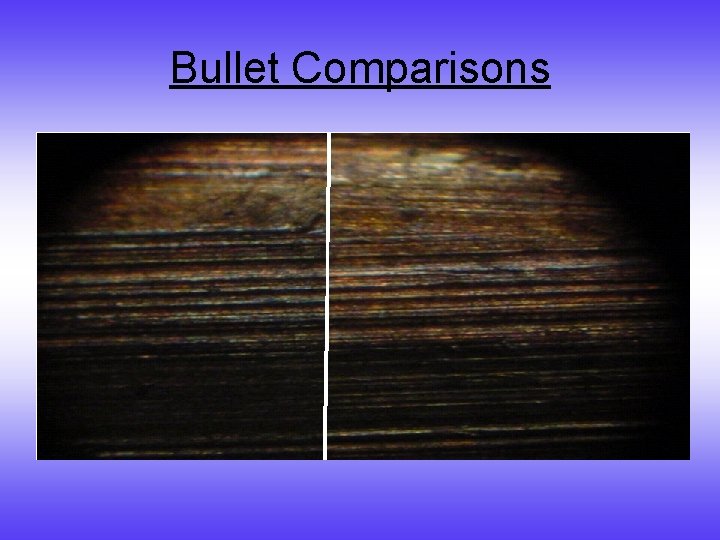
Bullet Comparisons
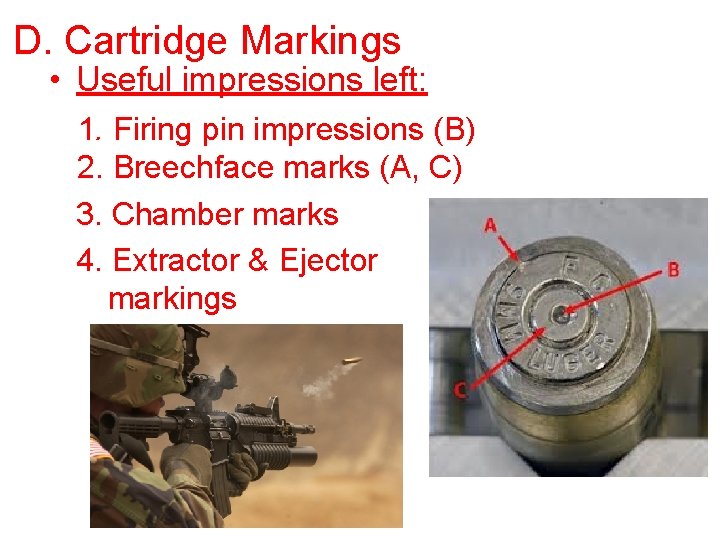
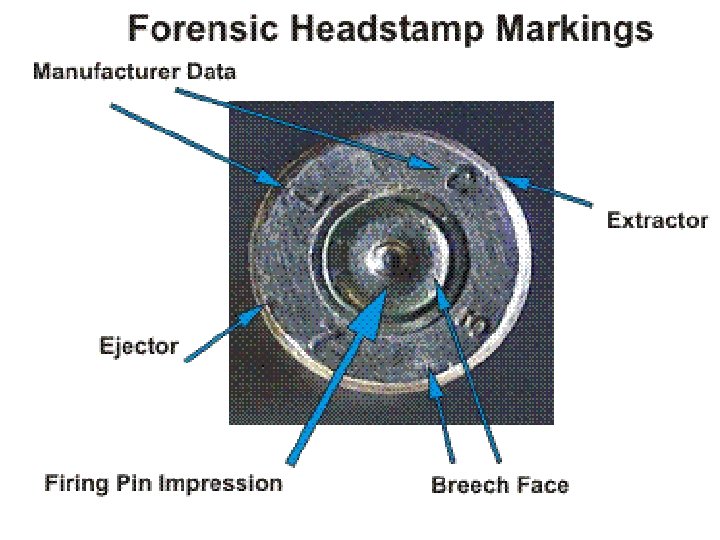
D. Cartridge Markings • Useful impressions left: 1. Firing pin impressions (B) 2. Breechface marks (A, C) 3. Chamber marks 4. Extractor & Ejector markings
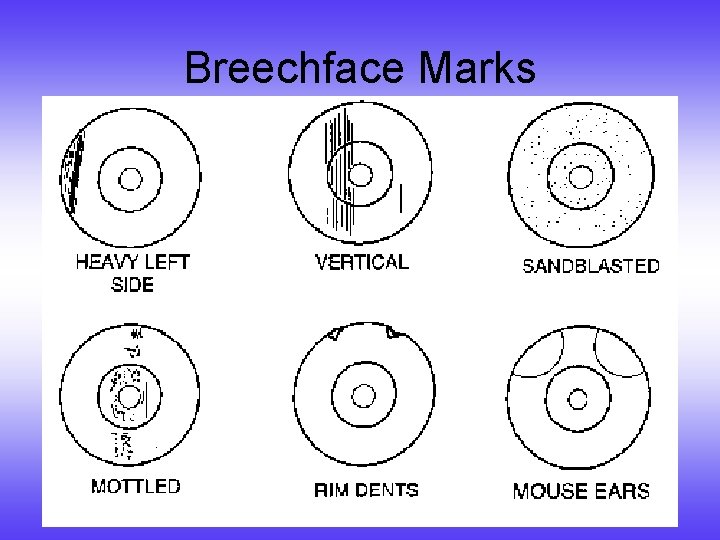
Breechface Marks
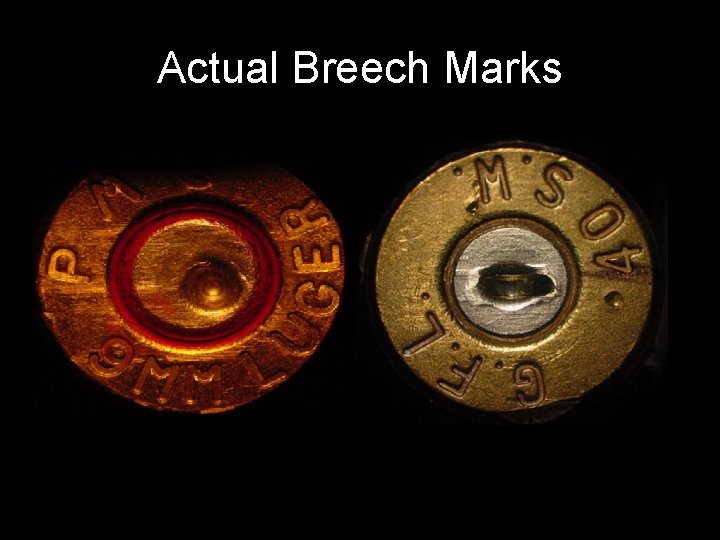
Actual Breech Marks
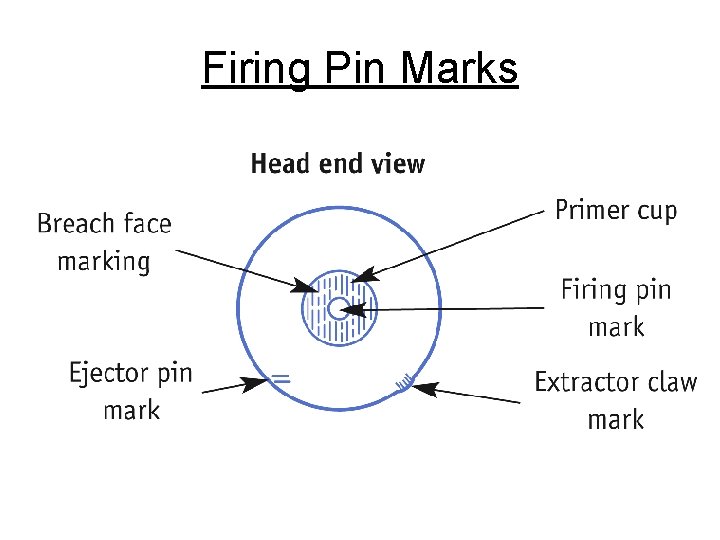
Firing Pin Marks
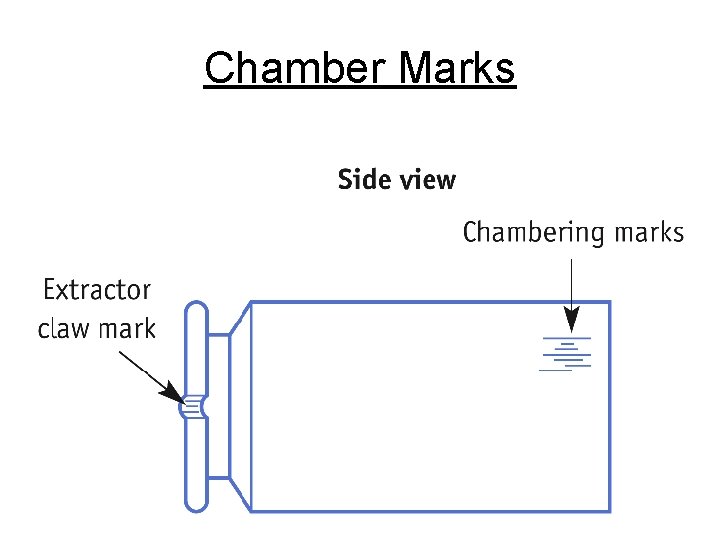
Chamber Marks
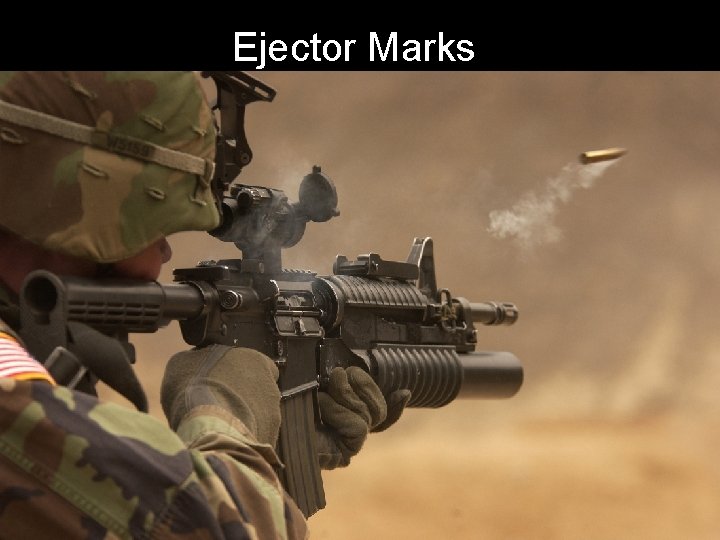
Ejector Marks
X. Other Factors 1. Perfect matches sometimes difficult b/c: – Presence of grit & rust in a barrel – Recovered bullets too mutilated or distorted on impact 2. A spent bullet’s weight can sometimes determine the gun make. 3. General Rifling Characteristics File – FBI database of known land/groove width for all weapons. (called NIBIN)
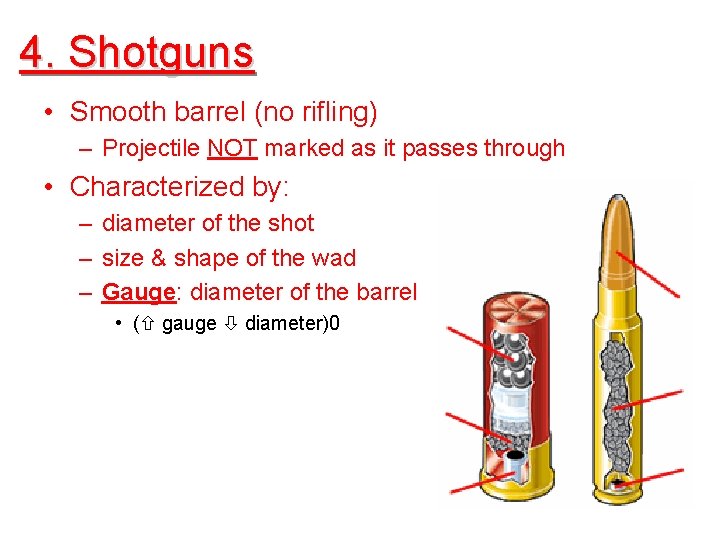
4. Shotguns • Smooth barrel (no rifling) – Projectile NOT marked as it passes through • Characterized by: – diameter of the shot – size & shape of the wad – Gauge: diameter of the barrel • ( gauge diameter)0
Gunshot Residue & Info From Wounds
XI. Gunshot Residue (GSR) A. Sources: – victim, clothing or target – shooter’s hands B. Gunpowder Chemistry 1. Detect elements: lead (Pb), barium (Ba) & antimony (Sb) 2. Virtually all cartridge cases are made of brass (copper & zinc); also detectable.
C. Griess Test 1. Tests for the presence of nitrates (partially burned or unburned gunpowder) 2. Swab of shooter’s hand 3. Must produce a pattern for a distance determination
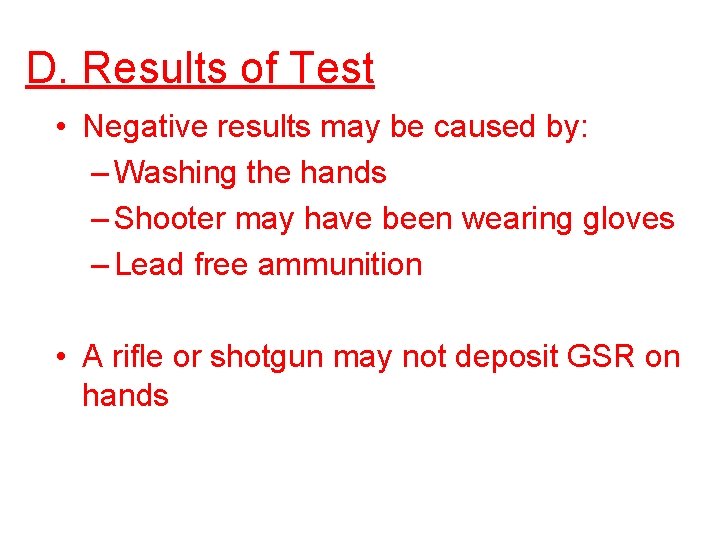
D. Results of Test • Negative results may be caused by: – Washing the hands – Shooter may have been wearing gloves – Lead free ammunition • A rifle or shotgun may not deposit GSR on hands
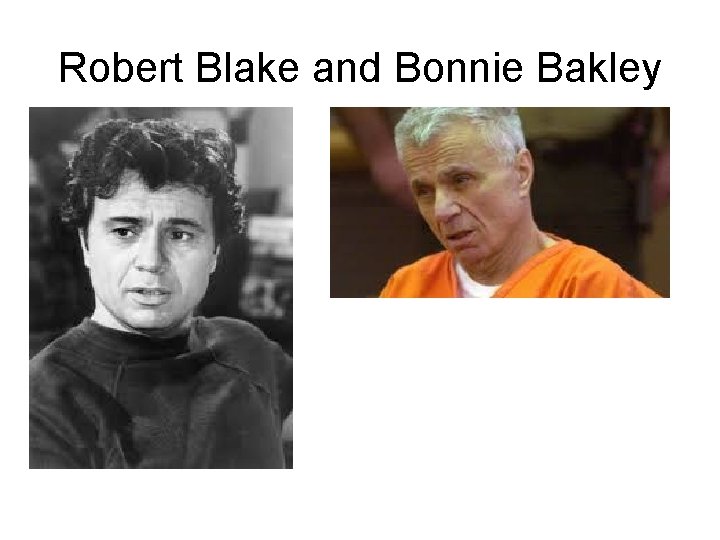
Robert Blake and Bonnie Bakley
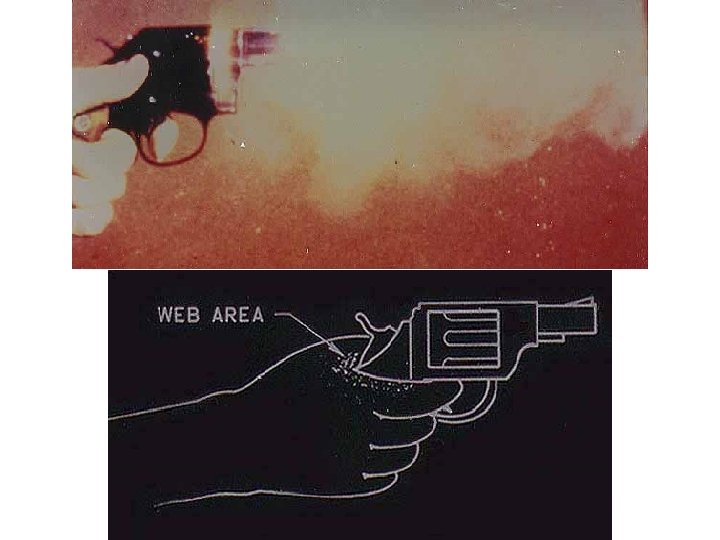
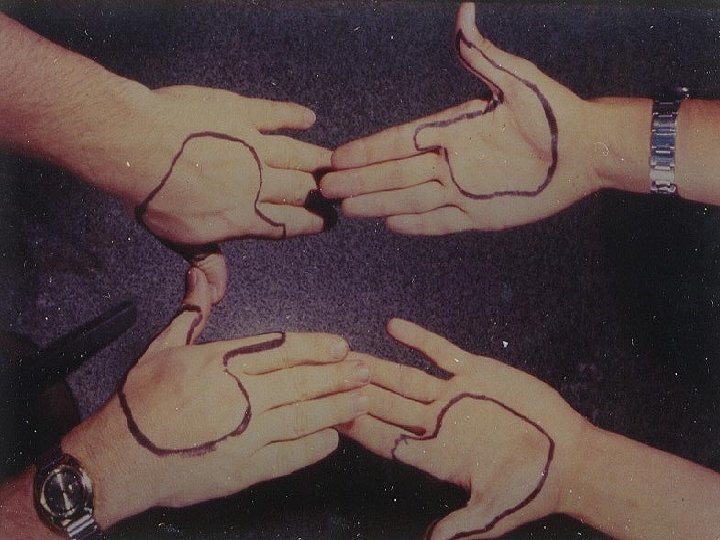
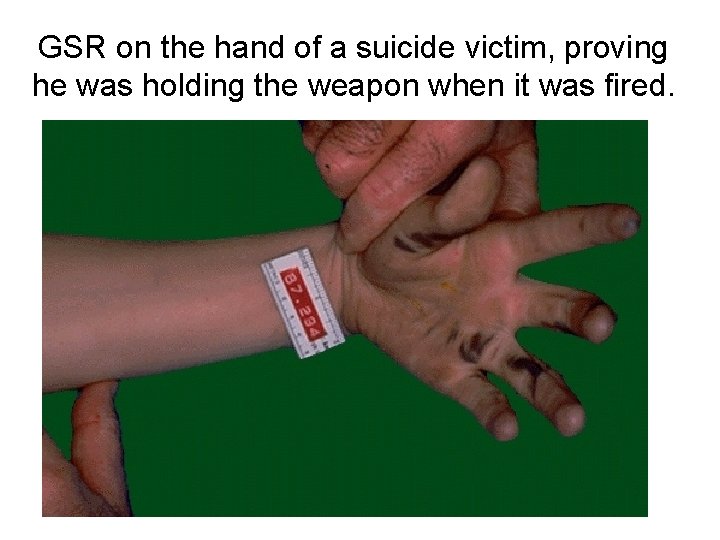
GSR on the hand of a suicide victim, proving he was holding the weapon when it was fired.

DANGER GRAPHIC IMAGES!
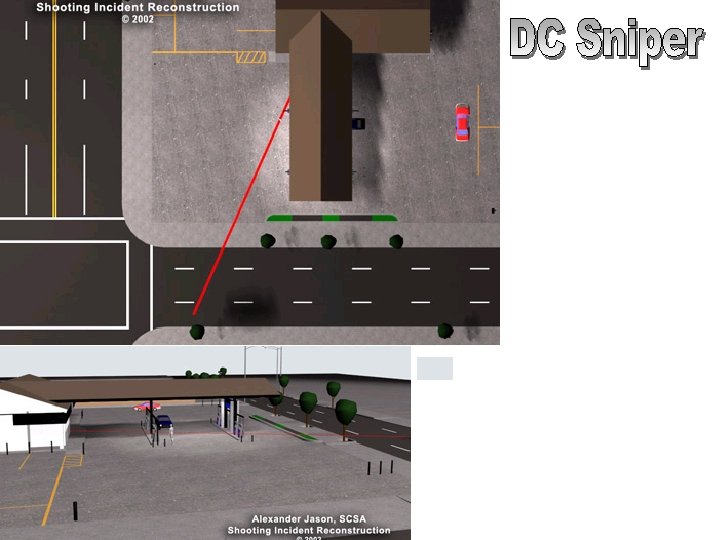
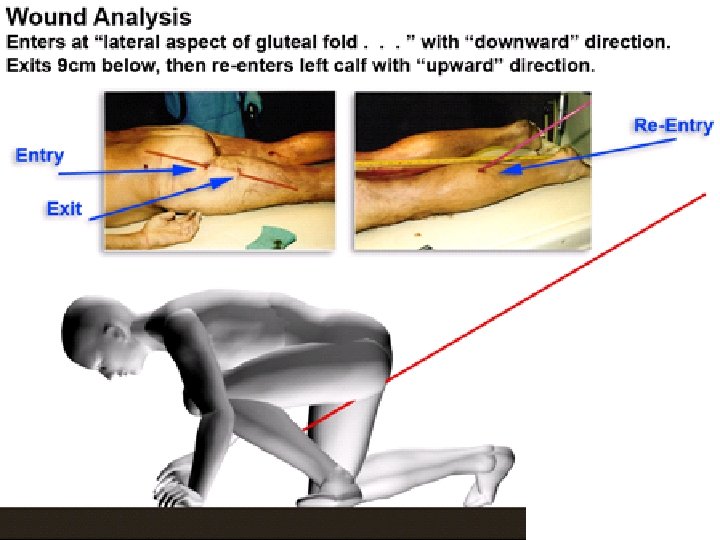
XII. Info from Wounds • examination of firearm wounds and evidence may allow determination of: 1. Range of fire: • contact, near contact, intermediate, distant 2. Type of weapon, caliber of ammunition 3. Trajectory: • direction, path of projectile
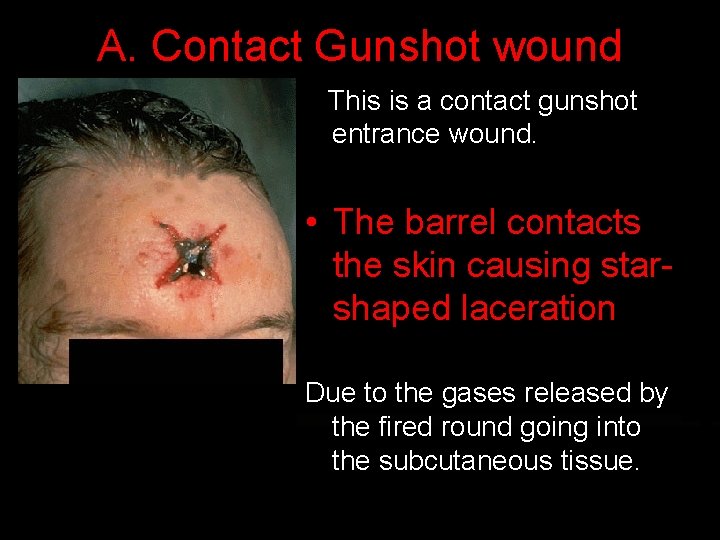
A. Contact Gunshot wound This is a contact gunshot entrance wound. • The barrel contacts the skin causing starshaped laceration Due to the gases released by the fired round going into the subcutaneous tissue.
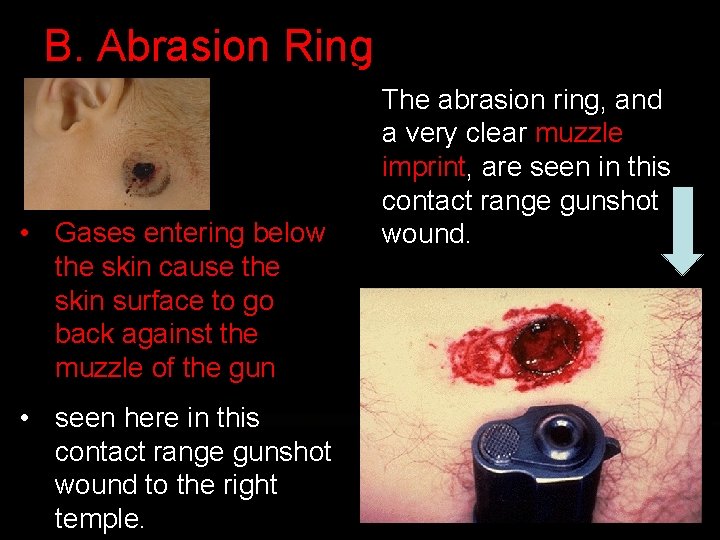
B. Abrasion Ring • Gases entering below the skin cause the skin surface to go back against the muzzle of the gun • seen here in this contact range gunshot wound to the right temple. The abrasion ring, and a very clear muzzle imprint, are seen in this contact range gunshot wound.
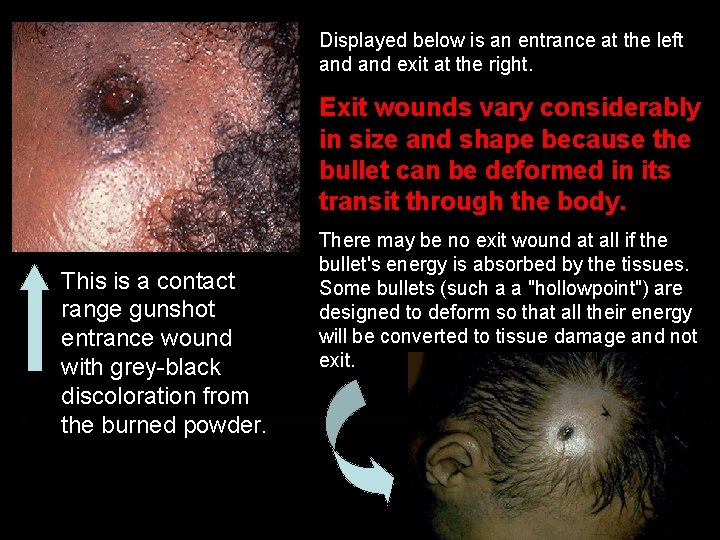
Displayed below is an entrance at the left and exit at the right. Exit wounds vary considerably in size and shape because the bullet can be deformed in its transit through the body. This is a contact range gunshot entrance wound with grey-black discoloration from the burned powder. There may be no exit wound at all if the bullet's energy is absorbed by the tissues. Some bullets (such a a "hollowpoint") are designed to deform so that all their energy will be converted to tissue damage and not exit.
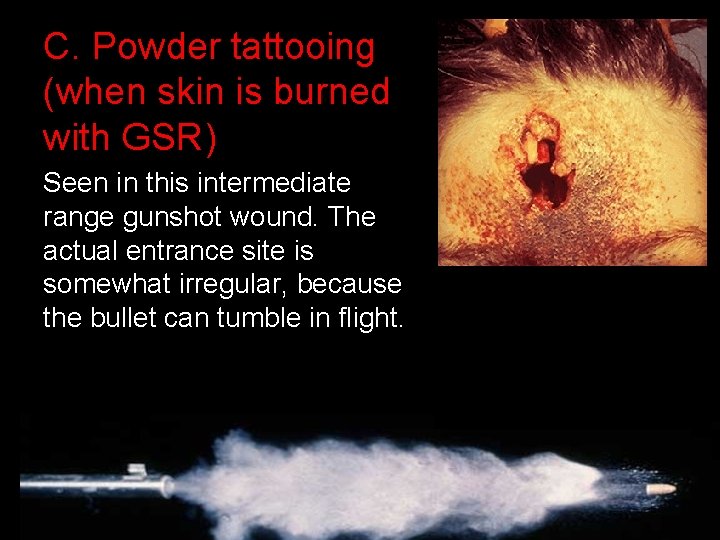
C. Powder tattooing (when skin is burned with GSR) Seen in this intermediate range gunshot wound. The actual entrance site is somewhat irregular, because the bullet can tumble in flight.
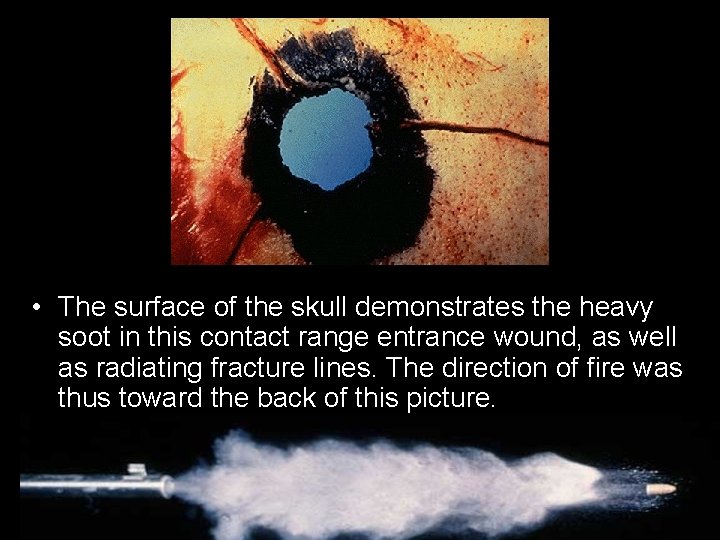
• The surface of the skull demonstrates the heavy soot in this contact range entrance wound, as well as radiating fracture lines. The direction of fire was thus toward the back of this picture.
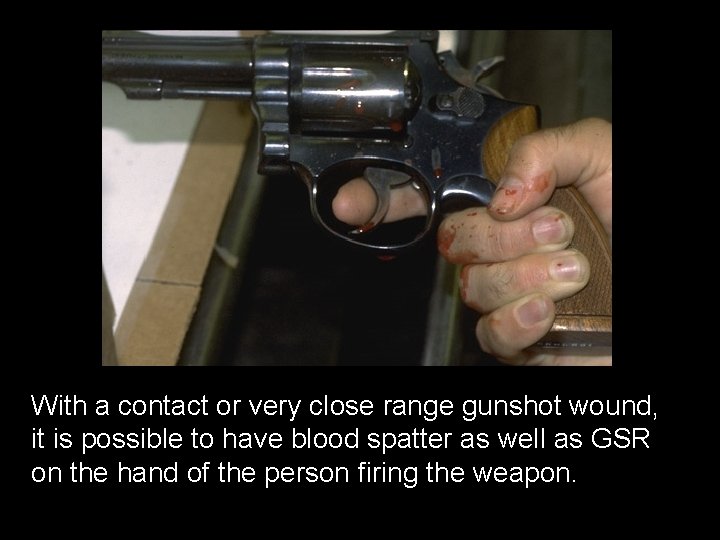
With a contact or very close range gunshot wound, it is possible to have blood spatter as well as GSR on the hand of the person firing the weapon.

Trajectory

END GRAPHIC IMAGES!

Serial Number & Collection
XIII. SERIAL NUMBER RESTORATION – When a serial # is stamped into a gun, the metal underneath the number is compressed & hardened. – If the # is filed-off, the hardened area may still be present. – acid solutions slowly eat the metal away – softer metal will be eaten away first and the # may reappear.
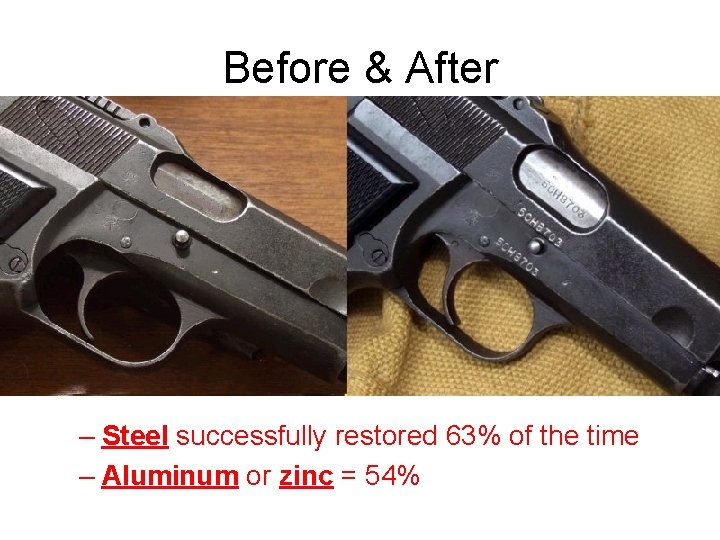
Before & After – Steel successfully restored 63% of the time – Aluminum or zinc = 54%
XIV. FIREARMS EVID. COLLECTION Make sure it is unloaded!!!!! A. REVOLVERS n Indicate location of fired & unfired ammunition B. AUTOMATICS n Check magazine for number of rounds n Fingerprint magazine n Place ID tag on trigger guard n
FIREARMS EVIDENCE COLLECTION (cont. ) C. AMMUNITION n Write on base or nose n Package in pill box or envelope n Wrap in tissue to protect
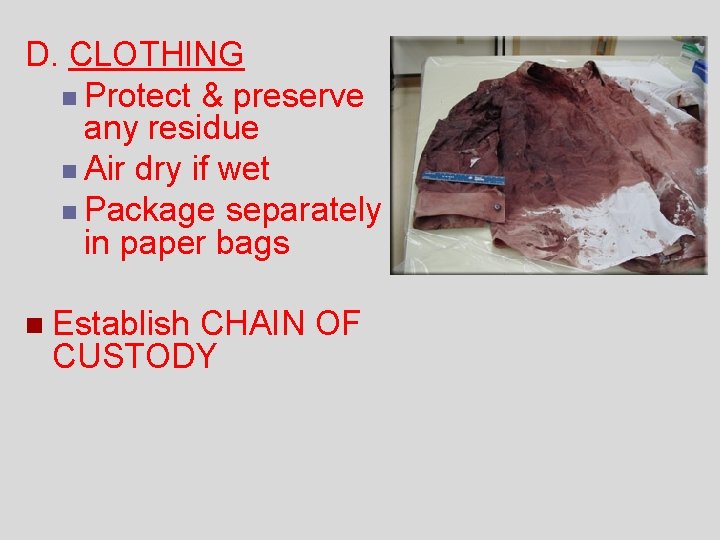
D. CLOTHING n Protect & preserve any residue n Air dry if wet n Package separately in paper bags n Establish CHAIN OF CUSTODY
- Slides: 70