
Ch 15 2 Classifying Life Essential Question How
- Slides: 11
Ch. 15. 2 Classifying Life Essential Question: How are Living Things alike yet Different? Why Do Biologist Classify Organisms? What are the levels of Classification? How are the Taxonomic Keys Useful?
Vocabulary Ch. 15. 2 Classification- The process of grouping things based on their similarities. Taxonomy-The scientific study of how living things are classified. Binomial Nomenclature- The classification system in which each organism is given a unique, two-part scientific name indicating its genus and species. Genus- A classification grouping that consists of a number of similar, closely related species. Species- A group of similar organisms that can mate with each other and produce offspring that can also mate and produce.
Ch. 15. 2 • One million kinds of organisms on Earth( and the number keeps growing) • In order to keep track, scientists group organisms based on similarities= classify them. e. i. supermarket store • Biologists use ______ to _____ living things into groups so that the organisms are easier to study. • The scientific study of how living things are classified is called taxonomy. • Taxonomy also involves naming organisms.
The Naming System of Linnaeus pg. 592 What is the scientific name for humans? H______ S____ The system scientists use, developed by Swedish botanist Carolus Linnaeus, is called binomial nomenclature (B. N. ). (observable features) B. N. = each organism has a unique two-part scientific name. e. i. Felis concolor= puma • The first word is the genus, a classification grouping that contains similar, closely related organisms. (share same characteristics) e. i. Felis= sharp, retractable claws, hunt other animals • The second word often describes where an organism lives or its appearance • Species is a group of similar organisms that can mate with each other and produce offspring that can also mate and reproduce.
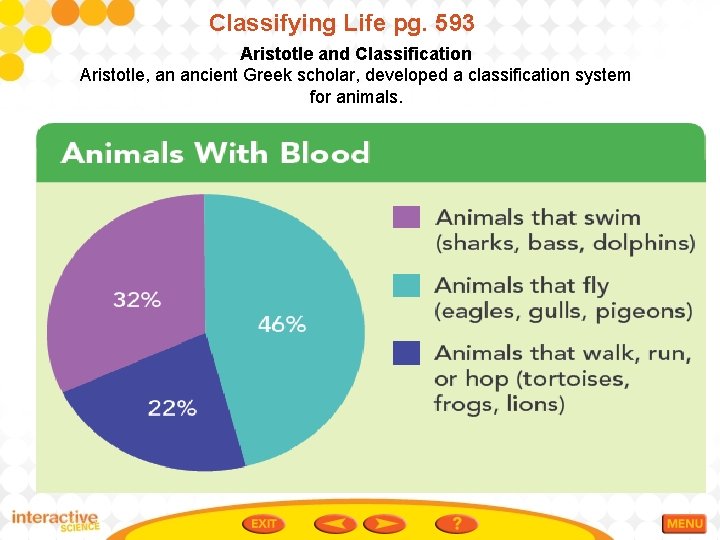
Classifying Life pg. 593 Aristotle and Classification Aristotle, an ancient Greek scholar, developed a classification system for animals.
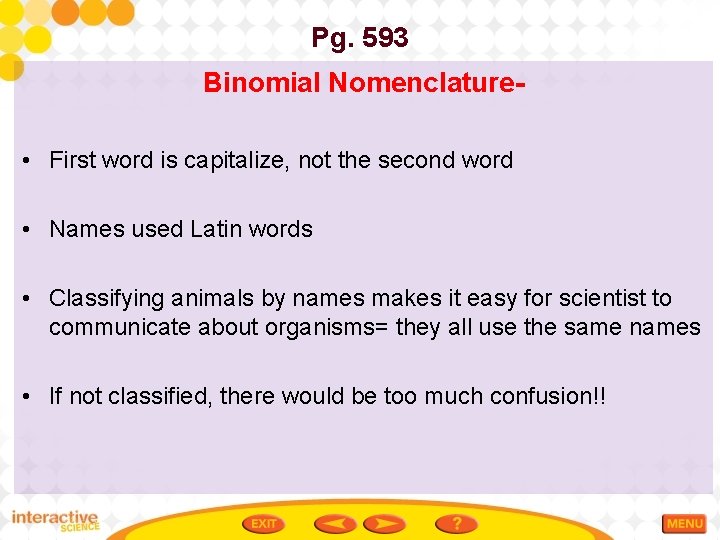
Pg. 593 Binomial Nomenclature • First word is capitalize, not the second word • Names used Latin words • Classifying animals by names makes it easy for scientist to communicate about organisms= they all use the same names • If not classified, there would be too much confusion!!
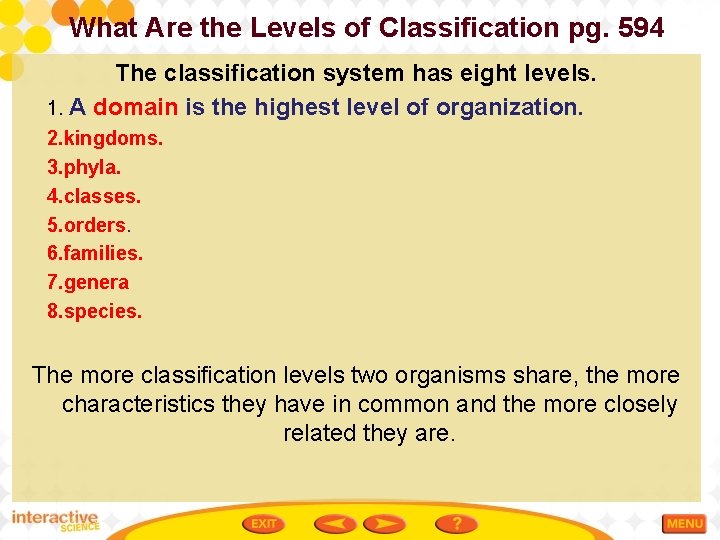
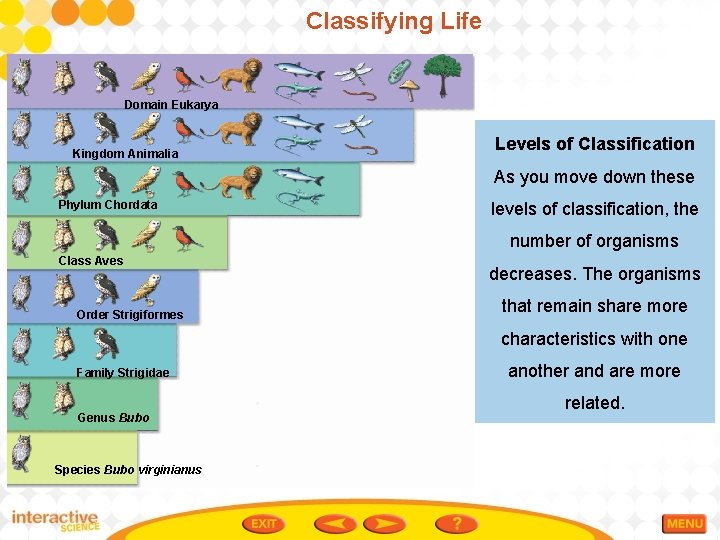
What Are the Levels of Classification pg. 594 The classification system has eight levels. 1. A domain is the highest level of organization. 2. kingdoms. 3. phyla. 4. classes. 5. orders. 6. families. 7. genera 8. species. The more classification levels two organisms share, the more characteristics they have in common and the more closely related they are.
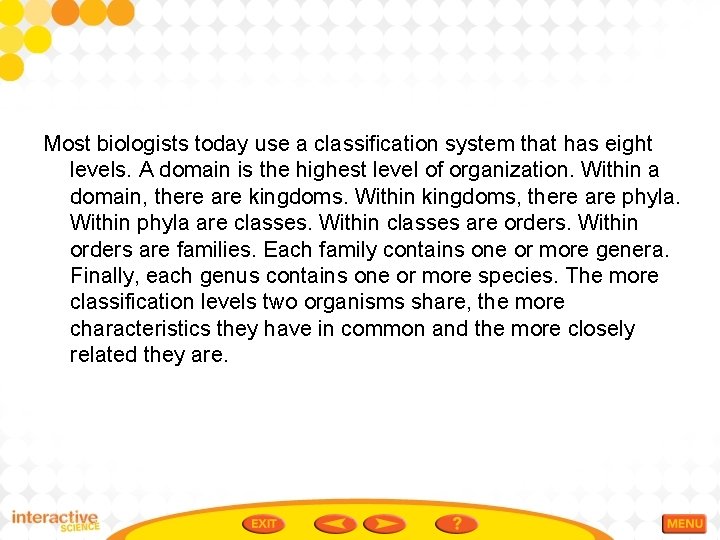
Most biologists today use a classification system that has eight levels. A domain is the highest level of organization. Within a domain, there are kingdoms. Within kingdoms, there are phyla. Within phyla are classes. Within classes are orders. Within orders are families. Each family contains one or more genera. Finally, each genus contains one or more species. The more classification levels two organisms share, the more characteristics they have in common and the more closely related they are.
Classifying Life Domain Eukarya Kingdom Animalia Levels of Classification As you move down these Phylum Chordata levels of classification, the number of organisms Class Aves Order Strigiformes decreases. The organisms that remain share more characteristics with one Family Strigidae Genus Bubo Species Bubo virginianus another and are more related.
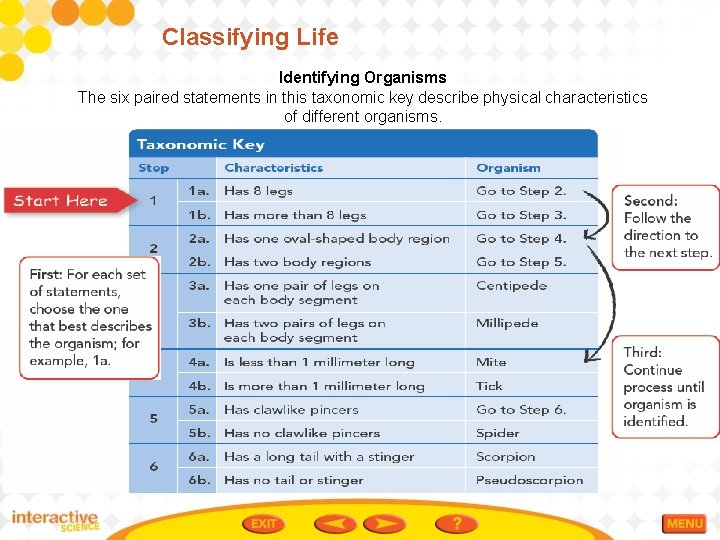
How are Taxonomic keys Useful? pg. 596 • Taxonomic keys are useful tools that help determine the identity of organisms. • A taxonomic key consists of a series of paired statements that describe the various physical characteristics of different organisms. By choosing one statement in each pair and following its directive, the identity of an unfamiliar organism can eventually be determined.
Classifying Life Identifying Organisms The six paired statements in this taxonomic key describe physical characteristics of different organisms.