
Ch 14 From Randomness to Probability Beginning of
Ch 14: From Randomness to Probability Beginning of Unit 4, AP Stats
Vocab! • Random phenomenon (“rolling a die”) • Has set of trials (“roll 20 times”) • Each trial has an outcome (“this time I rolled a 1”) • Outcomes combine to make an event (“Rolling a 4” --all times rolling a 4 fits into this category) • Try another example: List each item for a coin toss. Random phenomenon: Set of Trials: Outcome: Event:
Law of Large Numbers • As n grows, collected data will reflect a probability • Probability = long-run (or large n) relative frequency of repeated independent events Caution! There is NOT a law of averages based on small n • Just because you know P, doesn’t mean you will see it within a small n
Personal Probability • Subjective probability • Not based on long-run relative frequencies • Personal opinion • NOT probability! Be careful not to use “probability” this way!
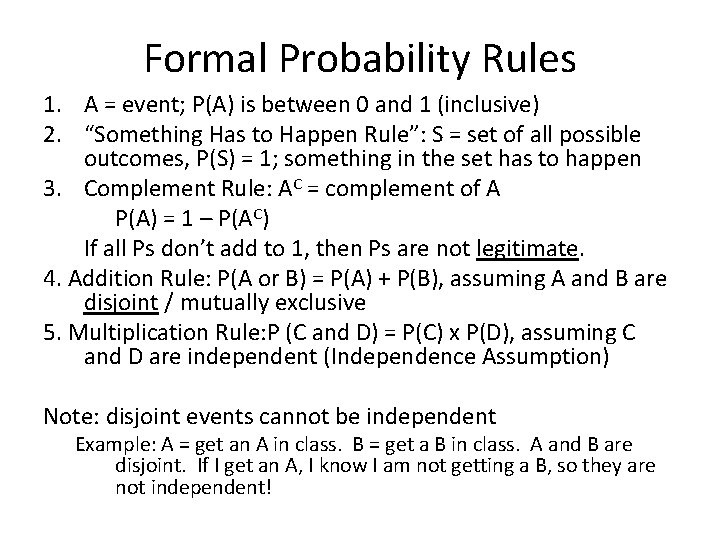
Formal Probability Rules 1. A = event; P(A) is between 0 and 1 (inclusive) 2. “Something Has to Happen Rule”: S = set of all possible outcomes, P(S) = 1; something in the set has to happen 3. Complement Rule: AC = complement of A P(A) = 1 – P(AC) If all Ps don’t add to 1, then Ps are not legitimate. 4. Addition Rule: P(A or B) = P(A) + P(B), assuming A and B are disjoint / mutually exclusive 5. Multiplication Rule: P (C and D) = P(C) x P(D), assuming C and D are independent (Independence Assumption) Note: disjoint events cannot be independent Example: A = get an A in class. B = get a B in class. A and B are disjoint. If I get an A, I know I am not getting a B, so they are not independent!
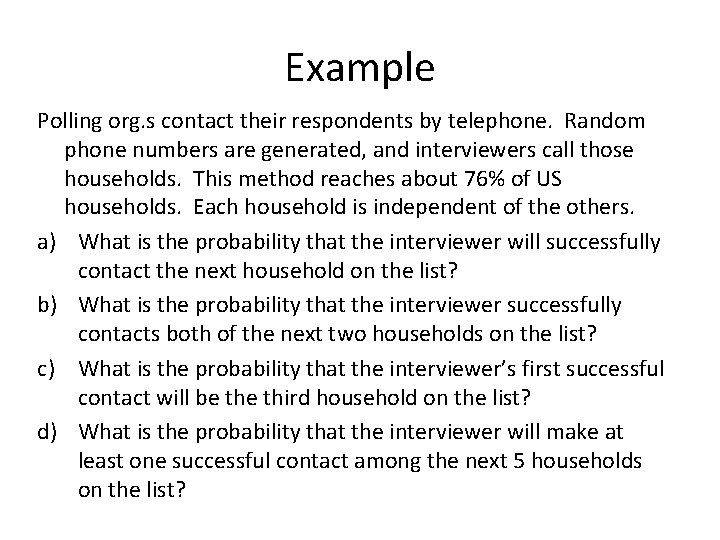
Example Polling org. s contact their respondents by telephone. Random phone numbers are generated, and interviewers call those households. This method reaches about 76% of US households. Each household is independent of the others. a) What is the probability that the interviewer will successfully contact the next household on the list? b) What is the probability that the interviewer successfully contacts both of the next two households on the list? c) What is the probability that the interviewer’s first successful contact will be third household on the list? d) What is the probability that the interviewer will make at least one successful contact among the next 5 households on the list?
- Slides: 6