
Ch 13 The worlds of th 15 Century
- Slides: 22
Ch. 13 The worlds of th 15 Century
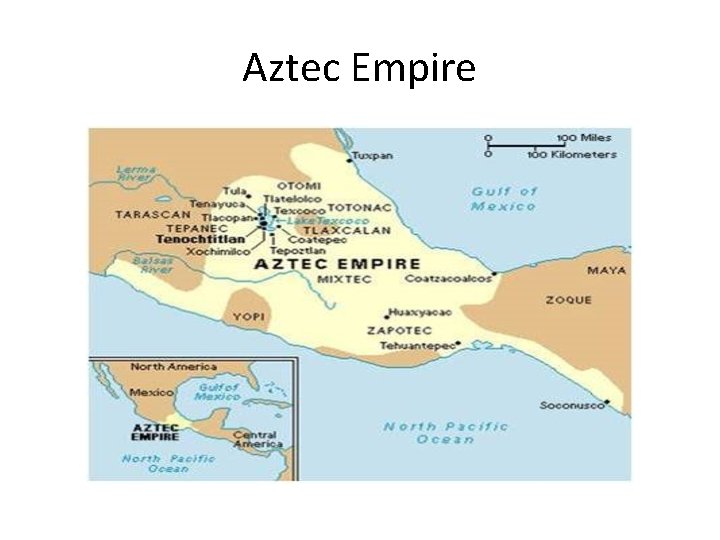
Who were the Mexica & where did they migrate?
Aztec Empire
How did the Mexica build their empire?
Building the Aztec Empire • 1428, Triple Alliance : Mexica & 2 other citystates united a) started a program of military conquest b) Conquered most of Mesoamerica in less than a century c) Aztec claimed descent from earlier peoples d) Early: serfs, mercenaries, conquered peoples had to pay tribute
How was organized the Aztec Empire?
The organization of the Aztec Empire Unstable conquest state with a loose structure Popul. 5 -6 million Conquered peoples paid tribute Central monarch: in Tenochtitlan, had pol. & relig. power, but no absolute power • Council of nobles: elect the ruler, take decisions • Military based empire • •
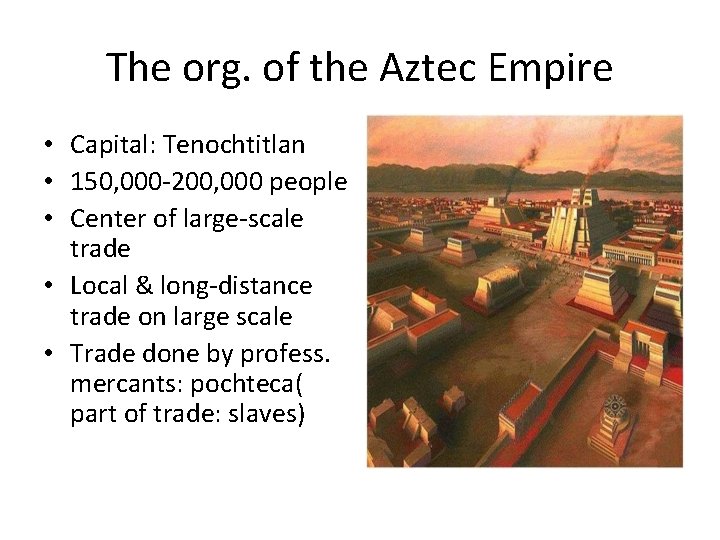
The org. of the Aztec Empire • Capital: Tenochtitlan • 150, 000 -200, 000 people • Center of large-scale trade • Local & long-distance trade on large scale • Trade done by profess. mercants: pochteca( part of trade: slaves)
What was the ideology of human sacrifice?
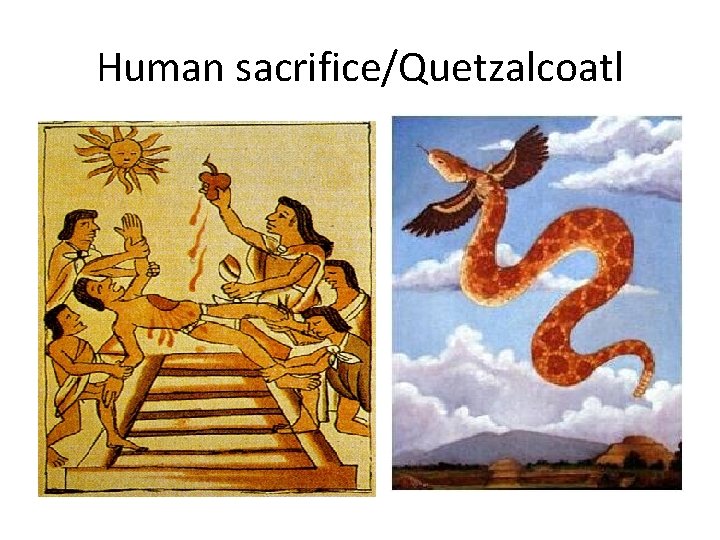
Religion • Sun needs human blood to fight darkness • Gods shed their blood to create humankind, so payback is fair • Aztec Empire’s role: to maintain the cosmic order by providing blood to the gods • Polytheistic • Temples • Gods: 1)Quetzalcoatl 2) Huitzilopochtli (hummingbird)
Human sacrifice/Quetzalcoatl
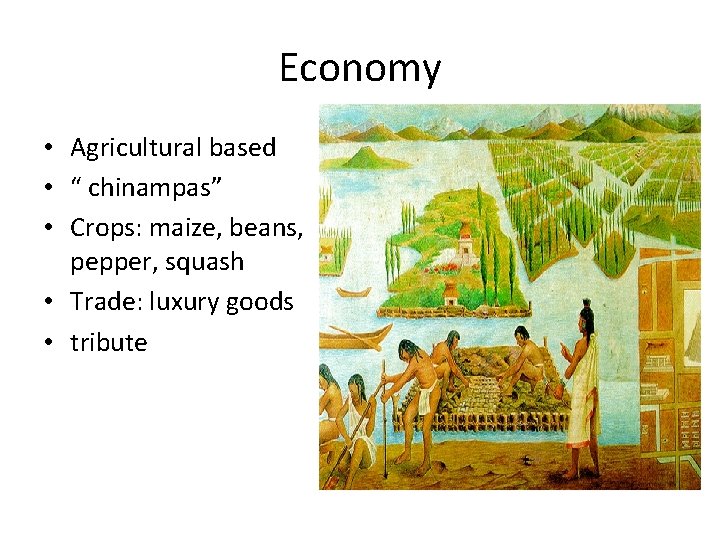
Economy • Agricultural based • “ chinampas” • Crops: maize, beans, pepper, squash • Trade: luxury goods • tribute
Culture • Calendar • Writing system • Main city: Tenochtitlan
Who established the Inca Empire? Where was Inca Empire located?
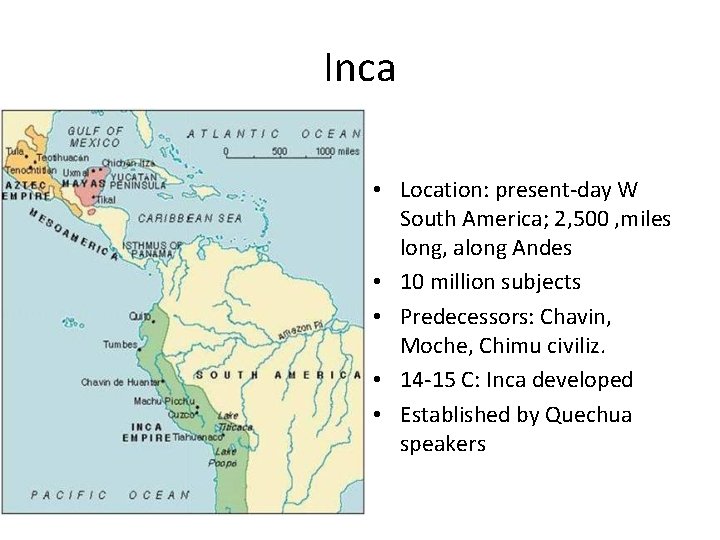
Inca • Location: present-day W South America; 2, 500 , miles long, along Andes • 10 million subjects • Predecessors: Chavin, Moche, Chimu civiliz. • 14 -15 C: Inca developed • Established by Quechua speakers
What was the polit. & admin. organization of the empire?
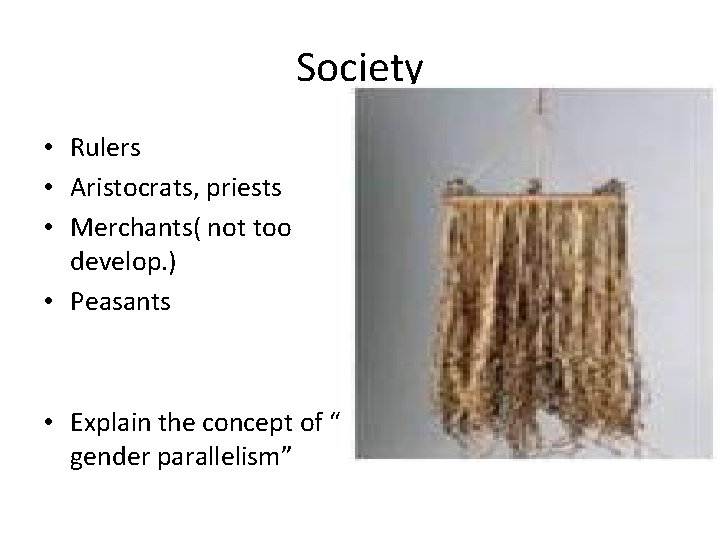
Polit. organization • • Highly centralized govern. Military based empire Emperor-absolute ruler, regarded as divine State organized in 80 provinces, each with an Inca governor Provin. officials were checked by inspectors Subjects grouped into hierarchical unit of people (10, 50, 100) Popul. data recorded on quipus Massive resettlement moved much of the popul.
What was the econ. based on? Explain the dif. between the 2 types of mita.
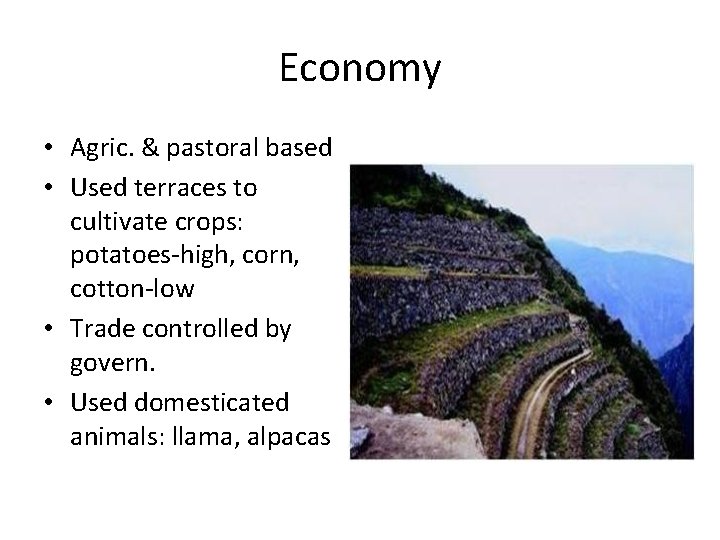
Economy • Agric. & pastoral based • Used terraces to cultivate crops: potatoes-high, corn, cotton-low • Trade controlled by govern. • Used domesticated animals: llama, alpacas
Economy • Everyone had to perform mita 1) Work on state farms, mining, military, constr. 2) Prod. of goods for the state E. G. “chosen women”-removed from their homes, trained to make beers, cloth • State-essential role in the distrib. of goods
Society • Rulers • Aristocrats, priests • Merchants( not too develop. ) • Peasants • Explain the concept of “ gender parallelism”
Gender parallelism • Men & women operate in “separate but equivalent spheres” • Parallel hierarchies of female & male polit. officials • Men-top posit. in polit. & relig. life • Women’s household tasks were not regarded as inferior • Inca emperor & his wife governed jointly