
Ch 13 Source Rock Evaluation Source Rock Definitions
- Slides: 15
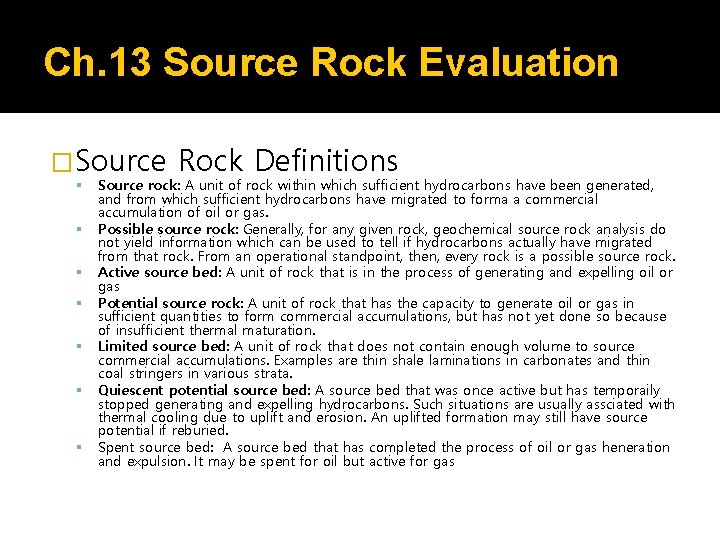
Ch. 13 Source Rock Evaluation �Source Rock Definitions Source rock: A unit of rock within which sufficient hydrocarbons have been generated, and from which sufficient hydrocarbons have migrated to forma a commercial accumulation of oil or gas. Possible source rock: Generally, for any given rock, geochemical source rock analysis do not yield information which can be used to tell if hydrocarbons actually have migrated from that rock. From an operational standpoint, then, every rock is a possible source rock. Active source bed: A unit of rock that is in the process of generating and expelling oil or gas Potential source rock: A unit of rock that has the capacity to generate oil or gas in sufficient quantities to form commercial accumulations, but has not yet done so because of insufficient thermal maturation. Limited source bed: A unit of rock that does not contain enough volume to source commercial accumulations. Examples are thin shale laminations in carbonates and thin coal stringers in various strata. Quiescent potential source bed: A source bed that was once active but has temporaily stopped generating and expelling hydrocarbons. Such situations are usually assciated with thermal cooling due to uplift and erosion. An uplifted formation may still have source potential if reburied. Spent source bed: A source bed that has completed the process of oil or gas heneration and expulsion. It may be spent for oil but active for gas
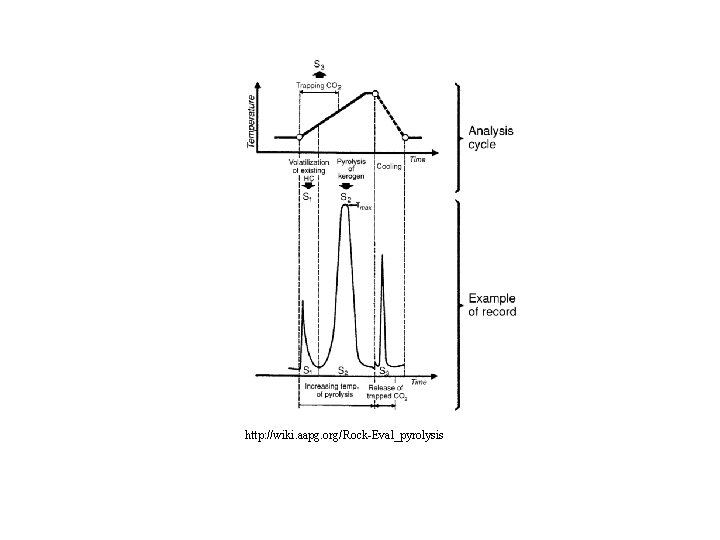
http: //wiki. aapg. org/Rock-Eval_pyrolysis
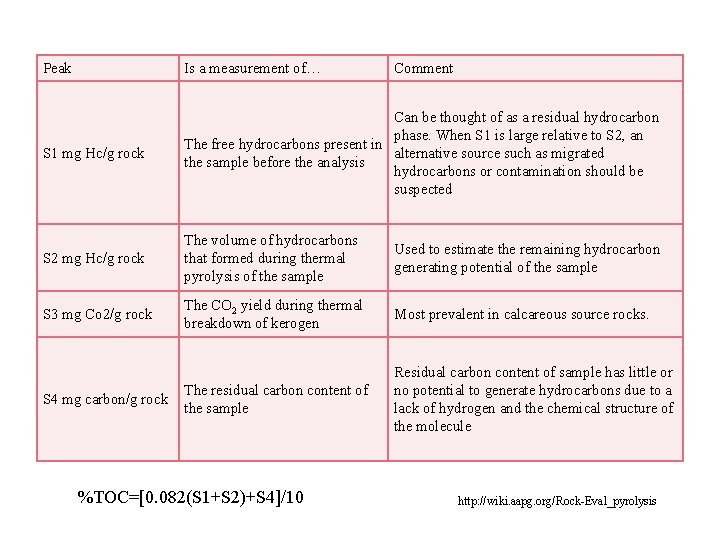
Peak Is a measurement of… S 1 mg Hc/g rock Can be thought of as a residual hydrocarbon phase. When S 1 is large relative to S 2, an The free hydrocarbons present in alternative source such as migrated the sample before the analysis hydrocarbons or contamination should be suspected S 2 mg Hc/g rock The volume of hydrocarbons that formed during thermal pyrolysis of the sample Used to estimate the remaining hydrocarbon generating potential of the sample S 3 mg Co 2/g rock The CO 2 yield during thermal breakdown of kerogen Most prevalent in calcareous source rocks. The residual carbon content of the sample Residual carbon content of sample has little or no potential to generate hydrocarbons due to a lack of hydrogen and the chemical structure of the molecule S 4 mg carbon/g rock %TOC=[0. 082(S 1+S 2)+S 4]/10 Comment http: //wiki. aapg. org/Rock-Eval_pyrolysis
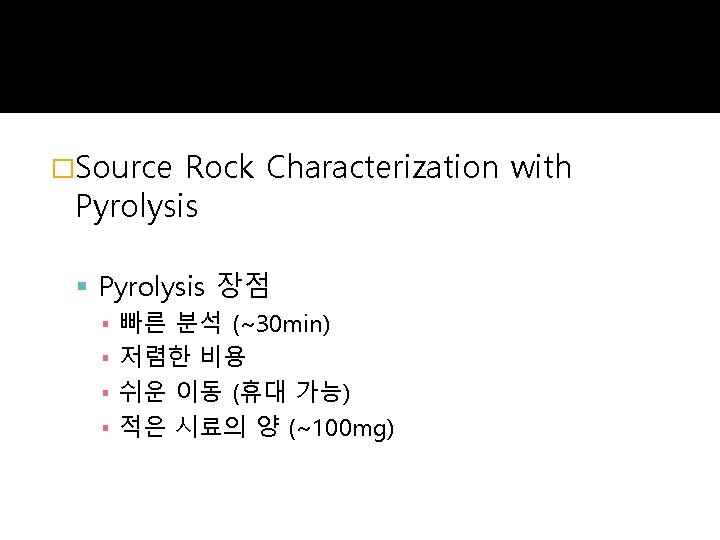
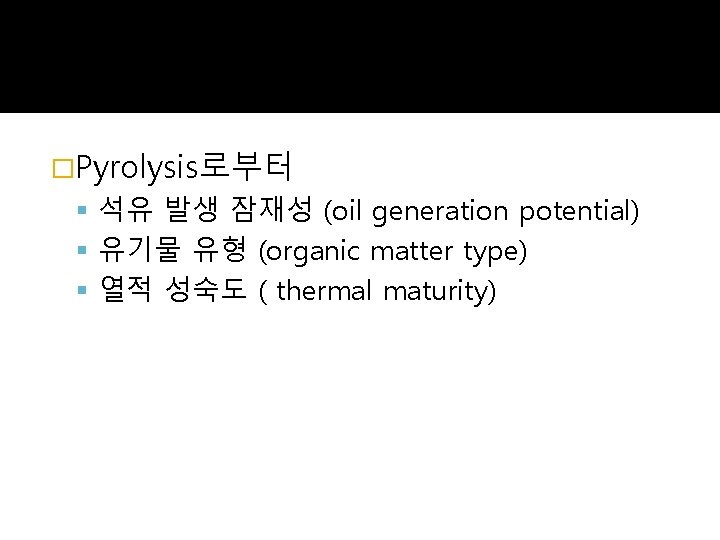
�Pyrolysis로부터 석유 발생 잠재성 (oil generation potential) 유기물 유형 (organic matter type) 열적 성숙도 ( thermal maturity)
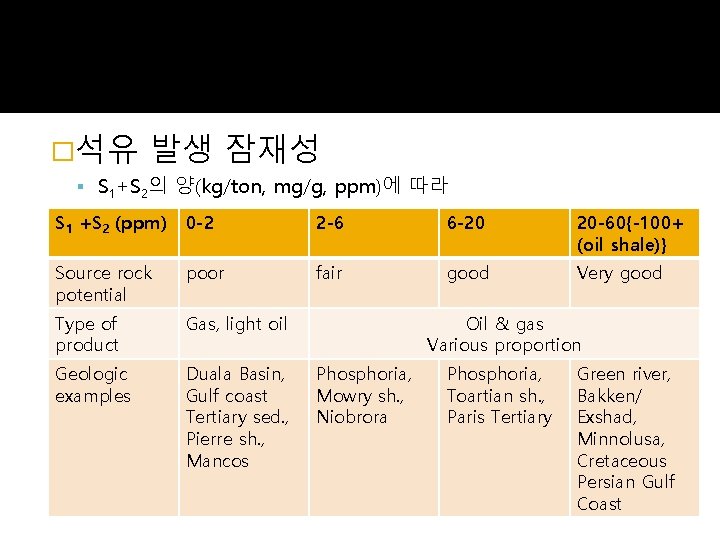
�석유 발생 잠재성 S 1+S 2의 양(kg/ton, mg/g, ppm)에 따라 S 1 +S 2 (ppm) 0 -2 2 -6 6 -20 20 -60{-100+ (oil shale)} Source rock potential poor fair good Very good Type of product Gas, light oil Geologic examples Duala Basin, Gulf coast Tertiary sed. , Pierre sh. , Mancos Oil & gas Various proportion Phosphoria, Mowry sh. , Niobrora Phosphoria, Toartian sh. , Paris Tertiary Green river, Bakken/ Exshad, Minnolusa, Cretaceous Persian Gulf Coast
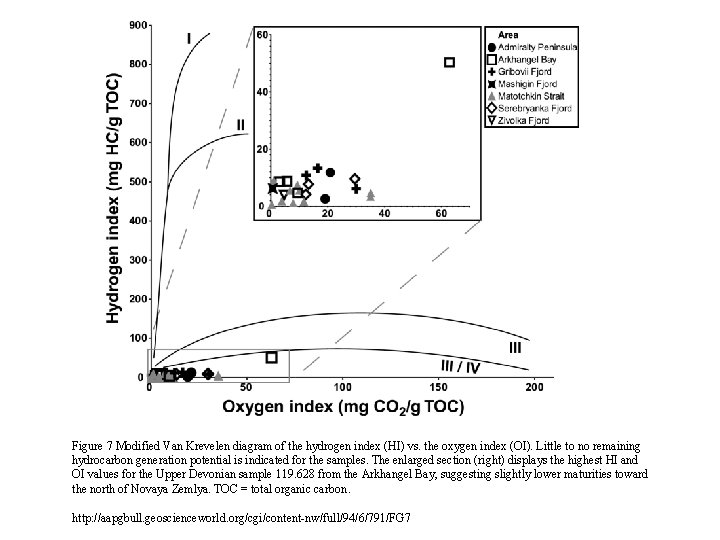
Figure 7 Modified Van Krevelen diagram of the hydrogen index (HI) vs. the oxygen index (OI). Little to no remaining hydrocarbon generation potential is indicated for the samples. The enlarged section (right) displays the highest HI and OI values for the Upper Devonian sample 119. 628 from the Arkhangel Bay, suggesting slightly lower maturities toward the north of Novaya Zemlya. TOC = total organic carbon. http: //aapgbull. geoscienceworld. org/cgi/content-nw/full/94/6/791/FG 7
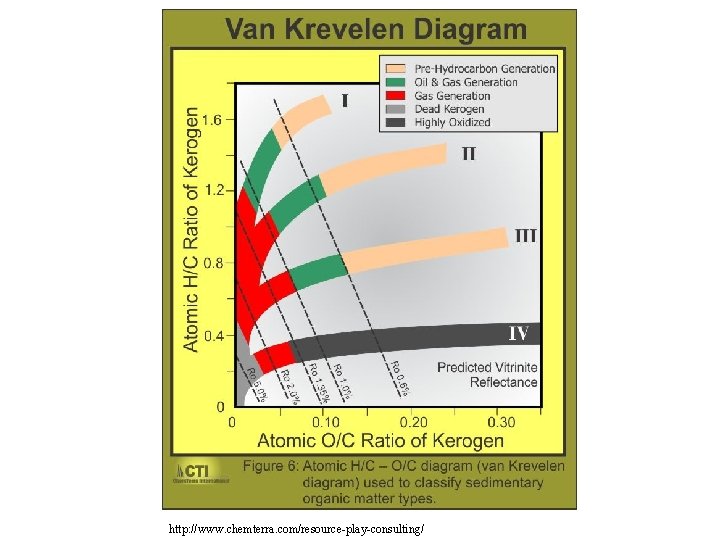
http: //www. chemterra. com/resource-play-consulting/
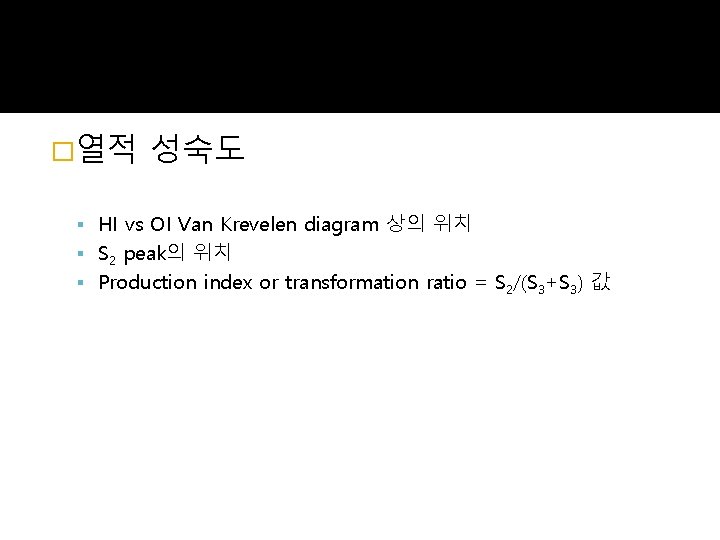
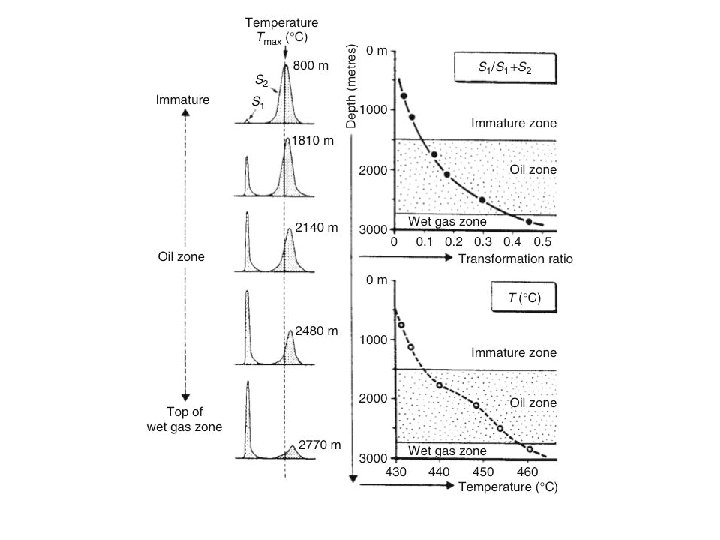
�열적 성숙도 HI vs OI Van Krevelen diagram 상의 위치 S 2 peak의 위치 Production index or transformation ratio = S 2/(S 3+S 3) 값
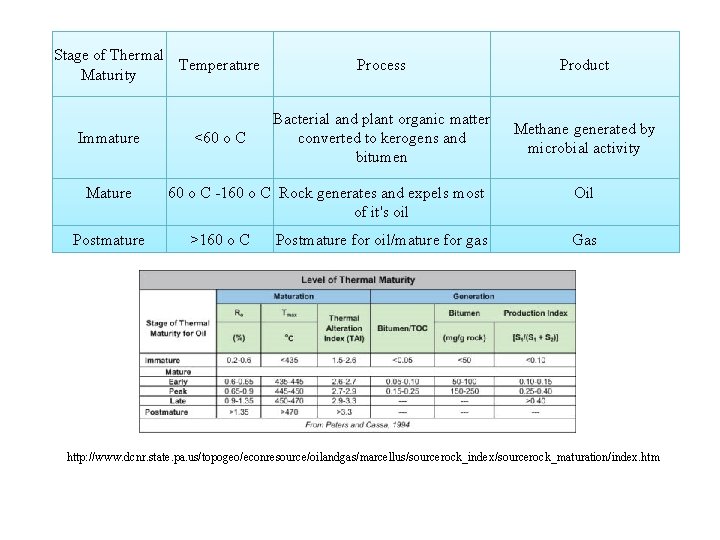
Stage of Thermal Temperature Maturity Immature Mature Postmature <60 o C Process Product Bacterial and plant organic matter converted to kerogens and bitumen Methane generated by microbial activity 60 o C -160 o C Rock generates and expels most of it's oil >160 o C Postmature for oil/mature for gas Oil Gas http: //www. dcnr. state. pa. us/topogeo/econresource/oilandgas/marcellus/sourcerock_index/sourcerock_maturation/index. htm
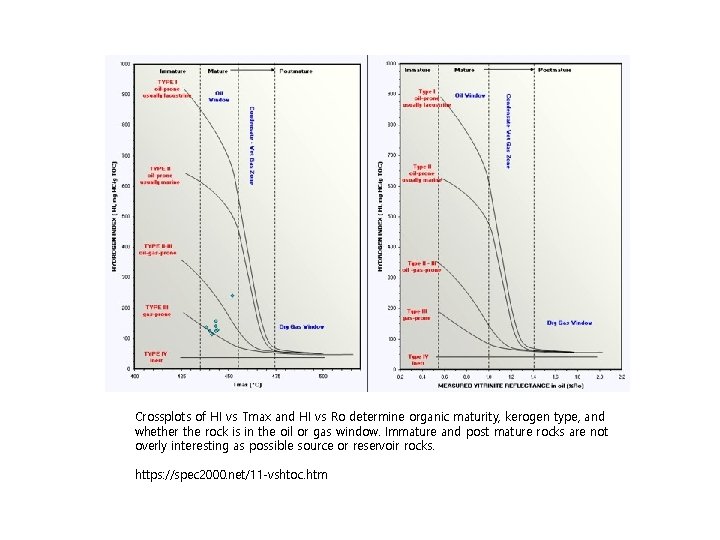
Crossplots of HI vs Tmax and HI vs Ro determine organic maturity, kerogen type, and whether the rock is in the oil or gas window. Immature and post mature rocks are not overly interesting as possible source or reservoir rocks. https: //spec 2000. net/11 -vshtoc. htm
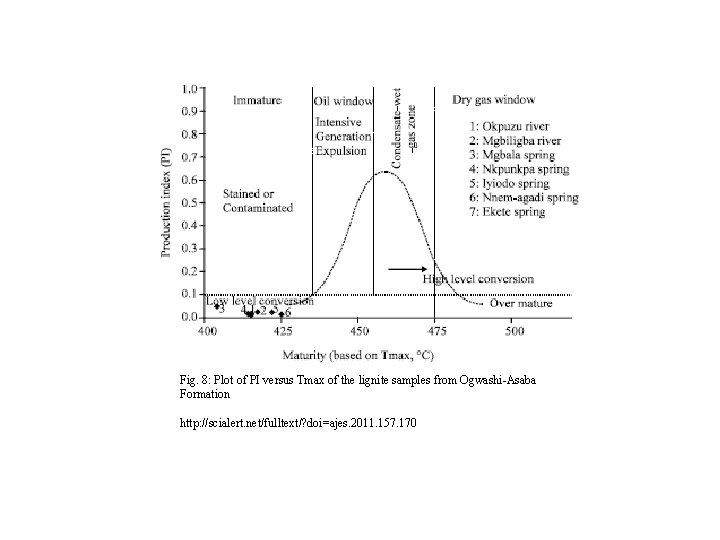
Fig. 8: Plot of PI versus Tmax of the lignite samples from Ogwashi-Asaba Formation http: //scialert. net/fulltext/? doi=ajes. 2011. 157. 170
�Pyrolysis 해석 상 문제점 Tmax decreases as sample weight increases Tmax increases as grain size increases Flow rate: too slow saturate the dectector and slow the response Splitter tempertaure too high may see extra peak (due to ionization) Too heavy or too lean samples may cause some errors in Tmax determination Mineral matrix effect Flame ionization detector error