
Ch 13 Paths to Constitutionalism Absolutism English Constitutionalism
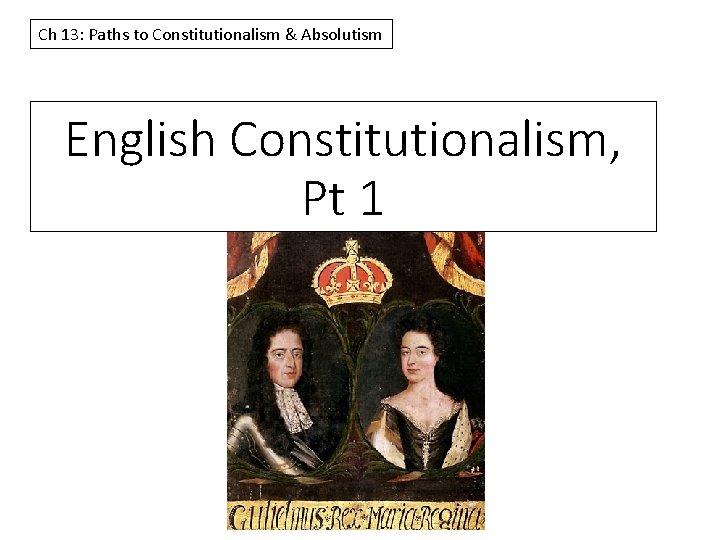
Ch 13: Paths to Constitutionalism & Absolutism English Constitutionalism, Pt 1
Today • English Constitutionalism Pt UNO • Oliver Cromwell reading • Tomorrow = ID Quiz
Focus Question • What were the main issues in the struggle between the King and Parliament in England how were they resolved?
What is Constitutionalism? • Limitation of government by law • Balance between authority of gov’t and rights of citizens • Government acknowledges it must respect the laws • Ultimate authority rests in voters, though monarchs possess political authority

An Overview of Social Classes in England • Nobility • Gentry • Yeomen • Craftsmen, tenant farmers, and laborers
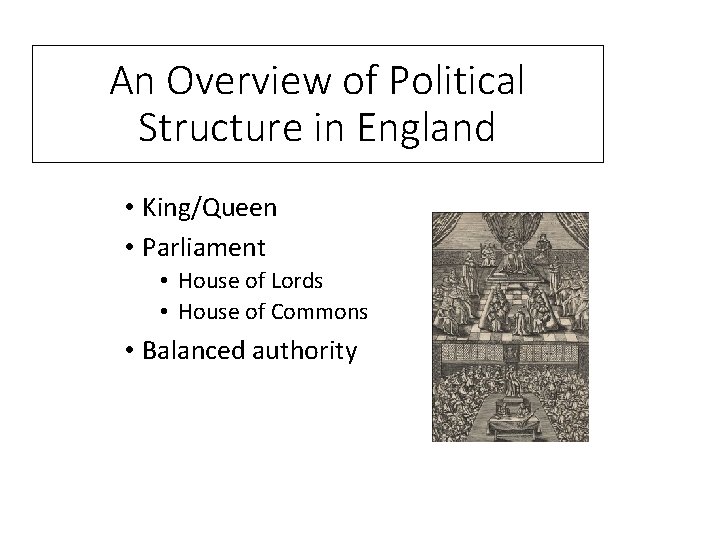
An Overview of Political Structure in England • King/Queen • Parliament • House of Lords • House of Commons • Balanced authority
House of Lords • Made up of nobility and superior clergy • Appointed • Usually hereditary • Possess veto power
House of Commons • Lower house • Made up mostly of landed gentry – becoming wealthier & wealthier • Elected • Given the say over all measures to initiate taxation • Many were sheriffs, justices of the peace, etc
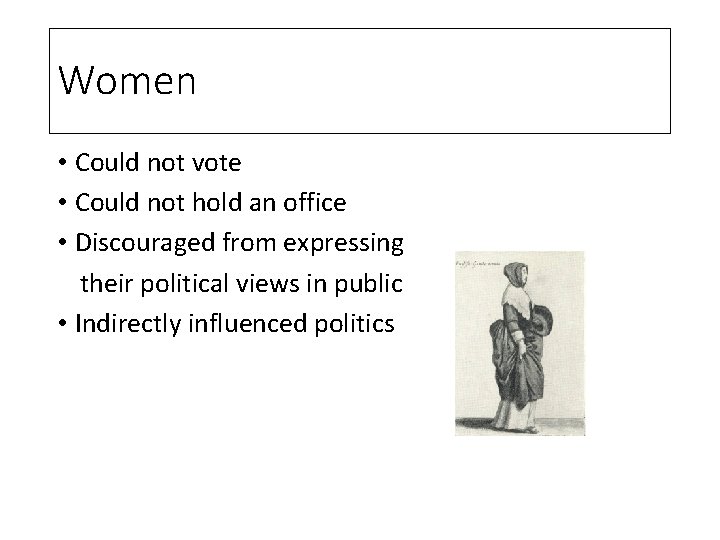
Women • Could not vote • Could not hold an office • Discouraged from expressing their political views in public • Indirectly influenced politics
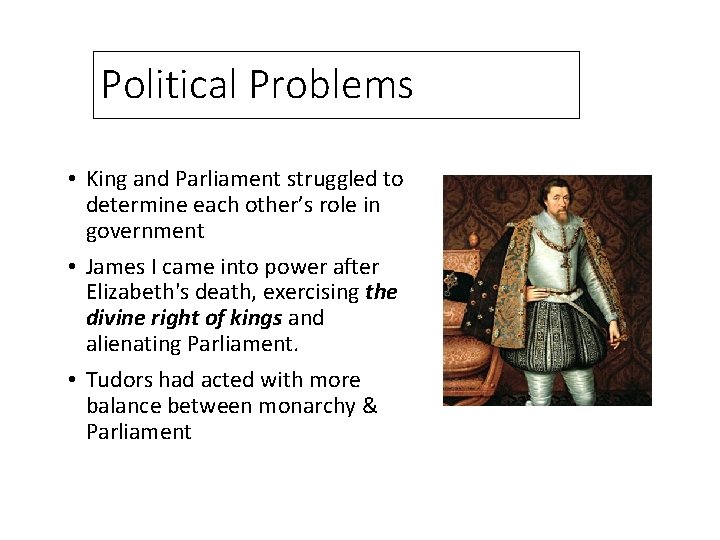
Political Problems • King and Parliament struggled to determine each other’s role in government • James I came into power after Elizabeth's death, exercising the divine right of kings and alienating Parliament. • Tudors had acted with more balance between monarchy & Parliament
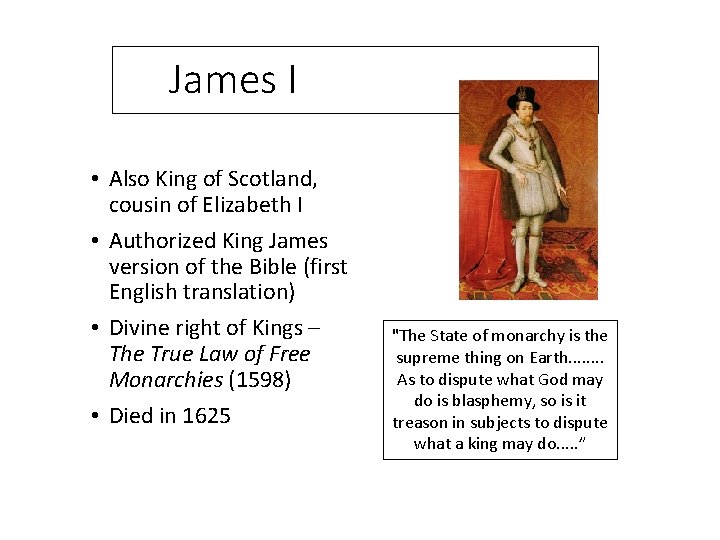
James I • Also King of Scotland, cousin of Elizabeth I • Authorized King James version of the Bible (first English translation) • Divine right of Kings – The True Law of Free Monarchies (1598) • Died in 1625 "The State of monarchy is the supreme thing on Earth. . . . As to dispute what God may do is blasphemy, so is it treason in subjects to dispute what a king may do. . . ”
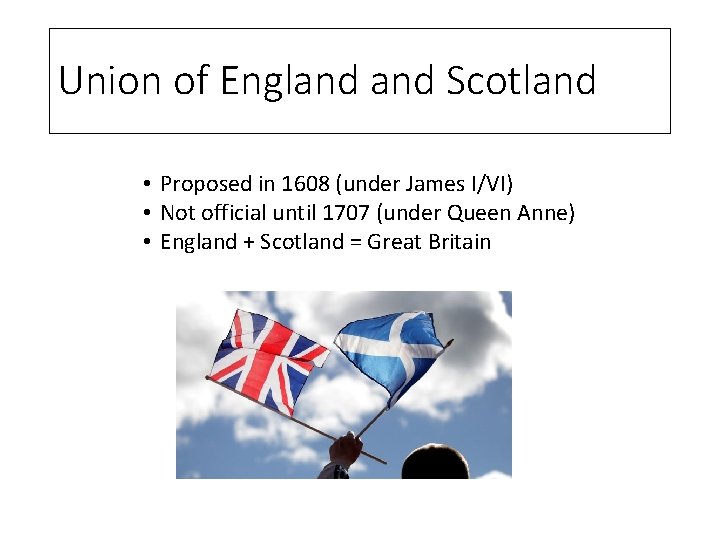
Union of England Scotland • Proposed in 1608 (under James I/VI) • Not official until 1707 (under Queen Anne) • England + Scotland = Great Britain
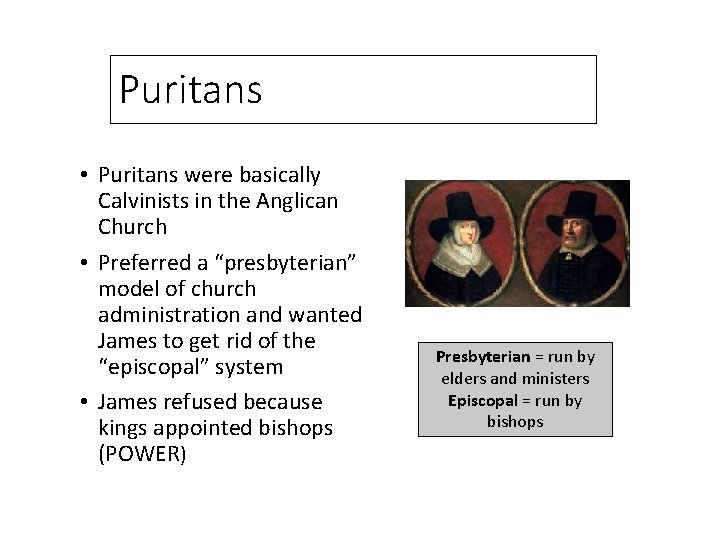
Puritans • Puritans were basically Calvinists in the Anglican Church • Preferred a “presbyterian” model of church administration and wanted James to get rid of the “episcopal” system • James refused because kings appointed bishops (POWER) Presbyterian = run by elders and ministers Episcopal = run by bishops
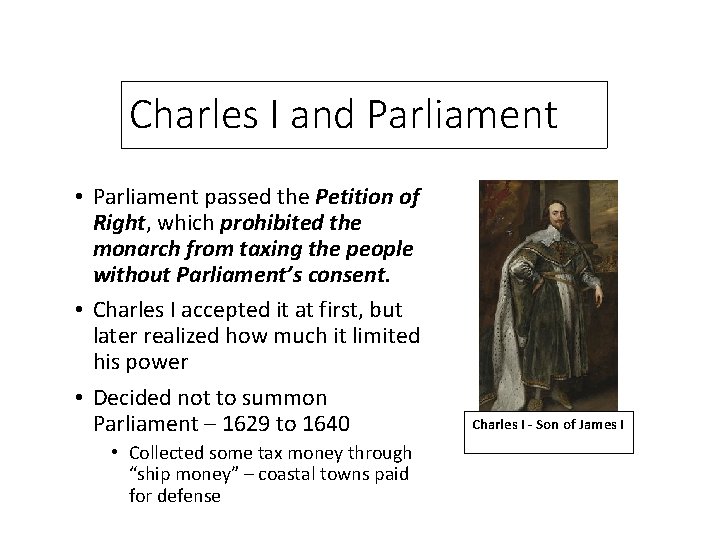
Charles I and Parliament • Parliament passed the Petition of Right, which prohibited the monarch from taxing the people without Parliament’s consent. • Charles I accepted it at first, but later realized how much it limited his power • Decided not to summon Parliament – 1629 to 1640 • Collected some tax money through “ship money” – coastal towns paid for defense Charles I - Son of James I
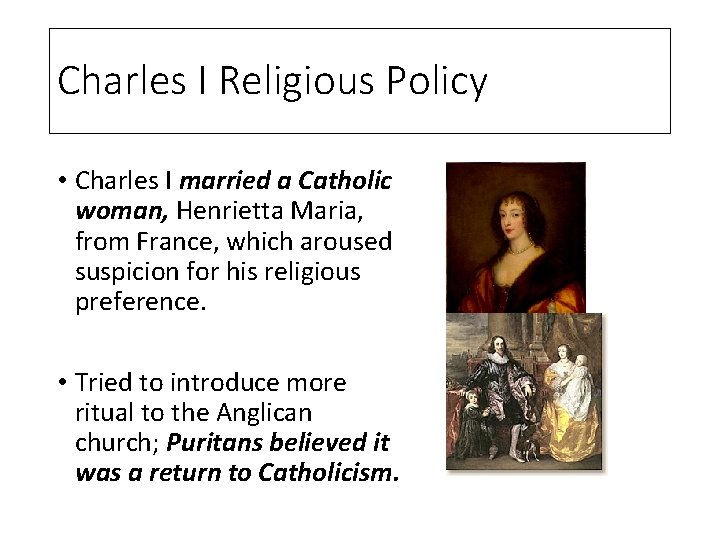
Charles I Religious Policy • Charles I married a Catholic woman, Henrietta Maria, from France, which aroused suspicion for his religious preference. • Tried to introduce more ritual to the Anglican church; Puritans believed it was a return to Catholicism.
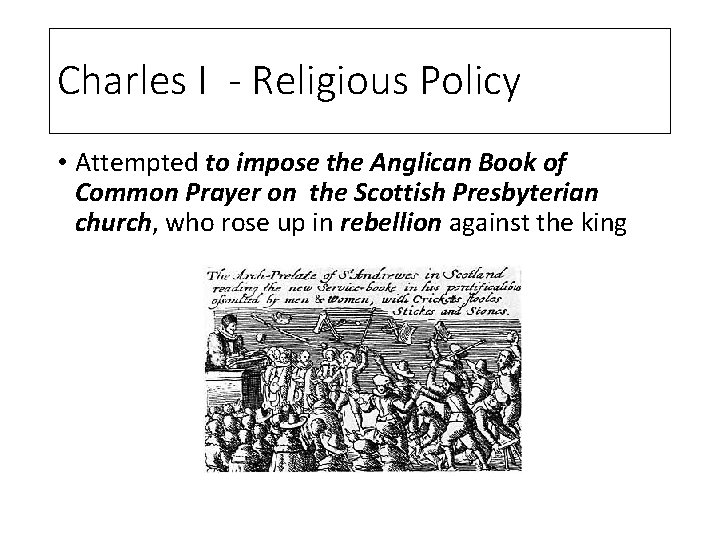
Charles I - Religious Policy • Attempted to impose the Anglican Book of Common Prayer on the Scottish Presbyterian church, who rose up in rebellion against the king
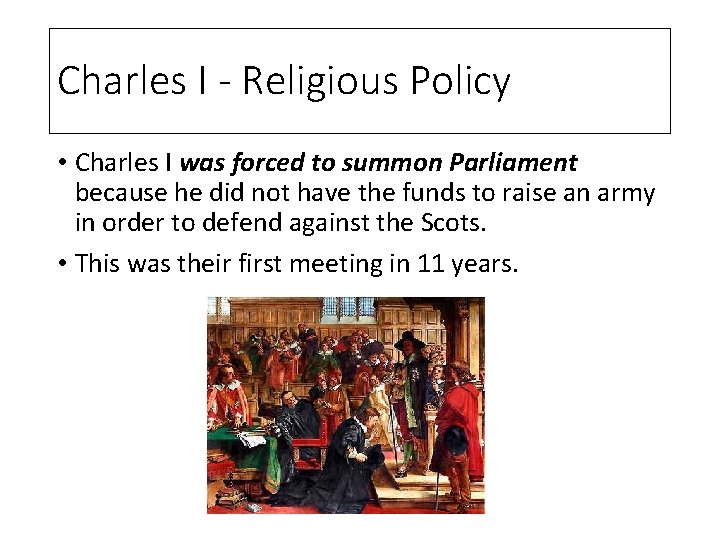
Charles I - Religious Policy • Charles I was forced to summon Parliament because he did not have the funds to raise an army in order to defend against the Scots. • This was their first meeting in 11 years.
The “Long Parliament” • Lasted more or less from 1640 to 1660 • Limited royal authority in their first session. • Abolished taxes imposed without Parliaments consent. • Passed Triennal Act – Parliament must meet at least once every 3 years • Pushed for the elimination of bishops in the Anglican church.
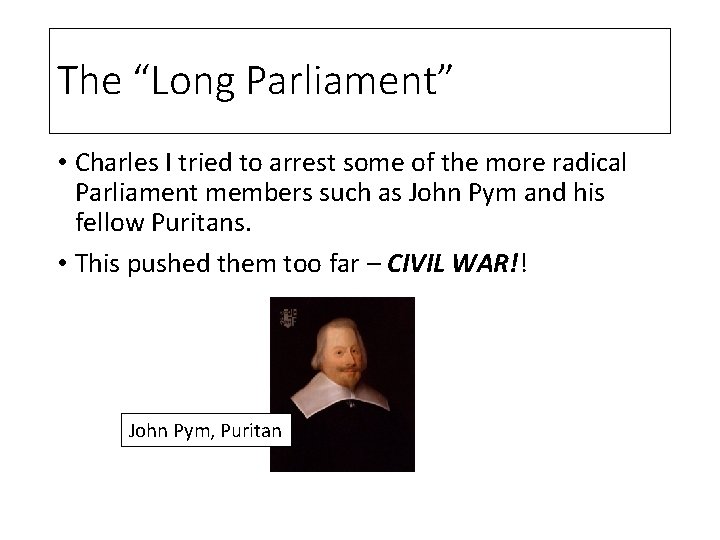
The “Long Parliament” • Charles I tried to arrest some of the more radical Parliament members such as John Pym and his fellow Puritans. • This pushed them too far – CIVIL WAR!! John Pym, Puritan
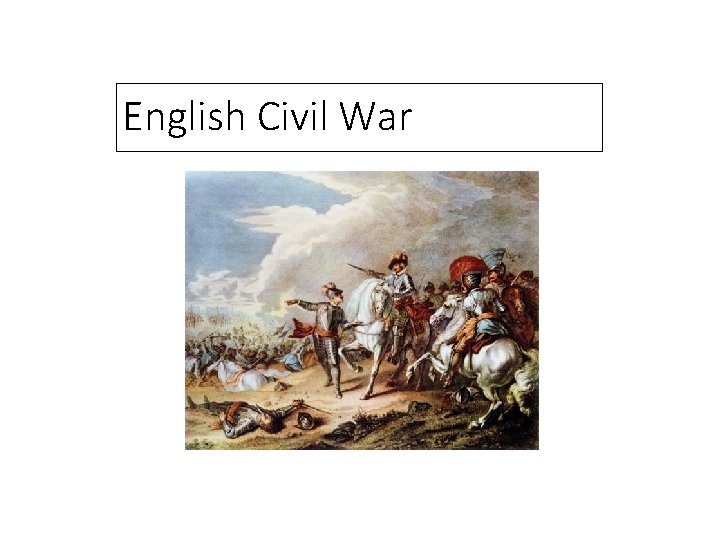
English Civil War
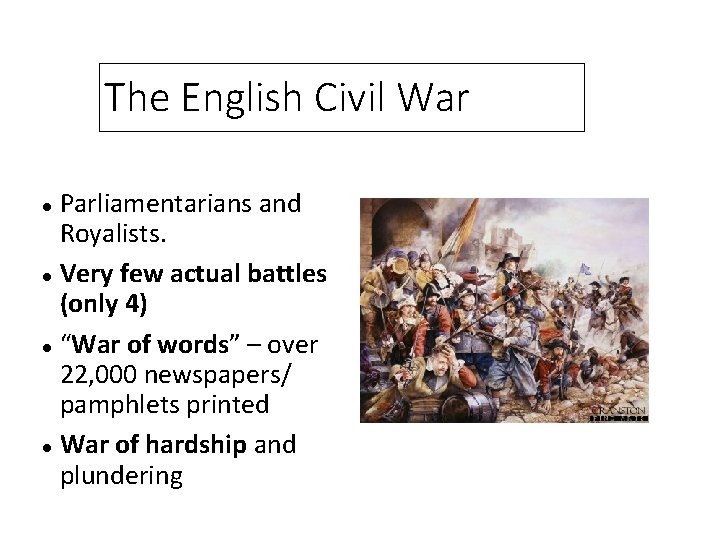
The English Civil War Parliamentarians and Royalists. Very few actual battles (only 4) “War of words” – over 22, 000 newspapers/ pamphlets printed War of hardship and plundering
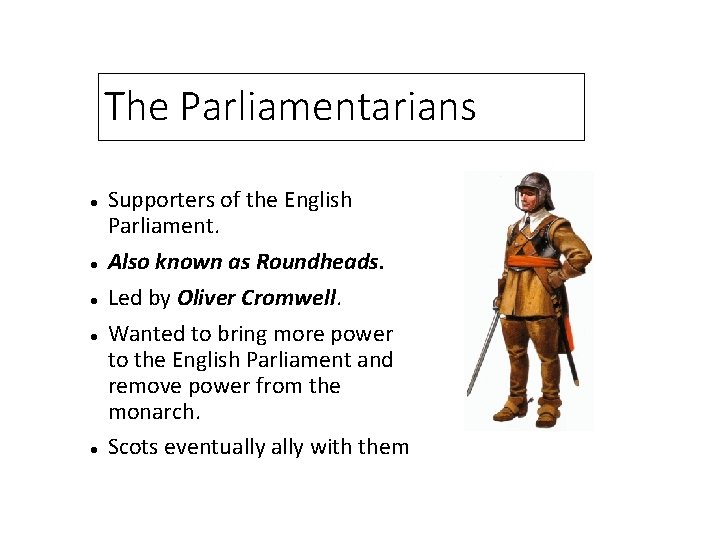
The Parliamentarians Supporters of the English Parliament. Also known as Roundheads. Led by Oliver Cromwell. Wanted to bring more power to the English Parliament and remove power from the monarch. Scots eventually with them
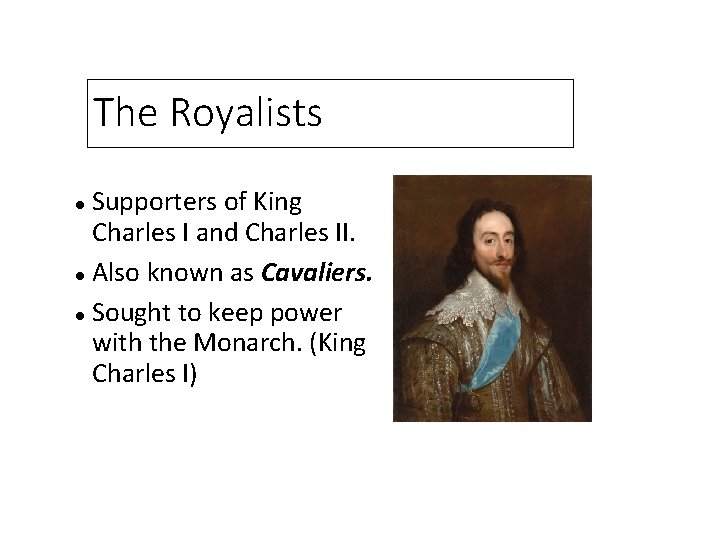
The Royalists Supporters of King Charles I and Charles II. Also known as Cavaliers. Sought to keep power with the Monarch. (King Charles I)
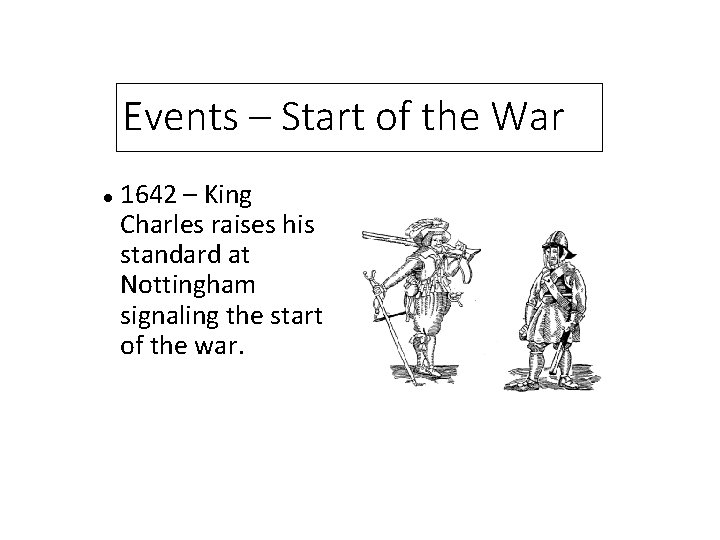
Events – Start of the War 1642 – King Charles raises his standard at Nottingham signaling the start of the war.
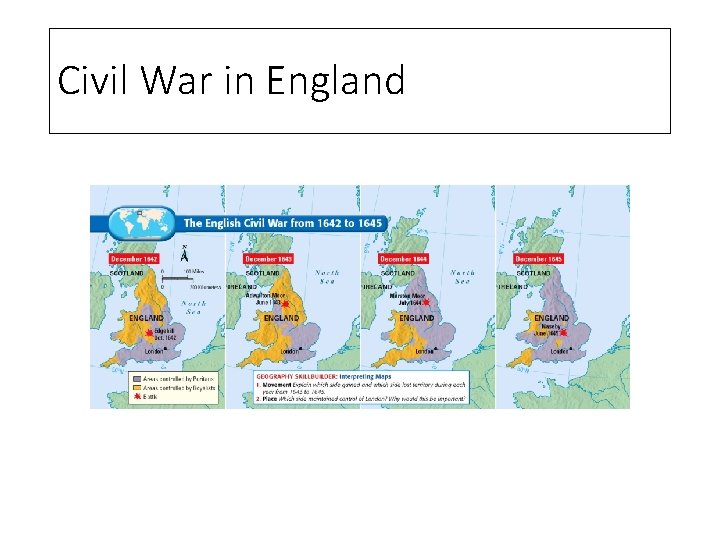
Civil War in England
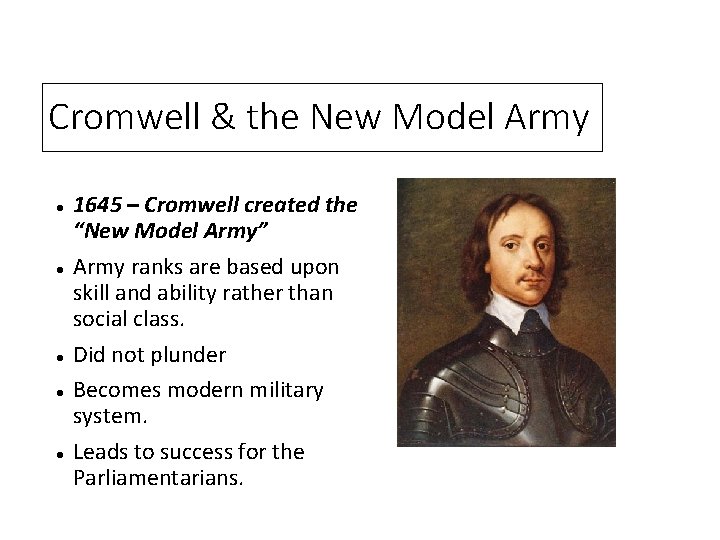
Cromwell & the New Model Army 1645 – Cromwell created the “New Model Army” Army ranks are based upon skill and ability rather than social class. Did not plunder Becomes modern military system. Leads to success for the Parliamentarians.
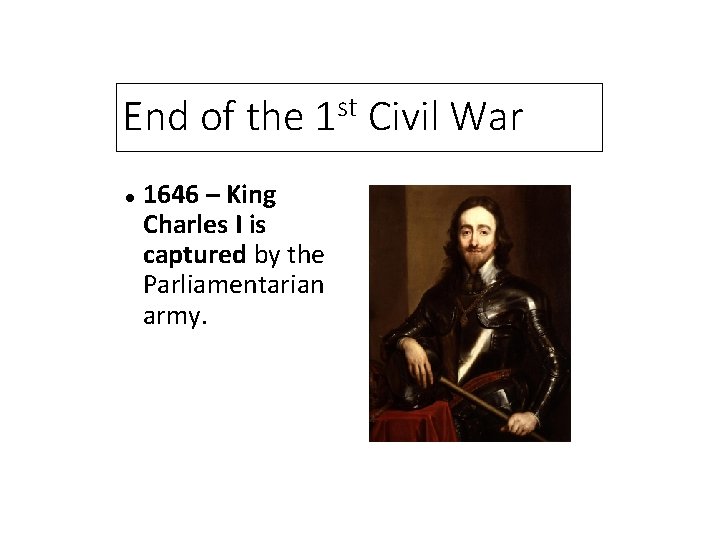
End of the st 1 1646 – King Charles I is captured by the Parliamentarian army. Civil War
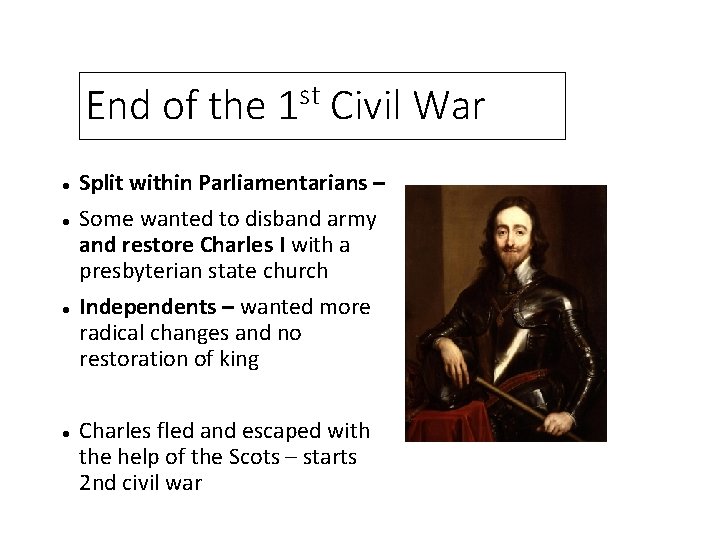
End of the 1 st Civil War Split within Parliamentarians – Some wanted to disband army and restore Charles I with a presbyterian state church Independents – wanted more radical changes and no restoration of king Charles fled and escaped with the help of the Scots – starts 2 nd civil war
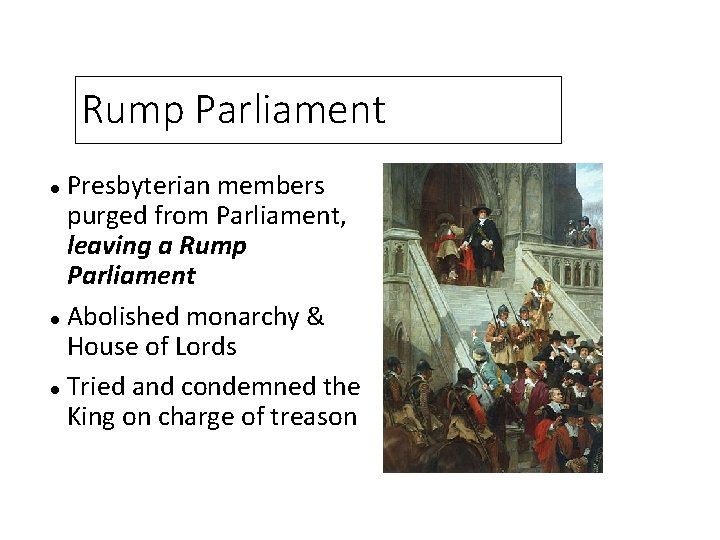
Rump Parliament Presbyterian members purged from Parliament, leaving a Rump Parliament Abolished monarchy & House of Lords Tried and condemned the King on charge of treason
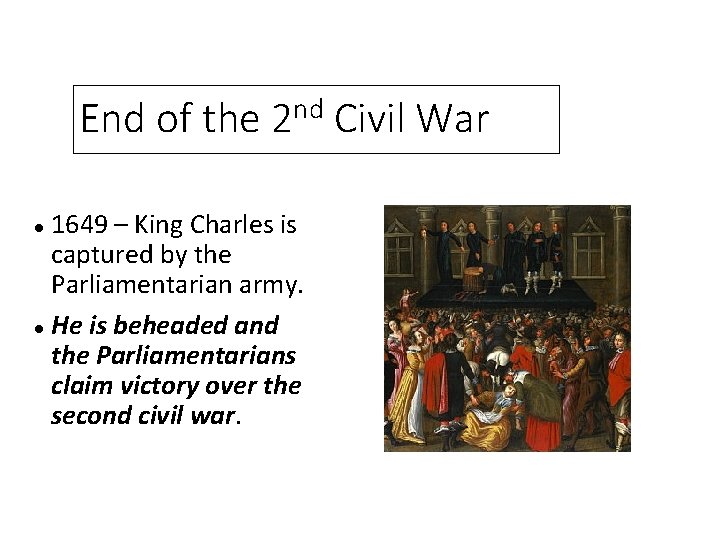
End of the nd 2 1649 – King Charles is captured by the Parliamentarian army. He is beheaded and the Parliamentarians claim victory over the second civil war. Civil War
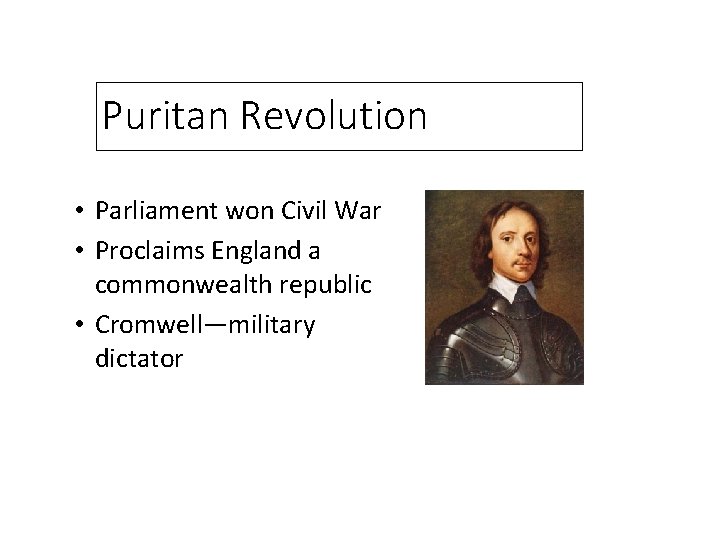
Puritan Revolution • Parliament won Civil War • Proclaims England a commonwealth republic • Cromwell—military dictator
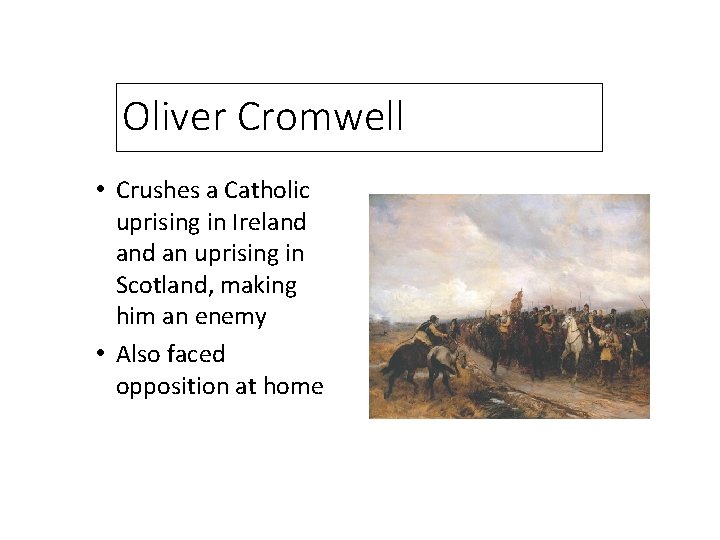
Oliver Cromwell • Crushes a Catholic uprising in Ireland an uprising in Scotland, making him an enemy • Also faced opposition at home
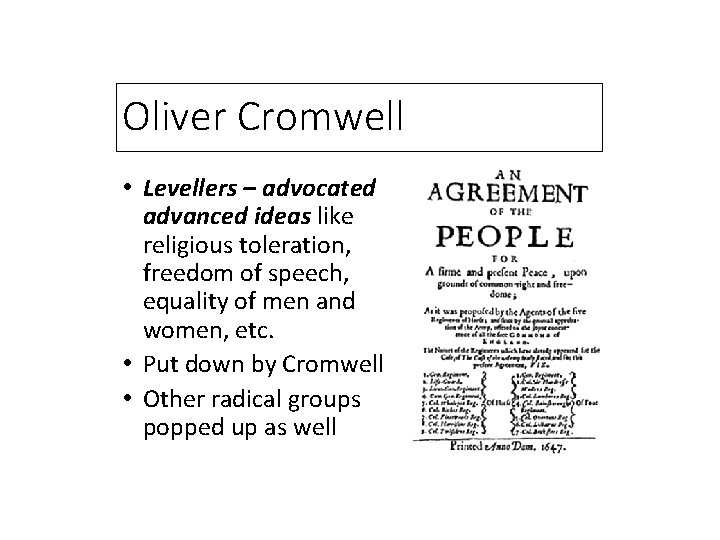
Oliver Cromwell • Levellers – advocated advanced ideas like religious toleration, freedom of speech, equality of men and women, etc. • Put down by Cromwell • Other radical groups popped up as well
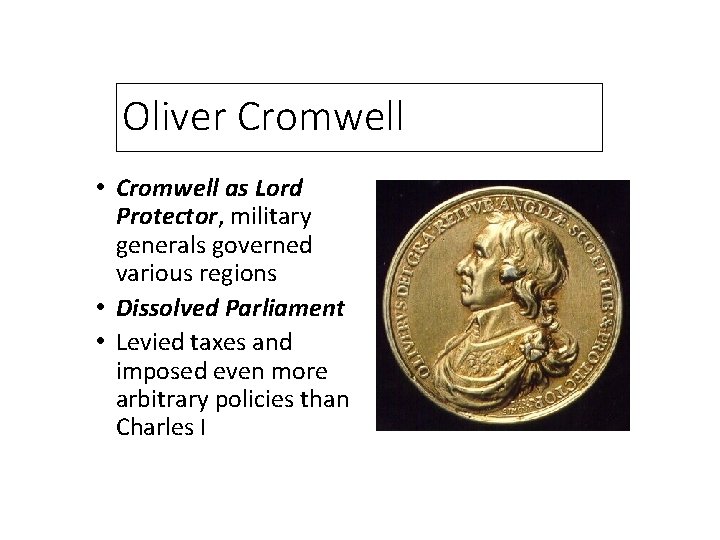
Oliver Cromwell • Cromwell as Lord Protector, military generals governed various regions • Dissolved Parliament • Levied taxes and imposed even more arbitrary policies than Charles I
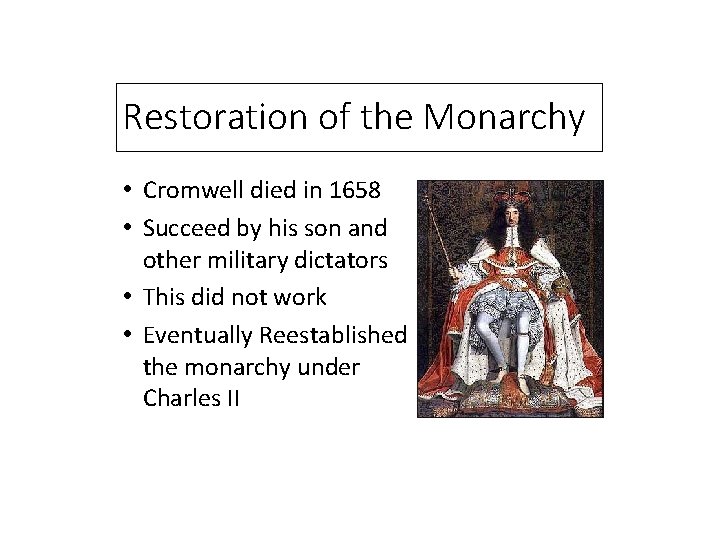
Restoration of the Monarchy • Cromwell died in 1658 • Succeed by his son and other military dictators • This did not work • Eventually Reestablished the monarchy under Charles II
Opposing Viewpoints: Cromwell Answer the four questions on the back or a separate sheet of paper 1. What motivated Cromwell’s political and military action? 2. What was Edmund Ludlow’s criticism of Cromwell? 3. In what ways did Edward Hyde (Lord Clarendon) see both good and bad features in Cromwell? 4. How do you explain the differences in these three perspectives?
- Slides: 36