
Ch 13 Money Creation A A bala nce
Ch 13. Money Creation
A. A bala nce sh must be ba eet lanced ! Balance sheet – statement of assets and claims on assets. 1. Liabilities 2. Net worth Assets = Liabilities + Net worth -- This chapter shows how commercial banks and thrifts create checkable deposits by issuing loans. -- A Thrift institution is a savings and loan association, mutual savings bank, or credit union.
B. Fractional reserve banking system 1. Money creation & reserves 2. Bank panics & regulation -- Fractional = only a fraction of the total money supply is held in reserve as currency. -- Started with the Goldsmiths who held gold in their vaults for a fee and issued receipts to the depositor, the first kind of paper money. -- $1 mill in gold; issued another $1 mill in paper = $2 mill total (fractional) -- Banks create money through lending, limited by currency reserves/laws. -- Vulnerable to ‘runs’ but unlikely due to system of deposit insurance.
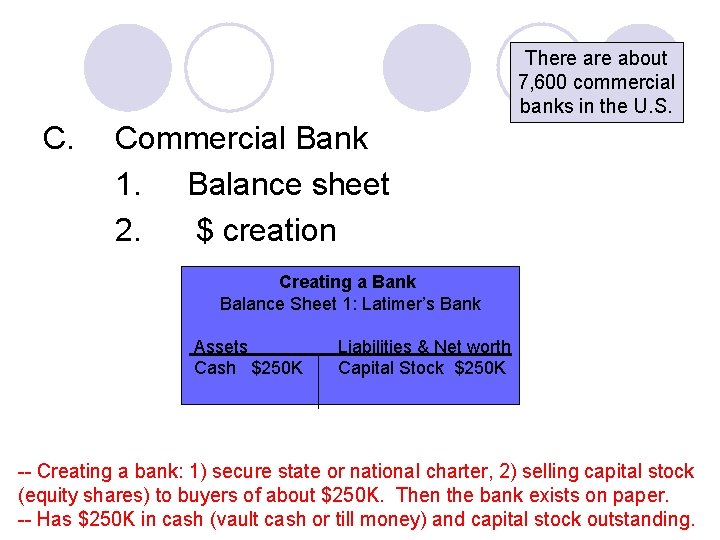
There about 7, 600 commercial banks in the U. S. Commercial Bank 1. Balance sheet 2. $ creation Creating a Bank Balance Sheet 1: Latimer’s Bank Assets Cash $250 K Liabilities & Net worth Capital Stock $250 K -- Creating a bank: 1) secure state or national charter, 2) selling capital stock (equity shares) to buyers of about $250 K. Then the bank exists on paper. -- Has $250 K in cash (vault cash or till money) and capital stock outstanding.
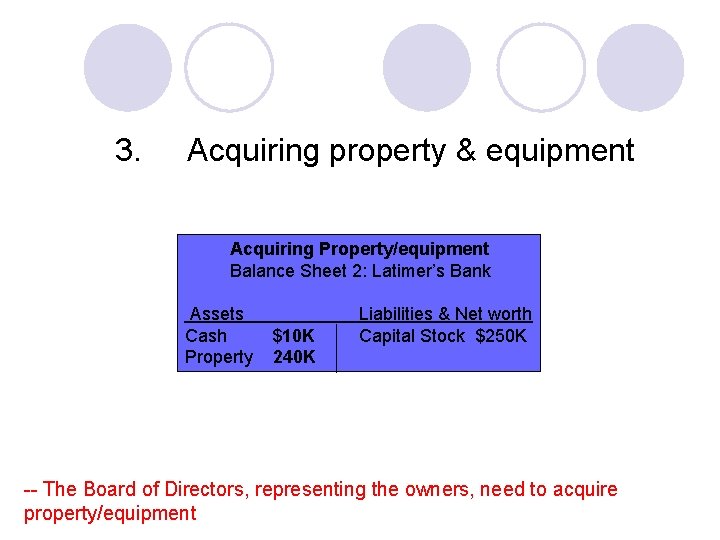
3. Acquiring property & equipment Acquiring Property/equipment Balance Sheet 2: Latimer’s Bank Assets Cash Property $10 K 240 K Liabilities & Net worth Capital Stock $250 K -- The Board of Directors, representing the owners, need to acquire property/equipment
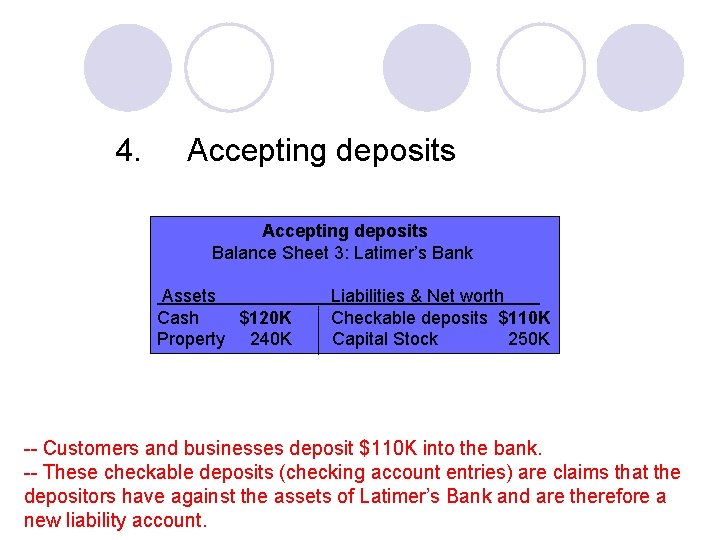
4. Accepting deposits Balance Sheet 3: Latimer’s Bank Assets Cash $120 K Property 240 K Liabilities & Net worth Checkable deposits $110 K Capital Stock 250 K -- Customers and businesses deposit $110 K into the bank. -- These checkable deposits (checking account entries) are claims that the depositors have against the assets of Latimer’s Bank and are therefore a new liability account.
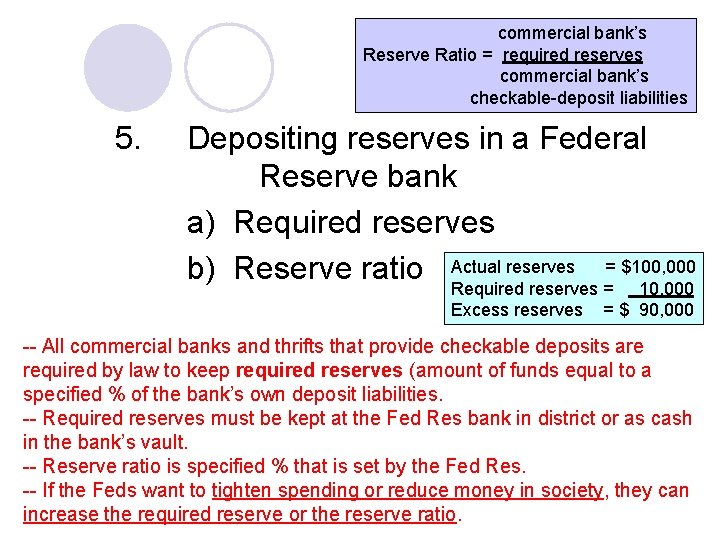
commercial bank’s Reserve Ratio = required reserves commercial bank’s checkable-deposit liabilities 5. Depositing reserves in a Federal Reserve bank a) Required reserves = $100, 000 b) Reserve ratio Actual Required reserves = 10, 000 Excess reserves = $ 90, 000 -- All commercial banks and thrifts that provide checkable deposits are required by law to keep required reserves (amount of funds equal to a specified % of the bank’s own deposit liabilities. -- Required reserves must be kept at the Fed Res bank in district or as cash in the bank’s vault. -- Reserve ratio is specified % that is set by the Fed Res. -- If the Feds want to tighten spending or reduce money in society, they can increase the required reserve or the reserve ratio.
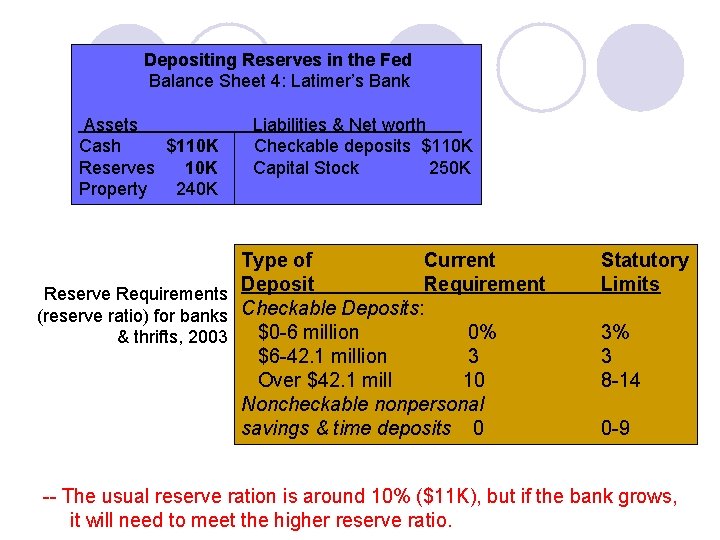
Depositing Reserves in the Fed Balance Sheet 4: Latimer’s Bank Assets Cash $110 K Reserves 10 K Property 240 K Liabilities & Net worth Checkable deposits $110 K Capital Stock 250 K Type of Current Requirement Reserve Requirements Deposit (reserve ratio) for banks Checkable Deposits: $0 -6 million 0% & thrifts, 2003 $6 -42. 1 million 3 Over $42. 1 mill 10 Noncheckable nonpersonal savings & time deposits 0 Statutory Limits 3% 3 8 -14 0 -9 -- The usual reserve ration is around 10% ($11 K), but if the bank grows, it will need to meet the higher reserve ratio.
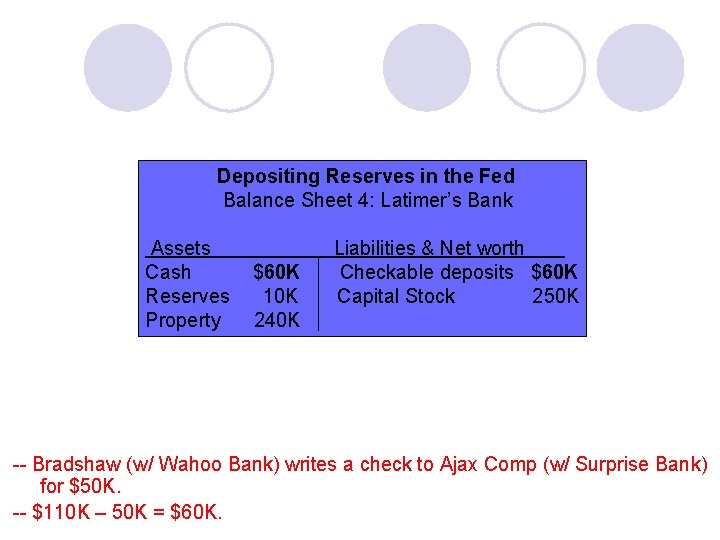
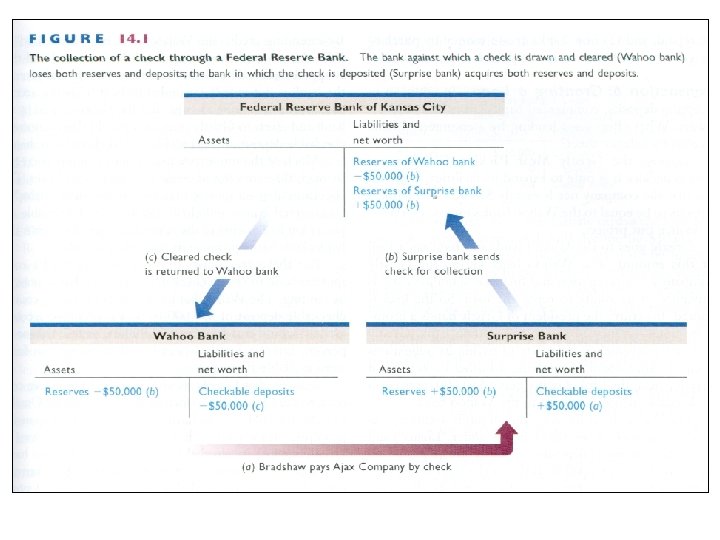
Depositing Reserves in the Fed Balance Sheet 4: Latimer’s Bank Assets Cash Reserves Property $60 K 10 K 240 K Liabilities & Net worth Checkable deposits $60 K Capital Stock 250 K -- Bradshaw (w/ Wahoo Bank) writes a check to Ajax Comp (w/ Surprise Bank) for $50 K. -- $110 K – 50 K = $60 K.
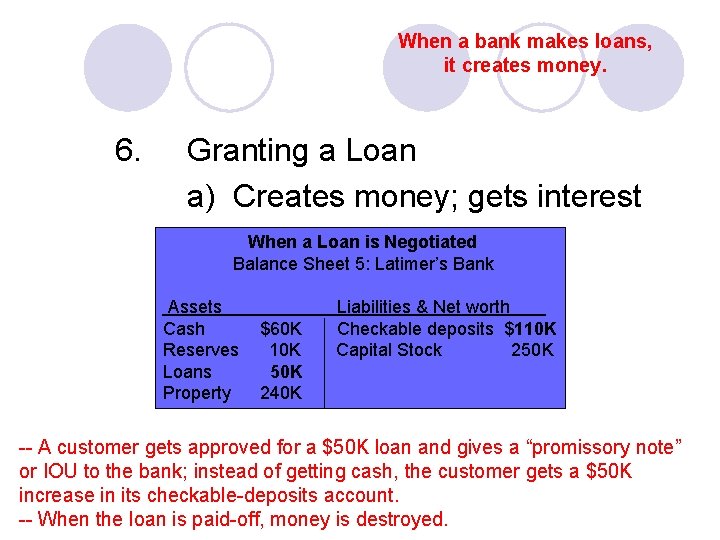
When a bank makes loans, it creates money. 6. Granting a Loan a) Creates money; gets interest When a Loan is Negotiated Balance Sheet 5: Latimer’s Bank Assets Cash Reserves Loans Property $60 K 10 K 50 K 240 K Liabilities & Net worth Checkable deposits $110 K Capital Stock 250 K -- A customer gets approved for a $50 K loan and gives a “promissory note” or IOU to the bank; instead of getting cash, the customer gets a $50 K increase in its checkable-deposits account. -- When the loan is paid-off, money is destroyed.
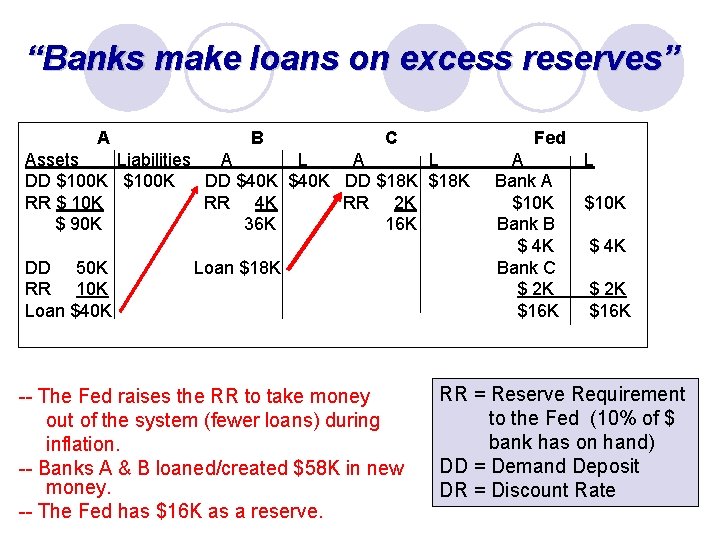
“Banks make loans on excess reserves” A B C Fed Assets Liabilities A L DD $100 K DD $40 K DD $18 K RR $ 10 K RR 4 K RR 2 K $ 90 K 36 K 16 K DD 50 K RR 10 K Loan $40 K Loan $18 K -- The Fed raises the RR to take money out of the system (fewer loans) during inflation. -- Banks A & B loaned/created $58 K in new money. -- The Fed has $16 K as a reserve. A Bank A $10 K Bank B $ 4 K Bank C $ 2 K $16 K L $10 K $ 4 K $ 2 K $16 K RR = Reserve Requirement to the Fed (10% of $ bank has on hand) DD = Demand Deposit DR = Discount Rate

D. Money Multiplier: checkable-deposit multiplier. Monetary multiplier = 1 required reserve ratio Maximum excess monetary checkable-deposit = reserves X multiplier creation OR M=1 RR OR D=Ex. M -- Excess reserves (E) are monies left over in the checkable-deposits (D) after required reserve ratio. -- Spending multiplier = 1/MPS, or, 1 over 1 -MPC
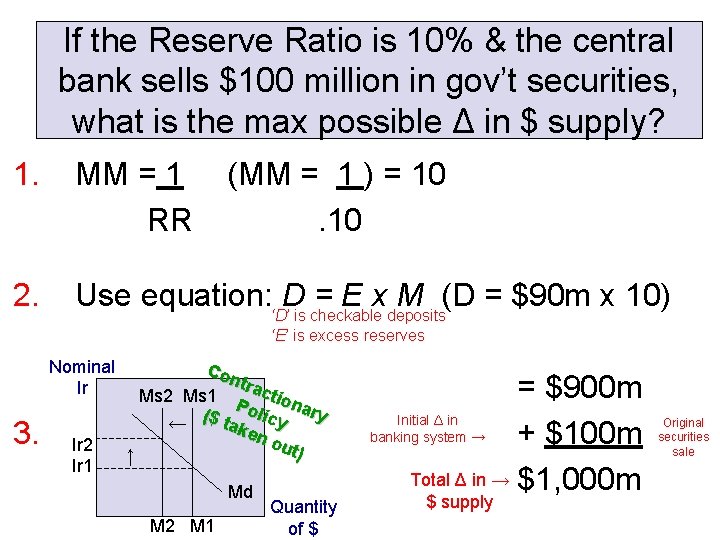
If the Reserve Ratio is 10% & the central bank sells $100 million in gov’t securities, what is the max possible Δ in $ supply? 1. MM = 1 RR (MM = 1 ) = 10. 10 2. Use equation: ‘D’Dis checkable = E xdeposits M (D = $90 m x 10) ‘E’ is excess reserves Nominal Ir 3. Ir 2 Ir 1 ↑ Con tr Ms 2 Ms 1 P action olic ary ( $ y tak ← en out ) Md M 2 M 1 Quantity of $ = $900 m Initial Δ in banking system → + $100 m Total Δ in → $1, 000 m $ supply Original securities sale

The Monetary Multiplier or Checkable-Deposit Multiplier Monetary Multiplier = or in Symbols… Graphic Example 1 Required Reserve Ratio 1 m = New Reserves $100 $80 Excess Reserves $400 Bank System Lending Money Created R $20 Required Reserves $100 Initial Deposit
E. F. Liquidity – ex: cash Federal funds rate – interest The Federal funds rate is the interest banks charges other banks for overnight loans out of their excess reserves.
- Slides: 16