
CH 12 THREE DIMENSIONAL GEOMETRY CONTENT Straight Line

- Slides: 18
CH – 12 THREE DIMENSIONAL GEOMETRY CONTENT: Straight Line in space and Equation Angle Between Two lines Shortest Distance between skew Lines Co-planarity of Two Lines
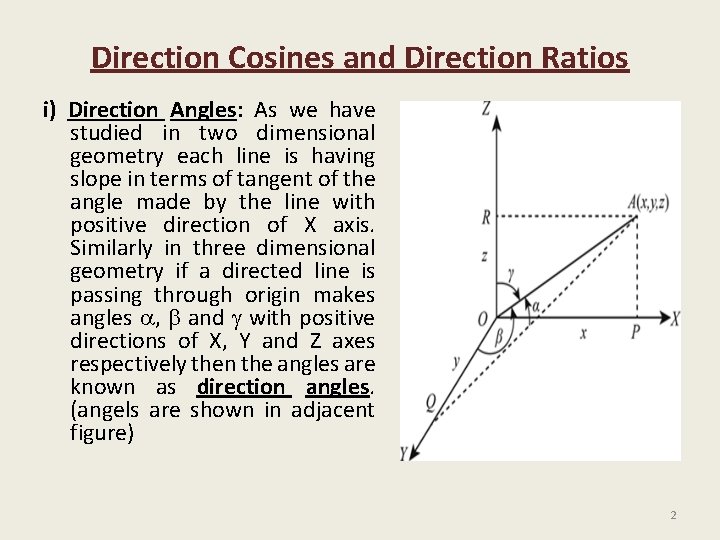
Direction Cosines and Direction Ratios i) Direction Angles: As we have studied in two dimensional geometry each line is having slope in terms of tangent of the angle made by the line with positive direction of X axis. Similarly in three dimensional geometry if a directed line is passing through origin makes angles , and with positive directions of X, Y and Z axes respectively then the angles are known as direction angles. (angels are shown in adjacent figure) 2
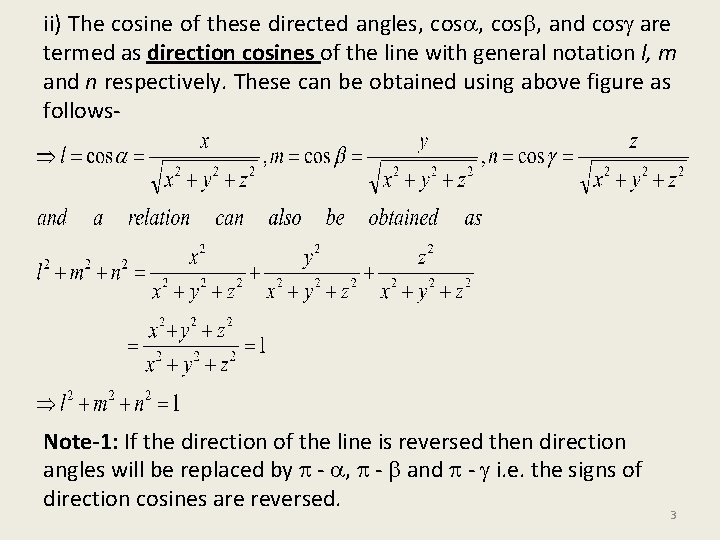
ii) The cosine of these directed angles, cos , and cos are termed as direction cosines of the line with general notation l, m and n respectively. These can be obtained using above figure as follows- Note-1: If the direction of the line is reversed then direction angles will be replaced by - , - and - i. e. the signs of direction cosines are reversed. 3
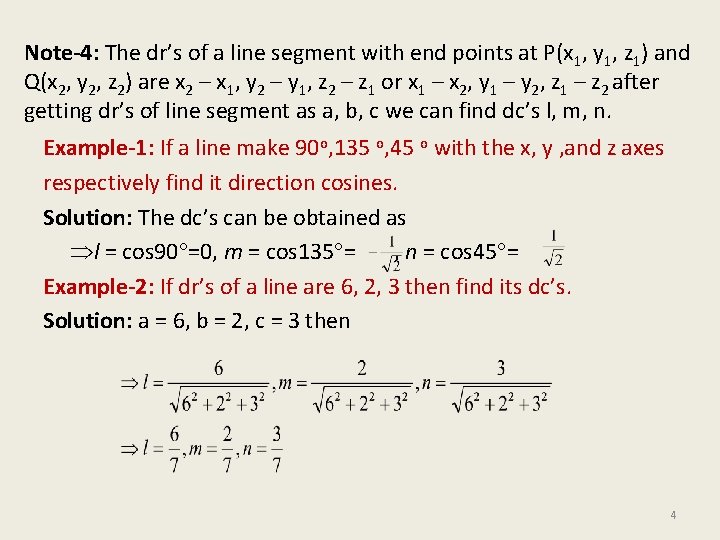
Note-4: The dr’s of a line segment with end points at P(x 1, y 1, z 1) and Q(x 2, y 2, z 2) are x 2 – x 1, y 2 – y 1, z 2 – z 1 or x 1 – x 2, y 1 – y 2, z 1 – z 2 after getting dr’s of line segment as a, b, c we can find dc’s l, m, n. Example-1: If a line make 90 o, 135 o, 45 o with the x, y , and z axes respectively find it direction cosines. Solution: The dc’s can be obtained as l = cos 90 =0, m = cos 135 = , n = cos 45 = Example-2: If dr’s of a line are 6, 2, 3 then find its dc’s. Solution: a = 6, b = 2, c = 3 then 4
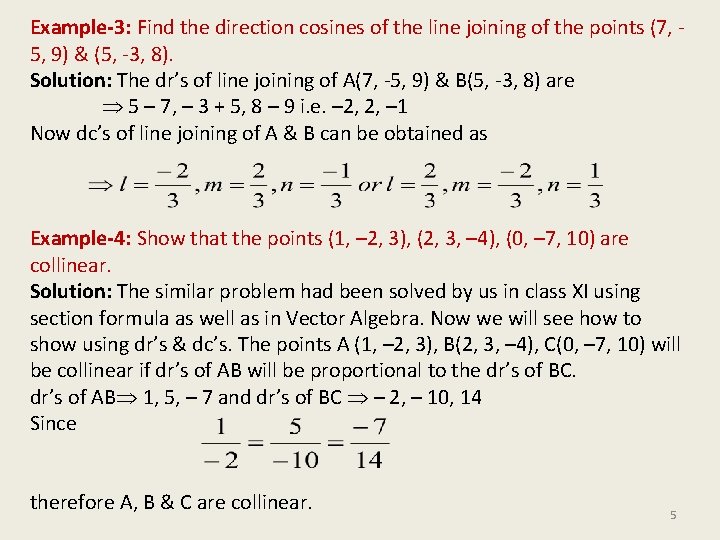
Example-3: Find the direction cosines of the line joining of the points (7, 5, 9) & (5, -3, 8). Solution: The dr’s of line joining of A(7, -5, 9) & B(5, -3, 8) are 5 – 7, – 3 + 5, 8 – 9 i. e. – 2, 2, – 1 Now dc’s of line joining of A & B can be obtained as Example-4: Show that the points (1, – 2, 3), (2, 3, – 4), (0, – 7, 10) are collinear. Solution: The similar problem had been solved by us in class XI using section formula as well as in Vector Algebra. Now we will see how to show using dr’s & dc’s. The points A (1, – 2, 3), B(2, 3, – 4), C(0, – 7, 10) will be collinear if dr’s of AB will be proportional to the dr’s of BC. dr’s of AB 1, 5, – 7 and dr’s of BC – 2, – 10, 14 Since therefore A, B & C are collinear. 5
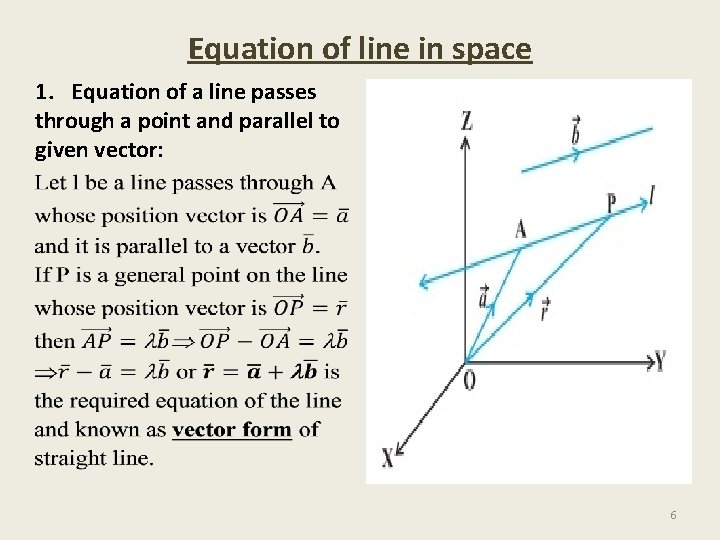
Equation of line in space 1. Equation of a line passes through a point and parallel to given vector: 6
7
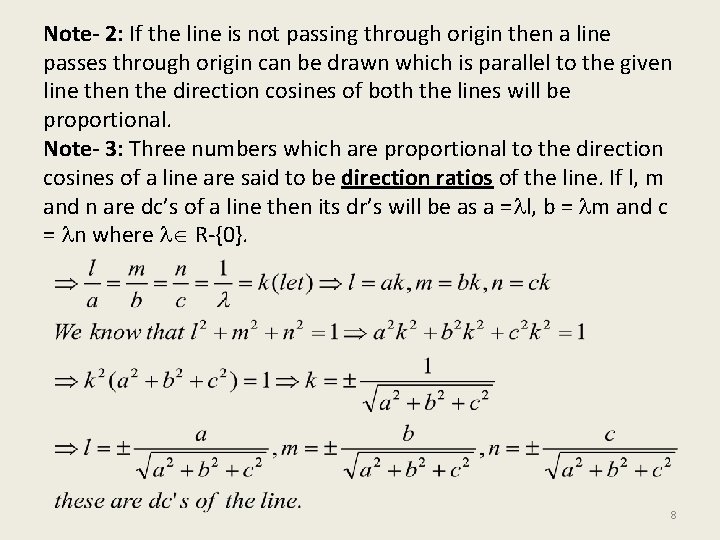
Note- 2: If the line is not passing through origin then a line passes through origin can be drawn which is parallel to the given line then the direction cosines of both the lines will be proportional. Note- 3: Three numbers which are proportional to the direction cosines of a line are said to be direction ratios of the line. If l, m and n are dc’s of a line then its dr’s will be as a = l, b = m and c = n where R-{0}. 8
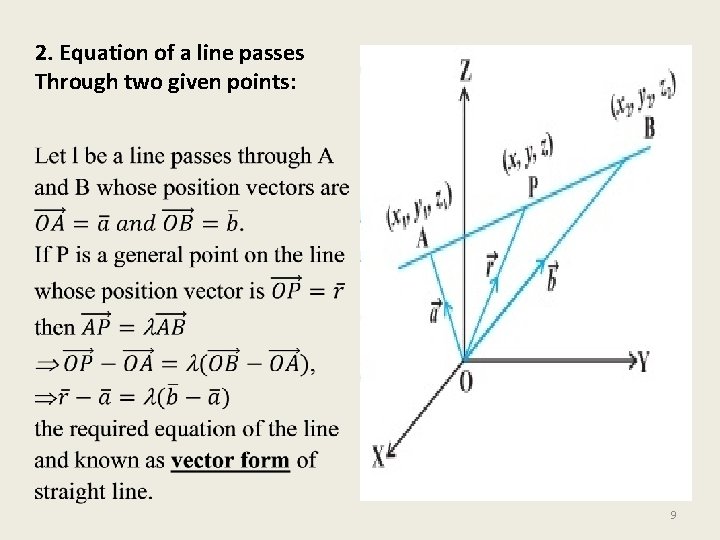
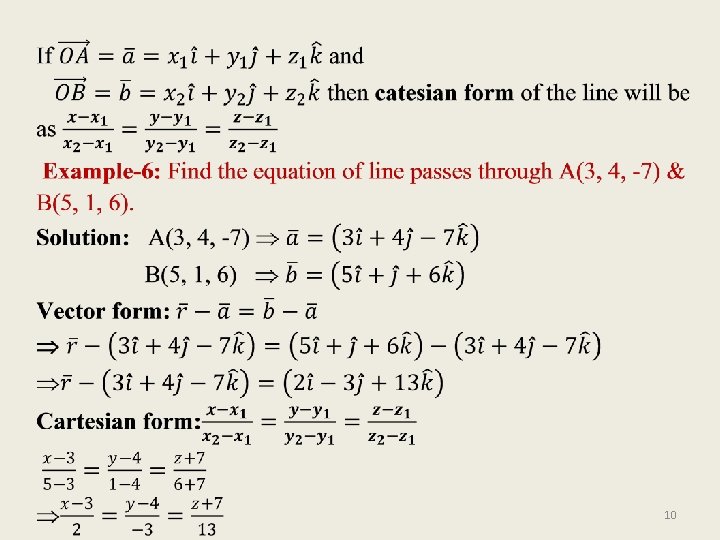
2. Equation of a line passes Through two given points: 9
10
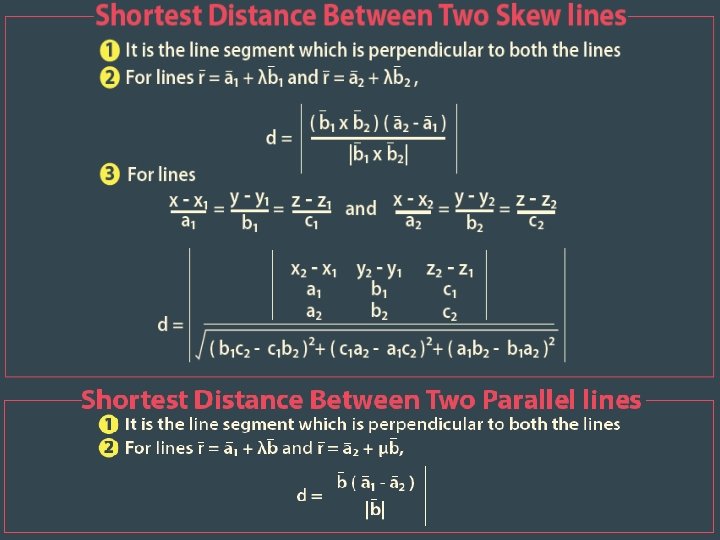
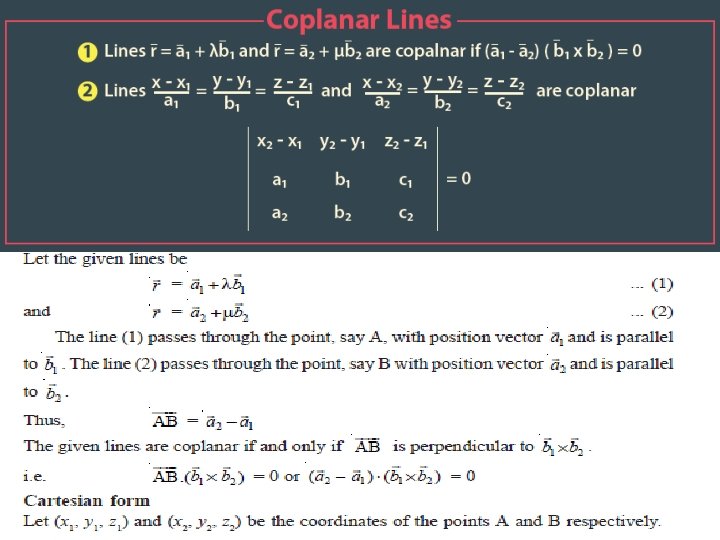
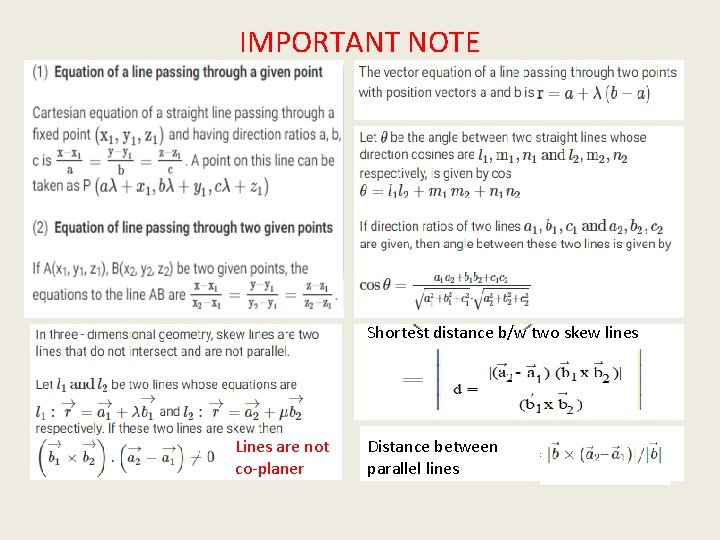
IMPORTANT NOTE Shortest distance b/w two skew lines Lines are not co-planer Distance between parallel lines
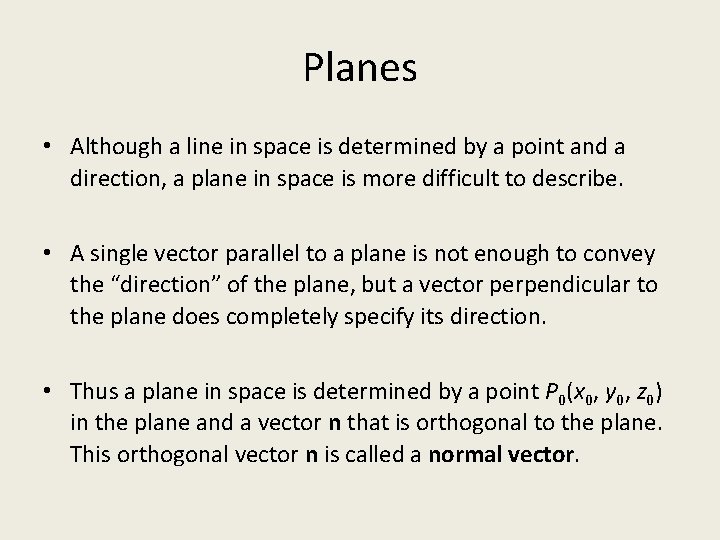
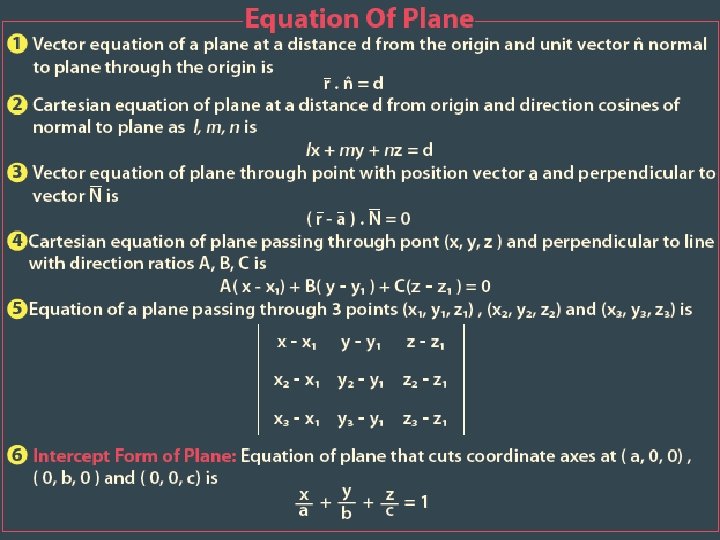
Planes • Although a line in space is determined by a point and a direction, a plane in space is more difficult to describe. • A single vector parallel to a plane is not enough to convey the “direction” of the plane, but a vector perpendicular to the plane does completely specify its direction. • Thus a plane in space is determined by a point P 0(x 0, y 0, z 0) in the plane and a vector n that is orthogonal to the plane. This orthogonal vector n is called a normal vector.
THANK YOU