
Ch 12 Sample Surveys AP Statistics Unit 3
- Slides: 20
Ch 12: Sample Surveys AP Statistics (Unit 3)
Poll vs. Census Poll = sample survey Select individuals at random. On average, sample should look like pop. sample is representative of pop (no parts OVER or UNDER represented) n = big enough to measure full range of data (n is not defined by a % of pop) Census = survey of entire pop Why does this never/rarely happen? Hint: Consider a census for saltiness of soup.
Poll Design Example Ex: Testing Twinkies for freshness (absence of mold). Design your poll! Component: Trial: Response Variable:
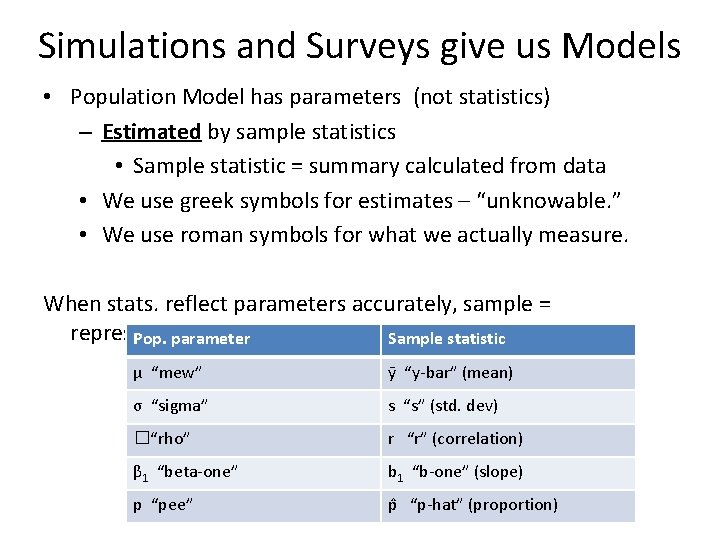
Simulations and Surveys give us Models • Population Model has parameters (not statistics) – Estimated by sample statistics • Sample statistic = summary calculated from data • We use greek symbols for estimates – “unknowable. ” • We use roman symbols for what we actually measure. When stats. reflect parameters accurately, sample = representative Pop. parameter Sample statistic μ “mew” ȳ “y-bar” (mean) σ “sigma” s “s” (std. dev) �“rho” r “r” (correlation) β 1 “beta-one” b 1 “b-one” (slope) p “pee” p “p-hat” (proportion)
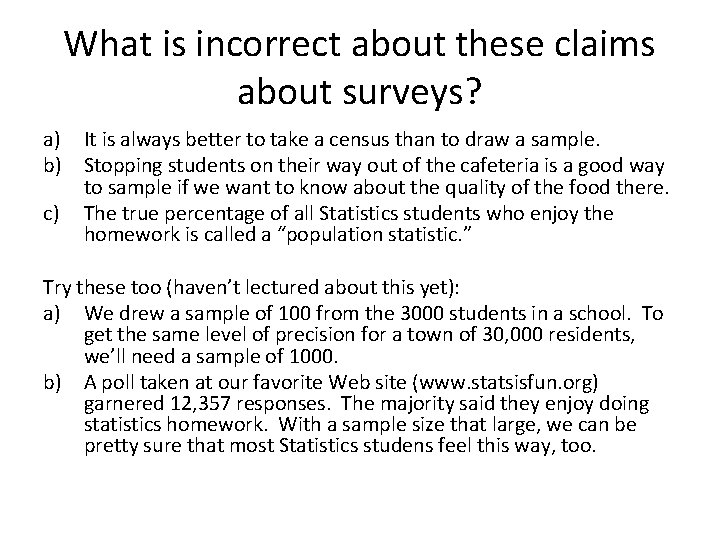
What is incorrect about these claims about surveys? a) It is always better to take a census than to draw a sample. b) Stopping students on their way out of the cafeteria is a good way to sample if we want to know about the quality of the food there. c) The true percentage of all Statistics students who enjoy the homework is called a “population statistic. ” Try these too (haven’t lectured about this yet): a) We drew a sample of 100 from the 3000 students in a school. To get the same level of precision for a town of 30, 000 residents, we’ll need a sample of 1000. b) A poll taken at our favorite Web site (www. statsisfun. org) garnered 12, 357 responses. The majority said they enjoy doing statistics homework. With a sample size that large, we can be pretty sure that most Statistics studens feel this way, too.
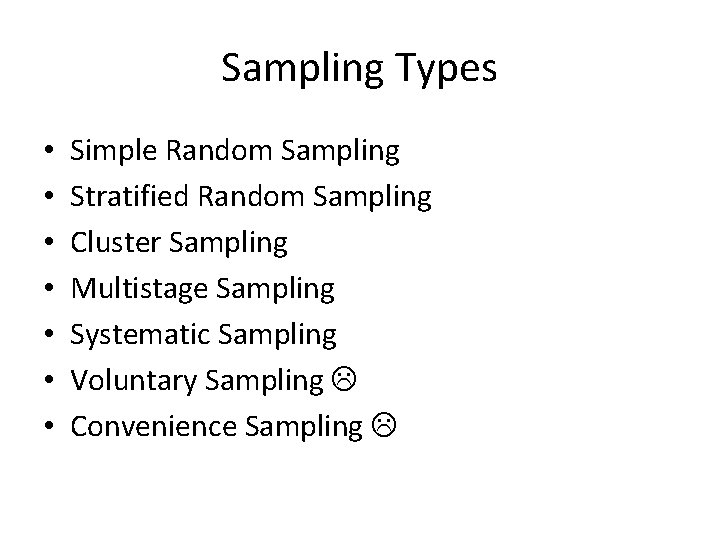
Sampling Types • • Simple Random Sampling Stratified Random Sampling Cluster Sampling Multistage Sampling Systematic Sampling Voluntary Sampling Convenience Sampling
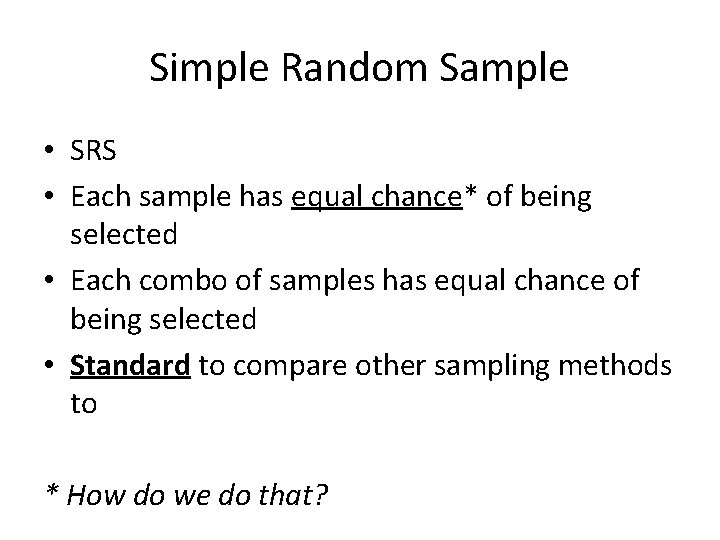
Simple Random Sample • SRS • Each sample has equal chance* of being selected • Each combo of samples has equal chance of being selected • Standard to compare other sampling methods to * How do we do that?
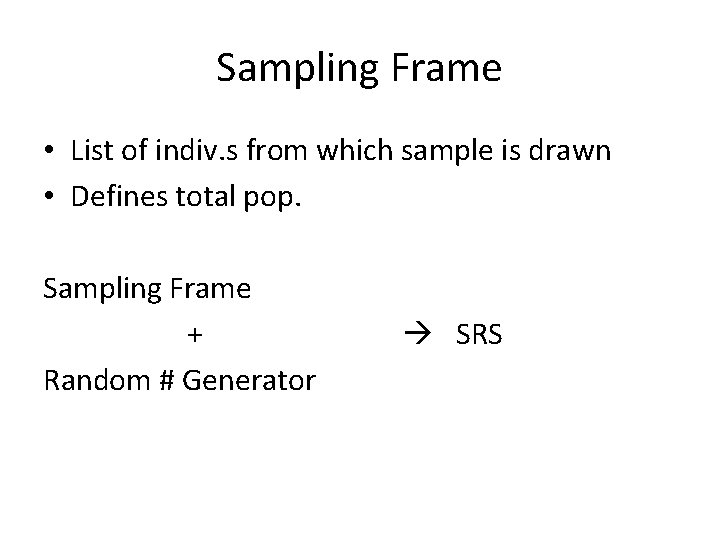
Sampling Frame • List of indiv. s from which sample is drawn • Defines total pop. Sampling Frame + Random # Generator SRS
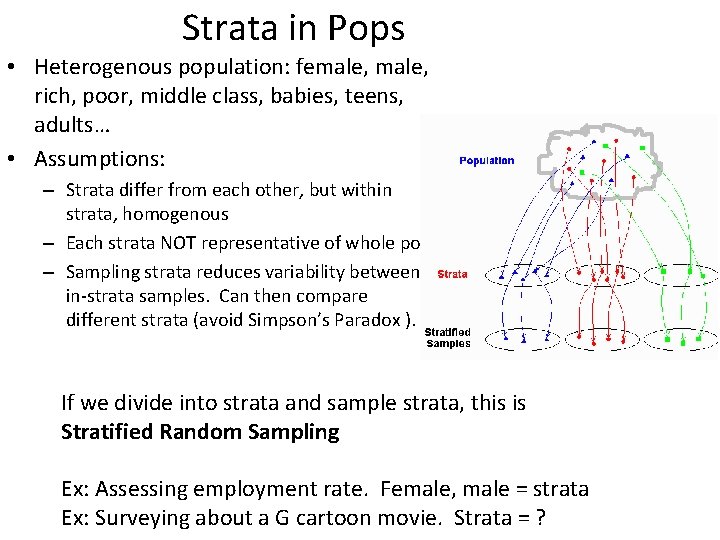
Strata in Pops • Heterogenous population: female, rich, poor, middle class, babies, teens, adults… • Assumptions: – Strata differ from each other, but within strata, homogenous – Each strata NOT representative of whole pop. – Sampling strata reduces variability between in-strata samples. Can then compare different strata (avoid Simpson’s Paradox ). If we divide into strata and sample strata, this is Stratified Random Sampling Ex: Assessing employment rate. Female, male = strata Ex: Surveying about a G cartoon movie. Strata = ?
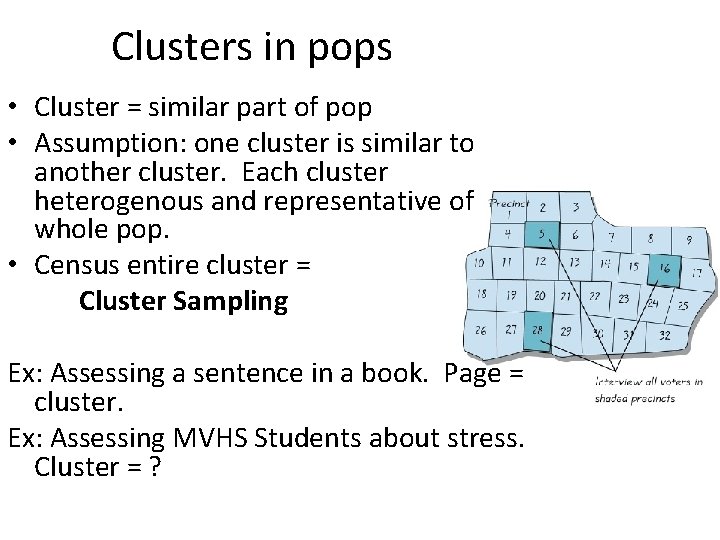
Clusters in pops • Cluster = similar part of pop • Assumption: one cluster is similar to another cluster. Each cluster heterogenous and representative of whole pop. • Census entire cluster = Cluster Sampling Ex: Assessing a sentence in a book. Page = cluster. Ex: Assessing MVHS Students about stress. Cluster = ?
Cluster, Strata, and SRS • Common: Sampling Frame: All clusters, each in different strata + Random number generator to pick some clusters SRS Note: Multistage Sampling = Sampling scheme combining several methods.
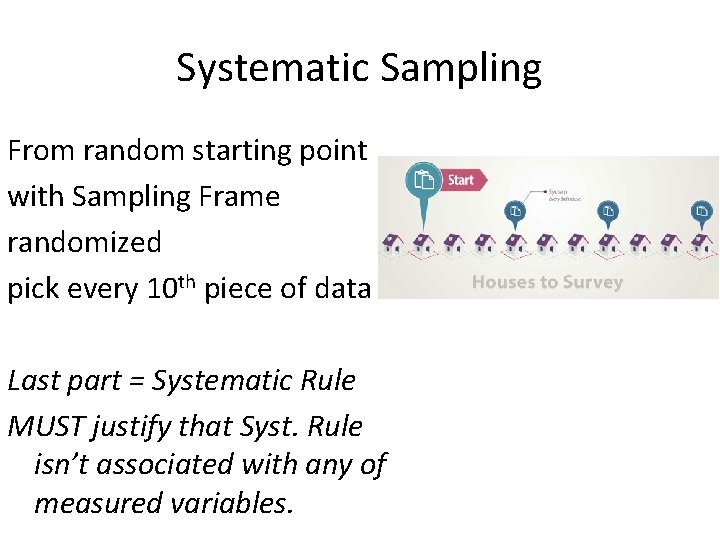
Systematic Sampling From random starting point with Sampling Frame randomized pick every 10 th piece of data Last part = Systematic Rule MUST justify that Syst. Rule isn’t associated with any of measured variables.
Danger! Voluntary Response Sample • Danger! Voluntary Response Bias • Almost always biased conclusions drawn from them almost always wrong • People with – opinion tend to respond more than people with + opinions • Biased towards those w strong opinions or those who are strongly motivated
Danger! Convenience Sampling • No well defined sampling frame • E. g. Internet survey at website regarding computer use • E. g. Grocery store survey re. purchase practices • Neither are representative of the entire pop!
Danger! Undercoverage • Some proportion of population is not sampled at all or is under represented • Why most survey results include details about the survey respondents and details about the whole pop.
Danger! Nonresponse & Influential Response Bias • Common and Serious Source of Bias • Issue if those not responding differ from those that do • Avoid survey refusal by: – Keeping survey short • Only ask ? s whose answers would direct you to model or do differently – Avoid influential responses • Response Bias = anything in survey design that influences responses – – – Don’t ask personal facts Don’t ask about illegal behavior Remove desire to please interviewer Avoid leading statements Avoid misinterpretation or confusion
Recovery from bias? • No way to recover from bias! • Statisticians know this! • Always report your sampling methods in detail
Sampling Types • • Simple Random Sampling Stratified Random Sampling Cluster Sampling Multistage Sampling Systematic Sampling Voluntary Sampling Convenience Sampling
Practice Each group will do one problem, then we’ll share out. For all, ID: • Population • Pop parameter of interest • The sampling frame • The sampling method, including whether or not randomization was employed • Any potential sources of bias and any problems you see in generalizing to the population of interest • Ch 12 (3, 5, 6, 9, 10, 14, 15, 32 a, 32 b) • Let’s look at a thorough example on the next slide.
Example: #2 A question posted on the Lycos Website on 18 June 2000 asked visitors to the site to say whether they thought that marijuana should be legally available for medicinal purposes. Pop = All people Pop parameter = proportion of people thinking med marijuana should be legal Sampling Frame = list of IPs visiting site (? ) Sample = people who volunteer to do survey Method = Convenience (who came to site) & Voluntary Sampling. No randomization was employed. Sources of bias = Nonresponse bias, Voluntary Response Bias (negative or more vocal opinions tend to predominate), asking about illegal activity, Convenience Sampling Bias (overrepresentation (just “wealthy” with a Internet-enabled digital device and free time)/underrepresentation), overrepresentation because users can be counted more than once (if new IP) or underrep if same IPs-different users cannot be counted (for family using same IP).