
Ch 12 Forces and Motion EQ Column Essential

- Slides: 13
Ch 12 Forces and Motion EQ Column (Essential Questions) Support from ch 12/ Evidence
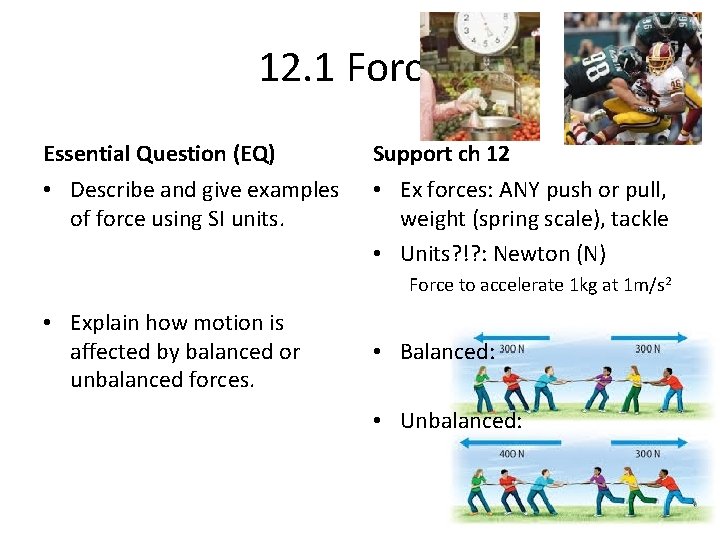
12. 1 Forces Essential Question (EQ) Support ch 12 • Describe and give examples of force using SI units. • Ex forces: ANY push or pull, weight (spring scale), tackle • Units? !? : Newton (N) Force to accelerate 1 kg at 1 m/s 2 • Explain how motion is affected by balanced or unbalanced forces. • Balanced: • Unbalanced:
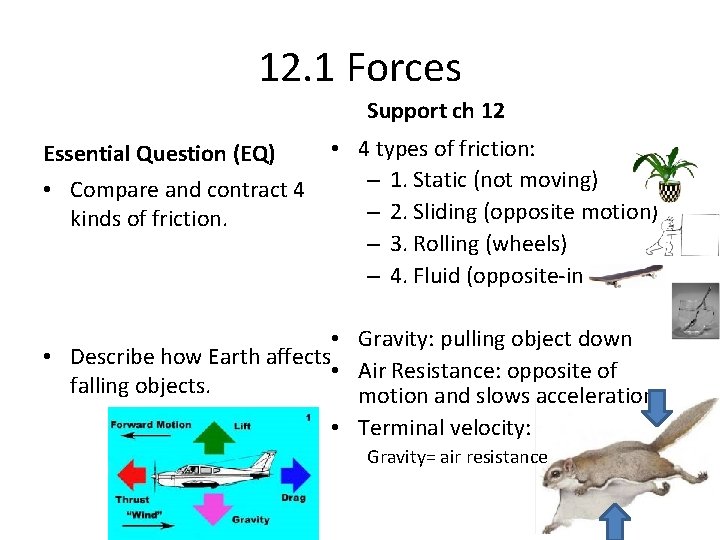
12. 1 Forces Support ch 12 Essential Question (EQ) • Compare and contract 4 kinds of friction. • 4 types of friction: – 1. Static (not moving) – 2. Sliding (opposite motion) – 3. Rolling (wheels) – 4. Fluid (opposite-in water) • Gravity: pulling object down • Describe how Earth affects • Air Resistance: opposite of falling objects. motion and slows acceleration • Terminal velocity: Gravity= air resistance
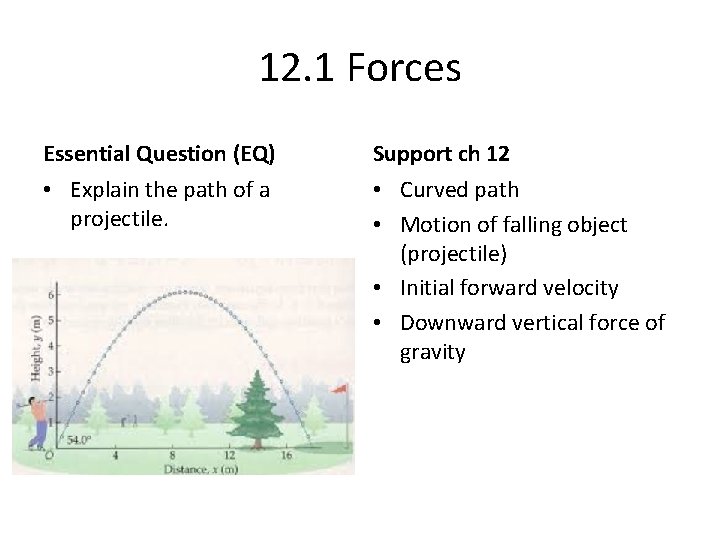
12. 1 Forces Essential Question (EQ) Support ch 12 • Explain the path of a projectile. • Curved path • Motion of falling object (projectile) • Initial forward velocity • Downward vertical force of gravity
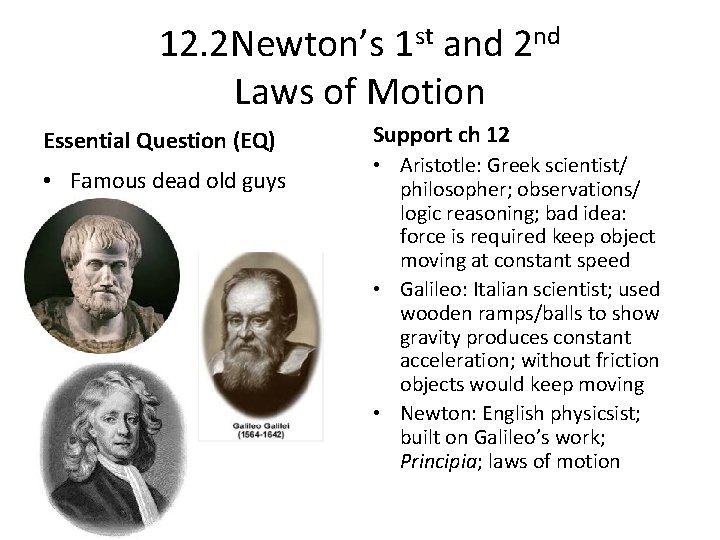
12. 2 Newton’s 1 st and 2 nd Laws of Motion Essential Question (EQ) • Famous dead old guys Support ch 12 • Aristotle: Greek scientist/ philosopher; observations/ logic reasoning; bad idea: force is required keep object moving at constant speed • Galileo: Italian scientist; used wooden ramps/balls to show gravity produces constant acceleration; without friction objects would keep moving • Newton: English physicsist; built on Galileo’s work; Principia; laws of motion
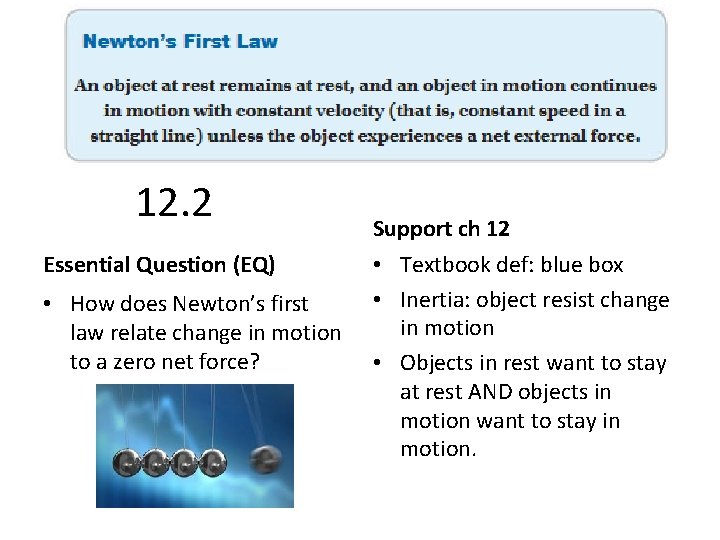
12. 2 Essential Question (EQ) • How does Newton’s first law relate change in motion to a zero net force? Support ch 12 • Textbook def: blue box • Inertia: object resist change in motion • Objects in rest want to stay at rest AND objects in motion want to stay in motion.
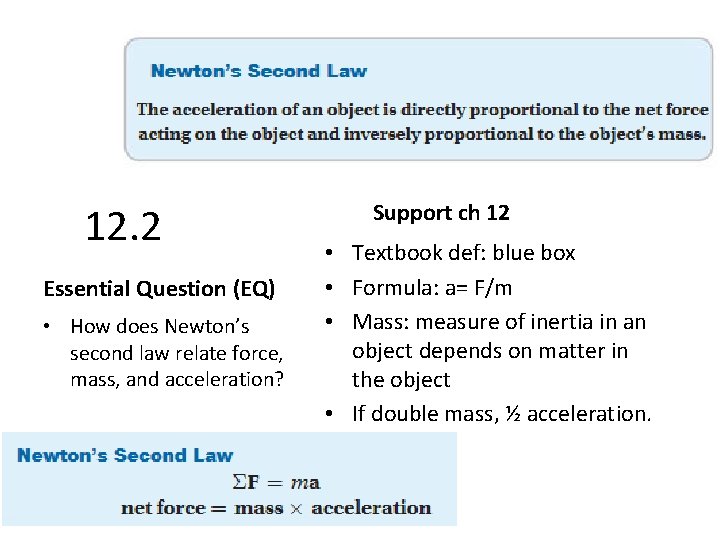
12. 2 Essential Question (EQ) • How does Newton’s second law relate force, mass, and acceleration? Support ch 12 • Textbook def: blue box • Formula: a= F/m • Mass: measure of inertia in an object depends on matter in the object • If double mass, ½ acceleration.
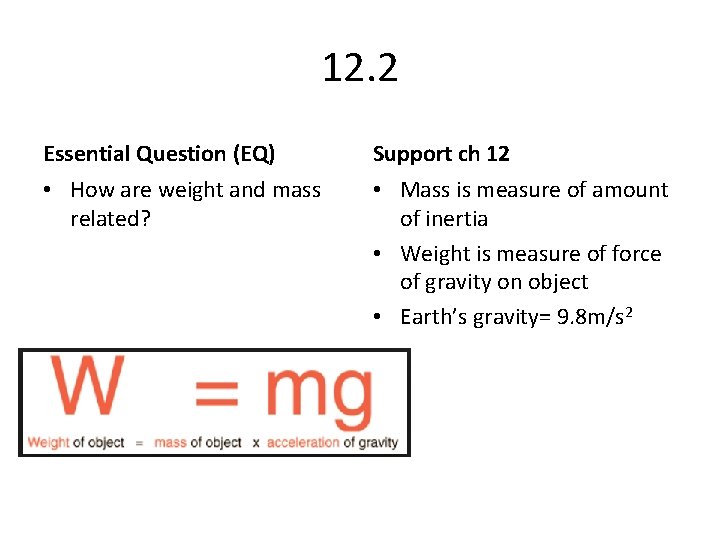
12. 2 Essential Question (EQ) Support ch 12 • How are weight and mass related? • Mass is measure of amount of inertia • Weight is measure of force of gravity on object • Earth’s gravity= 9. 8 m/s 2
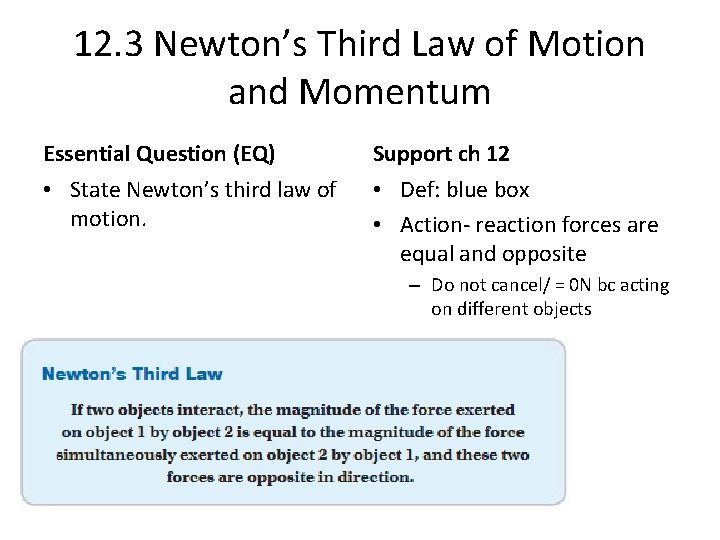
12. 3 Newton’s Third Law of Motion and Momentum Essential Question (EQ) Support ch 12 • State Newton’s third law of motion. • Def: blue box • Action- reaction forces are equal and opposite – Do not cancel/ = 0 N bc acting on different objects
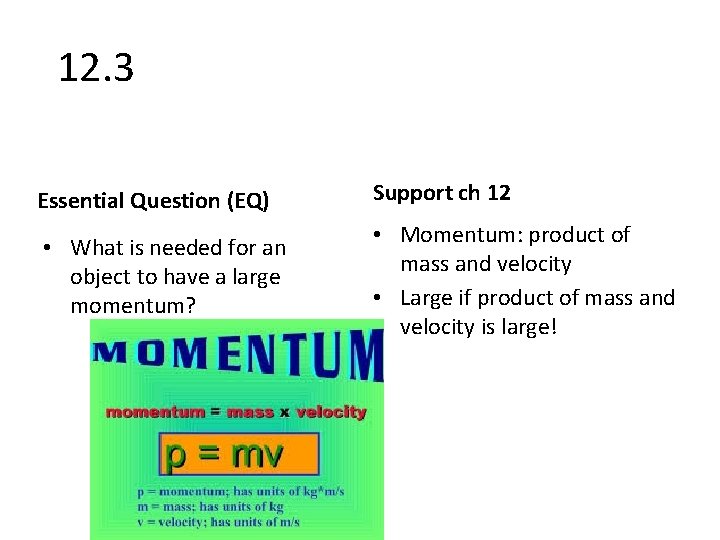
12. 3 Essential Question (EQ) Support ch 12 • What is needed for an object to have a large momentum? • Momentum: product of mass and velocity • Large if product of mass and velocity is large!
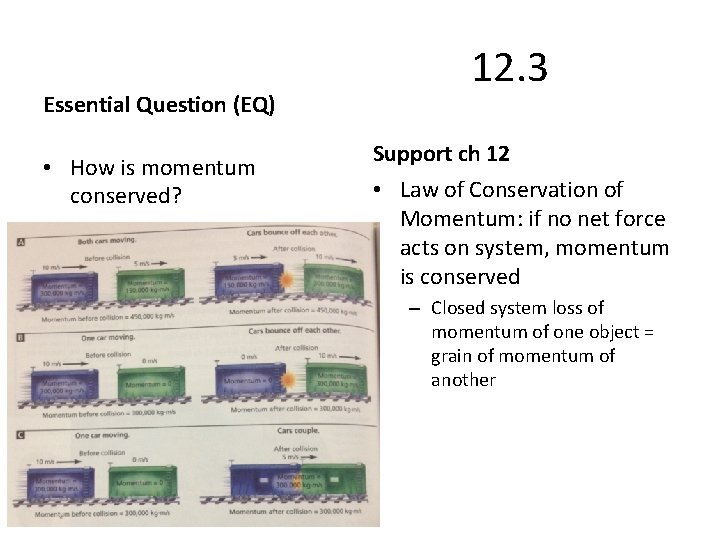
Essential Question (EQ) • How is momentum conserved? 12. 3 Support ch 12 • Law of Conservation of Momentum: if no net force acts on system, momentum is conserved – Closed system loss of momentum of one object = grain of momentum of another
12. 4 Essential Question (EQ) • What force can attract and repel? • What force holds the nucleus together? Support ch 12 • Electronegative Forces – Electric Force: + and -, opposites attract – Magnetic Force: metals, poles of magnets (N and S) • Nuclear Forces – Strong: neurons and p+ – Weak: short range, same particles
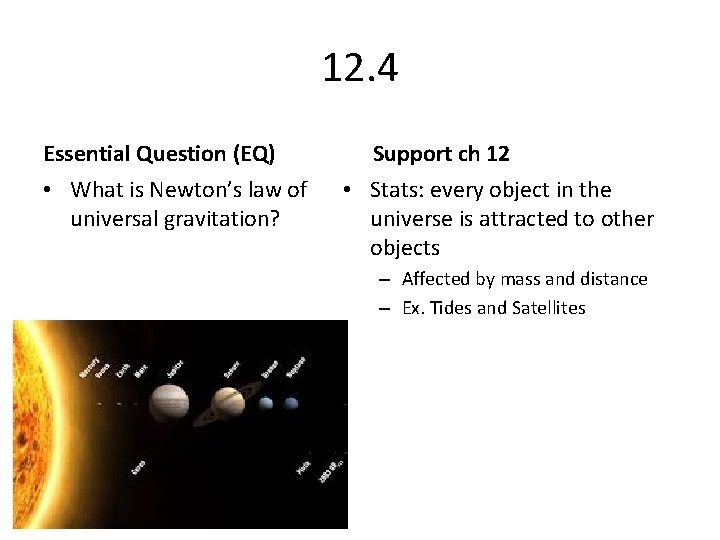
12. 4 Essential Question (EQ) • What is Newton’s law of universal gravitation? Support ch 12 • Stats: every object in the universe is attracted to other objects – Affected by mass and distance – Ex. Tides and Satellites