
Ch 11 Compressibility of soil 11 4 ONEDIMENSIONAL
Ch. 11 Compressibility of soil

11. 4 ONE-DIMENSIONAL LABORATORY CONSOLIDATION TEST

11. 4 ONE-DIMENSIONAL LABORATORY CONSOLIDATION TEST ※The one-dimensional consolidation testing procedure was first suggested by Terzaghi. § consolidometer (sometimes referred to as an oedometer) § The specimens are usually 2½ in. (63. 5 mm) in diameter and 1 in. (25. 4 mm) thick. § Each load is usually kept for 24 hours. § After that, the load is usually doubled. § At the end of the test, the dry weight of the test specimen is determined.
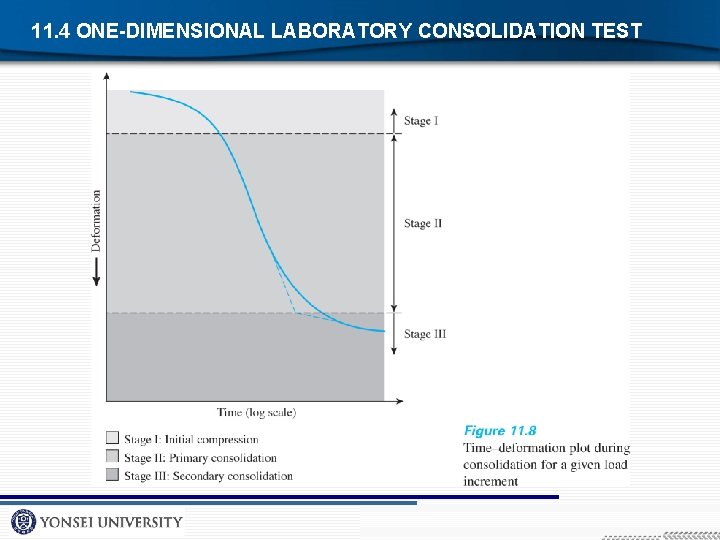
11. 4 ONE-DIMENSIONAL LABORATORY CONSOLIDATION TEST § The general shape of the plot of deformation of the specimen against time : Figure 11. 8 § Three distinct stages Stage Ⅰ: Initial compression, which is mostly caused by preloading. Stage Ⅱ: Primary consolidation, during which excess pore water pressure gradually is transferred into effective stress because of the expulsion of pore water. Stage Ⅲ: Secondary consolidation, which occurs after complete dissipation of the excess pore water pressure, when some deformation of the specimen takes place because of the plastic readjustment of soil fabric.
11. 4 ONE-DIMENSIONAL LABORATORY CONSOLIDATION TEST
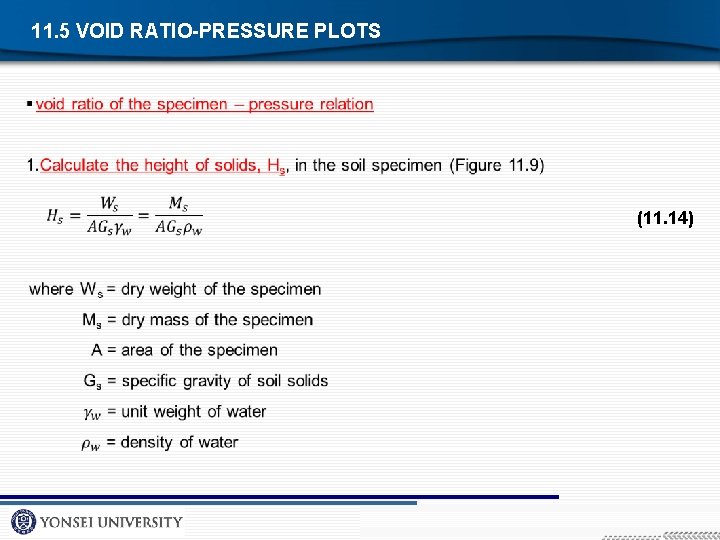
11. 5 VOID RATIO-PRESSURE PLOTS (11. 14)
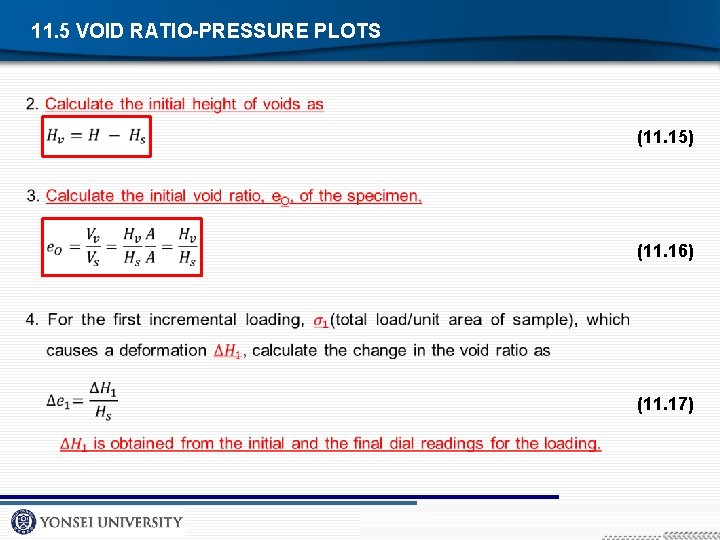
11. 5 VOID RATIO-PRESSURE PLOTS (11. 15) (11. 16) (11. 17)
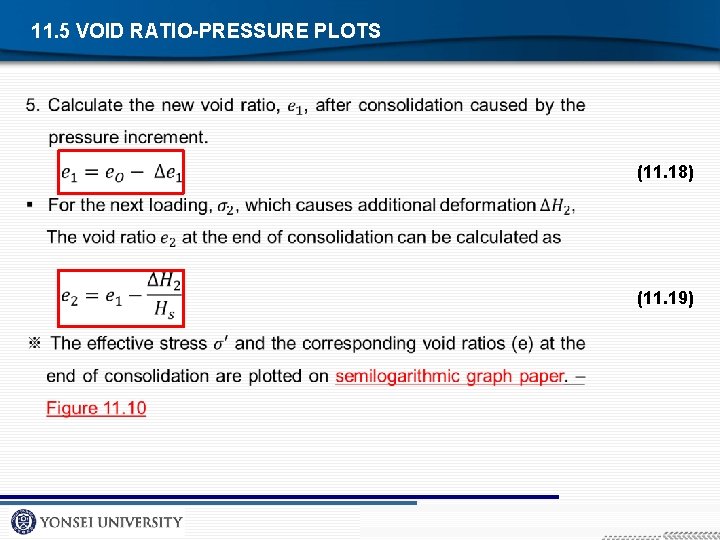
11. 5 VOID RATIO-PRESSURE PLOTS (11. 18) (11. 19)

11. 5 VOID RATIO-PRESSURE PLOTS
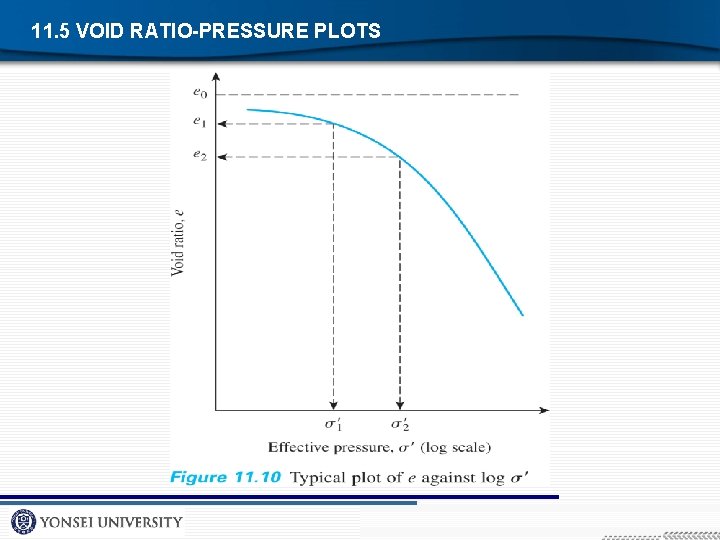
11. 5 VOID RATIO-PRESSURE PLOTS
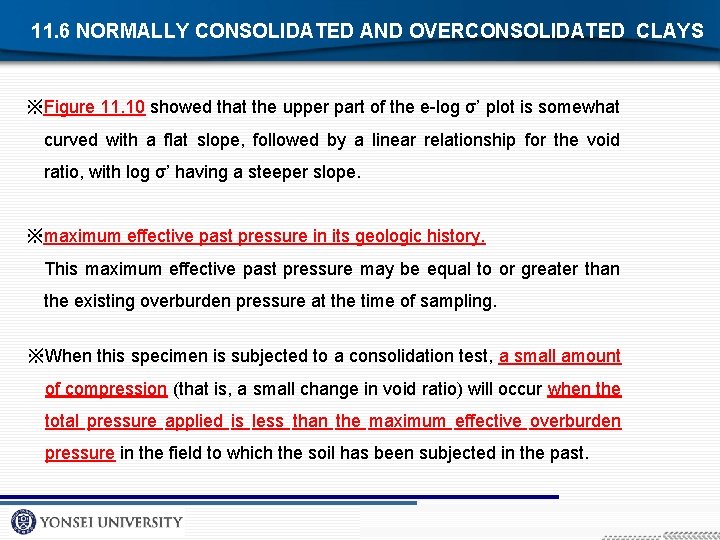
11. 6 NORMALLY CONSOLIDATED AND OVERCONSOLIDATED CLAYS ※Figure 11. 10 showed that the upper part of the e-log σ’ plot is somewhat curved with a flat slope, followed by a linear relationship for the void ratio, with log σ’ having a steeper slope. ※maximum effective past pressure in its geologic history. This maximum effective past pressure may be equal to or greater than the existing overburden pressure at the time of sampling. ※When this specimen is subjected to a consolidation test, a small amount of compression (that is, a small change in void ratio) will occur when the total pressure applied is less than the maximum effective overburden pressure in the field to which the soil has been subjected in the past.

11. 6 NORMALLY CONSOLIDATED AND OVERCONSOLIDATED CLAYS When the total applied pressure on the specimen is greater than the maximum effective past pressure, the change in the void ratio is much larger, and the e – log σ’ relationship is practically linear with a steeper slope. ■ Figure 11. 12 leads us to the two basic definitions of clay based on stress history : 1. Normally consolidated(정규압밀), whose present effective overburden pressure is the maximum pressure that the soil has been subjected to in the past. 2. Overconsolidated(과압밀), whose present effective overburden pressure is less than that which the soil has experienced in the past. The maximum effective past pressure is called the preconsolidation pressure(선행압밀하중).

11. 6 NORMALLY CONSOLIDATED AND OVERCONSOLIDATED CLAYS

11. 6 NORMALLY CONSOLIDATED AND OVERCONSOLIDATED CLAYS ■ Casagrande (1936) method to determine the preconsolidation pressure, 1. By visual observation, establish point a at which the e – log σ’ plot has a minimum radius of curvature. 2. Draw a horizontal line ab. 3. Draw the line ac tangent at a. 4. Draw the line ad, which is the bisector of the angle back. 5. Project the straight-line portion gh of the e – log σ’ plot back to intersect ad at f. The abscissa of point f is the preconsolidation pressure, σ’c.
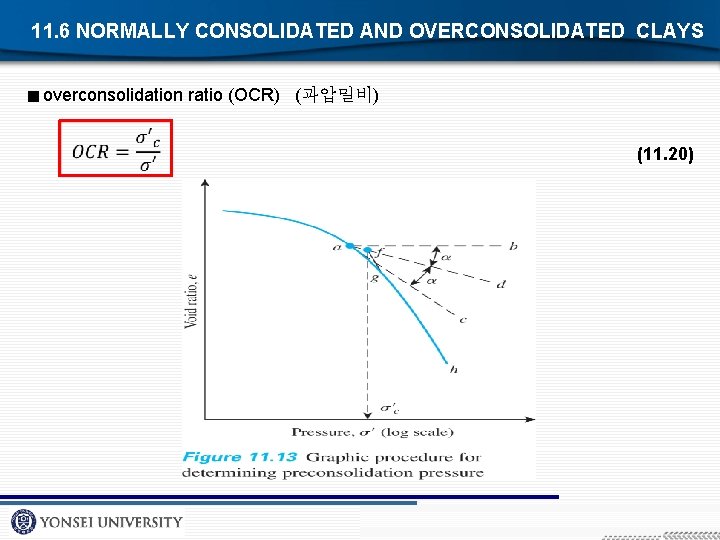
11. 6 NORMALLY CONSOLIDATED AND OVERCONSOLIDATED CLAYS ■ overconsolidation ratio (OCR) (과압밀비) (11. 20)
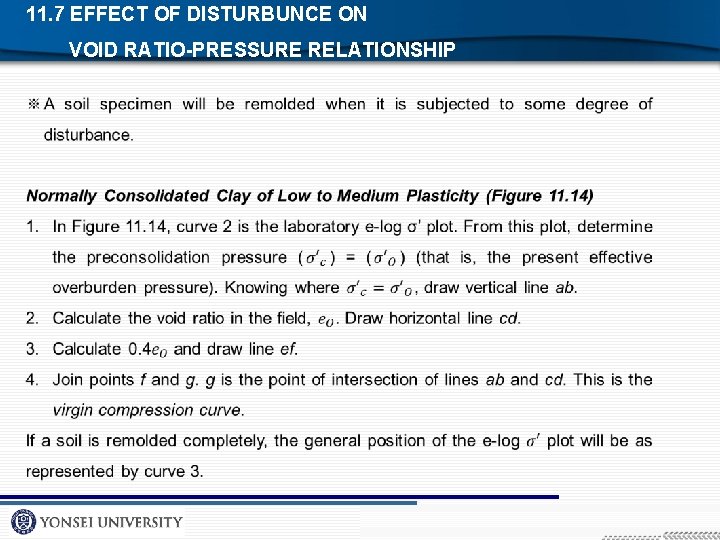
11. 7 EFFECT OF DISTURBUNCE ON VOID RATIO-PRESSURE RELATIONSHIP
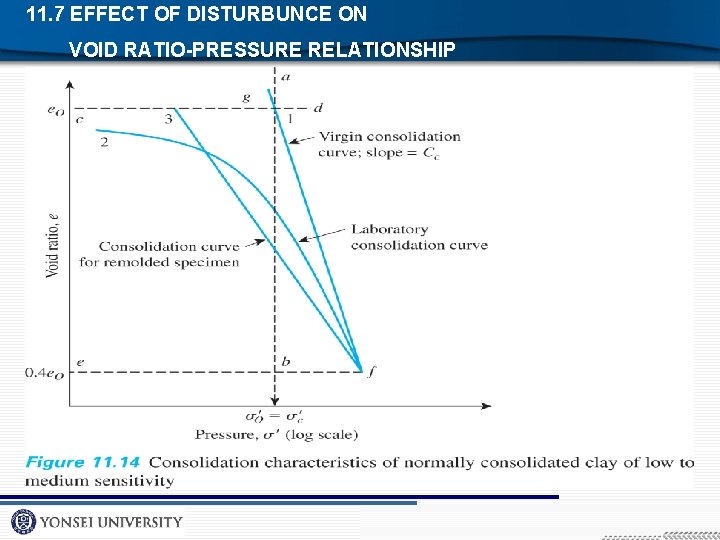
11. 7 EFFECT OF DISTURBUNCE ON VOID RATIO-PRESSURE RELATIONSHIP
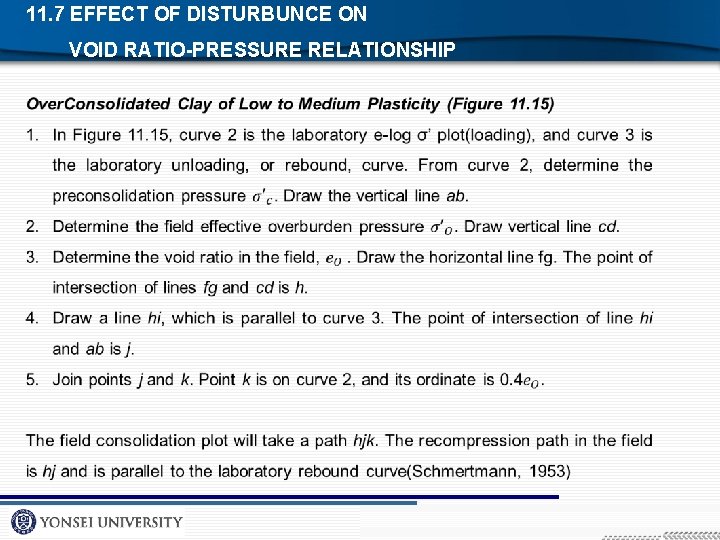
11. 7 EFFECT OF DISTURBUNCE ON VOID RATIO-PRESSURE RELATIONSHIP
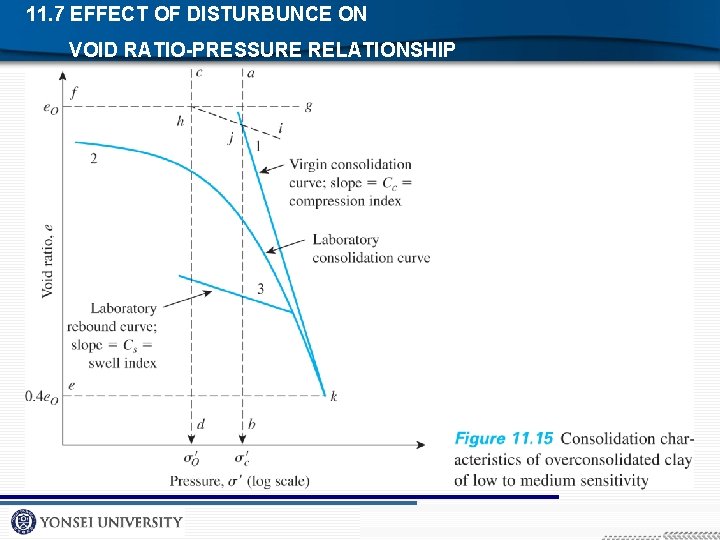
11. 7 EFFECT OF DISTURBUNCE ON VOID RATIO-PRESSURE RELATIONSHIP
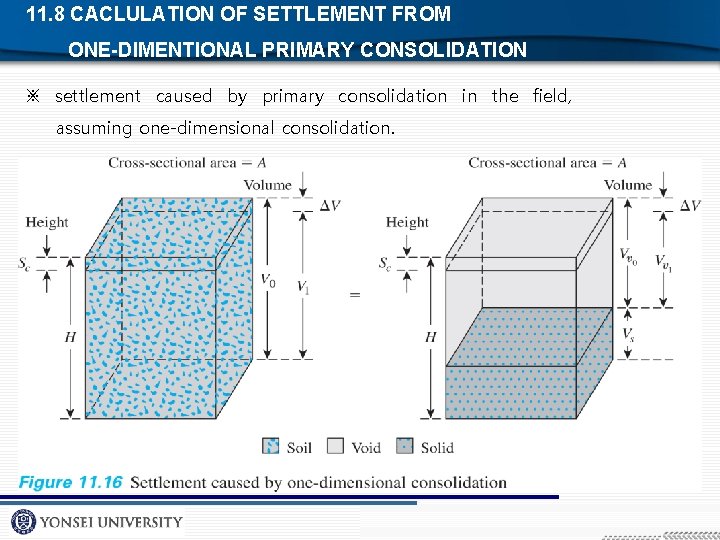
11. 8 CACLULATION OF SETTLEMENT FROM ONE-DIMENTIONAL PRIMARY CONSOLIDATION ※ settlement caused by primary consolidation in the field, assuming one-dimensional consolidation.
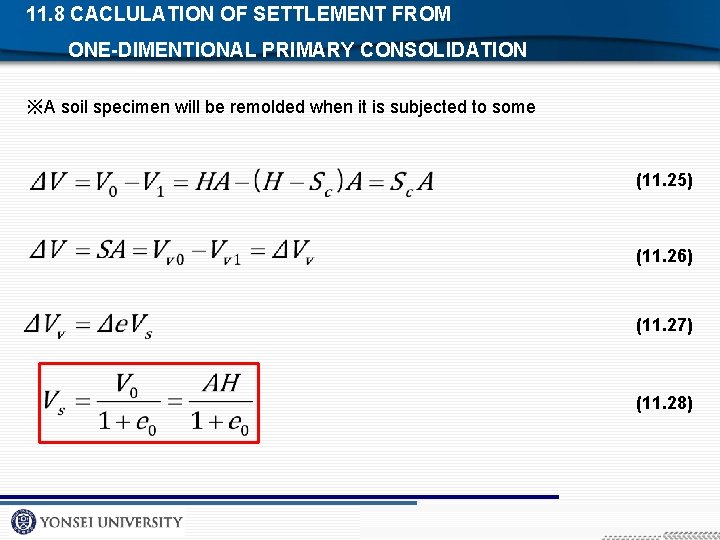
11. 8 CACLULATION OF SETTLEMENT FROM ONE-DIMENTIONAL PRIMARY CONSOLIDATION ※A soil specimen will be remolded when it is subjected to some (11. 25) (11. 26) (11. 27) (11. 28)
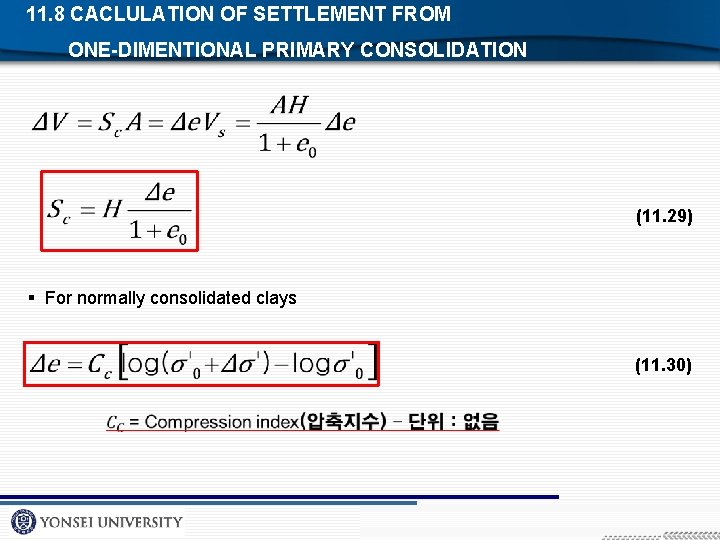
11. 8 CACLULATION OF SETTLEMENT FROM ONE-DIMENTIONAL PRIMARY CONSOLIDATION (11. 29) § For normally consolidated clays (11. 30)
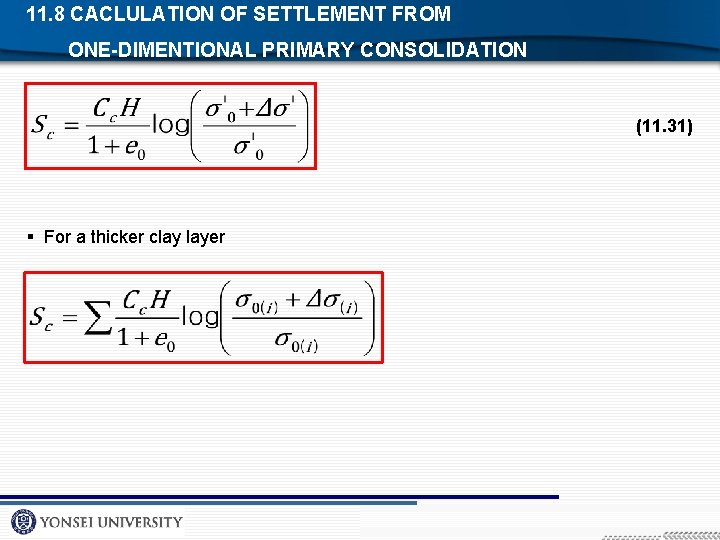
11. 8 CACLULATION OF SETTLEMENT FROM ONE-DIMENTIONAL PRIMARY CONSOLIDATION (11. 31) § For a thicker clay layer
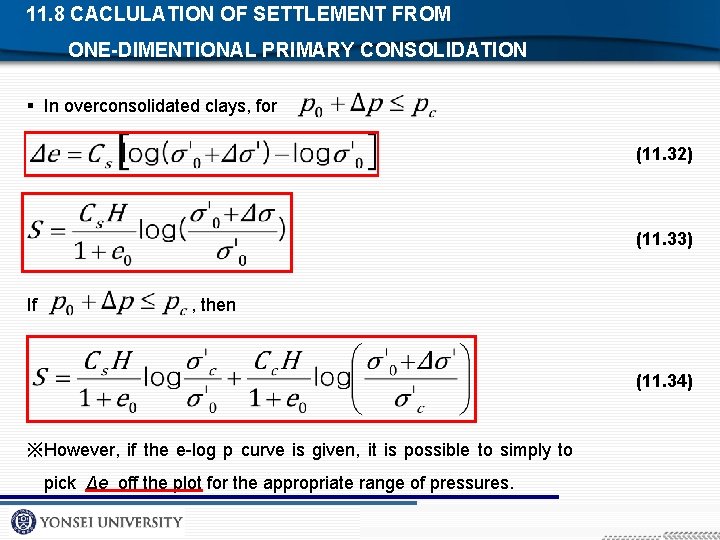
11. 8 CACLULATION OF SETTLEMENT FROM ONE-DIMENTIONAL PRIMARY CONSOLIDATION § In overconsolidated clays, for (11. 32) (11. 33) If , then (11. 34) ※However, if the e-log p curve is given, it is possible to simply to pick Δe off the plot for the appropriate range of pressures.
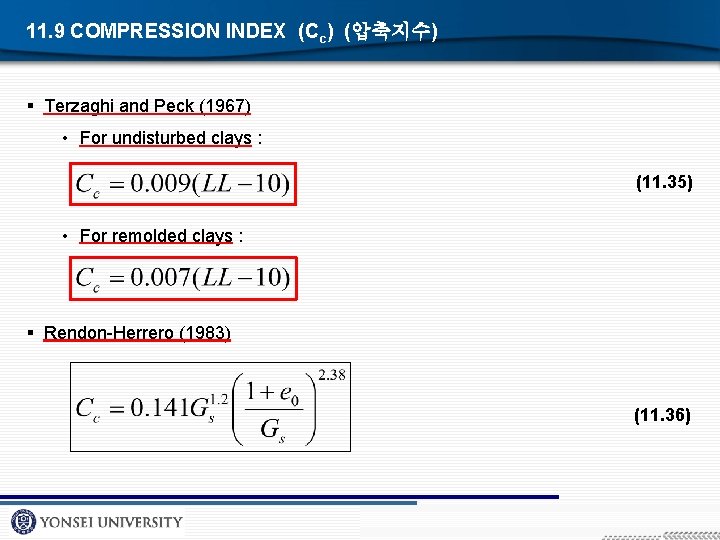
11. 9 COMPRESSION INDEX (Cc) (압축지수) § Terzaghi and Peck (1967) • For undisturbed clays : (11. 35) • For remolded clays : § Rendon-Herrero (1983) (11. 36)
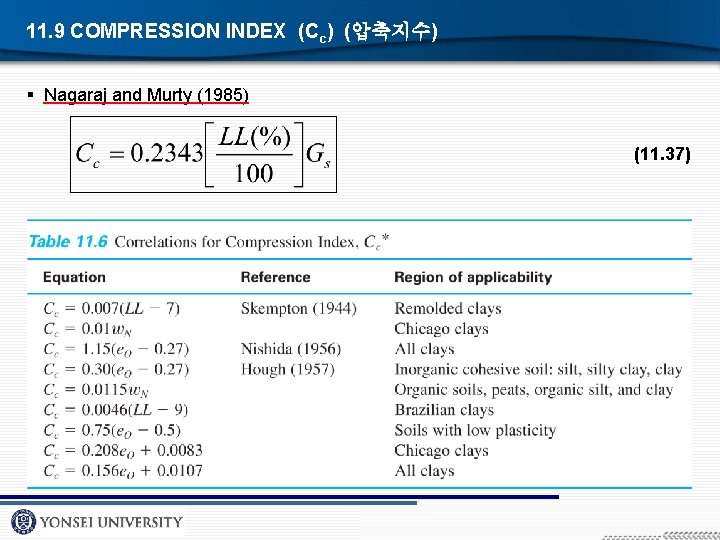
11. 9 COMPRESSION INDEX (Cc) (압축지수) § Nagaraj and Murty (1985) (11. 37)
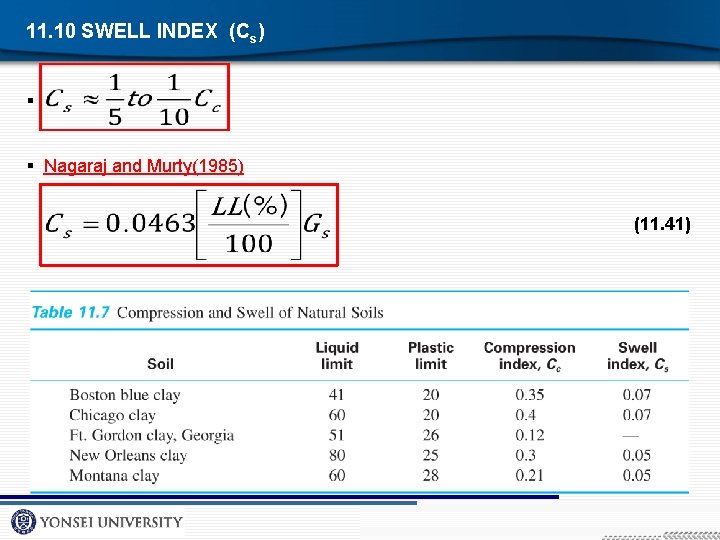
11. 10 SWELL INDEX (Cs) § § Nagaraj and Murty(1985) (11. 41)
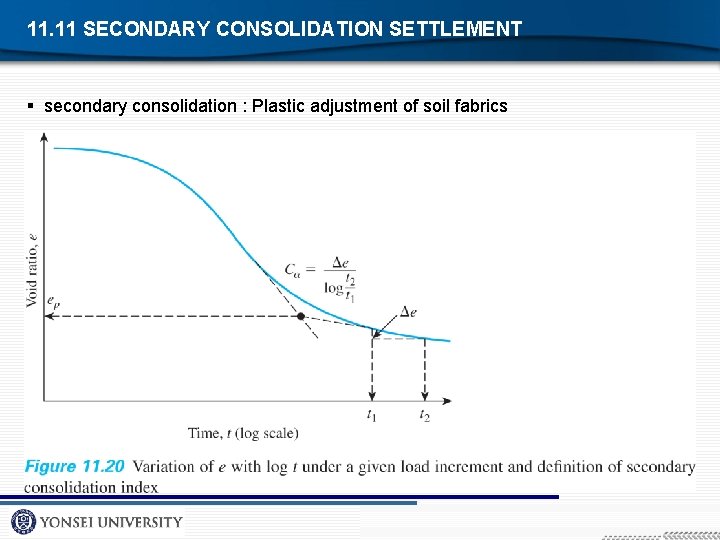
11. 11 SECONDARY CONSOLIDATION SETTLEMENT § secondary consolidation : Plastic adjustment of soil fabrics
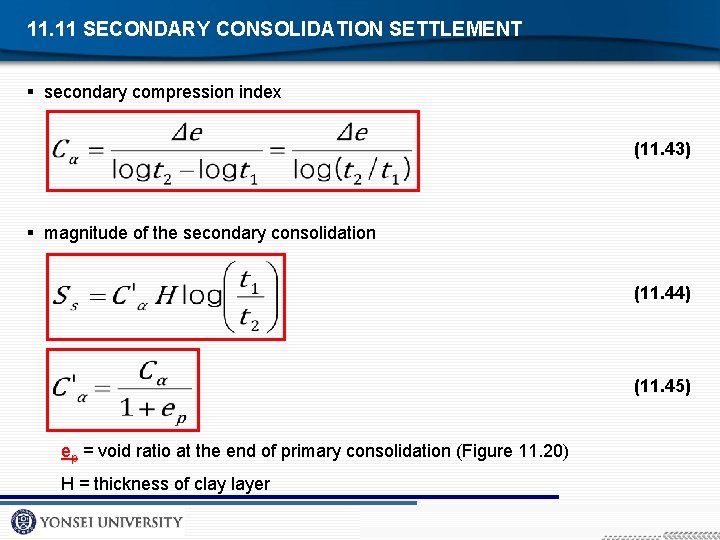
11. 11 SECONDARY CONSOLIDATION SETTLEMENT § secondary compression index (11. 43) § magnitude of the secondary consolidation (11. 44) (11. 45) ep = void ratio at the end of primary consolidation (Figure 11. 20) H = thickness of clay layer
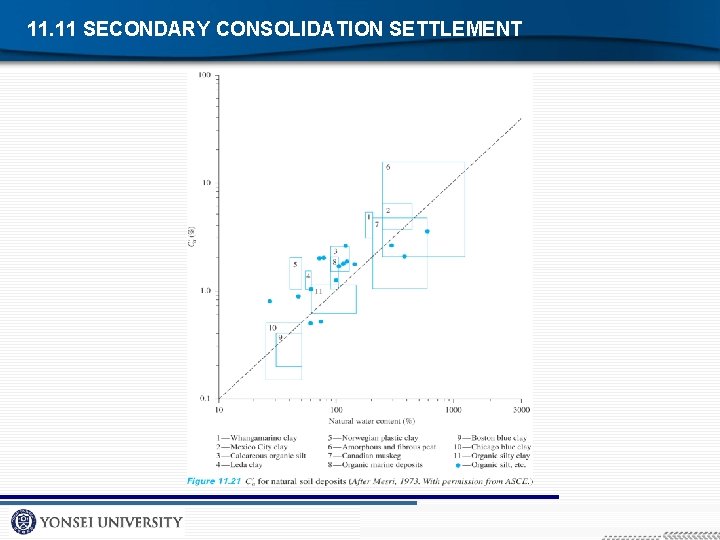
11. 11 SECONDARY CONSOLIDATION SETTLEMENT
11. 11 SECONDARY CONSOLIDATION SETTLEMENT § The general magnitude of C’α as observed in various natural deposits are given in Figure 11. 21. § Secondary consolidation settlement is more important than primary consolidation in organic and highly compressible inorganic soils. In overconsolidated inorganic clays, the secondary compression index is very small and of less practical significance. § The ratio of secondary to primary compression for a given thickness of soil layer is dependent on the ratio of the stress increment(Δp) to the initial effective stress(p). For small Δp/p ratios, the secondary-to-primary compression ratio is larger.
- Slides: 31