
CH 103 SOLUBILITY AND SOLUTIONS In todays experiment
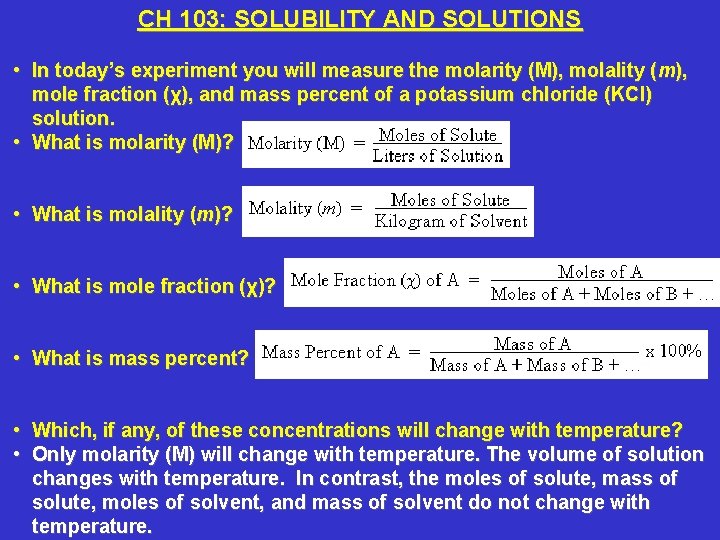
CH 103: SOLUBILITY AND SOLUTIONS • In today’s experiment you will measure the molarity (M), molality ( m), mole fraction (χ), and mass percent of a potassium chloride (KCl) solution. • What is molarity (M)? • What is molality (m)? • What is mole fraction (χ)? • What is mass percent? • Which, if any, of these concentrations will change with temperature? • Only molarity (M) will change with temperature. The volume of solution changes with temperature. In contrast, the moles of solute, mass of solute, moles of solvent, and mass of solvent do not change with temperature.
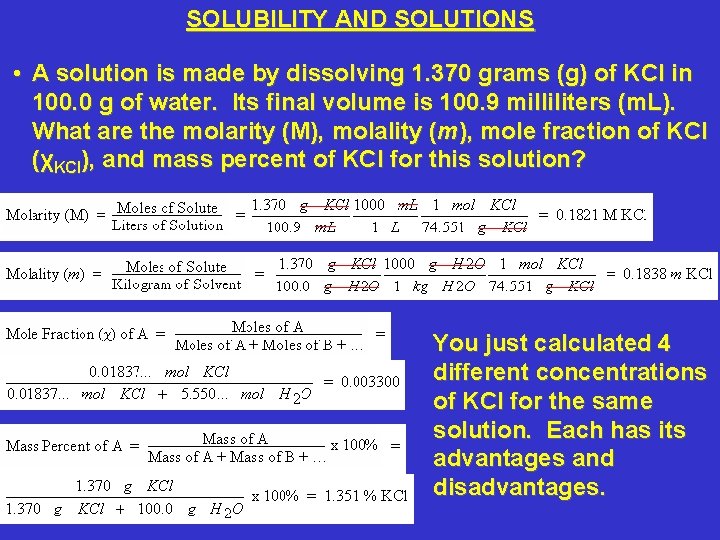
SOLUBILITY AND SOLUTIONS • A solution is made by dissolving 1. 370 grams (g) of KCl in 100. 0 g of water. Its final volume is 100. 9 milliliters (m. L). What are the molarity (M), molality (m), mole fraction of KCl (χKCl), and mass percent of KCl for this solution? You just calculated 4 different concentrations of KCl for the same solution. Each has its advantages and disadvantages.

SOLUBILITY AND SOLUTIONS • The terms insoluble, slightly soluble, and very soluble describe the relative solubility of a substance in a solvent. • In today’s experiment you will use these terms to compare the solubilities of sodium carbonate (Na 2 CO 3), naphthalene (C 10 H 8), and calcium carbonate (Ca. CO 3) in 2 different solvents. • The first solvent is water (H 2 O) and the second solvent is cyclohexane (C 6 H 12). Water is relatively polar and C 6 H 12 is relatively nonpolar. • “Like dissolves like. ” That is, polar solvents tend to dissolve polar solutes. And nonpolar solvents tend to dissolve nonpolar solutes.
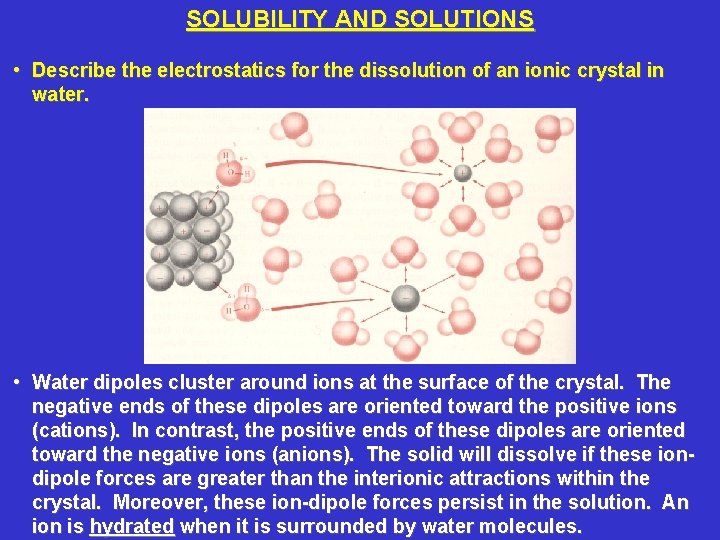
SOLUBILITY AND SOLUTIONS • Describe the electrostatics for the dissolution of an ionic crystal in water. • Water dipoles cluster around ions at the surface of the crystal. The negative ends of these dipoles are oriented toward the positive ions (cations). In contrast, the positive ends of these dipoles are oriented toward the negative ions (anions). The solid will dissolve if these iondipole forces are greater than the interionic attractions within the crystal. Moreover, these ion-dipole forces persist in the solution. An ion is hydrated when it is surrounded by water molecules.
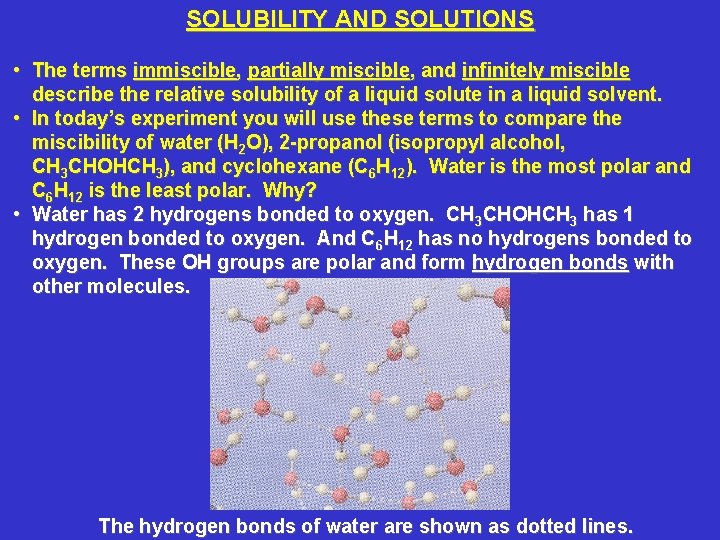
SOLUBILITY AND SOLUTIONS • The terms immiscible, partially miscible, and infinitely miscible describe the relative solubility of a liquid solute in a liquid solvent. • In today’s experiment you will use these terms to compare the miscibility of water (H 2 O), 2 -propanol (isopropyl alcohol, CH 3 CHOHCH 3), and cyclohexane (C 6 H 12). Water is the most polar and C 6 H 12 is the least polar. Why? • Water has 2 hydrogens bonded to oxygen. CH 3 CHOHCH 3 has 1 hydrogen bonded to oxygen. And C 6 H 12 has no hydrogens bonded to oxygen. These OH groups are polar and form hydrogen bonds with other molecules. The hydrogen bonds of water are shown as dotted lines.
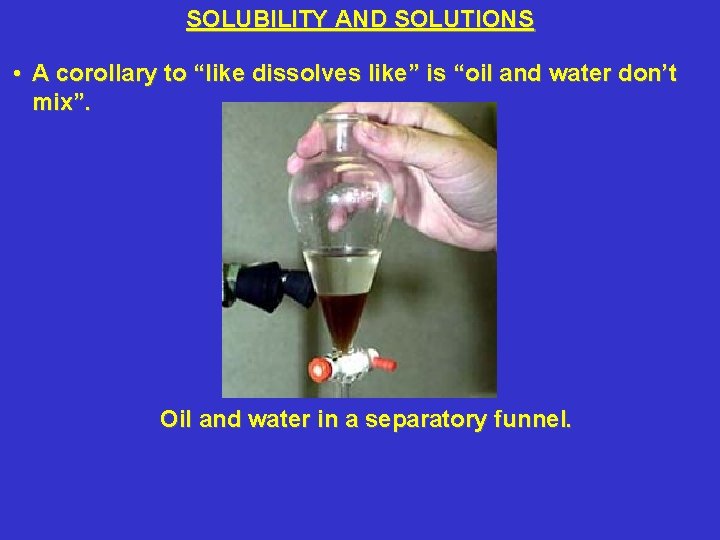
SOLUBILITY AND SOLUTIONS • A corollary to “like dissolves like” is “oil and water don’t mix”. Oil and water in a separatory funnel.
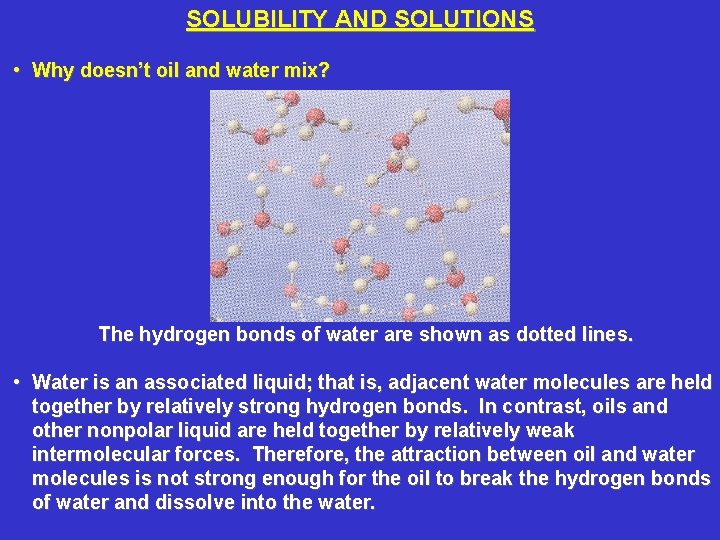
SOLUBILITY AND SOLUTIONS • Why doesn’t oil and water mix? The hydrogen bonds of water are shown as dotted lines. • Water is an associated liquid; that is, adjacent water molecules are held together by relatively strong hydrogen bonds. In contrast, oils and other nonpolar liquid are held together by relatively weak intermolecular forces. Therefore, the attraction between oil and water molecules is not strong enough for the oil to break the hydrogen bonds of water and dissolve into the water.
SAFETY • Do NOT use cyclohexane (C 6 H 12) or 2 -propanol (CH 3 CHOHCH 3) until all the Bunsen burners in the laboratory are extinguished. Treat these compounds as if they were gasoline. They are extremely flammable. • Wear your goggles at all times. • Your laboratory manual has an extensive list of safety procedures. Read and understand this section. • Ask your instructor if you ever have any questions about safety.
SOURCES • Mc. Murry, J. , R. C. Fay. 2004. Chemistry, 4 th ed. Upper Saddle River, NJ: Prentice Hall. • Petrucci, R. H. 1985. General Chemistry Principles and Modern Applications, 4 th ed. New York, NY: Macmillan Publishing Company. • Wright, A. E. 2006. NOAA Ocean Explorer. Available: http: //www. oceanexplorer. noaa. gov/explorations/02 sab/bac kground/products. html [accessed 13 December 2006].
- Slides: 9