
Ch 10 Social Stratification WHAT IS SOCIAL STRATIFICATION
- Slides: 22
Ch. 10 Social Stratification
WHAT IS SOCIAL STRATIFICATION? o The hierarchical arrangement of large social groups based on their control over basic resources and their access to opportunities or life chances. o A system by which a society ranks categories of people in a hierarchy.
Basic Principles 1. Stratification is a trait of society 2. It carries over from generation to generation 3. It is universal, but variable 4. The explanation of why people should be unequal differs from society to society
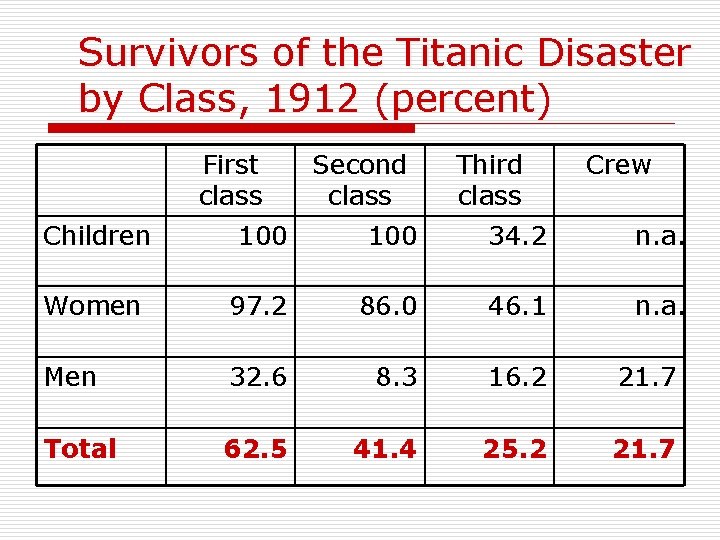
Survivors of the Titanic Disaster by Class, 1912 (percent) First class Second class Third class Crew Children 100 34. 2 n. a. Women 97. 2 86. 0 46. 1 n. a. Men 32. 6 8. 3 16. 2 21. 7 Total 62. 5 41. 4 25. 2 21. 7
SYSTEMS OF STRATIFICATION o Systems of stratification may be open or closed based on the degree of social mobility o Intergenerational mobility is the social movement experienced by family members from one generation to the next. o Intragenerational mobility is the social movement of individuals within their own lifetime
The caste system o System of social inequality in which people’s status is permanently determined at birth based on their parents’ ascribed characteristics o A closed system. o Caste systems grow weaker as societies industrialize.
The class system o A type of stratification based on the ownership and control of resources and on the type of work people do o In theory, is more open o Status comes at least partly through achievement rather than entirely by ascription. o Social Mobility n horizontal mobility vs vertical mobility n Ideal of meritocracy
Classical Perspectives on Class Cultural beliefs justify particular social arrangements, including inequality n e. g. , the rich are smart and the poor are lazy o Plato: every culture considers some type of inequality to be fair o Karl Marx: ideas as well as resources are controlled by a society’s elite o Herbert Spencer: applied Darwin to society, the “fittest” people rise to wealth and power and “failures” sink to poverty
Marx’s Ideas on Stratification o The ability of capitalists to hire and fire wage workers at first encouraged rapid technological change and economic growth. o The drive for profits also caused capitalists to concentrate many workers, keep wages low, and spend little on improving working conditions. o The result: class polarization, the growth of class consciousness and working-class organizations, and a growing demand on the part of workers to end capitalist exploitation. o Because capitalism could produce more than workers could consume, ever-worsening crises of overproduction would result in the fall of capitalism.
But…. o Industrial societies did not polarize into two opposed classes engaged in bitter conflict. o Capitalism persisted by stimulating demand. o Investment in technology made it possible for workers to earn higher wages and work fewer hours in better conditions. o Workers fought for, and won, state benefits. o Communism took root in semi-industrialized countries and witnessed the emergence of totalitarianism and new forms of privilege
Max Weber: Wealth, Prestige, and Power o The interplay among wealth, prestige, and power as being necessary in determining a person’s class position o Prestige is the respect or regard with which a person or status position is regarded by others o Power—the ability of people or groups to achieve their goals despite opposition from others
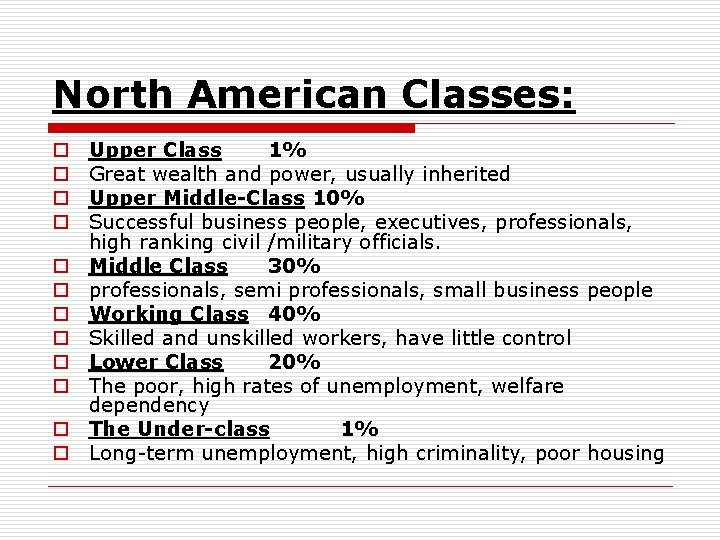
North American Classes: o o o Upper Class 1% Great wealth and power, usually inherited Upper Middle-Class 10% Successful business people, executives, professionals, high ranking civil /military officials. Middle Class 30% professionals, semi professionals, small business people Working Class 40% Skilled and unskilled workers, have little control Lower Class 20% The poor, high rates of unemployment, welfare dependency The Under-class 1% Long-term unemployment, high criminality, poor housing
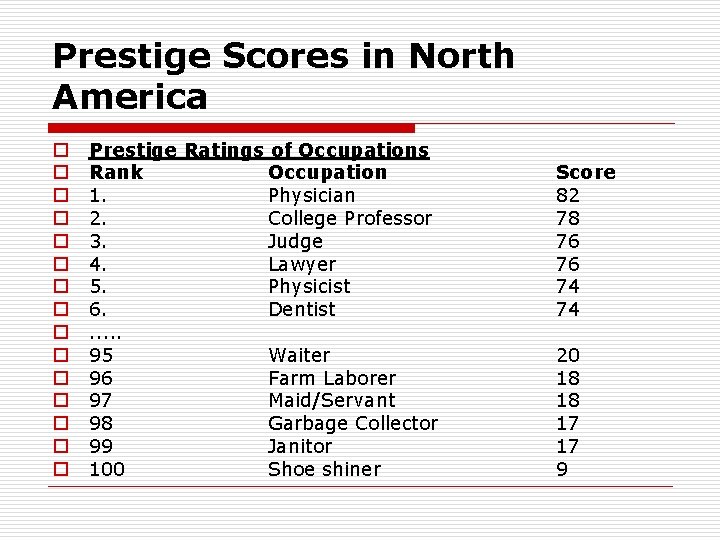
Prestige Scores in North America o o o o Prestige Ratings of Occupations Rank Occupation 1. Physician 2. College Professor 3. Judge 4. Lawyer 5. Physicist 6. Dentist. . . 95 Waiter 96 Farm Laborer 97 Maid/Servant 98 Garbage Collector 99 Janitor 100 Shoe shiner Score 82 78 76 76 74 74 20 18 18 17 17 9
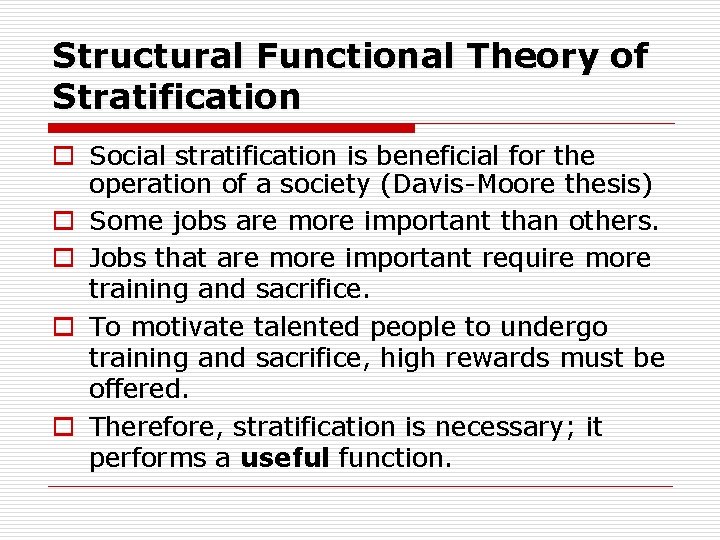
Structural Functional Theory of Stratification o Social stratification is beneficial for the operation of a society (Davis-Moore thesis) o Some jobs are more important than others. o Jobs that are more important require more training and sacrifice. o To motivate talented people to undergo training and sacrifice, high rewards must be offered. o Therefore, stratification is necessary; it performs a useful function.
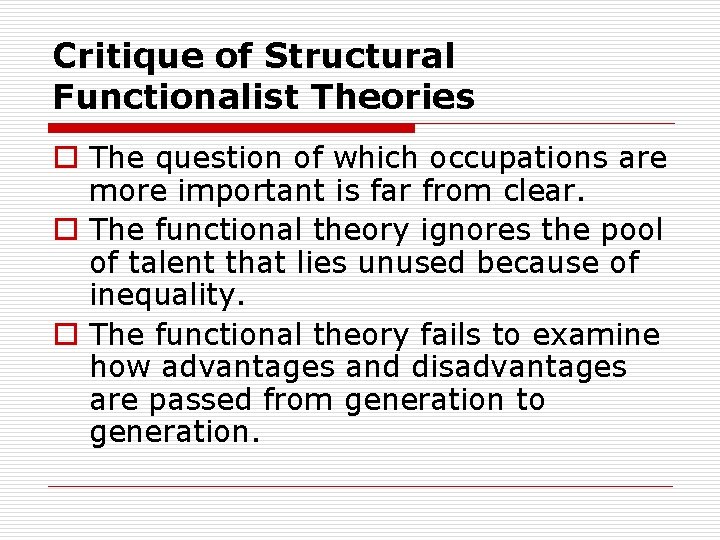
Critique of Structural Functionalist Theories o The question of which occupations are more important is far from clear. o The functional theory ignores the pool of talent that lies unused because of inequality. o The functional theory fails to examine how advantages and disadvantages are passed from generation to generation.
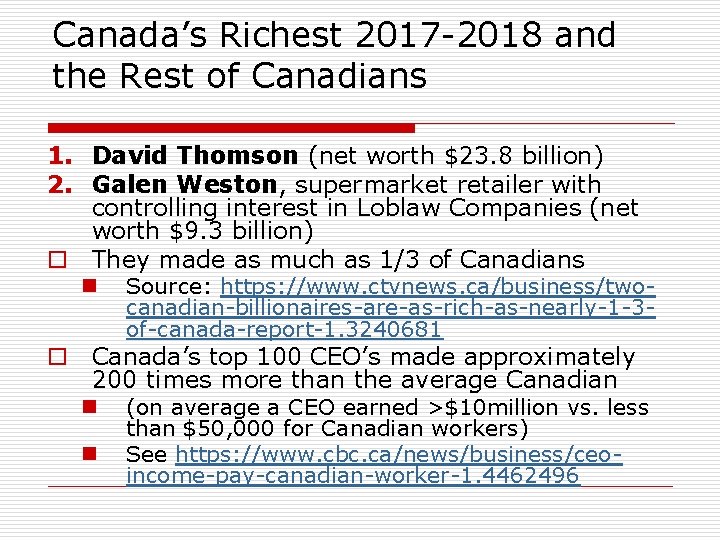
Canada’s Richest 2017 -2018 and the Rest of Canadians 1. David Thomson (net worth $23. 8 billion) 2. Galen Weston, supermarket retailer with controlling interest in Loblaw Companies (net worth $9. 3 billion) o They made as much as 1/3 of Canadians n Source: https: //www. ctvnews. ca/business/twocanadian-billionaires-are-as-rich-as-nearly-1 -3 of-canada-report-1. 3240681 o Canada’s top 100 CEO’s made approximately 200 times more than the average Canadian n n (on average a CEO earned >$10 million vs. less than $50, 000 for Canadian workers) See https: //www. cbc. ca/news/business/ceoincome-pay-canadian-worker-1. 4462496
You can also read… o 'The super-rich and the rest of us' (CBCNews, 2017) o Two Canadian billionaires are as rich as nearly 1/3 of Canada: report (CTV News, 2017) n (Note that globally, the world’s 8 richest have as much wealth as 50% of the world!)
Stratification and Interactionist Theories o People socialize primarily with people of the same social standing o People with different social standing keep their distance from one another o The way we dress, the car we drive, etc. , say something about our budgets o Conspicuous consumption: using products because of the “statements” they make about one’s social position
Note that: o There is nothing inevitable about the level of social stratification. We are neither headed inexorably toward classlessness nor are we bound to endure high levels of inequality. o As Weber believed, social stratification depends on the complex interplay of class, status, and party and their effect on social mobility. o For example, in a democracy, citizens decide which party is in office, and the political party in office enacts policies that have implications for social mobility; we decide how much inequality there should be.
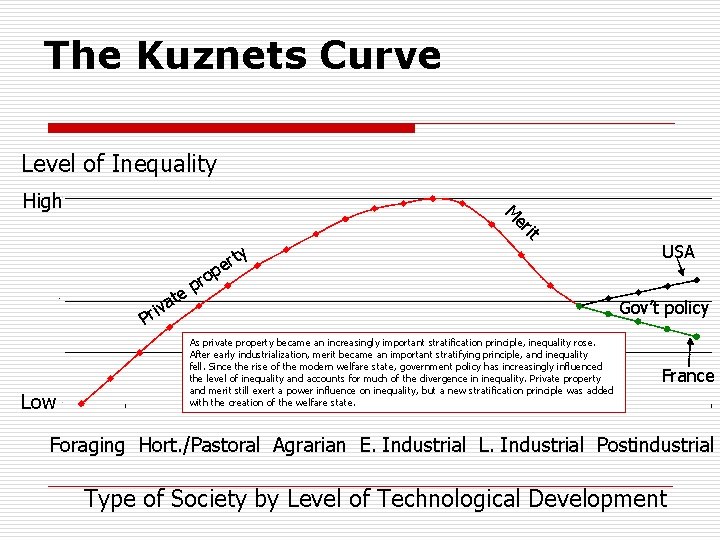
Stratification Over Time…. o Hunters and gatherer societies: little inequality o Horticultural, pastoral, and agrarian societies: more inequality as surplus begins leading to striking inequality o Industrial societies: standard of living of poor majority is raised through increasing education for specialized labour and a lessening of men’s domination over women
The Kuznets Curve Level of Inequality High it er M y t r pe ro p e t ir va P Low As private property became an increasingly important stratification principle, inequality rose. After early industrialization, merit became an important stratifying principle, and inequality fell. Since the rise of the modern welfare state, government policy has increasingly influenced the level of inequality and accounts for much of the divergence in inequality. Private property and merit still exert a power influence on inequality, but a new stratification principle was added with the creation of the welfare state. USA Gov’t policy France Foraging Hort. /Pastoral Agrarian E. Industrial L. Industrial Postindustrial Type of Society by Level of Technological Development
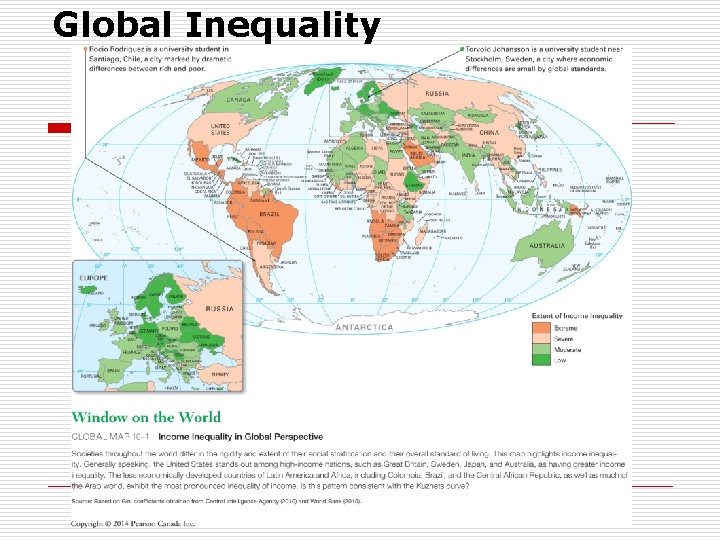
Global Inequality