
Ch 10 Social and Personality Development in Middle

- Slides: 58
Ch. 10 Social and Personality Development in Middle Childhood Group 6 Developing Self Psychosocial Development – Erikson Understanding of oneself Social comparison Self concept
Group 7 How does self-esteem affect behavior? 335 -337 What sorts of relationships and friendships are typical of middle childhood? 343 -345
How do sex and ethnicity affect friendships? 348 -349 How do today’s diverse family and care arrangements affect children? 352
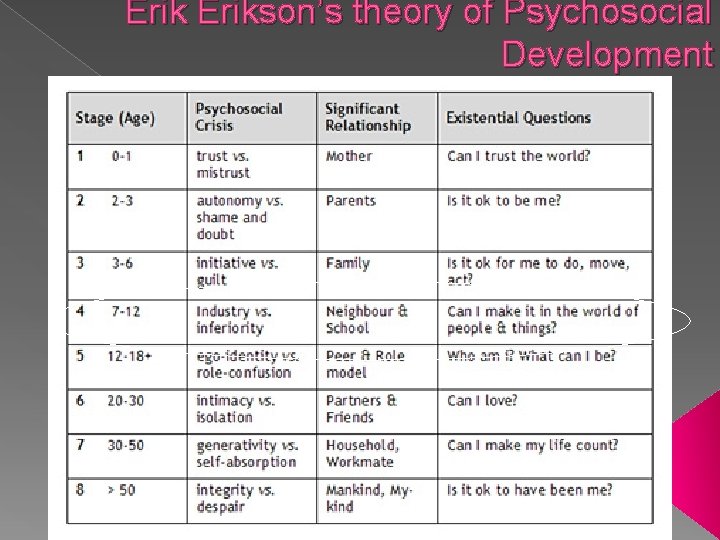
Erikson’s theory of Psychosocial Development
Psychosocial Development in Middle Childhood Industry vs. Inferiority stage – period from ages 6 to 12 characterized by a focus on efforts to attain competence in meeting the challenges presented by parents, peers, school, and the complexities of the world. i. e. Competence
Their energies are not only to mastering what they are presented in school but also to making a place for themselves in their social worlds. Success in this stage brings with it feelings of mastery and proficiency and a growing sense of competence. e. g experience. Difficulties lead to feelings of failure and inadequacy.
According to a research, the men who are most industrious and hard working in early childhood were most successful as adults, both in occupational attainment and in their personal lives. Childhood industrious was more closely associated with adult success than was intelligence or family background
Understanding the Self: A new Response to “WHO AM I”? As children become older, they view themselves in terms of psychological attributes in addition to their physical attributes. e. g a 6 -year- old would describe herself as a fast runner and good at drawing A 11 - year old would describe herself as pretty smart, friendly, helpful…. Children’s self-concept becomes divided into personal and academic spheres.
Due to the development in the cognitive skills, the child is able to use more inner traits to determine self-concept. They view themselves as more complex. As they grow older, she will find out that she can be good at something and weak at others.
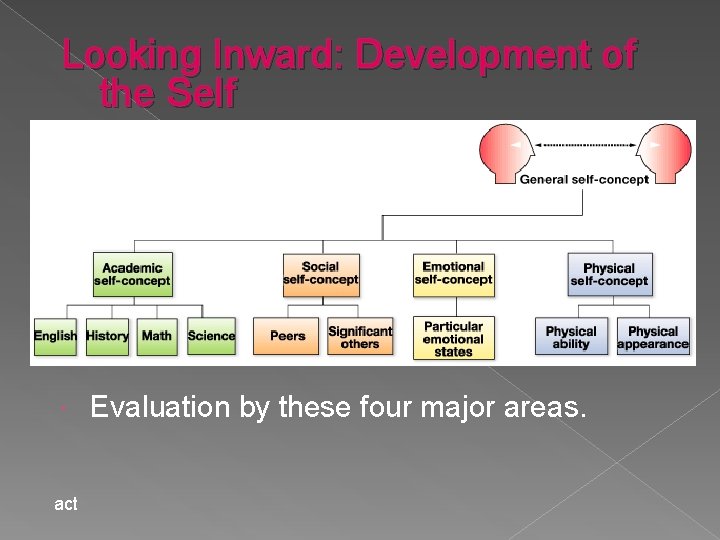
Looking Inward: Development of the Self act Evaluation by these four major areas.
Social comparison – evaluation of one’s own behavior, abilities, expertise, and opinions by comparing them to those of others. A desire to evaluate one’s own behavior, abilities, expertise and opinions by comparing them to those of others. E. g Math skills.
downward social comparisons It is when children compare themselves to less competent and less successful children. it protects their self-image by preserving an image of themselves as successful. This helps explain why some students in low achievement level schools have stronger academic self-esteem than in very capable students in high achievement schools. It’s better to be a big fish in a small pond
Self-Esteem – an individual’s overall and specific positive and negative self-evaluation. ( not self-concept; esteem is more emotional oriented) How is self-esteem developed? Increasing comparing themselves with others. Then they assess how well they measure up to society’s standards. Increasing developing their own standards of success. See how well they are compare to others
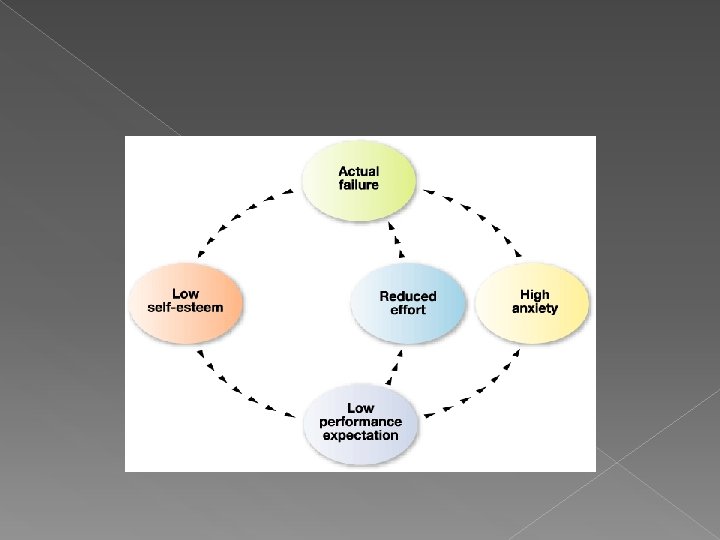
Change and stability in Self-esteem In middle childhood, self-concept becomes more differentiated from self-esteem. Self-esteem tends to increase during middle childhood with a slight downward trend around age 12 due in part to the transition to middle school. If self-esteem is low in middle childhood, the result can be a cycle of failure. The kid would expect himself to do poorly in school. He will become anxious that he is unable to concentrate well and study effectively.
Self Esteem Parenting style can help break the cycle of a negative self-esteem; authoritative parenting is associate with promotion in self-esteem. Characteristics: firm, setting clear and consistent limits. Although relatively strict, loving and emotionally supportive and encourage their children to be independent.
Topics Group 8 Kohlberg’s Sequence of Moral Reasoning 339 Gilligan’s 3 stages of Moral Development for women
Morality involves issues of right and wrong Moral rules refer to broad issues of fairness and justice Social conventions are rules used by society to maintain order
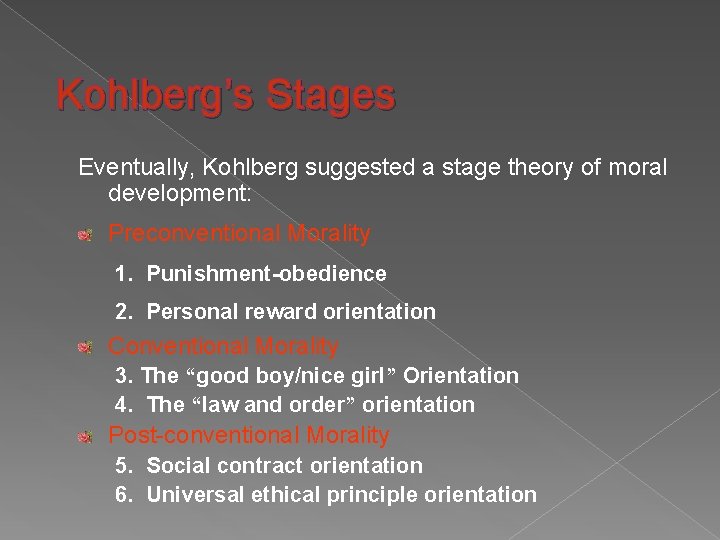
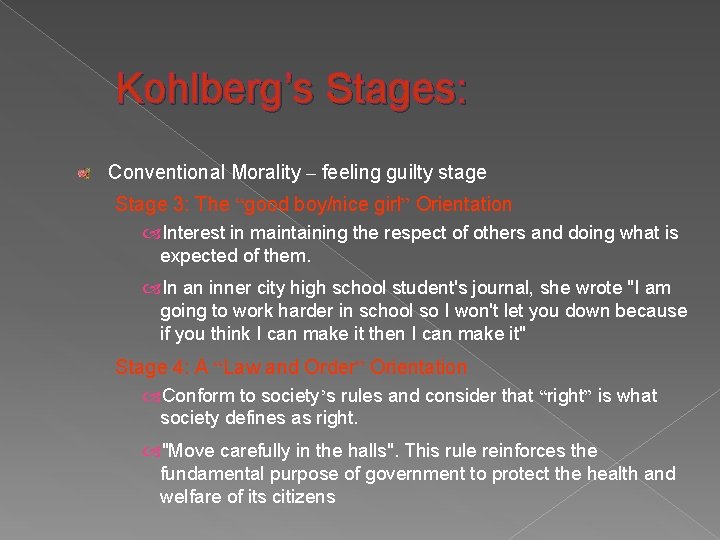
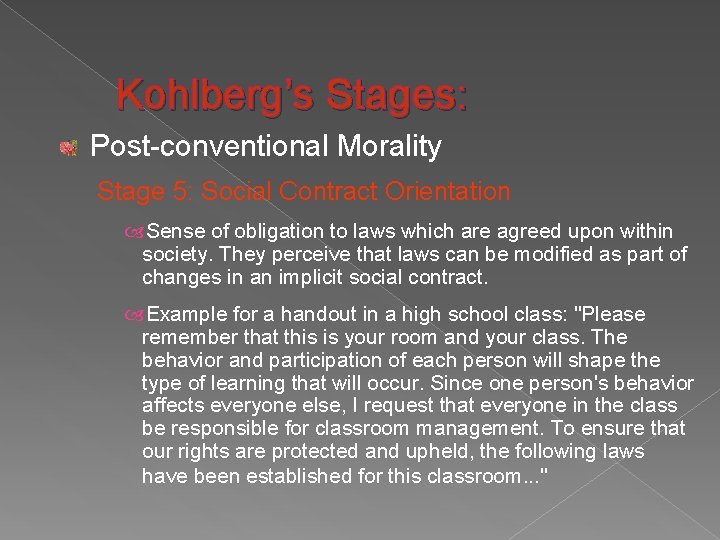
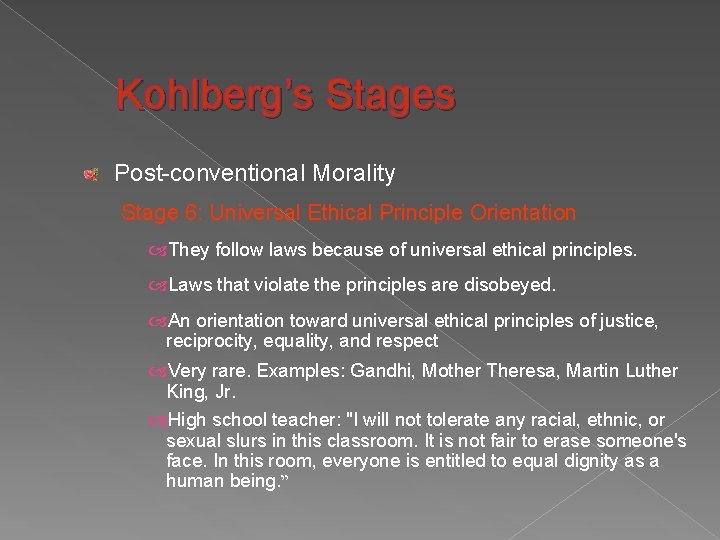
Kohlberg’s Stages Eventually, Kohlberg suggested a stage theory of moral development: Preconventional Morality 1. Punishment-obedience 2. Personal reward orientation Conventional Morality 3. The “good boy/nice girl” Orientation 4. The “law and order” orientation Post-conventional Morality 5. Social contract orientation 6. Universal ethical principle orientation
Kohlberg’s Stages: Preconventional Morality Stage 1: Punishment-Obedience Orientation Avoid (physical) punishment High school example: One middle school teacher has latecomers do pushups--50 of them--in front of the class. Stage 2: Personal Reward Orientation Obedience occurs because of rewards that are received. “You scratch my back, I’ll scratch yours” High school example: A group of high school students involved in a cooperative learning activity get upset because one of their group members is repeatedly absent and did not do any work.
Kohlberg’s Stages: Conventional Morality – feeling guilty stage Stage 3: The “good boy/nice girl” Orientation Interest in maintaining the respect of others and doing what is expected of them. In an inner city high school student's journal, she wrote "I am going to work harder in school so I won't let you down because if you think I can make it then I can make it" Stage 4: A “Law and Order” Orientation Conform to society’s rules and consider that “right” is what society defines as right. "Move carefully in the halls". This rule reinforces the fundamental purpose of government to protect the health and welfare of its citizens
Kohlberg’s Stages: Post-conventional Morality Stage 5: Social Contract Orientation Sense of obligation to laws which are agreed upon within society. They perceive that laws can be modified as part of changes in an implicit social contract. Example for a handout in a high school class: "Please remember that this is your room and your class. The behavior and participation of each person will shape the type of learning that will occur. Since one person's behavior affects everyone else, I request that everyone in the class be responsible for classroom management. To ensure that our rights are protected and upheld, the following laws have been established for this classroom. . . "
Kohlberg’s Stages Post-conventional Morality Stage 6: Universal Ethical Principle Orientation They follow laws because of universal ethical principles. Laws that violate the principles are disobeyed. An orientation toward universal ethical principles of justice, reciprocity, equality, and respect Very rare. Examples: Gandhi, Mother Theresa, Martin Luther King, Jr. High school teacher: "I will not tolerate any racial, ethnic, or sexual slurs in this classroom. It is not fair to erase someone's face. In this room, everyone is entitled to equal dignity as a human being. ”
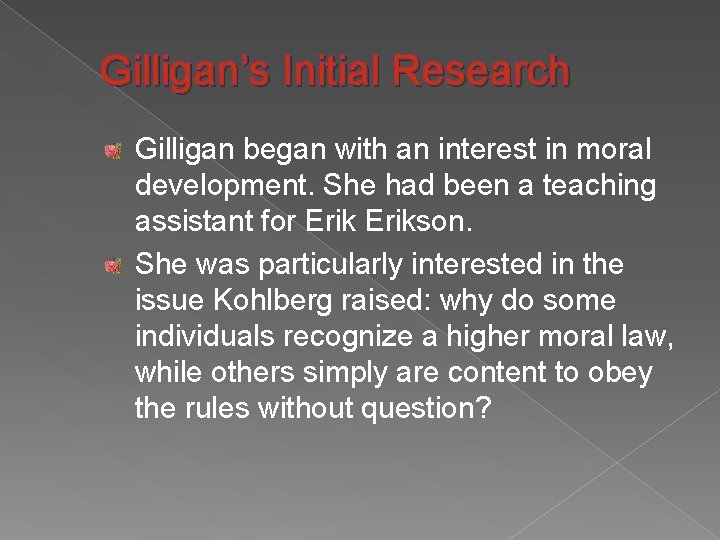
Gilligan’s Initial Research Gilligan began with an interest in moral development. She had been a teaching assistant for Erikson. She was particularly interested in the issue Kohlberg raised: why do some individuals recognize a higher moral law, while others simply are content to obey the rules without question?
Gilligan’s Critique In light of the differences between the scores of males and females on the Kohlberg scale, one could draw either of two conclusions: › females are less morally developed than males, or › something is wrong with Kohlberg’s framework.
Gillian’s Three Stages of Moral Development for women Stage 1 Orientation toward individual survival › Initial concentration is on what is practical and best for self. Gradual transition from selfishness to responsibility, which includes thinking about what would be best for others. › E. g. A 1 st grader may insist on playing only games of her own choice.
Stage 2. Goodness as self-sacrifice › Initial view is that a woman must sacrifice her own wishes to what other people want. Gradual transition from “goodness” to “truth”, which takes into account needs of both self and others. E. g. the same girl may believed that to be a good friend, she must play the games her friend chooses, even if she herself doesn’t like them.
Stage 3. Morality of nonviolence › A moral equivalence is established between self and others. Hurting anyone-including one’s self is seen as immoral › E. g the same girl may realized that both friends must enjoy their time together and look for activities that both she and her friend can enjoy.
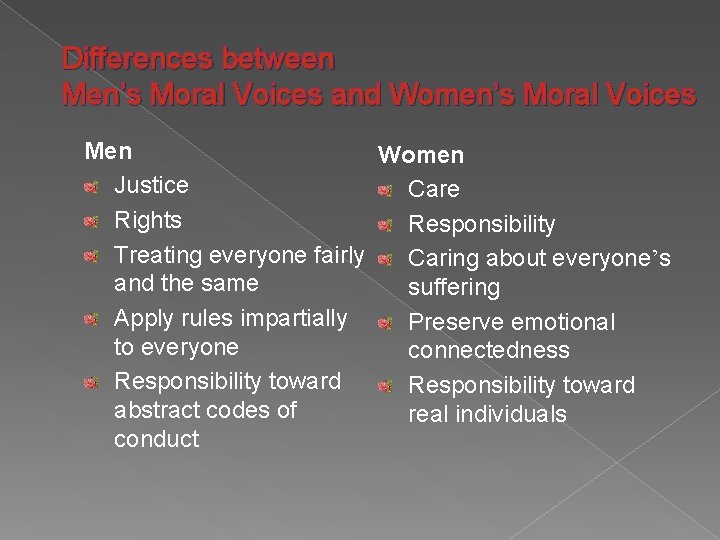
Differences between Men’s Moral Voices and Women’s Moral Voices Men Women Justice Care Rights Responsibility Treating everyone fairly Caring about everyone’s and the same suffering Apply rules impartially Preserve emotional to everyone connectedness Responsibility toward abstract codes of real individuals conduct
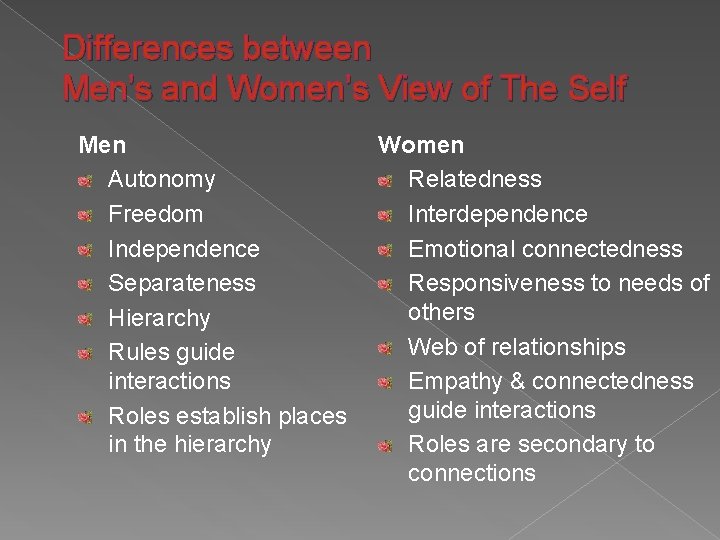
Differences between Men’s and Women’s View of The Self Men Autonomy Freedom Independence Separateness Hierarchy Rules guide interactions Roles establish places in the hierarchy Women Relatedness Interdependence Emotional connectedness Responsiveness to needs of others Web of relationships Empathy & connectedness guide interactions Roles are secondary to connections
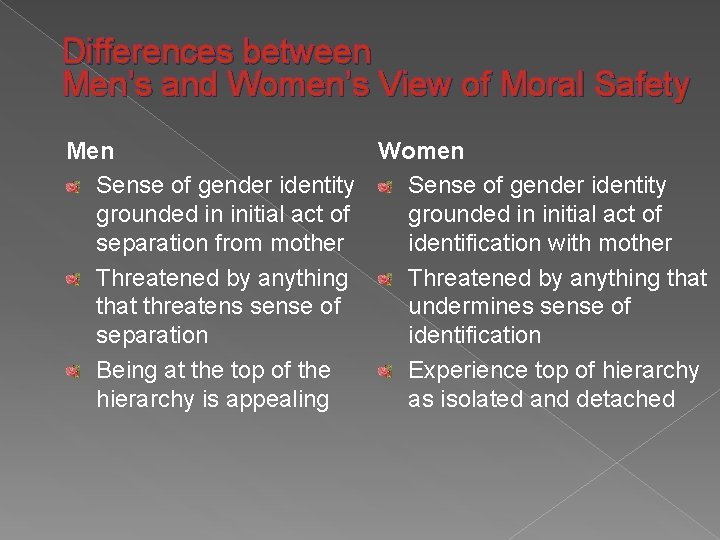
Differences between Men’s and Women’s View of Moral Safety Men Women Sense of gender identity grounded in initial act of separation from mother identification with mother Threatened by anything that threatens sense of undermines sense of separation identification Being at the top of the Experience top of hierarchy is appealing as isolated and detached
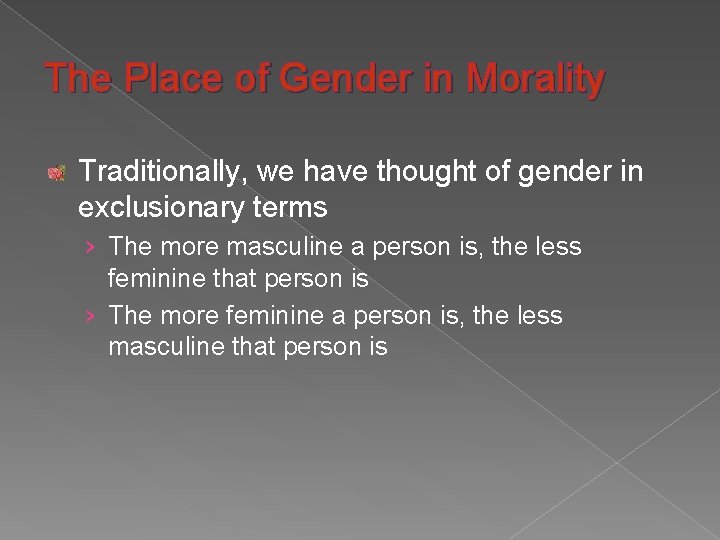
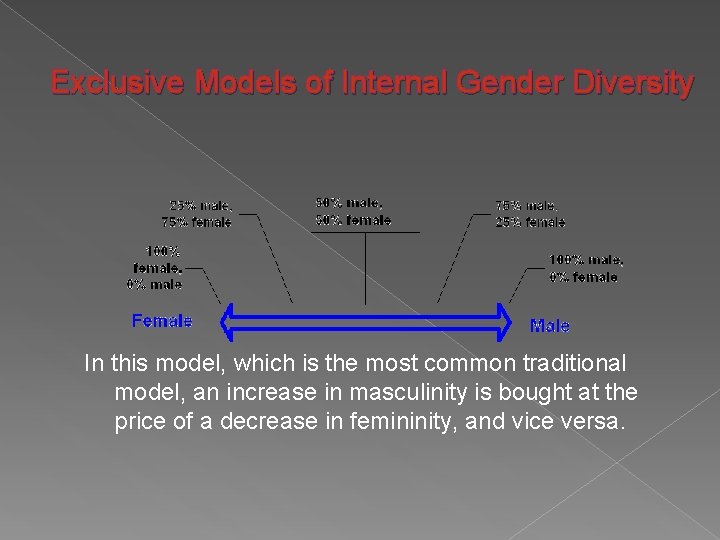
The Place of Gender in Morality Traditionally, we have thought of gender in exclusionary terms › The more masculine a person is, the less feminine that person is › The more feminine a person is, the less masculine that person is
Exclusive Models of Internal Gender Diversity In this model, which is the most common traditional model, an increase in masculinity is bought at the price of a decrease in femininity, and vice versa.
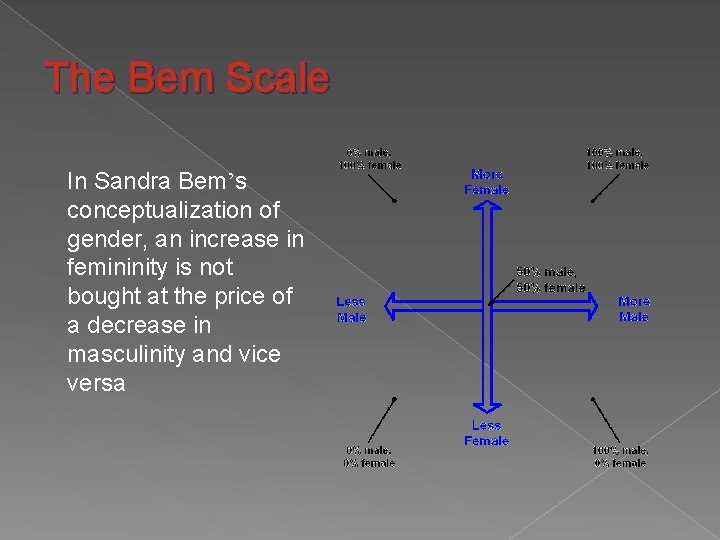
The Bem Scale In Sandra Bem’s conceptualization of gender, an increase in femininity is not bought at the price of a decrease in masculinity and vice versa
Group 9 What are Peers? What are some of the functions of peers/friends? What are the factors involved in popularity? Family- Developing Environment for Children (352 onwards)
Children grow progressively more sensitive to the importance of friends, and building and maintaining friendships becomes a large part of children’s social lives. Friendships provide children with information about the world and other people as well as about themelves.
Friends provides emotional support that allows children to respond more effectively to stress. Having friends makes a child less likely to be the target of aggression, and it can teach children how to manage and control their emotions and help them interpret their own emotional experience.
Friendships also provide a training group for communicating and interacting with others. They can foster intellectual growth by increasing children’s range of experiences. Even those friends are important but they are not as important as parents yet in this stage.
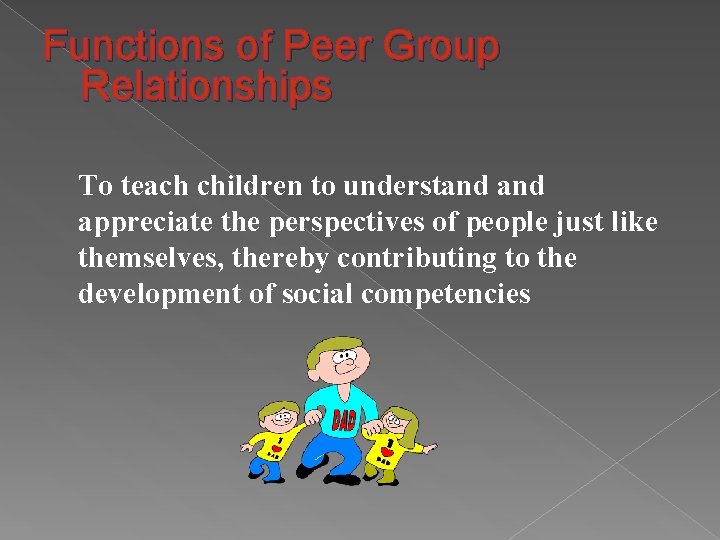
Functions of Peer Group Relationships To teach children to understand appreciate the perspectives of people just like themselves, thereby contributing to the development of social competencies
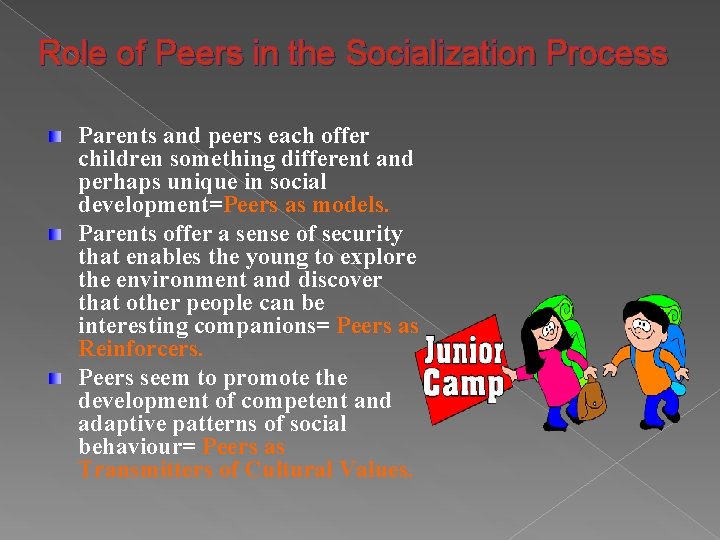
Role of Peers in the Socialization Process Parents and peers each offer children something different and perhaps unique in social development=Peers as models. Parents offer a sense of security that enables the young to explore the environment and discover that other people can be interesting companions= Peers as Reinforcers. Peers seem to promote the development of competent and adaptive patterns of social behaviour= Peers as Transmitters of Cultural Values.
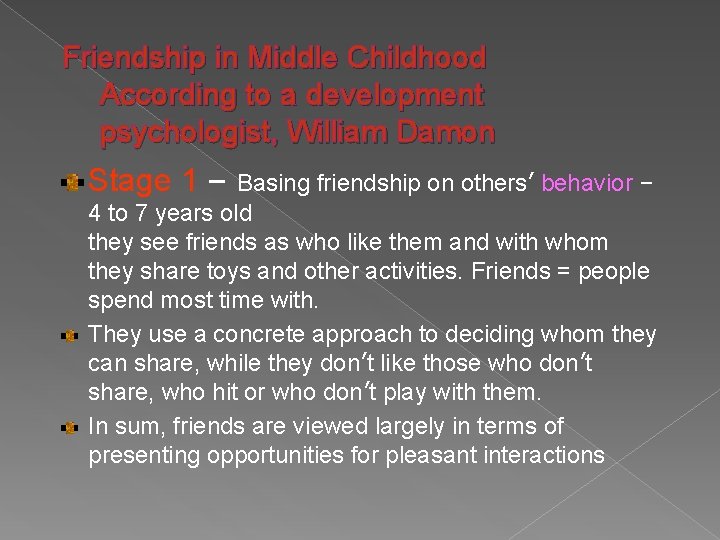
Friendship in Middle Childhood According to a development psychologist, William Damon Stage 1 – Basing friendship on others’ behavior – 4 to 7 years old they see friends as who like them and with whom they share toys and other activities. Friends = people spend most time with. They use a concrete approach to deciding whom they can share, while they don’t like those who don’t share, who hit or who don’t play with them. In sum, friends are viewed largely in terms of presenting opportunities for pleasant interactions
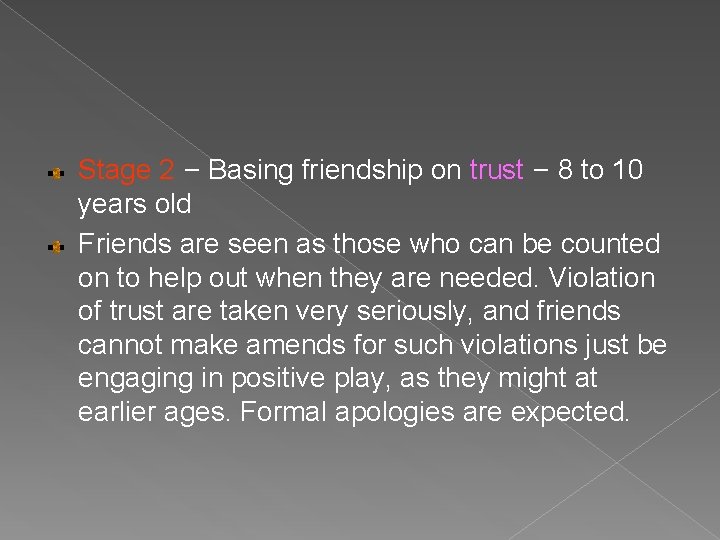
Stage 2 – Basing friendship on trust – 8 to 10 years old Friends are seen as those who can be counted on to help out when they are needed. Violation of trust are taken very seriously, and friends cannot make amends for such violations just be engaging in positive play, as they might at earlier ages. Formal apologies are expected.
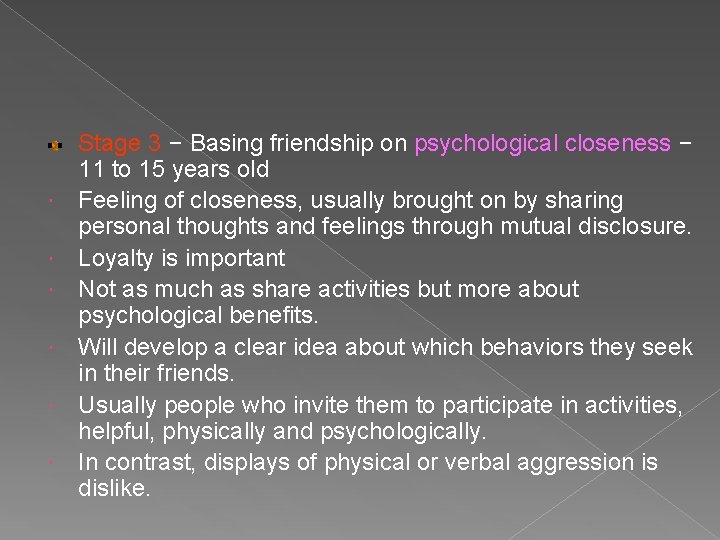
Stage 3 – Basing friendship on psychological closeness – 11 to 15 years old Feeling of closeness, usually brought on by sharing personal thoughts and feelings through mutual disclosure. Loyalty is important Not as much as share activities but more about psychological benefits. Will develop a clear idea about which behaviors they seek in their friends. Usually people who invite them to participate in activities, helpful, physically and psychologically. In contrast, displays of physical or verbal aggression is dislike.
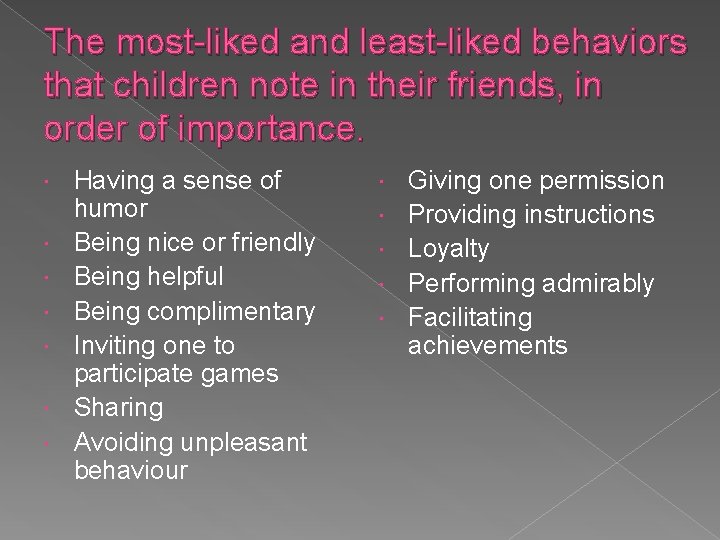
The most-liked and least-liked behaviors that children note in their friends, in order of importance. Having a sense of humor Being nice or friendly Being helpful Being complimentary Inviting one to participate games Sharing Avoiding unpleasant behaviour Giving one permission Providing instructions Loyalty Performing admirably Facilitating achievements
least-liked behaviors that children note in their friends, in order of importance. Verbal aggression Expression of anger Dishonesty Being critical Being greedy or bossy Physical aggression Being annoying Interfering achievements Unfaithfulness Violating of rules Ignoring others
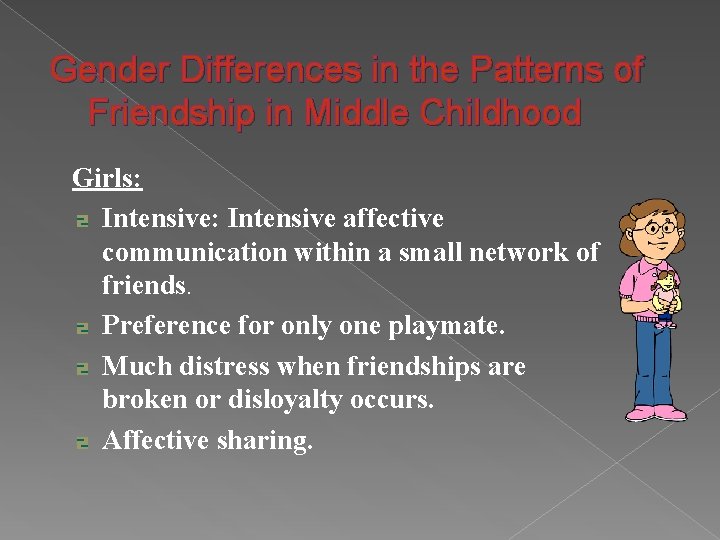
Gender Differences in the Patterns of Friendship in Middle Childhood Girls: Intensive affective communication within a small network of friends. Preference for only one playmate. Much distress when friendships are broken or disloyalty occurs. Affective sharing.
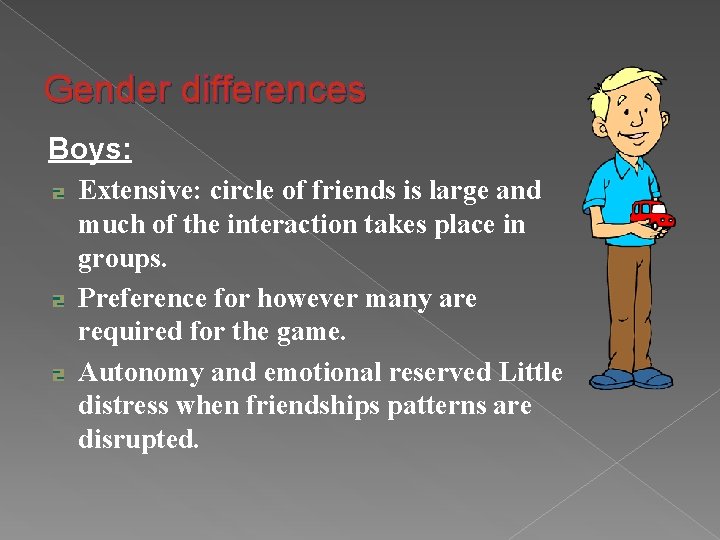
Gender differences Boys: Extensive: circle of friends is large and much of the interaction takes place in groups. Preference for however many are required for the game. Autonomy and emotional reserved Little distress when friendships patterns are disrupted.
What Makes A Child Popular? Status- the relative position of a person ascribed by other members of a group.
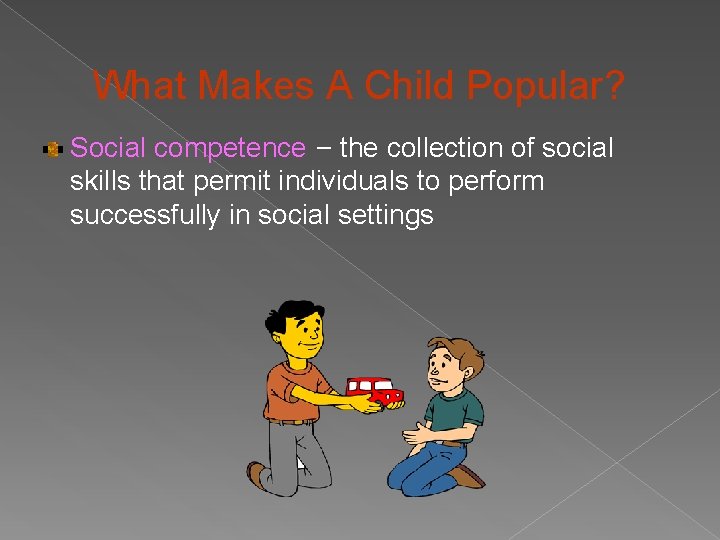
What Makes A Child Popular? Social competence – the collection of social skills that permit individuals to perform successfully in social settings
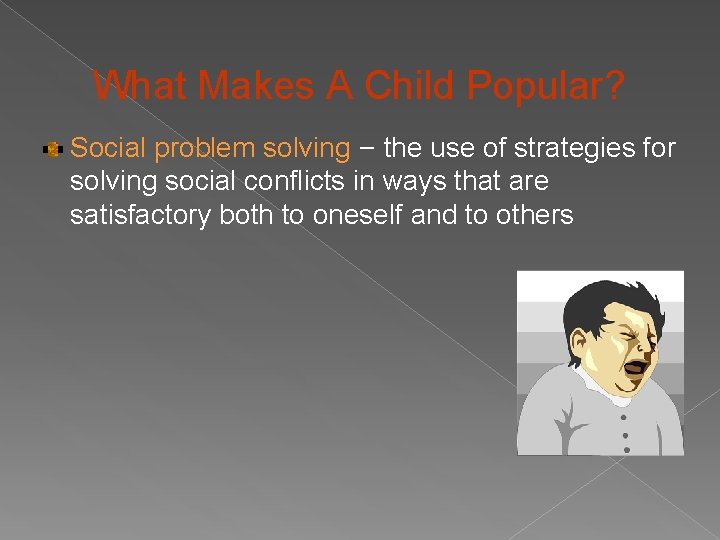
What Makes A Child Popular? Social problem solving – the use of strategies for solving social conflicts in ways that are satisfactory both to oneself and to others
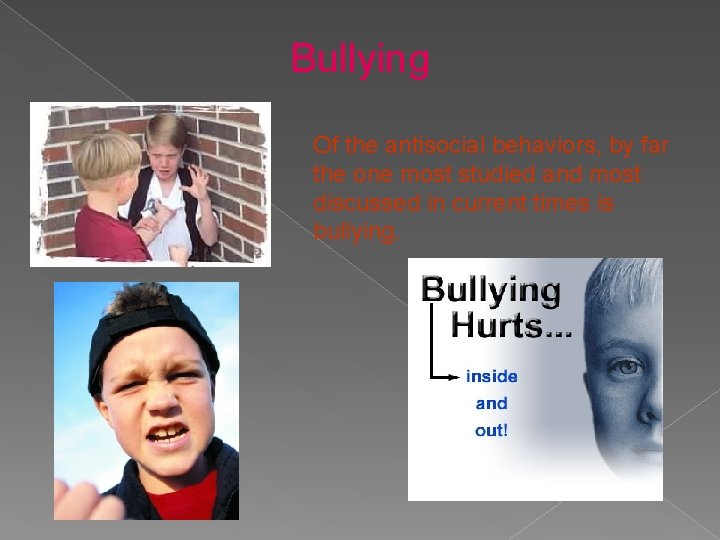
Bullying Of the antisocial behaviors, by far the one most studied and most discussed in current times is bullying.
Bullying Of the antisocial behaviors, by far the one most studied and most discussed in current times is bullying.
Family Life During Childhood Co-regulation – joint control of children’s behavior exercised by the parents and the children themselves Children spend significantly less time with their parents during middle childhood. Children with both parents working fare quite well. As long as parents are loving and sensitive to their children’s needs, the children can be well adjusted. Self-care children let themselves into home after school and wait alone until a caretaker arrives.
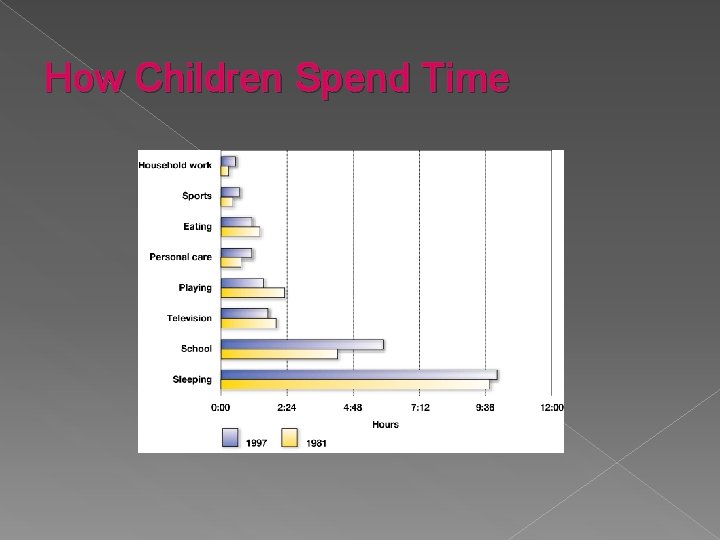
How Children Spend Time
Divorce Both children and parents may show psychological maladjustment for 6 months to a few years following divorce. Children may experience anxiety, depression, sleep disturbances, or phobias. During the early childhood, children often blame themselves for their parent’s divorce. By the age of 10, children feel the pressure to choose sides and experience some divided loyalty.
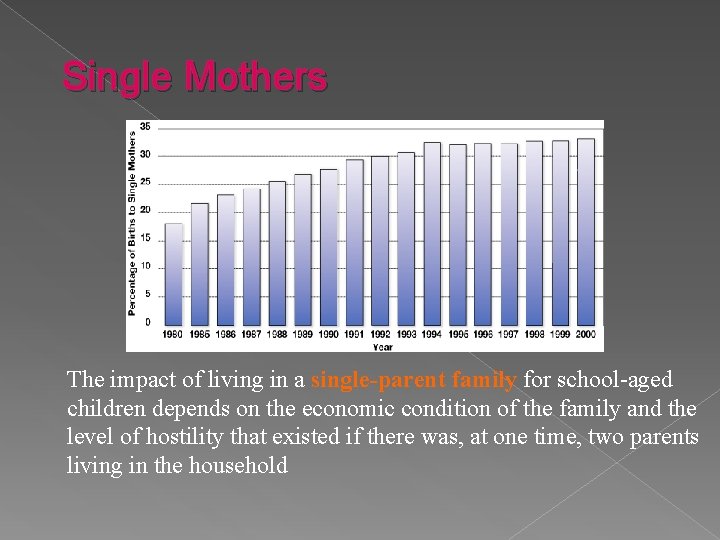
Single Mothers The impact of living in a single-parent family for school-aged children depends on the economic condition of the family and the level of hostility that existed if there was, at one time, two parents living in the household
Blended Families A blended family is a household consisting of a couple and at least one child from a prior relationship. Role ambiguity exists in blended households as children become uncertain of their responsibilities and roles.