
CH 10 Projectile and Satellite Motion Projectiles Projectile
- Slides: 13
CH 10 – Projectile and Satellite Motion Projectiles Projectile Motion
Motion Revisited… Horizontal Motion n Speed or Velocity or velocity = distance time ¨v = d / t ¨ Speed n Acceleration ¨a n = velocity time =v/t A ball rolling horizontally… ¨ Moves friction at a constant speed if we neglect
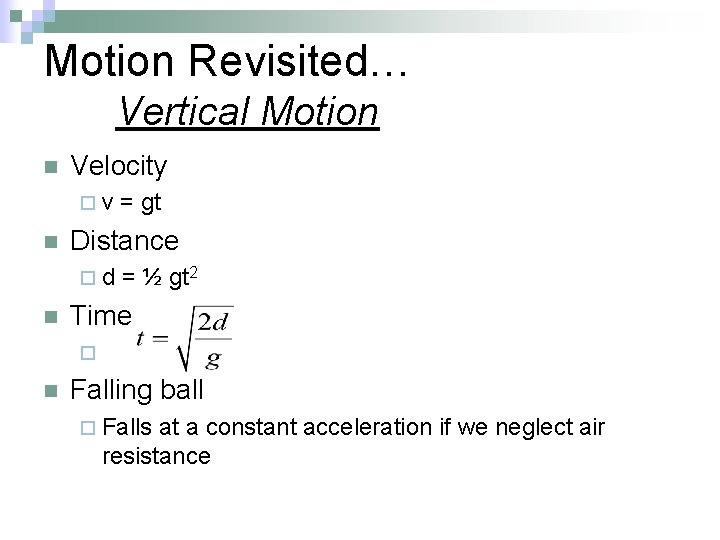
Motion Revisited… Vertical Motion n Velocity ¨v n Distance ¨d n = gt = ½ gt 2 Time ¨ n Falling ball ¨ Falls at a constant acceleration if we neglect air resistance
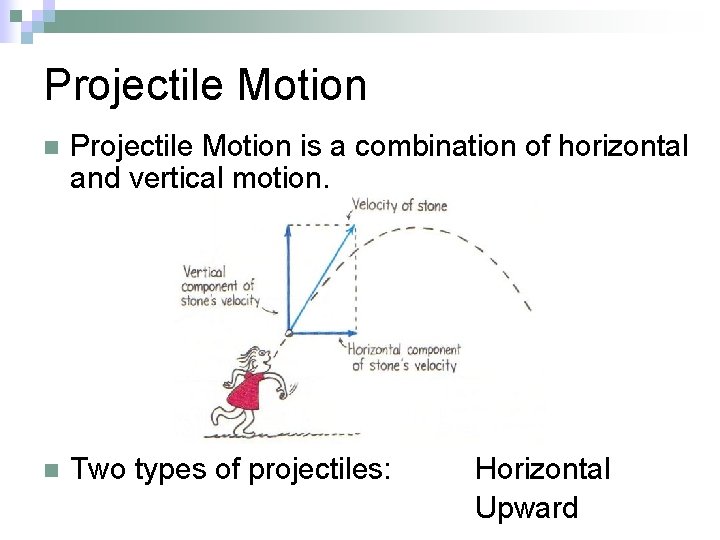
Projectile Motion A projectile is an object moving only under the influence of gravity. n No other forces are involved, other than an initial push, hit, throw, launch, shoot, etc. n The horizontal motion is independent of the vertical motion. n Projectiles have parabolic path. n
Projectile Motion n Projectile Motion is a combination of horizontal and vertical motion. n Two types of projectiles: Horizontal Upward
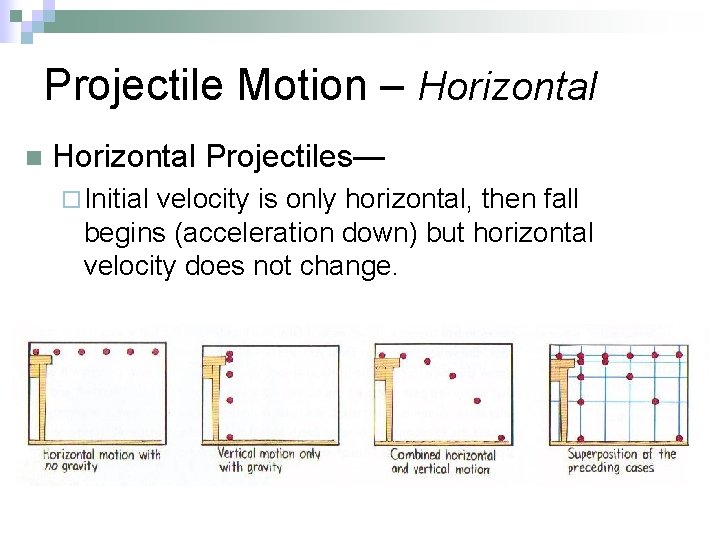
Projectile Motion – Horizontal n Horizontal Projectiles— ¨ Initial velocity is only horizontal, then fall begins (acceleration down) but horizontal velocity does not change.
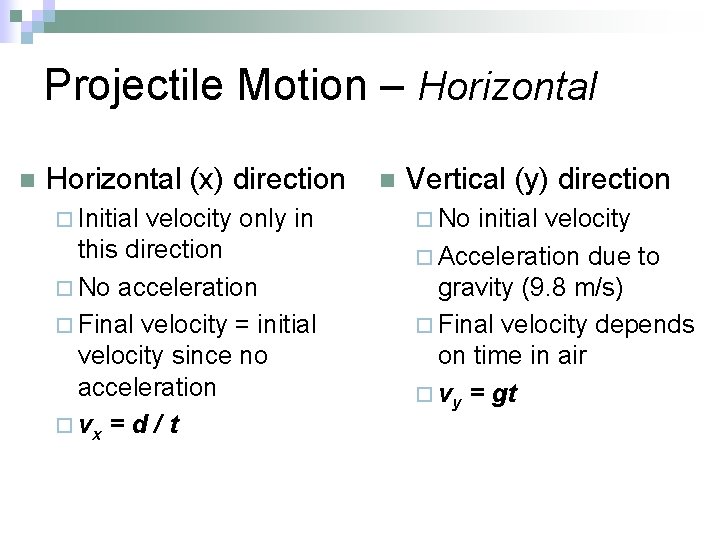
Projectile Motion – Horizontal n Horizontal (x) direction ¨ Initial velocity only in this direction ¨ No acceleration ¨ Final velocity = initial velocity since no acceleration ¨ vx = d / t n Vertical (y) direction ¨ No initial velocity ¨ Acceleration due to gravity (9. 8 m/s) ¨ Final velocity depends on time in air ¨ vy = gt
Projectile Motion – Horizontal At the instant a horizontally held rifle is fired over a lever range, a bullet held at the side of the rifle is released and drops to the ground. Which bullet, the one fired downrange or the one dropped from rest, strikes the ground first? They strike the ground at the same time!
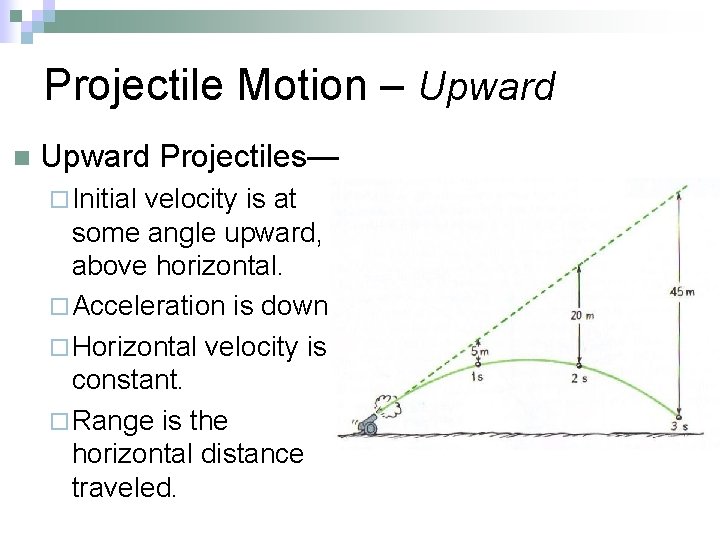
Projectile Motion – Upward n Upward Projectiles— ¨ Initial velocity is at some angle upward, above horizontal. ¨ Acceleration is down. ¨ Horizontal velocity is constant. ¨ Range is the horizontal distance traveled.
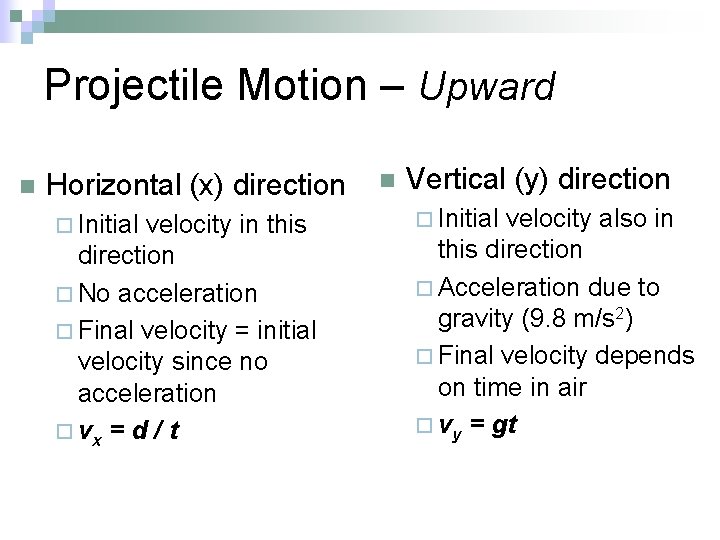
Projectile Motion – Upward n Horizontal (x) direction ¨ Initial velocity in this direction ¨ No acceleration ¨ Final velocity = initial velocity since no acceleration ¨ vx = d / t n Vertical (y) direction ¨ Initial velocity also in this direction ¨ Acceleration due to gravity (9. 8 m/s 2) ¨ Final velocity depends on time in air ¨ vy = gt
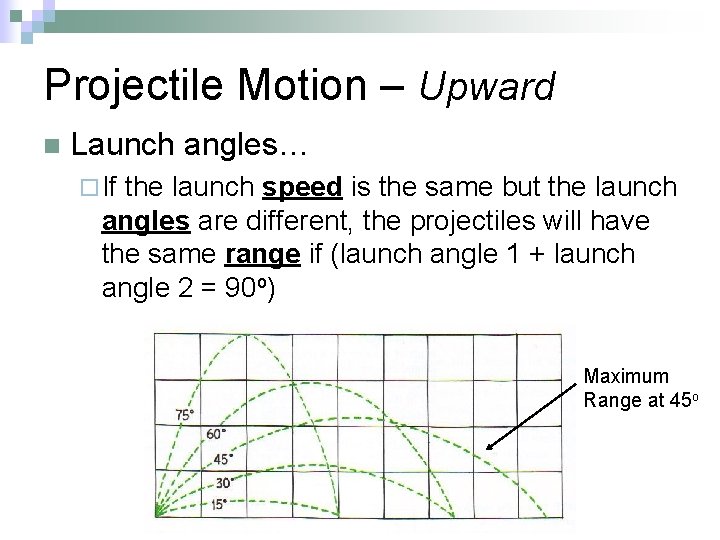
Projectile Motion – Upward n Launch angles… ¨ If the launch speed is the same but the launch angles are different, the projectiles will have the same range if (launch angle 1 + launch angle 2 = 90 o) Maximum Range at 45 o
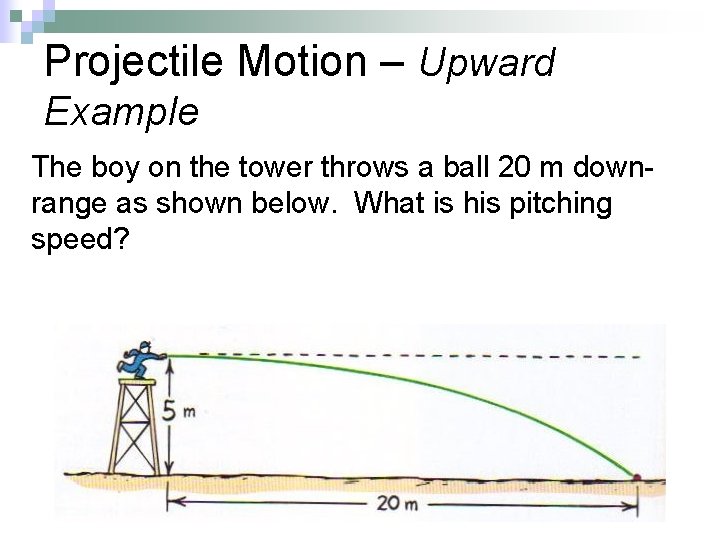
Projectile Motion – Upward Example The boy on the tower throws a ball 20 m downrange as shown below. What is his pitching speed?
Questions about Projectile Motion 1. Why does the vertical component of velocity for a projectile change with time, whereas the horizontal component doesn’t? 2. A rock is thrown upward at an angle. What happens to the vertical component of its velocity (A) as it rises? (B) as it falls? 3. A projectile falls beneath the straight-line path it would follow if there were no gravity. How many meters does it fall below this line if it has been traveling (A) for 1 s? (B) for 2 s?