
Ch 10 Molar Quantities Notes Learning Target 1
- Slides: 15
Ch. 10 Molar Quantities Notes Learning Target 1
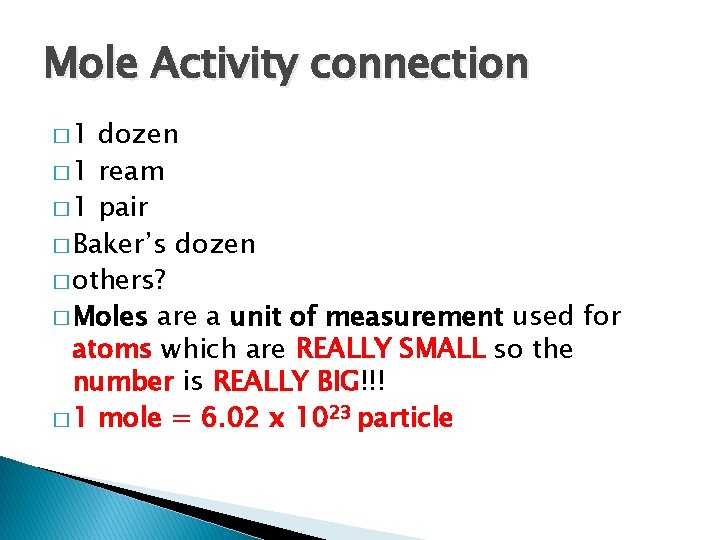
Mole Activity connection � 1 dozen � 1 ream � 1 pair � Baker’s dozen � others? � Moles are a unit of measurement used for atoms which are REALLY SMALL so the number is REALLY BIG!!! � 1 mole = 6. 02 x 1023 particle
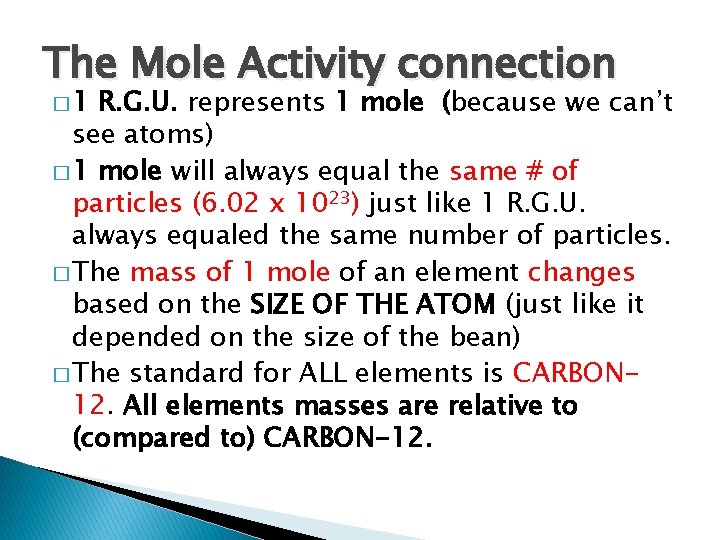
The Mole Activity connection � 1 R. G. U. represents 1 mole (because we can’t see atoms) � 1 mole will always equal the same # of particles (6. 02 x 1023) just like 1 R. G. U. always equaled the same number of particles. � The mass of 1 mole of an element changes based on the SIZE OF THE ATOM (just like it depended on the size of the bean) � The standard for ALL elements is CARBON 12. All elements masses are relative to (compared to) CARBON-12.
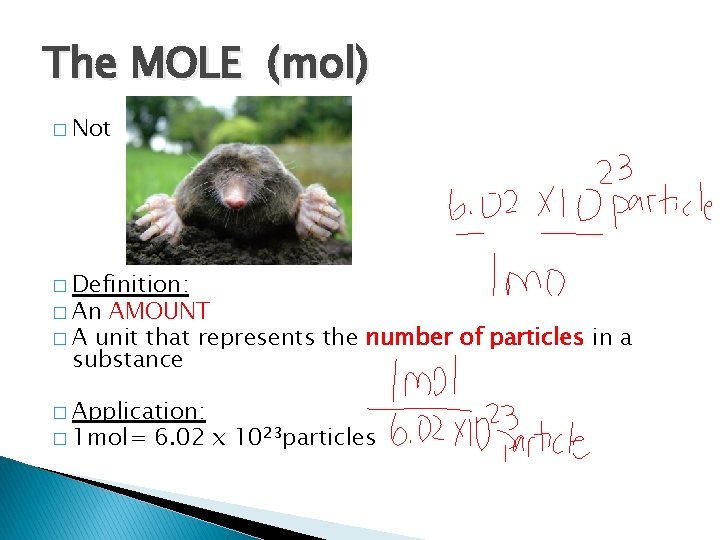
The MOLE (mol) � Not � Definition: � An AMOUNT � A unit that represents the number of particles in a substance � Application: � 1 mol= 6. 02 x 1023 particles
1 mole= Avogadro’s number � Think Avocado � Definition: � Equal to 1 mole of a substance � Application: � 6. 02 x 1023
Representative particles- the smallest part of a substance that retains the properties. � Definition: � Element-- atom � Molecular � Ionic compound molecule compound formula unit � Application: � 1 mole Na= 6. 02 x 1023 atoms � 1 mol H 2 O= 6. 02 x 1023 molecules � 1 mol Na. Cl= 6. 02 x 1023 formula units
Conversion Factors � Definition: # of equivalent values with different units � Application: � Use the card to convert 13 inches to miles
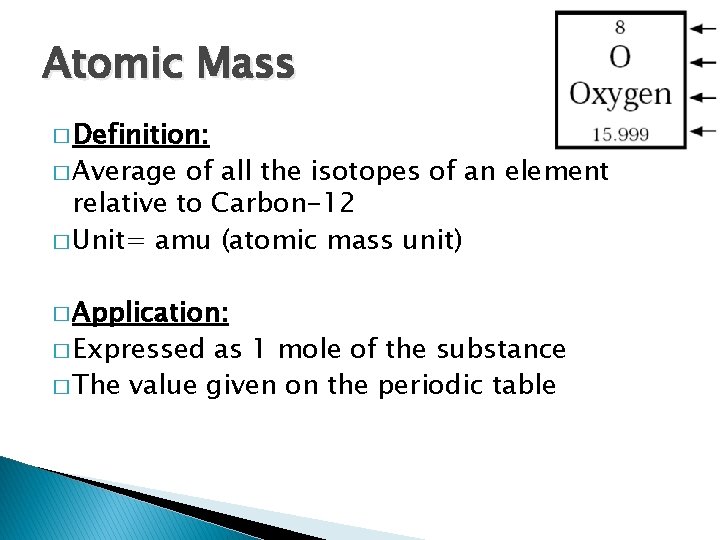
Atomic Mass � Definition: � Average of all the isotopes of an element relative to Carbon-12 � Unit= amu (atomic mass unit) � Application: � Expressed as 1 mole of the substance � The value given on the periodic table
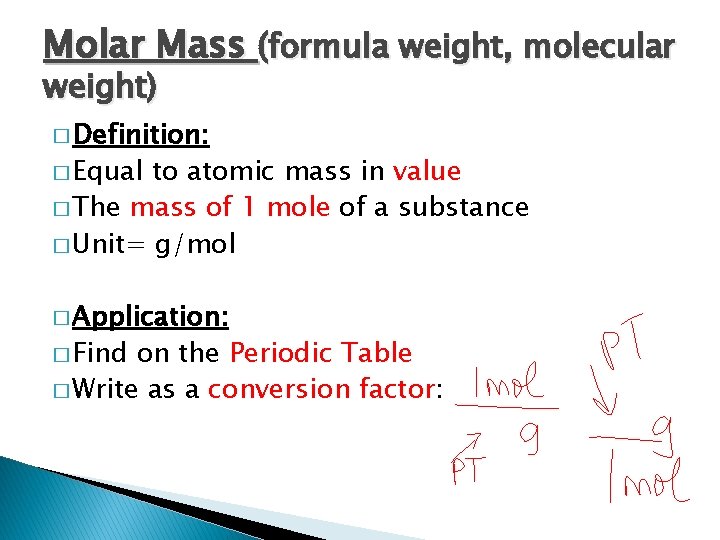
Molar Mass (formula weight, molecular weight) � Definition: � Equal to atomic mass in value � The mass of 1 mole of a substance � Unit= g/mol � Application: � Find on the Periodic Table � Write as a conversion factor:
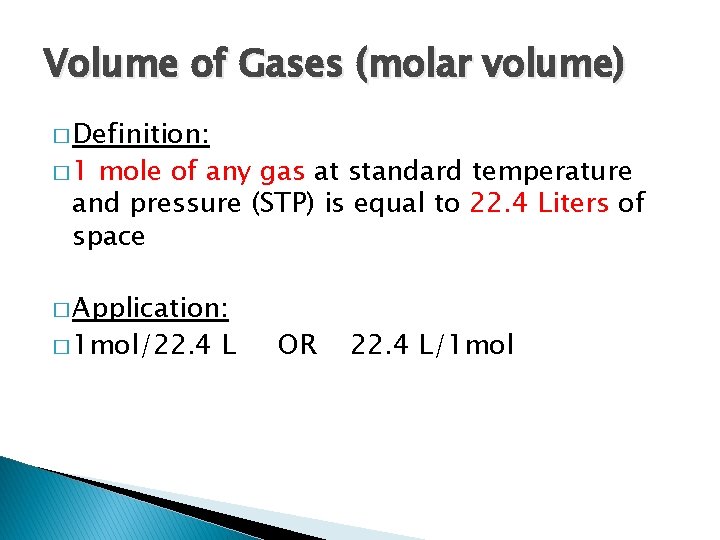
Volume of Gases (molar volume) � Definition: � 1 mole of any gas at standard temperature and pressure (STP) is equal to 22. 4 Liters of space � Application: � 1 mol/22. 4 L OR 22. 4 L/1 mol
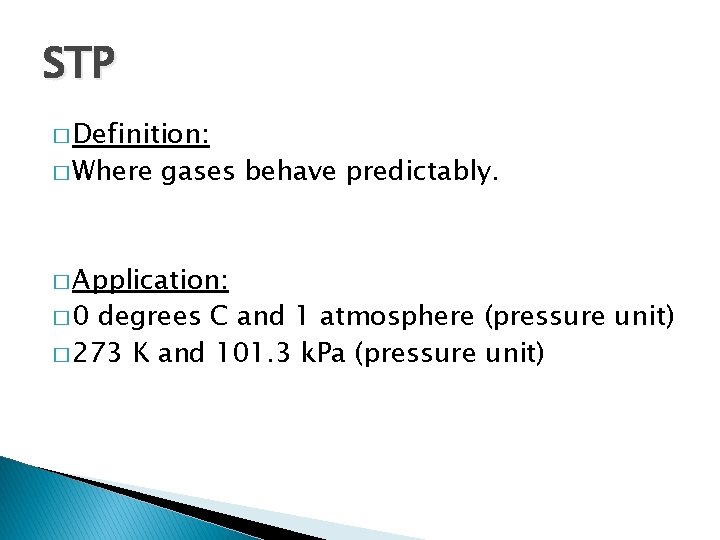
STP � Definition: � Where gases behave predictably. � Application: � 0 degrees C and 1 atmosphere (pressure unit) � 273 K and 101. 3 k. Pa (pressure unit)
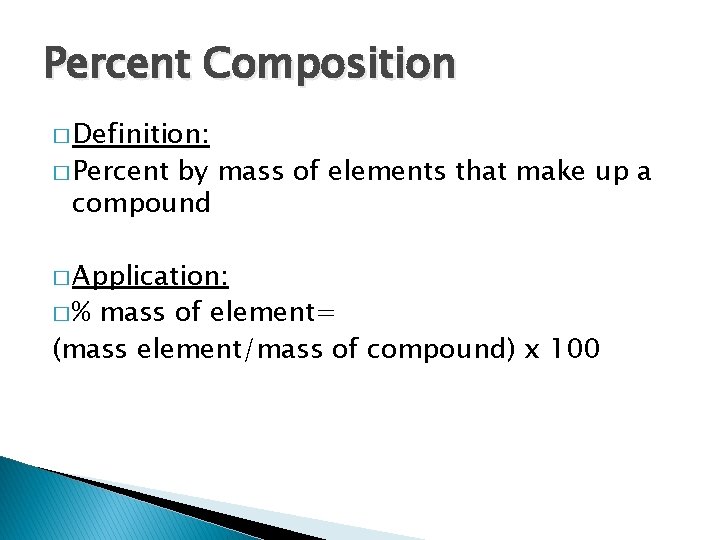
Percent Composition � Definition: � Percent by mass of elements that make up a compound � Application: �% mass of element= (mass element/mass of compound) x 100
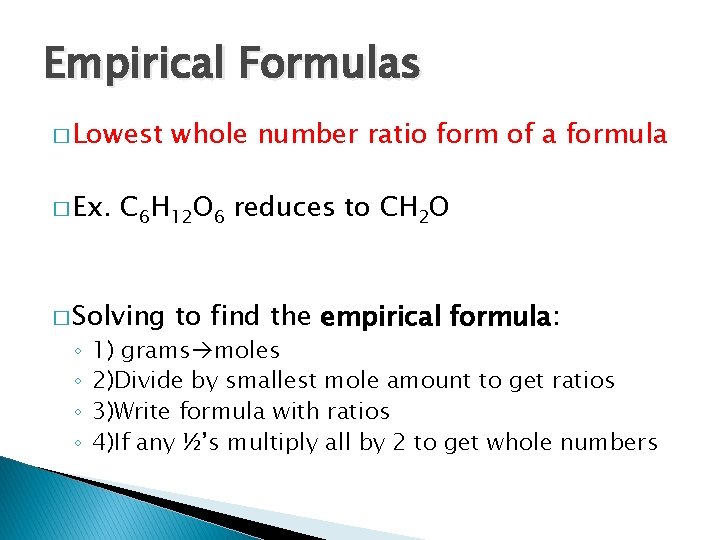
Empirical Formulas � Lowest � Ex. C 6 H 12 O 6 reduces to CH 2 O � Solving ◦ ◦ whole number ratio form of a formula to find the empirical formula: 1) grams moles 2)Divide by smallest mole amount to get ratios 3)Write formula with ratios 4)If any ½’s multiply all by 2 to get whole numbers
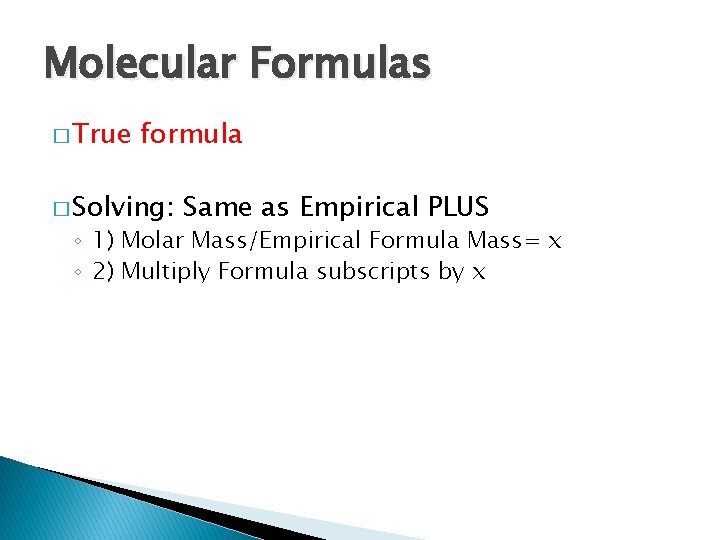
Molecular Formulas � True formula � Solving: Same as Empirical PLUS ◦ 1) Molar Mass/Empirical Formula Mass= x ◦ 2) Multiply Formula subscripts by x
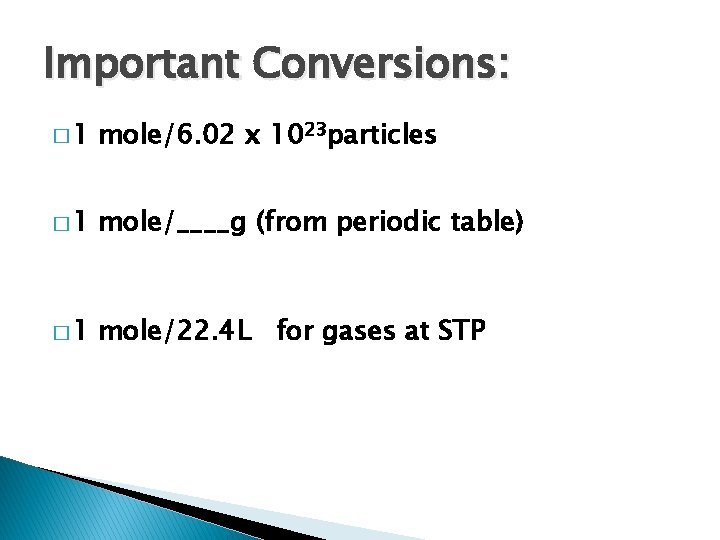
Important Conversions: � 1 mole/6. 02 x 1023 particles � 1 mole/____g (from periodic table) � 1 mole/22. 4 L for gases at STP