
CH 10 Chemical Equations Calcs Renee Y Becker
CH 10: Chemical Equations & Calcs Renee Y. Becker CHM 1025 Valencia Community College
What is Stoichiometry? • Chemists and chemical engineers must perform calculations based on balanced chemical reactions to predict the cost of processes. • These calculations are used to avoid using large, excess amounts of costly chemicals. • The calculations these scientists use are called stoichiometry calculations. 2

Interpreting Chemical Equations • Let’s look at the reaction of nitrogen monoxide with oxygen to produce nitrogen dioxide: 2 NO(g) + O 2(g) → 2 NO 2(g) • Two molecules of NO gas react with one molecule of O 2 gas to produce 2 molecules of NO 2 gas. 3
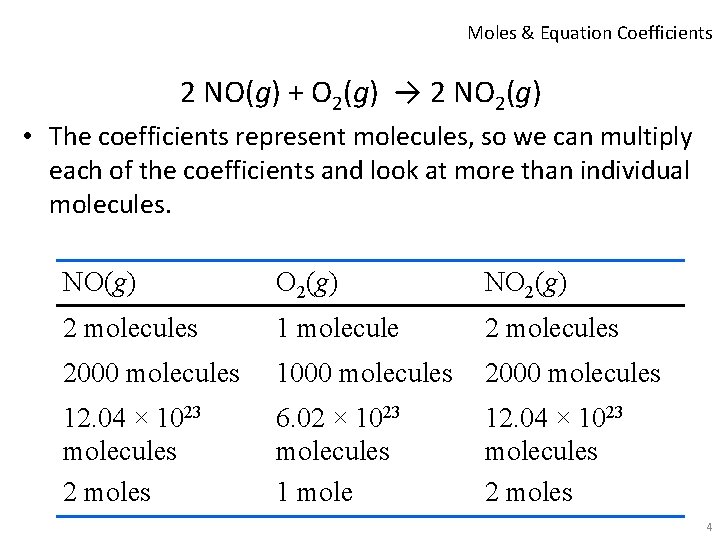
Moles & Equation Coefficients 2 NO(g) + O 2(g) → 2 NO 2(g) • The coefficients represent molecules, so we can multiply each of the coefficients and look at more than individual molecules. NO(g) O 2(g) NO 2(g) 2 molecules 1 molecule 2 molecules 2000 molecules 1000 molecules 2000 molecules 12. 04 × 1023 molecules 2 moles 6. 02 × 1023 molecules 1 mole 12. 04 × 1023 molecules 2 moles 4
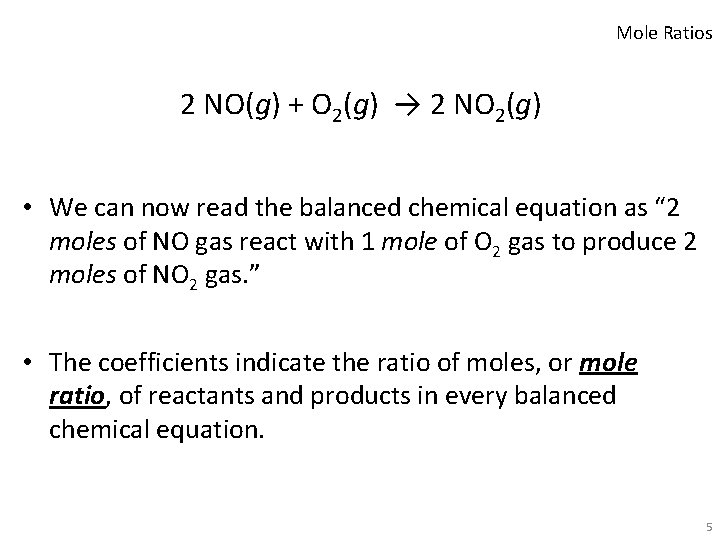
Mole Ratios 2 NO(g) + O 2(g) → 2 NO 2(g) • We can now read the balanced chemical equation as “ 2 moles of NO gas react with 1 mole of O 2 gas to produce 2 moles of NO 2 gas. ” • The coefficients indicate the ratio of moles, or mole ratio, of reactants and products in every balanced chemical equation. 5
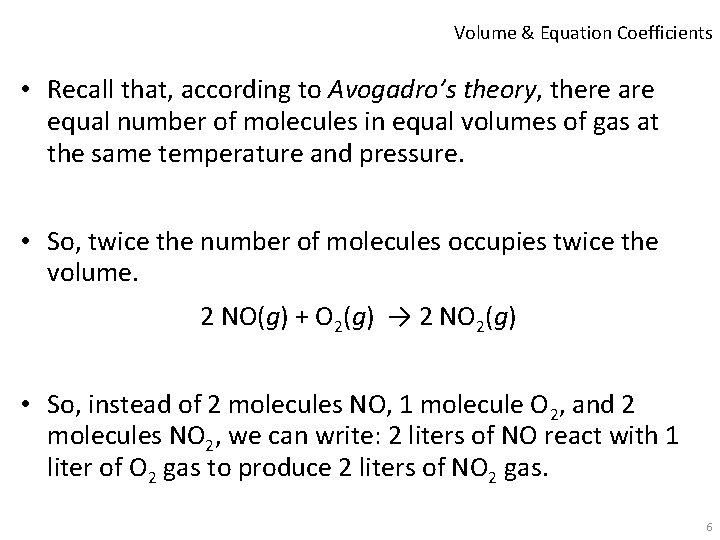
Volume & Equation Coefficients • Recall that, according to Avogadro’s theory, there are equal number of molecules in equal volumes of gas at the same temperature and pressure. • So, twice the number of molecules occupies twice the volume. 2 NO(g) + O 2(g) → 2 NO 2(g) • So, instead of 2 molecules NO, 1 molecule O 2, and 2 molecules NO 2, we can write: 2 liters of NO react with 1 liter of O 2 gas to produce 2 liters of NO 2 gas. 6
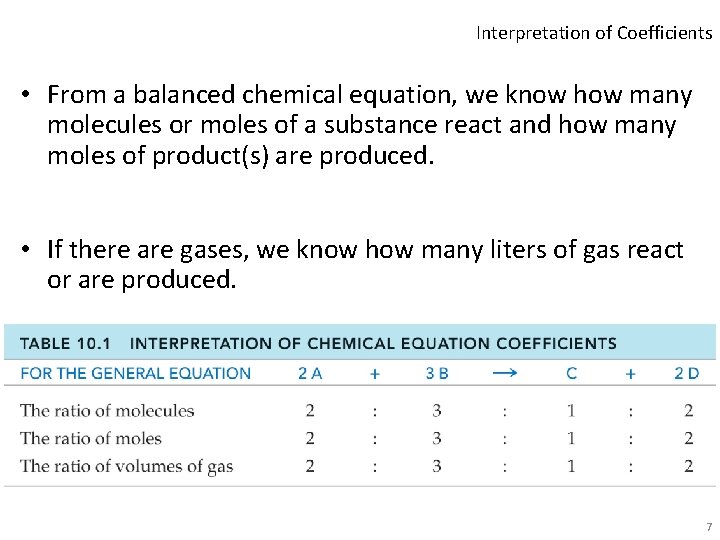
Interpretation of Coefficients • From a balanced chemical equation, we know how many molecules or moles of a substance react and how many moles of product(s) are produced. • If there are gases, we know how many liters of gas react or are produced. 7
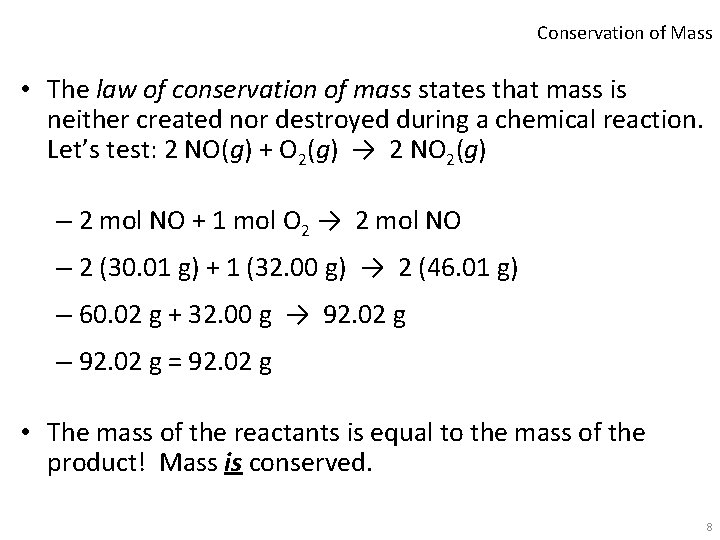
Conservation of Mass • The law of conservation of mass states that mass is neither created nor destroyed during a chemical reaction. Let’s test: 2 NO(g) + O 2(g) → 2 NO 2(g) – 2 mol NO + 1 mol O 2 → 2 mol NO – 2 (30. 01 g) + 1 (32. 00 g) → 2 (46. 01 g) – 60. 02 g + 32. 00 g → 92. 02 g – 92. 02 g = 92. 02 g • The mass of the reactants is equal to the mass of the product! Mass is conserved. 8
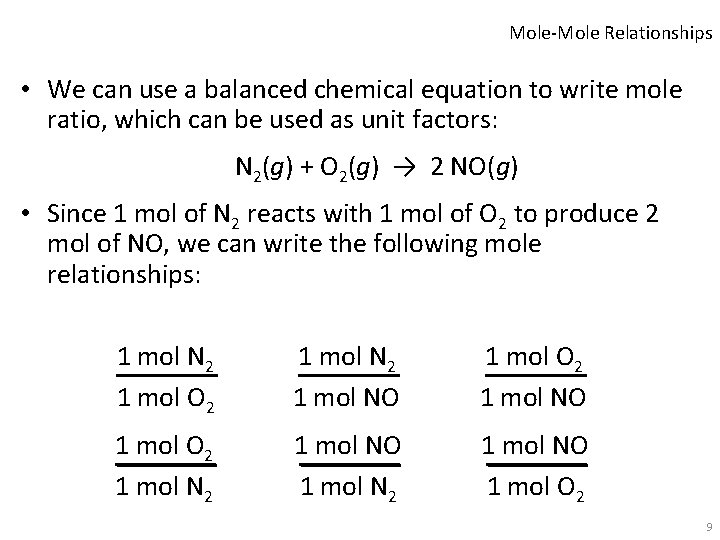
Mole-Mole Relationships • We can use a balanced chemical equation to write mole ratio, which can be used as unit factors: N 2(g) + O 2(g) → 2 NO(g) • Since 1 mol of N 2 reacts with 1 mol of O 2 to produce 2 mol of NO, we can write the following mole relationships: 1 mol N 2 1 mol O 2 1 mol NO 1 mol O 2 1 mol NO 1 mol N 2 1 mol NO 1 mol O 2 9
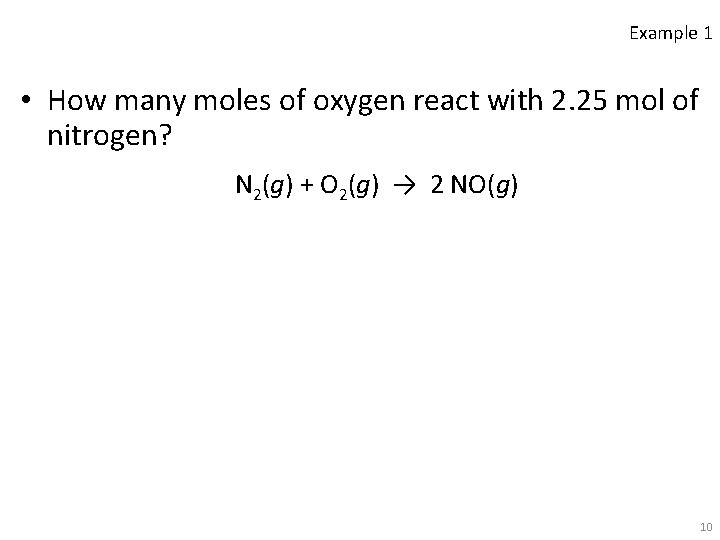
Example 1 • How many moles of oxygen react with 2. 25 mol of nitrogen? N 2(g) + O 2(g) → 2 NO(g) 10
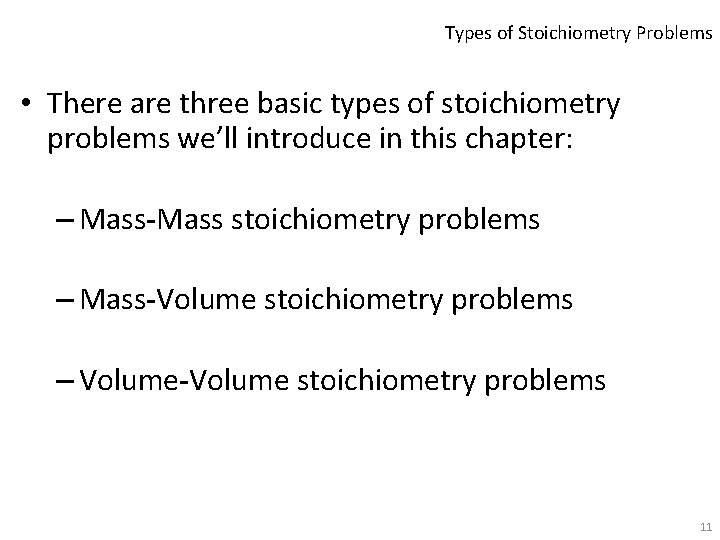
Types of Stoichiometry Problems • There are three basic types of stoichiometry problems we’ll introduce in this chapter: – Mass-Mass stoichiometry problems – Mass-Volume stoichiometry problems – Volume-Volume stoichiometry problems 11
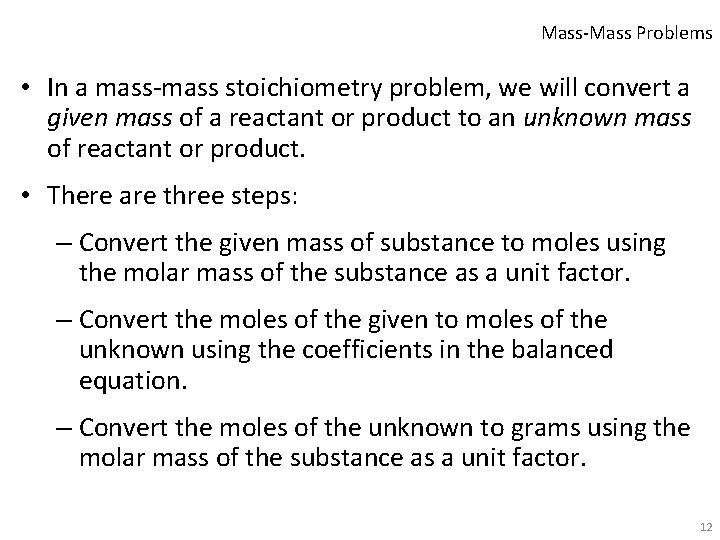
Mass-Mass Problems • In a mass-mass stoichiometry problem, we will convert a given mass of a reactant or product to an unknown mass of reactant or product. • There are three steps: – Convert the given mass of substance to moles using the molar mass of the substance as a unit factor. – Convert the moles of the given to moles of the unknown using the coefficients in the balanced equation. – Convert the moles of the unknown to grams using the molar mass of the substance as a unit factor. 12
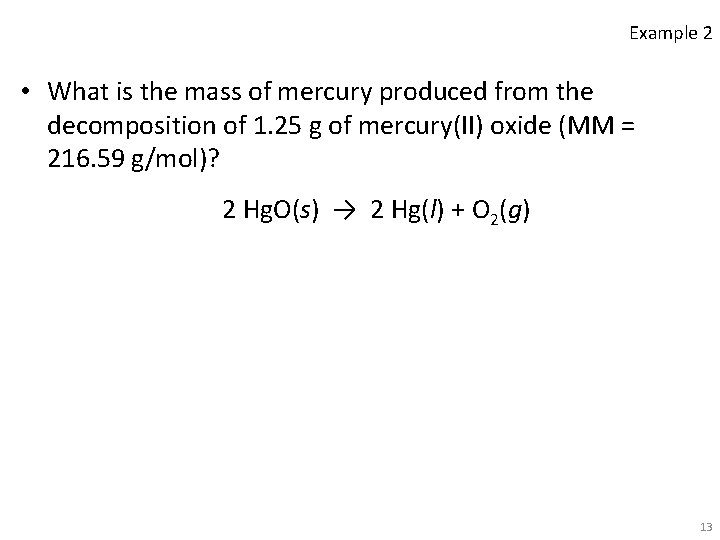
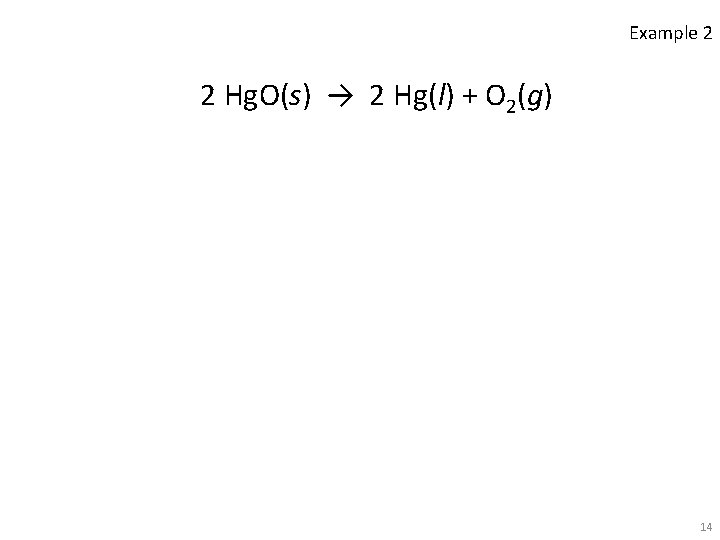
Example 2 • What is the mass of mercury produced from the decomposition of 1. 25 g of mercury(II) oxide (MM = 216. 59 g/mol)? 2 Hg. O(s) → 2 Hg(l) + O 2(g) 13
Example 2 2 Hg. O(s) → 2 Hg(l) + O 2(g) 14
Mass-Volume Problems • In a mass-volume stoichiometry problem, we will convert a given mass of a reactant or product to an unknown volume of reactant or product. • There are three steps: – Convert the given mass of a substance to moles using the molar mass of the substance as a unit factor. – Convert the moles of the given to moles of the unknown using the coefficients in the balanced equation. – Convert the moles of unknown to liters using the molar volume of a gas as a unit factor. 15
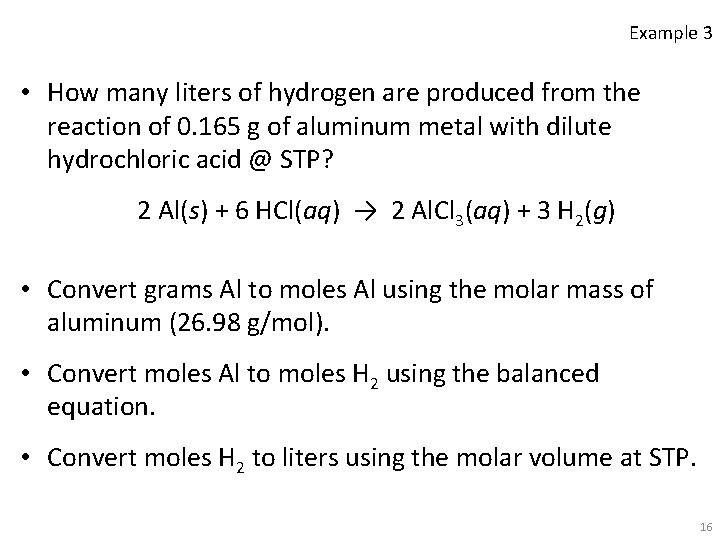
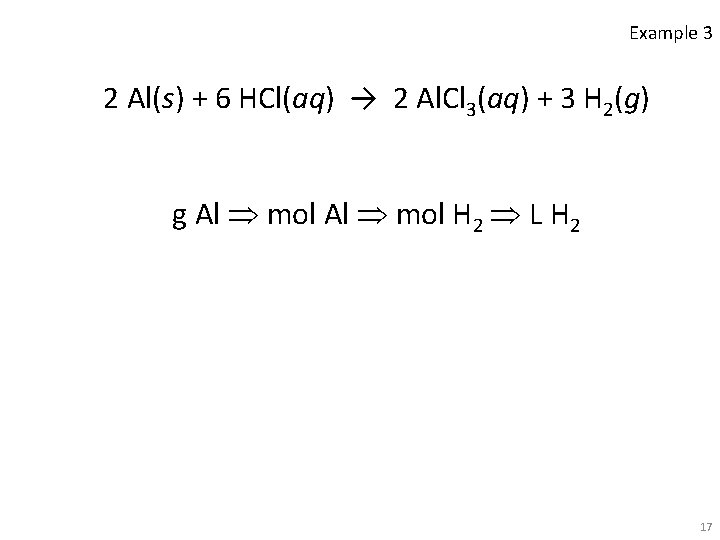
Example 3 • How many liters of hydrogen are produced from the reaction of 0. 165 g of aluminum metal with dilute hydrochloric acid @ STP? 2 Al(s) + 6 HCl(aq) → 2 Al. Cl 3(aq) + 3 H 2(g) • Convert grams Al to moles Al using the molar mass of aluminum (26. 98 g/mol). • Convert moles Al to moles H 2 using the balanced equation. • Convert moles H 2 to liters using the molar volume at STP. 16
Example 3 2 Al(s) + 6 HCl(aq) → 2 Al. Cl 3(aq) + 3 H 2(g) g Al mol H 2 L H 2 17
Example 4 • How many grams of sodium chlorate are needed to produce 9. 21 L of oxygen gas at STP? 2 Na. Cl. O 3(s) → 2 Na. Cl(s) + 3 O 2(g) • Convert liters of O 2 to moles O 2, to moles Na. Cl. O 3, to grams Na. Cl. O 3 (106. 44 g/mol). 18
Volume-Volume Stoichiometry • Gay-Lussac discovered that volumes of gases under similar conditions combined in small whole number ratios. This is the law of combining volumes. • Consider the reaction: H 2(g) + Cl 2(g) → 2 HCl(g) • 10 m. L of H 2 reacts with 10 m. L of Cl 2 to produce 20 m. L of HCl. • The ratio of volumes is 1: 1: 2, small whole numbers. 19
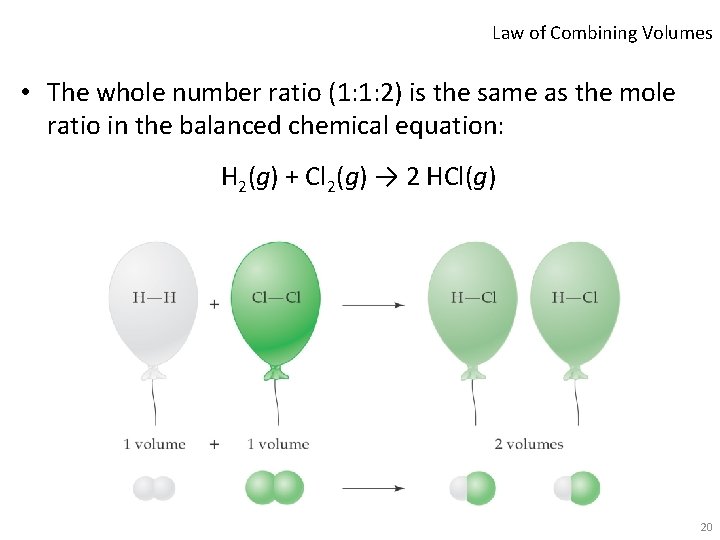
Law of Combining Volumes • The whole number ratio (1: 1: 2) is the same as the mole ratio in the balanced chemical equation: H 2(g) + Cl 2(g) → 2 HCl(g) 20
Volume-Volume Problems • In a volume-volume stoichiometry problem, we will convert a given volume of a gas to an unknown volume of gaseous reactant or product. • There is one step: – Convert the given volume to the unknown volume using the mole ratio (therefore, the volume ratio) from the balanced chemical equation. 21
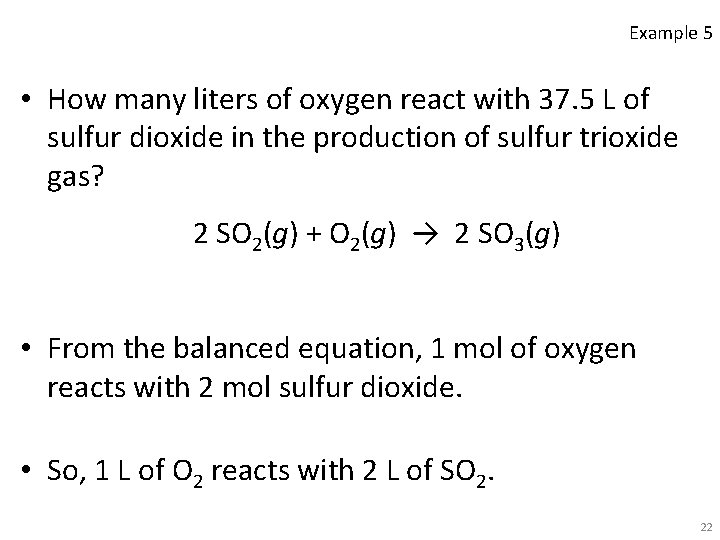
Example 5 • How many liters of oxygen react with 37. 5 L of sulfur dioxide in the production of sulfur trioxide gas? 2 SO 2(g) + O 2(g) → 2 SO 3(g) • From the balanced equation, 1 mol of oxygen reacts with 2 mol sulfur dioxide. • So, 1 L of O 2 reacts with 2 L of SO 2. 22
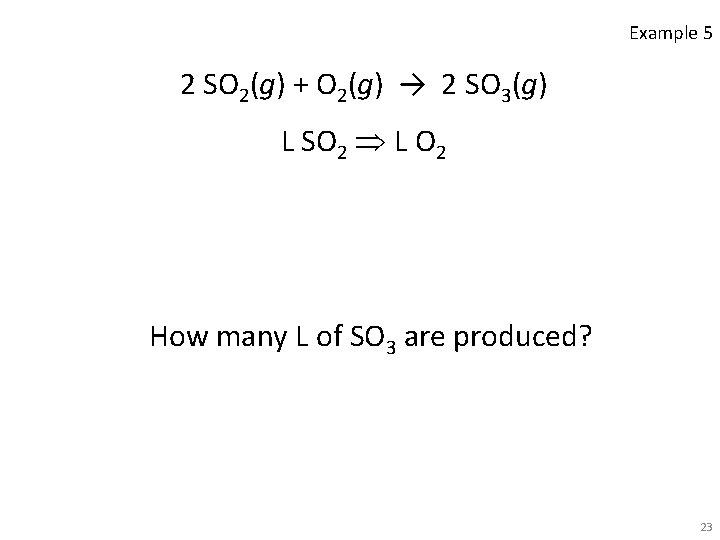
Example 5 2 SO 2(g) + O 2(g) → 2 SO 3(g) L SO 2 L O 2 How many L of SO 3 are produced? 23
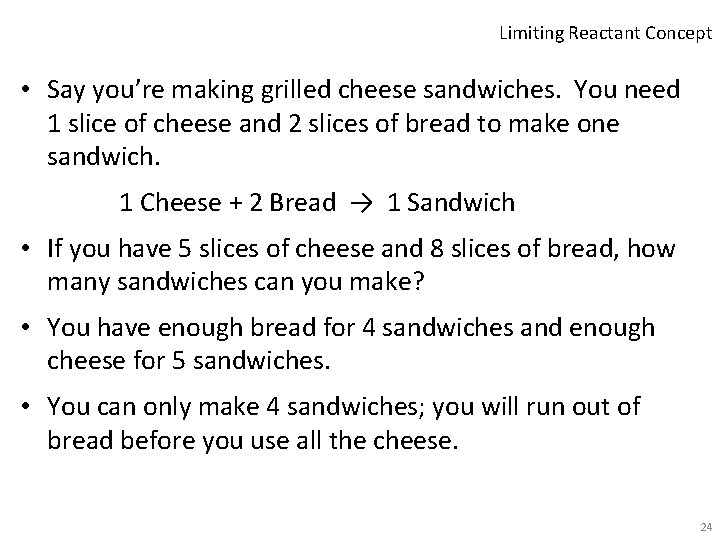
Limiting Reactant Concept • Say you’re making grilled cheese sandwiches. You need 1 slice of cheese and 2 slices of bread to make one sandwich. 1 Cheese + 2 Bread → 1 Sandwich • If you have 5 slices of cheese and 8 slices of bread, how many sandwiches can you make? • You have enough bread for 4 sandwiches and enough cheese for 5 sandwiches. • You can only make 4 sandwiches; you will run out of bread before you use all the cheese. 24
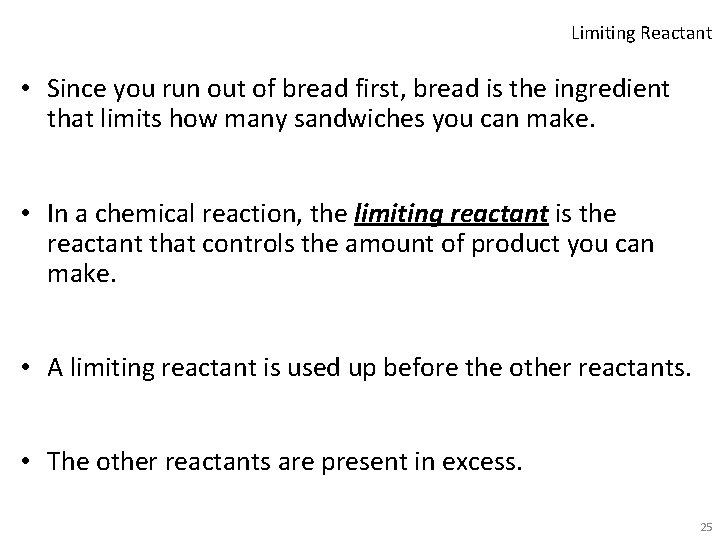
Limiting Reactant • Since you run out of bread first, bread is the ingredient that limits how many sandwiches you can make. • In a chemical reaction, the limiting reactant is the reactant that controls the amount of product you can make. • A limiting reactant is used up before the other reactants. • The other reactants are present in excess. 25
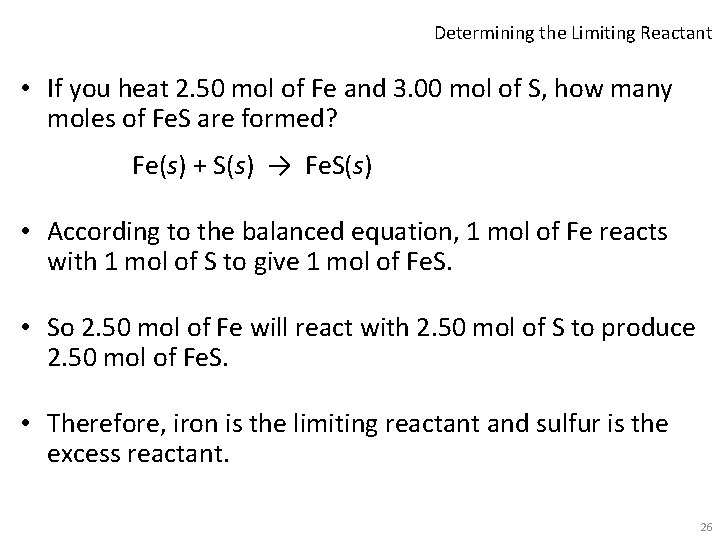
Determining the Limiting Reactant • If you heat 2. 50 mol of Fe and 3. 00 mol of S, how many moles of Fe. S are formed? Fe(s) + S(s) → Fe. S(s) • According to the balanced equation, 1 mol of Fe reacts with 1 mol of S to give 1 mol of Fe. S. • So 2. 50 mol of Fe will react with 2. 50 mol of S to produce 2. 50 mol of Fe. S. • Therefore, iron is the limiting reactant and sulfur is the excess reactant. 26
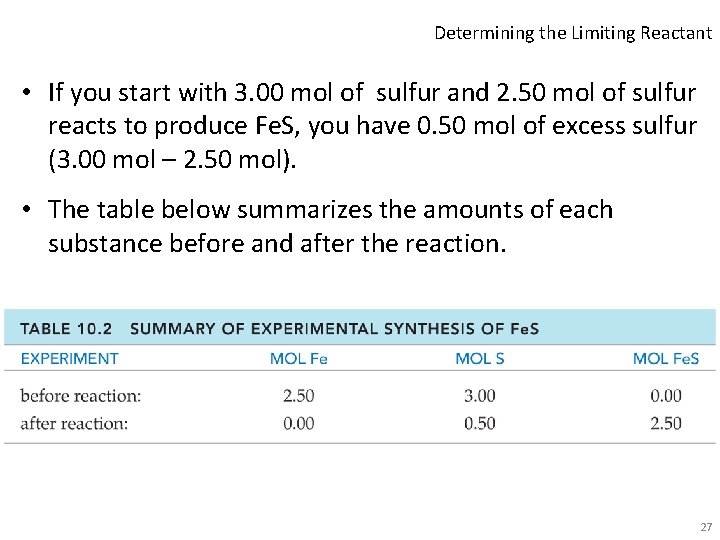
Determining the Limiting Reactant • If you start with 3. 00 mol of sulfur and 2. 50 mol of sulfur reacts to produce Fe. S, you have 0. 50 mol of excess sulfur (3. 00 mol – 2. 50 mol). • The table below summarizes the amounts of each substance before and after the reaction. 27
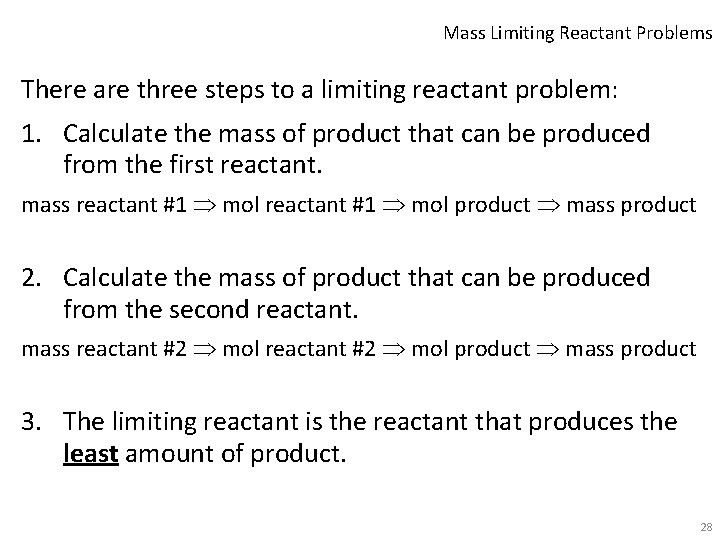
Mass Limiting Reactant Problems There are three steps to a limiting reactant problem: 1. Calculate the mass of product that can be produced from the first reactant. mass reactant #1 mol product mass product 2. Calculate the mass of product that can be produced from the second reactant. mass reactant #2 mol product mass product 3. The limiting reactant is the reactant that produces the least amount of product. 28
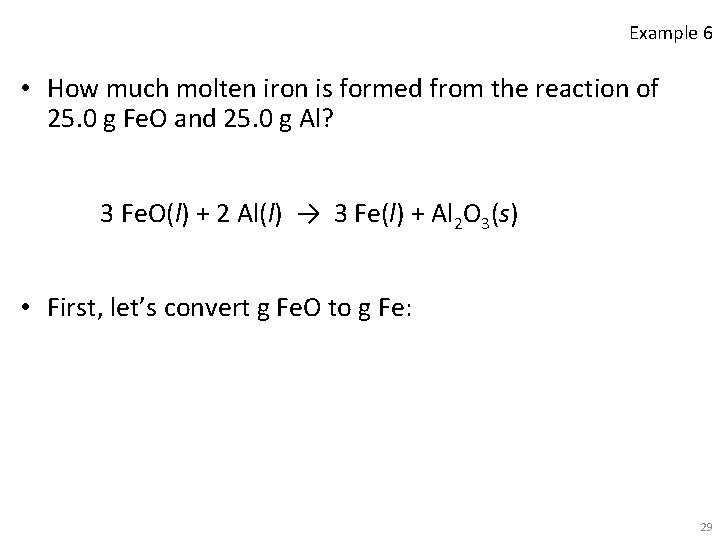
Example 6 • How much molten iron is formed from the reaction of 25. 0 g Fe. O and 25. 0 g Al? 3 Fe. O(l) + 2 Al(l) → 3 Fe(l) + Al 2 O 3(s) • First, let’s convert g Fe. O to g Fe: 29
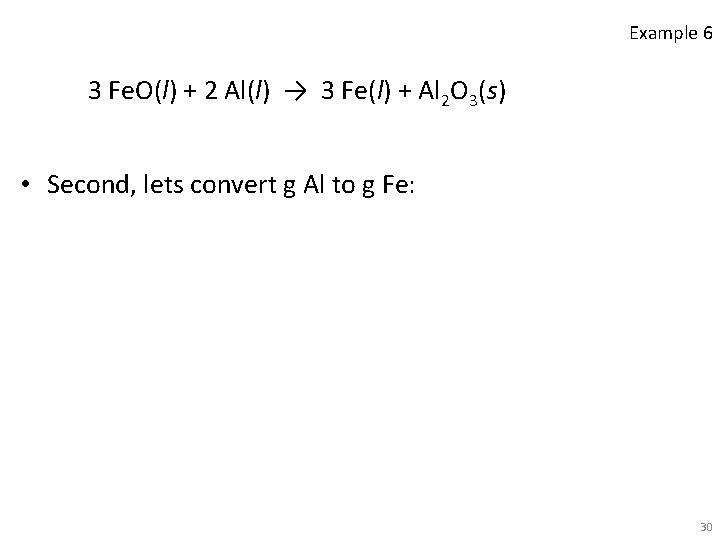
Example 6 3 Fe. O(l) + 2 Al(l) → 3 Fe(l) + Al 2 O 3(s) • Second, lets convert g Al to g Fe: 30
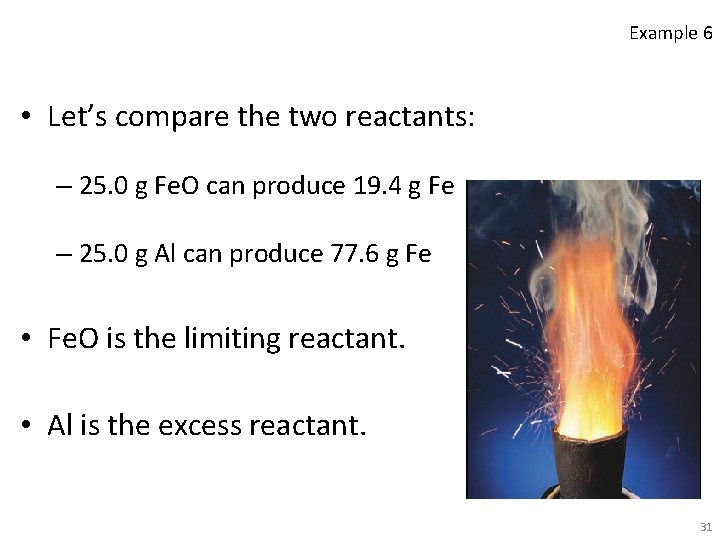
Example 6 • Let’s compare the two reactants: – 25. 0 g Fe. O can produce 19. 4 g Fe – 25. 0 g Al can produce 77. 6 g Fe • Fe. O is the limiting reactant. • Al is the excess reactant. 31
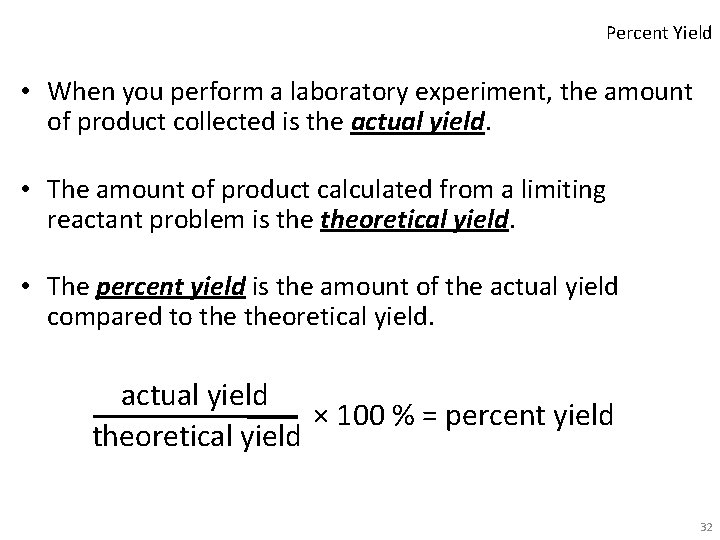
Percent Yield • When you perform a laboratory experiment, the amount of product collected is the actual yield. • The amount of product calculated from a limiting reactant problem is theoretical yield. • The percent yield is the amount of the actual yield compared to theoretical yield. actual yield × 100 % = percent yield theoretical yield 32
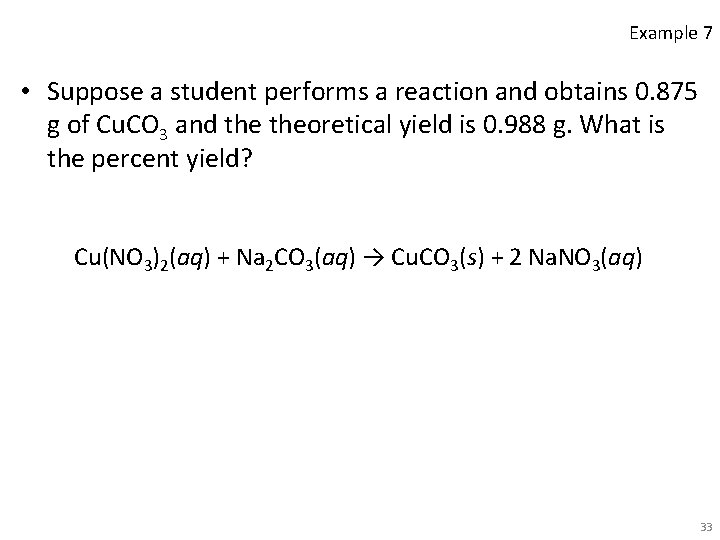
Example 7 • Suppose a student performs a reaction and obtains 0. 875 g of Cu. CO 3 and theoretical yield is 0. 988 g. What is the percent yield? Cu(NO 3)2(aq) + Na 2 CO 3(aq) → Cu. CO 3(s) + 2 Na. NO 3(aq) 33
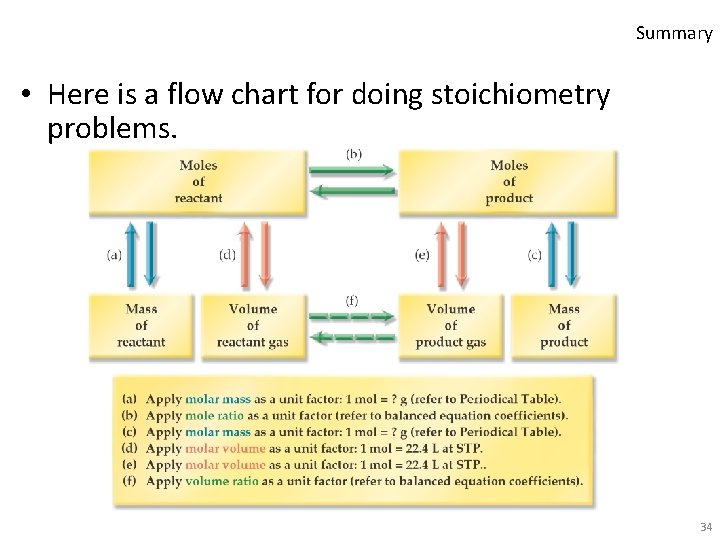
Summary • Here is a flow chart for doing stoichiometry problems. 34
- Slides: 34