
Ch 10 Business in a Global Economy Introduction
Ch. 10 – Business in a Global Economy Introduction to Business Mrs. Ellsworth 1
Global Producers & Consumers During the last 20 years the US & other nations have greatly relied on one another’s goods & services to remain prosperous. l Most countries don’t produce everything their citizens want. l A country may not have the resources needed. l Countries satisfy their citizens needs & wants by buying goods on the global market. l 2
The Global Marketplace Multinational Corporation – Does business in & has facilities & offices in many countries around the world. l No matter how much a country produces, it cannot make everything itself. l The US is rich in resources (human, natural & production) but it still needs things from other countries. l 3
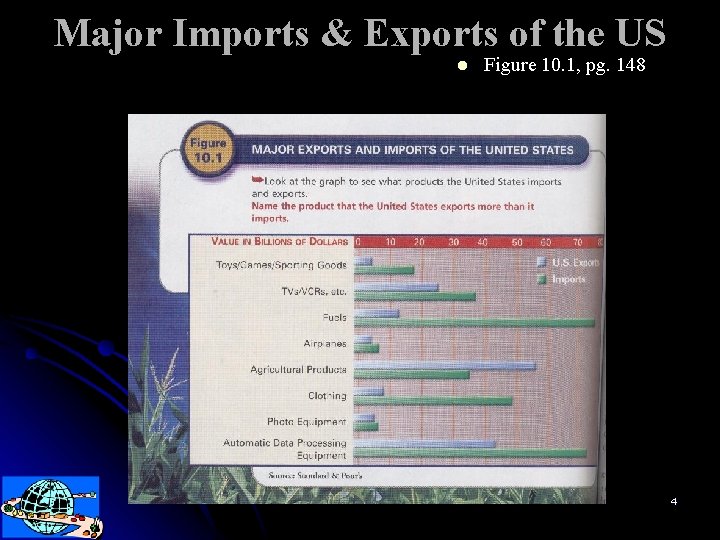
Major Imports & Exports of the US l Figure 10. 1, pg. 148 4

Specialization Few people produce ALL the goods & services they will ever need. l Individuals concentrate their activities in a particular area or field (carpenter, doctor). l Each worker’s money buys goods & services others have specialized in producing. l Countries specialize & trade some of the items they produce in order to gain the other countries goods & services. l 5
World’s Top Automobile Producers l l US, Japan & Germany They have the resources needed to produce a large volume of cars. l l These countries have a comparative advantage in producing cars. l l l Materials, technology, factories & labor force A strong area of producing compared to other ways they could use their resources. Other countries have decided they have a comparative advantage in producing something else. Money gained from the sales of the cars to other countries is then used to buy items other countries produce. 6
Types of resources available to a country influences what they specialize in producing. l Columbia’s comparative advantage is in coffee. l Resources needed: climate, soil & environmental conditions l US could produce coffee but it would require a costly controlled environment. 7
l. A country that has little $ or advanced technology, but a large population may specialize in manual labor – low wages. l Asia (S. Korea & Taiwan) l Assembling color televisions & color components. l Without trade you would have to produce everything yourself, making you unable to specialize. 8
l Countries specialize in certain goods or services so they can sell what they produce best. l They can then buy the products they need from other countries. l Some don’t have the capital resources to manufacture goods but have valuable natural resources. 9
l Kuwait – Producing Oil l Israel & Ireland – Rely on their culture to attract tourism. l US – has a wide range of resources so it can specialize in many products such as wheat, cars & movies. 10

Imports Types of Trade l Goods & services a country buys from another country. l The US imports: l Pepper from India l Bananas from Honduras l Coffee from Colombia 11
Exports l Goods & services one country sells to another country. l The US sells wheat & corn syrup to places like Mexico & Australia. 12
One countries exports are another countries imports. 13
Imports & Exports are not the only types of trade between countries l Invest in other countries l Build factories there, etc. l Exchange l Doctors, human resources managers, etc. 14
Currency (Money) l Just as different countries use different languages, they also have different currencies. l Americans use Dollar l Mexicans use Pesos l Japanese use Yen 15
Foreign Exchange Rates Made of banks where different currencies are exchanged. l Exchange rates – the price at which one currency can buy another currency. l Different currencies have different values. l Values change daily. l How much money a currency is worth depends on how much a country wants to buy its products. l 16

http: //www. x-rates. com/calculator. html 17
l If every country wants TV’s & VCR’s from Japan they will need Japanese Yen to buy them. l Demand increases for Japanese Yen making its value increase. l If no one wants products from Japan the value of the Yen will decrease. 18
Prices l Favorable Exchange Rate – when the value of a countries currency goes up compared to another countries. l A country with a favorable exchange rate can buy more Unfavorable Exchange Rate – When the value goes down. l Balance of Trade – Difference in the value of how much a country imports & how much they export. l 19

Surplus vs. Deficit l Trade surplus – when a country exports more than it imports. l l Trade deficit – when a country imports more than it exports. l l It has money left over to buy more products. It means it is in debt. A country can have an unfavorable balance of trade with 1 country & a favorable balance of trade with another. 20
Fast Review pg. 152 l Quiz – Explain what trade is. l Explain exchange rates. l Why would a country want to devalue its currency? l Go online & research trade barriers print, read & highlight an article on trade barriers, tarriff, quota, embargo 21
Global Competition l Countries benefit by purchasing one another’s products. l Trade disputes can arise, usually about limiting & restricting trade. l 2 Opposing points of view l Free trade l Protectionism 22
Protectionism l Putting limits on foreign trade to protect businesses at home. l Why? Most countries sell what they produce at home so they often want to keep out foreign competitors. 23
Reasons FOR Protectionism Foreign competitors can lower the demand for products made at home. l Companies at home need to be protected from unfair foreign competition. l Industries that make products related to national defense need to be protected such as satellites, aircraft, weapons. l Cheap labor in other countries can lower wages or threaten jobs at home. l A country can become too dependent on another country for important products such as oil, steel, grain, etc. . l 24
Why have trade barriers? ? ? l To keep foreign products out!!! l US & Brazil both produce sugar, but Brazil can sell it to the US for less. l There are 3 ways the US can protect the sugar producers at home. l Tariff l Quota l Embargo 25
l Tariff – a tax placed on imports to increase their price in the domestic market. l Quota - a limit is placed on the quantities of a product that can be imported. l Embargo – government decides to stop an import or export of a product. l Very rare l Usually used for political or military reasons 26
Free Trade l Free trade believes that there should be no limits on trade. l There are both benefits & detriments to free trade. 27
Benefits of Free Trade l It opens new markets in other countries. l l It creates new jobs. l l Especially in banking, shipping, communications Competition forces businesses to be more efficient & productive. More product choices for consumers. l l Instead of 250 million potential customers in only the US, there are 6 billion world-wide. Variety, price & quality Promotes cultural understanding & cooperation between countries. Helps all countries raise their standards of living. 28
Trade Alliances l Formed to reduce limits on trade l Several countries merge their economies into 1 huge market. l Major Trade Alliances l NAFTA (North American Free Trade Agreement) l EU (European Union) l ASEAN (Assoc. of South Eastern Asian Nations) 29
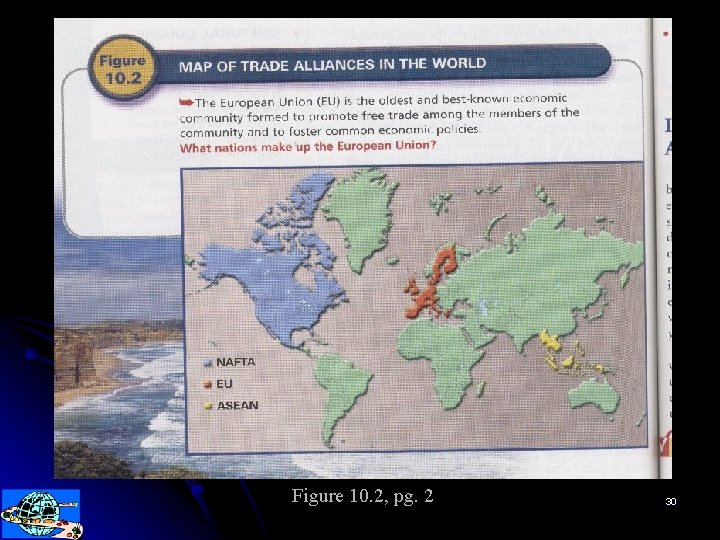
Figure 10. 2, pg. 2 30
NAFTA (North American Free Trade Agreement) Combined the economies of US, Canada & Mexico. l It is easier for the US to buy oil from Mexico & sell its cars there. l Disadvantage: NAFTA was controversial because some workers would be displaced when barriers were lowered. l 31
International Business & Finance Citizens should understand international trade in order to make decisions in the polling booth. l Helps you understand why goods & services are at particular prices. l To understand why you can buy more goods in some countries than in others. l Business leaders of tomorrow will have a good grasp of international business & finance. l 32
Fast Review, pg. 135 l What is a trade war? l What are some of the major trade alliances in the world today? 33
- Slides: 33