
Ch 1 THE COLONIZATION OF AMERICA European movement
- Slides: 57
Ch. 1: THE COLONIZATION OF AMERICA
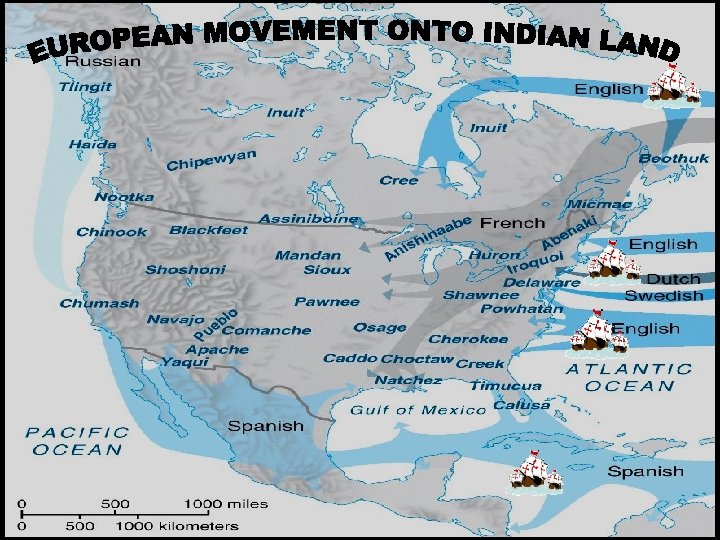
European movement
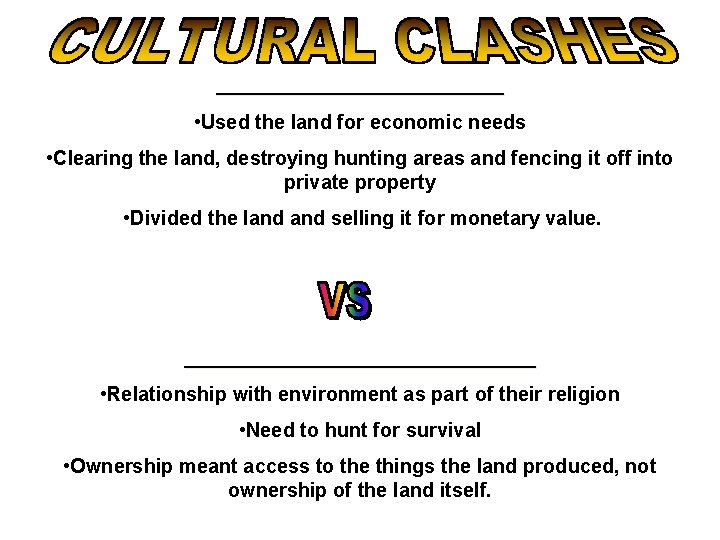
________________ • Used the land for economic needs • Clearing the land, destroying hunting areas and fencing it off into private property • Divided the land selling it for monetary value. ____________________ • Relationship with environment as part of their religion • Need to hunt for survival • Ownership meant access to the things the land produced, not ownership of the land itself.
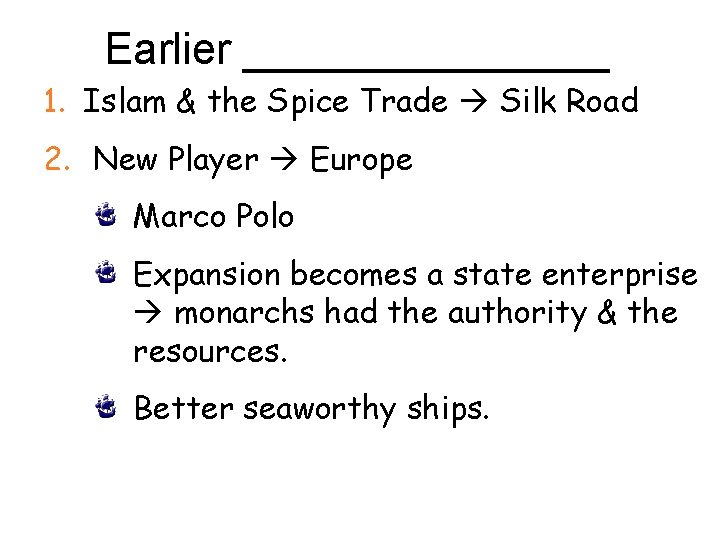
Earlier ________ 1. Islam & the Spice Trade Silk Road 2. New Player Europe Marco Polo Expansion becomes a state enterprise monarchs had the authority & the resources. Better seaworthy ships.
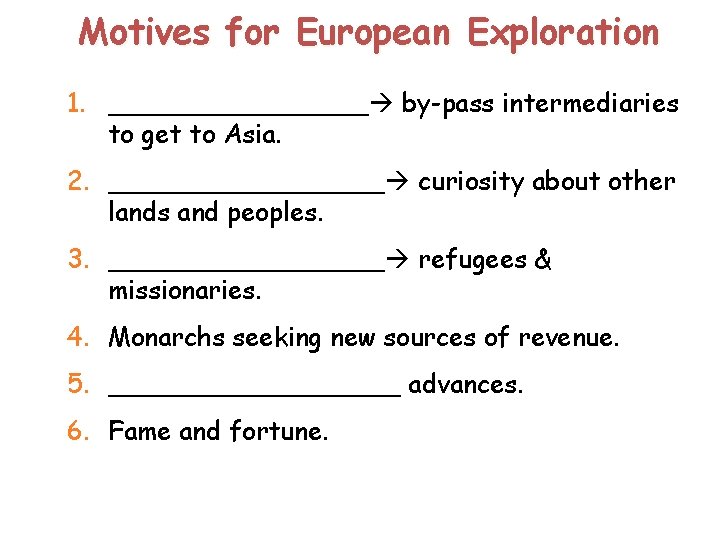
Motives for European Exploration 1. ________ by-pass intermediaries to get to Asia. 2. _________ curiosity about other lands and peoples. 3. _________ refugees & missionaries. 4. Monarchs seeking new sources of revenue. 5. _________ advances. 6. Fame and fortune.
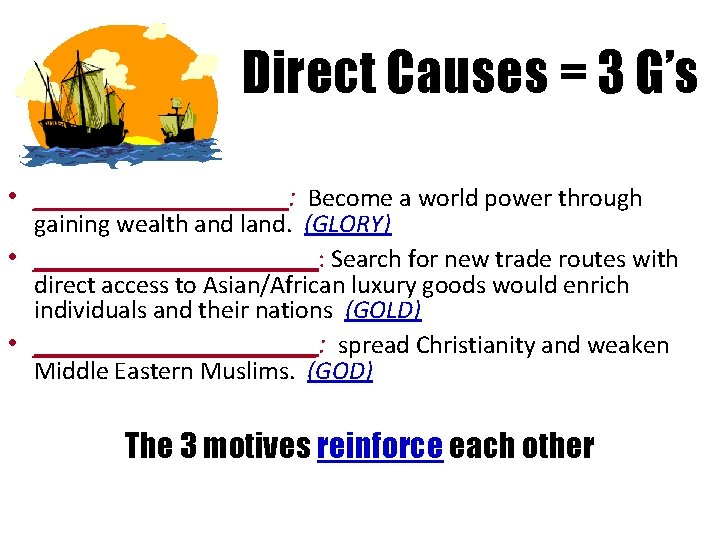
Direct Causes = 3 G’s • _________: Become a world power through gaining wealth and land. (GLORY) • __________: Search for new trade routes with direct access to Asian/African luxury goods would enrich individuals and their nations (GOLD) • __________: spread Christianity and weaken Middle Eastern Muslims. (GOD) The 3 motives reinforce each other
EFFECTS • Europeans reach and settle Americas • Expanded knowledge of world ______________ • Growth of __________, mercantilism and capitalism • __________conflicts over land impact of disease on Indian populations • Introduction of the institution of _____________ • ____________________
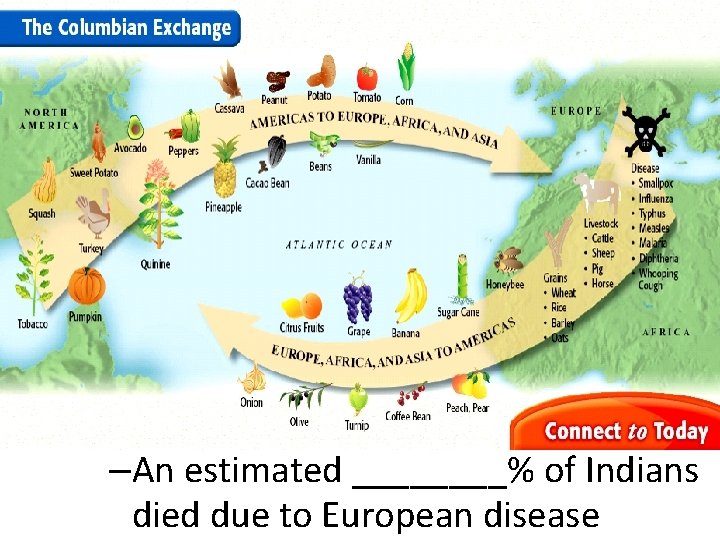
The Columbian Exchange • The arrival of Europeans led to the introduction of new products between Indians & Europeans called the Columbian Exchange: –Indians introduced corn, tobacco, potatoes, peanuts to whites –Europeans introduced horses, livestock, citrus, & diseases –An estimated ____% of Indians died due to European disease
European Colonization • Once the New World is discovered, the Big 4 four European countries begin competing for control of North America and the world…. – __________________ • This power struggle ultimately leads to several wars.
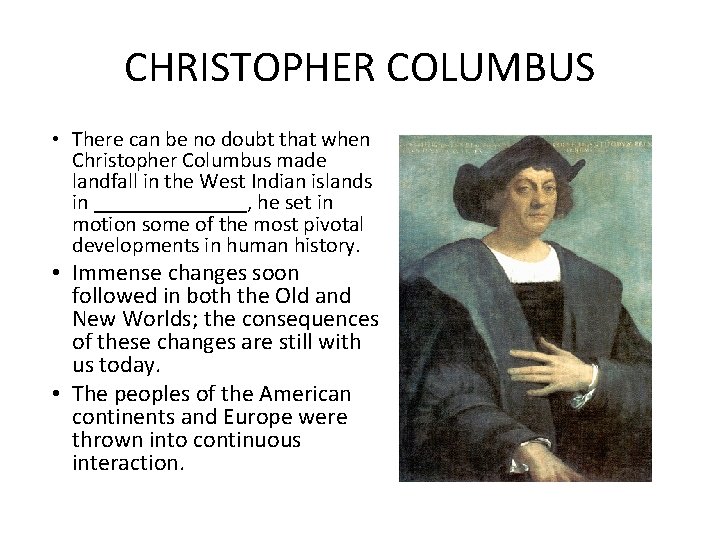
CHRISTOPHER COLUMBUS • There can be no doubt that when Christopher Columbus made landfall in the West Indian islands in _______, he set in motion some of the most pivotal developments in human history. • Immense changes soon followed in both the Old and New Worlds; the consequences of these changes are still with us today. • The peoples of the American continents and Europe were thrown into continuous interaction.
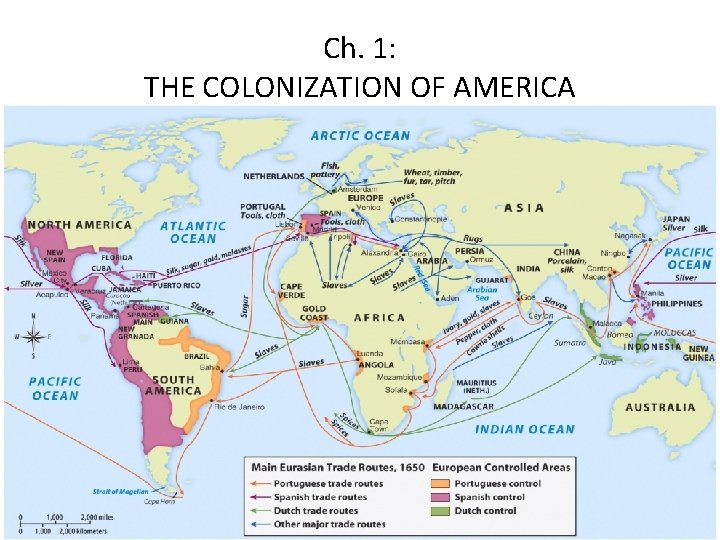
THE EXPANSION OF EUROPE The European conquest of America began as an offshoot of the quest for a sea route to India, China, and the islands of the East Indies – the source of the _____________________, and other luxury items on which international trade in the early modern era centered.
THE EXPANSION OF EUROPE • For centuries, this commerce had been conducted across land, from _____and South Asia to the _________and the Mediterranean region. • ___________– the desire to eliminate Islamic middlemen and win control of the lucrative trade for Christian Western Europe – combined to inspire the quest for a direct route to Asia.
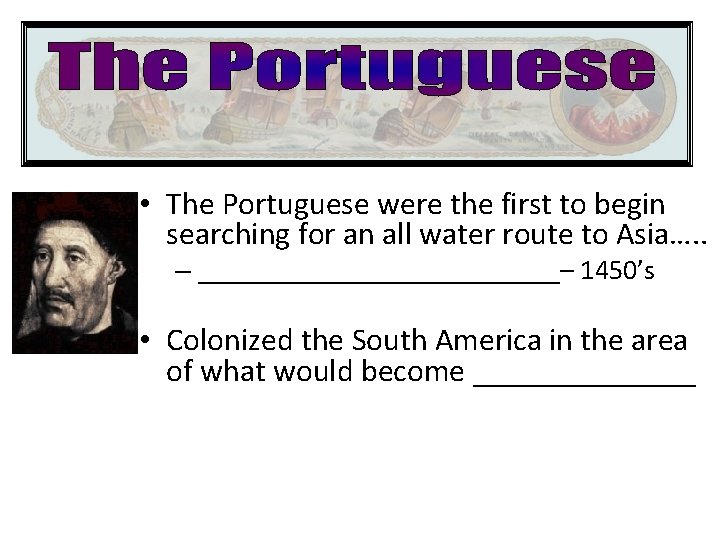
European Colonization • The Portuguese were the first to begin searching for an all water route to Asia…. . – _____________– 1450’s • Colonized the South America in the area of what would become _______
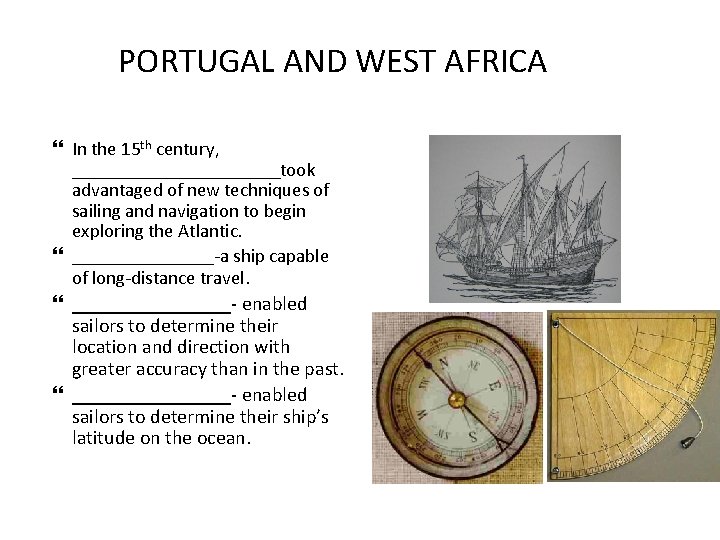
PORTUGAL AND WEST AFRICA In the 15 th century, ___________took advantaged of new techniques of sailing and navigation to begin exploring the Atlantic. ________-a ship capable of long-distance travel. ________- enabled sailors to determine their location and direction with greater accuracy than in the past. ________- enabled sailors to determine their ship’s latitude on the ocean.
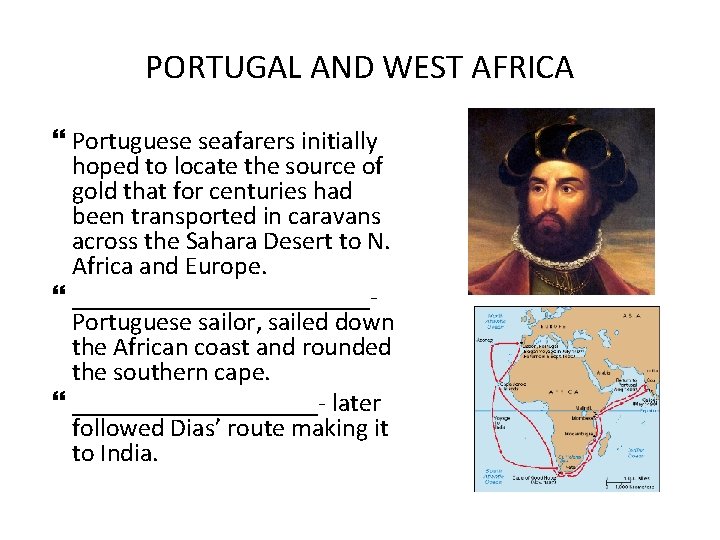
PORTUGAL AND WEST AFRICA Portuguese seafarers initially hoped to locate the source of gold that for centuries had been transported in caravans across the Sahara Desert to N. Africa and Europe. ____________Portuguese sailor, sailed down the African coast and rounded the southern cape. __________- later followed Dias’ route making it to India.
PORTUGAL AND WEST AFRICA • Until 1434, however, no European sailor had seen the coast of Africa below the _________, or the forest kingdom south of Mali that contained the actual gold fields. • But in that year, a Portuguese ship brought a ship of rosemary from ________, proof that one could sail beyond the desert and return.
THE VOYAGES OF COLUMBUS • Like all navigators of his time, Columbus knew that the earth was round. • He believed by sailing westward he could quickly cross the _______and reach ________. • No one knew that two giant ________ existed 3, 000 miles to the west.
THE VOYAGES OF COLUMBUS • Most of his contemporaries knew that he had underestimated the earth’s size. • This helps explain why he had difficulty getting the needed financial support. • Columbus’ brother even visited Henry VII of England seeking financial support to no avail.
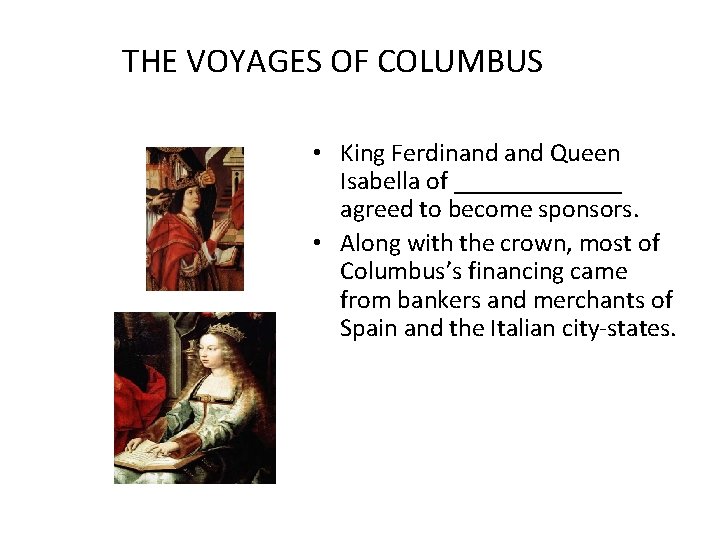
THE VOYAGES OF COLUMBUS • King Ferdinand Queen Isabella of _______ agreed to become sponsors. • Along with the crown, most of Columbus’s financing came from bankers and merchants of Spain and the Italian city-states.
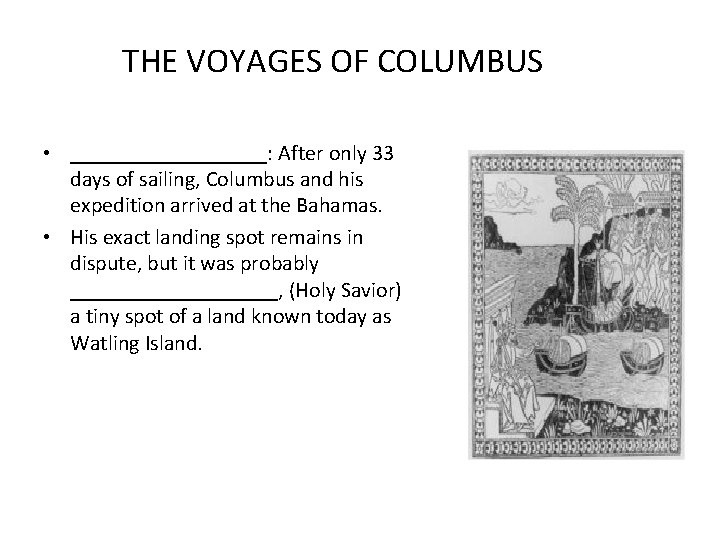
THE VOYAGES OF COLUMBUS • _________: After only 33 days of sailing, Columbus and his expedition arrived at the Bahamas. • His exact landing spot remains in dispute, but it was probably __________, (Holy Savior) a tiny spot of a land known today as Watling Island.
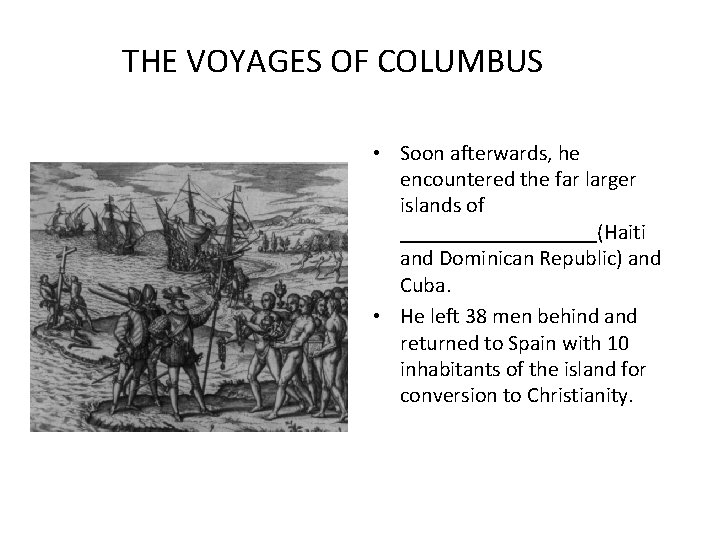
THE VOYAGES OF COLUMBUS • Soon afterwards, he encountered the far larger islands of _________(Haiti and Dominican Republic) and Cuba. • He left 38 men behind and returned to Spain with 10 inhabitants of the island for conversion to Christianity.
THE VOYAGES OF COLUMBUS • 1493: European colonization of the New World began. • Columbus returned with 17 ships and over a 1, 000 men to explore the area and establish a Spanish outpost. • Columbus’s settlement on Hispaniola, which he named La Isabella, failed. • Before he died in 1506, Columbus made _____more voyages to the New World in 1498 and 1502. • He went to his grave believing he had discovered a ________ route to Asia.
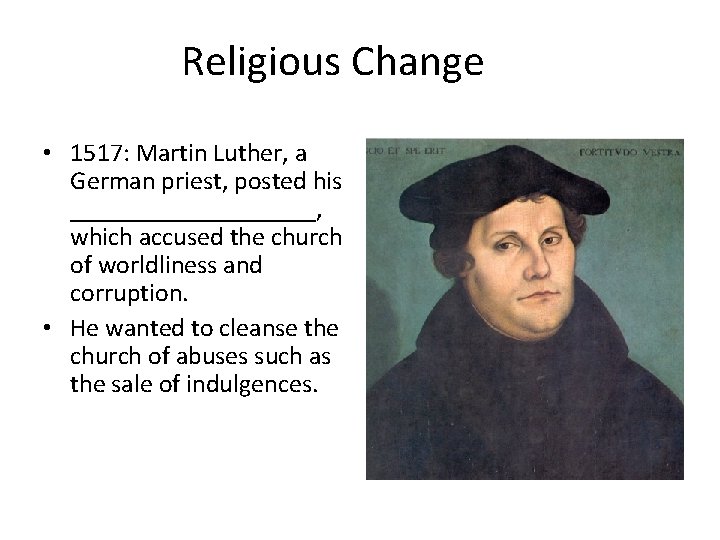
Religious Change • 1517: Martin Luther, a German priest, posted his __________, which accused the church of worldliness and corruption. • He wanted to cleanse the church of abuses such as the sale of indulgences.
MARTIN LUTHER • Luther insisted that all believers read the _____for themselves, rather than relying of priests to interpret it for them. • His call for reform led to the rise of new Protestant churches independent of Rome and plunged Europe into more than a century of _______and ________strife.
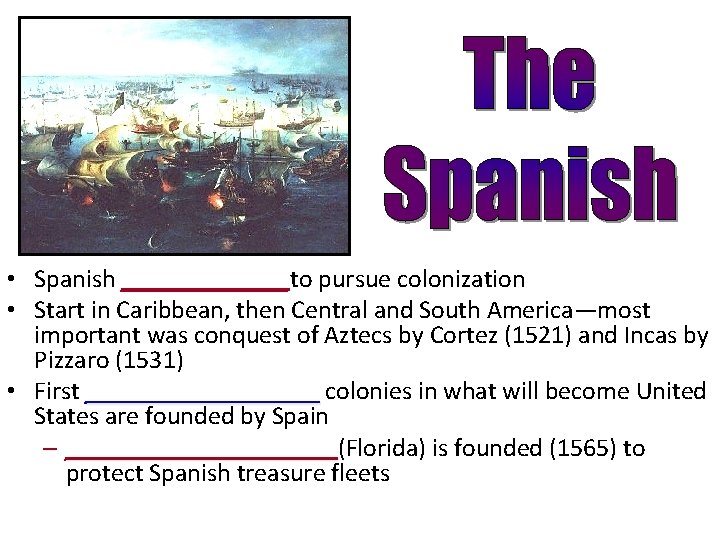
• Spanish _______to pursue colonization • Start in Caribbean, then Central and South America—most important was conquest of Aztecs by Cortez (1521) and Incas by Pizzaro (1531) • First _________ colonies in what will become United States are founded by Spain – ___________(Florida) is founded (1565) to ___________ protect Spanish treasure fleets
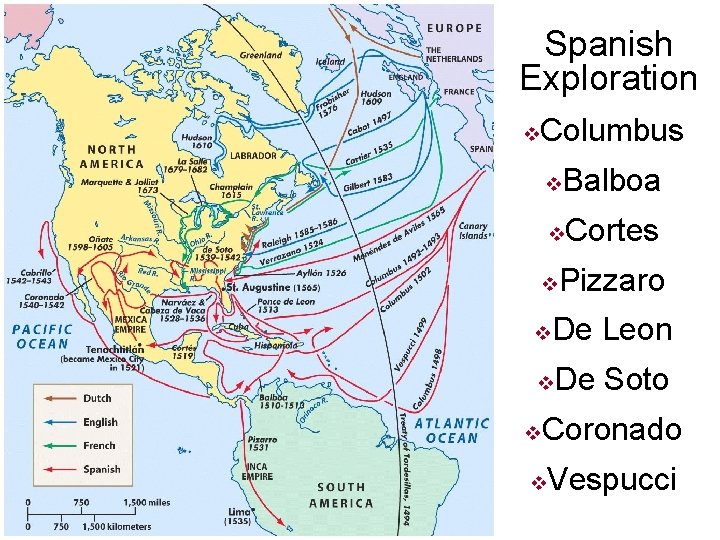
Spanish Exploration v Columbus v Balboa v v v Pizzaro De Leon v v Cortes De Soto Coronado v Vespucci
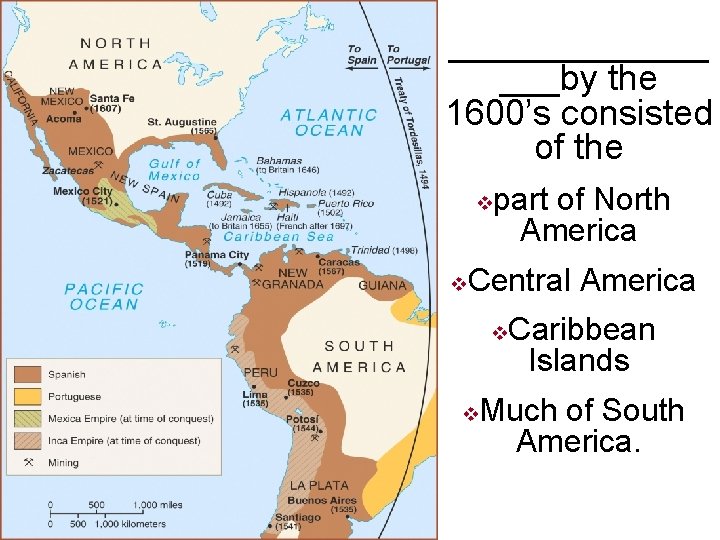
_______ ___by the 1600’s consisted of the v v part of North America Central America v v Caribbean Islands Much of South America.
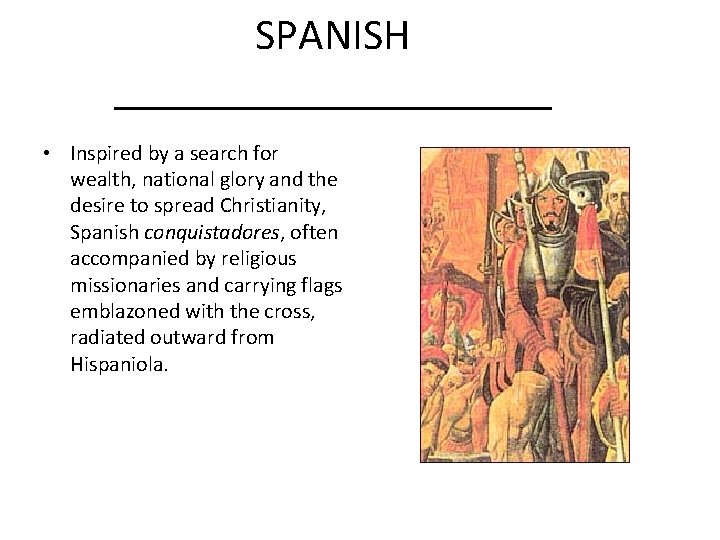
SPANISH __________ • Inspired by a search for wealth, national glory and the desire to spread Christianity, Spanish conquistadores, often accompanied by religious missionaries and carrying flags emblazoned with the cross, radiated outward from Hispaniola.
• Spanish soldiers who came to the New World to help conquer and settle the Americas for Spain. • Some of their methods were harsh and brutal especially to the _________population. • With every Spanish explorer were conquistadors and members of the ____________ to convert Native Americans.
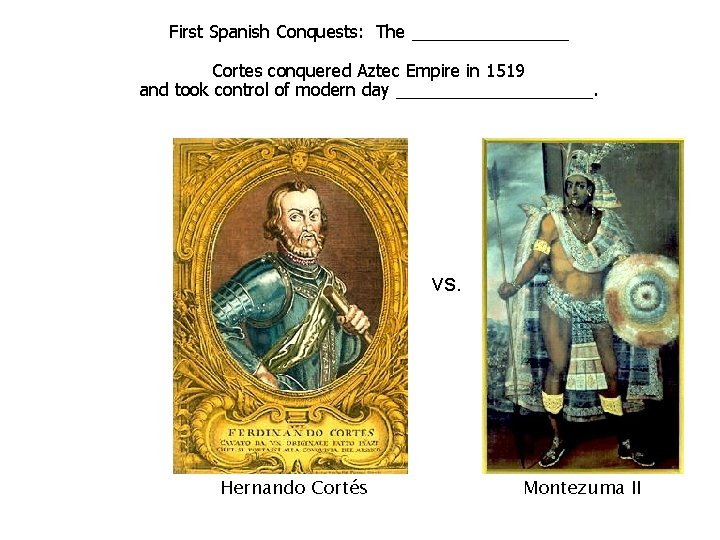
First Spanish Conquests: The ________ Cortes conquered Aztec Empire in 1519 and took control of modern day __________. vs. Hernando Cortés Montezuma II
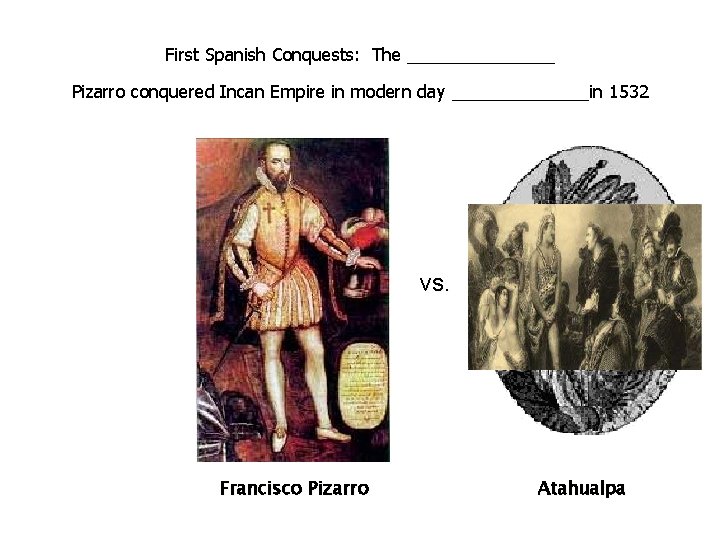
First Spanish Conquests: The ________ Pizarro conquered Incan Empire in modern day _______in 1532 vs. Francisco Pizarro Atahualpa
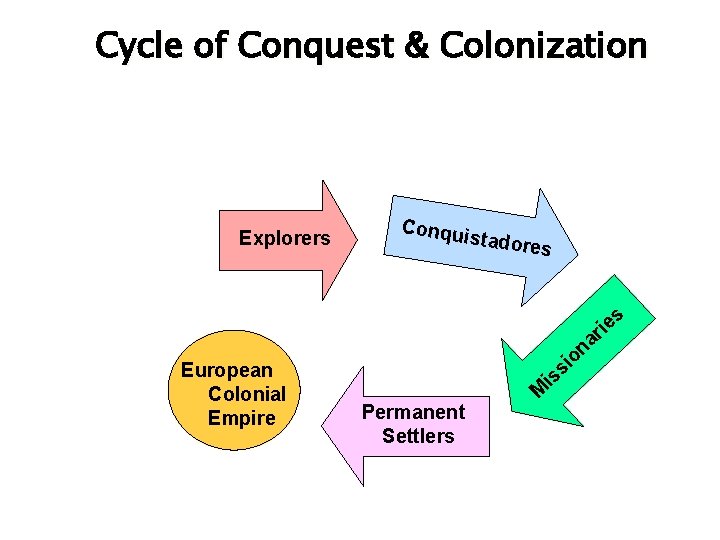
Cycle of Conquest & Colonization Explorers Conqui stadore s s rie European Colonial Empire i a n o s is Permanent Settlers M
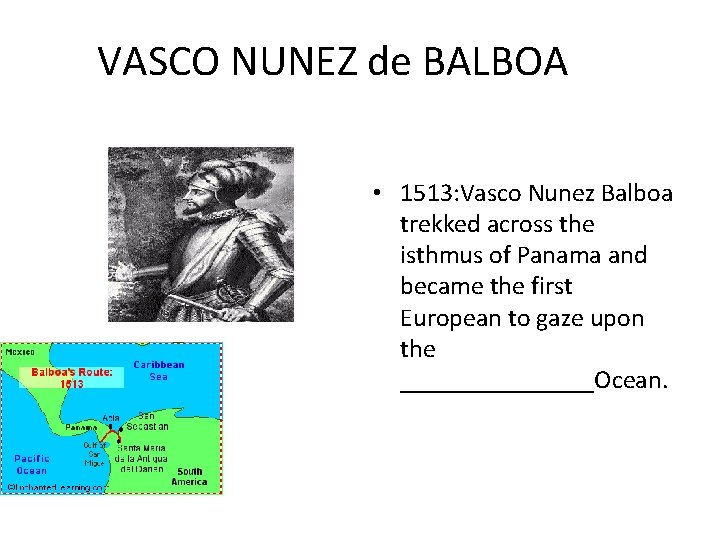
VASCO NUNEZ de BALBOA • 1513: Vasco Nunez Balboa trekked across the isthmus of Panama and became the first European to gaze upon the ________Ocean.
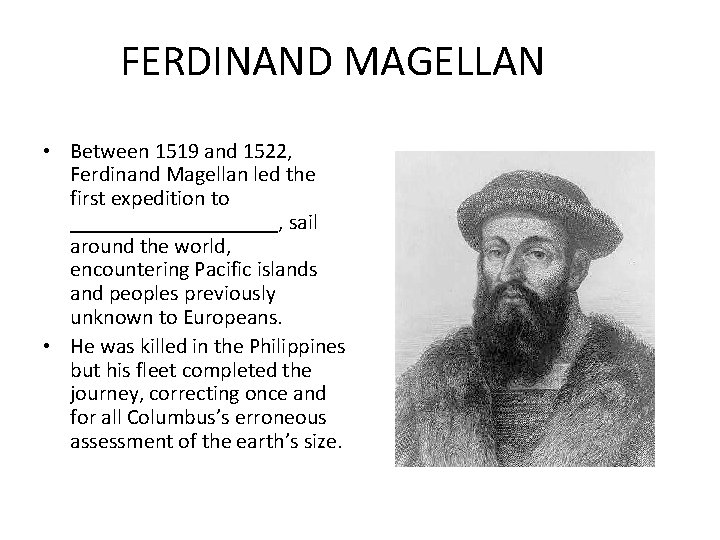
FERDINAND MAGELLAN • Between 1519 and 1522, Ferdinand Magellan led the first expedition to __________, sail around the world, encountering Pacific islands and peoples previously unknown to Europeans. • He was killed in the Philippines but his fleet completed the journey, correcting once and for all Columbus’s erroneous assessment of the earth’s size.
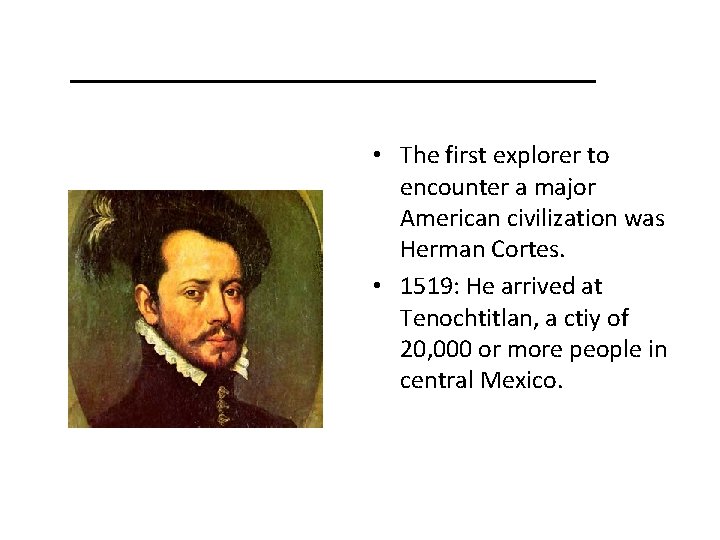
____________ • The first explorer to encounter a major American civilization was Herman Cortes. • 1519: He arrived at Tenochtitlan, a ctiy of 20, 000 or more people in central Mexico.
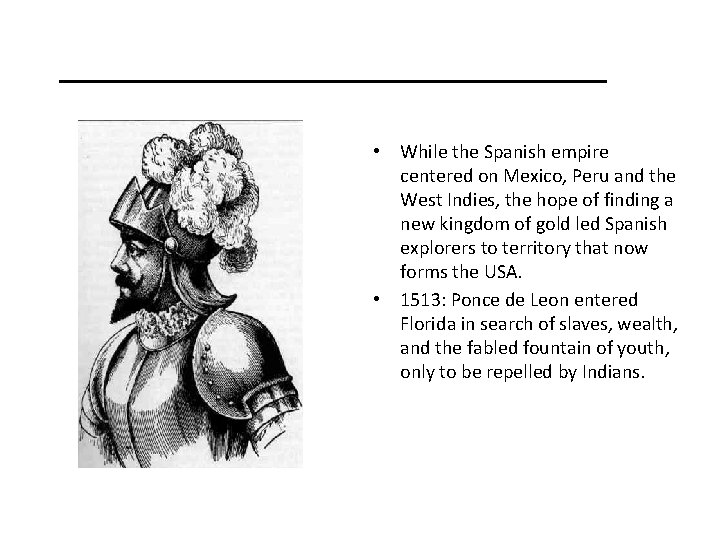
_____________ • While the Spanish empire centered on Mexico, Peru and the West Indies, the hope of finding a new kingdom of gold led Spanish explorers to territory that now forms the USA. • 1513: Ponce de Leon entered Florida in search of slaves, wealth, and the fabled fountain of youth, only to be repelled by Indians.
SPAIN IN NORTH AMERICA • Expeditions led by Hernando de Soto, Cabeza de Vaca, and Franciso de Coronado marched through the Gulf region and Southwest fruitlessly searching for another Mexico or Peru. • Coronado explored much of the interior of the continent, reaching as far north as the _________, and became the first European to encounter the immense herds of buffalo that roamed the West.
SPAIN IN NORTH AMERICA • These explorations established Spain’s claim to a large part of what is now the American South and __________. • The first region within the present-day USA to be colonized was _________.
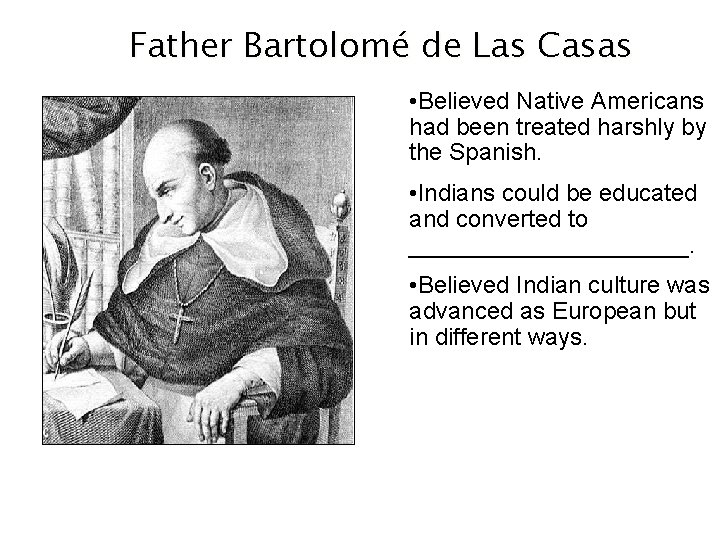
Father Bartolomé de Las Casas • Believed Native Americans had been treated harshly by the Spanish. • Indians could be educated and converted to ___________. • Believed Indian culture was advanced as European but in different ways.
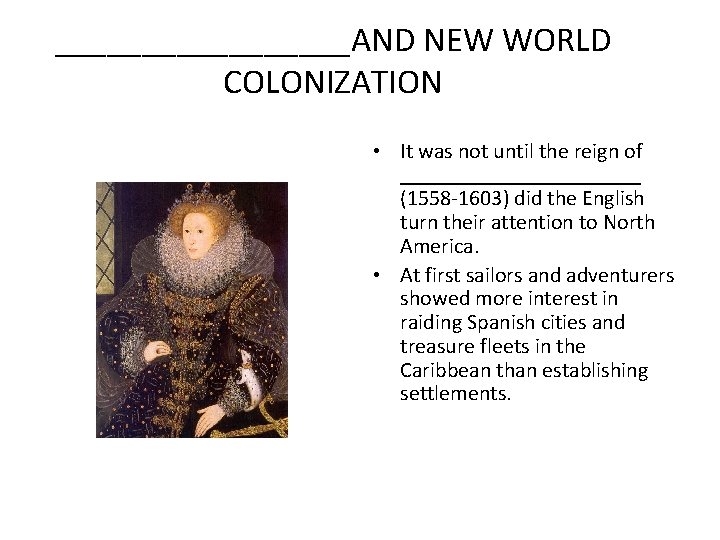
_________AND NEW WORLD COLONIZATION • It was not until the reign of ___________ (1558 -1603) did the English turn their attention to North America. • At first sailors and adventurers showed more interest in raiding Spanish cities and treasure fleets in the Caribbean than establishing settlements.
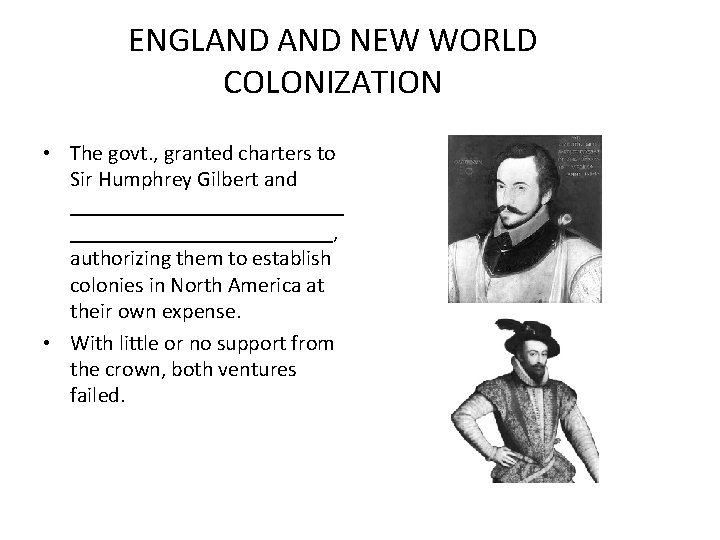
ENGLAND NEW WORLD COLONIZATION • The govt. , granted charters to Sir Humphrey Gilbert and _____________, authorizing them to establish colonies in North America at their own expense. • With little or no support from the crown, both ventures failed.
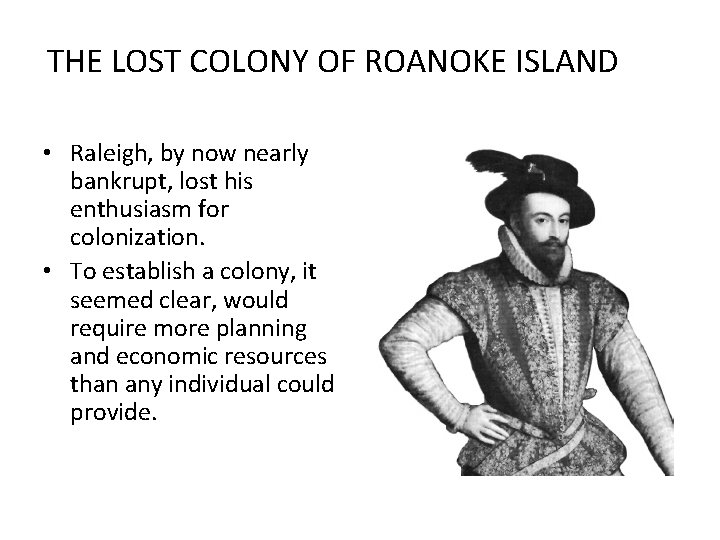
THE LOST COLONY OF _______ISLAND • 1585: Sir Walter Raleigh dispatched a fleet of five ships and some 100 colonists to set up a base on Roanoke Island, off the coast of _______, partially to facilitate continuing raids on Spanish shipping. • But the colonists, mostly young men under military leadership, abandoned the venture in 1586 and returned to England.
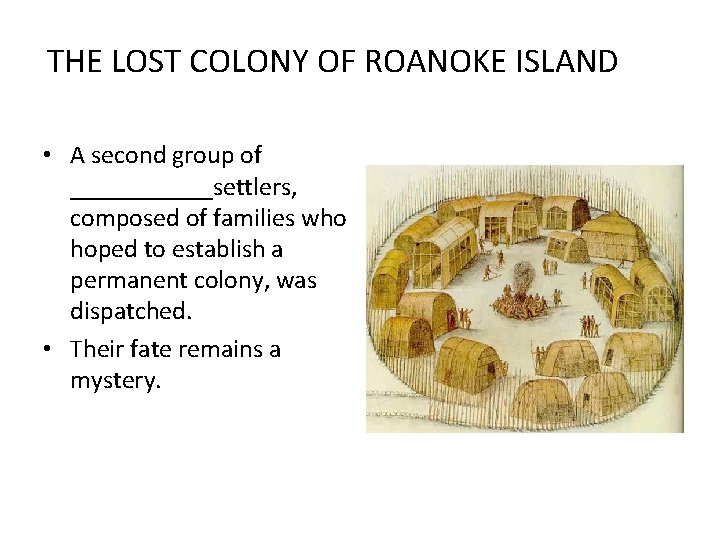
THE LOST COLONY OF ROANOKE ISLAND • A second group of ______settlers, composed of families who hoped to establish a permanent colony, was dispatched. • Their fate remains a mystery.
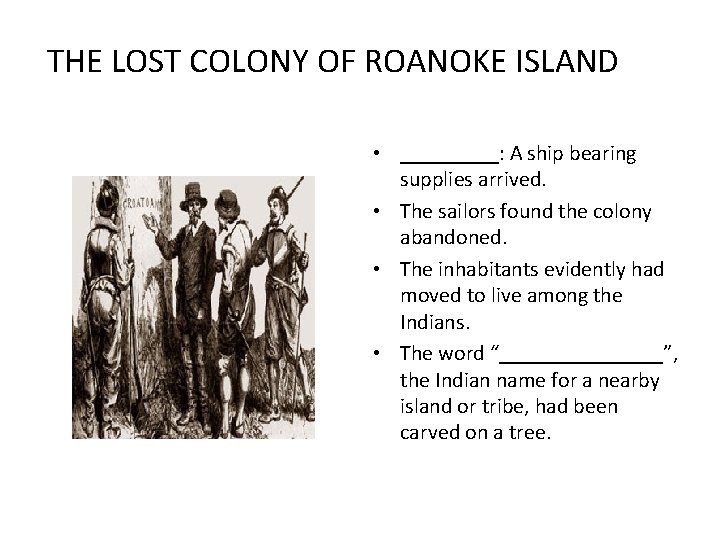
THE LOST COLONY OF ROANOKE ISLAND • _____: A ship bearing supplies arrived. • The sailors found the colony abandoned. • The inhabitants evidently had moved to live among the Indians. • The word “________”, the Indian name for a nearby island or tribe, had been carved on a tree.
THE LOST COLONY OF ROANOKE ISLAND • Raleigh, by now nearly bankrupt, lost his enthusiasm for colonization. • To establish a colony, it seemed clear, would require more planning and economic resources than any individual could provide.
ENGLAND NEW WORLD COLONIZATION • As in the case of Spain, national glory, profit, and religious mission emerged in early English thinking about the ___________. • The __________heightened the English government’s sense of Catholic Spain as its mortal enemy. • England expressed its imperial ambitions in terms of an obligation to liberate the New World from the tyranny of the pope.
ENGLAND NEW WORLD COLONIZATION • By the late 16 th century, _____________ had become deeply ingrained in English popular culture. • Reports of the atrocities of Spanish rule were widely circulated. • English translations of de la Casas’s writings appeared during Elizabeth’s reign. • The idea that the empire of Catholic Spain was murderous and tyrannical enabled the English to describe their own imperial ambitions in the language of ____________.
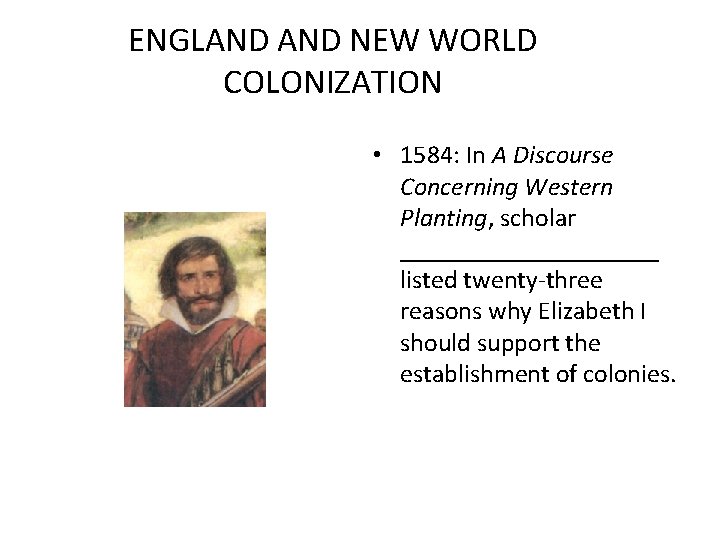
ENGLAND NEW WORLD COLONIZATION • 1584: In A Discourse Concerning Western Planting, scholar __________ listed twenty-three reasons why Elizabeth I should support the establishment of colonies.
ENGLAND NEW WORLD COLONIZATION • Among them was the idea that English settlements would strike a blow against Spain’s empire. • English colonization would be a ________mission to rescue the New World and its inhabitants from the influence of Catholicism and tyranny.
ENGLAND NEW WORLD COLONIZATION • _________would repeat much of Spain’s behavior in the New World. • But the English always believed that they were unique. • In their case, empire and freedom would go hand in hand.
ENGLAND NEW WORLD COLONIZATION • But bringing freedom to Indians was hardly the only argument Hakluyt made. • National ______and _____were never far from the era’s propagandists of empire. • Through colonization, England, a relatively minor power in Europe at the end of the 16 th century, could come to rival the wealth and standing of great nations like Spain and France.
ENGLAND NEW WORLD COLONIZATION • Equally important, ________could be a refuge for England’s “surplus” population, benefiting the mother country and emigrates. • The late 16 th century was a time of crisis for England, with economic growth unable to keep pace with the needs of a population that grew from 3 million in 1550 to about 4 million in 1600.
Roanoke Quick Review In 1585 they landed on Roanoke Island (off of the coast of North Carolina). ◦ Within a year, food grew short. ◦ They began to quarrel with local Indians. ◦ ___________was sent back to England returns with new settlers, including women and children. ◦ ____________is born. She is the first British child born in North America. ◦ Supplies run low again and White returns to England to resupply. It takes him three years to return. ◦ When he does return, all of Roanoke’s settlers are gone. Their disappearance is still a mystery.
• French settle _______(1608) & Montreal (1642) and what would become Canada – Control ______________& access to interior of North America – Develop a _______trade – Coureurs du bois (independent woodsman)
Explorers Sailing For France • _________- France - Reached St. Lawrence River - Claimed Eastern Canada for France – 1535 • ___________- France - “Father of New France” - Established Quebec (the 1 st permanent French colony in N. America) - Established settlements and explored Maine, Montreal & Nova Scotia - 1608
European Colonization • Like French, ________focus on fur trade & ________ send only a few men to settlements – Found Albany (New York, 1614) on Hudson River – ____________(becomes New York) is an extension of the Dutch global trade system • Dutch & French form alliances with Native Americans—increase warfare & _______ (Dutch ally) defeat Hurons
Explorers Sailing For The Netherlands • ______________________ English sailing for the Dutch - Searching for Northwest Passage - Claimed Hudson River - Settlers established New Netherlands (New York) - 1609