
CH 1 INTRODUCTION TO COMMODITY MARKET HISTORY ORIGIN













- Slides: 53
CH. 1 INTRODUCTION TO COMMODITY MARKET
HISTORY & ORIGIN OF COMMODITY MARKET Barter System Commodities trading originated in Sumeria Clay tokens were used as medium of exchange Animals were the first commodity traded Internationalization of commodities trade began after the European Voyages of Discovery • Volumes of trade increased • Commodity exchanges were developed in France & England in 15 th, 16 th & 17 th Centuries. • • •
• During the first half of the second millennium, India & China had trading arrangements with Southeast Asia, Eastern Europe, the Islamic countries & the Mediterranean nations. • Improvement in transport technologies & development of shipping industry facilitated growth in international commodity trade • In 1340 s Europe & Middle East was attacked by killer plague which reduced the population of those region by 1/3, this was known as ‘Black Death’. • This resulted in more per capita income for individuals, due to which demand for luxuries increased.
• This increased the trade between Europe & Eastern region which in turn led to increased dependence on Indian Ocean trade routes & thus led to the discovery of sea route to Asia. • In the 19 th century, US businessmen began to organize forums in the market to make the trade easier. • In the 1840 s, Chicago had become a commercial centre since it has good railroad & telegraph lines connecting it with the East. • At this time, good agriculture technologies were developed which led to higher wheat production.
• Midwest farmers used to come to Chicago to sell their wheat to dealers, who in turn transported it to all over the country. • The city had very limited storage facilities & hence, the farmers were often left at the mercy of the dealers. • The situation changed in 1848, when a central market place was opened for farmers & dealers could meet to take the wheat in exchange for cash. • Farmers & dealers slowly started entering into contract forward exchanges of grain for cash to avoid the trouble of transporting & storing wheat.
• This system of forward contracts was suitable to farmers as well dealers. • The farmer knew how much he would be paid for his wheat, & the dealer knew his costs of purchasing well in advance. • If the dealer decided he didn’t want the wheat, he would sell the contract to someone else who needed it, & if the farmer didn’t want to deliver his wheat, he could pass on the contractual obligation to another farmer. • The price of the contract would fluctuate depending on the situation in the wheat market
• Slowly, even those individuals who had no intention of ever buying or selling wheat began trading in these contracts expecting to make some profits based on their knowledge of the situation in the market for wheat. • They were called speculators. • They hoped to buy (Long position) contracts at low price & sell (Short position) them at high price & buy again later at low price. • This is how the futures market developed in the U. S • The hedgers began to transfer their risk to speculators by trading in futures exchanges.
• It is believed that the futures trade first started about approximately 6, 000 years ago in China with rice as the commodity. • Futures trade first started in Japan in 17 th century. • The first organized futures market was the Osaka Rice Exchange, in 1730. • Historically, organized trading in futures began in the US in the mid 19 th Century with maize contracts at the Chocago Board of Trade (CBOT) & later cotton contracts in New York. • The CBOT was the first commodity exchange in the US to be opened in 1848, & is still the largest exchange.
• In the first few years of CBOT, weeks could go by without any transaction taking place • Trade took place in 1856 when new management decided that the mere provision of a trading floor was not sufficient & invested in the establishment of grades & standards. 1860 – futures contract was developed 1871 – New York Cotton Exchange was founded, which was among the few other early US Exchanges 1872 – a few dairy merchants from Manhattan got together to bring some chaotic conditions in the New York market to a system in terms of storage, pricing & transfer of agricultural produce
1933 – Commodity Exchange Inc. was established. It was started in New York & via the merger & amalgamation of four smaller exchanges – the National Raw Silk Exchange, the Rubber Exchange of New York, the National Metal Exchange & the New York Hide Exchange. 1919 – Chicago Mercantile Exchange was set up 1934 – Legalized options trading was started
INTRODUCTION TO INDIAN COMMODITY MARKETS • Indian traders started trading in commodities around the last quarter of the nineteenth century much before many other countries started commodity trading. • In India, there has been long history of commodity futures of more than 125 years. • Wide speculations in the commodity futures market & the negative sentiments prompted the government to ban commodity futures trading in mid seventies
• After a long hibernation of the forwards market in commodities, the Khusro Committee in 1980 suggested re-introducing the future trading in commodities primarily in agricultural produce. • Since 1991, steps were taken to open up the futures trading in commodities. • The recommendations of the Kabra Committee in 1994 & the National Agriculture Policy in 2000 directed the development of commodity markets in India.
• There are three types of regulated commodity markets in India – ü Spot Market ü Forward Market ü Derivatives Market
Spot Markets & Forward Markets (OTC Market) • The physical markets for commodities in India deal in either cash or spot contracts for ready delivery & payment within 11 days or forward contracts for delivery of goods after 11 days • These are party to party contracts & are fulfilled by the seller giving delivery of goods • In case of unforeseen events & situations beyond the control of the parties to the contract, then the contract may be settled in cash mutually
• Forward contract is an agreement entered between two parties to buy or sell specified quantity & quality of a commodity at a future date for an agreed price at the time of entering into the contract • The terms & conditions of forward contracts are customized & mutually negotiated by parties to the contract • Forward contracts are not traded on an exchange • Market place where party to party negotiated contracts are entered is known as OTC market
Derivatives (Futures & Options) Market • The futures market trade in futures contract mainly for the purpose of hedging. • The speculators are the key players in commodity futures & options market • They deliberately take position in futures & options market to benefit from price movements • The difference in the spot price & future prices of a commodity is referred to as “Basis”
• Initially the spot price & future price are different, but irrespective of the market condition, the spot & future price tend to equalize at the maturity date • This process of futures price moving toward the spot price at the maturity date is known as ‘Convergence”
Commodity Market Ecosystem • Buyers/Sellers or Consumers/Producers • Logistics Companies • Markets & Exchanges • Support Agencies • Lending Agencies
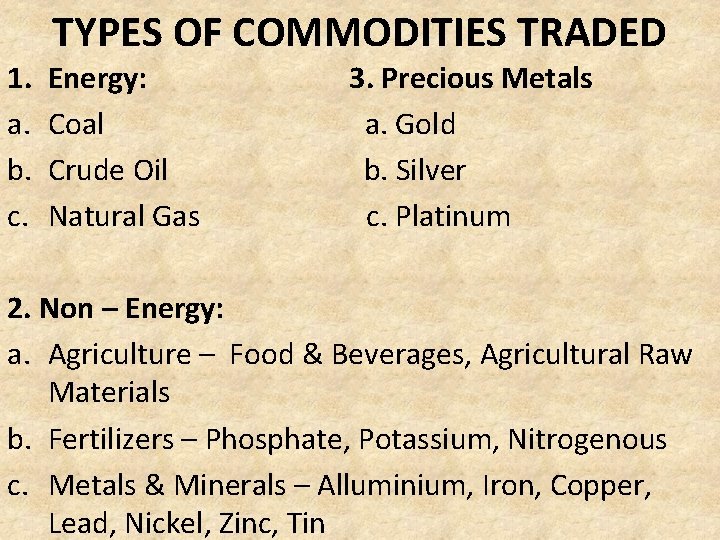
1. a. b. c. TYPES OF COMMODITIES TRADED Energy: Coal Crude Oil Natural Gas 3. Precious Metals a. Gold b. Silver c. Platinum 2. Non – Energy: a. Agriculture – Food & Beverages, Agricultural Raw Materials b. Fertilizers – Phosphate, Potassium, Nitrogenous c. Metals & Minerals – Alluminium, Iron, Copper, Lead, Nickel, Zinc, Tin
STRUCTURE OF COMMODITIES MARKET IN INDIA The commodity markets in India is broadly divided into 2 A. Physical Commodity Markets (Spot & Forward) B. Commodity Derivatives Market (Futures & Options)
A. PHYSICAL COMMODITY MARKETS • Physical commodity markets in India primarily trades in agricultural produce • The increasing trend of agricultural production has brought new challenges in terms of finding market for the surplus produce • Most of the agricultural commodity markets operate under the forces of demand & supply • In order to protect the farmers & to encourage them to increase the production, the government has made arrangement for their purchases whenever the prices fall below the support level
• Also, to cope up with the need to handle increasing agricultural production, the number of regulated markets were also increased • By the end of 1950, there were 286 regulated markets in the country & that number stood to more than 12, 000 by the end of March, 2011 • Most of these markets are wholesale markets • The Central Government advised all the State Governments to pass Marketing Legislation to provide competitive & transparent transactional methods to protect the interest of the farmers
Mandi • Mandis are market place where all agricultural commodities trade • The price of a commodity is determined by free market forces of demand & supply • Rice, wheat, pulses, oilseeds, cotton, & sugarcane are some of the principal commodities • Agricultural commodity markets in India started in specific geographical locations • The producers & buyers from that specific & nearby areas gathered to trade their goods
• Different regions in the country have different prices for the same commodities • Due to unhealthy & cheap transportation facility & other problems related to structure & design of the market, there is a difference in the price of the same commodity in different markets • State Government has given permission to set up Mandis under the respective State Agricultural Produce Marketing Act. • Each state has a State Agricultural Marketing Board (SAMB)
Governance & Regulation of Mandis • Mandis are set up & monitored by the mandi board which is a committee that has representatives both by the farmers & traders • There is also a representative from the State Government on the Mandi board • The chairman of the Mandi board, however is typically from the farmer community, & usually starts discussions with the SAMB to organize Mandi in a new locality & this community has a large governance
• The operations of the Mandi are handled by staff consisting of Secretary, Clerks & at least one Inspector qualified to certify the quality of the products • The staff is paid fee collected from market intermediaries • In the spot market, settlement takes place on T+0 or T+1 basis, thus there is little scope for problems of governance • The disputes about price & quality are handled by the Mandi Inspector
• The most important regulatory requirement is the reporting of prices & volumes to the SAMB • Every district Mandi Board takes the responsibility of collecting & dispatching this information to SAMB • The SAMB, in return, dispatches it to the Ministry of Agriculture, where the prices are available on the internet at the end of every trading day
Participants in Mandi • The main participants in Mandi are the buyers & the sellers. • Besides them, are the traders who act as an intermediary between wholesalers. • Mandi issues license to these traders • After obtaining the license they can trade • They have to pay the basic transaction fee & other fees in the form of taxes • These fees are usually passed back to the sellers
Products • Every Mandi trades in at least one primary commodity specific to that region • As the seller brings the produce to the market, it is first weighed & both the type & quantity recorded at the entrance by the Mandi inspector • The seller is then given a certificate of the type & quantity • Some Mandis charge fees at the entrance • Once the produce is recorded at one Mandi, it can be freely taken to another Mandi in the same district
Trading • Trading in Mandi takes place in two different ways – 1. Dealer Market: in this case, sellers directly approach traders for a quote. Once sellers find quote acceptable strikes a deal with trader & it is considered sold to the trader 2. Auction Market: in this case, commodity is sold in “Open Outcry Auction”. The auction process has a fixed time at every Mandi. The auction is run sequentially from one lot with fixed grade to the next. As every lot is auctioned, a new price is set
Clearing • Traders have to clear deals with buyers & sellers • At the time the trade is cleared with the seller, the produce gets inspected for quality • The trader themselves inspects the quality • If there is a dispute about the quality, the conflict is resolved by the Mandi inspector who certifies the quality • At the close of the trading day, trader reports both the price & volume to the Mandi • The Mandi verifies actual traded volumes by tallying the total volume brought into the Mandi
Settlement • There are no long term storage facilities in the Mandi • The excess produce is sold on the same day, the Mandi permits the traders to keep the goods at the Mandi yard (Market Yard) overnight for which the fees are charged • Mandi inspectors have the power to close the trade at a price that they deem correct
MARKET YARDS • Market yards are either private or state owned warehouses that provide storage in close proximity to the mandis • Market yards are long felt need of the farming community as it provides higher remuneration to them through proper weighing, cleaning, grading & better price realization of their produce • Farmers consider it as a boon to them where they can confidently sell their produce & get an appropriate return for the quantity & quality that they produce
• The development of regulated market yard infrastructure in our country is very lop-sided & its progress is satisfactory only in few states like Rajasthan, Gujarat, Maharashtra, Karnataka & Punjab • In all other states it is quite inadequate • Urgent attention is needed towards the inadequacy of agricultural marketing infrastructure in other states • There is a need for co-ordination among all the developmental agencies responsible for creation of market yard infrastructure
Categories of Market Yard • Primary – Sellers of a primary market yard are mainly farmers of the command area • Secondary – in case of secondary market yard, farmers & traders beyond the command area bring their commodities for sale • Terminal – in the terminal market yard mainly the traders bring in their commodities for marketing
Market Yard Requirements • A primary market yard should be located for easy accessibility & have provisions to sell produces grown by farmers in the command area & have sundry shops to meet the immediate requirements of a farmer when he comes there to sell his produce • It should also have facilities for the traders, commission agents & other market functionaries to facilitate easy trading • Secondary & Terminal market yards are located in semi-urban & urban areas & the facilities are planned for the commodities to be traded
B. COMMODITY DERIVATIVES (FUTURES & OPTIONS) • Organized futures market in India emerged in 1875 when the Bombay Cotton Trade Association was established • The futures trading in oilseeds started in 1900 when Gujarati Vyapari Mandali (National Multi Commodity Exchange, Ahmadabad) was established • The Calcutta Hessian Exchange Ltd, was set up in 1912 for Forward trading in raw jute & jute goods
• In case of wheat, futures market were in existence at several centres at Punjab & U. P. • The most notable amongst them was the Chamber of Commerce at Hapur which was established in 1913 • In 1919, Government of Bombay passed the Bombay Contract Control Act & set up the Cotton Contracts Board • The futures trading in gold began in Mumbai in 1920 • The organized futures trading in raw jute commenced in 1927 with the establishment of East India Jute Association Ltd.
• During the first half of the 20 th century, there were many commodity futures exchanges • These exchanges traded in jute, pepper, potatoes, sugar, turmeric, etc. • With a view to curb widespread speculation in cotton market options were banned in cotton in September 1939 by the Government of Bombay • In mid 1940 s, trading in forward & futures became difficult as a result of price controls by the government • In 1943, The Defense of India Act was introduced for the purpose of prohibiting forward trading
• In the same year, oilseeds forward contracts prohibition order was issued & forward contracts in oilseeds were banned • In 1945, the Calcutta Hessian Exchange Ltd & East India Jute Association Ltd were amalgamated to form East India Jute & Hessian Ltd • After independence, the Constitution of India brought the subject of “Stock Exchanges & Futures Markets” in the union list
• A bill on forward contract was referred to an expert committee headed by Prof. A. D. Shroff & Select Committees of two successive parliaments & in December 1952 Forward Contract Regulation Act was introduced • The Act provides 3 -tier regulatory system: a. An association recognized by the Government of India on the recommendation of Forward Markets Commission (FMC) b. FMC under the Ministry of Consumer Affairs, Food & Public Administration c. The Central Government
• Forward Contracts (Regulation) Rules were notified by the Central Government in July, 1954. • The Act divides the commodities into 3 categories: a. The commodities in which futures trading can be organized under the support of recognized association b. The commodities in which futures trading is prohibited c. Those commodities which have neither been regulated for being traded under the recognized association nor prohibited are referred as Free Commodities
• The association organized in such free commodities is required to obtain the Certificate of Registration from the FMC • In late 1960 s, the Government of India suspended forward & futures trading in several commodities like jute, edible oil seeds, cotton etc. due to the fear of increase in commodity prices • However, the government offered to buy agricultural products at Minimum Support Price (MSP) to ensure that the farmer is benefitted • The government also managed storage, transportation & distribution of agricultural products
• The government appointed four different committees to go into the regulatory aspects of forward & futures trading in India ü Shroff Committee in 1950 ü Dantwala Committee in 1966 ü Khusro Committee in 1979 ü Kabra Committee in 1993
• The Khusro Committee had recommended reintroduction of futures trading in most of the major commodities like cotton, raw jute & jute goods & also suggested that steps may be taken for introducing futures trading in commodities, like potatoes, onions etc. at appropriate time. • The government, accordingly initiated futures trading in potato during the latter half of 1980 in quite a few markets in Punjab & U. P. • In June 1993, one more committee was appointed by the Government of India on Forward Markets under the chairmanship of K. N. Kabra.
• The Kabra Committee recommended that futures trading be introduced in Basmati Rice, Cotton, Raw Jute & Jute Goods, Groundnut, Mustard Seeds, Sesame, Cottonseeds, Sunflower Seed, Safflower Seed, Copra & Soybean, Rice Bran Oil, Castor Oil, Linseed, Silver & Onions • The committee also recommended that some of the existing commodity exchanges particularly the ones in pepper & castor seed, may be upgraded to the level of international futures markets • In 1996, the World Bank in association with United Nations Conference on Trade & Development (UNCTAD) conducted study on Indian Commodity Markets
PARTICIPANTS IN COMMODITY MARKETS • There are 4 types of participants in commodity markets ü Hedgers ü Speculators ü Day-traders / Scalpers ü Arbitrageurs
Hedgers • Hedger is a user of the market who enters into futures contract to manage the risk of adverse price fluctuation in respect of his existing or future asset • Hedgers are those who have an underlying interest in the commodity & are using futures market to insure themselves against adverse price fluctuations • Example – Stockists, Exporters, Producers, etc.
Speculators • A trader who trades or takes position without having exposure in the physical market, with the sole intention of earning profit from price movements is a speculator • Speculators are those who may not have an interest in the ready contracts, but see an opportunity of price movements favorable to them • They are prepared to assume the risks, which the hedgers are trying to cover in the futures market • They provide depth & liquidity to the market
• They provide useful economic function & are an integral part of the futures market • It would not be wrong to say that in absence of speculators the market will not be liquid & may at times collapse
Day Traders • Day traders take positions in futures or options contracts & liquidate them prior to the close of the same trading day • They speculate on price fluctuations during the day
Arbitrageurs • Arbitrage refers to the simultaneous purchase & sale in two markets so that the selling price is higher than the buying price & the transaction cost resulting in risk-less profit to the arbitrageur • Thus, Arbitrageurs are interested in making purchases & sales in different markets at the same time to profit from price discrepancy between the two markets