
CGS Ground School Technical The Magnetic Compass Crown
- Slides: 15
CGS Ground School Technical The Magnetic Compass © Crown Copyright 2012 No Part of this presentation may be reproduced without the permission of the issuing authority. The views expressed in this presentation do not necessarily reflect the views or policy of the MOD.
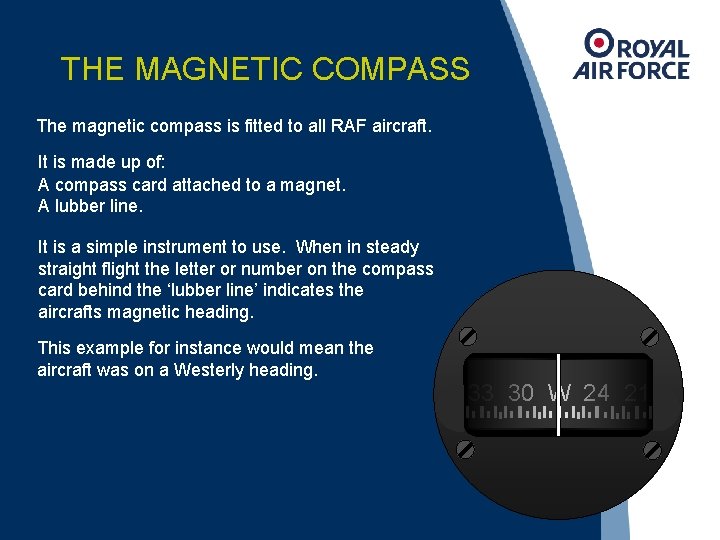
THE MAGNETIC COMPASS The magnetic compass is fitted to all RAF aircraft. It is made up of: A compass card attached to a magnet. A lubber line. It is a simple instrument to use. When in steady straight flight the letter or number on the compass card behind the ‘lubber line’ indicates the aircrafts magnetic heading. This example for instance would mean the aircraft was on a Westerly heading. 33 30 W 24 21
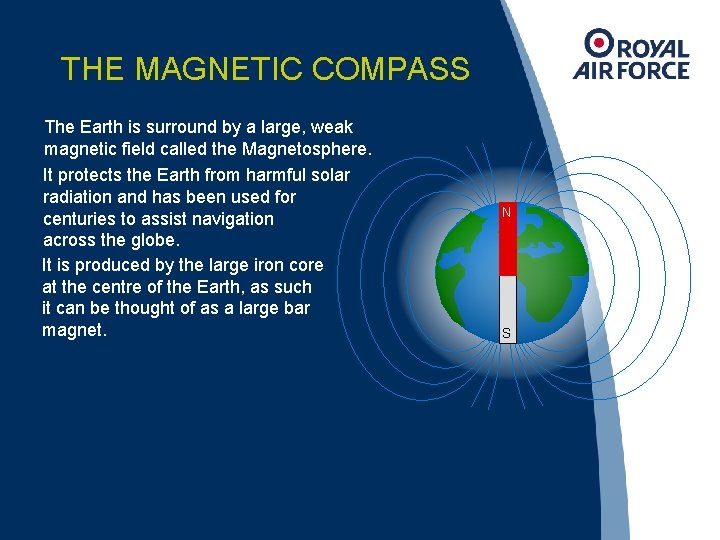
THE MAGNETIC COMPASS The Earth is surround by a large, weak magnetic field called the Magnetosphere. It protects the Earth from harmful solar radiation and has been used for centuries to assist navigation across the globe. It is produced by the large iron core at the centre of the Earth, as such it can be thought of as a large bar magnet. N S
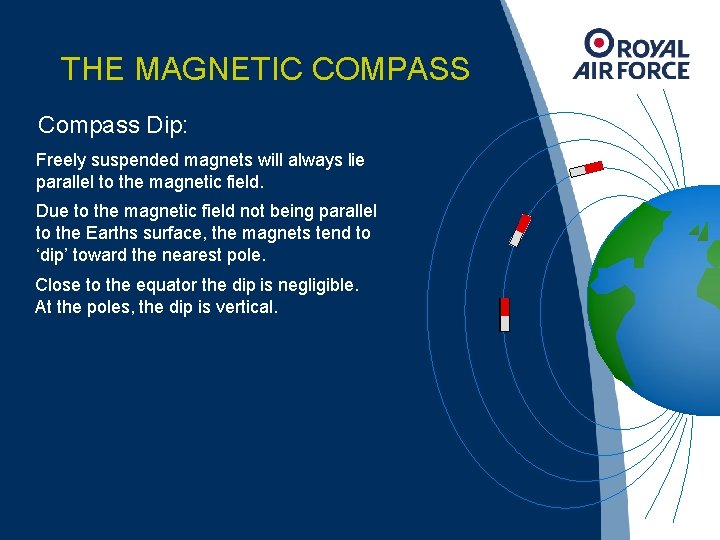
THE MAGNETIC COMPASS Compass Dip: Freely suspended magnets will always lie parallel to the magnetic field. Due to the magnetic field not being parallel to the Earths surface, the magnets tend to ‘dip’ toward the nearest pole. Close to the equator the dip is negligible. At the poles, the dip is vertical.
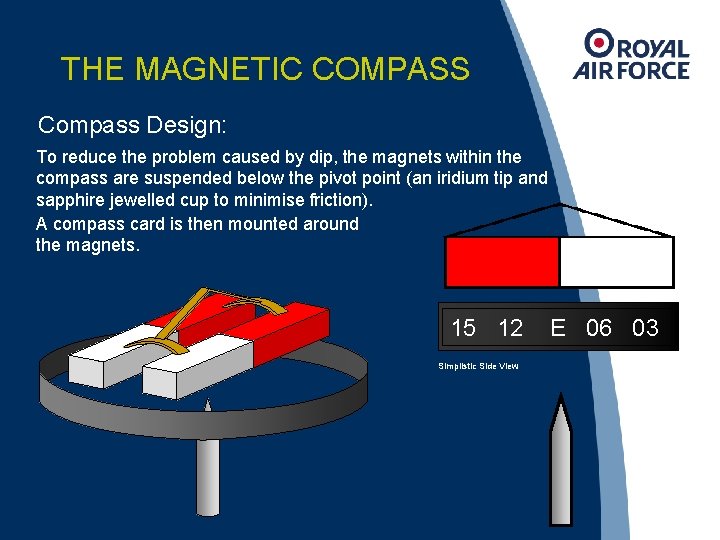
THE MAGNETIC COMPASS Compass Design: To reduce the problem caused by dip, the magnets within the compass are suspended below the pivot point (an iridium tip and sapphire jewelled cup to minimise friction). A compass card is then mounted around the magnets. 15 12 Simplistic Side View E 06 03
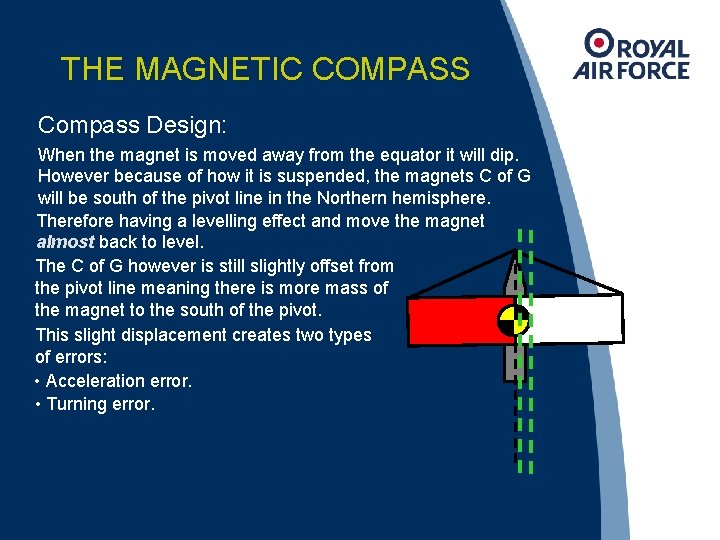
THE MAGNETIC COMPASS Compass Design: When the magnet is moved away from the equator it will dip. However because of how it is suspended, the magnets C of G will be south of the pivot line in the Northern hemisphere. Therefore having a levelling effect and move the magnet almost back to level. The C of G however is still slightly offset from the pivot line meaning there is more mass of the magnet to the south of the pivot. This slight displacement creates two types of errors: • Acceleration error. • Turning error.
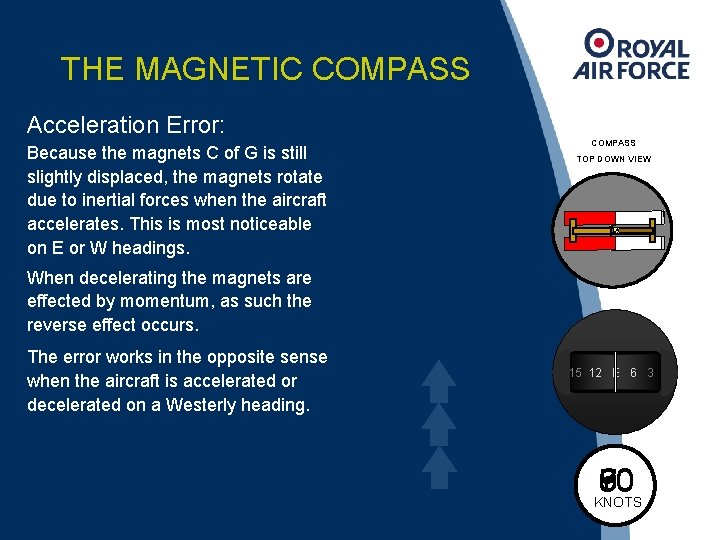
THE MAGNETIC COMPASS Acceleration Error: Because the magnets C of G is still slightly displaced, the magnets rotate due to inertial forces when the aircraft accelerates. This is most noticeable on E or W headings. COMPASS TOP DOWN VIEW When decelerating the magnets are effected by momentum, as such the reverse effect occurs. The error works in the opposite sense when the aircraft is accelerated or decelerated on a Westerly heading. 15 12 E 6 3 N 60 90 80 70 KNOTS
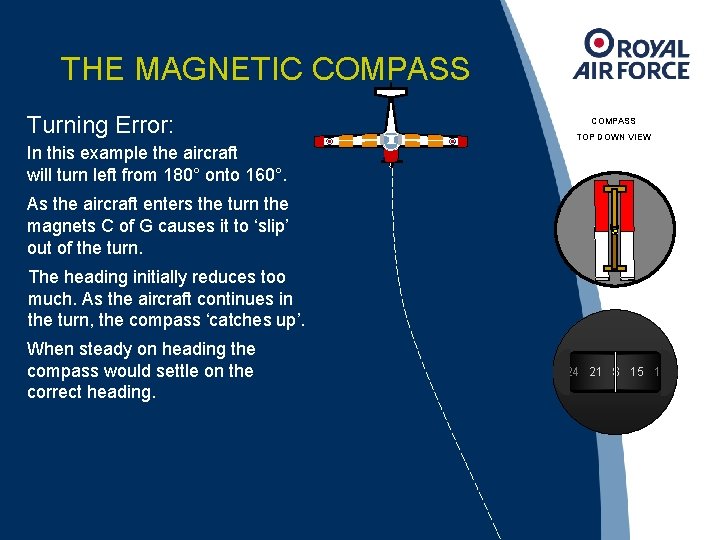
THE MAGNETIC COMPASS Turning Error: COMPASS TOP DOWN VIEW In this example the aircraft will turn left from 180° onto 160°. As the aircraft enters the turn the magnets C of G causes it to ‘slip’ out of the turn. The heading initially reduces too much. As the aircraft continues in the turn, the compass ‘catches up’. When steady on heading the compass would settle on the correct heading. 24 21 S 15 12
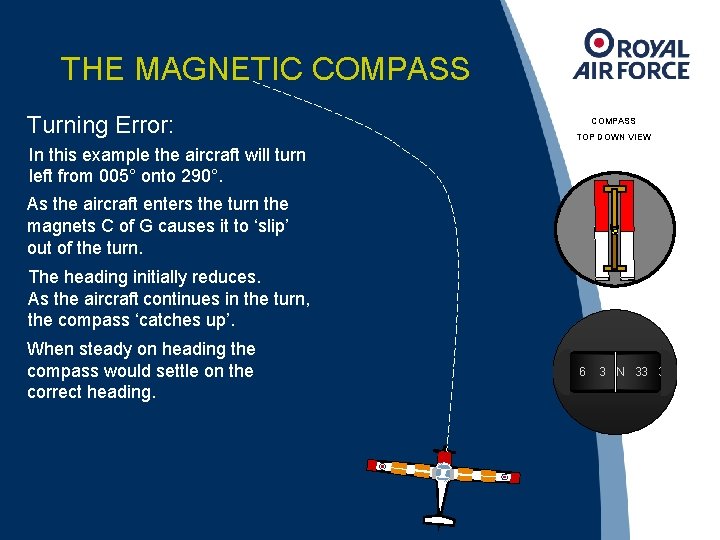
THE MAGNETIC COMPASS Turning Error: COMPASS TOP DOWN VIEW In this example the aircraft will turn left from 005° onto 290°. As the aircraft enters the turn the magnets C of G causes it to ‘slip’ out of the turn. The heading initially reduces. As the aircraft continues in the turn, the compass ‘catches up’. When steady on heading the compass would settle on the correct heading. 6 3 N 33 30 W
THE MAGNETIC COMPASS Combined Error: The errors previously discussed are assuming that the only disturbance is either a change in speed (acceleration errors) or a change in heading (turning errors). If the aircraft speed is changed when turning the errors may be cancelled out or exacerbated depending on the direction of turn and whether the aircraft is accelerated or decelerated. The following slides describe the correct technique to use when turning onto headings.
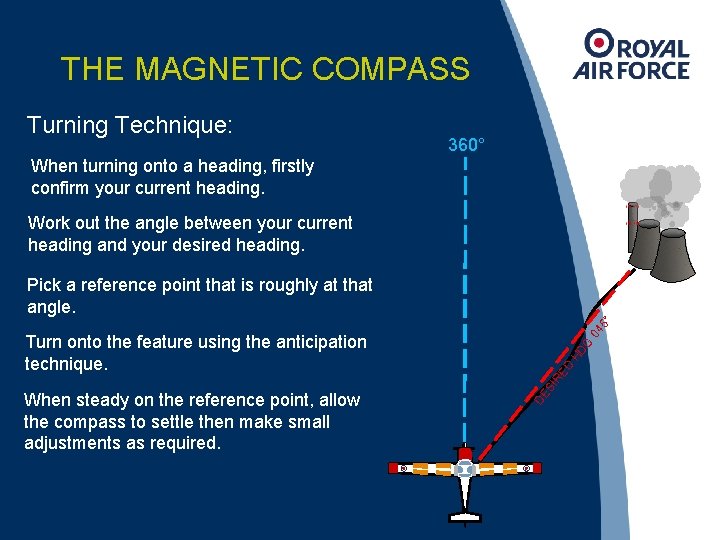
THE MAGNETIC COMPASS Turning Technique: 360° When turning onto a heading, firstly confirm your current heading. Work out the angle between your current heading and your desired heading. G HD D RE SI When steady on the reference point, allow the compass to settle then make small adjustments as required. DE Turn onto the feature using the anticipation technique. 04 5 ° Pick a reference point that is roughly at that angle.
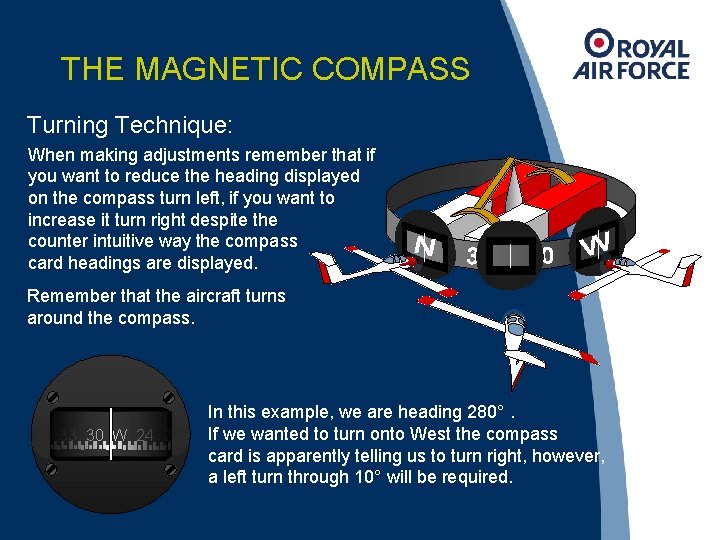
THE MAGNETIC COMPASS Turning Technique: When making adjustments remember that if you want to reduce the heading displayed on the compass turn left, if you want to increase it turn right despite the counter intuitive way the compass card headings are displayed. Remember that the aircraft turns around the compass. 33 30 W 24 21 In this example, we are heading 280°. If we wanted to turn onto West the compass card is apparently telling us to turn right, however, a left turn through 10° will be required.
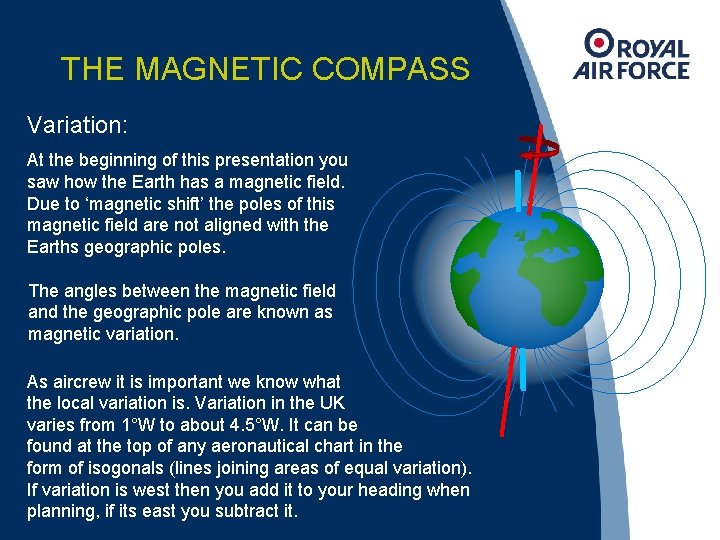
THE MAGNETIC COMPASS Variation: At the beginning of this presentation you saw how the Earth has a magnetic field. Due to ‘magnetic shift’ the poles of this magnetic field are not aligned with the Earths geographic poles. The angles between the magnetic field and the geographic pole are known as magnetic variation. As aircrew it is important we know what the local variation is. Variation in the UK varies from 1°W to about 4. 5°W. It can be found at the top of any aeronautical chart in the form of isogonals (lines joining areas of equal variation). If variation is west then you add it to your heading when planning, if its east you subtract it.
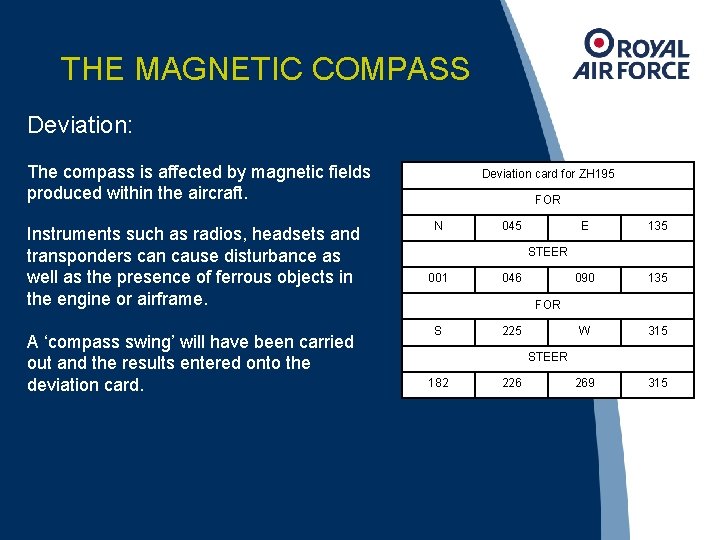
THE MAGNETIC COMPASS Deviation: The compass is affected by magnetic fields produced within the aircraft. Instruments such as radios, headsets and transponders can cause disturbance as well as the presence of ferrous objects in the engine or airframe. A ‘compass swing’ will have been carried out and the results entered onto the deviation card. Deviation card for ZH 195 FOR N 045 E 135 090 135 W 315 269 315 STEER 001 046 FOR S 225 STEER 182 226
THE END Any Questions?