
CGE Greenhouse Gas Inventory Handson Training Workshop UNFCCC
- Slides: 28
CGE Greenhouse Gas Inventory Hands-on Training Workshop UNFCCC – NAI SOFTWARE Sector: Waste Practical Aspects and Exercises 6. 1
CONTENT n n Details on use of the UNFCCC-NAI Software to calculate and report GHG emissions in the Waste sector. Practical exercises (to be solved by the participants after the presentation). 6. 2
BACKGROUND n n n The decision trees in the IPCC good practice guidance (GPG 2000) are used to choose a good practice method that suits national circumstances. The UNFCCC-NAI Software contains, basically, the methods of lesser complexity that countries can use to prepare their inventories. However, in principle, the software can be used to report the estimated emissions independently of the complexity of method used (Tier 2, 3, etc). 6. 3
SECTOR: WASTE 6. 4
SECTOR: WASTE CH 4 Emissions from Solid Waste Disposal 6. 5
SECTOR: WASTE CH 4 Emissions from Solid Waste Disposal 6. 6
SECTOR: WASTE CH 4 Emissions from Solid Waste Disposal 6. 7
SECTOR: WASTE CH 4 Emissions from Domestic and Commercial Wastewater and Sludge Handling 6. 8
SECTOR: WASTE CH 4 Emissions from Domestic and Commercial Wastewater and Sludge Handling 6. 9
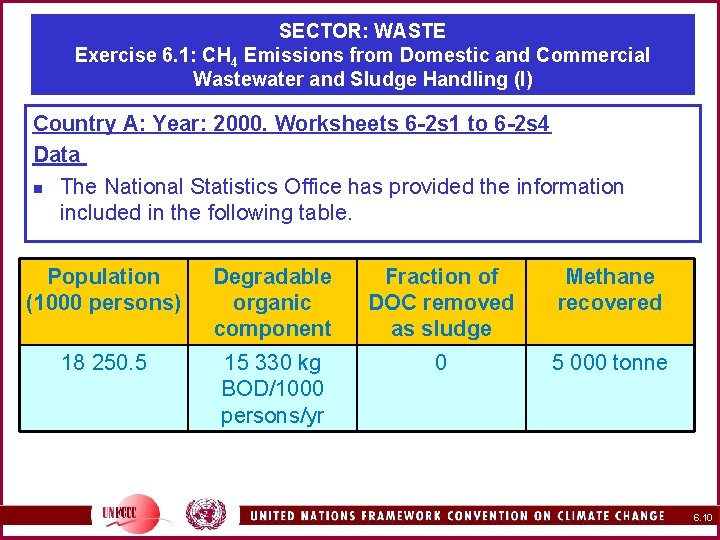
SECTOR: WASTE Exercise 6. 1: CH 4 Emissions from Domestic and Commercial Wastewater and Sludge Handling (I) Country A: Year: 2000. Worksheets 6 -2 s 1 to 6 -2 s 4 Data n The National Statistics Office has provided the information included in the following table. Population (1000 persons) Degradable organic component Fraction of DOC removed as sludge Methane recovered 18 250. 5 15 330 kg BOD/1000 persons/yr 0 5 000 tonne 6. 10
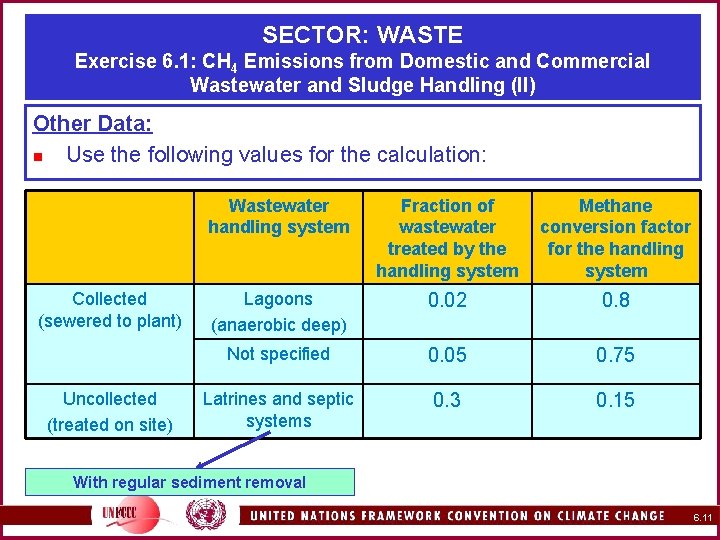
SECTOR: WASTE Exercise 6. 1: CH 4 Emissions from Domestic and Commercial Wastewater and Sludge Handling (II) Other Data: n Use the following values for the calculation: Collected (sewered to plant) Uncollected (treated on site) Wastewater handling system Fraction of wastewater treated by the handling system Methane conversion factor for the handling system Lagoons (anaerobic deep) 0. 02 0. 8 Not specified 0. 05 0. 75 Latrines and septic systems 0. 3 0. 15 With regular sediment removal 6. 11
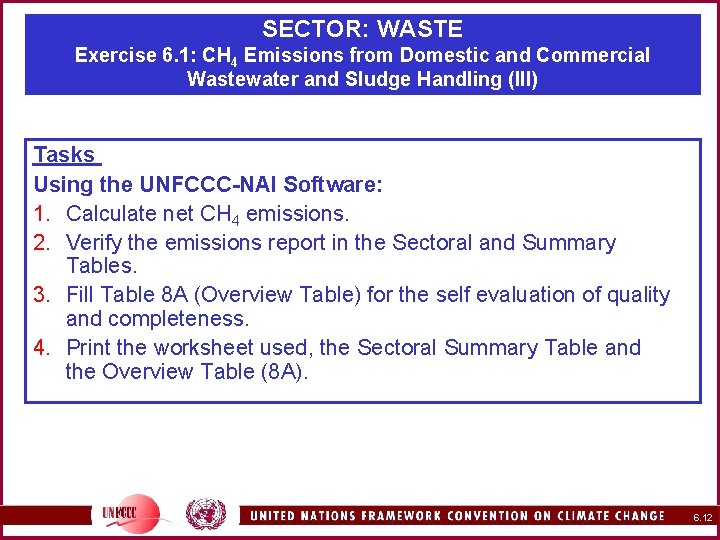
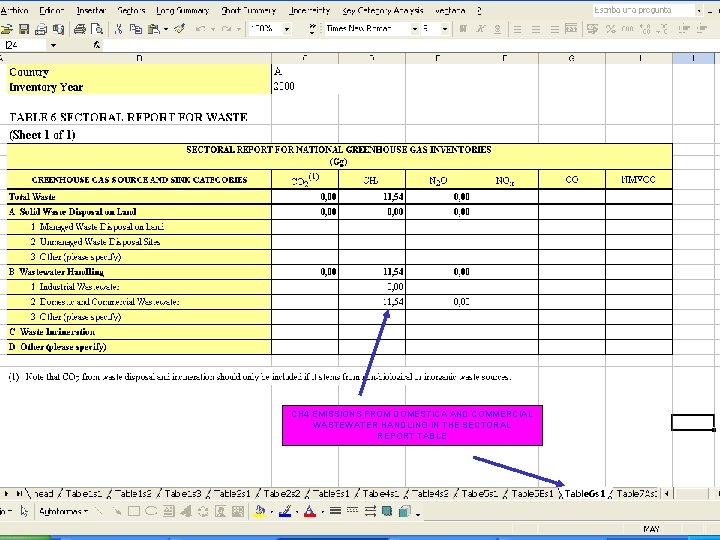
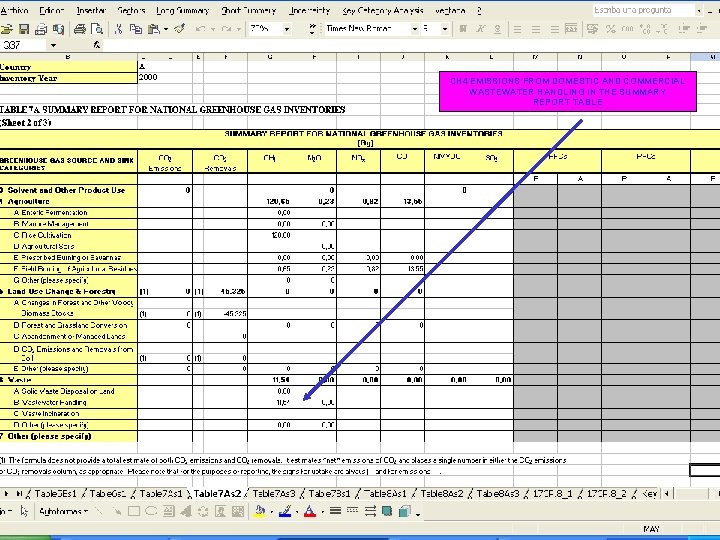
SECTOR: WASTE Exercise 6. 1: CH 4 Emissions from Domestic and Commercial Wastewater and Sludge Handling (III) Tasks Using the UNFCCC-NAI Software: 1. Calculate net CH 4 emissions. 2. Verify the emissions report in the Sectoral and Summary Tables. 3. Fill Table 8 A (Overview Table) for the self evaluation of quality and completeness. 4. Print the worksheet used, the Sectoral Summary Table and the Overview Table (8 A). 6. 12
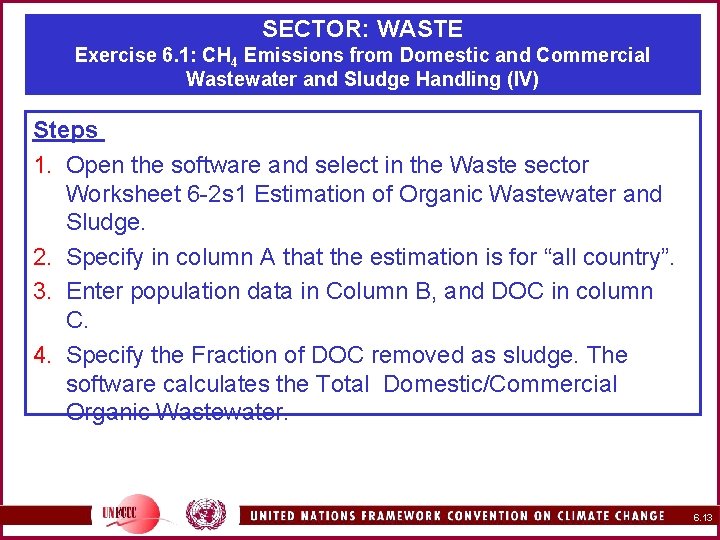
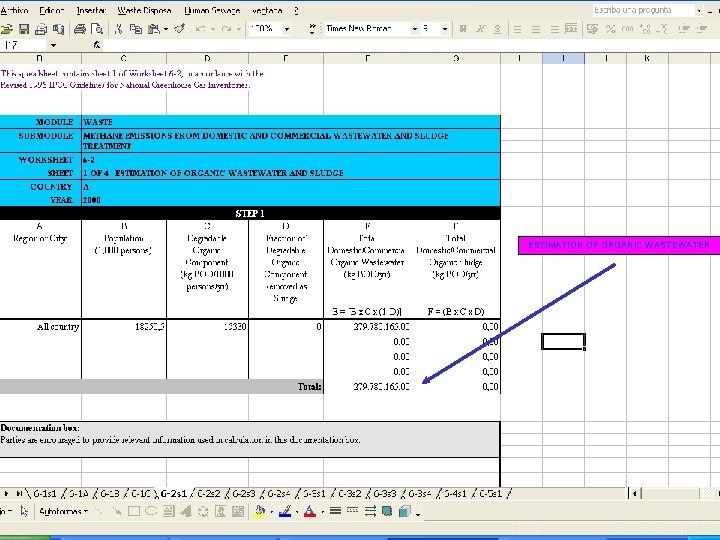
SECTOR: WASTE Exercise 6. 1: CH 4 Emissions from Domestic and Commercial Wastewater and Sludge Handling (IV) Steps 1. Open the software and select in the Waste sector Worksheet 6 -2 s 1 Estimation of Organic Wastewater and Sludge. 2. Specify in column A that the estimation is for “all country”. 3. Enter population data in Column B, and DOC in column C. 4. Specify the Fraction of DOC removed as sludge. The software calculates the Total Domestic/Commercial Organic Wastewater. 6. 13
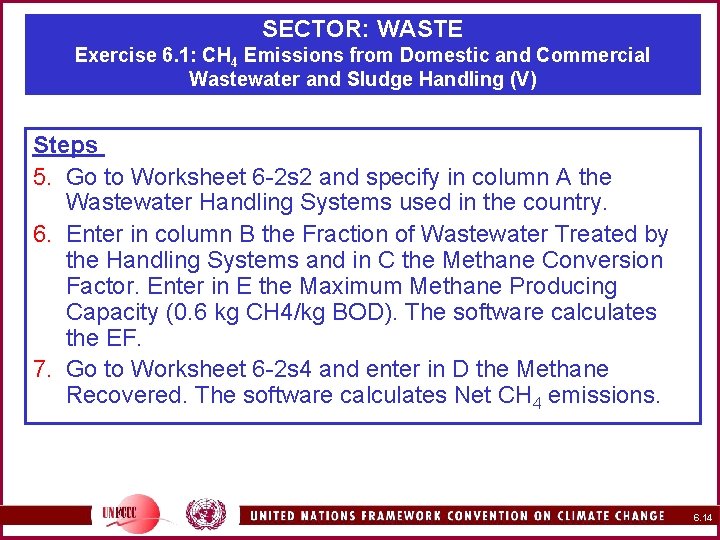
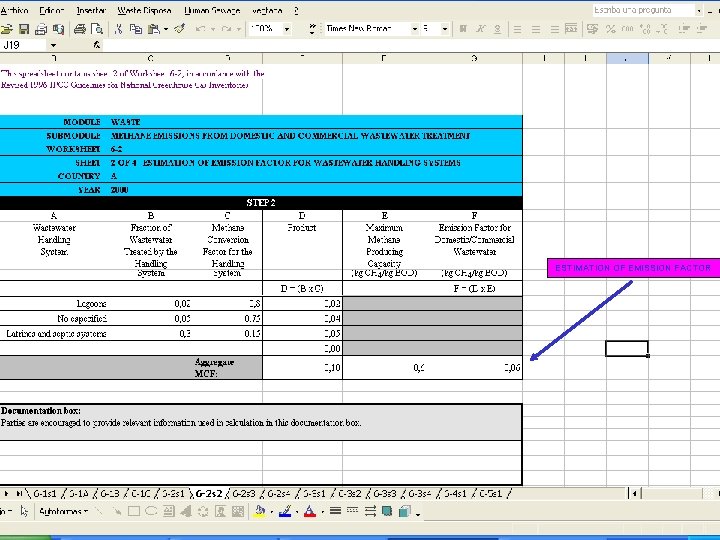
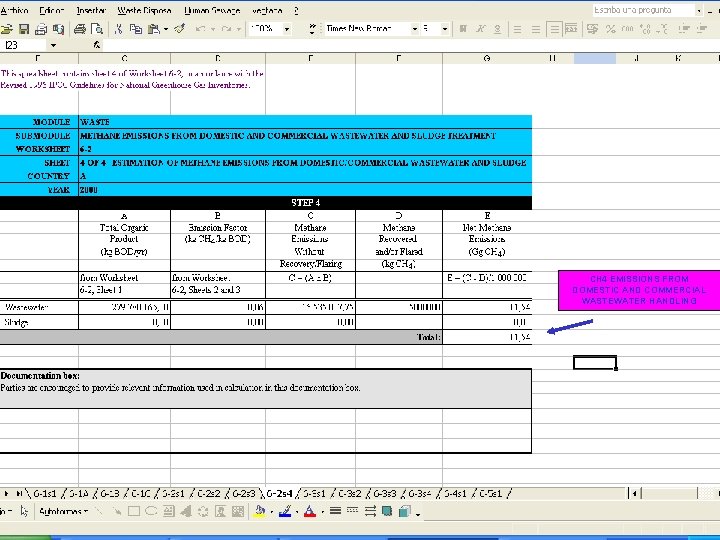
SECTOR: WASTE Exercise 6. 1: CH 4 Emissions from Domestic and Commercial Wastewater and Sludge Handling (V) Steps 5. Go to Worksheet 6 -2 s 2 and specify in column A the Wastewater Handling Systems used in the country. 6. Enter in column B the Fraction of Wastewater Treated by the Handling Systems and in C the Methane Conversion Factor. Enter in E the Maximum Methane Producing Capacity (0. 6 kg CH 4/kg BOD). The software calculates the EF. 7. Go to Worksheet 6 -2 s 4 and enter in D the Methane Recovered. The software calculates Net CH 4 emissions. 6. 14
ESTIMATION OF ORGANIC WASTEWATER 6. 15
ESTIMATION OF EMISSION FACTOR 6. 16
CH 4 EMISSIONS FROM DOMESTIC AND COMMERCIAL WASTEWATER HANDLING 6. 17
CH 4 EMISSIONS FROM DOMESTICA AND COMMERCIAL WASTEWATER HANDLING IN THE SECTORAL REPORT TABLE 6. 18
CH 4 EMISSIONS FROM DOMESTIC AND COMMERCIAL WASTEWATER HANDLING IN THE SUMMARY REPORT TABLE 6. 19
SECTOR: WASTE CH 4 Emissions from Industrial Wastewater and Sludge Handling 6. 20
SECTOR: WASTE CH 4 Emissions from Industrial Wastewater and Sludge Handling 6. 21
SECTOR: WASTE Indirect N 2 O Emissions from Human Sewage
SECTOR: WASTE Emissions from Waste Incineration 6. 23
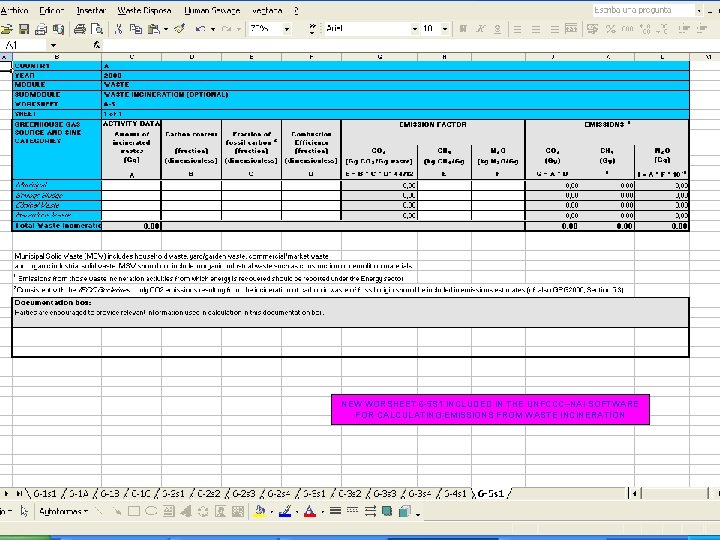
NEW WORSHEET 6 -5 S 1 INCLUDED IN THE UNFCCC–NAI SOFTWARE FOR CALCULATING EMISSIONS FROM WASTE INCINERATION 6. 24
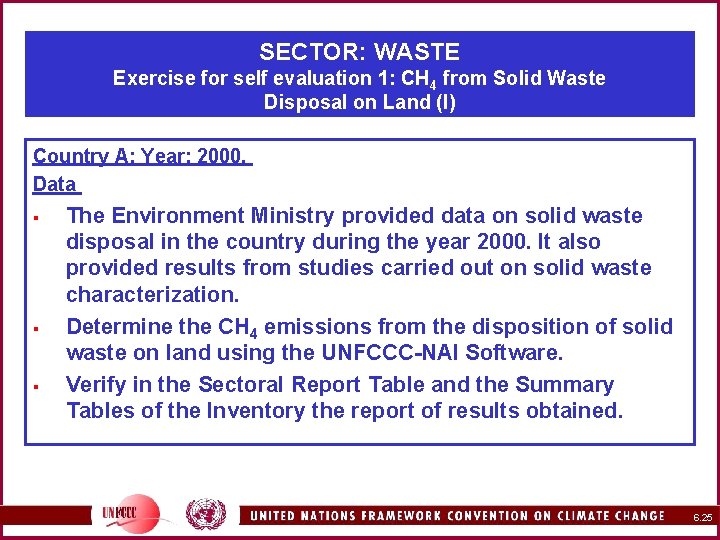
SECTOR: WASTE Exercise for self evaluation 1: CH 4 from Solid Waste Disposal on Land (I) Country A: Year: 2000. Data § § § The Environment Ministry provided data on solid waste disposal in the country during the year 2000. It also provided results from studies carried out on solid waste characterization. Determine the CH 4 emissions from the disposition of solid waste on land using the UNFCCC-NAI Software. Verify in the Sectoral Report Table and the Summary Tables of the Inventory the report of results obtained. 6. 25
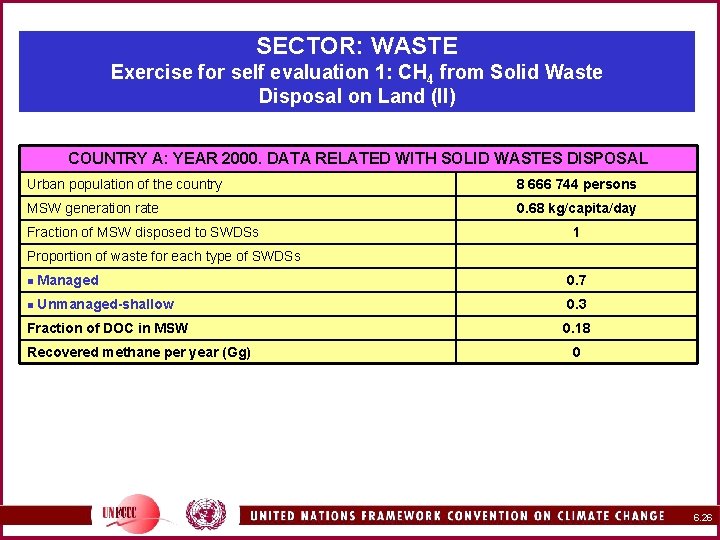
SECTOR: WASTE Exercise for self evaluation 1: CH 4 from Solid Waste Disposal on Land (II) COUNTRY A: YEAR 2000. DATA RELATED WITH SOLID WASTES DISPOSAL Urban population of the country 8 666 744 persons MSW generation rate 0. 68 kg/capita/day Fraction of MSW disposed to SWDSs 1 Proportion of waste for each type of SWDSs n Managed 0. 7 n Unmanaged-shallow 0. 3 Fraction of DOC in MSW 0. 18 Recovered methane per year (Gg) 0 6. 26
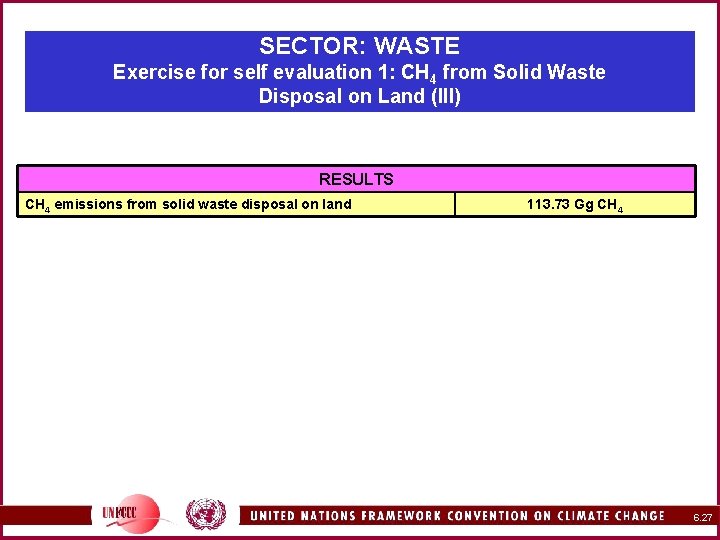
SECTOR: WASTE Exercise for self evaluation 1: CH 4 from Solid Waste Disposal on Land (III) RESULTS CH 4 emissions from solid waste disposal on land 113. 73 Gg CH 4 6. 27
Thank you 6.