
CGC 1 D Unit 1 Mapping and Earth
- Slides: 8
CGC 1 D Unit 1: Mapping and Earth Systems Topic 1 : Defining Geography and Map Essentials
Map Essentials • Title: indicates what the map represents • Legend: indicates the meaning of symbols used to represent real-world features (e. g. cities, boundaries, rivers, train tracks, etc) • Scale: indicates the difference between distances on the map and distances in the real world.
Map Essentials • Direction: (compass rose or north arrow) Orientation on a map is very important. The cardinal points (North, South, East, West) are used to indicate direction to the map reader. • Border: sets the limits of the map. • Color: used to represent certain features (esp. water is always BLUE)
Map Essentials • Horizontal Labels: to make the map easyto-read. • Name of Cartographer: that’s you! (take credit when its due. ) • Date: (of Publication)
Defining Geography • The academic discipline that examines variations on the Earth’s surface. Geographers attempt to explain the diverse characteristics of the Earth’s landscape; exploring topics such as population distribution, earth processes (e. g. earthquakes), the atmosphere and oceans, and international issues. • Geography is divided into two main categories: Physical Geography and Human Geography
Physical Geography • The study of non-human processes relating to the earth.
Human Geography • The study of the distribution and organization of humans, and the human use of resources.
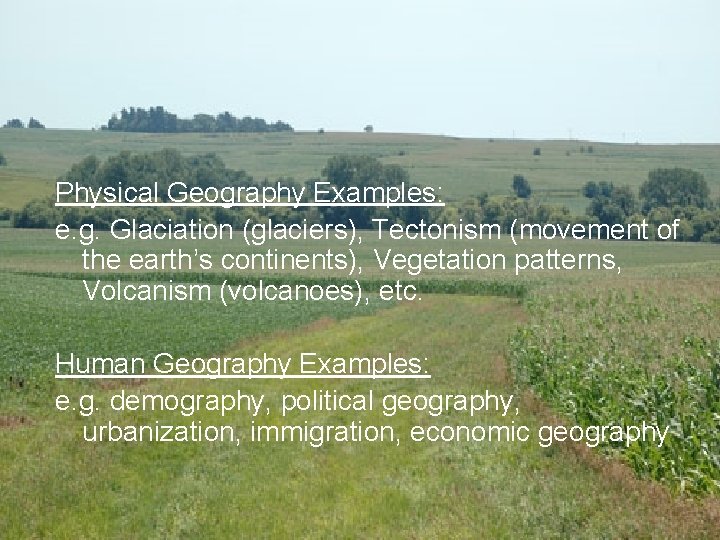
Physical Geography Examples: e. g. Glaciation (glaciers), Tectonism (movement of the earth’s continents), Vegetation patterns, Volcanism (volcanoes), etc. Human Geography Examples: e. g. demography, political geography, urbanization, immigration, economic geography