
CFCs BISC 312 Group 7 November 17 2004
CFCs BISC 312 - Group 7 November 17, 2004 Amy Hamon Carlie Flynn Christina Gulbransen Danny Lee Kevin Inouye Kristin Fox Marco Arruda Melissa Cook Susan Hand
Outline 1. Introduction • Types and Uses 2. Environmental Effects • Ozone Destruction/Ozone Layer Depletion • Greenhouse Gas/Greenhouse Effect 3. Direct Toxic Effects • Toxicokinetics • Dose - Dose Response 4. Indirect Toxic Effects • Relating UVB radiation and CFCs • Effects of Overexposure to UVB radiation 5. Future Considerations • Montreal Protocol • Destruction and Replacement

Introduction What are CFCs? Chlorofluorocarbons (also known as freons) Uses Pre-1987 Use Distribution • coolants in refrigerators and air conditioners • solvents in cleaners (i. e. for electric circuit boards) • blowing agents for foam production (i. e. fire extinguishers) • propellants in aerosols (i. e. asthma inhalers) Major Types • trichlorofluoromethane - CFCl 3(CFC-11) • dichlorodifluoromethane - CF 2 Cl 2 (CFC-12) • trichlorotrifluoroethane - C 2 F 3 Cl 3 (CFC-113) • dichlorotetrfluoroethane - C 2 F 4 Cl 2 (CFC-114 ) • chloropentafluoroethane - C 2 F 5 Cl (CFC-115) http: //www. ace. mmu. ac. uk/Resources/Fact_Sheets/Key_Stage_4/Ozone_Depletion/05. html most prevalent in atmosphere used in human studies
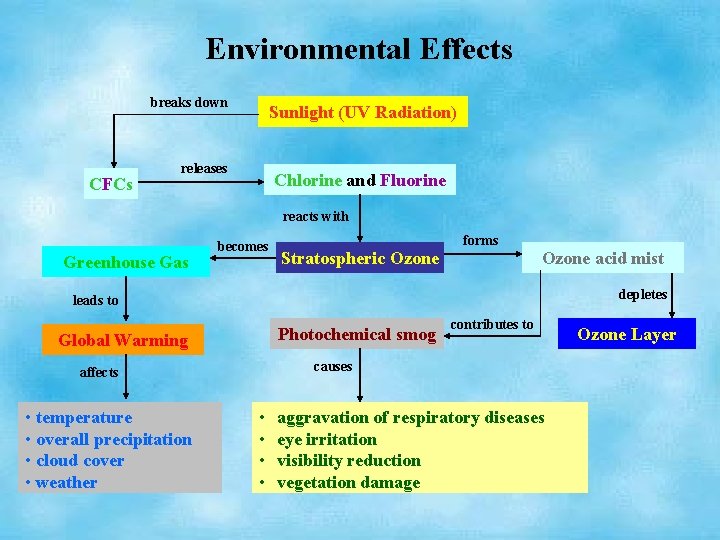
Environmental Effects breaks down CFCs Sunlight (UV Radiation) releases Chlorine and Fluorine reacts with Greenhouse Gas becomes Stratospheric Ozone forms Ozone acid mist depletes leads to Photochemical smog Global Warming causes affects • temperature • overall precipitation • cloud cover • weather contributes to • • aggravation of respiratory diseases eye irritation visibility reduction vegetation damage Ozone Layer
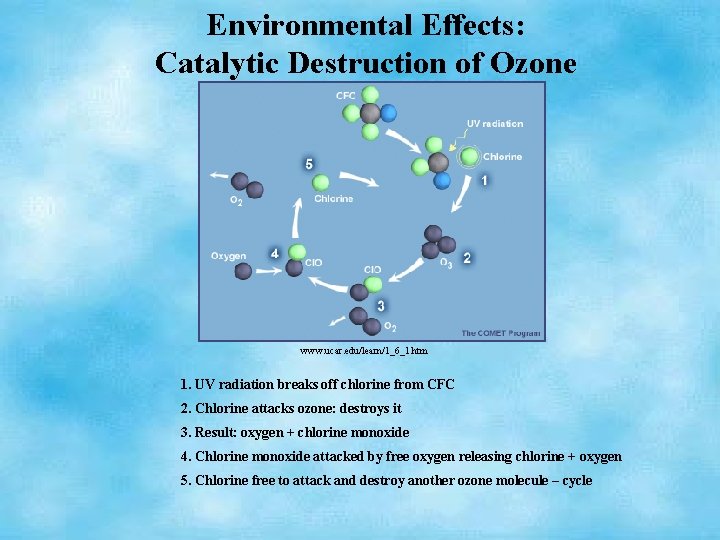
Environmental Effects: Catalytic Destruction of Ozone www. ucar. edu/learn/1_6_1. htm 1. UV radiation breaks off chlorine from CFC 2. Chlorine attacks ozone: destroys it 3. Result: oxygen + chlorine monoxide 4. Chlorine monoxide attacked by free oxygen releasing chlorine + oxygen 5. Chlorine free to attack and destroy another ozone molecule – cycle
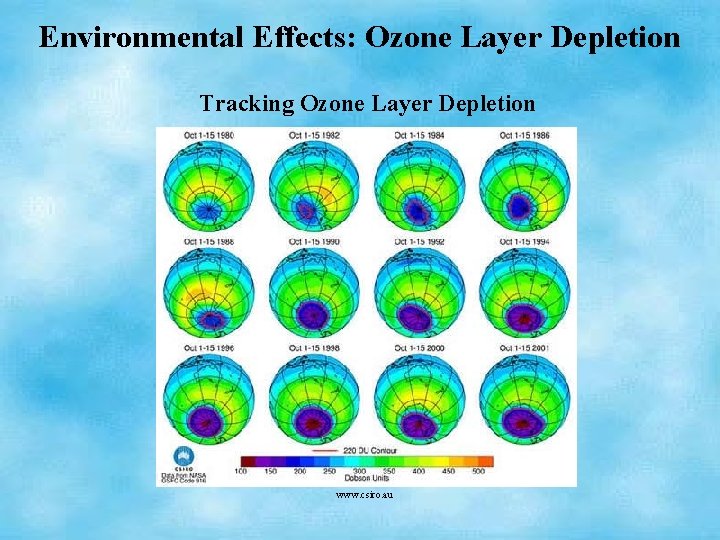
Environmental Effects: Ozone Layer Depletion Tracking Ozone Layer Depletion www. csiro. au
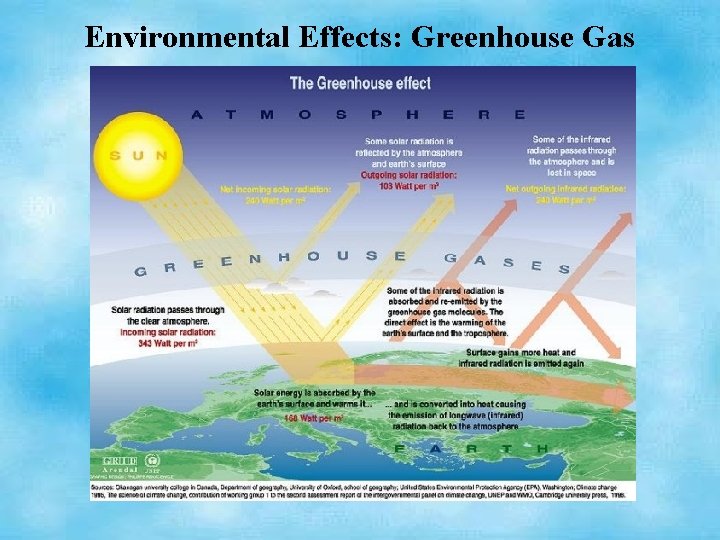
Environmental Effects: Greenhouse Gas
Direct Toxic Effects: Toxicokinetics (From Inhalation Study) Absorption • main route of absorption = lungs • absorption after inhalation: 35 to 48 times greater than ingestion Distribution and Storage • CFCs are lipophilic: found in brain, liver, kidney Metabolism • metabolites of trichlorofluoromethane = dichlorofluoromethane, tetrachlorodifluoroethane Excretion • Mostly through respiratory tract (trichlorofluoromethane = 79 - 99%) • Little found in urine (trichlorofluoromethane = 0. 07 - 0. 09%, metabolites < 0. 2 %)
Direct Toxic Effects: Acute Exposure Low Concentration: • leaking air conditioners, refrigerators Effects: • transient eye, nose, throat irritations • palpitations, light headedness, headaches High concentration: • inhalation after industrial use in confined/poorly ventilated areas • CFC-113 (cleaning agent) v. p (~ 285 mm Hg) @ room temp • Produces ambient [ ] during use of liquid (bioavailable) Effects: • respiratory system: asphyxiation/pulmonary edema • circulatory system: ventricular arrhythmia • nervous system: damage to tissue • sudden death
![Direct Toxic Effects: Dose – Dose Response Lethal airborne [ ] thought to be](http://slidetodoc.com/presentation_image_h/7c84be61ac40435694481a5e76f322b5/image-10.jpg "Direct Toxic Effects: Dose – Dose Response Lethal airborne [ ] thought to be")
Direct Toxic Effects: Dose – Dose Response Lethal airborne [ ] thought to be same for humans, animals (CFC-113 study) Rats: - 4 hr exposure - CFC-113 LD 50= 52, 000 -68, 000 ppm - 1. 25 -1. 75 hr exposure Humans: - 2500 ppm observed psychomotor impairment threshold (dexterity, vigilance, concentration) - Impairment disappeared 15 minutes after exposure stopped Dose (ppm) Response 1, 000 No observed adverse health effects 2, 500 Impairs ability to perform simple tasks; induces mild lethargy, and loss of ability to concentrate 4, 500 IDLH (immediately dangerous to life and health) 7, 600 (> 24 hr exposed) Death from cardiac arrhythmia (case 1) 300, 000 (est. ) Death from asphyxiation and pulmonary edema (case 2) Note: People often think CFC-113 completely safe due to relative nontoxicity < 2500 ppm
![Indirect Toxic Effects: CFCs and UV-B rays • [CFC]atmospheric= ozone = level of UV-B](http://slidetodoc.com/presentation_image_h/7c84be61ac40435694481a5e76f322b5/image-11.jpg "Indirect Toxic Effects: CFCs and UV-B rays • [CFC]atmospheric= ozone = level of UV-B")
Indirect Toxic Effects: CFCs and UV-B rays • [CFC]atmospheric= ozone = level of UV-B rays able to reach Earth’s surface • UV-B rays = ultraviolet rays, wavelength = 290 – 320 nm Ø limited dosage required for catalysis of vitamin D in humans Dermal Absorption of UVB rays • Transmission of UV-B rays µ epidermal thickness -1 • UV-B rays on surface of epidermis scattered by: Ø air within outermost layers of epidermis Ø melanin (skin pigment) granules in deeper epidermis layers • Genetic make up of individual determines amount of pigmentation in epidermis Ø heavily pigmented epidermis thicker than less pigmented epidermis
Indirect Toxic Effects: Effects of Overexposure to UV-B Radiation • • • Cataracts Immunosuppression Severe photo allergies Accelerated dermal aging Photokeratitis: sunburn of the cornea or “snow-blindness” Skin cancer Exposure: - chance of skin cancer with UV scattering ability - multiple protracted exposures - long interval common between exposure and cancer Experimentation: - UV and chemical carcinogens act synergistically in dermal tumor induction
Indirect Toxic Effects: Effects of Overexposure to UV-B Radiation Biological Effects • caused by photochemical absorption of UV-B radiation by biologically significant molecules: Ø proteins Østeroids Ø porphyrins Ø carotenoids Effects of UV-B Absorption by Nucleic Acids • Dimerization of thymine base pairs in DNA • Production of range of chromosome aberrations Ø in high doses, UV-B rays can fragment or shatter entire chromosome • Damage to DNA is essential part of all cancer inductions
Indirect Toxic Effects: Ecological Effects of UV-B Exposure • Affect ecosystems by attacking lowest trophic levels • Small organisms like plankton, larvae especially sensitive to UV-B light: do not possess protective layer (skin) • UV-B light also inhibits growth and development in some plants • Can reduce a population if individuals killed before reaching reproductive size
Future Considerations: The Montreal Protocol 1985 – Vienna Convention on the protection of the ozone layer - ideas for action proposed, no laws imposed 1987 – Montreal Protocol on Substances that Deplete the Ozone Layer - requires reduction (by industrialized countries) in use of chemicals that harm ozone layer - 183 countries involved as of 2004 - funding of $340 – 500 million between 1994 - 1996 - 4 main agencies: - UNIDO (United Nations Industrial Development Organization) - UNDP (United Nations Development Programme) - UNEP (United Nations Environment Programme) - World Bank
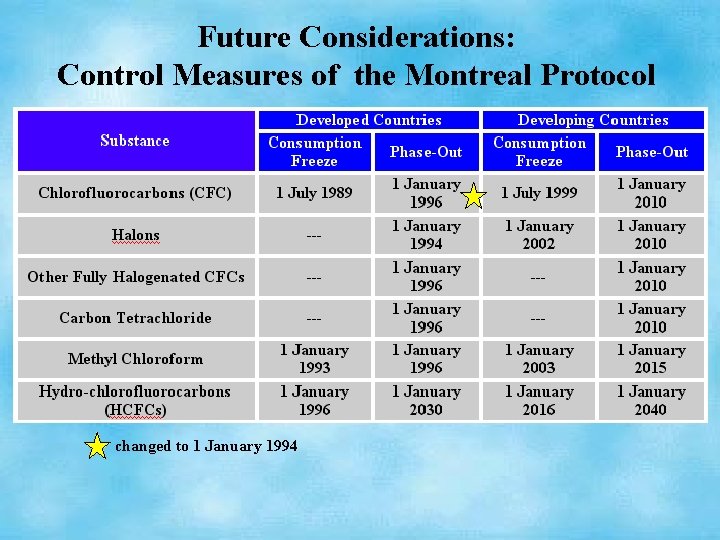
Future Considerations: Control Measures of the Montreal Protocol changed to 1 January 1994
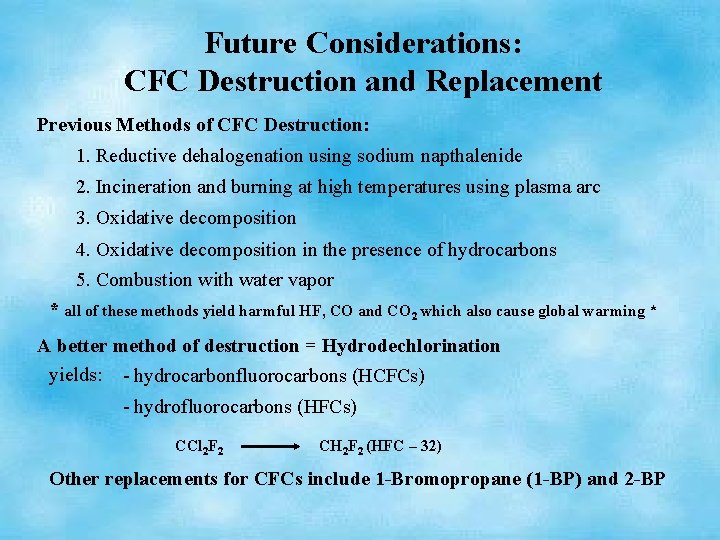
Future Considerations: CFC Destruction and Replacement Previous Methods of CFC Destruction: 1. Reductive dehalogenation using sodium napthalenide 2. Incineration and burning at high temperatures using plasma arc 3. Oxidative decomposition 4. Oxidative decomposition in the presence of hydrocarbons 5. Combustion with water vapor * all of these methods yield harmful HF, CO and CO 2 which also cause global warming * A better method of destruction = Hydrodechlorination yields: - hydrocarbonfluorocarbons (HCFCs) - hydrofluorocarbons (HFCs) CCl 2 F 2 CH 2 F 2 (HFC – 32) Other replacements for CFCs include 1 -Bromopropane (1 -BP) and 2 -BP
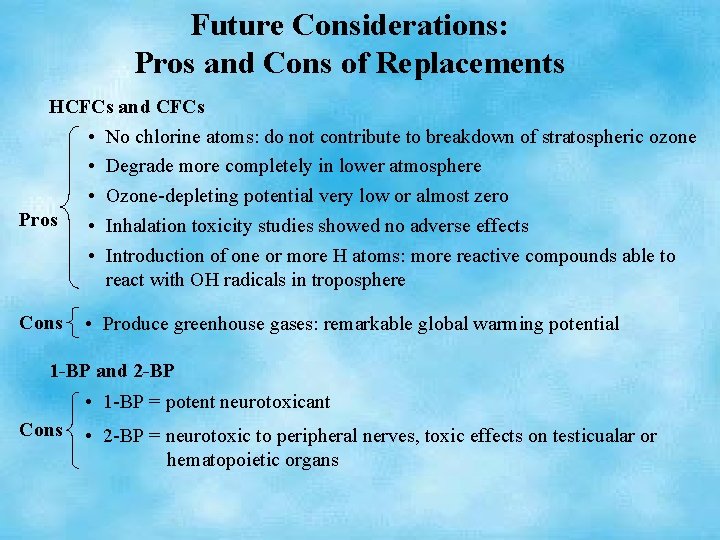
Future Considerations: Pros and Cons of Replacements HCFCs and CFCs • No chlorine atoms: do not contribute to breakdown of stratospheric ozone • Degrade more completely in lower atmosphere • Ozone-depleting potential very low or almost zero Pros • Inhalation toxicity studies showed no adverse effects • Introduction of one or more H atoms: more reactive compounds able to react with OH radicals in troposphere Cons • Produce greenhouse gases: remarkable global warming potential 1 -BP and 2 -BP • 1 -BP = potent neurotoxicant Cons • 2 -BP = neurotoxic to peripheral nerves, toxic effects on testicualar or hematopoietic organs
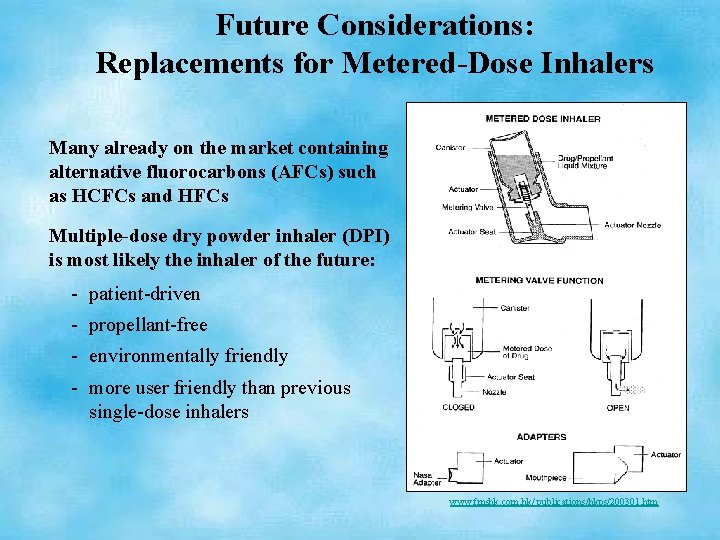
Future Considerations: Replacements for Metered-Dose Inhalers Many already on the market containing alternative fluorocarbons (AFCs) such as HCFCs and HFCs Multiple-dose dry powder inhaler (DPI) is most likely the inhaler of the future: - patient-driven - propellant-free - environmentally friendly - more user friendly than previous single-dose inhalers www. fmshk. com. hk/ publications/hkps/200301. htm
Conclusion • CFCs = Chlorofluorocarbons • Used in air conditioners, refrigerators, cleaners, fire extinguishers, inhalers • Breakdown by sunlight to Chlorine + Fluorine: negative environmental effects Ø Depletion of ozone layer, production of smog Ø Increased exposure to UV-rays • Direct effects on humans Ø Absorption: mostly via inhalation Ø Damage to respiratory, cardiovascular, nervous systems • Solution: reduce the use of CFCs? Ø Montreal Protocol Ø Replacement compounds
- Slides: 20