
CFARS Canadian Forces Affiliate Radio System CFARS WEB
CFARS Canadian Forces Affiliate Radio System CFARS WEB SITE - http: //www. cfars. ca
CFARS Executive CFARS National Manager - Maj Dan Bergeron (CIW 603), Kingston, Ont. Training Officer - John Bradley (CIW 444), Saskatoon, Sask. RAC LO – J. T. (Mitch) Mitchell (CIW 308), Edmonton, Alta. Reserve Unit LO – Maj Hal Buller (Retd) (CIW 660), Toronto, Ont. CFARS LO - Ken Halcrow (CIW 652), Ottawa, Ont. Network Manager - Bill Hicks (CIW 320), Chauvin, Alta. Digital Systems Manager - Les Lindstrom (CIW 650), Kingston, Ont.
Contact info Training Officer - John Bradley CIW 444, Email CIW 444@cfars. ca 306 652 3701 Cell 306 281 6531 RAC LO – J. T. (Mitch) Mitchell Email CIW 308@cfars. ca Cell 780 446 8958 Or via the Web site e-mailer WWW. CFARS. CA CIW 308
History AFARS (Air Force Amateur Radio System) started in 1946 mostly dedicated to civil defence and Search and Rescue. Mid 1950 on, Amateur stations in Canada provided “phone patch“ services to deployed CAF personnel in Egypt, Golan Heights and Sinai. Big boost to morale
History Hundreds of radio amateurs participated in phone patch traffic over the next 20 years. Traffic was extended to ships at sea and to Canada’s far north. By 1976, interference on the ham bands created problems and some phone patch traffic had to be shut down, as well as fewer licensed hams were available for remote deployment.

History CFARS was created, enabling stations to operate on DND frequencies outside the regular ham bands, and at the same time operators at remote sites did not need to be licensed hams.
Current Affiliate amateur stations in Canada were given permission by Industry Canada and DND to operate on these frequencies. Satellite systems did away with the need for phone patches, but the technology is still available in some CFARS stations.
Current CFARS exists today as a training tool for the CAF, as well as backup HF communications across Canada.
Current Approximately 120 members Calls issued 20 other stations Clubs Mil bases RMS email gateways
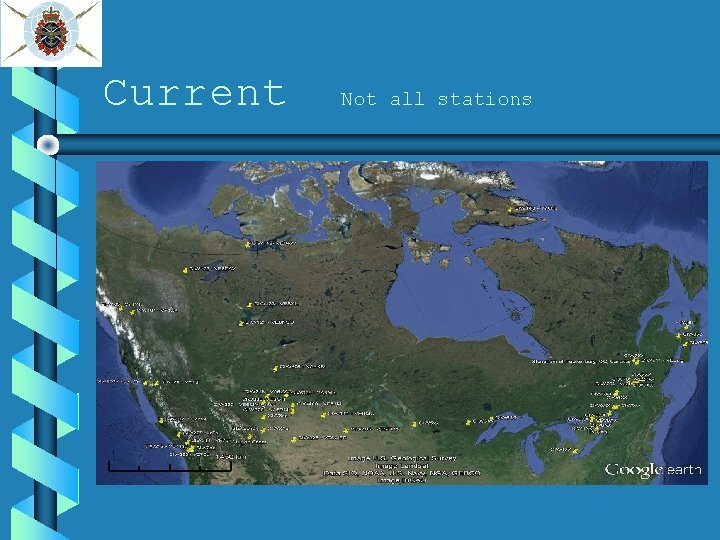
Current Not all stations
Ownership For years CFARS rattled around inside DND without a leader. With CFARS growing role in training and other communications, we now fall under DGIMO and CJOC. Frequency allocations for CFARS are provided by DFSM and Industry Canada
CFARS CAN DO SSB voice - most stations can run between 2 MHz and 30 MHz, upper or lower sideband. ALE: Some, not all stations can run 2 G ALE, compatible with green radios. We can also send and receive AMD messages using ALE. This was proven during EX Northern Mercury spring 2013.
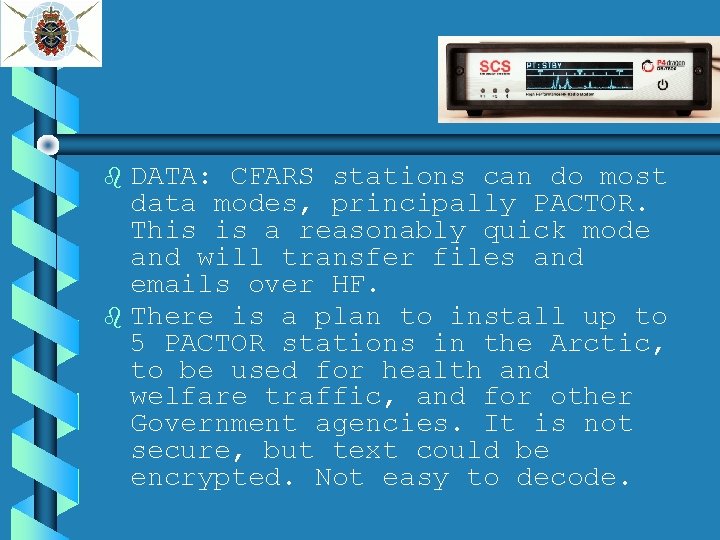
DATA: CFARS stations can do most data modes, principally PACTOR. This is a reasonably quick mode and will transfer files and emails over HF. There is a plan to install up to 5 PACTOR stations in the Arctic, to be used for health and welfare traffic, and for other Government agencies. It is not secure, but text could be encrypted. Not easy to decode.
Exercise role playing: CFARS stations can follow a master events list inserting messages into an exercise. CFARS stations do practice standard voice procedures as used in the CAF.
Training: CFARS stations are active with Regular and Reserve Signal Squadrons assisting with training. Makes life more interesting than talking across a parade square. Most reserve squadrons have a CFARS member in their community who would be willing to assist with training.

• MARS, (USA Version of CFARS) the Military Auxiliary Radio System functions in the United States similar to CFARS. • Recognizing the need for some common frequencies. CFARS and MARS obtained approval for 6 common frequencies.
• These can also be used by the USA Reserve, Regular and National Guard units on both sides of the border, including Alaska. • Frequencies range from 4 to 14 MHz
CFARS Cannot Do: 3 G ALE / 5066 Data modes compatible with green radios. There is some ability for 188 -110 A, etc. but it will not work with military radios. Secure Comms (No encryption devices) Digital SSB Frequency hopping Wideband HF
Security Clearances Most of our members (80 -90%) at some point have been cleared by DND / RCMP to Secret and better. In most instances these have now lapsed. A possible alternative to these clearances would be an “enhanced reliability” clearance as used by Ground Search and Rescue, should DND need and/or require a clearance level.
Wish List Signalers completing training within a unit would also qualify for a Radio Amateur License, which is a lifetime license to operate. This would benefit DND, as RADOPS leaving regular or reserve forces could join CFARS, or help with emergency communications in their own communities
Ready access to surplus gear, especially older Harris data modems which would enhance our ability to pass traffic to CAF units. More involvement with reserve units, both in training and as a source of more operators.
CFARS Q & A WWW. CFARS. CA
FIN / END
- Slides: 23