
cetis Centre for Educational Technology Interoperability Standards Why
cetis Centre for Educational Technology Interoperability Standards Why Learning Technology Standards? Why IMS? a Discussion Bill Olivier Technical Director, c etis
Following: Some slides actually used in the Session
Where IMS fits in - the others Early on: • AICC (Aircraft Industries CBT Committee) – Problem: Airplanes need maintenance – need many reliably-trained technicians, worldwide – need CBT to help with training • BUT – Airplanes last for 20 years – Computer platforms for 5 (at most) – How to avoid multiple, costly, re-implementations • AICC Specifications – Content sequencing & delivery oriented – Multiple choice testing – CDs, stand-alone PC & isolated learner model

Where IMS fits in - the others • Europe: ARIADNE Project – CE funded project – Large Consortium of University & Industrial Partners – Content & Metadata focused – By ‘ 98 had produced a Metadata specification – Initially hostile to IMS – Signed an Mo. U with IMS to collaborate on Metadata – Both IMS & ARIADNE built on Dublin Core • about 2/3 rds of their extensions cross-mapped • worked to harmonise their specifications

Where IMS fits in - the others • ADLnet (Advanced Distributed Learning Network) – US Dept of Defense initiative – Agreed early (‘ 97) to work with IMS – But narrower focus than IMS (web content delivery) – Impatient with slow rate of progress in IMS 98 -99 – Invited specific companies to define a closed spec – Built on AICC & IMS Content ideas – Produced SCORM v 1. 0 Jan 2000; v 1. 1 Jan 2001 – (Shareable Courseware Object Reference Model) – roughly: AICC for the Web – Web Content, Browser and isolated learner model
- and IMS • IMS - (Not Instructional Management Systems!) – Set up in late ‘ 97 by US universities’ EDUCAUSE – But involved Vendors, US Gov. and non-US bodies – JISC joined in May ‘ 98 on behalf of all UK HE - and now FE - institutions – Early on inherited work of other Groups on Metadata – Look at IMS in more detail later
Then the European Mo. U • PROMETEUS & CEN/ISSS WS-LT – Partially a European response to IMS – Set up at ministerial level in Council of Europe • PROMETEUS – Gather cross-sectoral views – Formulate requirements for specifications – Feed these to CEN/ISSS WS-LT – Trial Projects, Evaluate, Best Practice, Disseminate • CEN/ISSS WS-LT – European Centre for Standards/Information Society… – Working Group has recently put forward a report – Recommendations made to the CE
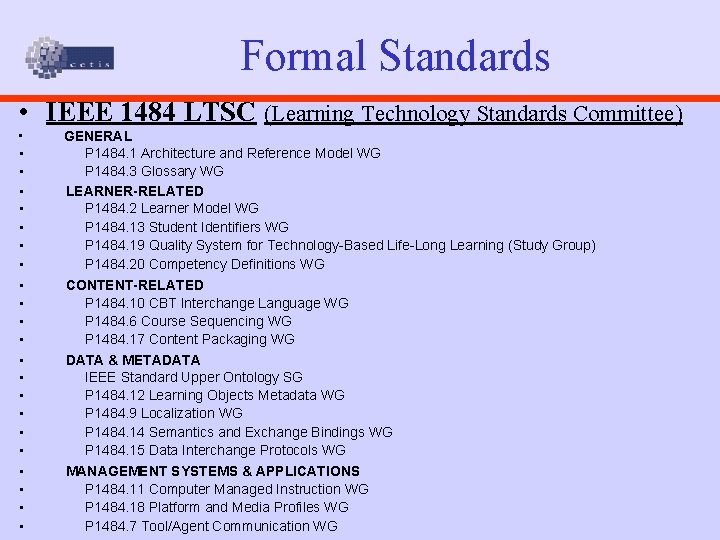
Formal Standards • IEEE 1484 LTSC (Learning Technology Standards Committee) • • • • • • GENERAL P 1484. 1 Architecture and Reference Model WG P 1484. 3 Glossary WG LEARNER-RELATED P 1484. 2 Learner Model WG P 1484. 13 Student Identifiers WG P 1484. 19 Quality System for Technology-Based Life-Long Learning (Study Group) P 1484. 20 Competency Definitions WG CONTENT-RELATED P 1484. 10 CBT Interchange Language WG P 1484. 6 Course Sequencing WG P 1484. 17 Content Packaging WG DATA & METADATA IEEE Standard Upper Ontology SG P 1484. 12 Learning Objects Metadata WG P 1484. 9 Localization WG P 1484. 14 Semantics and Exchange Bindings WG P 1484. 15 Data Interchange Protocols WG MANAGEMENT SYSTEMS & APPLICATIONS P 1484. 11 Computer Managed Instruction WG P 1484. 18 Platform and Media Profiles WG P 1484. 7 Tool/Agent Communication WG
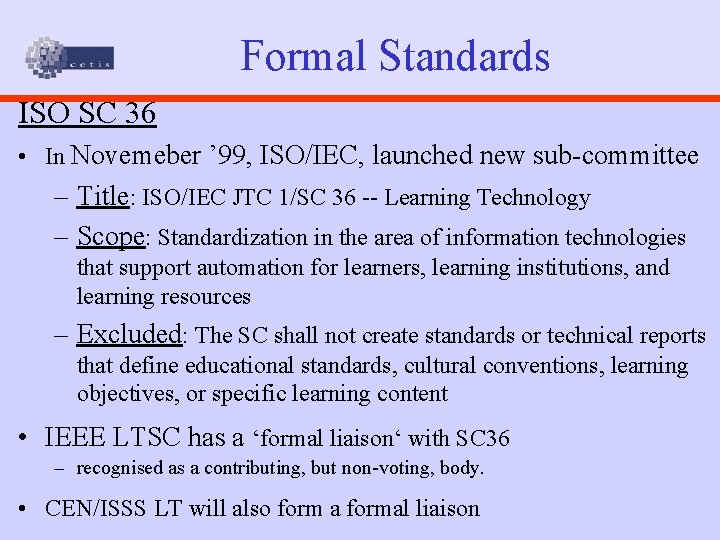
Formal Standards ISO SC 36 • In Novemeber ’ 99, ISO/IEC, launched new sub-committee – Title: ISO/IEC JTC 1/SC 36 -- Learning Technology – Scope: Standardization in the area of information technologies that support automation for learners, learning institutions, and learning resources – Excluded: The SC shall not create standards or technical reports that define educational standards, cultural conventions, learning objectives, or specific learning content • IEEE LTSC has a ‘formal liaison‘ with SC 36 – recognised as a contributing, but non-voting, body. • CEN/ISSS LT will also form a formal liaison
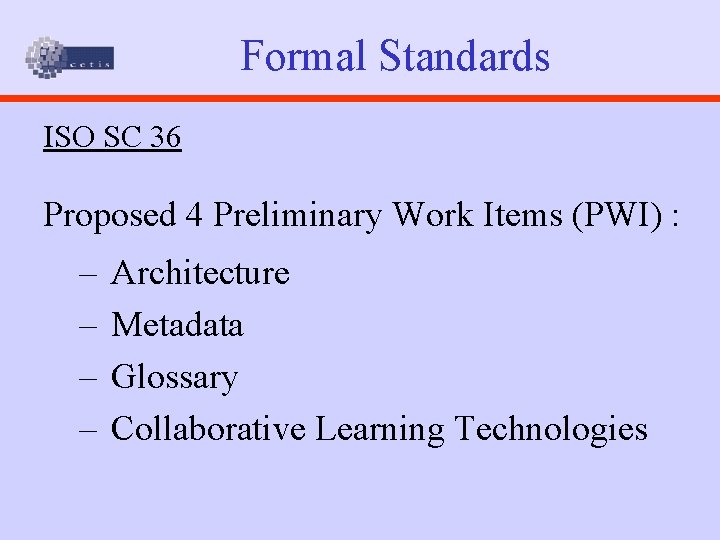
Formal Standards ISO SC 36 Proposed 4 Preliminary Work Items (PWI) : – Architecture – Metadata – Glossary – Collaborative Learning Technologies
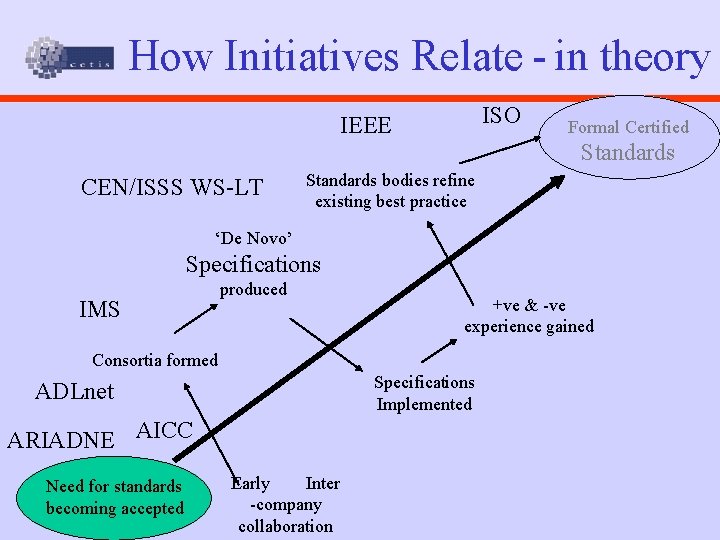
How Initiatives Relate - in theory ISO IEEE Formal Certified Standards CEN/ISSS WS-LT Standards bodies refine existing best practice ‘De Novo’ Specifications IMS produced +ve & -ve experience gained Consortia formed Specifications Implemented ADLnet ARIADNE AICC Need for standards becoming accepted Early Inter -company collaboration
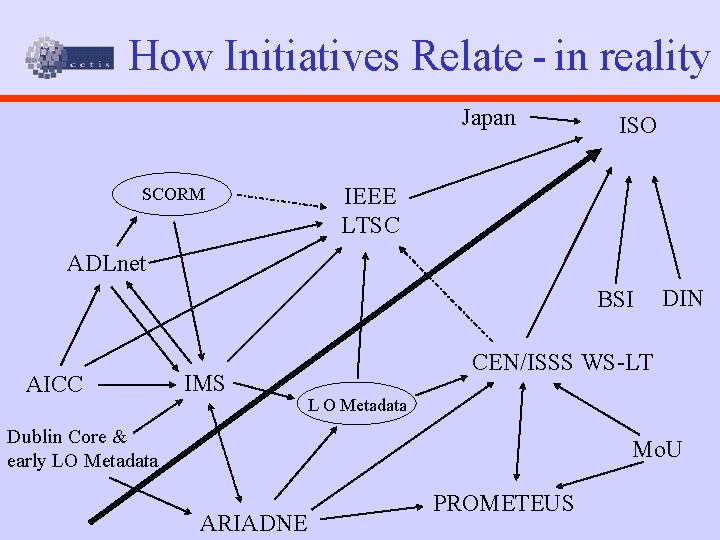
How Initiatives Relate - in reality Japan ISO IEEE LTSC SCORM ADLnet BSI AICC IMS DIN CEN/ISSS WS-LT L O Metadata Dublin Core & early LO Metadata Mo. U ARIADNE PROMETEUS
Following: Slides prepared, but not used, in the Session
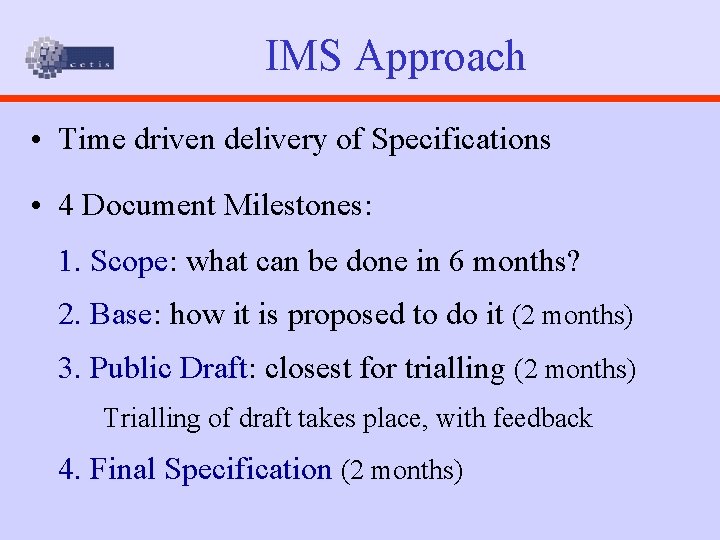
IMS Approach • Time driven delivery of Specifications • 4 Document Milestones: 1. Scope: what can be done in 6 months? 2. Base: how it is proposed to do it (2 months) 3. Public Draft: closest for trialling (2 months) Trialling of draft takes place, with feedback 4. Final Specification (2 months)
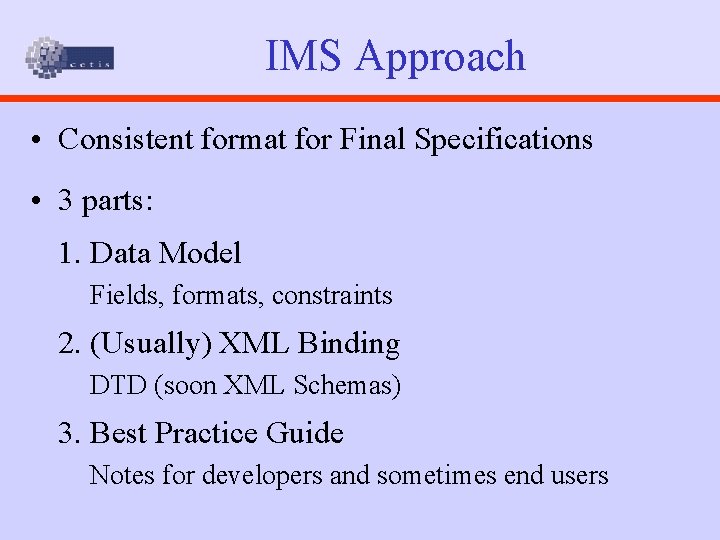
IMS Approach • Consistent format for Final Specifications • 3 parts: 1. Data Model Fields, formats, constraints 2. (Usually) XML Binding DTD (soon XML Schemas) 3. Best Practice Guide Notes for developers and sometimes end users
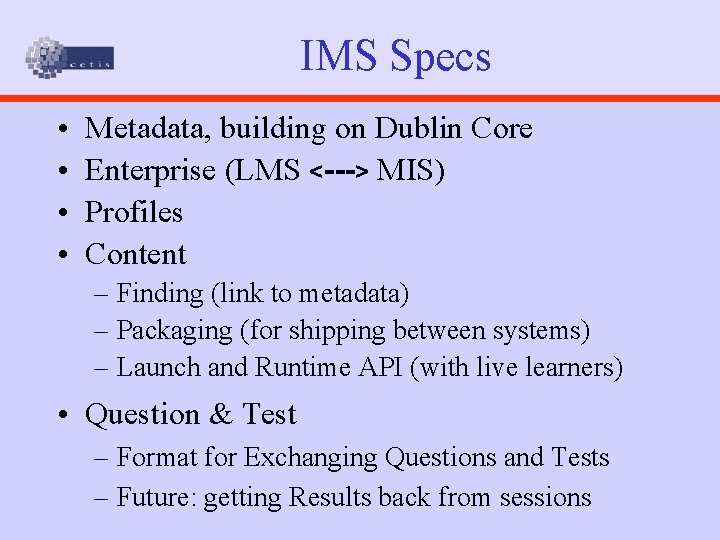
IMS Specs • • Metadata, building on Dublin Core Enterprise (LMS <---> MIS) Profiles Content – Finding (link to metadata) – Packaging (for shipping between systems) – Launch and Runtime API (with live learners) • Question & Test – Format for Exchanging Questions and Tests – Future: getting Results back from sessions
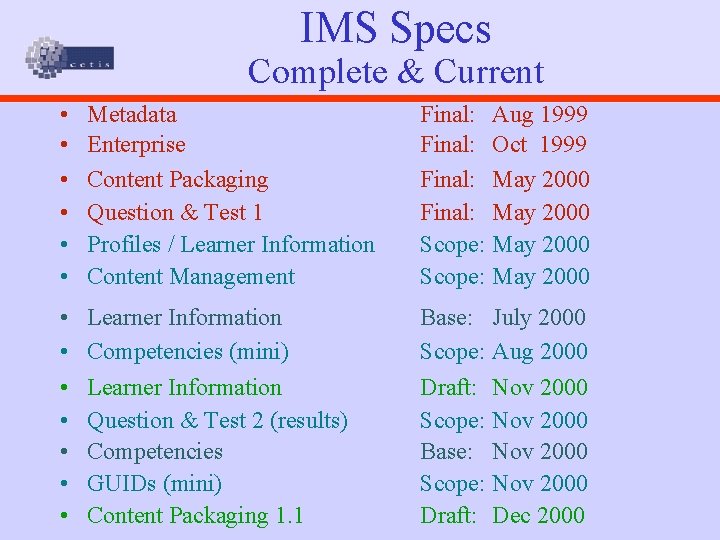
IMS Specs Complete & Current • • • Metadata Enterprise Content Packaging Question & Test 1 Profiles / Learner Information Content Management Final: Aug 1999 Final: Oct 1999 Final: May 2000 Scope: May 2000 • • Learner Information Competencies (mini) Base: July 2000 Scope: Aug 2000 Learner Information Question & Test 2 (results) Competencies GUIDs (mini) Content Packaging 1. 1 Draft: Nov 2000 Scope: Nov 2000 Base: Nov 2000 Scope: Nov 2000 Draft: Dec 2000
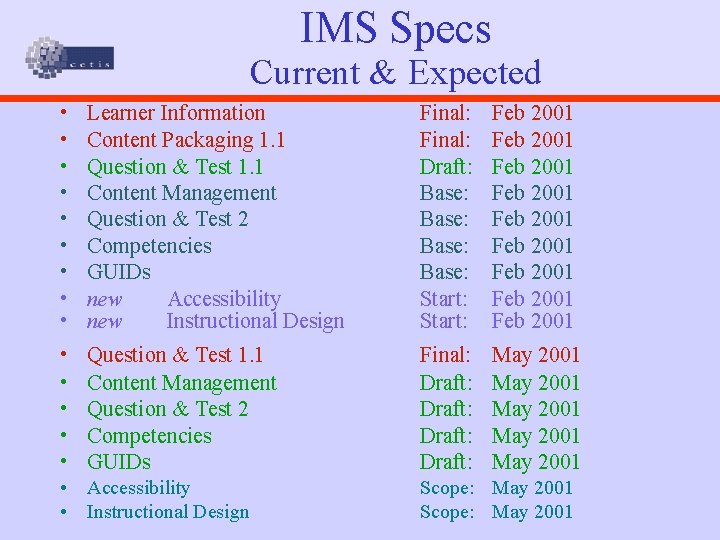
IMS Specs Current & Expected • • • Learner Information Content Packaging 1. 1 Question & Test 1. 1 Content Management Question & Test 2 Competencies GUIDs new Accessibility new Instructional Design Final: Draft: Base: Start: Feb 2001 Feb 2001 Feb 2001 • • • Question & Test 1. 1 Content Management Question & Test 2 Competencies GUIDs Final: Draft: May 2001 May 2001 • Accessibility • Instructional Design Scope: May 2001
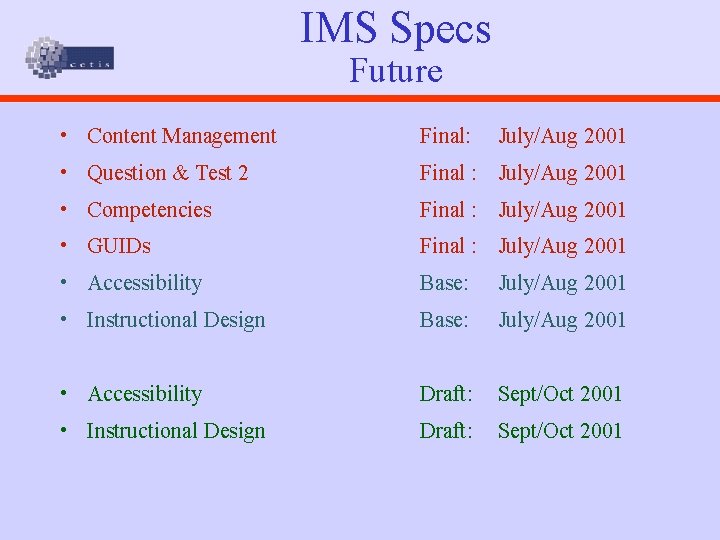
IMS Specs Future • Content Management Final: July/Aug 2001 • Question & Test 2 Final : July/Aug 2001 • Competencies Final : July/Aug 2001 • GUIDs Final : July/Aug 2001 • Accessibility Base: July/Aug 2001 • Instructional Design Base: July/Aug 2001 • Accessibility Draft: Sept/Oct 2001 • Instructional Design Draft: Sept/Oct 2001
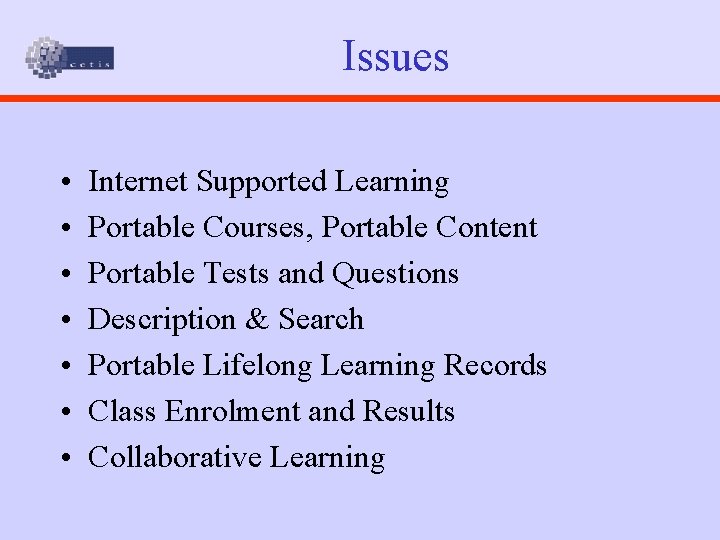
Issues • • Internet Supported Learning Portable Courses, Portable Content Portable Tests and Questions Description & Search Portable Lifelong Learning Records Class Enrolment and Results Collaborative Learning
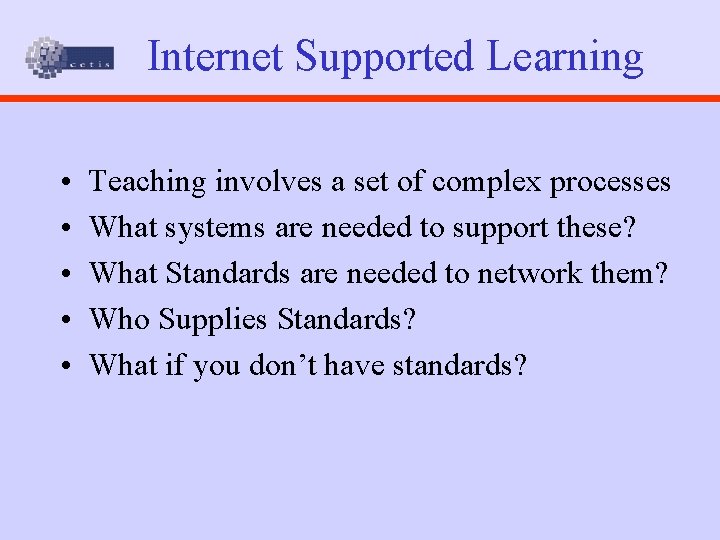
Internet Supported Learning • • • Teaching involves a set of complex processes What systems are needed to support these? What Standards are needed to network them? Who Supplies Standards? What if you don’t have standards?
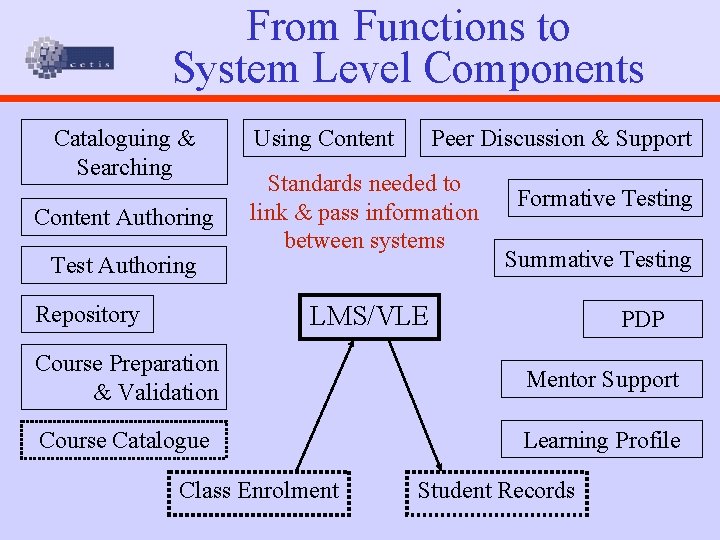
From Functions to System Level Components Cataloguing & Searching Content Authoring Test Authoring Using Content Peer Discussion & Support Standards needed to link & pass information between systems Formative Testing Summative Testing LMS/VLE Repository PDP Course Preparation & Validation Mentor Support Course Catalogue Learning Profile Class Enrolment Student Records
Portable Courses & Content • Why not just use Web Standards? • Is there more to using Content than delivery? • Is there a cultural difference between the approach to learning in the UK the US? • Are we converging? • Will the use of LT bring about uniformity? • Is/Should Learning be Content Driven?
Portable Courses & Content • • • Transporting Learning Objects Aggregation & Disaggregation Using Descriptions Tracking Learners Getting Results back form Session Tests
Portable Tests and Questions • • • Computer Assisted Assessment What is its role? Can it be improved? Must high quality assessment be expensive? Portable tests? Portable results?
Description & Search • Describing Learning Content • What needs to be described? – To Find it? – To Use it? • How should it be described? • Is Metadata the only way? – How have we found learning resources?
Class Enrolment and Results • • • Will Class teaching continue online? What is needed? Linking Academic to Administrative systems Where is the boundary? All ‘Administration’? Negotiating Learning: – Learner – Mentor – Administrator
Lifelong Learning Records • • • Multiple Learning Institutions What should pass between them? Information: Learner’s or Institutions? Control? Will Employers demand it, if it is there? What Levels of detail? Who For?
Collaborative Learning • • Is Internet Learning still based on CDs? Can we harness Internet communication? What kinds of Collaborative Learning? What information is needed? – Groups, Members, Identity, Role, Location, Access, • What functionality is needed? – Messaging (person 2 person & system 2 system), Presence, Shared/Distributed Authoring
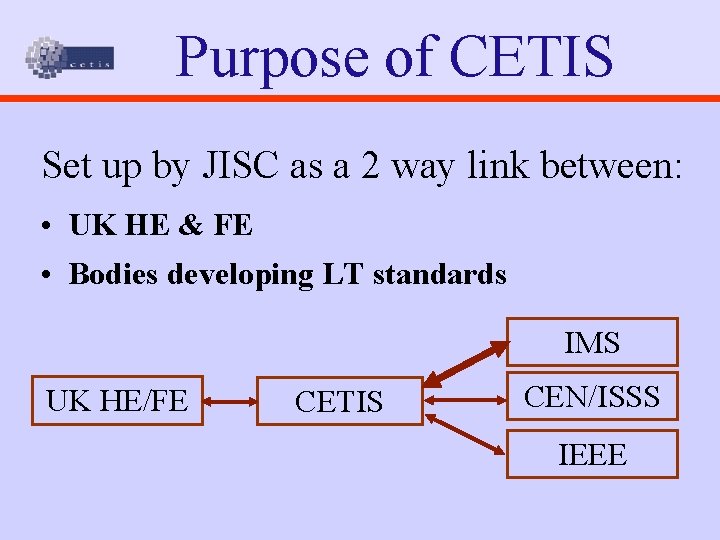
Purpose of CETIS Set up by JISC as a 2 way link between: • UK HE & FE • Bodies developing LT standards IMS UK HE/FE CETIS CEN/ISSS IEEE
CETIS • Funded by JISC Integrated Environments for Learning (JCIEL) Committee • Set up in May 1998, extended in 2000 for 3 further years • Managed by University of Wales Bangor in collaboration with O. U. and Sheffield Hallam University
CETIS Special Interest Groups Group Co-ordinators: • Question & Test: Strathclyde U. • Metadata: Loughborough U. • Enterprise & Profiles: Consortium of universities headed by Centre for Recording Achievement • Content: soon • Accessibility: soon
Staff and Contacts At Bangor: • Bill Olivier, Oleg Liber, Lisa Rowlands cetis@bangor. ac. uk http: //cetis. bangor. ac. uk/cetis/ • Paul Lefrere (OU) • Andy Heath (SHU)
- Slides: 33