
Cesium calibration for ATLAS Tile Calorimeter Alexander Solodkov
Cesium calibration for ATLAS Tile Calorimeter Alexander Solodkov for IHEP+UTA Cesium team Tile. Cal DP Workshop, Sep-2013 Sanya. Solodkov@cern. ch 1
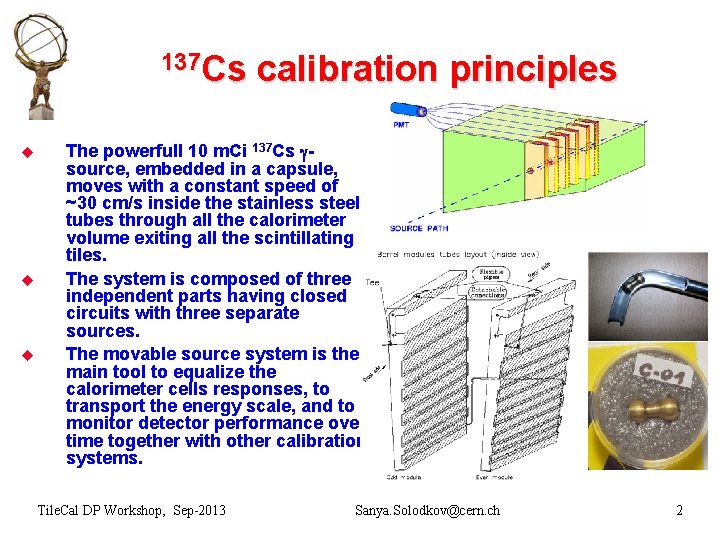
137 Cs u u u calibration principles The powerfull 10 m. Ci 137 Cs source, embedded in a capsule, moves with a constant speed of ~30 cm/s inside the stainless steel tubes through all the calorimeter volume exiting all the scintillating tiles. The system is composed of three independent parts having closed circuits with three separate sources. The movable source system is the main tool to equalize the calorimeter cells responses, to transport the energy scale, and to monitor detector performance over time together with other calibration systems. Tile. Cal DP Workshop, Sep-2013 Sanya. Solodkov@cern. ch 2
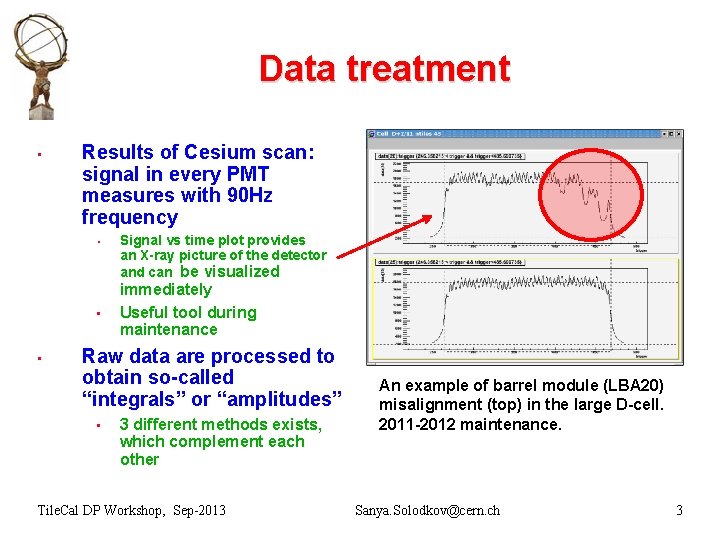
Data treatment • Results of Cesium scan: signal in every PMT measures with 90 Hz frequency • • • Signal vs time plot provides an X-ray picture of the detector and can be visualized immediately Useful tool during maintenance Raw data are processed to obtain so-called “integrals” or “amplitudes” • 3 different methods exists, which complement each other Tile. Cal DP Workshop, Sep-2013 An example of barrel module (LBA 20) misalignment (top) in the large D-cell. 2011 -2012 maintenance. Sanya. Solodkov@cern. ch 3
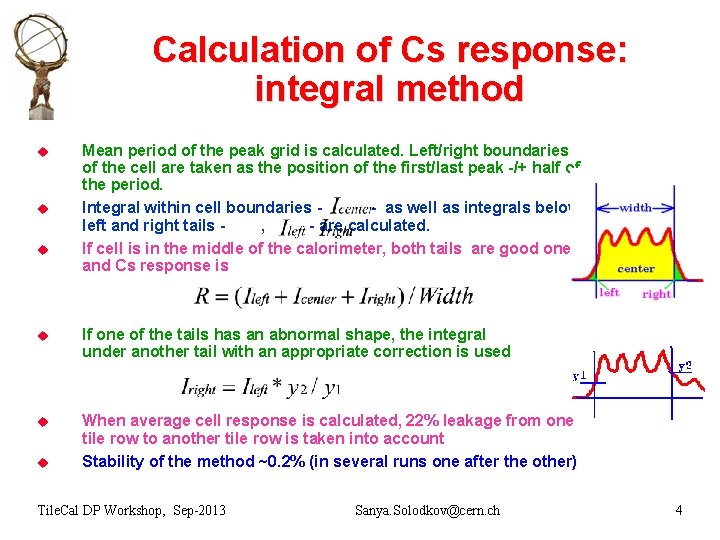
Calculation of Cs response: integral method u u u Mean period of the peak grid is calculated. Left/right boundaries of the cell are taken as the position of the first/last peak -/+ half of the period. Integral within cell boundaries - as well as integrals below left and right tails , - are calculated. If cell is in the middle of the calorimeter, both tails are good ones and Cs response is u If one of the tails has an abnormal shape, the integral under another tail with an appropriate correction is used u When average cell response is calculated, 22% leakage from one tile row to another tile row is taken into account Stability of the method ~0. 2% (in several runs one after the other) u Tile. Cal DP Workshop, Sep-2013 Sanya. Solodkov@cern. ch 4
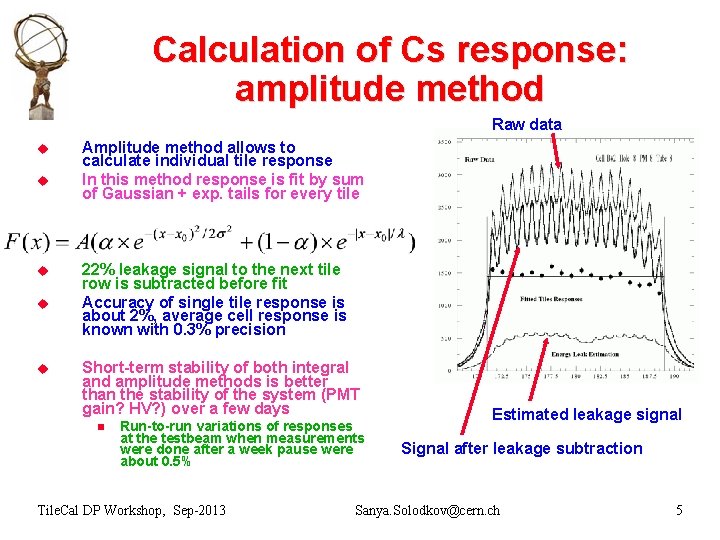
Calculation of Cs response: amplitude method Raw data u u u Amplitude method allows to calculate individual tile response In this method response is fit by sum of Gaussian + exp. tails for every tile 22% leakage signal to the next tile row is subtracted before fit Accuracy of single tile response is about 2%, average cell response is known with 0. 3% precision Short-term stability of both integral and amplitude methods is better than the stability of the system (PMT gain? HV? ) over a few days n Run-to-run variations of responses at the testbeam when measurements were done after a week pause were about 0. 5% Tile. Cal DP Workshop, Sep-2013 Estimated leakage signal Signal after leakage subtraction Sanya. Solodkov@cern. ch 5
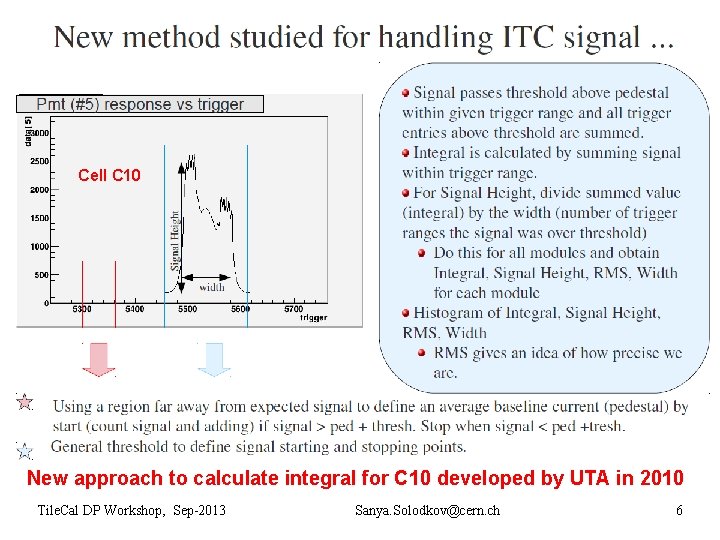
Cell C 10 New approach to calculate integral for C 10 developed by UTA in 2010 Tile. Cal DP Workshop, Sep-2013 Sanya. Solodkov@cern. ch 6
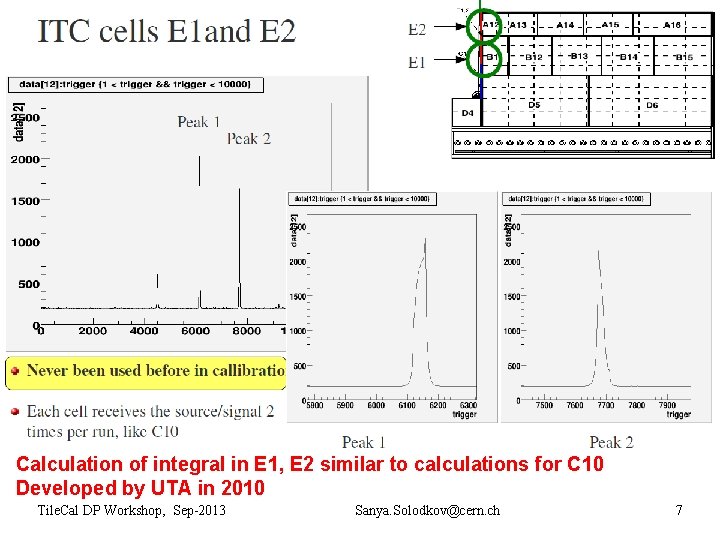
Calculation of integral in E 1, E 2 similar to calculations for C 10 Developed by UTA in 2010 Tile. Cal DP Workshop, Sep-2013 Sanya. Solodkov@cern. ch 7
Comparison of the methods u Integral method n n u Amplitude method n n n u Stability – RMS of the subsequent measurements 0. 2% Doesn’t work for C 10, E 1, E 2 Stability 0. 5% Works well for C 10 and special cells Comparable with integral method for normal cells UTA method n n n Stability ~1% Designed to work for C 10, E 1, E 2 Sometimes results are not reliable, because program doesn’t find position of the signal correctly Tile. Cal DP Workshop, Sep-2013 Sanya. Solodkov@cern. ch 8
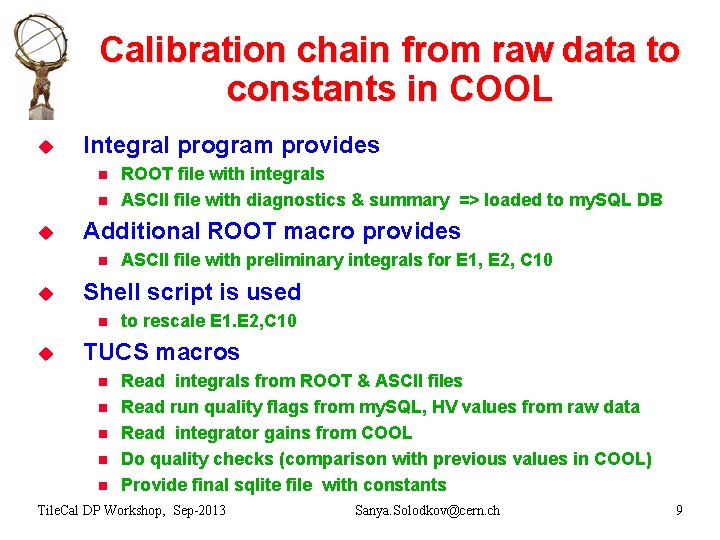
Calibration chain from raw data to constants in COOL u Integral program provides n n u Additional ROOT macro provides n u ASCII file with preliminary integrals for E 1, E 2, C 10 Shell script is used n u ROOT file with integrals ASCII file with diagnostics & summary => loaded to my. SQL DB to rescale E 1. E 2, C 10 TUCS macros n n n Read integrals from ROOT & ASCII files Read run quality flags from my. SQL, HV values from raw data Read integrator gains from COOL Do quality checks (comparison with previous values in COOL) Provide final sqlite file with constants Tile. Cal DP Workshop, Sep-2013 Sanya. Solodkov@cern. ch 9
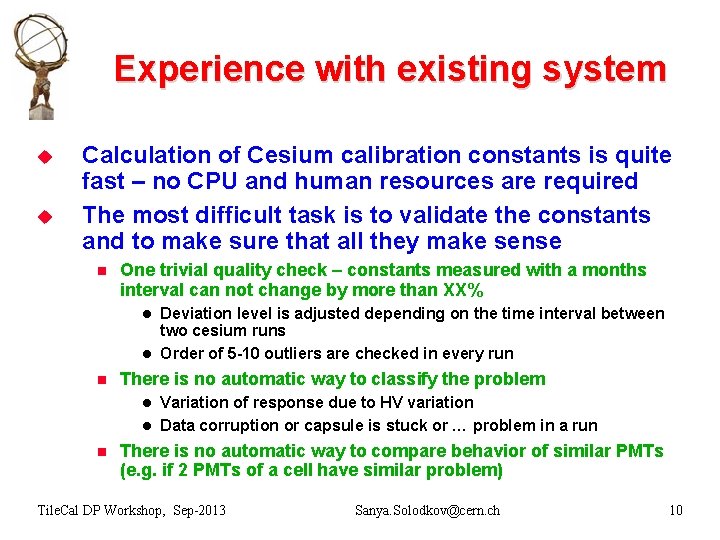
Experience with existing system u u Calculation of Cesium calibration constants is quite fast – no CPU and human resources are required The most difficult task is to validate the constants and to make sure that all they make sense n One trivial quality check – constants measured with a months interval can not change by more than XX% Deviation level is adjusted depending on the time interval between two cesium runs l Order of 5 -10 outliers are checked in every run l n There is no automatic way to classify the problem Variation of response due to HV variation l Data corruption or capsule is stuck or … problem in a run l n There is no automatic way to compare behavior of similar PMTs (e. g. if 2 PMTs of a cell have similar problem) Tile. Cal DP Workshop, Sep-2013 Sanya. Solodkov@cern. ch 10
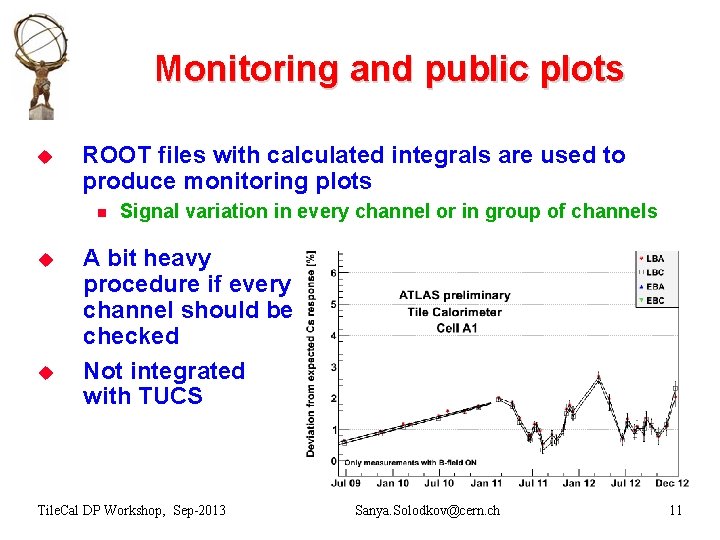
Monitoring and public plots u ROOT files with calculated integrals are used to produce monitoring plots n u u Signal variation in every channel or in group of channels A bit heavy procedure if every channel should be checked Not integrated with TUCS Tile. Cal DP Workshop, Sep-2013 Sanya. Solodkov@cern. ch 11
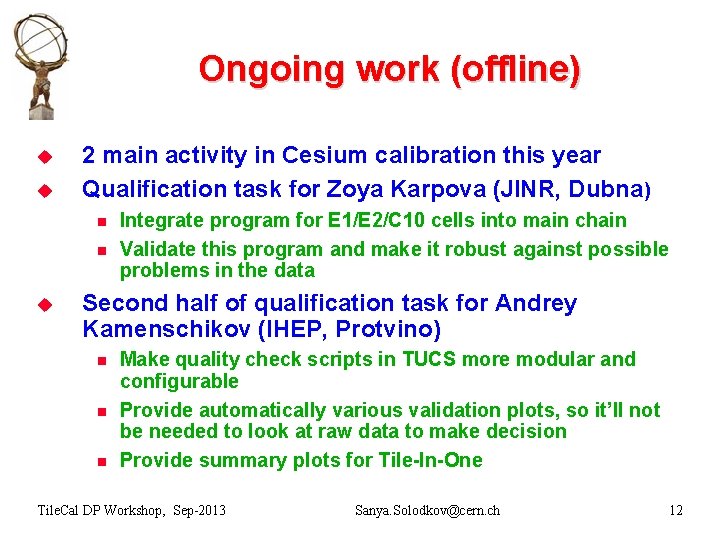
Ongoing work (offline) u u 2 main activity in Cesium calibration this year Qualification task for Zoya Karpova (JINR, Dubna) n n u Integrate program for E 1/E 2/C 10 cells into main chain Validate this program and make it robust against possible problems in the data Second half of qualification task for Andrey Kamenschikov (IHEP, Protvino) n n n Make quality check scripts in TUCS more modular and configurable Provide automatically various validation plots, so it’ll not be needed to look at raw data to make decision Provide summary plots for Tile-In-One Tile. Cal DP Workshop, Sep-2013 Sanya. Solodkov@cern. ch 12
Ongoing work (online) u Online software is being modified as well n u Updates due to hardware modifications (new water stations) More updates are in pipeline – to automatize some decisions during data taking n n n Confirm that system is ready to take data before the run (e. g. pedestals are within expected limits) Detect abnormal situations and fix them (e. g. capsule is stuck) Provide short report about data quality for every module during the run, so it’s possible to rescan problematic modules Tile. Cal DP Workshop, Sep-2013 Sanya. Solodkov@cern. ch 13
Future work (demonstrator) u u u Cs system would like to send sensor data via slow control path from the drawers to RODs This requires the usage of GBT interface in the drawer electronics Cs system would like to reserve a port/connection to the drawer interface FPGA for Cs communication The port could be CAN-bus and/or SPI CAN-bus messages will be encapsulated inside GBT packets and unpacked by the RODs Non-negligible amount of work is needed to update online and offline software for that Tile. Cal DP Workshop, Sep-2013 Sanya. Solodkov@cern. ch 14
Conclusions u u u Cesium calibration system works reliably and is able to provide calibration constants for all the cells promptly Over next year efforts of experts will be concentrated on n Integration of E 1/E 2/C 10 analysis into main calibration chain n Automatic visualization of the results, with emphasize on problematic cases n Integration into Tile-in-One n Online software will be updated as well Protvino team will be responsible for Cesium calibration constants in Tile. Cal during RUN II Tile. Cal DP Workshop, Sep-2013 Sanya. Solodkov@cern. ch 15
BACKUP Tile. Cal DP Workshop, Sep-2013 Sanya. Solodkov@cern. ch 16
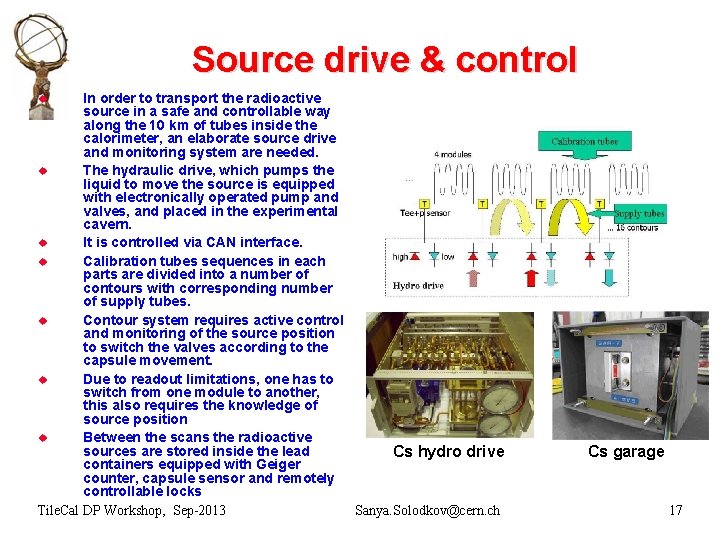
Source drive & control In order to transport the radioactive source in a safe and controllable way along the 10 km of tubes inside the calorimeter, an elaborate source drive and monitoring system are needed. u The hydraulic drive, which pumps the liquid to move the source is equipped with electronically operated pump and valves, and placed in the experimental cavern. u It is controlled via CAN interface. u Calibration tubes sequences in each parts are divided into a number of contours with corresponding number of supply tubes. u Contour system requires active control and monitoring of the source position to switch the valves according to the capsule movement. u Due to readout limitations, one has to switch from one module to another, this also requires the knowledge of source position u Between the scans the radioactive sources are stored inside the lead Cs hydro drive containers equipped with Geiger counter, capsule sensor and remotely controllable locks Tile. Cal DP Workshop, Sep-2013 Sanya. Solodkov@cern. ch u Cs garage 17
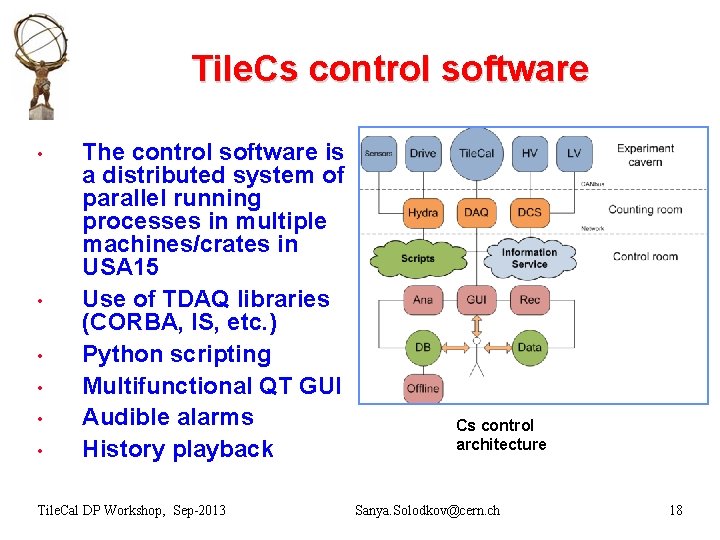
Tile. Cs control software • • • The control software is a distributed system of parallel running processes in multiple machines/crates in USA 15 Use of TDAQ libraries (CORBA, IS, etc. ) Python scripting Multifunctional QT GUI Audible alarms History playback Tile. Cal DP Workshop, Sep-2013 Cs control architecture Sanya. Solodkov@cern. ch 18
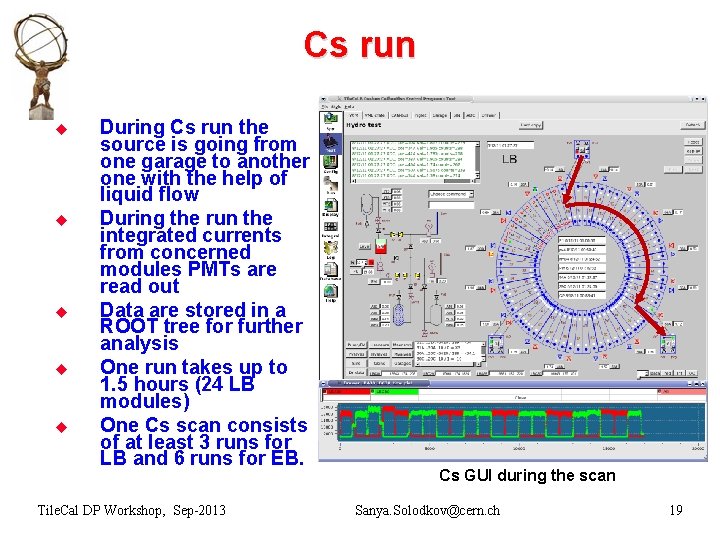
Cs run u u u During Cs run the source is going from one garage to another one with the help of liquid flow During the run the integrated currents from concerned modules PMTs are read out Data are stored in a ROOT tree for further analysis One run takes up to 1. 5 hours (24 LB modules) One Cs scan consists of at least 3 runs for LB and 6 runs for EB. Tile. Cal DP Workshop, Sep-2013 Cs GUI during the scan Sanya. Solodkov@cern. ch 19
Tile. Cal DP Workshop, Sep-2013 Sanya. Solodkov@cern. ch 20
- Slides: 20