
Cervical and Thoracic spine 2008 06 17 Upper
- Slides: 36
Cervical and Thoracic spine 2008. 06. 17
Upper limb tension test 1 • Tension on C 5, C 6, C 7 nerve root • Median nerve dominant • Not specific with regard to a given level • Median N. 관련된 1 – 3 root의 자극, 압박
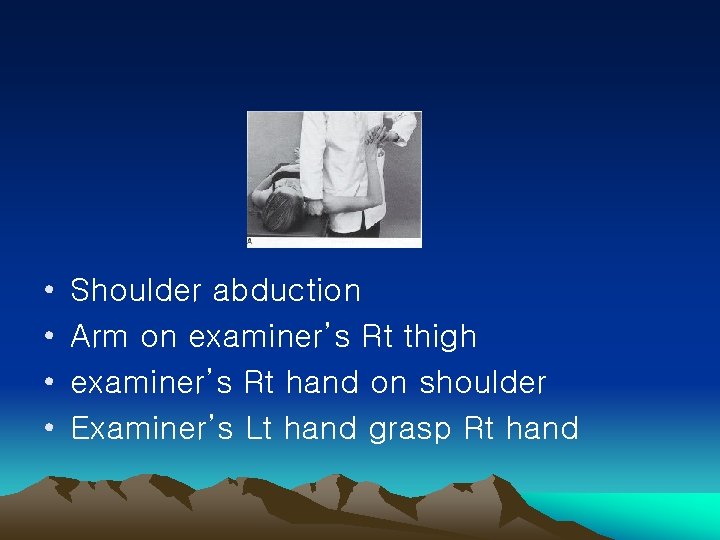
• • Shoulder abduction Arm on examiner’s Rt thigh examiner’s Rt hand on shoulder Examiner’s Lt hand grasp Rt hand
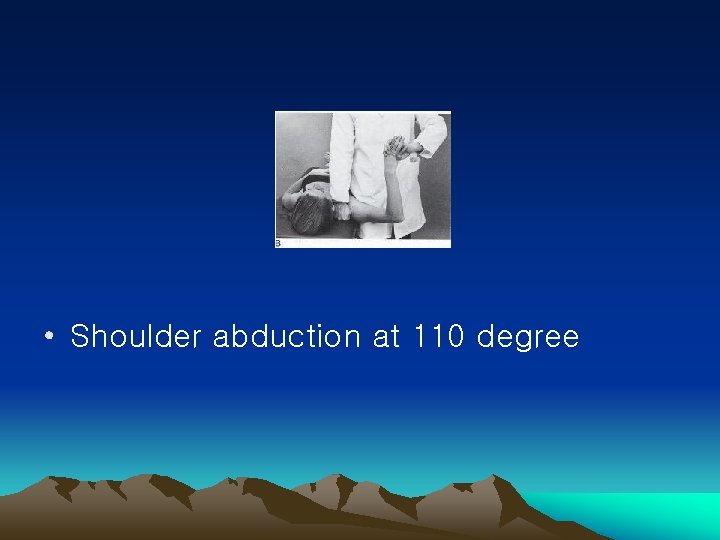
• Shoulder abduction at 110 degree
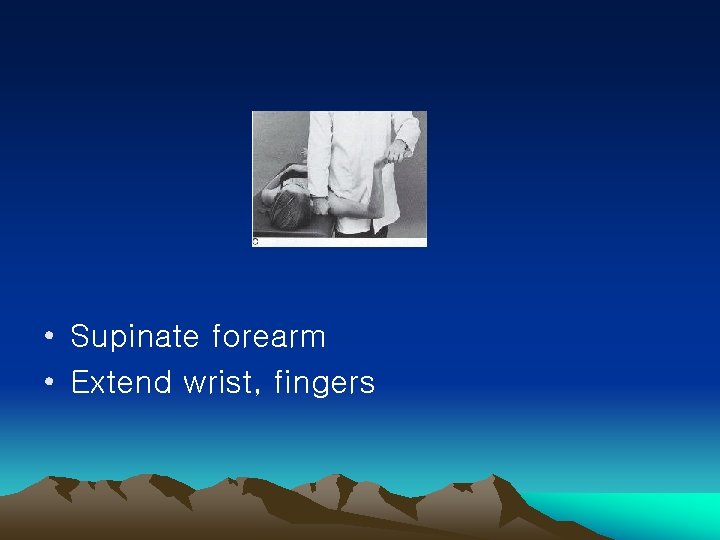
• Supinate forearm • Extend wrist, fingers
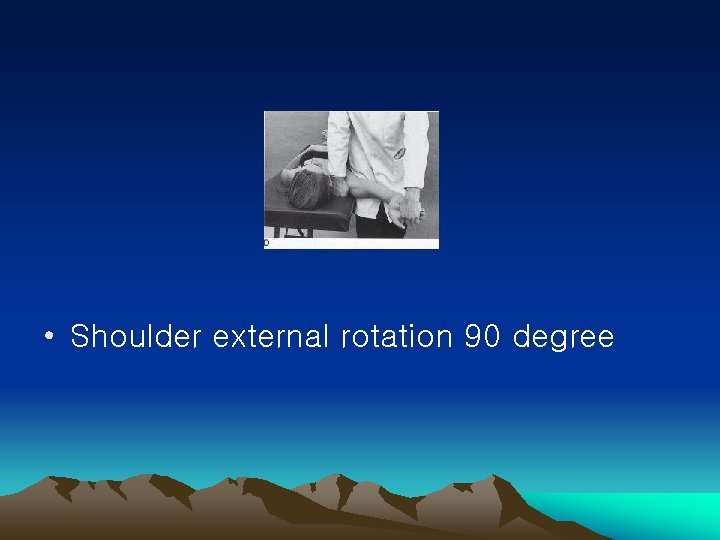
• Shoulder external rotation 90 degree
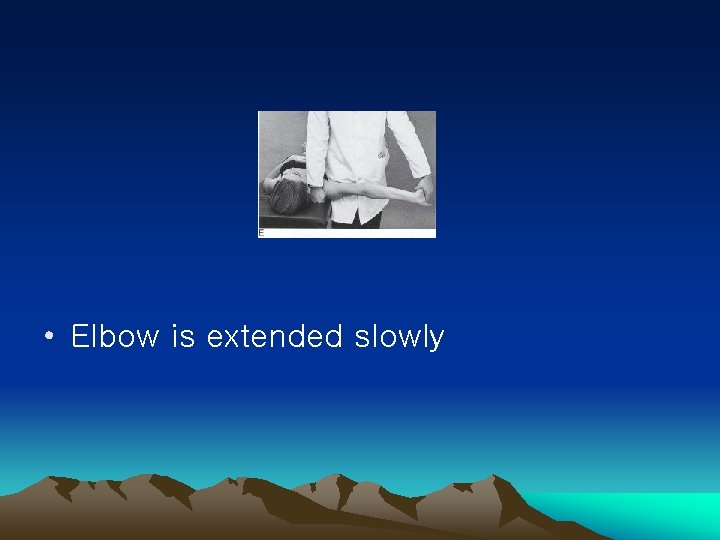
• Elbow is extended slowly
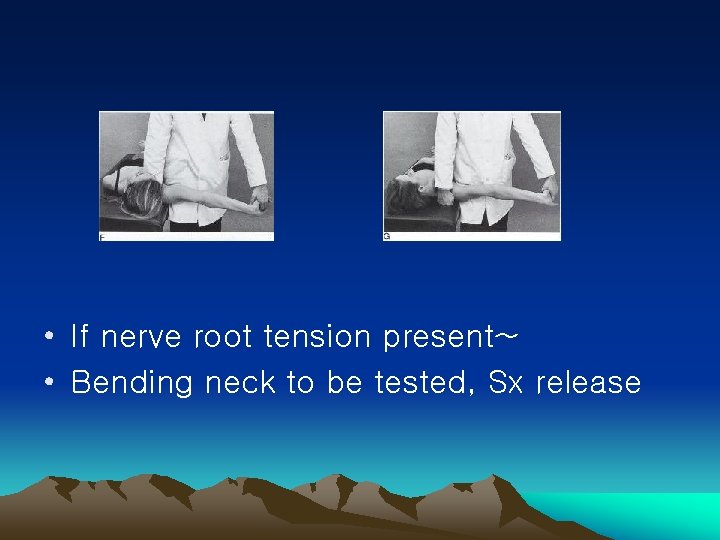
• If nerve root tension present~ • Bending neck to be tested, Sx release
• Stretching, aching at Antecubital fossa : WNL • C 5 : lateral detoid and the midarm • C 6 : dorsal radial aspect of the forearm involving index finger and the thumb • C 7 : centrally down the forearm involving the long finger
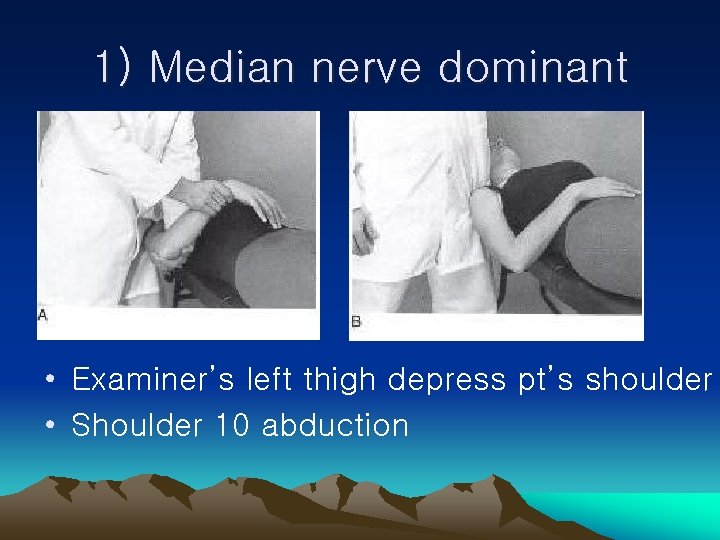
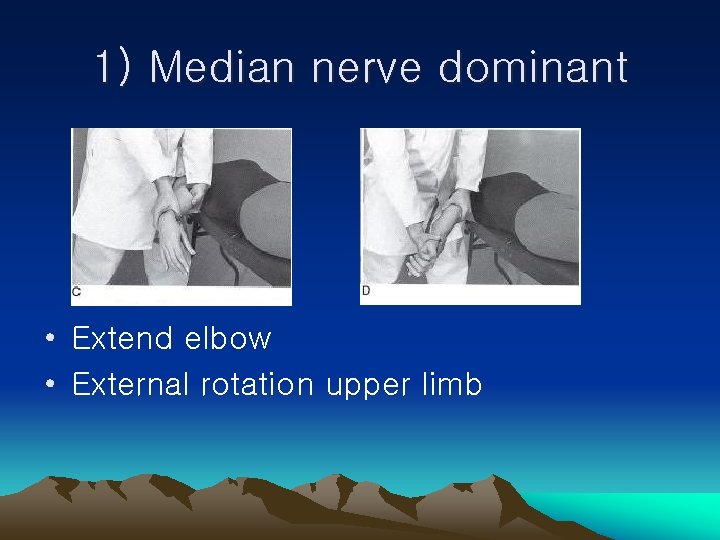
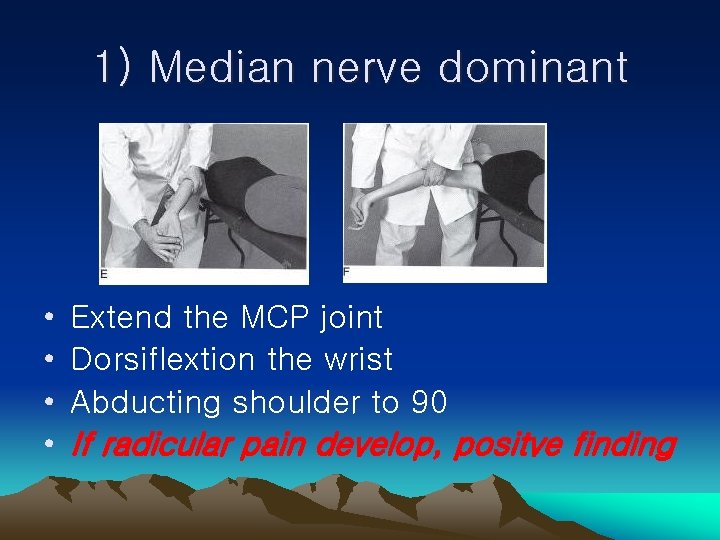
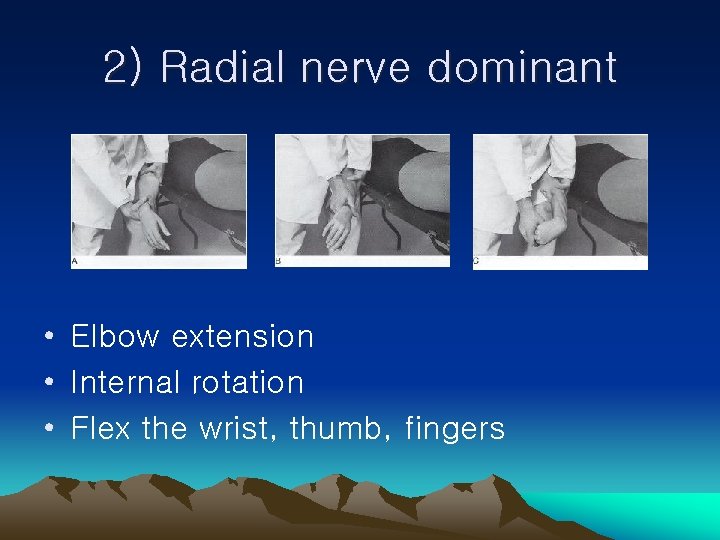
Upper limb tension test 2 • C 6, C 7 nerve root • Median nerve dominant • Radial nerve dominant
1) Median nerve dominant • Examiner’s left thigh depress pt’s shoulder • Shoulder 10 abduction
1) Median nerve dominant • Extend elbow • External rotation upper limb
1) Median nerve dominant • • Extend the MCP joint Dorsiflextion the wrist Abducting shoulder to 90 If radicular pain develop, positve finding
2) Radial nerve dominant • Elbow extension • Internal rotation • Flex the wrist, thumb, fingers
Upper limb tension test 3 • C 8, T 1 nerve root • Ulnar nerve dominant
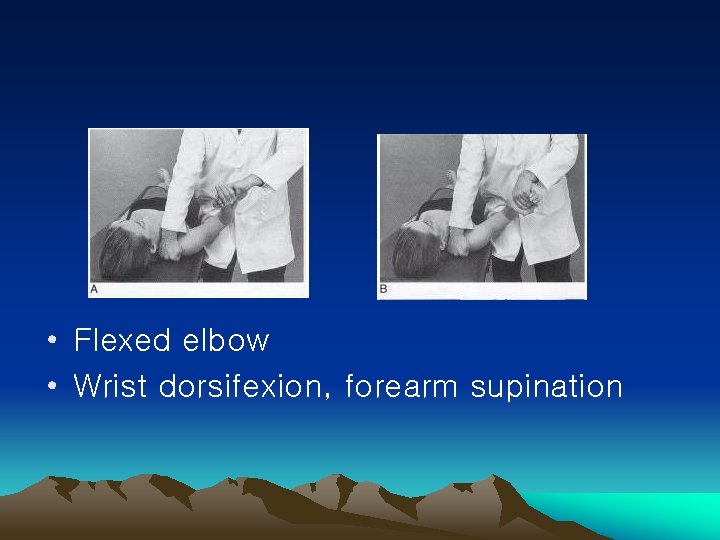
• Flexed elbow • Wrist dorsifexion, forearm supination
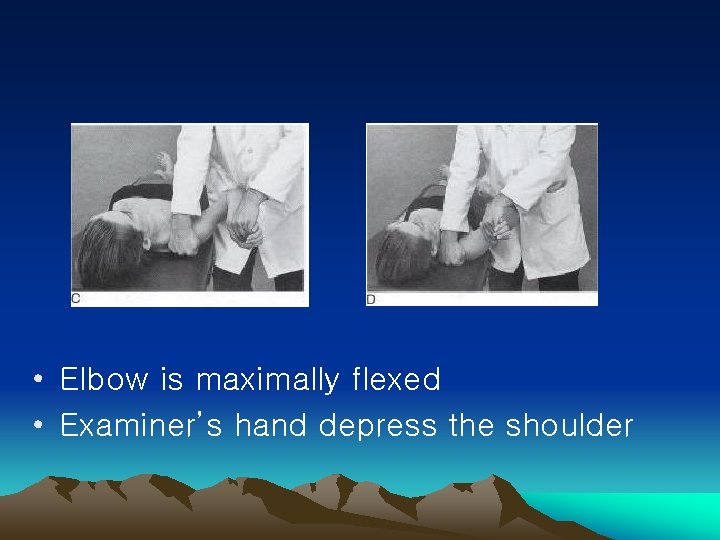
• Elbow is maximally flexed • Examiner’s hand depress the shoulder
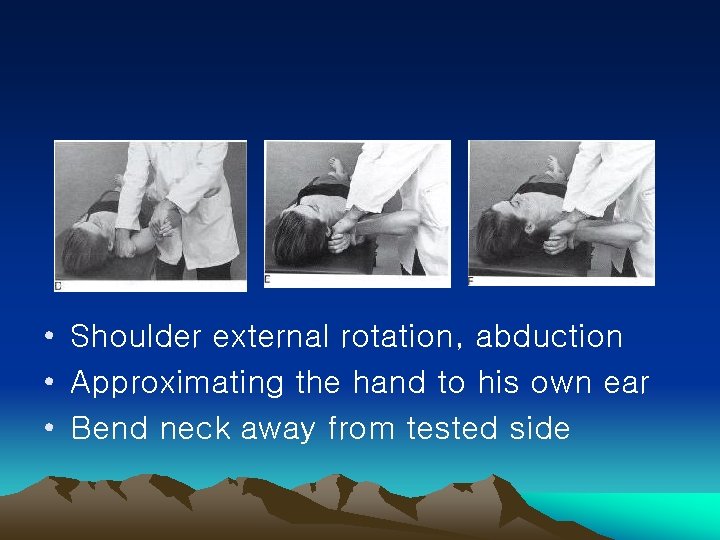
• Shoulder external rotation, abduction • Approximating the hand to his own ear • Bend neck away from tested side
• Tugging sensation in the axilla : WNL • C 8 : radiating down the arm past the elbow to the little finger • T 1 : radiating down the arm past the elbow to the axilla
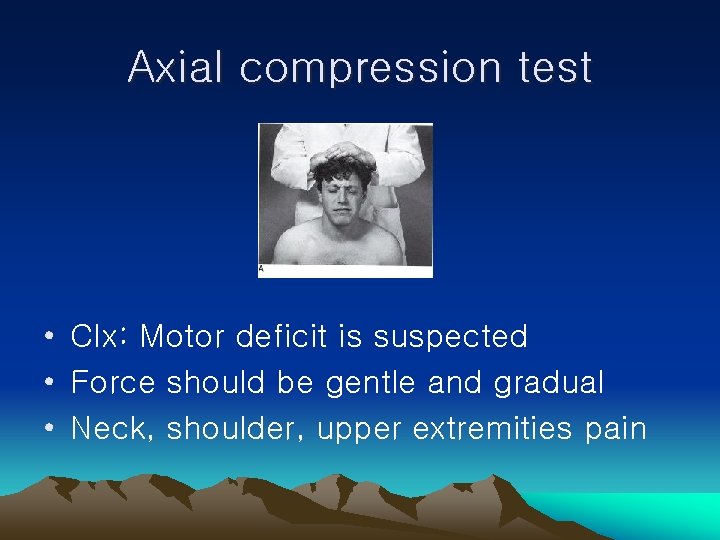
Axial compression test • CIx: Motor deficit is suspected • Force should be gentle and gradual • Neck, shoulder, upper extremities pain
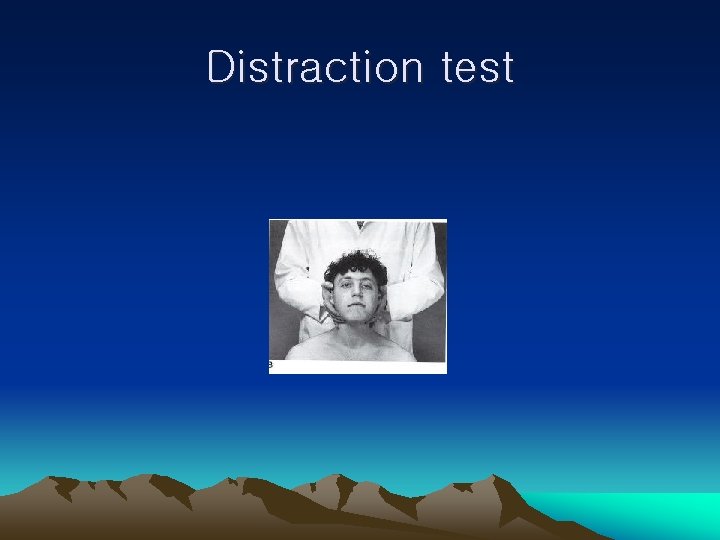
Distraction test
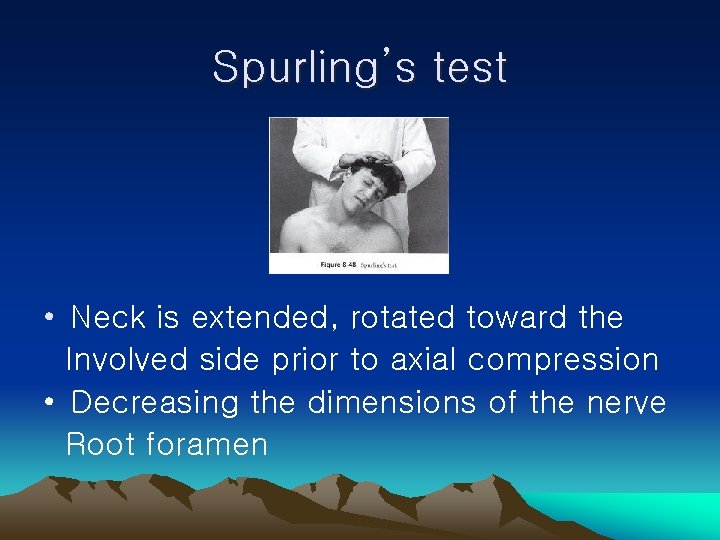
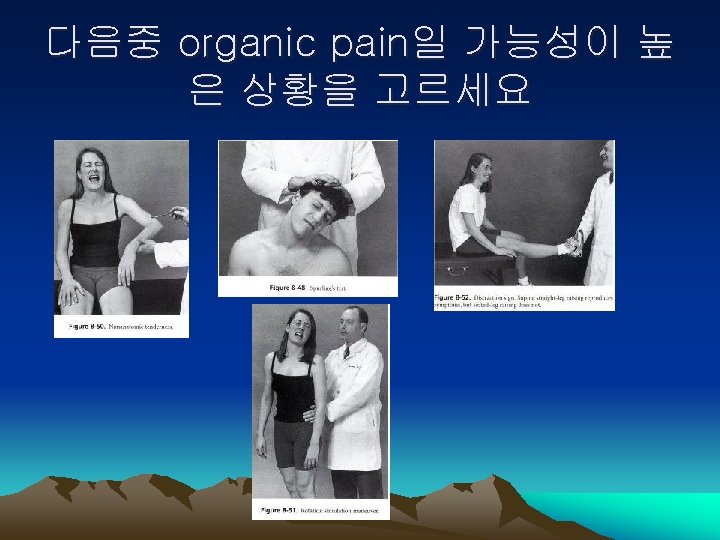
Spurling’s test • Neck is extended, rotated toward the Involved side prior to axial compression • Decreasing the dimensions of the nerve Root foramen
Response to Axial compression test and Spurling’s test • • • No discomfort Sensation of heaviness Nonradicular pain Pseudoradicular pain Radicular pain
No discomfort • muscular strains • mild ligamentous sprains • -> pain is not aggravated by test
Nonradicular pain, Pseudoradicular pain • radiates to the occiput, scapular, sholders occasionally down the arm but not distal to the elbow • 1. Spondylolisthesis • 2. Degenerative disc disease without nerve root compression
Radicular pain • • • Radiates into upper extremity Usually below the elbow Along the distribution of dermatome Young adults: intervertebral disc prolapse Older patient: foraminal stenosis owing to the combination of disc degeneration and secondary facet hypertrophy
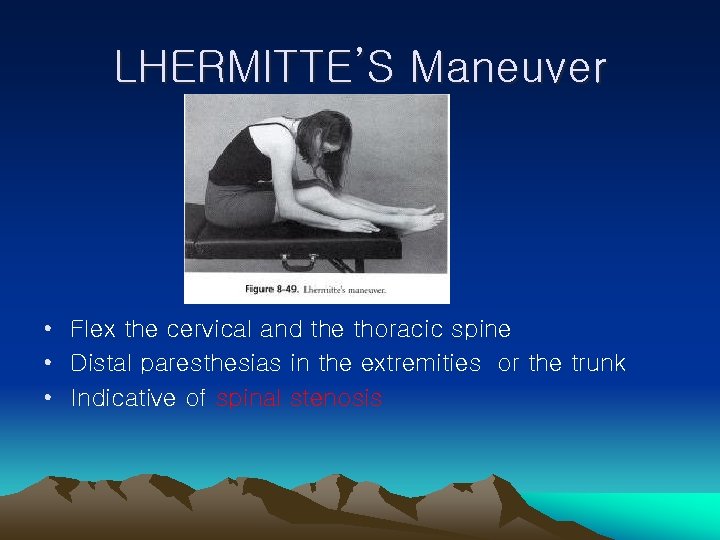
LHERMITTE’S Maneuver • Flex the cervical and the thoracic spine • Distal paresthesias in the extremities or the trunk • Indicative of spinal stenosis
Nonorganic signs of Waddell • Cannot be explained by current knowledge of anatomy & physiology • Behavioral maladaptations to disease process or reaction to Real or perceived pain
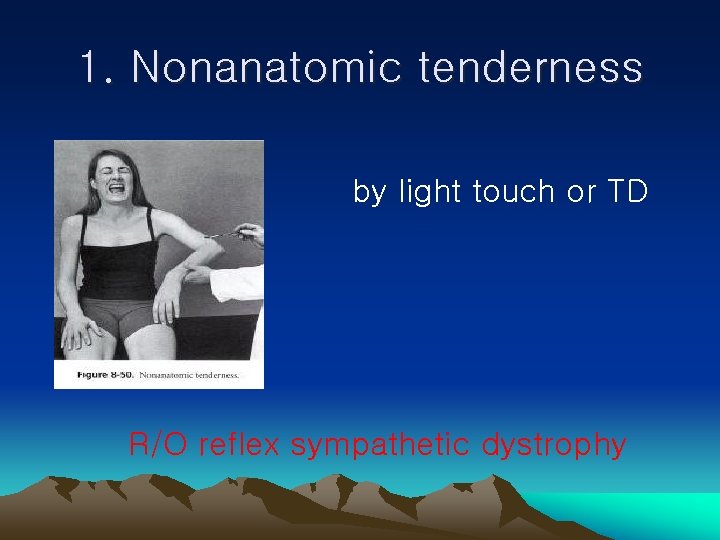
1. Nonanatomic tenderness by light touch or TD R/O reflex sympathetic dystrophy
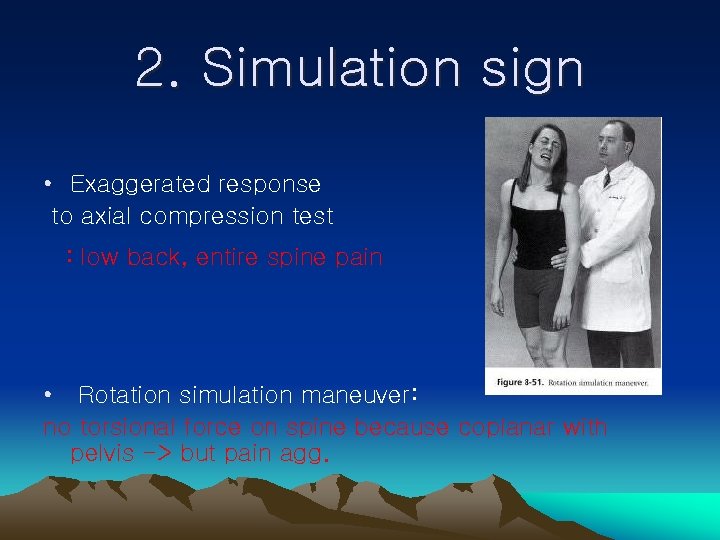
2. Simulation sign • Exaggerated response to axial compression test : low back, entire spine pain • Rotation simulation maneuver: no torsional force on spine because coplanar with pelvis -> but pain agg.
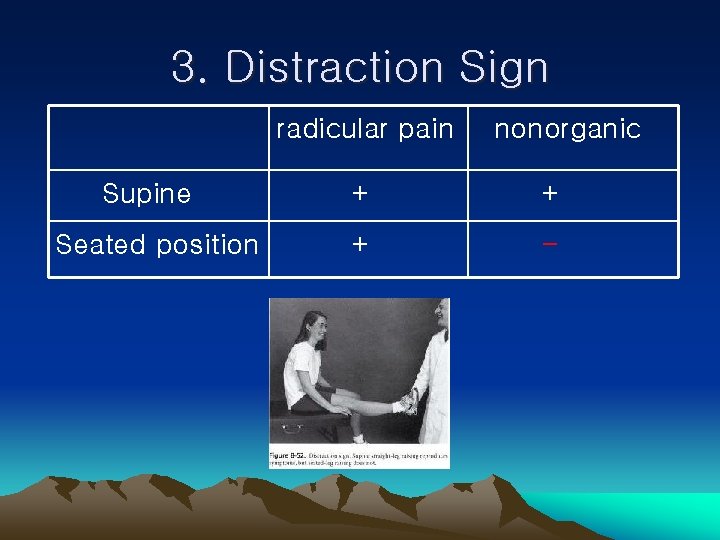
3. Distraction Sign radicular pain Supine Seated position nonorganic + + + -
4. Regional sensory or motor disturbance 1. Sensory : Stocking, glove distribution Ex) DM neuropathy 2. Motor : diffuse motor weakness of multiple muscle group
5. Overreaction • light forms of palpation or gentle examination techniques -> reacts physically or verbally in an inappropriately theatrical manner