
Certification vs Credential vs Licensing or How Virginia


- Slides: 31
Certification vs. Credential vs. Licensing or How Virginia Tried to Re-Invent the Wheel 01/16/2014
Keynote Speaker - What an Honor! Then the panic set in - Why Me? Qualifications? - None to speak of • I don’t have a PHD, am not a leading Public Health Official or Legislator • I haven’t developed some new way to treat wastewater • I am not a manufacturer of some spiffy new treatment or dispersal device Simply a “Reformed” regulator and owner of a small wastewater maintenance company. • Am outspoken on my views regarding Maintenance, Regulations & Licensing • Was elected to the Board for the National Association and was appointed by two Governors to the Licensing Board 01/16/2014
OMG - What am I going to Talk About! Suggestions from my CPOW and my Peanut Gallery - read Staff and Wife • CPOW – Regulation Reform, Maintenance & Credentialing • Wife - Stick with what you know - (Be a Cheering Section for Onsite - Don’t tick off the designers like you do in Virginia) • Staff – You’re Going to Colorado? In January? Brrrrrr Oh WAIT … didn’t they just approve recreational Marijuana? Cool! 01/16/2014
1 st, 2 nd, and 3 rd Topic Suggestions Regulation Reform – looks like you did it, so not a lot to say as it appears you have a good document in 5 -CCR-1002 -43. Maintenance – lots of good topics here for discussion, but in truth not enough time for a “Key Note” presentation. (ps. Love teaching maintenance as I get a chance to talk “crap” for hours and get paid for it!) Credentialing – WINNER – This was probably the single most challenging and game changing event in Onsite in Virginia in the last 10 years. 01/16/2014
History - 2000 New Onsite Regulations (12 -VAC-5 -610) passed by the General Assembly and enacted in 2000. – Opened the door for any NSF Standard 40 system to be Installed with footprint reductions and decreased stand-offs and NO additional testing. Alternative Onsite Regulations (12 -VAC-5 -613) requiring perpetual Maintenance, reporting, sampling and “Certified” Operators – FAILED! This opened the door for thousands of installations and building growth that would not have been allowed under the previous regulations. 01/16/2014
History - 2005 State Health Department approaches VOWRA for a partnership in developing MANDATORY maintenance regulations with NO GRANDFATHERING! Basically asked for support in developing a program for mandatory maintenance that the Legislature would be happy with AND that the Health Department WON’T get crucified by the general public! Health Department estimated between 80, 000 and 100, 000 Alternative OWTS installed in a five year period! 01/16/2014
Four Things Needed to Happen A working group was formed and it was determined that FOUR things needed to happen! 1. Dust off 12 -VAC-5 -613, make some editing changes and it should be good to go – EASY 2. Develop a DATA BASE and an INVENTORY of what was permitted! – Not so Easy 3. Switch from “Criminal” enforcements to “Civil Penalties” – big regulation change and paradigm shift! 4. Have “Certified” Operators available so when #1 goes into effect, the property owners can’t holler – much! 01/16/2014
Inventing the Wheel So What type of Certification or HOW did we want to “Certify” or Credential Operators? Require Manufacturer Certification for ALL? - 44 manufacturers listed on NSF! What type of age / education / experience? Who handles the paperwork? – Application / Fees / TESTING? What type and how much Continuing Education? How frequently does the Certification get renewed? How do you discipline the “Bad Actors”? What type of Sanctions? Who does the Investigations? Who foots the bill for the Investigations? Where does the money come from? Who sets the “Standard of Practice”? 01/16/2014
First Thought The original thought was to track ALL Operators and REQUIRE Operators to have Manufacturer certifications for the treatment systems they were providing services to. This died a slow and agonizing death as it was pointed out: 1. Not all manufacturers WANT everyone to be certified as an operator for their system(s). 2. There are / were 44 manufacturers with NSF standard 40 systems. 3. There are systems out there that have two or more manufactured systems installed (ATU / Polishing Filter / Dis-infection / Dispersal) 4. Manufacturers or their dealers can be “Fickle” in certifying and de-certifying individuals or companies 5. Under this paradigm, the property owner MAY NOT have a choice of what company services their system! 6. An ATU is an ATU … Media Filters are Media Filters, and Drip is Drip! 01/16/2014
Second Thought Was to develop a program, where the ONUS of education and responsibility was solely on the Operator. As such, it was agreed that the certification / credentialling process would be broken up into two parts … The first part being an “Interim Certification” which was open to anyone who could produce a manufacturers certificate as a service provider; NSF or NAWT Inspector Certification; or a completion certificate of the CIDWT Residential O&M program. The Interim Certificate would be good for 48 to 54 months depending on the date that the regulation change took effect. We hoped that this would provide a larger initial population of operators available for the homeowners to work with. It also allowed time for an operator to obtain specific manufacturer certifications, develop their math skills, and gain the knowledge of how and why Alternative OWTS operate, and how they fit into the framework of the regulation(s). 01/16/2014
Second Thought – Part Two After an Operator gained the requisite “experience, then they could make application for “THE CREDENTIAL” which would require minimum qualifications such as age, education and experience, and WOULD require that the applicant take a written test to demonstrate knowledge of basic operation and maintenance of Alternative OWTS and demonstrate knowledge of the regulations. This also allowed time to actually develop a written multiple choice examination, further develop the “Ethics” portion of the program, and further develop “Standards of Practice” guidelines. Hey … this stuff is “EASY” when sitting in committee … the debate of what we wanted was complete, we had a rough guideline of what we wanted, now we had to put it all on paper! 01/16/2014
The Nitty Gritty - Qualifications for “The Credential” 1. 18 years of age – Why? Because that is the legal age to vote! 2. High School Diploma or GED Equivalent – Why? – because you need to know Algebraic Math, read formal plans and specifications, read control panel schematics, etc. 3. One year experience – Why? – solely based on my experience in training my technician. It takes me 8 to 12 weeks to train a technician for basic Preventive Maintenance, then it is another 6 months before they have that “AHA” moment where everything finally clicks. 4. Pass a multiple test examination that tests your basic knowledge of the Regulations, basic maintenance principles for ATU’s, Media Filters, Soil Absorption Fields, Safety, Math, Microbiology. 5. Maintain 20 hours of Continuing Education per Credentialing Cycle. 01/16/2014
The Nitty Gritty - Administration The proposal was that the Health Department would be the administrator of the program. This means they had to create a budget, and proposed staffing. They would process the applications, verify the applicant had the appropriate initial certifications, and issue the credential. They would have to develop and maintain security for an examination and the examination test sites (local health departments). 01/16/2014
The Nitty Gritty Standard of Practice Why define Standard of Practice? First, it sets a base standard of what ALL operators should be doing when conducting maintenance. Second, it gives a base line standard for the Investigator to utilize WHEN the complaint from the homeowner is filed. We used the Consortium of Institutes for Decentralized Wastewater Training “National Operation and Maintenance Program for Residential Onsite Wastewater Treatment Systems” as a primary reference for the examination and as our baseline for written SOP’s! Just chock full of useful information, plus CHECKLISTS for what the new service provider should be looking for when conducting maintenance visits. Hey, this ain’t too bad … things are just falling into place! 01/16/2014
The Nitty Gritty - Ethics This was fairly easy to develop as there are written “Ethical” guidelines already established in code for such professions as Engineers, Physicians, Nurses, etc. So a lot of this was just cut and paste what we wanted to see … Really, developing this program is a piece of cake … 01/16/2014
The Nitty Gritty Complaint Resolution Have to lump Investigation into this as well. We pulled information on “sanctions” and “investigations” again from professional Engineers, Physicians and Nursing licensing programs. The most difficult part was developing who was going to “Investigate” … to keep the investigation impartial, it couldn’t involve any of the EH personnel in the district where the complaint was filed. So arrangements and protocols were discussed about pulling a responsible party in from outlying districts. 01/16/2014
The Nitty Gritty Complaint Resolution – part 2 Expense was a big part of this, as you had to provide for travel, possible overnight accommodations for interviews, etc. We felt that the majority of this could be handled via Email as none of the complaints were going to be “an Emergency” and though you want the complaint handled in a “timely” manner, time itself was not a factor. The committee never got into the financial considerations, figuring some of the offset would come from licensing fees. 01/16/2014
Elsewhere and Elsewhen While we spent a lot of time focused on developing a “Credentialing” program, we also continued to work on the other three elements of the overall program. We dusted off 12 -VAC-5 -613 and made it so it was more “performance” based vs. “proscriptive”. We developed a “Civil Penalty” regulation allowing the HD’s to write a “ticket” for non-compliance, with progressively steeper penalties. And the HD contracted with a firm to develop a database that would be “web based” allowing Operators to file their required reports electronically. 01/16/2014
Let’s See What the Attorney’s Have to Say! It is now June, 2006 … the committee thought we had a pretty good program laid out. We had a “Certification Program” developed, we had tweaked the Alternative Onsite Regulations, We had a regulatory proposal written for “Civil Penalties”, the HD was well on their way to having an online database, so now we put it all in front of the Commonwealth Attorney for review. The Attorney liked everything, but said that the chances of VDH revoking someone’s credential, or having a fine paid by a “Credentialed” Operator was probably slim to NONE! WHAT? 01/16/2014
Conflict of Interest! It seems that we overlooked or didn’t think of one teeny tiny little thing! In the course of developing a credentialing program, managed by the Health Department, we created a “Conflict of Interest” within the Health Department. The Health Department in short was going to be … a partner in training, the credentialing agency, the primary complainant, the investigator, the judge, the jury and the executioner of a credentialed operator! All an Operator had to do was scream “Conflict of Interest” and any sanction would probably NEVER be held up in court. 01/16/2014
Back to Square ONE? Luckily NO – The attorney asked a simple question – Did we run the credentialing program or the idea of a credentialing program past the Department of Professional and Occupational Regulation? Answer – NO! We got tunnel vision and never looked outside the initial proposal of the Health Department managing a credentialing program. Turns out that all the work we did in developing the program is or was already in place! 01/16/2014
So What Happened? The Health Department submitted a major legislative package in December 2006 for the 2007 Legislative Session. The Legislature passed all of the proposed regulatory changes, with delayed timelines for implementation of certain sections. They expanded the Board for Waterworks and Wastewater Works Operators to include Onsite Sewage System Professionals and the Governor appointed one Designer (AOSE), one Installer (AOSSI) and one Operator (AOSSO) to the board. 01/16/2014
Aftermath Timeline Licensing for AOWTS Designers, Installers and Operators became mandatory July 1, 2009. Interim Licenses expired December 31, 2013. The Health Department has a so / so online database and inventory of the treatment systems installed and currently permitted which went online and active April 2010 Mandatory maintenance “Interim” regulations became effective April 2010 and the final rule became active December 2011. Civil penalties went into effect September 2013. 01/16/2014
Fall Out? Surprisingly there has been very little Fall Out received on the public side. We still have a few Installers, Pumpers out there that are not in Compliance with the licensing requirements. We have however been finding treatment systems damaged during installation or that have “structural” flaws that are needing to be replaced – COSTLY for the property owner. 01/16/2014
Un-Intended Consequences As a result of the Onsite Community being licensed professionals: The Health Department has reduced their inspections of “Privately” designed systems to “Quality Assurance” inspections. The “Indemnification Fund” that was created to assist homeowners in repairing “Bad Designs” and “Bad Installations” has pretty much been withdrawn for use on the “Private” side – That is what we Professionals have Liability Insurance for! 01/16/2014
Un-Intended Consequences A portion of the “Indemnification Fund” is being withdrawn from the Health Department and will be used to fund “Betterment Loans” to assist low income property owners with repairing failed onsite systems. This doesn’t fund 100% of the costs, but is based on financial “Needs” assessment A portion of the “Fines” from Civil Penalties will go to the local HD to offset the costs of court, etc. The remainder goes into the “Betterment Loan” fund. 01/16/2014
Un-Intended Consequences As a result of having “Licensed Professionals”, there is a push for the Health Department to get out of the soil evaluation and design business entirely. “SHIFT” Committee with industry representatives met throughout 2013 to help chart the course for this and to make recommendations. We have lost a few good installers who have decided they have gotten too old for the game and that the rules are changing too fast so they have chosen NOT to become licensed and retired. 01/16/2014
Over All However New construction and repair installations are up – good economic driver! Operations Permits WON’T be issued without a service agreement in place! Ergo, a Certificate of Occupancy won’t be issued! Systems that haven’t been operating properly are now receiving the TLC they deserve. Local Governments appear to be more comfortable with Alternative Systems now that there is mandatory maintenance – “Zoning by Septic” complaints are down. 01/16/2014
In Closing There is probably a licensing or credentialing program of some sort already in place for Wastewater Operators – There are several companies that have the experience and programs already in place for Online Data Reporting – Let’s save a forest! – www. carmody. biz – Let’s Stop Re-Inventing the Wheel and spend our time enjoying our families. 01/16/2014
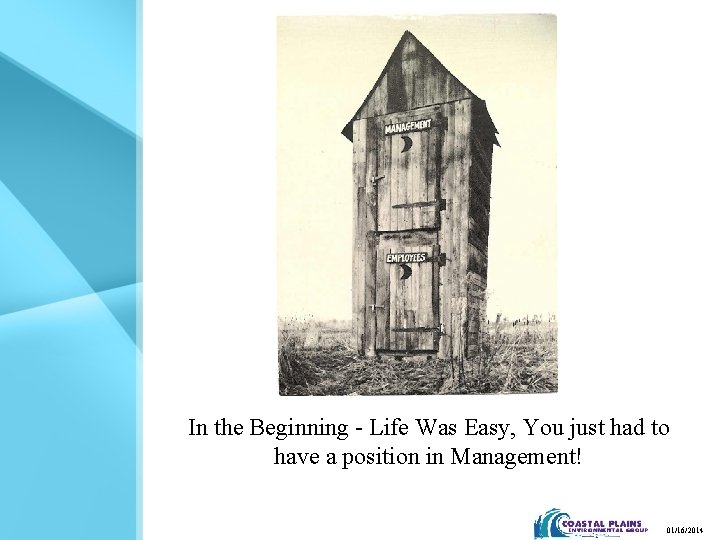
In the Beginning - Life Was Easy, You just had to have a position in Management! 01/16/2014
Thank You Coastal Plains Environmental Group, llc P. O. Box 236 New Kent, Virginia 23124 Office: 804 -966 -9190 Facsimile: 804 -966 -2739 Email: krdavis@cpegllc. com Web: www. cpegllc. com 01/14/2014