
CERTIFICATION OF SAFETY OF TOYS S K SINGH
- Slides: 19
CERTIFICATION OF SAFETY OF TOYS S K SINGH, SCIENTIST E & HEAD, BUREAU OF INDIAN STANDARDS, AHMEDABAD
TOYS QUALITY CONTROL ORDER 202 O • Toys (Quality Control) Order, 2020 issued by DPIIT, Ministry of Commerce and Industry vide notification dated 25 February 2020 through which Safety of Toys as per has been brought under compulsory BIS certification with effect from 01/09/2020. – • In this order, unless the context otherwise requires: • a) This Quality Control Order shall apply to (Toys) Product or material designed or clearly intended, whether or not exclusively, for use in play by children under 14 years of age or any other product as notified by the Central Government from time to time; • (b) This order shall apply to Toys as they are initially received by the children and, in addition, this shall apply after a toy is subjected to reasonably foreseeable conditions of normal use and abuse unless specifically noted otherwise.
AMENDMENT TO TOYS QUALITY CONTROL ORDER 202 O • Toys (Quality Control) Amendment Order, 2020 issued by DPIIT, Ministry of Commerce and Industry vide notification dated 15 th September, 2020 through which it shall come into force with effect from 1 st January, 2021 • BIS has initiated the process of grant licence to manufacturers of toys for use of BIS Standard Mark as per Scheme I of Schedule II of the BIS (Conformity Assessment) Regulations, 2018.
OVERVIEW • The certification is being done as per Option 1 (Normal Procedure) i. e. after receipt of application, BIS will conduct factory inspection and draw samples for testing in BIS Recognized Labs • Till date, 40 licences have been granted all over India for non-electric toys as per IS 9873(Part 1), 2 of them are from the state of Gujarat. • Similarly, Till date, 6 licences have been granted for Electric Toys as per IS 15644 on all India basis.
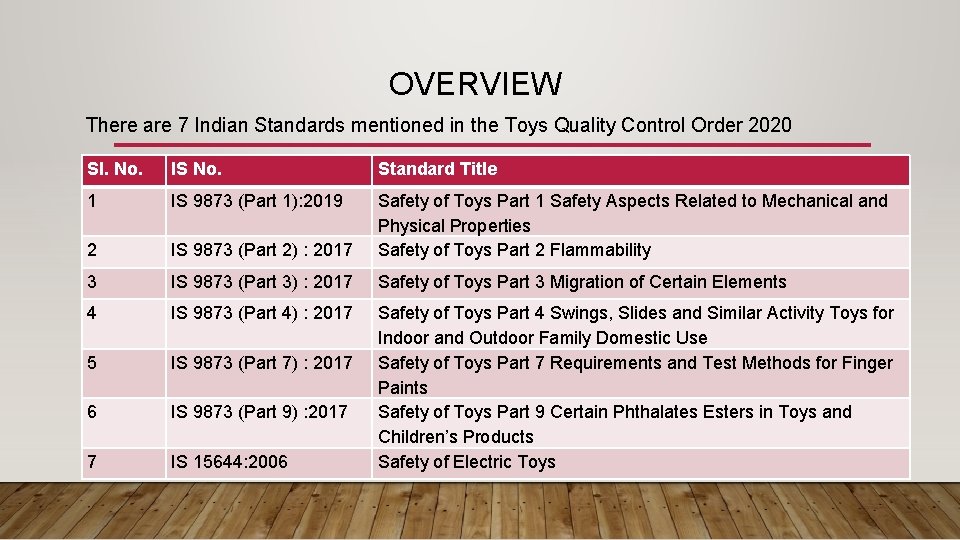
OVERVIEW There are 7 Indian Standards mentioned in the Toys Quality Control Order 2020 Sl. No. IS No. Standard Title 1 IS 9873 (Part 1): 2019 2 IS 9873 (Part 2) : 2017 Safety of Toys Part 1 Safety Aspects Related to Mechanical and Physical Properties Safety of Toys Part 2 Flammability 3 IS 9873 (Part 3) : 2017 Safety of Toys Part 3 Migration of Certain Elements 4 IS 9873 (Part 4) : 2017 5 IS 9873 (Part 7) : 2017 6 IS 9873 (Part 9) : 2017 7 IS 15644: 2006 Safety of Toys Part 4 Swings, Slides and Similar Activity Toys for Indoor and Outdoor Family Domestic Use Safety of Toys Part 7 Requirements and Test Methods for Finger Paints Safety of Toys Part 9 Certain Phthalates Esters in Toys and Children’s Products Safety of Electric Toys
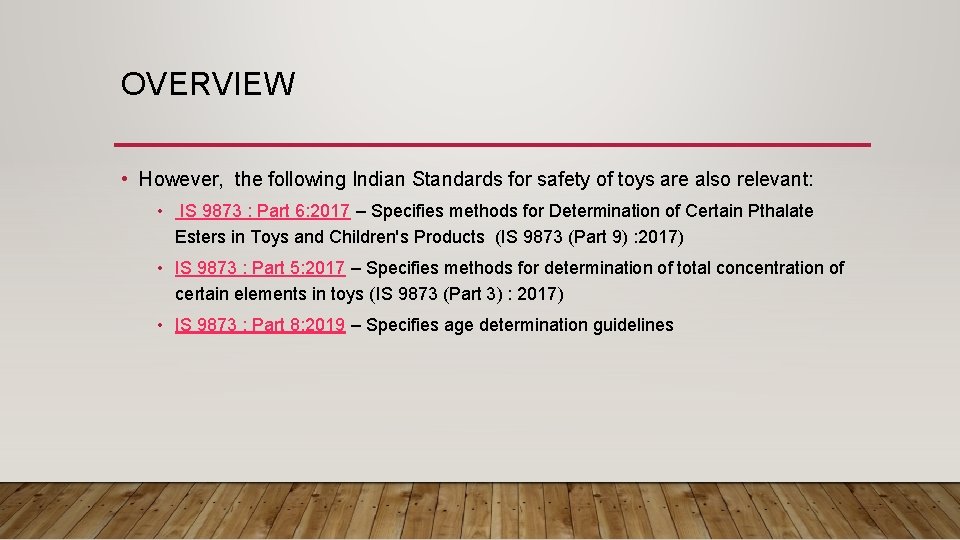
OVERVIEW • However, the following Indian Standards for safety of toys are also relevant: • IS 9873 : Part 6: 2017 – Specifies methods for Determination of Certain Pthalate Esters in Toys and Children's Products (IS 9873 (Part 9) : 2017) • IS 9873 : Part 5: 2017 – Specifies methods for determination of total concentration of certain elements in toys (IS 9873 (Part 3) : 2017) • IS 9873 : Part 8: 2019 – Specifies age determination guidelines
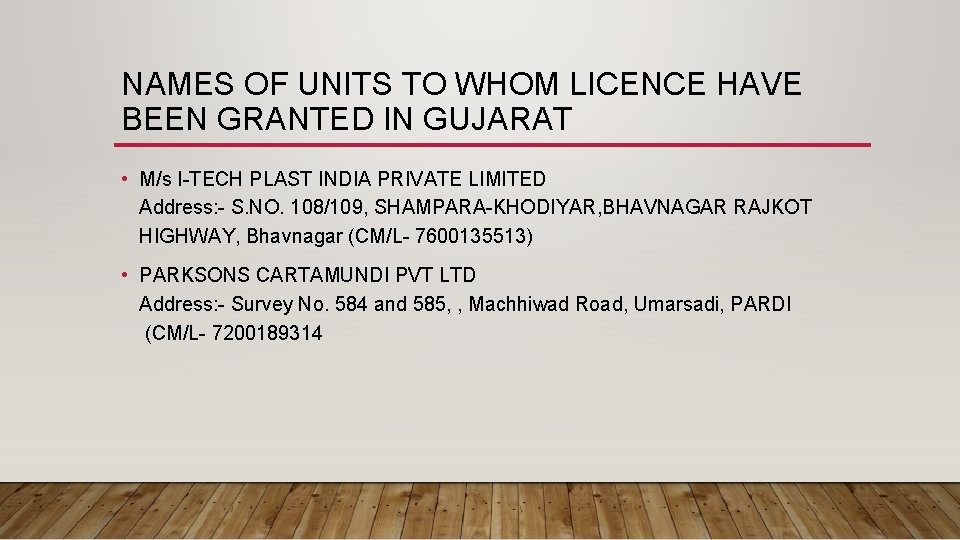
NAMES OF UNITS TO WHOM LICENCE HAVE BEEN GRANTED IN GUJARAT • M/s I-TECH PLAST INDIA PRIVATE LIMITED Address: - S. NO. 108/109, SHAMPARA-KHODIYAR, BHAVNAGAR RAJKOT HIGHWAY, Bhavnagar (CM/L- 7600135513) • PARKSONS CARTAMUNDI PVT LTD Address: - Survey No. 584 and 585, , Machhiwad Road, Umarsadi, PARDI (CM/L- 7200189314
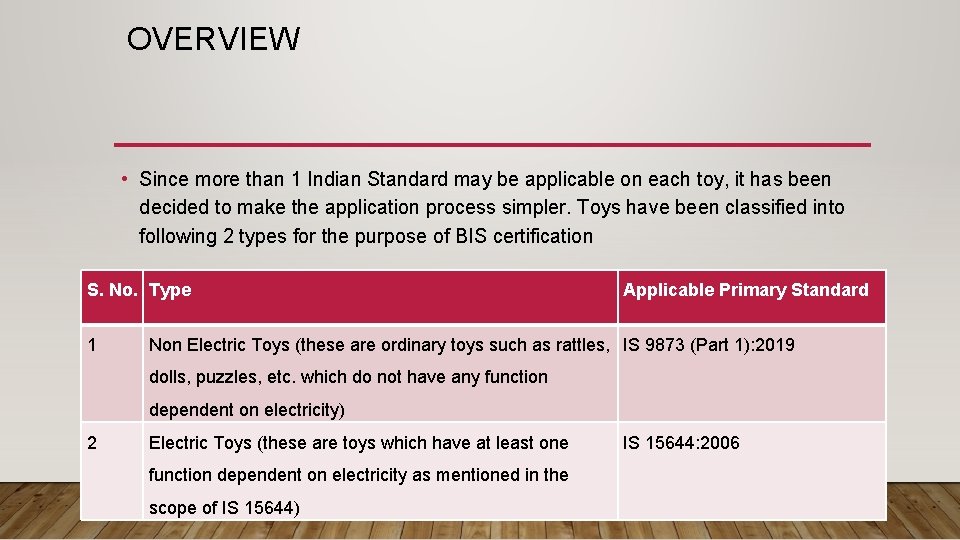
OVERVIEW • Since more than 1 Indian Standard may be applicable on each toy, it has been decided to make the application process simpler. Toys have been classified into following 2 types for the purpose of BIS certification S. No. Type 1 Applicable Primary Standard Non Electric Toys (these are ordinary toys such as rattles, IS 9873 (Part 1): 2019 dolls, puzzles, etc. which do not have any function dependent on electricity) 2 Electric Toys (these are toys which have at least one function dependent on electricity as mentioned in the scope of IS 15644) IS 15644: 2006
ILLUSTRATION 1 • Manufacturer is making mechanically operated plastic dolls with no electrical function • It is Non-Electric type of toy. Hence, while submitting application applicant shall choose IS 9873 (Part 1): 2019 • However, samples may be drawn and tested for • IS 9873 (Part 1): 2019 – Mechanical and Physical Properties • IS 9873 (Part 2): 2017 - Flammability (If applicable) • IS 9873 (Part 3): 2017 – Migration of Certain Elements • IS 9873 (Part 9): 2017 – Certain Phthalate Ester in Toys • Note: Testing as per IS 9873 (Part 4) is not applicable as it is not an Activity Toy. Similarly IS 9873 (Part 7) is not applicable as no finger paints are included in the toy and IS 15644 is not applicable as there is no electric function
ILLUSTRATION 2 • Manufacturer is making electrically operated plastic dolls • It is Electric type of toy. Hence, while submitting application applicant shall choose IS 15644: 2006 • However, samples may be drawn and tested for • IS 15644: 2006 • IS 9873 (Part 1): 2019 – Mechanical and Physical Properties • IS 9873 (Part 2): 2017 - Flammability (If applicable) • IS 9873 (Part 3): 2017 – Migration of Certain Elements • IS 9873 (Part 9): 2017 – Certain Phthalate Ester in Toys • Note: Testing as per IS 9873 (Part 4) is not applicable as it is not an Activity Toy. Similarly IS 9873 (Part 7) is not applicable as no finger paints are included in the toy.
GROUPING GUIDELINES • Since there a large number of models of toys being manufactured, it is practically difficult to test each and every model of toy for the purpose of BIS certification. • Accordingly, the product manual issued incorporates “Grouping Guidelines” which allow certification to be granted for a group of toy models based on the testing of certain representative models. • These grouping guidelines have been framed based on the Indian Standard IS 9873 (Part 8): 2019 which is identical with the International Standard ISO/TR 8124 -8: 2016 (Safety of Toys Part 8 Age Determination Guidelines)
GROUPING GUIDELINES • These guidelines classifies toys into 7 Categories and 146 Sub-Categories based on the appropriate starting age and the specific purpose or function of the toy. • For the purpose of certification, all the models of toys of similar design, made from the same materials and covered under a single sub-category, shall be considered as a series. Sample of any one model from each series shall be drawn and tested to cover all the models in that particular series.
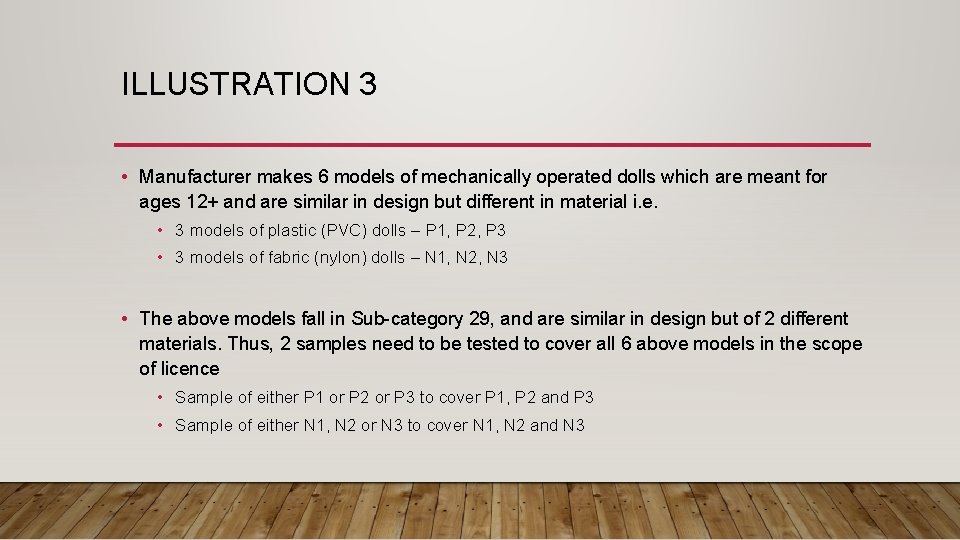
ILLUSTRATION 3 • Manufacturer makes 6 models of mechanically operated dolls which are meant for ages 12+ and are similar in design but different in material i. e. • 3 models of plastic (PVC) dolls – P 1, P 2, P 3 • 3 models of fabric (nylon) dolls – N 1, N 2, N 3 • The above models fall in Sub-category 29, and are similar in design but of 2 different materials. Thus, 2 samples need to be tested to cover all 6 above models in the scope of licence • Sample of either P 1 or P 2 or P 3 to cover P 1, P 2 and P 3 • Sample of either N 1, N 2 or N 3 to cover N 1, N 2 and N 3
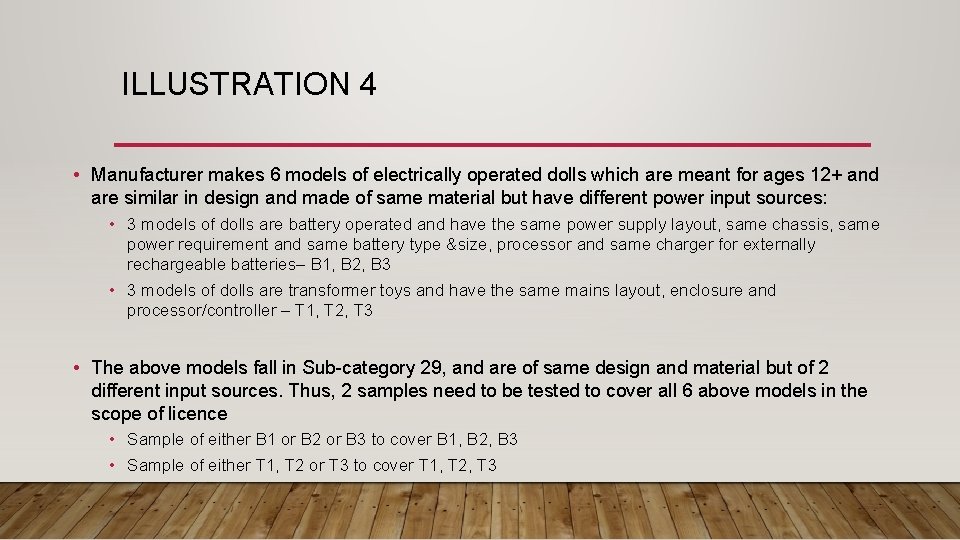
ILLUSTRATION 4 • Manufacturer makes 6 models of electrically operated dolls which are meant for ages 12+ and are similar in design and made of same material but have different power input sources: • 3 models of dolls are battery operated and have the same power supply layout, same chassis, same power requirement and same battery type &size, processor and same charger for externally rechargeable batteries– B 1, B 2, B 3 • 3 models of dolls are transformer toys and have the same mains layout, enclosure and processor/controller – T 1, T 2, T 3 • The above models fall in Sub-category 29, and are of same design and material but of 2 different input sources. Thus, 2 samples need to be tested to cover all 6 above models in the scope of licence • Sample of either B 1 or B 2 or B 3 to cover B 1, B 2, B 3 • Sample of either T 1, T 2 or T 3 to cover T 1, T 2, T 3
Scheme of Inspection and Testing • Scheme of Inspection and Testing or SIT defines the frequency of conducting the various tests specified in the Indian Standards • The SIT also specifies those tests for which in-house testing facilities need not be established (these tests can be subcontracted to BIS Recognized Labs). • Since the toy industry had expressed that it would be difficult for many manufacturers, especially the MSME units, to establish in-house testing facilities, subcontracting has been permitted in the SIT for all tests except for IS 9873 (Part 1) and 3 of the 13 requirements IS 15644.
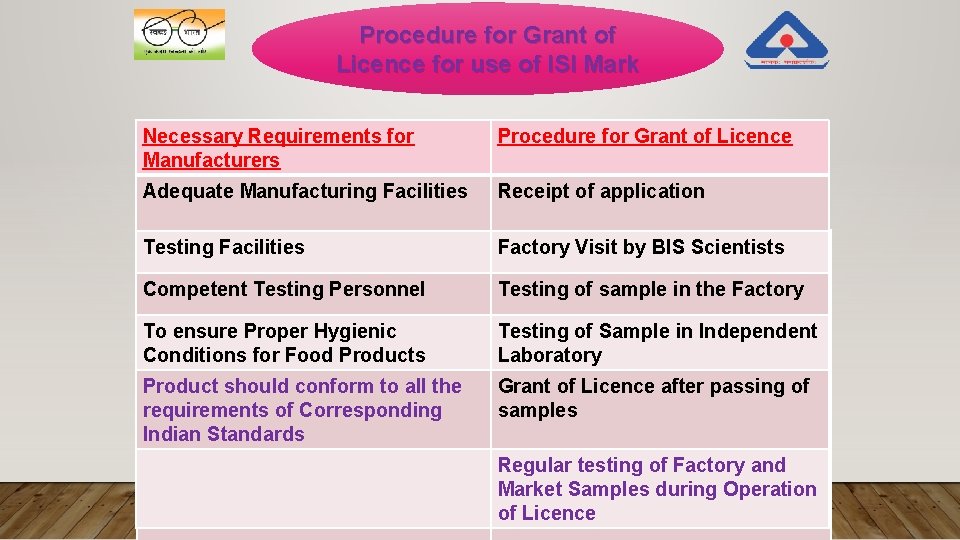
Procedure for Grant of Licence for use of ISI Mark Necessary Requirements for Manufacturers Procedure for Grant of Licence Adequate Manufacturing Facilities Receipt of application Necessary Requirements for Testing Facilities Manufacturers Competent Testing Personnel Procedure forby Grant of Licence Factory Visit BIS Scientists Adequate Facilities To ensure Manufacturing Proper Hygienic Conditions for Food Products Testing Facilities Product should conform to all the requirements of Corresponding Competent Testing Personnel Indian Standards To ensure Proper Hygienic Receipt of of Sample application Testing in Independent Laboratory Factory by BIS Scientists Grant of. Visit Licence after passing of samples Testing of sample in the Factory Conditions for Food Products Testing of sample in the Factory Testing of Sample in Independent Regular testing of Factory and Laboratory Market Samples during Operation of Licence
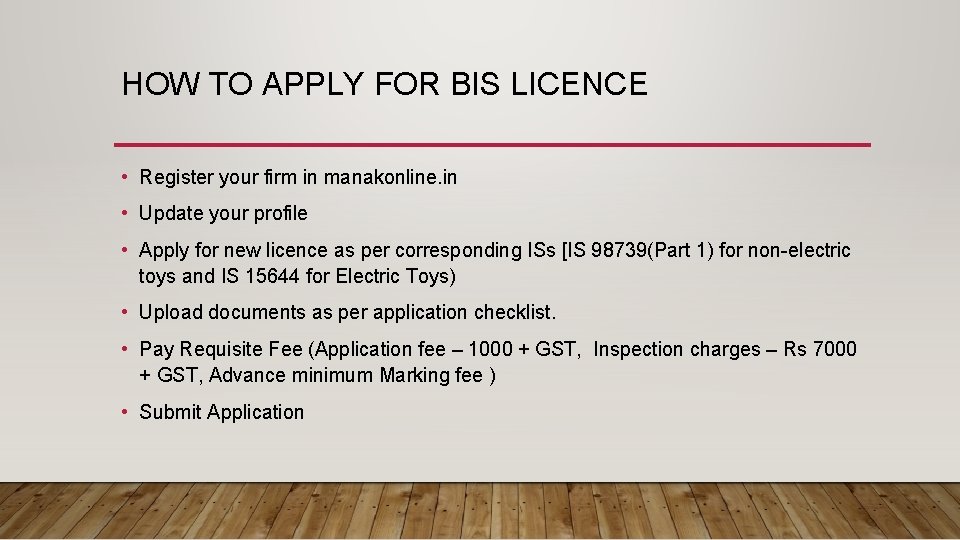
HOW TO APPLY FOR BIS LICENCE • Register your firm in manakonline. in • Update your profile • Apply for new licence as per corresponding ISs [IS 98739(Part 1) for non-electric toys and IS 15644 for Electric Toys) • Upload documents as per application checklist. • Pay Requisite Fee (Application fee – 1000 + GST, Inspection charges – Rs 7000 + GST, Advance minimum Marking fee ) • Submit Application
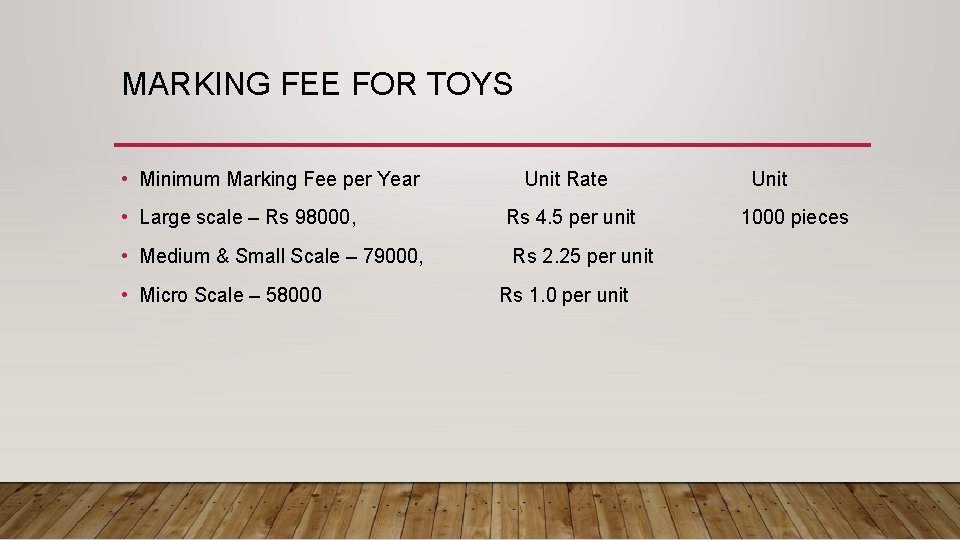
MARKING FEE FOR TOYS • Minimum Marking Fee per Year • Large scale – Rs 98000, • Medium & Small Scale – 79000, • Micro Scale – 58000 Unit Rate Rs 4. 5 per unit Rs 2. 25 per unit Rs 1. 0 per unit Unit 1000 pieces