
Certification in Infection Prevention and Control CIC Certification
- Slides: 64
Certification in Infection Prevention and Control ® (CIC ) Certification is Commitment
Sections 1. Background - CBIC and the CIC® Exam 2. Why Certify? 3. The Certification Process 4. Eligibility/How to Qualify 5. The Recertification Process 6. The Making of the CIC® Exam 7. a-IPC Exam 8. Validity 9. How to Prepare for the Exam 10. Resources
Section 1: CBIC and the CIC® Exam
What is CBIC? • Voluntary, independent, multidisciplinary Board • Mission: Provide pathways to assess and maintain infection prevention competency. • Vision: Healthcare without infection through verifiable competency.
CBIC, ctd. • Established by the Association for Professionals in Infection Control and Epidemiology, Inc. (APIC) in 1981; CBIC is an affiliate of APIC • Accredited by the National Commission for Certifying Agencies (NCCA) • Member of the Institute for Credentialing Excellence (ICE), formerly National Organization for Competency Assurance (NOCA)
Board Composition (Minimal Requirements per Bylaws, 2017) • Medical Doctor*: (1) • Medical Technologist or Microbiologist*: (1) • RNs: (3) • Canadian Infection Preventionist (IP)*: (1) • IP non-hospital setting*: (1) • IP long-term care setting*: (1) • IP 4 years or less experience as IP*: (1) • Public Consumer: (1) * Must be CIC®
CBIC Strategic Priorities • Maintain and improve the accredited certification program • Increase recognition/value of certification • Increase the number of certified IP/ICPs • Establish/maintain partnerships with APIC, IPAC Canada and other organizations to accomplish goals
Section 2: Why Certify?
Why Certify? • Reaffirms that through study and hard work, certificants attain an internationally recognized level of knowledge in the infection prevention and control field • Supports future knowledge and skills • Enhances professional credibility and prestige • Grants personal satisfaction
Why the CIC®? • Represents commitment to continual improvement of infection prevention and control functions and their contribution to healthcare and patient safety • Fosters a recognized professional community that helps to reduce infections in healthcare settings • The only accredited certification in infection prevention and control
Objectives of Certification • Provides standardized measure of current knowledge required for persons practicing infection prevention and control • Encourages individual growth and study, thereby promoting professionalism • Formally recognizes professionals in infection prevention and control who fulfill the requirements for certification and recertification
Use of the CIC® Credential • Only individuals who have successfully passed the proctored, initial certification examination and have maintained current certification, through the recertification process* may use the CIC® credential. • The CIC® credential may be used on resumes, business cards, letterhead, and other professional communications. • The CIC® credential may not be used for product or other endorsements. *Recertification is obtained by examination or continuing education. *CICs may maintain certification through the proctored examination only if they receive a failing score on the recertification exam or the portfolio submission.
Section 3: The Certification Process
Methods of Certification & Recertification Initial certification: Recertification: Proctored initial certification examination $375 Self-paced, open book recertification examination* OR Continuing Education (IPUs) $375 *If candidate fails the recertification examination, then they must take the proctored certification examination Certification/recertification is valid for 5 years
CIC® Examination • Comprehensive, job-related, objective tests • 150 multiple choice questions; 135 of which are scored • Developed from a practice analysis of Infection Prevention and Control Professionals in the U. S. , Canada and other countries • Recognized by APIC and IPAC Canada as the standard for certification in infection control • Recognized by TJC as a measure of competence
CIC® Examination • Aligned with recognized practice standards for Infection Control and Healthcare Epidemiology • The only standardized measurement of essential knowledge, skills, and abilities expected of infection prevention and control professionals in North America • ALL examination questions are the copyrighted property of CBIC
Applying for the CIC® Examination • Ensure eligibility requirements are met • Review the Candidate Handbook for additional information, applications, and suggested reference materials • Apply online at www. cbic. org or submit a paper application to the CBIC office
Taking the CIC® Examination • Proctored examination • Required for initial certification • Administered at assessment centers throughout the United States, Canada and other international sites • 90 -day window from application approval to exam completion
Section 4: Eligibility for the CIC®
Eligibility for Certification Successful certification indicates competence in the actual practice of infection prevention and control and healthcare epidemiology, and is intended for individuals who are actively accountable for the infection prevention and control program within their current position.
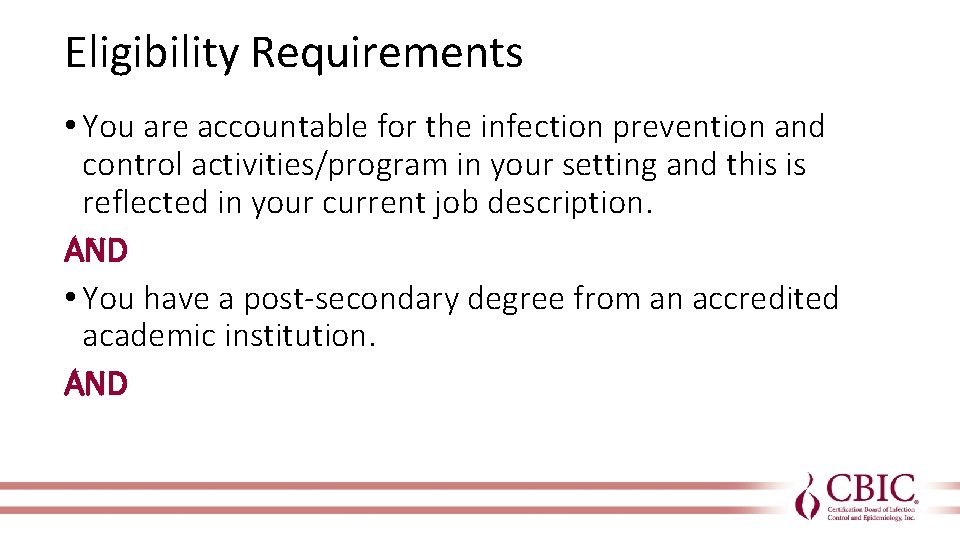
Eligibility Requirements • You are accountable for the infection prevention and control activities/program in your setting and this is reflected in your current job description. AND • You have a post-secondary degree from an accredited academic institution. AND
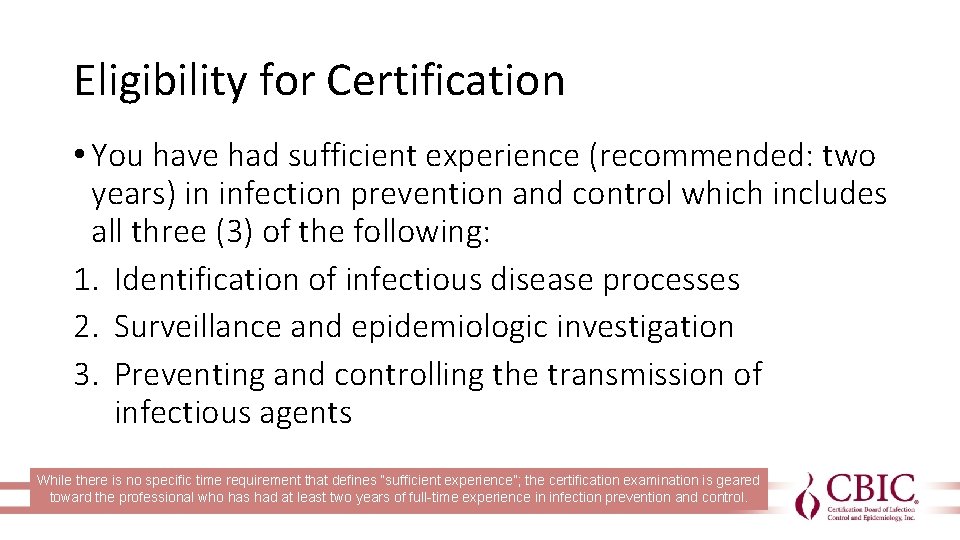
Eligibility for Certification • You have had sufficient experience (recommended: two years) in infection prevention and control which includes all three (3) of the following: 1. Identification of infectious disease processes 2. Surveillance and epidemiologic investigation 3. Preventing and controlling the transmission of infectious agents While there is no specific time requirement that defines “sufficient experience”; the certification examination is geared toward the professional who has had at least two years of full-time experience in infection prevention and control.
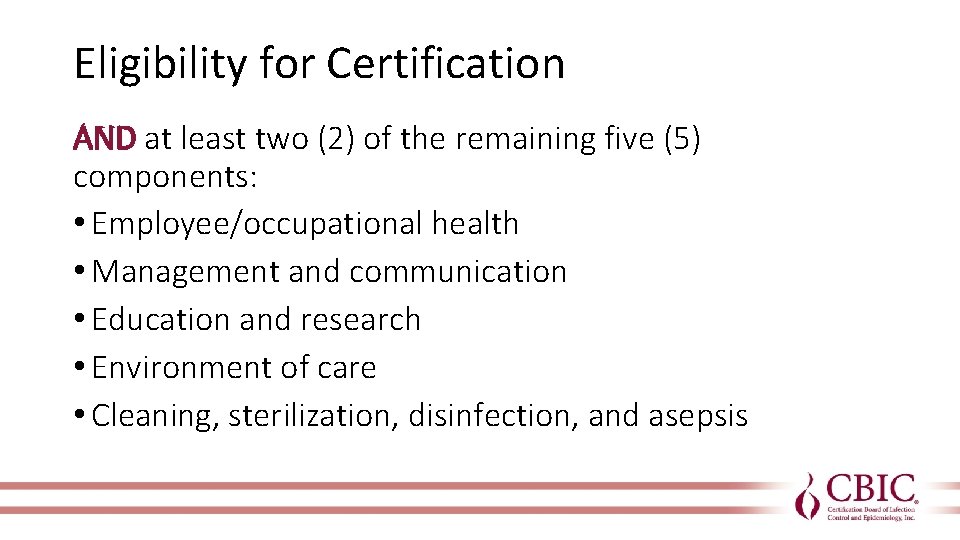
Eligibility for Certification AND at least two (2) of the remaining five (5) components: • Employee/occupational health • Management and communication • Education and research • Environment of care • Cleaning, sterilization, disinfection, and asepsis
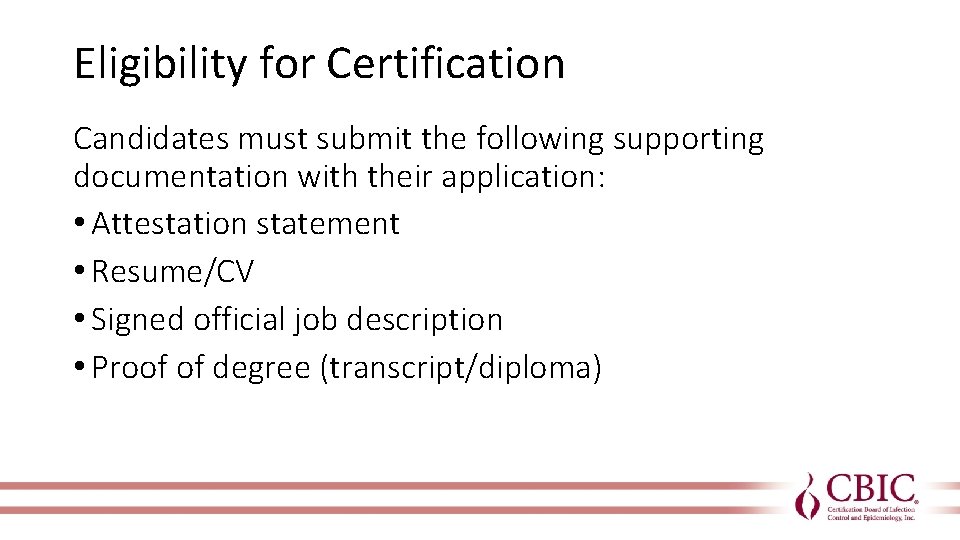
Eligibility for Certification Candidates must submit the following supporting documentation with their application: • Attestation statement • Resume/CV • Signed official job description • Proof of degree (transcript/diploma)
Eligibility for Recertification • Individuals who are currently certified are automatically eligible for recertification every 5 years. • Recertification can be obtained by: o. Examination o. Continuing Education (IPUs)
Lapsed Certification If you fail to recertify when you are due and later decide that you would like to, you: 1. Must meet the criteria for initial certification 2. May no longer be eligible if you have changed positions to one where infection control is NOT your main area of responsibility
Section 5: The Recertification Process
Recertification Examination • Self-administered (non-proctored), multiple choice, internet-based from any location • Questions are based on the most current CBIC practice analysis • The purpose of the recertification examination is to demonstrate continued knowledge mastery in the field of infection prevention and control
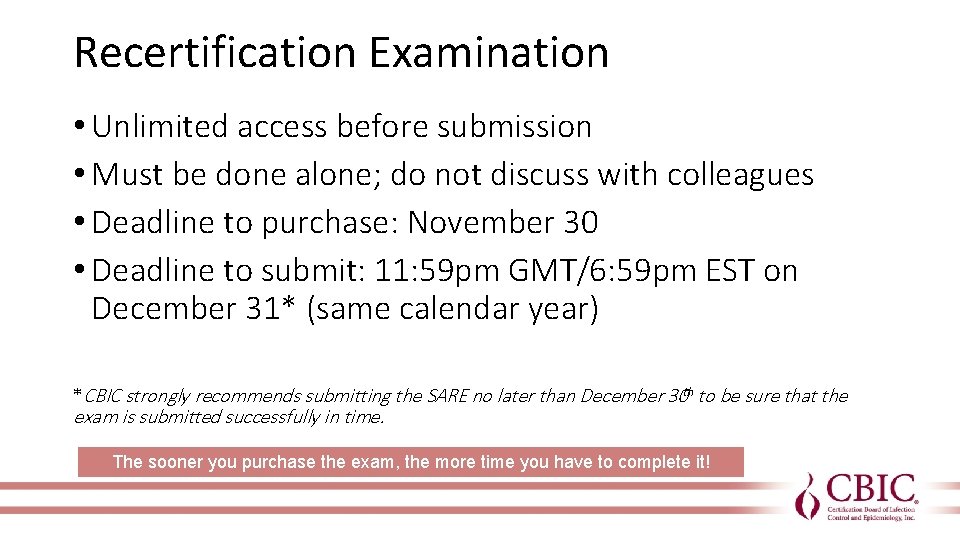
Recertification Examination • Unlimited access before submission • Must be done alone; do not discuss with colleagues • Deadline to purchase: November 30 • Deadline to submit: 11: 59 pm GMT/6: 59 pm EST on December 31* (same calendar year) *CBIC strongly recommends submitting the SARE no later than December 30 th to be sure that the exam is submitted successfully in time. The sooner you purchase the exam, the more time you have to complete it!
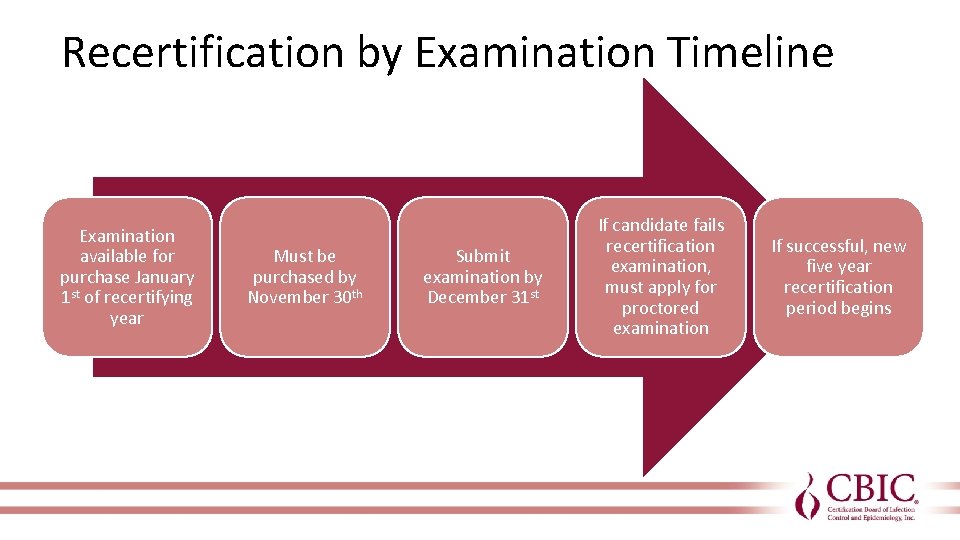
Recertification by Examination Timeline Examination available for purchase January 1 st of recertifying year Must be purchased by November 30 th Submit examination by December 31 st If candidate fails recertification examination, must apply for proctored examination If successful, new five year recertification period begins
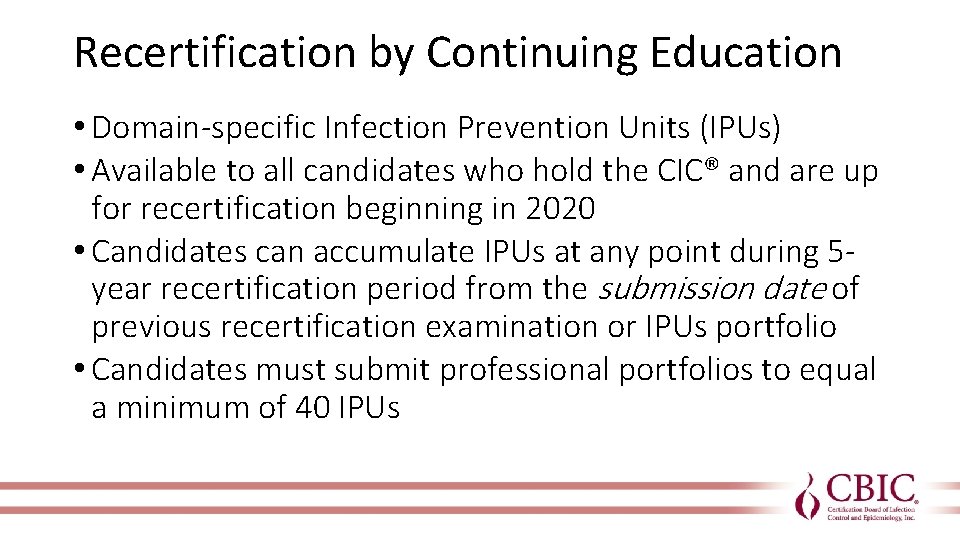
Recertification by Continuing Education • Domain-specific Infection Prevention Units (IPUs) • Available to all candidates who hold the CIC® and are up for recertification beginning in 2020 • Candidates can accumulate IPUs at any point during 5 year recertification period from the submission date of previous recertification examination or IPUs portfolio • Candidates must submit professional portfolios to equal a minimum of 40 IPUs
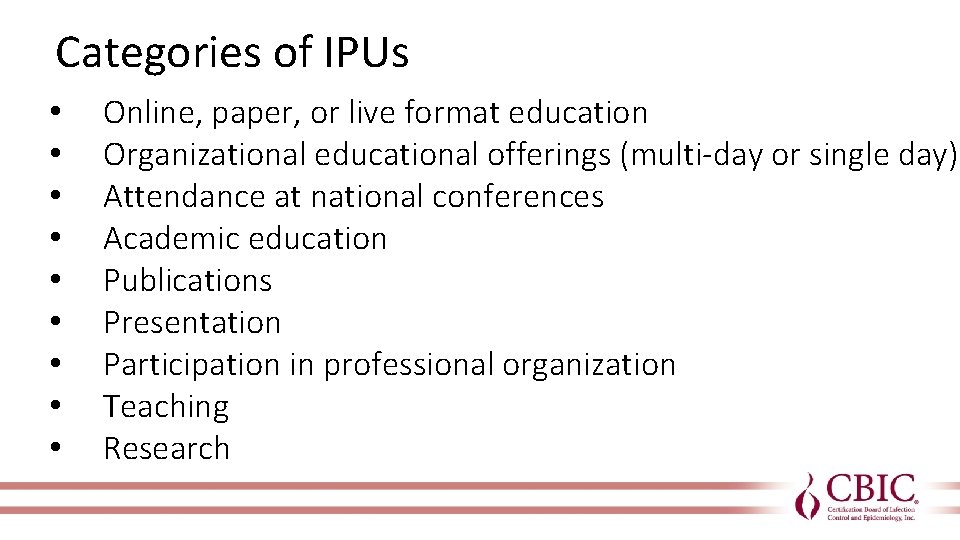
Categories of IPUs • • • Online, paper, or live format education Organizational educational offerings (multi-day or single day) Attendance at national conferences Academic education Publications Presentation Participation in professional organization Teaching Research
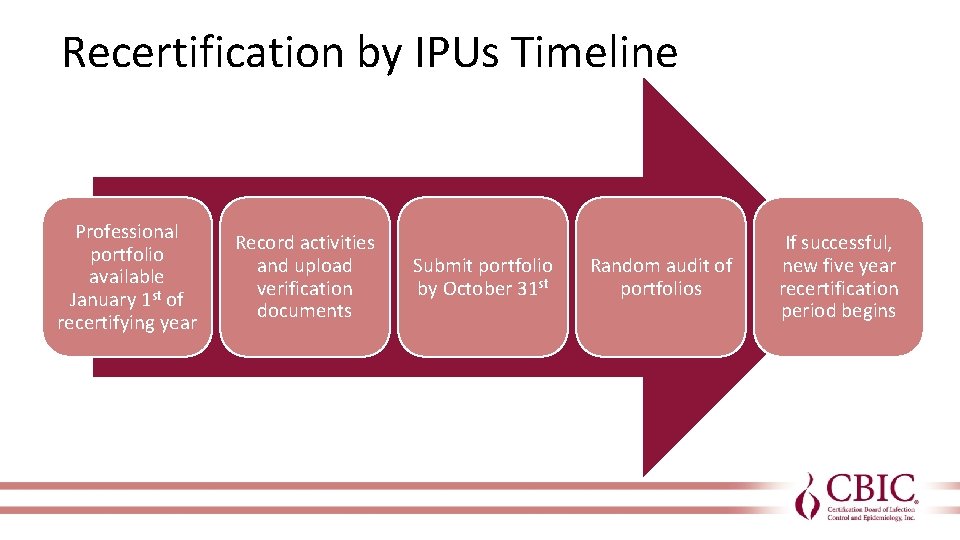
Recertification by IPUs Timeline Professional portfolio available January 1 st of recertifying year Record activities and upload verification documents Submit portfolio by October 31 st Random audit of portfolios If successful, new five year recertification period begins
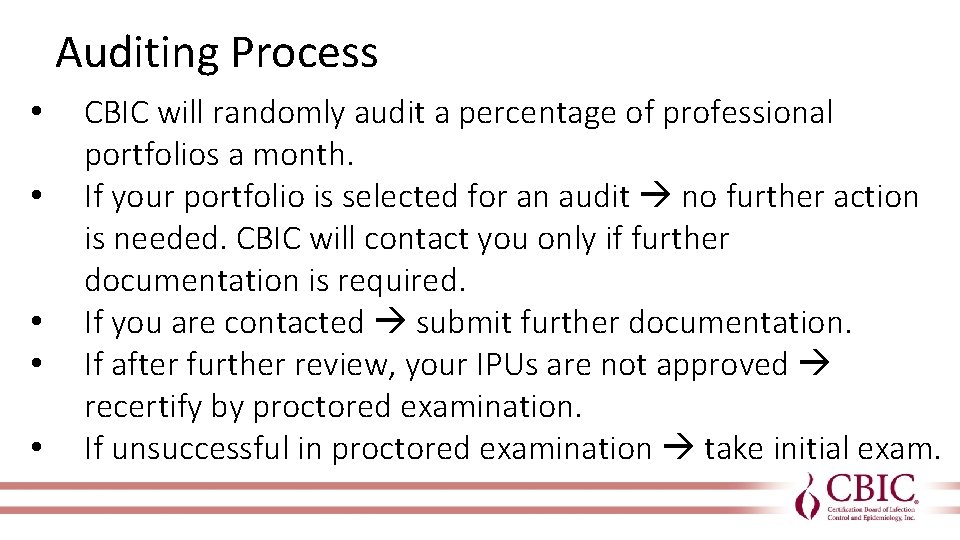
Auditing Process • • • CBIC will randomly audit a percentage of professional portfolios a month. If your portfolio is selected for an audit no further action is needed. CBIC will contact you only if further documentation is required. If you are contacted submit further documentation. If after further review, your IPUs are not approved recertify by proctored examination. If unsuccessful in proctored examination take initial exam.
Section 6: The Making of the Examinations
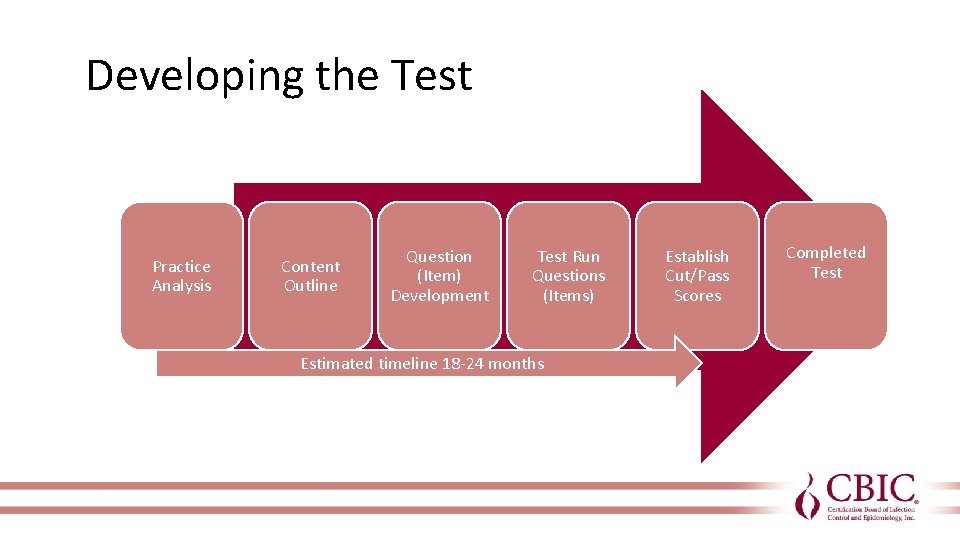
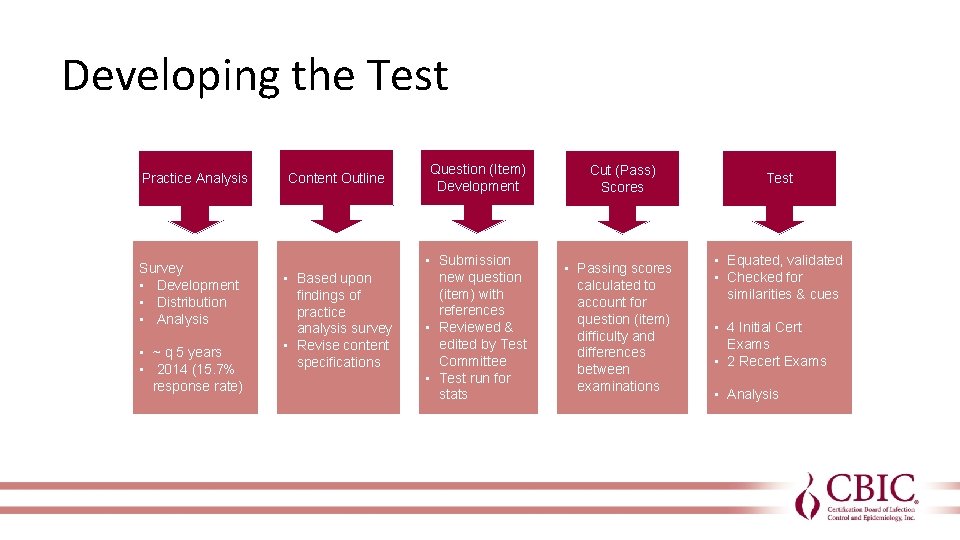
Developing the Test Practice Analysis Content Outline Question (Item) Development Test Run Questions (Items) Estimated timeline 18 -24 months Establish Cut/Pass Scores Completed Test
Developing the Test Practice Analysis Survey • Development • Distribution • Analysis • ~ q 5 years • 2014 (15. 7% response rate) Content Outline • Based upon findings of practice analysis survey • Revise content specifications Question (Item) Development • Submission new question (item) with references • Reviewed & edited by Test Committee • Test run for stats Cut (Pass) Scores • Passing scores calculated to account for question (item) difficulty and differences between examinations Test • Equated, validated • Checked for similarities & cues • 4 Initial Cert Exams • 2 Recert Exams • Analysis
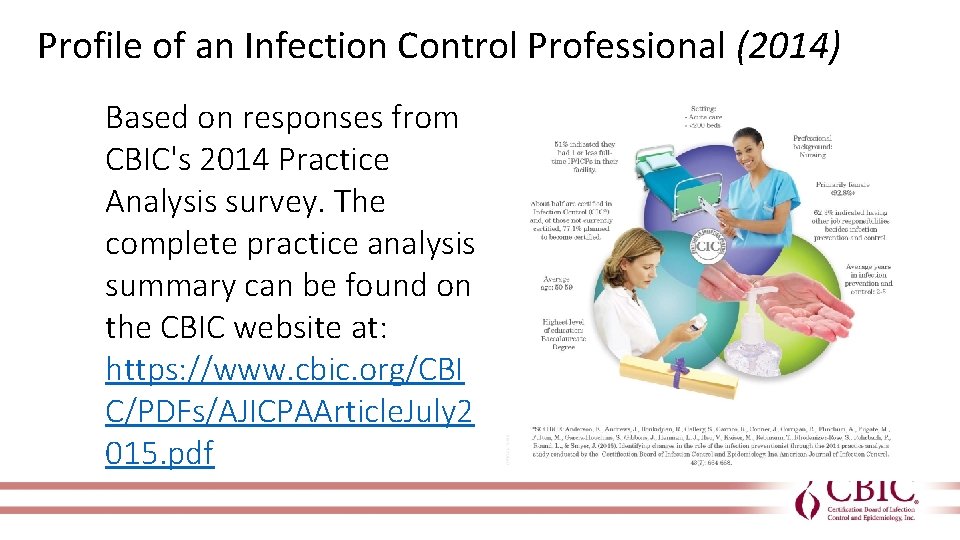
Profile of an Infection Control Professional (2014) Based on responses from CBIC's 2014 Practice Analysis survey. The complete practice analysis summary can be found on the CBIC website at: https: //www. cbic. org/CBI C/PDFs/AJICPAArticle. July 2 015. pdf
Section 7: Associate – Infection Prevention and Control (a-IPC)
Associate – Infection Prevention and Control (a-IPC) Examination • The perfect stepping stone to prove a candidate’s foundational knowledge, interest and dedication to the field and provide him or her with the confidence to launch a career in IPC. • Ideal for a candidate who would like to learn more about infection prevention and control and apply this knowledge to his or her current role or to evolve into another role.
a-IPC Eligibility for Certification • Intended for those individuals who do not meet the CIC® eligibility requirements and others interested in IPC. • No experience or job-specific requirements needed to apply.
a-IPC Exam Information • • Proctored examination 100 questions total, 85 questions scored 120 minutes to take the exam Same content areas tested as the CIC®
a-IPC Eligibility for Recertification • The a-IPC is not renewable. Once three-year period is up, it is expected that candidates will continue on to get their CIC®.
Section 8: Validity
Validity of the Certification Examinations • The exams are based on a practice analysis to ensure the content is current, practice-related and representative of the responsibilities of infection prevention and control professionals • The practice analysis, examination development and examination process adhere to nationally recognized standards for validation, educational, and psychological testing
Validity of the Certification Examinations • Developed under the guidance of a psychometrician and test development specialist from an independent testing agency • The testing agency oversees scoring of the examination • Each test question undergoes both expert and statistical scrutiny before use
Validity of the Certification Examinations • Passing scores are determined for each version of the test to ensure equivalency between the different forms at all times • Acknowledged by The Joint Commission as an important element of an effective infection control program
Confidentiality of Examination Scores • Both CBIC and Prometric (testing company) maintain complete confidentiality of individual test scores • Only summary statistics are provided at open forums and published periodically in the infection prevention and control literature
Section 9: How to Prepare for the Examinations
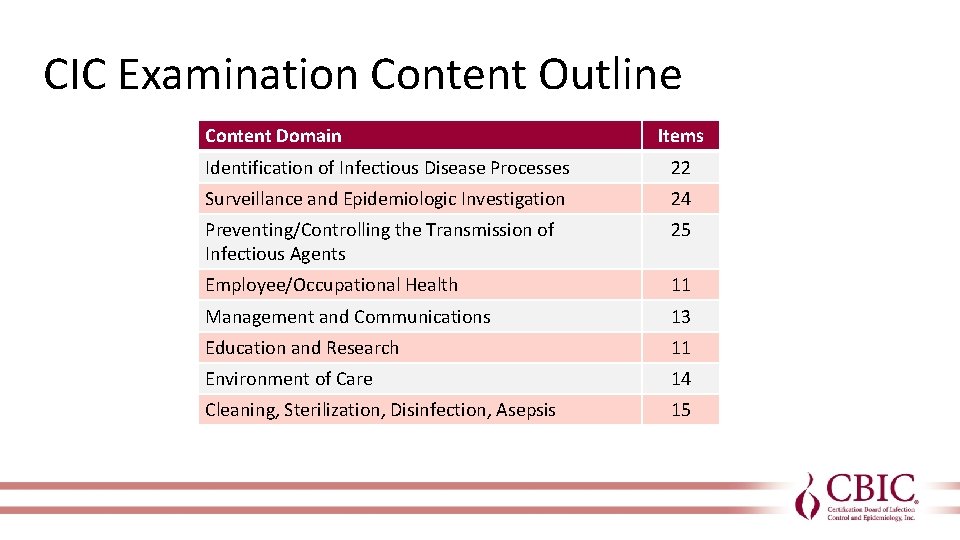
CIC Examination Content Outline Content Domain Items Identification of Infectious Disease Processes 22 Surveillance and Epidemiologic Investigation 24 Preventing/Controlling the Transmission of Infectious Agents 25 Employee/Occupational Health 11 Management and Communications 13 Education and Research 11 Environment of Care 14 Cleaning, Sterilization, Disinfection, Asepsis 15
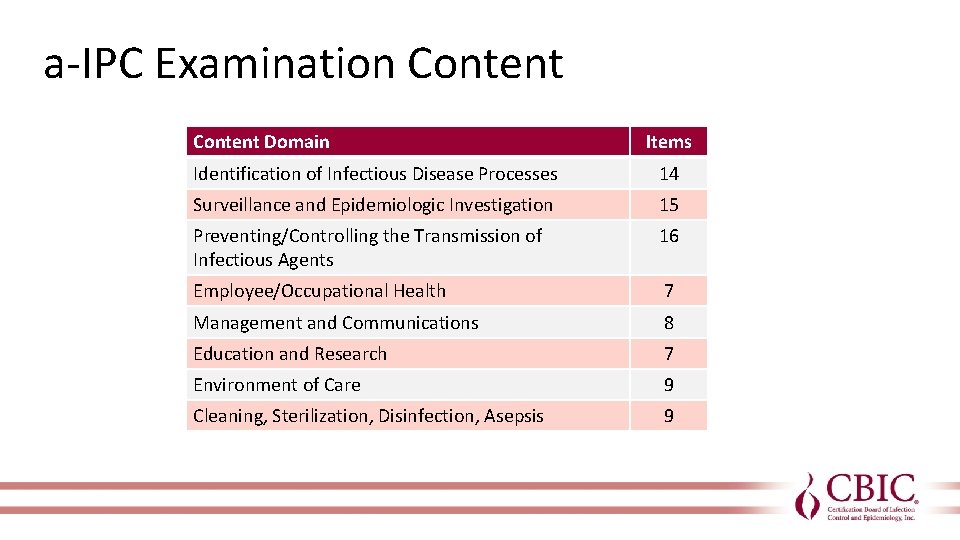
a-IPC Examination Content Domain Items Identification of Infectious Disease Processes 14 Surveillance and Epidemiologic Investigation 15 Preventing/Controlling the Transmission of Infectious Agents 16 Employee/Occupational Health 7 Management and Communications 8 Education and Research 7 Environment of Care 9 Cleaning, Sterilization, Disinfection, Asepsis 9
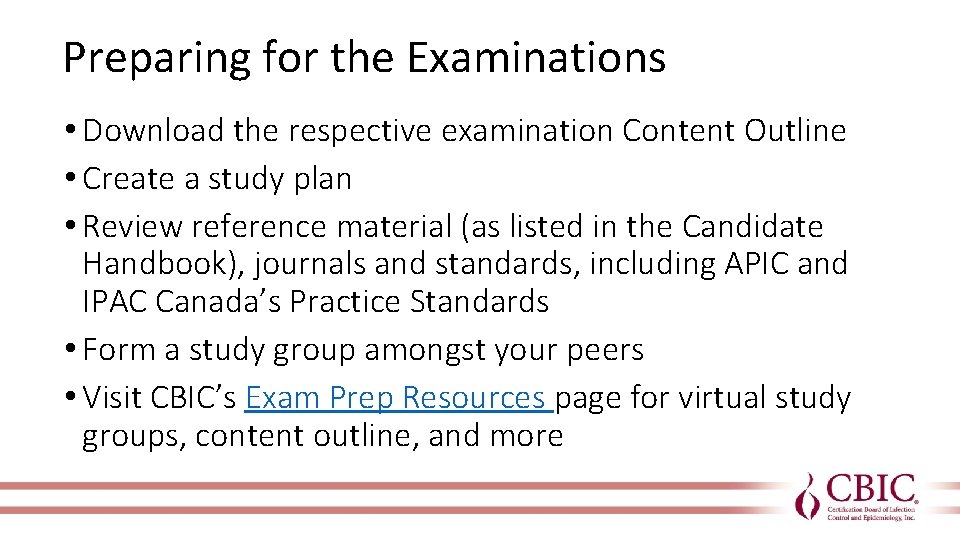
Preparing for the Examinations • Download the respective examination Content Outline • Create a study plan • Review reference material (as listed in the Candidate Handbook), journals and standards, including APIC and IPAC Canada’s Practice Standards • Form a study group amongst your peers • Visit CBIC’s Exam Prep Resources page for virtual study groups, content outline, and more
Preparing for the Examination • Listen to our webinars • “Road to CIC Certification” https: //webbertraining. com/recordingslibraryc 4. php • "How to Prepare for the CIC exam” http: //www. cbic. org/certification/media • Contact your local APIC or IPAC Canada chapter for support.
Test Questions Each content area includes test questions that target different cognitive levels: a) Recall (simple recall or recognition) b) Application (comprehension, interpretation or manipulation of concepts/information) c) Analysis (integration of a variety of concepts, problem solving, making judgments)
Sample Question: Recall In investigating an epidemic, cases should be categorized according to: A. time, place, and person. B. agent, host, and environment. C. agent, host, and date of onset. D. time, person, and date of onset. Answer: A
Sample Question: Application The lengths of stay for patients with nosocomial infections are 12, 12, 13, 15, 16, 20, and 30 days. What is the median length of stay? A. 12 days B. 15 days C. 16 days D. 25 days Answer: B
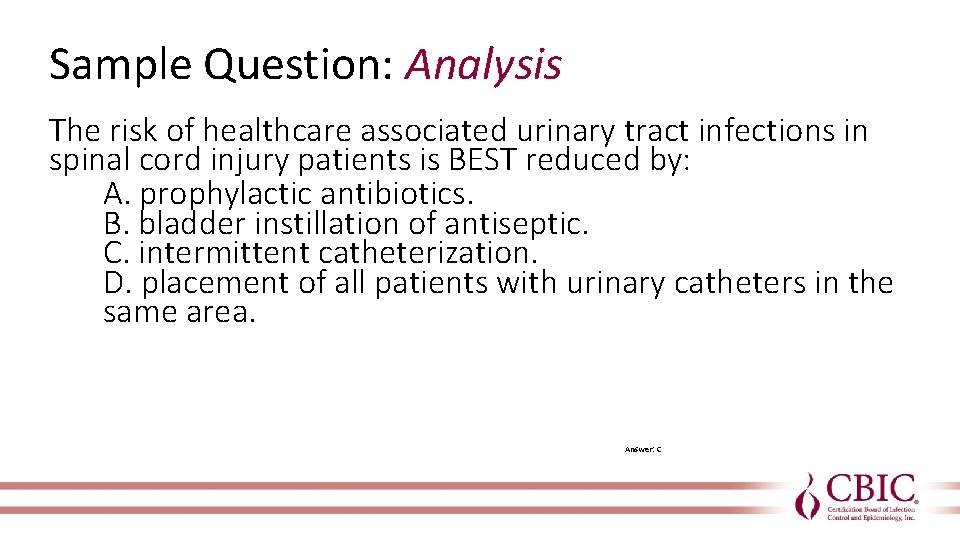
Sample Question: Analysis The risk of healthcare associated urinary tract infections in spinal cord injury patients is BEST reduced by: A. prophylactic antibiotics. B. bladder instillation of antiseptic. C. intermittent catheterization. D. placement of all patients with urinary catheters in the same area. Answer: C
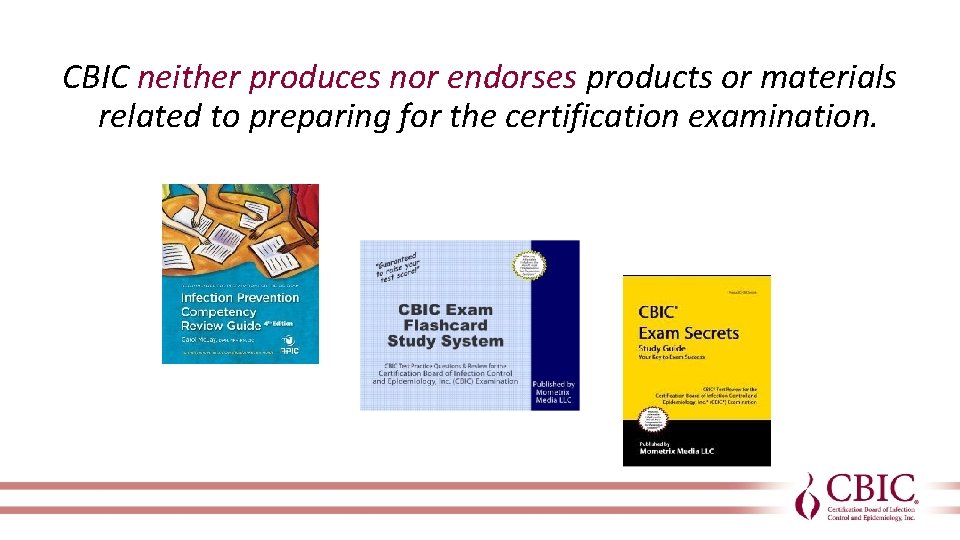
CBIC neither produces nor endorses products or materials related to preparing for the certification examination.
Section 10: Exam Resources
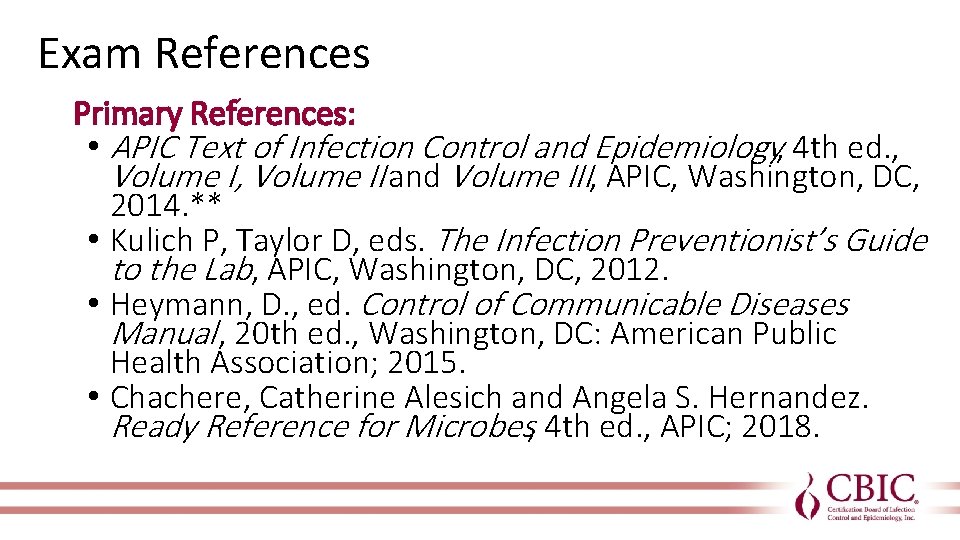
Exam References Primary References: • APIC Text of Infection Control and Epidemiology, 4 th ed. , Volume II and Volume III, APIC, Washington, DC, 2014. ** • Kulich P, Taylor D, eds. The Infection Preventionist’s Guide to the Lab, APIC, Washington, DC, 2012. • Heymann, D. , ed. Control of Communicable Diseases Manual , 20 th ed. , Washington, DC: American Public Health Association; 2015. • Chachere, Catherine Alesich and Angela S. Hernandez. Ready Reference for Microbes, 4 th ed. , APIC; 2018.
Exam References Secondary References: • Current Recommendations of the Advisory Committee on Immunization Practices (ACIP). • Current guidelines, standards, and recommendations from CDC, APIC, SHEA, and Public Health Agency of Canada. • Pickering, Larry K, ed. Red Book, 30 th ed. , Elk Grove Village, IL: American Academy of Pediatrics; 2015. **The 2015 recertification examination was written using the 3 rd edition of the APIC Text of Infection Control and Epidemiology, Volumes I and II.
Other Resources Check CBIC website www. cbic. org for: • Online Candidate Handbook (all application and order forms for the examinations are included) • Background information on CBIC and the certification process
Resources Association for Professionals in Infection Control and Epidemiology (APIC) 1275 K St. , NW Suite 1000 Washington, DC 20005 (202) 789 -1890 www. apic. org Infection Prevention and Control Canada (IPAC Canada) PO Box 46125 RPO Westdale Winnipeg, MB R 3 R 3 S 3 (866) 999 -7111 www. ipac-canada. org
Resources CBIC Executive Office: 555 East Wells Street Suite 1100 Milwaukee, WI 53202 Phone: (414) 918 -9796 Fax: (414) 276 -3349 Web site: www. cbic. org Email: info@cbic. org Testing Company: Prometric Phone: (800) 278 -6222 (toll free U. S. , U. S. Territories, and Canada) Website: www. prometric. com/cbic