
Certificate in Animal Welfare J Oosthuizen Senior Lecturer

![Modules MODULE CODE] MODULE NAME NQF LEVEL COMPULSORY OR OPTIONAL CREDITS YEAR (1 -4)](https://slidetodoc.com/presentation_image_h/99ff16383f5edbced0bc82bfec3b87e9/image-14.jpg "Modules MODULE CODE] MODULE NAME NQF LEVEL COMPULSORY OR OPTIONAL CREDITS YEAR (1 -4)")

- Slides: 23
Certificate in Animal Welfare J Oosthuizen Senior Lecturer
Introduction • Animal Welfare Organizations (AWO) contributed vastly over decades in providing a veterinary service to formally disadvantaged areas and promoted animal welfare. • For many people in the country, particularly in rural and formally disadvantaged areas, private veterinary care is inaccessible and unaffordable. • Historically, AWO have alleviated the problem of staff shortages due to a lack of veterinary professionals by using unqualified individuals drawn from local communities, whom they trained to perform tasks under veterinary supervision.
Introduction • Given the inconsistencies that have been problematic in the level of competency of Animal Welfare Assistants (AWA’s) – It is generally agreed that to standardize the training for AWA’s to enable registration with the SAVC will improve the delivery of veterinary services – This would also empower AWA’s by equipping them with nationally recognized qualification.
Introduction • Given the need for a course for VWA it was recommended that a course be developed to train the VWA • A number of representatives of AWO’s as well as the SAVC worked with Unisa to develop such a qualification, and the outcome of this work is embodied in the Higher Certificate in Animal Welfare.
Purpose of the VWA Qualification • It is intended that the qualification will equip students with the core knowledge and skills specified by the SAVC for the profession of Veterinary Welfare Assistants (VWA). – Aligned to the scope of practice that is being developed by the SAVC • The Higher Certificate will train the students in theory and practice of animal welfare
Purpose of the VWA Qualification • In addition to VWA’s, it is anticipated that many other people will be interested in this qualification, including people with a general interest in companion animals who wish to further their knowledge, such as pet owners, breeders and animal therapists. • The implementation of this qualification will provide uniformity of training across the spectrum of all AWO and ensure sufficient suitably qualified VWAs going forward to facilitate the provision of accessible primary healthcare.
Anticipated benefits of the course The qualification strives to § promote animal welfare awareness and a commitment to ethical animal care and well-being. § alleviate the severe shortage of veterinary-related skills in South Africa by providing qualified VWA to work in support of AWO in communities across the country. In so doing, § it will promote the general benefits people derive from a healthy companion animal population, § and also contribute to advancing social and economic transformation by providing accessible opportunities for individuals and career development to people from all social and cultural groups.
Why UNISA is suited to offer this course? • Unisa has a national reach and provides students with the opportunity of studying via distance education, which means greater flexibility for students already in employment, as many potential students are likely to be. • It is anticipated that students enrolling for this qualification will be drawn from the current ranks of employed AWAs, as well people who want to work with animals, who might not be able to attend full time training for a year.
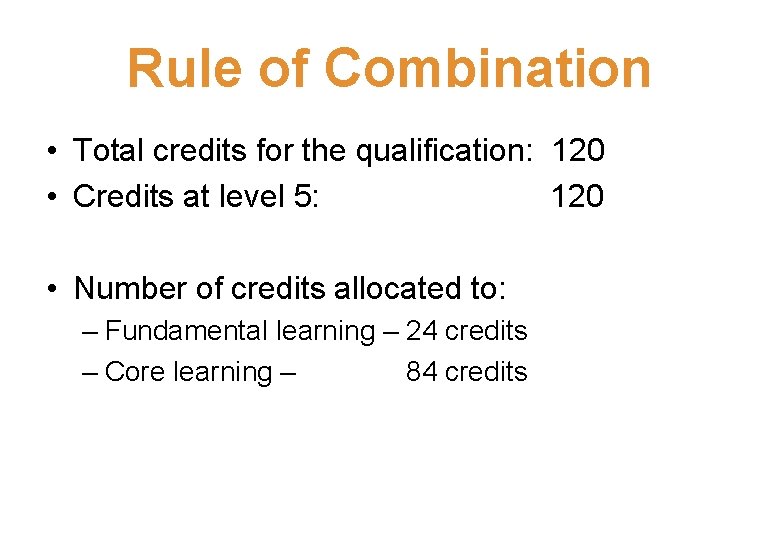
Rule of Combination • Total credits for the qualification: 120 • Credits at level 5: 120 • Number of credits allocated to: – Fundamental learning – 24 credits – Core learning – 84 credits
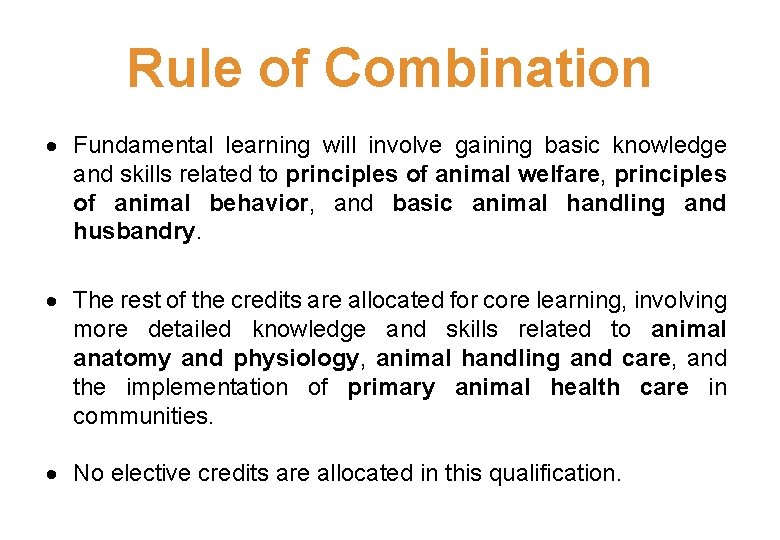
Rule of Combination Fundamental learning will involve gaining basic knowledge and skills related to principles of animal welfare, principles of animal behavior, and basic animal handling and husbandry. The rest of the credits are allocated for core learning, involving more detailed knowledge and skills related to animal anatomy and physiology, animal handling and care, and the implementation of primary animal health care in communities. No elective credits are allocated in this qualification.
Access to the Qualification • A National Senior Certificate (NSC) with at least 30% in the language of teaching and learning, or • a Senior Certificate (SC) with at least an F symbol on HG or an E symbol on SG in the language of teaching and learning, or • a National Certificate (Vocational) with at least 30% in the language of teaching and learning in terms of the NSC. • To enter higher certificate qualifications students have to comply with all admission requirements. • Students with disabilities will be granted admission wherever the nature of their disability does not preclude them from achieving the outcomes of the qualification.
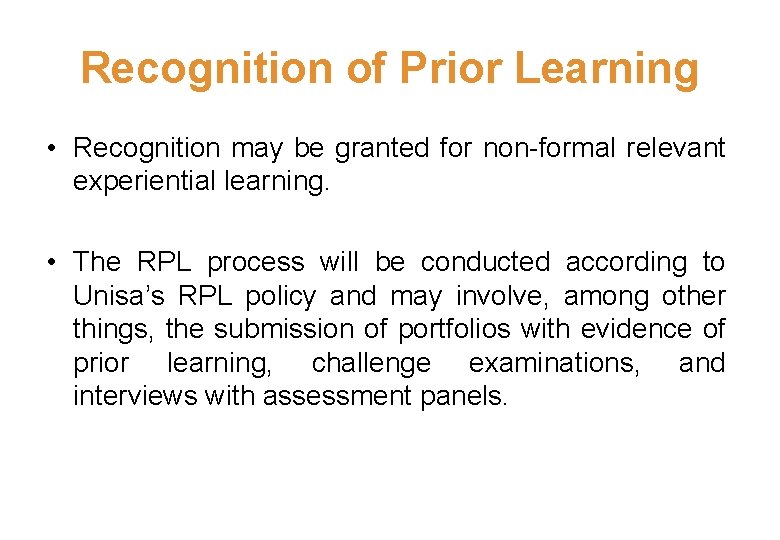
Recognition of Prior Learning • Recognition may be granted for non-formal relevant experiential learning. • The RPL process will be conducted according to Unisa’s RPL policy and may involve, among other things, the submission of portfolios with evidence of prior learning, challenge examinations, and interviews with assessment panels.
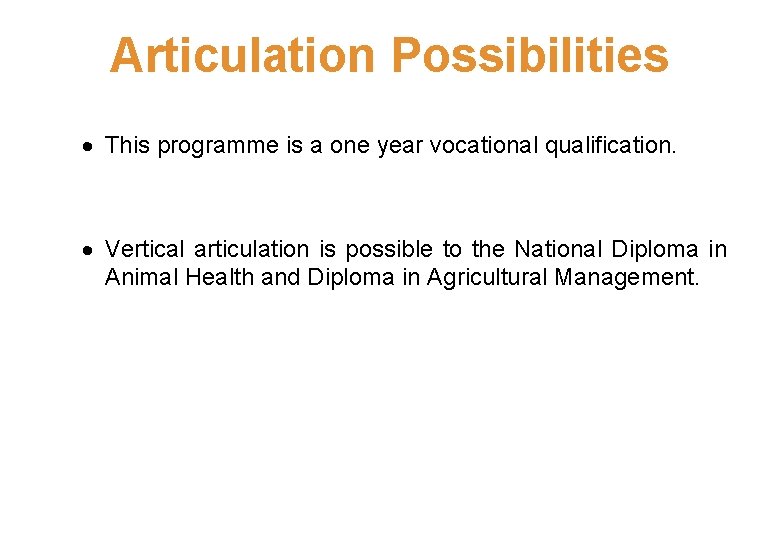
Articulation Possibilities This programme is a one year vocational qualification. Vertical articulation is possible to the National Diploma in Animal Health and Diploma in Agricultural Management.
Modules MODULE CODE] MODULE NAME NQF LEVEL COMPULSORY OR OPTIONAL CREDITS YEAR (1 -4) ‘’’’’’ APH 1501 ANW 1501 ANB 1501 AAH 1501 AHC 1501 PHC 1502 AWD 1501 AEX 1602 Anatomy & Physiology AW Introduction to Animal Welfare Introduction to Animal Behavior Animal Care and Handling Applied Animal Health Care Primary Animal Health Care II Introduction to Animal Diseases Community Extension Practice 5 12 C 1 5 24 C 1 5 12 C 1
Modules Anatomy and Physiology Animal Welfare (PAH 1501) • Students who complete this module can identify and describe the basic, normal structure and functions of the major organ systems in companion animals and horses. • They will then be able to apply this knowledge in evaluating the condition of the animals they deal with during their practical primary veterinary welfare work in communities.
Modules Introduction to Animal Behaviour (ANB 1501) • Students who complete this module can identify and distinguish between different types of companion animals, describe and interpret normal and abnormal companion animal behaviour, and recommend corrective measures for abnormal behaviour if needed.
Modules Animal Care and Handling (AAH 1501) • Students who complete this module can recommend appropriate practices for animal handling and husbandry, focusing on companion animals and horses. They will then be able to apply this knowledge during their practical primary veterinary welfare work.
Modules Applied Animal Health Care (AHC 1501) • This module is a work-integrated learning (WIL) module that forms part of the Higher Certificate in Animal Welfare. Students who complete this module can perform primary animal health care procedures as VWA in the context of a veterinary clinic. They can apply basic practices to assist with the running of a veterinary clinic and routine veterinary work under the supervision of a veterinarian. They can handle and restrain animals in humane ways, assess animal behavior and address behavioral problems, and implement routine practices of animal care and husbandry. They can also conduct a clinical examination and assist with applying diagnostic procedures, treat certain conditions, stabilise patients in a veterinary emergency, and perform humane animal euthanasia where required.
Modules Primary Animal Health Care I (PHC 1501) • Students who complete this module can identify and describe basic procedures involved in applying primary animal health care as Veterinary Welfare Assistants in the context of a veterinary clinic. • They can describe the application of routine health, hygiene and safety principles in a typical clinic, as well as the application of basic veterinary pharmacology, vaccinations, and theatre protocol within the clinic environment.
Modules Primary Animal Health Care I (PHC 1502) • Students who complete this module can explain how to perform the clinical work required of Veterinary Welfare Assistants who carry out PAHC at veterinary clinics or AWO’s. • They can outline how to perform a clinical examination and apply diagnostic procedures, how to treat certain conditions, which steps to take in a veterinary emergency, and how to perform humane animal euthanasia where required.
Modules Introduction to Animal Diseases Animal Welfare (AWD 1501) • Students who complete this module can identify and describe common pathological conditions in companion animals and horses. • They will then be able to apply this knowledge in evaluating the condition of and treating the animals they deal with during their practical primary veterinary welfare work in communities.
Modules Community Extension Practice (AEX 1602) • Students who complete this module can design and report on a basic community outreach project related to animal welfare. • They will then be able to apply the knowledge and experience they have gained in their practical primary veterinary welfare work in communities.