
CERN Resources Planning Budgeting and Control overview Kasia
CERN Resources Planning, Budgeting and Control overview Kasia Pokorska Financial Publication and Narrative Reporting Forum 24 June 2019
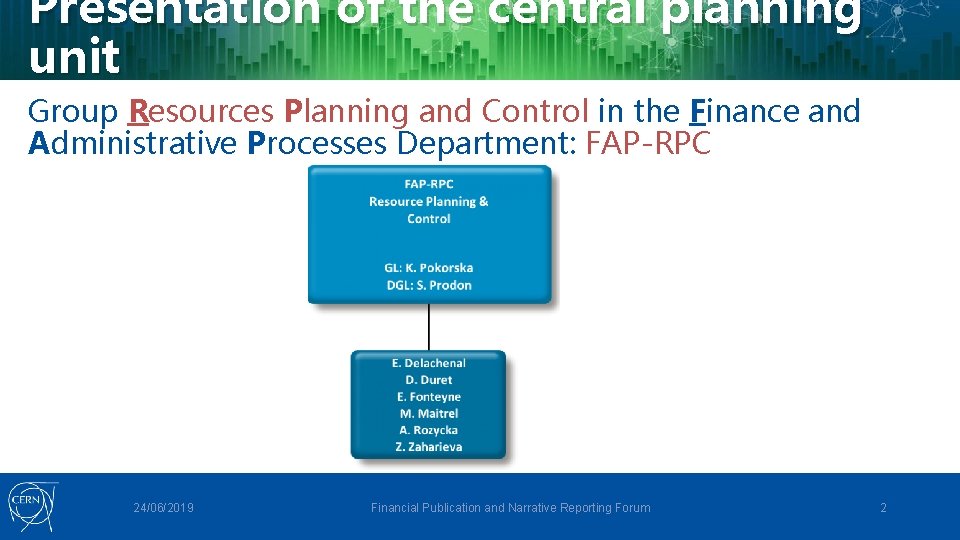
Presentation of the central planning unit Group Resources Planning and Control in the Finance and Administrative Processes Department: FAP-RPC 24/06/2019 Financial Publication and Narrative Reporting Forum 2
Overview of the CERN planning cycle (1) – core planning documents: MTP and Final Budget • Medium Term Plan (MTP) including Draft Budget • • • Overall underlining strategy (objectives) for the next 5 years Draft Budget for next year in the current prices Targets for next budget year (to be measured against these) Submitted to the approval by the Council E. g. MTP 2019: covers planning period 2020 -2024 and introduces Draft Budget for the year 2020 • Final Budget • Implements • The approved indexation to the expenses and revenues budget • The allowed transfers of unspent budget between years (carry forward, carry back, reprofilings) • Includes the information on the Probable Revenues and Expenses • For information only, no formal vote required from the Council • Long Term Plan (LTP) • More general and concise • Key strategic objectives • Time-frame 10 years • last time proposed in June 2007: 2007 -2016 at the end of the LHC construction 24/06/2019 Financial Publication and Narrative Reporting Forum 3
Overview of the CERN planning cycle (2) – core reporting document: APR • Annual Progress Report (APR) • Quantitative aspect: • Compares the actual amounts (budget out-turn) with the budgeted values by activity, showing the achievements • Report on budget carry over • KPIs • Qualitative aspect: • Explains the numerical variations • “Narrative” reporting on the targets / objectives set in the Final Budget • Joint effort of multiple actors • Accounting for the actual amounts • DHs, DPOs, Project Leaders for explanations • Revised Budget • Part of the MTP • eg. MTP 2019 contains Revised 2019 Budget • Published as a separate document occasionally (e. g. in 2009 as a result of the LHC incident in September 2008) 24/06/2019 Financial Publication and Narrative Reporting Forum 4
Overview of the CERN planning cycle (3) – auxiliary documents: CVI and “Scale” • Cost Variation Index (CVI) • Voted in December • Personnel part: to protect basic salaries and stipends from the erosion of purchasing power resulting from the increase in the cost of living • No “negative” indexation but keep the memory • Currently no memory left • Materials part: to align the expenses budget to the inflation / deflation tendency, corrected by the variation in exchange rate between national currencies and Swiss franc • Revenues part, only MS contributions are indexed, the “corridor” principle • Scale of Member States’ Contributions • Voted in June • The contributions are expressed in the current year prices • Indexation applied in December • Corridor principle: Member States’ contribution are indexed in between 0% and 2% 24/06/2019 Financial Publication and Narrative Reporting Forum 5

Overview of the CERN planning cycle (4) timeline Scale of contribution N+1 N-1 CVI N+1 N N+1 June N N+2 N+3 N+4 N+5 Dec. N Medium Term Plan N+1 -> N+5 Annual Progress Report N-1 Revised Budget N Draft Budget N+1 Planning Reporting 24/06/2019 Probable Revenues and Expenses N Final Budget N+1 Financial Publication and Narrative Reporting Forum 10
Resources planning @CERN (1) - Principles • Financial Rules and Regulations • Document approved by Council • Last revision 19/06/2013: CERN/FC/5305/Rev. • Stipulate (Article 15): CERN’s accounts shall be drawn up in accordance with the International Public Sector Accounting Standards (IPSAS). These standards and the way in which they are implemented shall be explained in the notes attached to the annual accounts of each financial year. • Planning and budget: Article 5 to 9 • IPSAS implementation • Since 2007 24/06/2019 Financial Publication and Narrative Reporting Forum 7
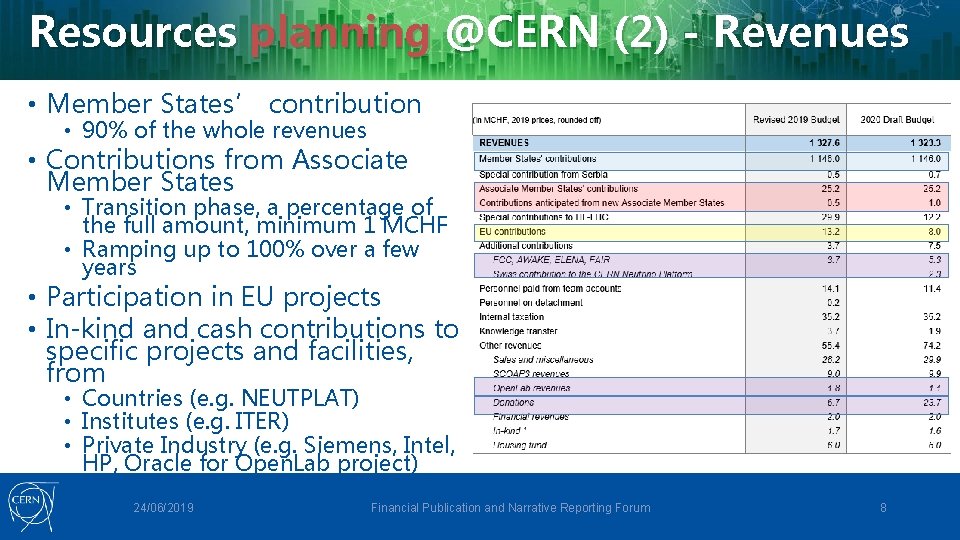
Resources planning @CERN (2) - Revenues • Member States’ contribution • 90% of the whole revenues • Contributions from Associate Member States • Transition phase, a percentage of the full amount, minimum 1 MCHF • Ramping up to 100% over a few years • Participation in EU projects • In-kind and cash contributions to specific projects and facilities, from • Countries (e. g. NEUTPLAT) • Institutes (e. g. ITER) • Private Industry (e. g. Siemens, Intel, HP, Oracle for Open. Lab project) • Donations (e. g. Science Gateway) 24/06/2019 Financial Publication and Narrative Reporting Forum 8
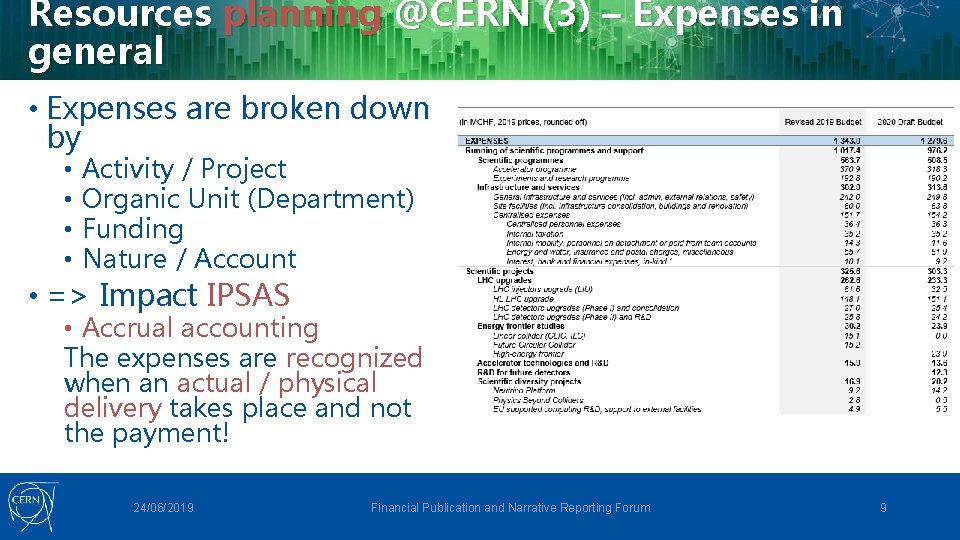
Resources planning @CERN (3) – Expenses in general • Expenses are broken down by • • Activity / Project Organic Unit (Department) Funding Nature / Account • => Impact IPSAS • Accrual accounting The expenses are recognized when an actual / physical delivery takes place and not the payment! 24/06/2019 Financial Publication and Narrative Reporting Forum 9
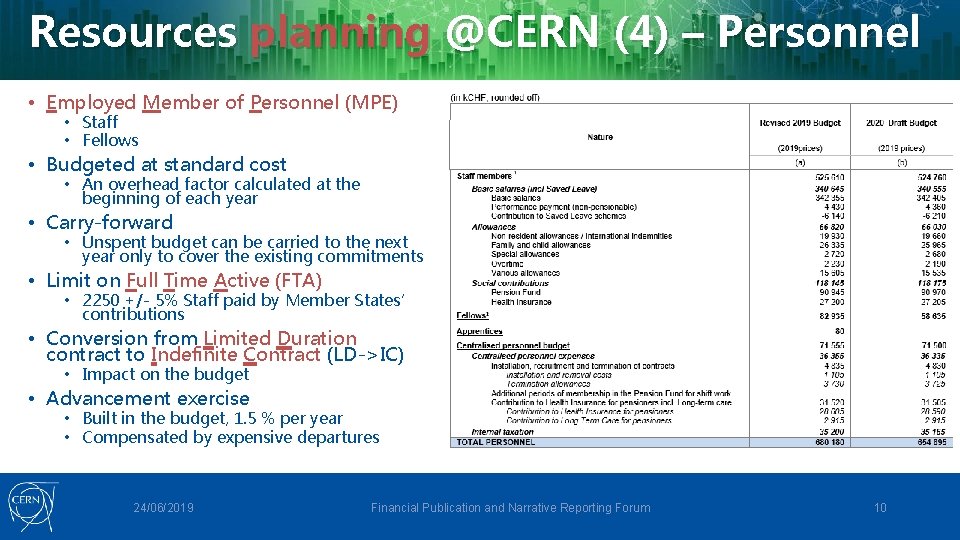
Resources planning @CERN (4) – Personnel • Employed Member of Personnel (MPE) • Staff • Fellows • Budgeted at standard cost • An overhead factor calculated at the beginning of each year • Carry-forward • Unspent budget can be carried to the next year only to cover the existing commitments • Limit on Full Time Active (FTA) • 2250 +/- 5% Staff paid by Member States’ contributions • Conversion from Limited Duration contract to Indefinite Contract (LD->IC) • Impact on the budget • Advancement exercise • Built in the budget, 1. 5 % per year • Compensated by expensive departures 24/06/2019 Financial Publication and Narrative Reporting Forum 10
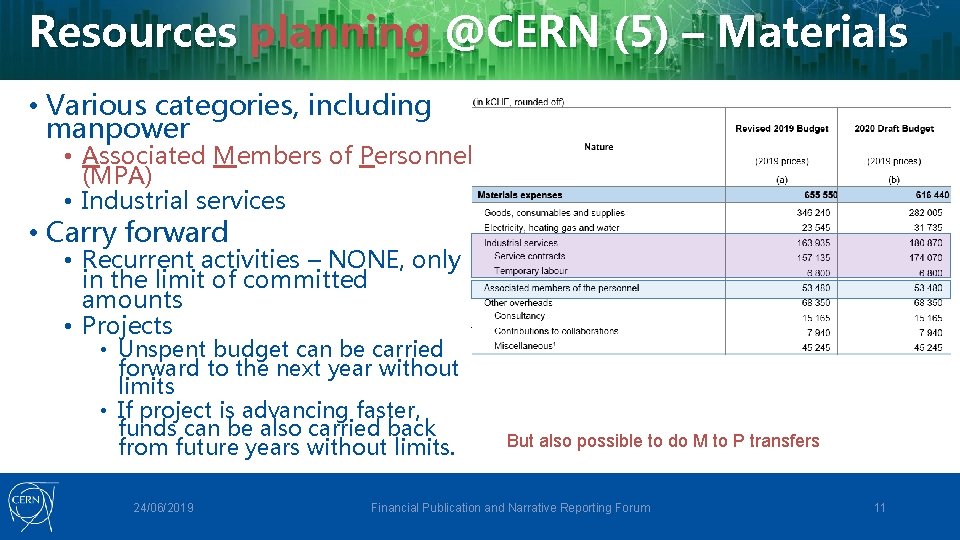
Resources planning @CERN (5) – Materials • Various categories, including manpower • Associated Members of Personnel (MPA) • Industrial services • Carry forward • Recurrent activities – NONE, only in the limit of committed amounts • Projects • Unspent budget can be carried forward to the next year without limits • If project is advancing faster, funds can be also carried back from future years without limits. 24/06/2019 But also possible to do M to P transfers Financial Publication and Narrative Reporting Forum 11
Resources controlling @CERN (1) Personnel • Staff • For each post opening for limited duration contract • Verification whether within FTAs limit • Check the implication on cost • LD to IC exercise • Budgetary consequences • Advancement exercise • Control of the cost – within 1. 5% limit? • Real cost versus standard • Follow-up on monthly basis • Readjustment if needed • Fellows • Follow up of the commitments (in k. CHF) versus budget • Regular reports on the recruitment margin • Follow-up of M to P transfers 24/06/2019 Financial Publication and Narrative Reporting Forum 12
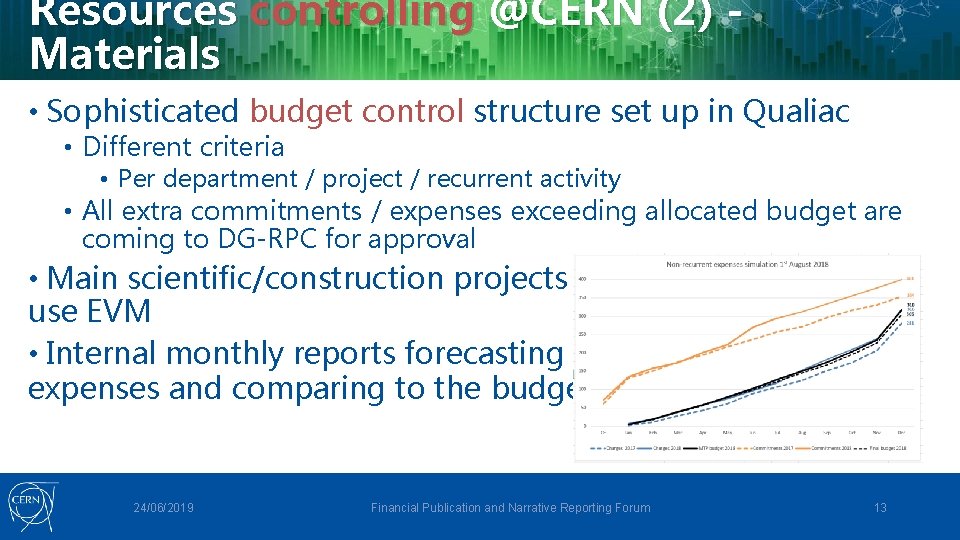
Resources controlling @CERN (2) Materials • Sophisticated budget control structure set up in Qualiac • Different criteria • Per department / project / recurrent activity • All extra commitments / expenses exceeding allocated budget are coming to DG-RPC for approval • Main scientific/construction projects use EVM • Internal monthly reports forecasting expenses and comparing to the budget 24/06/2019 Financial Publication and Narrative Reporting Forum 13
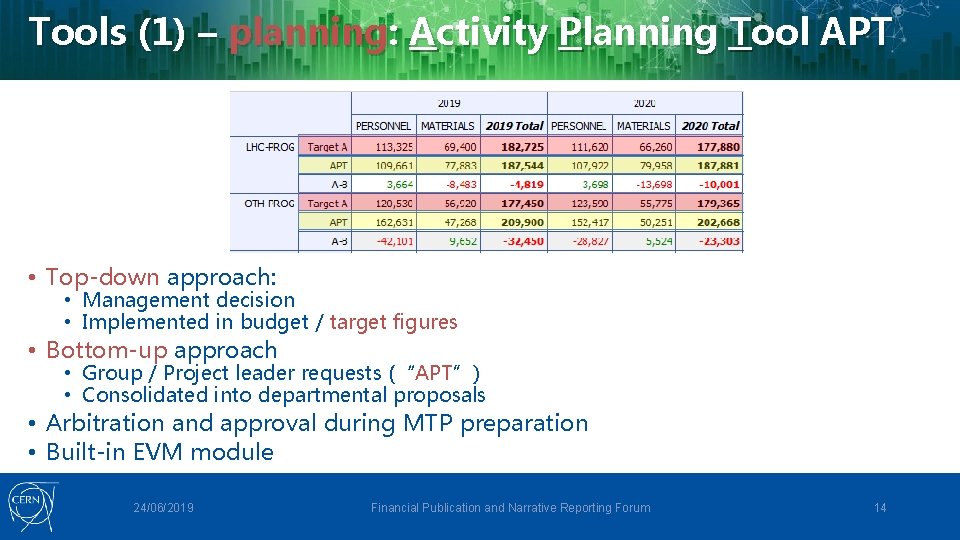
Tools (1) – planning: Activity Planning Tool APT • Top-down approach: • Management decision • Implemented in budget / target figures • Bottom-up approach • Group / Project leader requests (“APT”) • Consolidated into departmental proposals • Arbitration and approval during MTP preparation • Built-in EVM module 24/06/2019 Financial Publication and Narrative Reporting Forum 14
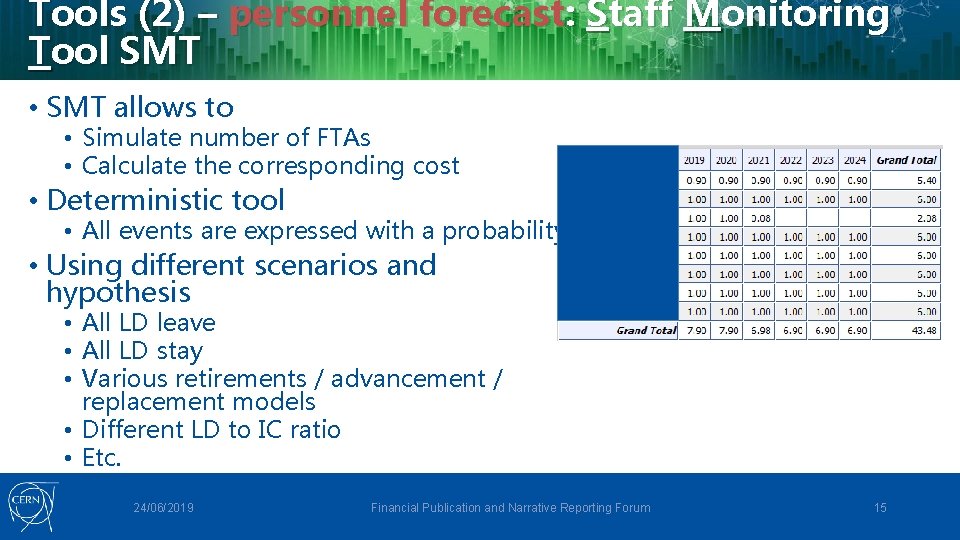
Tools (2) – personnel forecast: Staff Monitoring Tool SMT • SMT allows to • Simulate number of FTAs • Calculate the corresponding cost • Deterministic tool • All events are expressed with a probability • Using different scenarios and hypothesis • All LD leave • All LD stay • Various retirements / advancement / replacement models • Different LD to IC ratio • Etc. 24/06/2019 Financial Publication and Narrative Reporting Forum 15
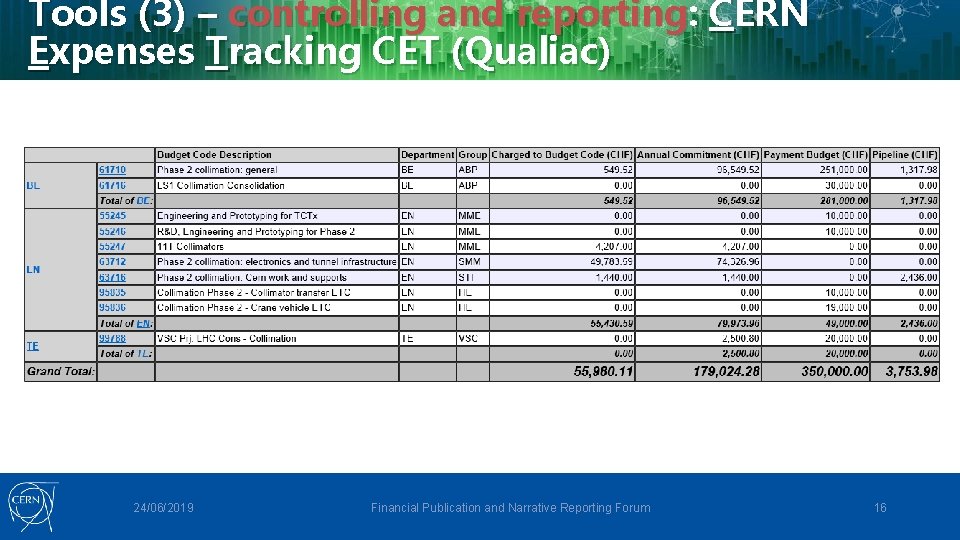
Tools (3) – controlling and reporting: CERN Expenses Tracking CET (Qualiac) 24/06/2019 Financial Publication and Narrative Reporting Forum 16
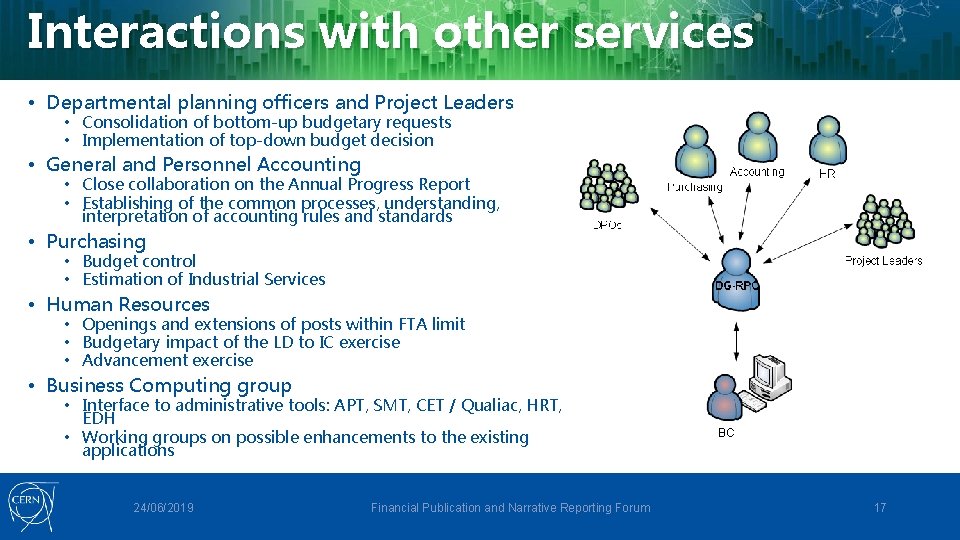
Interactions with other services • Departmental planning officers and Project Leaders • Consolidation of bottom-up budgetary requests • Implementation of top-down budget decision • General and Personnel Accounting • Close collaboration on the Annual Progress Report • Establishing of the common processes, understanding, interpretation of accounting rules and standards • Purchasing • Budget control • Estimation of Industrial Services • Human Resources • Openings and extensions of posts within FTA limit • Budgetary impact of the LD to IC exercise • Advancement exercise • Business Computing group • Interface to administrative tools: APT, SMT, CET / Qualiac, HRT, EDH • Working groups on possible enhancements to the existing applications 24/06/2019 Financial Publication and Narrative Reporting Forum BC 17

- Slides: 18