
CERN Reliability Training Andrea Apollonio TEMPEPE Acknowledgements J

CERN Reliability Training Andrea Apollonio, TE-MPE-PE Acknowledgements: J. Gutleber, R. Schmidt 3/8/2021 2
Scope of the Training Raise awareness on the importance of RAMS studies in the domain of particle accelerators q Provide basics for performing reliability analyses to CERN staff members q Train 120 -150 people from CERN over 4 years q 2 People from IMA Stuttgart q 1 from RAMENTOR q 08/03/2021 3
First Training - Test Validate contents (quantity, complexity, . . . ) q Tailor contents to the accelerator domain q Participants (total ~20): q CERN staff members WITH previous experience with reliability analyses q CERN staff members WITHOUT previous experience with reliability analyses q Students from IMA Stuttgart 08/03/2021 4
Contents Days 1 -3 (29 th Feb – 2 nd Mar): 1. Introduction 2. Mathematical Treatment of Reliability 3. Determination of System Reliability 4. Failure Mode and Effects Analysis 5. Fault Tree Analysis 6. Evaluation of Lifetime Tests and Failure Statistics 7. Availability 8. Modeling and Simulation of Availability Day 4 (3 rd Mar): 1. Hands-on training with ELMAS 08/03/2021 5
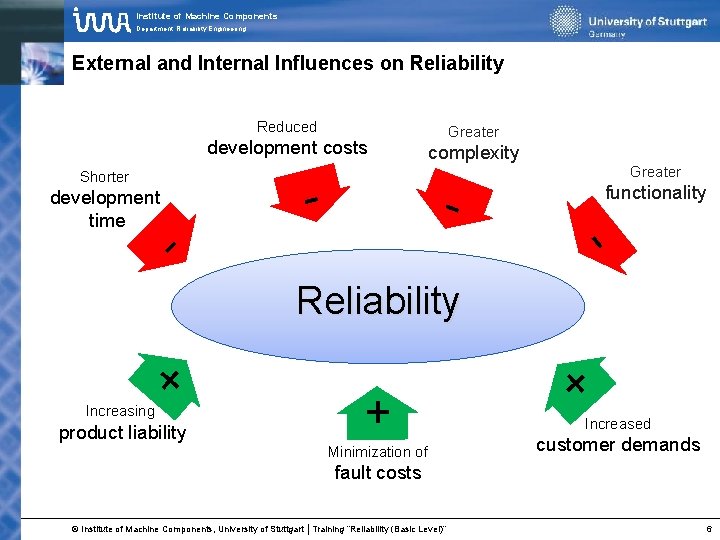
Institute of Machine Components Department: Reliability Engineering External and Internal Influences on Reliability Reduced development costs Shorter - complexity Greater - functionality - - development time Greater Reliability 19. -20. 06. 2013 + + product liability Minimization of + Increasing Increased customer demands fault costs © Institute of Machine Components, University of Stuttgart │Training “Reliability (Basic Level)“ 6
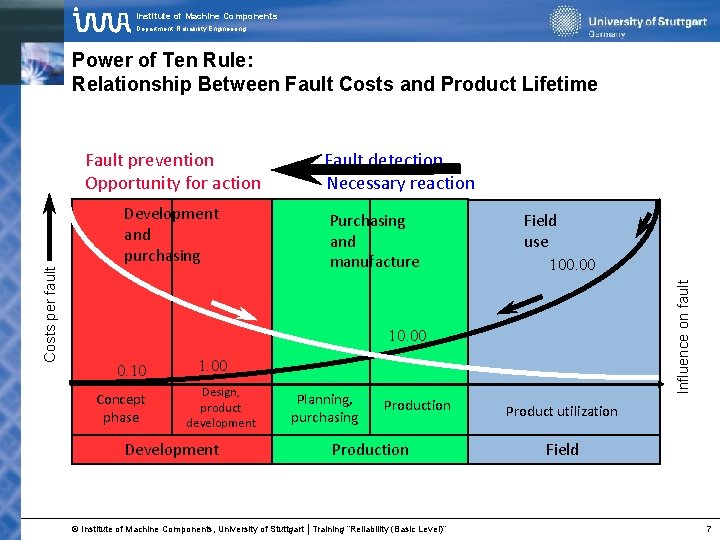
Institute of Machine Components Department: Reliability Engineering Power of Ten Rule: Relationship Between Fault Costs and Product Lifetime Costs per fault Development and purchasing Purchasing and manufacture Field use 100. 00 10. 00 0. 10 Concept phase 19. -20. 06. 2013 Fault detection Necessary reaction Influence on fault Fault prevention Opportunity for action 1. 00 Design, product development Development Planning, purchasing Production © Institute of Machine Components, University of Stuttgart │Training “Reliability (Basic Level)“ Product utilization Field 7
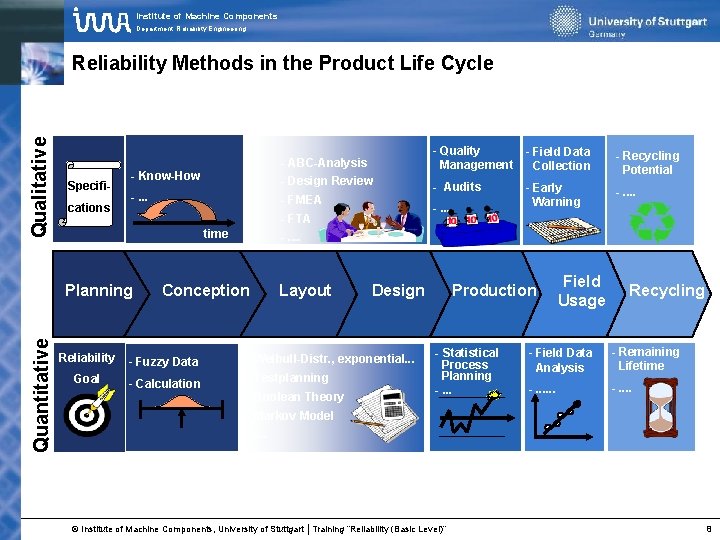
Institute of Machine Components Department: Reliability Engineering Qualitative Reliability Methods in the Product Life Cycle Specifications - Know-How -. . . Quantitative - Quality Management - Field Data Collection - Design Review - Recycling Potential - Audits - Early Warning -. . - FMEA -. . - FTA time Planning 19. -20. 06. 2013 - ABC-Analysis -. . Conception -. . Layout Design Reliability - Fuzzy Data - Weibull-Distr. , exponential. . . Goal - Calculation - Testplanning - Boolean Theory Production - Statistical Process Planning -. . . Field Usage Recycling - Field Data Analysis - Remaining Lifetime -. . - Markov Model -. . © Institute of Machine Components, University of Stuttgart │Training “Reliability (Basic Level)“ 8
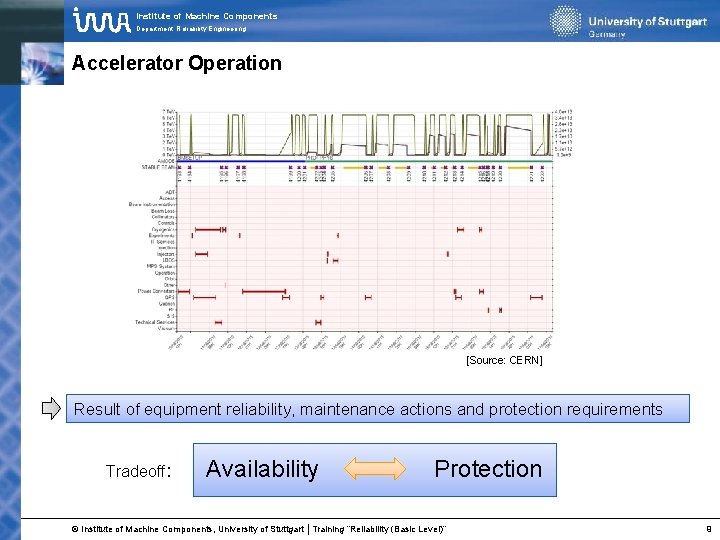
Institute of Machine Components Department: Reliability Engineering Accelerator Operation [Source: CERN] 19. -20. 06. 2013 Result of equipment reliability, maintenance actions and protection requirements Tradeoff: Availability Protection © Institute of Machine Components, University of Stuttgart │Training “Reliability (Basic Level)“ 9
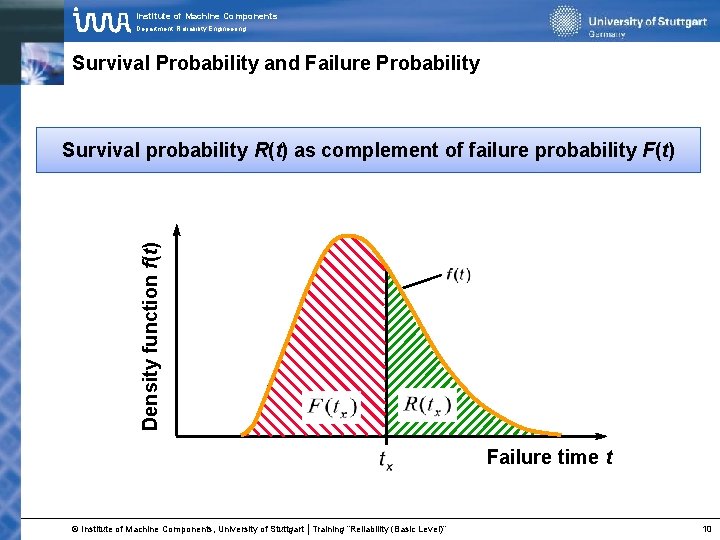
Institute of Machine Components Department: Reliability Engineering Survival Probability and Failure Probability 19. -20. 06. 2013 Density function f(t) Survival probability R(t) as complement of failure probability F(t) Failure time t © Institute of Machine Components, University of Stuttgart │Training “Reliability (Basic Level)“ 10
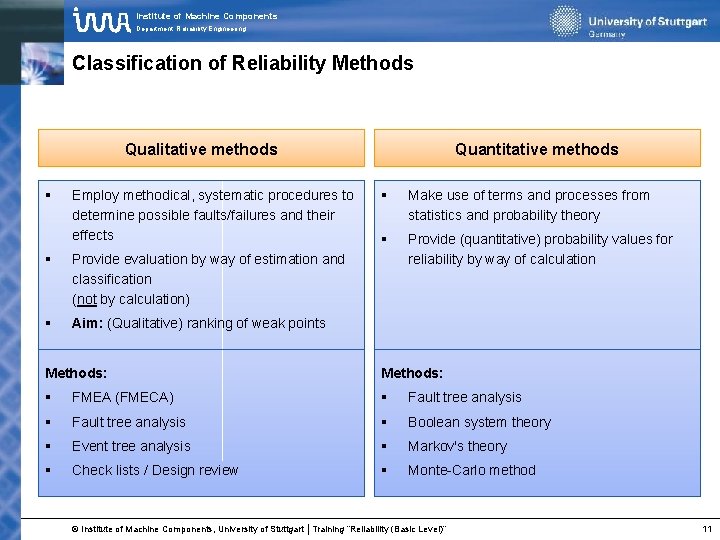
Institute of Machine Components Department: Reliability Engineering Classification of Reliability Methods Qualitative methods 19. -20. 06. 2013 § Employ methodical, systematic procedures to determine possible faults/failures and their effects § Provide evaluation by way of estimation and classification (not by calculation) § Aim: (Qualitative) ranking of weak points Quantitative methods § Make use of terms and processes from statistics and probability theory § Provide (quantitative) probability values for reliability by way of calculation Methods: § FMEA (FMECA) § Fault tree analysis § Boolean system theory § Event tree analysis § Markov's theory § Check lists / Design review § Monte-Carlo method © Institute of Machine Components, University of Stuttgart │Training “Reliability (Basic Level)“ 11
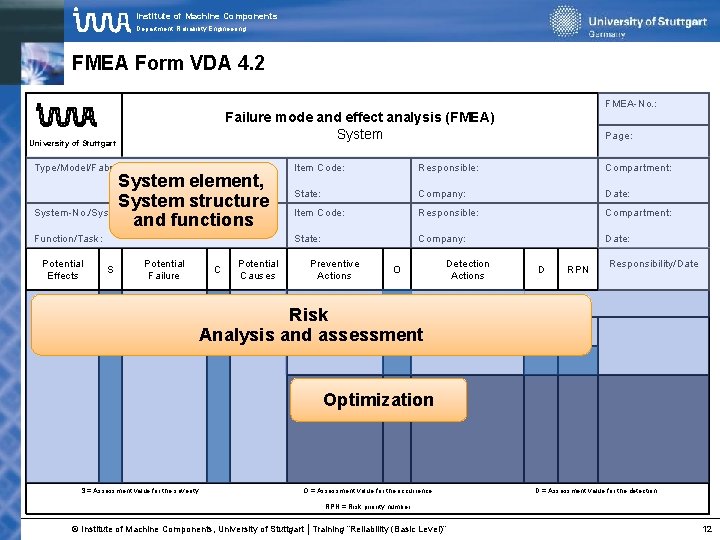
Institute of Machine Components Department: Reliability Engineering FMEA Form VDA 4. 2 FMEA-No. : Failure mode and effect analysis (FMEA) System University of Stuttgart Type/Model/Fabrication/Load: System element, System structure System-No. /System Element: and functions Function/Task: Potential Effects S Potential Failure C Potential Causes Page: Item Code: Responsible: Compartment: State: Company: Date: Preventive Actions O Detection Actions D RPN Responsibility/Date Risk Analysis and assessment 19. -20. 06. 2013 Optimization S = Assessment value for the severity O = Assessment value for the occurrence D = Assessment value for the detection RPN = Risk priority number © Institute of Machine Components, University of Stuttgart │Training “Reliability (Basic Level)“ 12
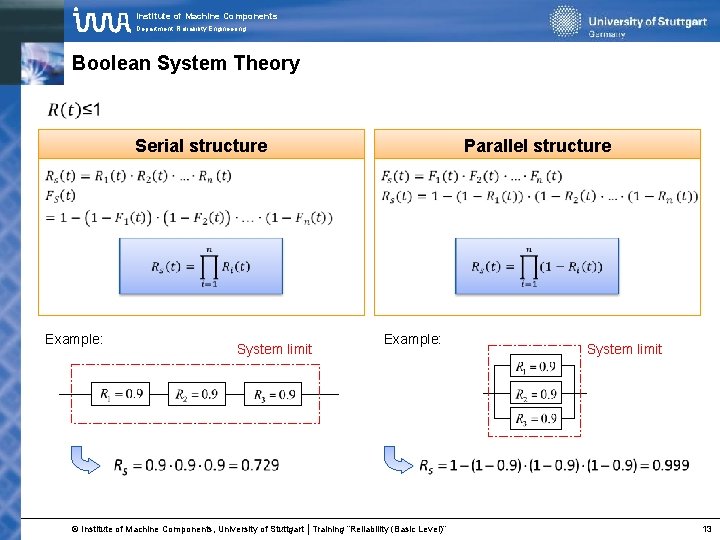
Institute of Machine Components Department: Reliability Engineering Boolean System Theory Serial structure § Parallel structure § 19. -20. 06. 2013 Example: System limit Example: © Institute of Machine Components, University of Stuttgart │Training “Reliability (Basic Level)“ System limit 13
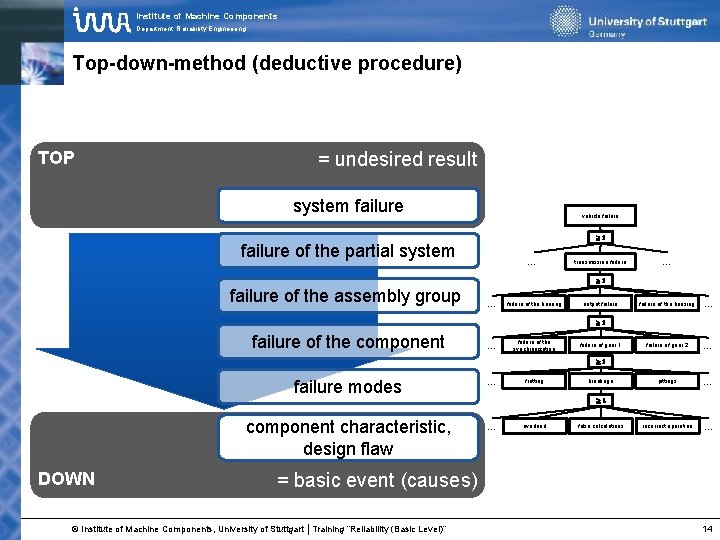
Institute of Machine Components Department: Reliability Engineering Top-down-method (deductive procedure) TOP = undesired result system failure vehicle failure ≥ 1 failure of the partial system … transmission failure … ≥ 1 failure of the assembly group … failure of the bearing output failure of the housing … failure of gear 2 … pittings … incorrect operation … ≥ 1 failure of the component … failure of the synchronization failure of gear 1 ≥ 1 failure modes … fretting breakage 19. -20. 06. 2013 ≥ 1 component characteristic, design flaw DOWN … overload false calculations = basic event (causes) © Institute of Machine Components, University of Stuttgart │Training “Reliability (Basic Level)“ 14
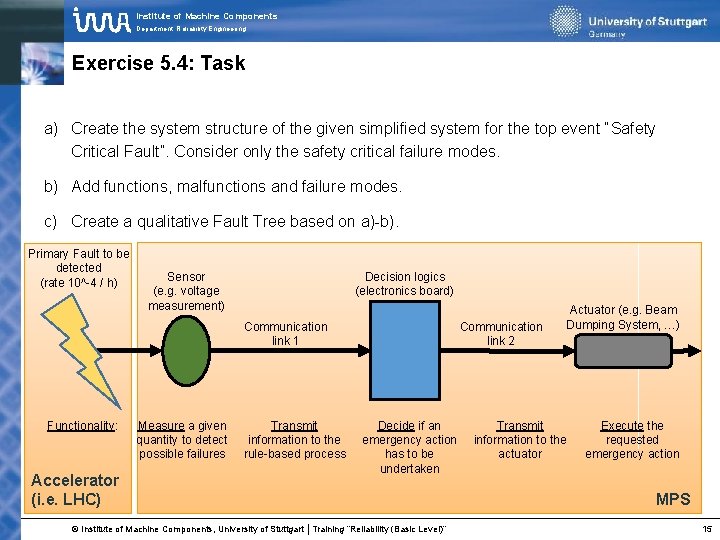
Institute of Machine Components Department: Reliability Engineering Exercise 5. 4: Task a) Create the system structure of the given simplified system for the top event “Safety Critical Fault”. Consider only the safety critical failure modes. b) Add functions, malfunctions and failure modes. c) Create a qualitative Fault Tree based on a)-b). Primary Fault to be detected (rate 10^-4 / h) Decision logics (electronics board) Sensor (e. g. voltage measurement) Communication link 1 19. -20. 06. 2013 Functionality: Accelerator (i. e. LHC) Measure a given quantity to detect possible failures Transmit information to the rule-based process Communication link 2 Decide if an emergency action has to be undertaken © Institute of Machine Components, University of Stuttgart │Training “Reliability (Basic Level)“ Actuator (e. g. Beam Dumping System, …) Transmit information to the actuator Execute the requested emergency action MPS 15
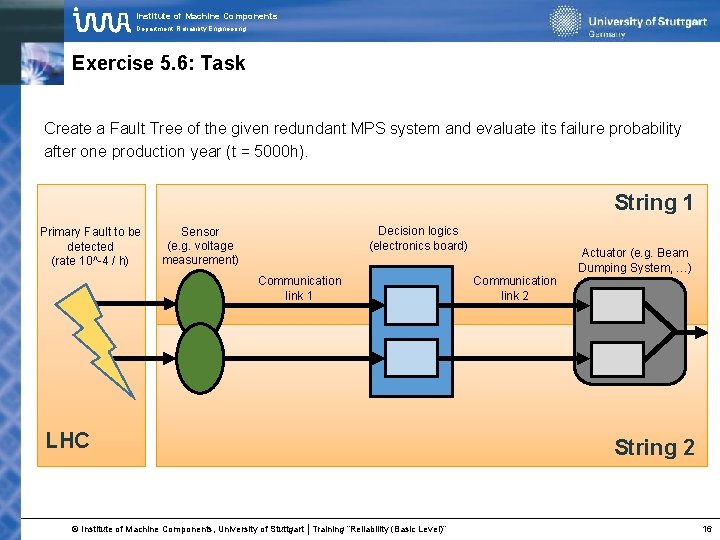
Institute of Machine Components Department: Reliability Engineering Exercise 5. 6: Task Create a Fault Tree of the given redundant MPS system and evaluate its failure probability after one production year (t = 5000 h). String 1 Primary Fault to be detected (rate 10^-4 / h) Decision logics (electronics board) Sensor (e. g. voltage measurement) Communication link 1 19. -20. 06. 2013 LHC © Institute of Machine Components, University of Stuttgart │Training “Reliability (Basic Level)“ Actuator (e. g. Beam Dumping System, …) Communication link 2 String 2 16
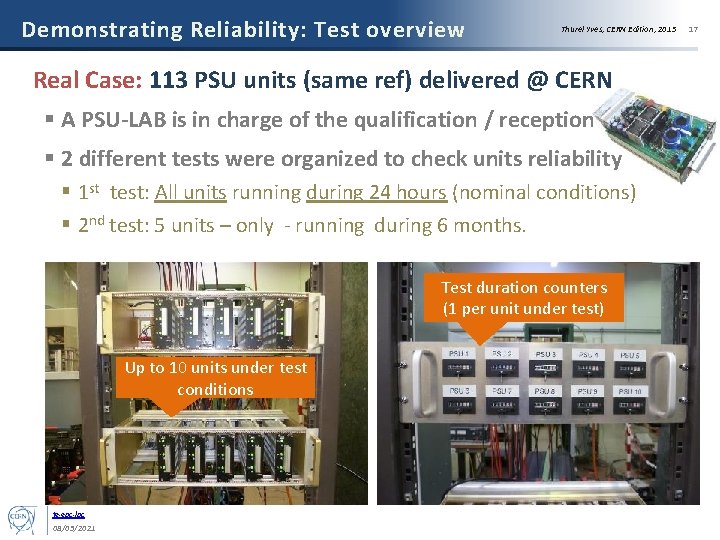
Demonstrating Reliability: Test overview Thurel Yves, CERN Edition, 2015 Real Case: 113 PSU units (same ref) delivered @ CERN § A PSU-LAB is in charge of the qualification / reception § 2 different tests were organized to check units reliability § 1 st test: All units running during 24 hours (nominal conditions) § 2 nd test: 5 units – only - running during 6 months. Test duration counters (1 per unit under test) Up to 10 units under test conditions te-epc-lpc 08/03/2021 17
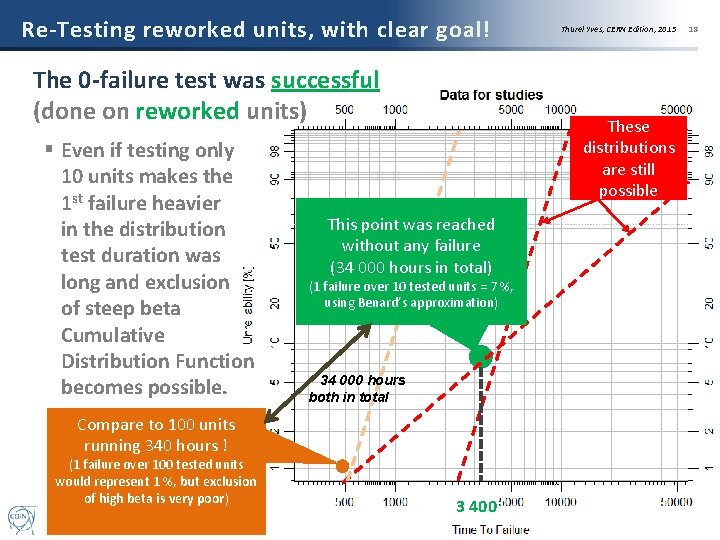
Re-Testing reworked units, with clear goal! The 0 -failure test was successful (done on reworked units) § Even if testing only 10 units makes the 1 st failure heavier in the distribution test duration was long and exclusion of steep beta Cumulative Distribution Function becomes possible. These distributions are still possible This point was reached without any failure (34 000 hours in total) (1 failure over 10 tested units = 7 %, using Benard’s approximation) 34 000 hours both in total Compare to 100 units running 340 hours ! (1 failure over 100 tested units would represent 1 %, but exclusion of high beta is very poor) te-epc-lpc 08/03/2021 Thurel Yves, CERN Edition, 2015 3 400 18
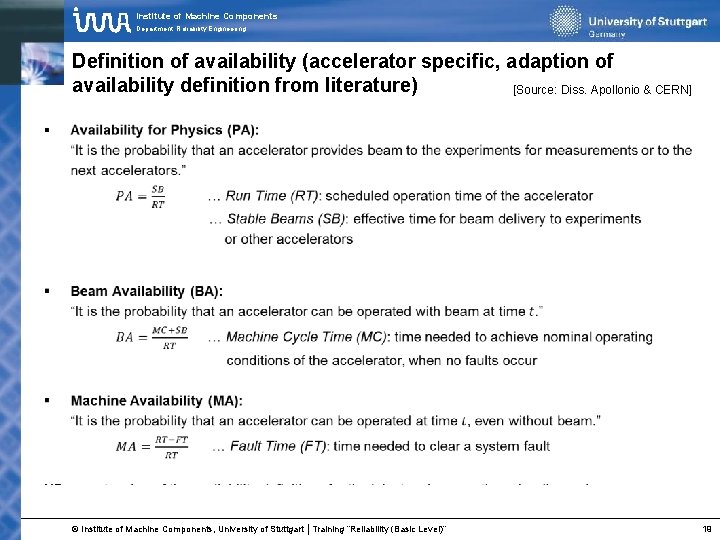
Institute of Machine Components Department: Reliability Engineering Definition of availability (accelerator specific, adaption of availability definition from literature) [Source: Diss. Apollonio & CERN] 19. -20. 06. 2013 § © Institute of Machine Components, University of Stuttgart │Training “Reliability (Basic Level)“ 19
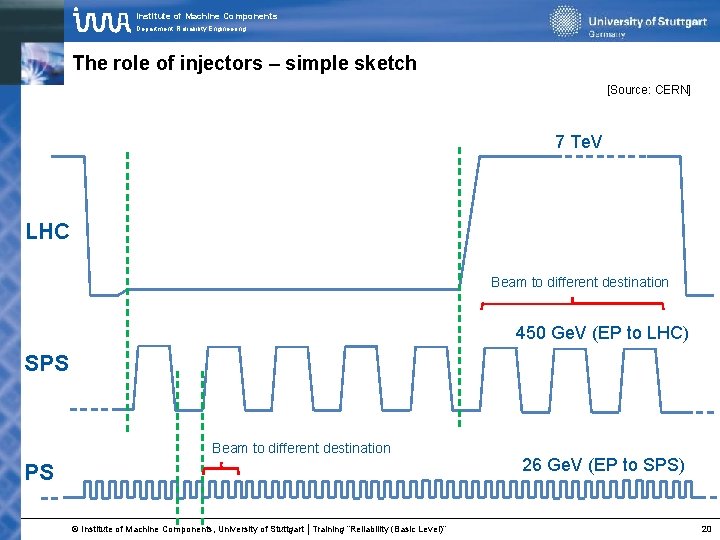
Institute of Machine Components Department: Reliability Engineering The role of injectors – simple sketch [Source: CERN] 7 Te. V LHC Beam to different destination 450 Ge. V (EP to LHC) 19. -20. 06. 2013 SPS Beam to different destination PS © Institute of Machine Components, University of Stuttgart │Training “Reliability (Basic Level)“ 26 Ge. V (EP to SPS) 20
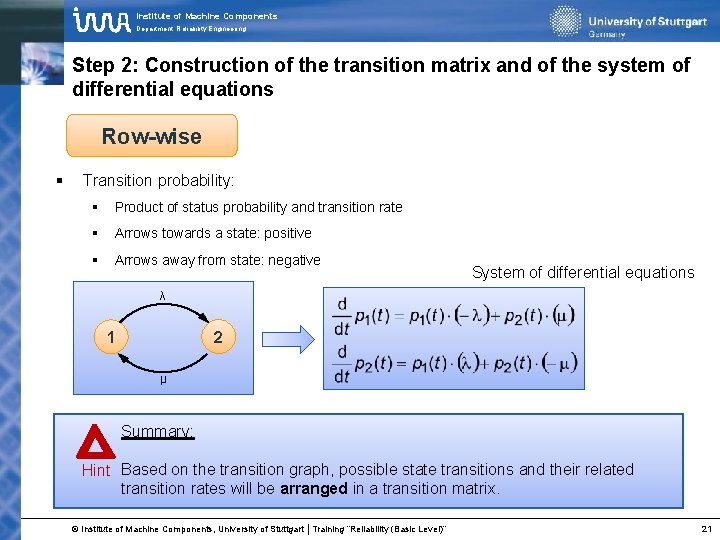
Institute of Machine Components Department: Reliability Engineering Step 2: Construction of the transition matrix and of the system of differential equations Row-wise § Transition probability: § Product of status probability and transition rate § Arrows towards a state: positive § Arrows away from state: negative System of differential equations λ 2 1 µ 19. -20. 06. 2013 Summary: Hint Based on the transition graph, possible state transitions and their related transition rates will be arranged in a transition matrix. © Institute of Machine Components, University of Stuttgart │Training “Reliability (Basic Level)“ 21
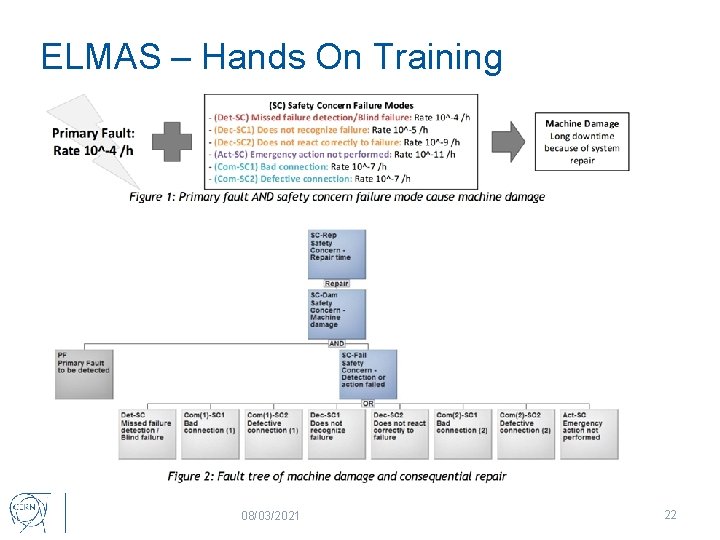
ELMAS – Hands On Training 08/03/2021 22
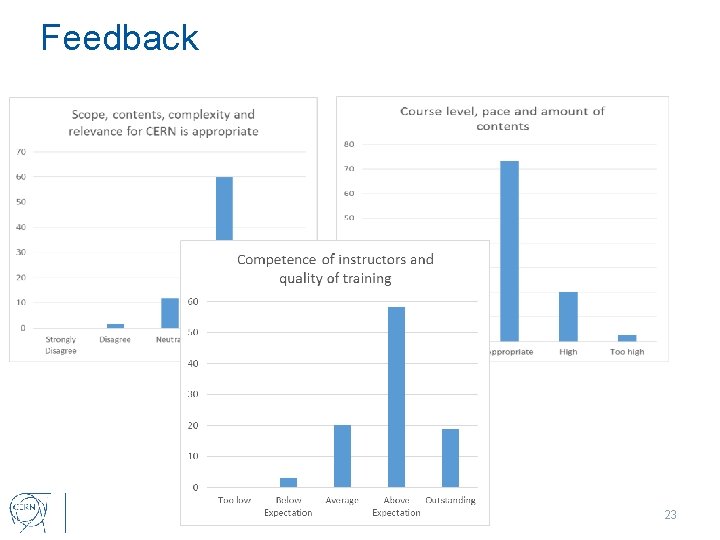
Feedback 08/03/2021 23
Thanks a lot for your attention! 3/8/2021 Document reference 24
- Slides: 24