
CERN HP Computing Dr John Manley HewlettPackard Laboratories
CERN & HP & Computing Dr John Manley Hewlett-Packard Laboratories, Bristol 27 th May, 2004 © 2004 Hewlett-Packard Development Company, L. P. The information contained herein is subject to change without notice
The Next 20 Minutes • • • Some context A little bit of history Some assertions CERN Grid Open. Lab/LCG A quick summary
John Taylor*: Motivation for e-Science will drive the next generation of technology for e-commerce, e-business, e-engineering e-auctions e-health, e-education, e-university e-democracy, e-community, e-family e-…………. . * DG UK Research Councils 1999 -2003
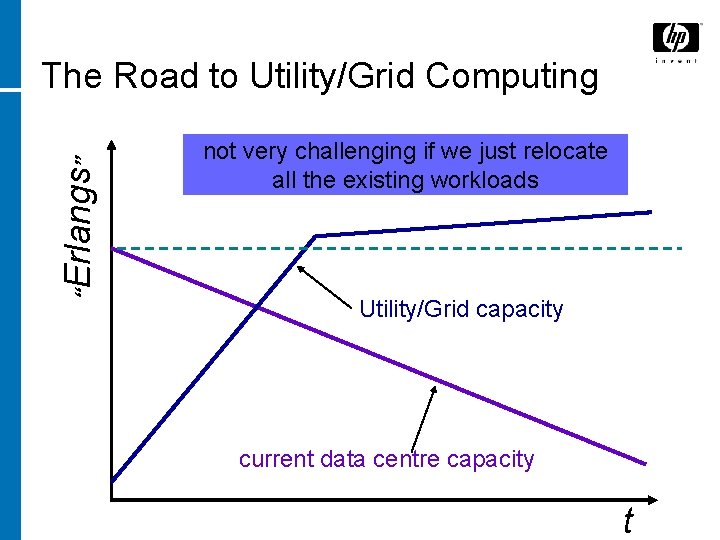
“ Erlangs” The Road to Utility/Grid Computing not very challenging if we just relocate all the existing workloads Utility/Grid capacity current data centre capacity t
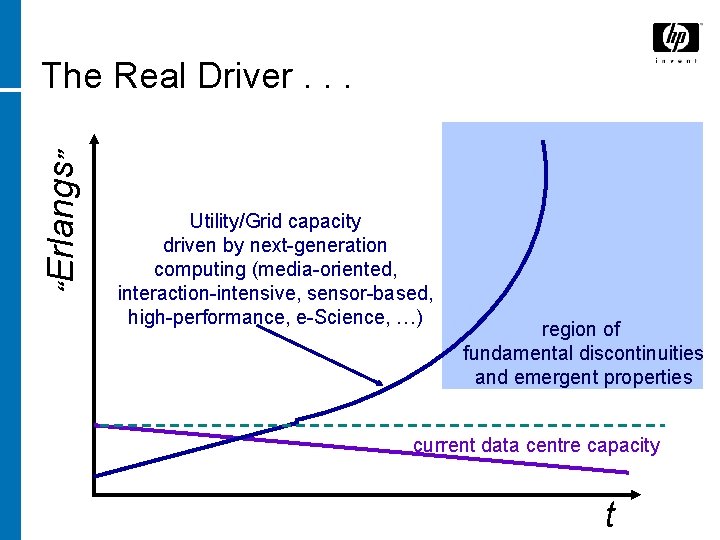
“ Erlangs” The Real Driver. . . Utility/Grid capacity driven by next-generation computing (media-oriented, interaction-intensive, sensor-based, high-performance, e-Science, …) region of fundamental discontinuities and emergent properties current data centre capacity t
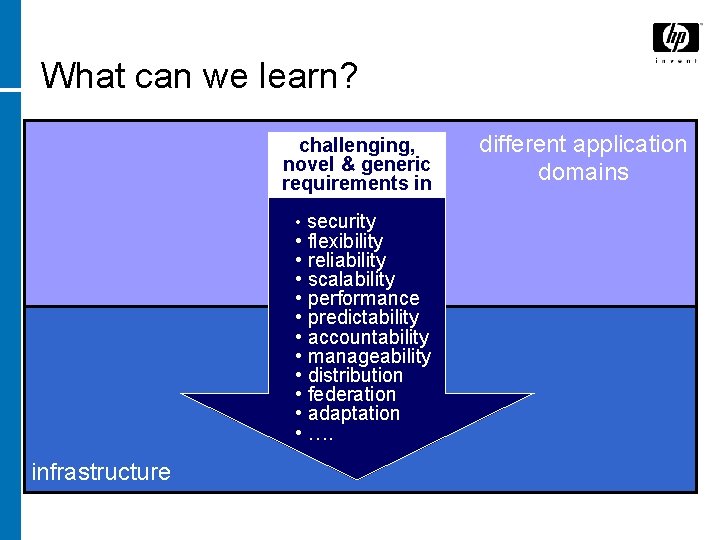
What can we learn? challenging, novel & generic requirements in • security • flexibility • reliability • scalability • performance • predictability • accountability • manageability • distribution • federation • adaptation • …. infrastructure different application domains
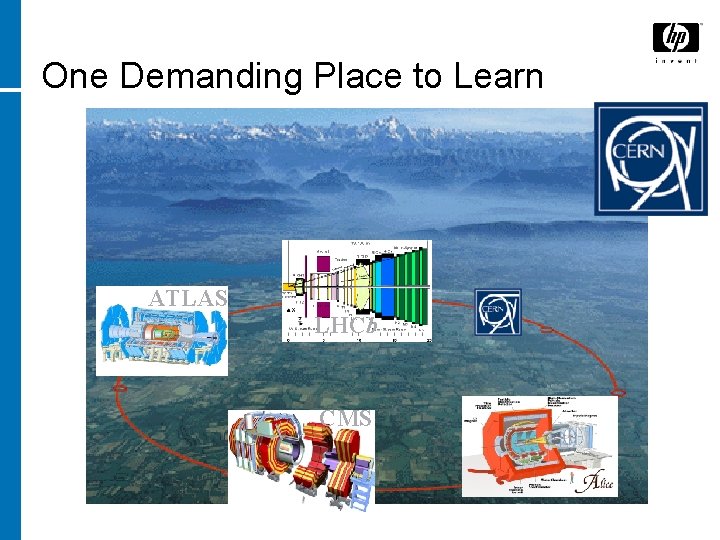
One Demanding Place to Learn ATLAS LHCb CMS
The Next 20 Minutes • • • Some context A little bit of history Some assertions CERN Grid Open. Lab/LCG A quick summary
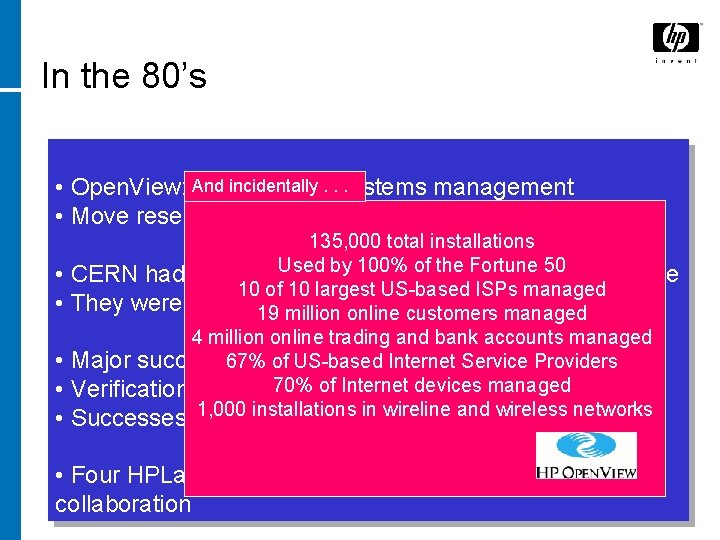
In the 80’s incidentally. • Open. View: And network and. . systems management • Move research from enterprise to global systems • • • 135, 000 total installations Used by 100% of the Fortune 50 in Europe CERN had one of the most advanced networks 10 of 10 largest US-based ISPs managed They were tolerant experimental research 19 of million online customers managed 4 million online trading and bank accounts managed Major success 67% in deployment many. Service low-cost probes of US-based of Internet Providers of Internet devices managed Verification of HP’s 70% three-loop model 1, 000 installations ininto wireline and wireless networks Successes fed technologies nascent Open. View • Four HPLabs staff transferred to Geneva for the collaboration
The Next 20 Minutes • • • Some context A little bit of history Some assertions CERN Grid Open. Lab/LCG A quick summary
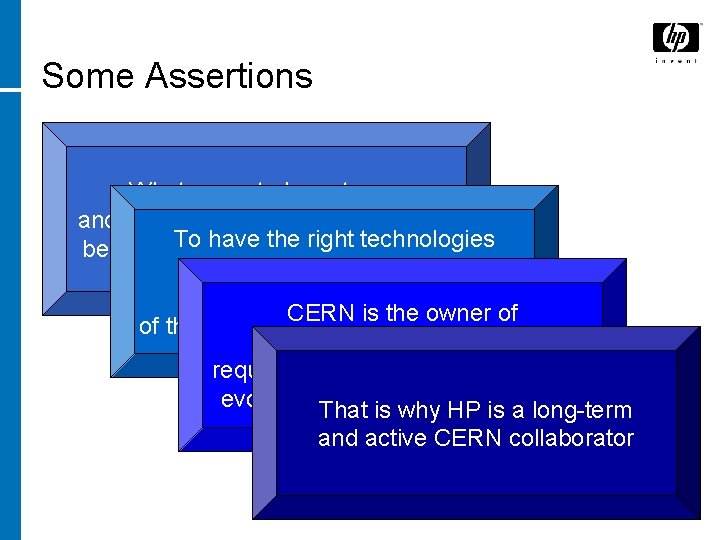
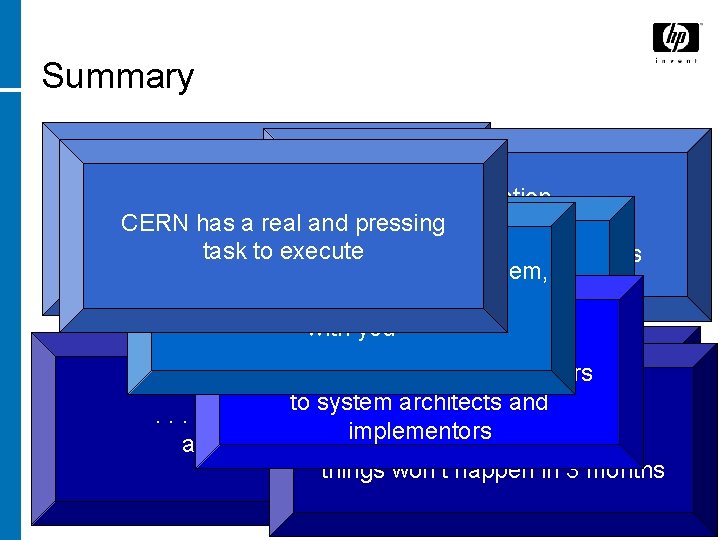
Some Assertions What seem to be extreme and specialized requirements today have the in right become To mainstream 3 –technologies 5 years in 3 – 5 years it is necessary to engage with the owners CERN is the owner of of those extreme requirements today extreme requirements – requirements that are central to the evolution That of Utility/Grid Computing is why HP is a long-term and active CERN collaborator
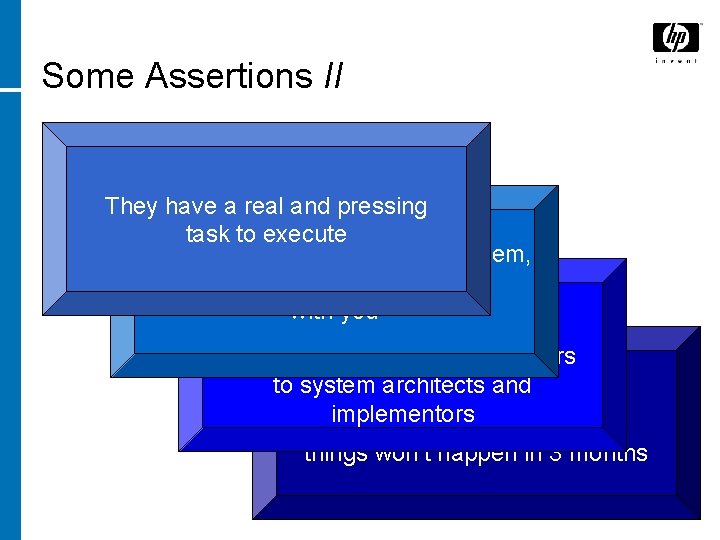
Some Assertions II They have a real and pressing task to execute If you engage strategically with them, they will engage strategically The quality of expertise with you at CERN is world-class – from users to application authors to system architects and Relationships with CERN implementors have to be strategic – things won’t happen in 3 months
Some Assertions III Collaboration, even strategic collaboration, no guarantee of sales CERN iscarries a pioneer in the larger community. Where they go, others follow CERN’s reach is global. . . and CERN has a track record
The Next 20 Minutes • • • Some context A little bit of history Some assertions CERN Grid Open. Lab/LCG A quick summary
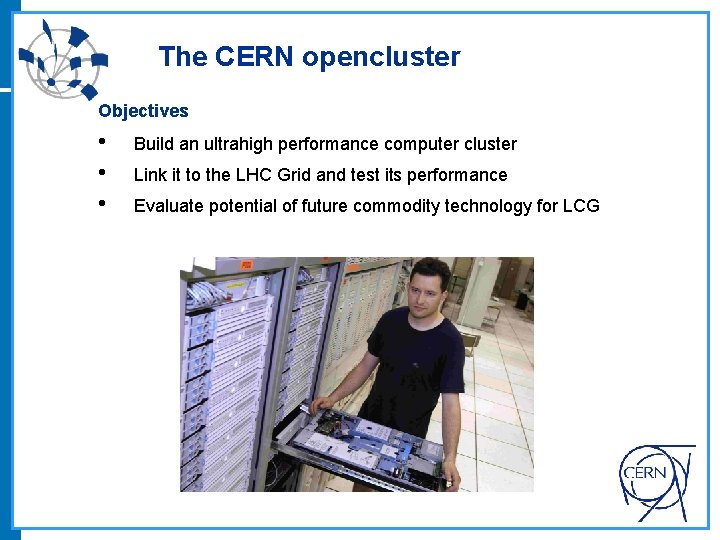
The CERN opencluster Objectives • • • Build an ultrahigh performance computer cluster Link it to the LHC Grid and test its performance Evaluate potential of future commodity technology for LCG
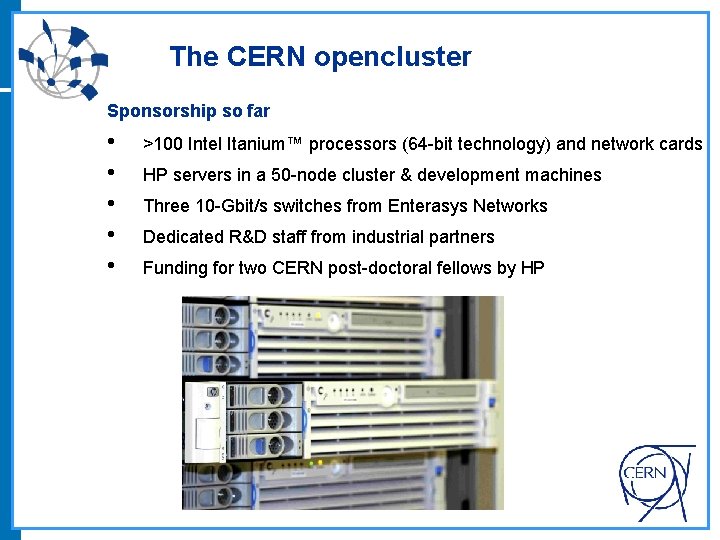
The CERN opencluster Sponsorship so far • • • >100 Intel Itanium™ processors (64 -bit technology) and network cards HP servers in a 50 -node cluster & development machines Three 10 -Gbit/s switches from Enterasys Networks Dedicated R&D staff from industrial partners Funding for two CERN post-doctoral fellows by HP
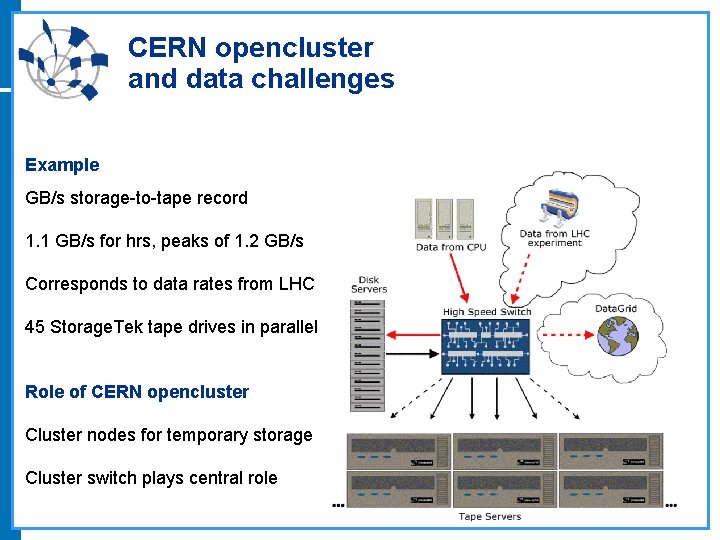
CERN opencluster and data challenges Example GB/s storage-to-tape record 1. 1 GB/s for hrs, peaks of 1. 2 GB/s Corresponds to data rates from LHC 45 Storage. Tek tape drives in parallel Role of CERN opencluster Cluster nodes for temporary storage Cluster switch plays central role
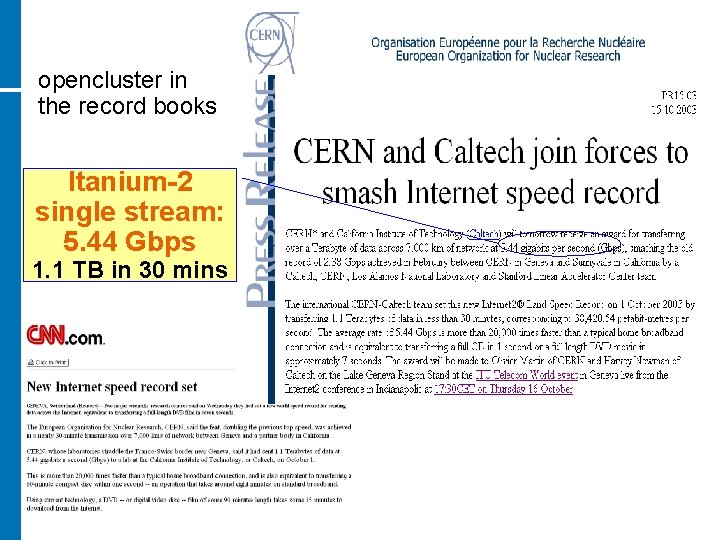
opencluster in the record books Itanium-2 single stream: 5. 44 Gbps 1. 1 TB in 30 mins
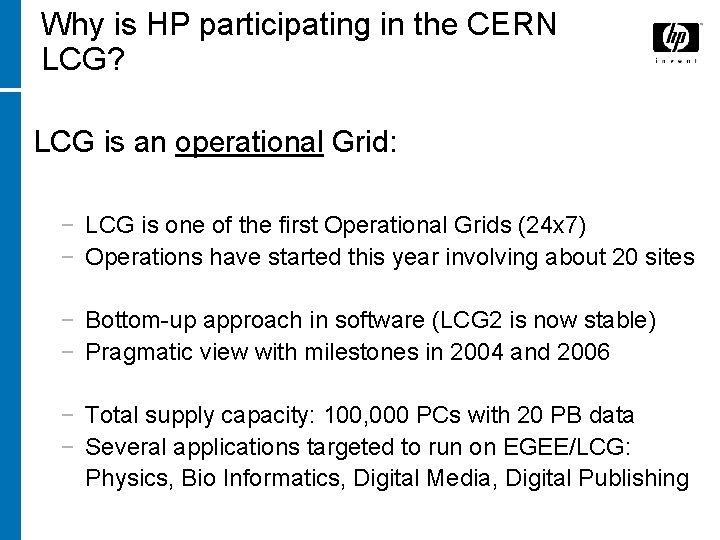
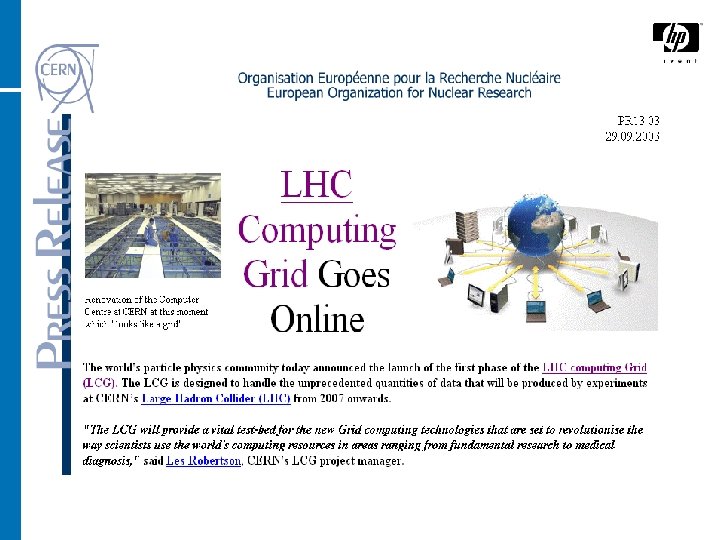
Why is HP participating in the CERN LCG? LCG is an operational Grid: − LCG is one of the first Operational Grids (24 x 7) − Operations have started this year involving about 20 sites − Bottom-up approach in software (LCG 2 is now stable) − Pragmatic view with milestones in 2004 and 2006 − Total supply capacity: 100, 000 PCs with 20 PB data − Several applications targeted to run on EGEE/LCG: Physics, Bio Informatics, Digital Media, Digital Publishing
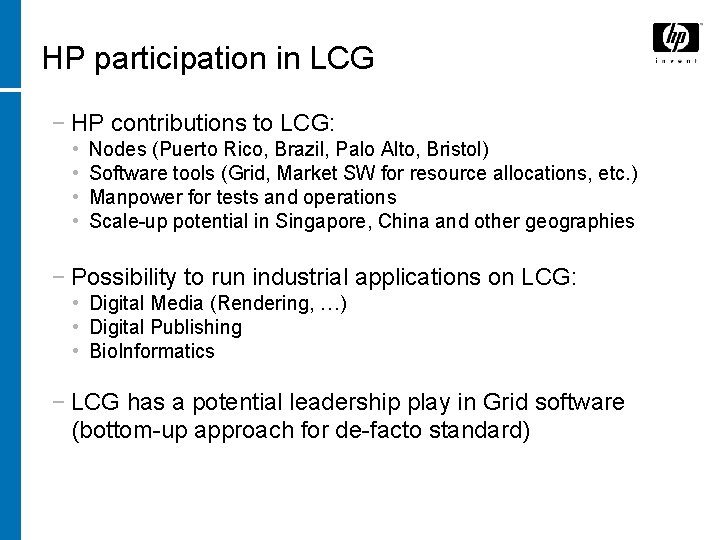
HP participation in LCG − HP contributions to LCG: • • Nodes (Puerto Rico, Brazil, Palo Alto, Bristol) Software tools (Grid, Market SW for resource allocations, etc. ) Manpower for tests and operations Scale-up potential in Singapore, China and other geographies − Possibility to run industrial applications on LCG: • Digital Media (Rendering, …) • Digital Publishing • Bio. Informatics − LCG has a potential leadership play in Grid software (bottom-up approach for de-facto standard)
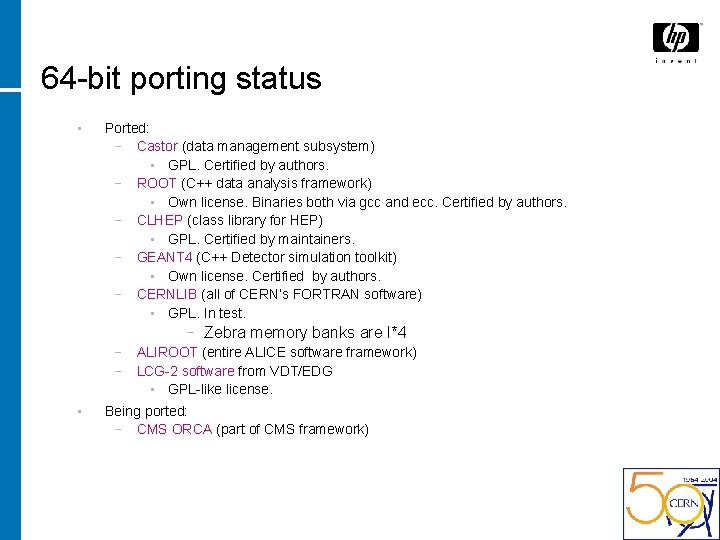
64 -bit porting status • Ported: − Castor (data management subsystem) • GPL. Certified by authors. − ROOT (C++ data analysis framework) • Own license. Binaries both via gcc and ecc. Certified by authors. − CLHEP (class library for HEP) • GPL. Certified by maintainers. − GEANT 4 (C++ Detector simulation toolkit) • Own license. Certified by authors. − CERNLIB (all of CERN’s FORTRAN software) • GPL. In test. − Zebra memory banks are I*4 − ALIROOT (entire ALICE software framework) − LCG-2 software from VDT/EDG • GPL-like license. • Being ported: − CMS ORCA (part of CMS framework)
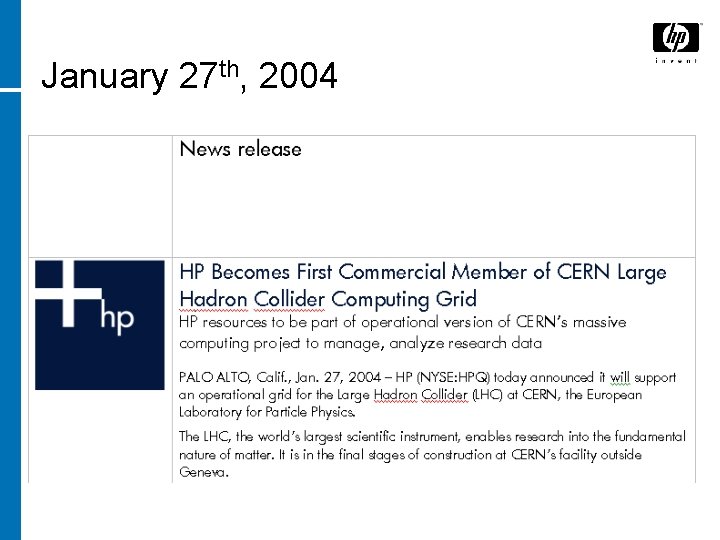
January 27 th, 2004
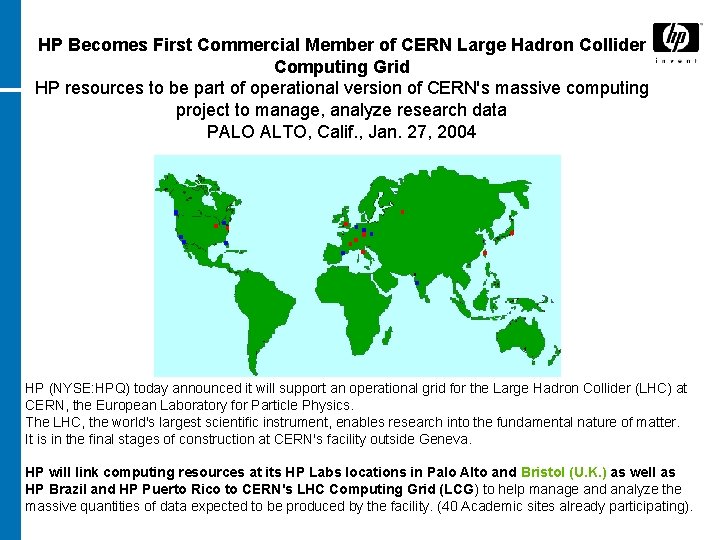
HP Becomes First Commercial Member of CERN Large Hadron Collider Computing Grid HP resources to be part of operational version of CERN's massive computing project to manage, analyze research data PALO ALTO, Calif. , Jan. 27, 2004 HP (NYSE: HPQ) today announced it will support an operational grid for the Large Hadron Collider (LHC) at CERN, the European Laboratory for Particle Physics. The LHC, the world's largest scientific instrument, enables research into the fundamental nature of matter. It is in the final stages of construction at CERN's facility outside Geneva. HP will link computing resources at its HP Labs locations in Palo Alto and Bristol (U. K. ) as well as HP Brazil and HP Puerto Rico to CERN's LHC Computing Grid (LCG) to help manage and analyze the massive quantities of data expected to be produced by the facility. (40 Academic sites already participating).
The Next 20 Minutes • • • Some context A little bit of history Some assertions CERN Grid Open. Lab/LCG A quick summary
Summary What seem to be extreme Collaboration, and CERN specialized today has arequirements real andeven pressing strategic collaboration, To have the right technologies become mainstream in 3 – 5 years task to execute carries no guarantee of sales CERN is a pioneer in the larger in 3 – 5 years it is necessary If you engage strategically with them, to engage withcommunity. the owners they will engage strategically CERN is the owner of The quality of expertise Where they go, others follow of those extreme requirements today with you extreme requirements –– at CERN is world-class CERN’s reachthat is global requirements are centralauthors to the from users to application evolution of Utility/Grid Computing to system architects That is why HP is and a long-term with CERN. . . and CERN has Relationships implementors and active collaborator have CERN to be strategic – a track record things won’t happen in 3 months
- Slides: 27