
CERN Beam Test of SiliconTungsten Calorimeter Test Module
CERN Beam Test of Silicon-Tungsten Calorimeter Test Module Shinwoo Nam (Ewha Womans University) Content: Silicon Sensor, Calorimeter Test Module, Beam Test and Data Plots On behalf of Ewha Womans University: S. J. Baek, H. J. Hyun, S. Nam, I. H. Park, J. Yang Korea University: J. S. Kang, S. K. Park, J. H. Choi Kyungpook National University: Y. D. Oh, K. H. Han, D. H. Kim, J. S. Seo, U. C. Yang Sungkyunkwan University: I. T. Yu, Y. P. Yu Yonsei University: B. S. Jang, S. H. Jeong, J. H. Kang, Y. J. Kwon
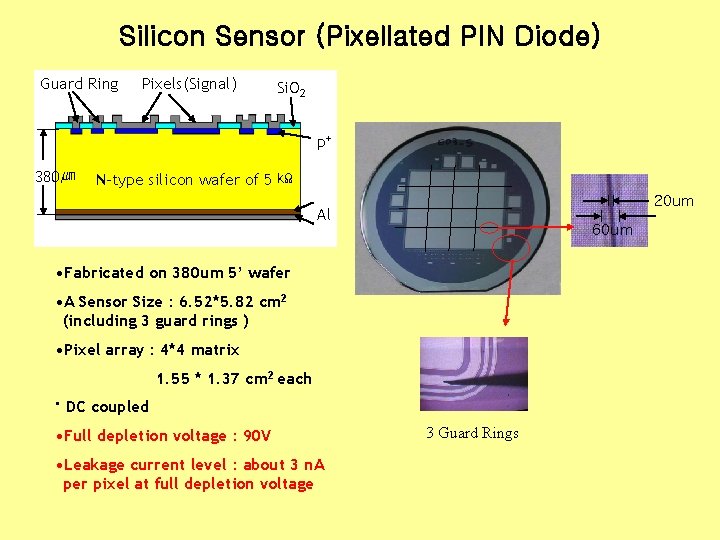
Silicon Sensor (Pixellated PIN Diode) Guard Ring Pixels(Signal) Si. O 2 p+ 380㎛ N-type silicon wafer of 5 ㏀ 20 um Al 60 um • Fabricated on 380 um 5’ wafer • A Sensor Size : 6. 52*5. 82 cm 2 (including 3 guard rings ) • Pixel array : 4*4 matrix 1. 55 * 1. 37 cm 2 each • DC coupled • Full depletion voltage : 90 V • Leakage current level : about 3 n. A per pixel at full depletion voltage 3 Guard Rings
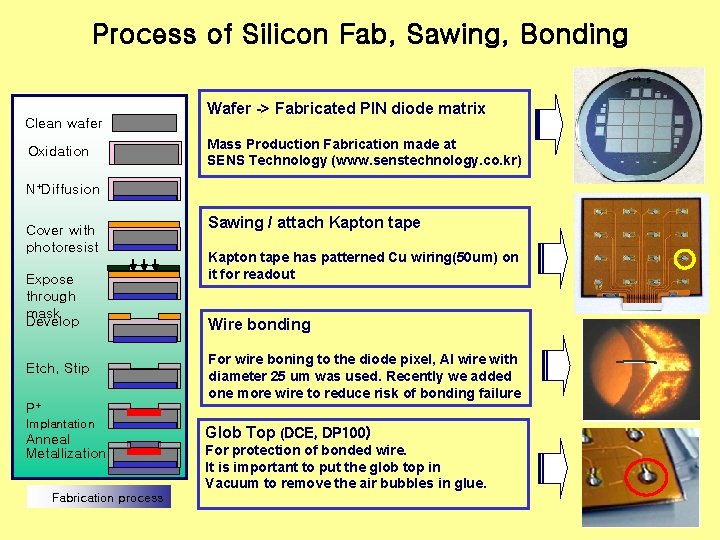
Process of Silicon Fab, Sawing, Bonding Clean wafer Oxidation Wafer -> Fabricated PIN diode matrix Mass Production Fabrication made at SENS Technology (www. senstechnology. co. kr) N+Diffusion Cover with photoresist Expose through mask Develop Etch, Stip Sawing / attach Kapton tape has patterned Cu wiring(50 um) on it for readout Wire bonding For wire boning to the diode pixel, Al wire with diameter 25 um was used. Recently we added one more wire to reduce risk of bonding failure P+ Implantation Anneal Metallization Fabrication process Glob Top (DCE, DP 100) For protection of bonded wire. It is important to put the glob top in Vacuum to remove the air bubbles in glue.
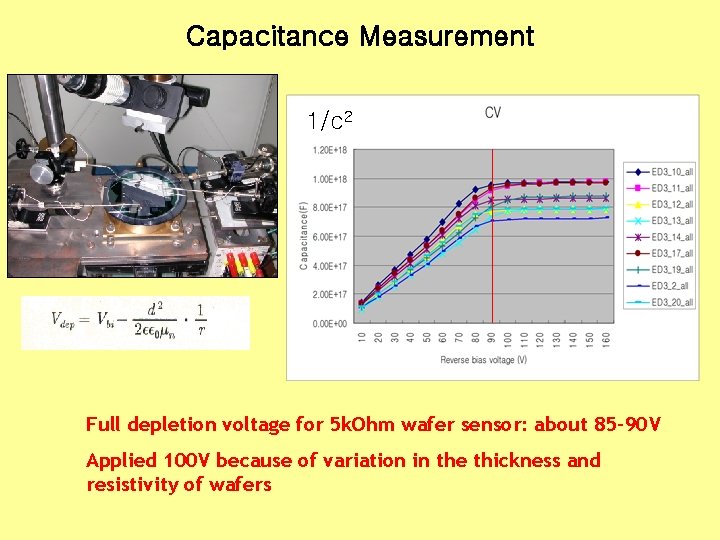
Capacitance Measurement 1/c 2 Full depletion voltage for 5 k. Ohm wafer sensor: about 85 -90 V Applied 100 V because of variation in the thickness and resistivity of wafers
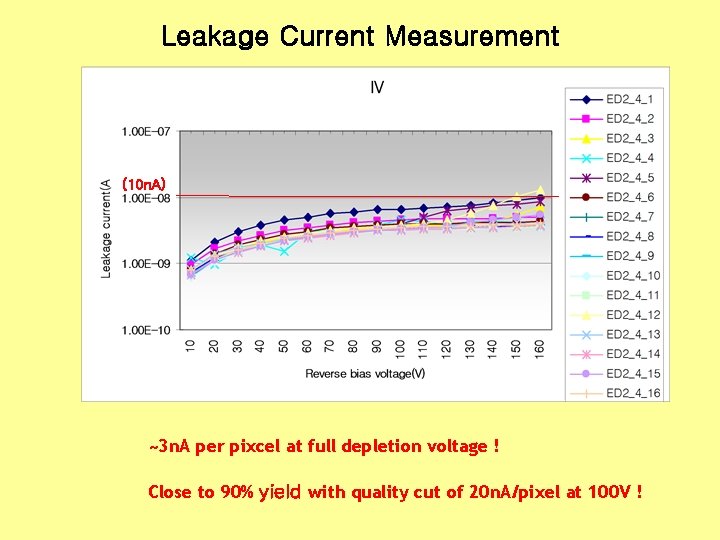
Leakage Current Measurement (10 n. A) ~3 n. A per pixcel at full depletion voltage ! Close to 90% yield with quality cut of 20 n. A/pixel at 100 V !
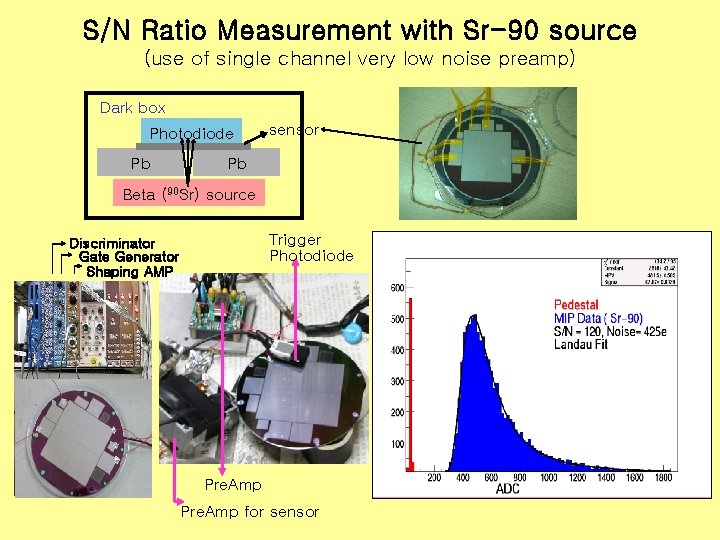
S/N Ratio Measurement with Sr-90 source (use of single channel very low noise preamp) Dark box Photodiode Pb sensor Pb Beta (90 Sr) source Trigger Photodiode Discriminator Gate Generator Shaping AMP S/N ~ 120 Pre. Amp for sensor
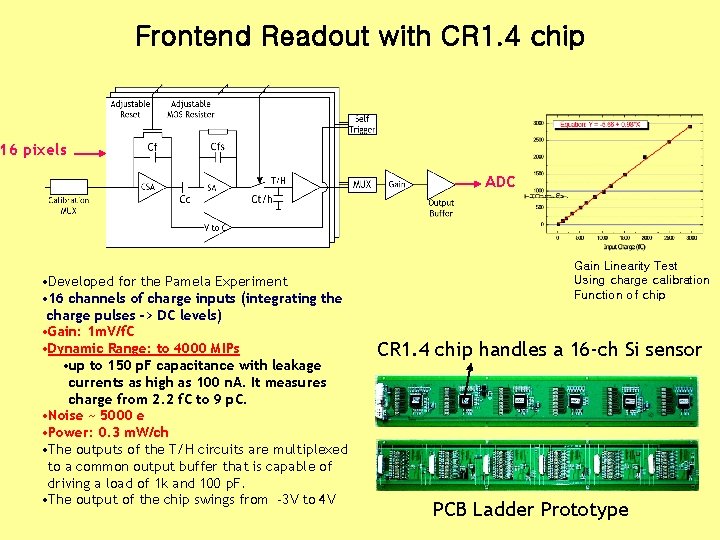
Frontend Readout with CR 1. 4 chip 16 pixels ADC • Developed for the Pamela Experiment • 16 channels of charge inputs (integrating the charge pulses -> DC levels) • Gain: 1 m. V/f. C • Dynamic Range: to 4000 MIPs • up to 150 p. F capacitance with leakage currents as high as 100 n. A. It measures charge from 2. 2 f. C to 9 p. C. • Noise ~ 5000 e • Power: 0. 3 m. W/ch • The outputs of the T/H circuits are multiplexed to a common output buffer that is capable of driving a load of 1 k and 100 p. F. • The output of the chip swings from -3 V to 4 V Gain Linearity Test Using charge calibration Function of chip CR 1. 4 chip handles a 16 -ch Si sensor PCB Ladder Prototype
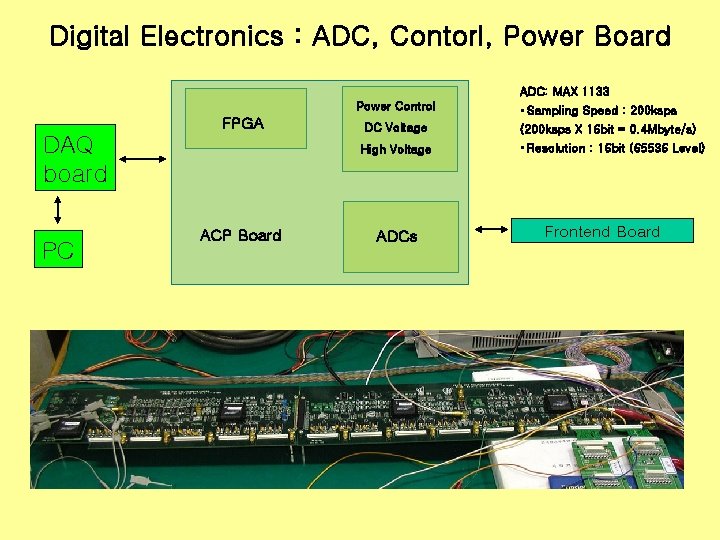
Digital Electronics : ADC, Contorl, Power Board ADC: MAX 1133 Power Control FPGA DAQ board PC DC Voltage High Voltage ACP Board ADCs • Sampling Speed : 200 ksps (200 ksps X 16 bit = 0. 4 Mbyte/s) • Resolution : 16 bit (65536 Level) Frontend Board
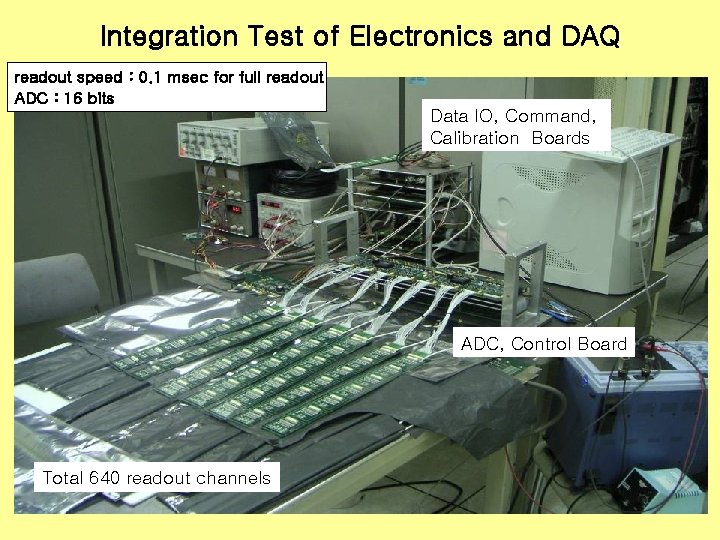
Integration Test of Electronics and DAQ readout speed : 0. 1 msec for full readout ADC : 16 bits Data IO, Command, Calibration Boards ADC, Control Board Total 640 readout channels
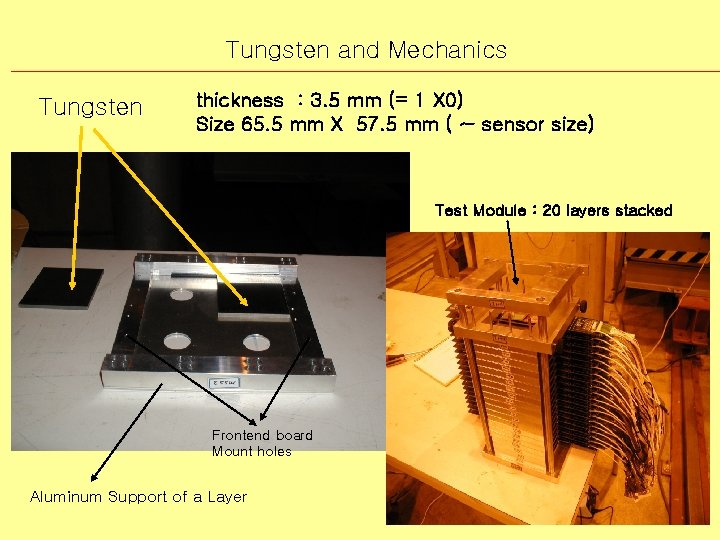
Tungsten and Mechanics Tungsten thickness : 3. 5 mm (= 1 X 0) Size 65. 5 mm X 57. 5 mm ( ~ sensor size) Test Module : 20 layers stacked Frontend board Mount holes Aluminum Support of a Layer
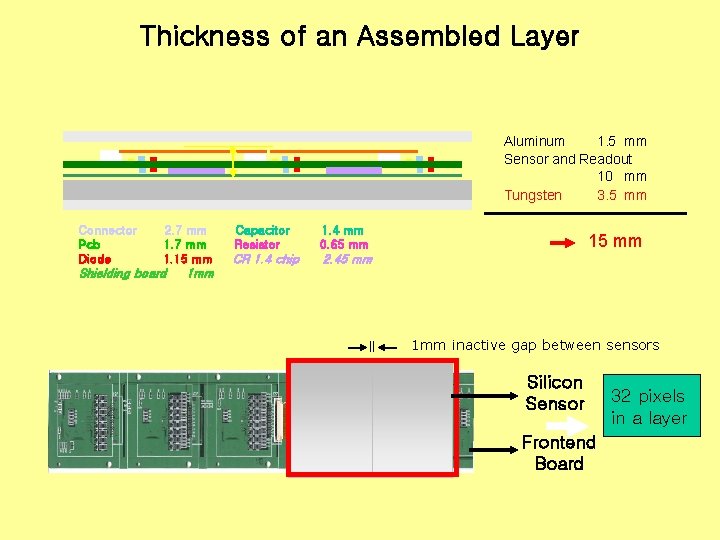
Thickness of an Assembled Layer Aluminum 1. 5 mm Sensor and Readout 10 mm Tungsten 3. 5 mm Connector Pcb Diode 2. 7 mm 1. 15 mm Shielding board Capacitor Resistor 1. 4 mm 0. 65 mm CR 1. 4 chip 2. 45 mm 1 mm 1 mm inactive gap between sensors Silicon Sensor 131 mm X 115 mm Frontend Board 32 pixels in a layer
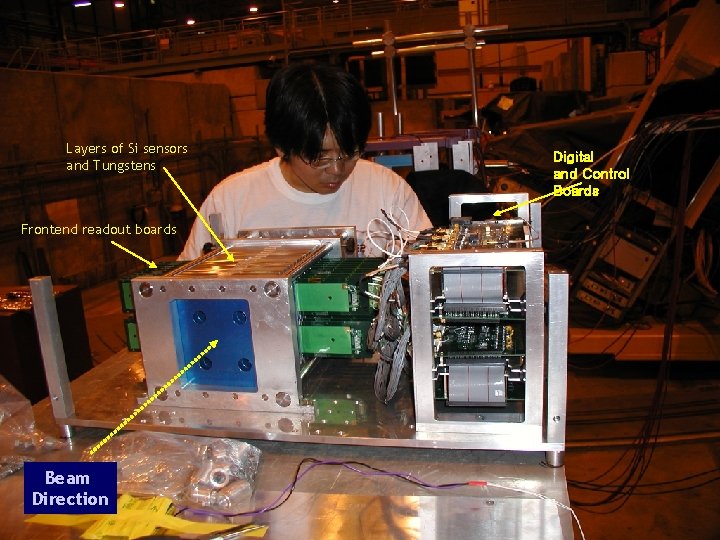
Layers of Si sensors and Tungstens Frontend readout boards Beam Direction Digital and Control Boards
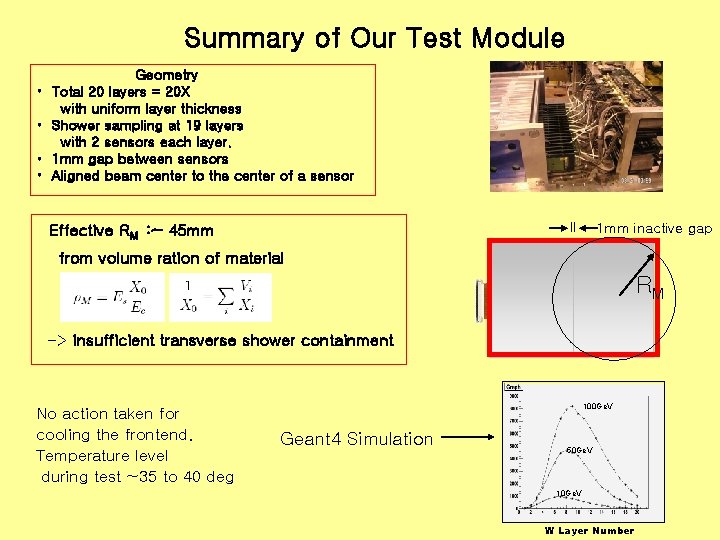
Summary of Our Test Module • • Geometry Total 20 layers = 20 X with uniform layer thickness Shower sampling at 19 layers with 2 sensors each layer. 1 mm gap between sensors Aligned beam center to the center of a sensor 1 mm inactive gap Effective RM : ~ 45 mm from volume ration of material RM 131 mm X 115 mm -> insufficient transverse shower containment No action taken for cooling the frontend. Temperature level during test ~35 to 40 deg 100 Ge. V Geant 4 Simulation 50 Ge. V 10 Ge. V W Layer Number
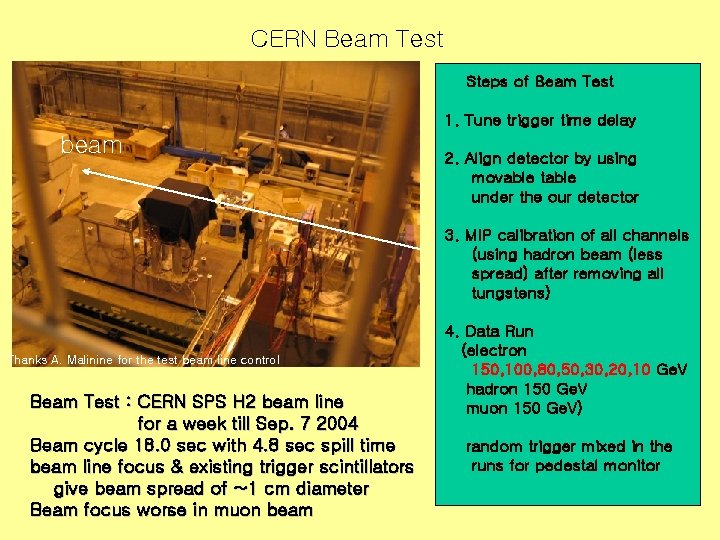
CERN Beam Test Steps of Beam Test 1. Tune trigger time delay beam 2. Align detector by using movable table under the our detector 3. MIP calibration of all channels (using hadron beam (less spread) after removing all tungstens) Thanks A. Malinine for the test beam line control Beam Test : CERN SPS H 2 beam line for a week till Sep. 7 2004 Beam cycle 18. 0 sec with 4. 8 sec spill time beam line focus & existing trigger scintillators give beam spread of ~1 cm diameter Beam focus worse in muon beam 4. Data Run (electron 150, 100, 80, 50, 30, 20, 10 Ge. V hadron 150 Ge. V muon 150 Ge. V) random trigger mixed in the runs for pedestal monitor
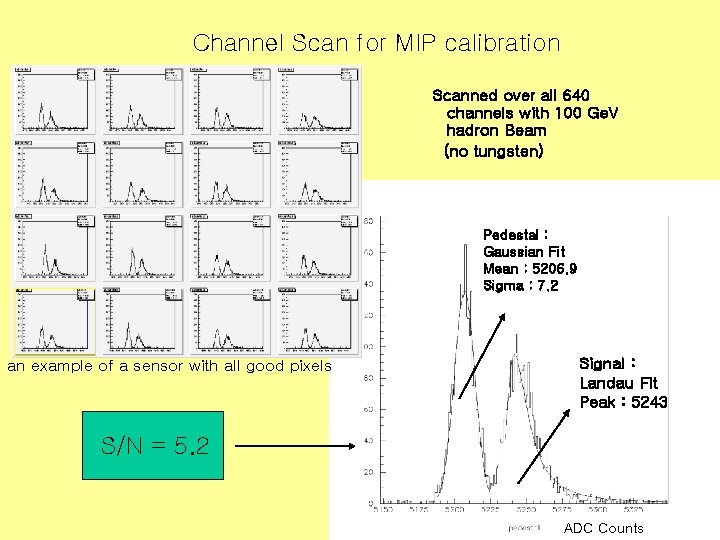
Channel Scan for MIP calibration Scanned over all 640 channels with 100 Ge. V hadron Beam (no tungsten) Pedestal : Gaussian Fit Mean : 5206. 9 Sigma : 7. 2 an example of a sensor with all good pixels Signal : Landau Fit Peak : 5243 S/N = 5. 2 ADC Counts
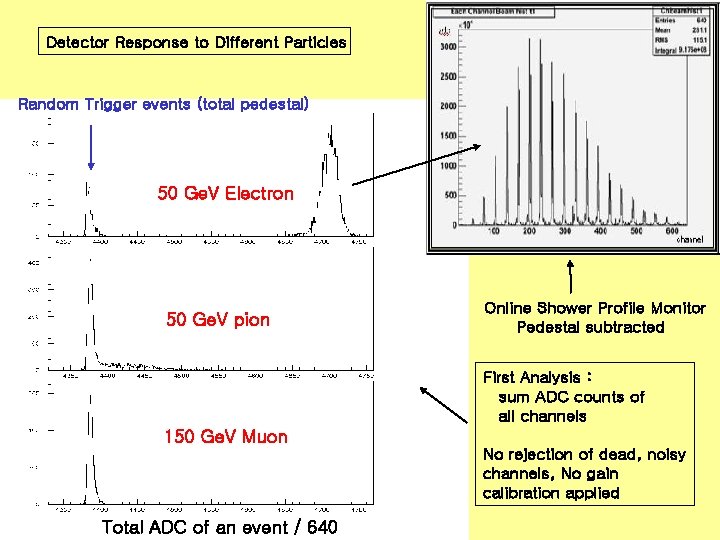
Detector Response to Different Particles Random Trigger events (total pedestal) 50 Ge. V Electron 50 Ge. V pion Online Shower Profile Monitor Pedestal subtracted First Analysis : sum ADC counts of all channels 150 Ge. V Muon No rejection of dead, noisy channels, No gain calibration applied Total ADC of an event / 640
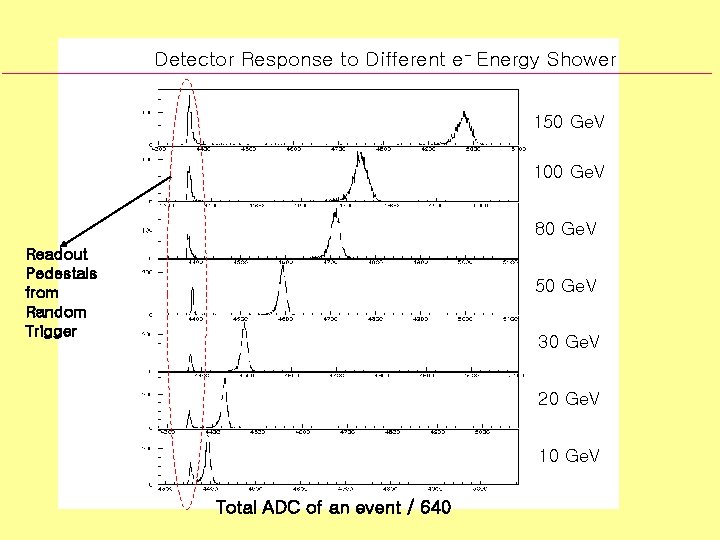
Detector Response to Different e- Energy Shower 150 Ge. V 100 Ge. V 80 Ge. V Readout Pedestals from Random Trigger 50 Ge. V 30 Ge. V 20 Ge. V 10 Ge. V Total ADC of an event / 640
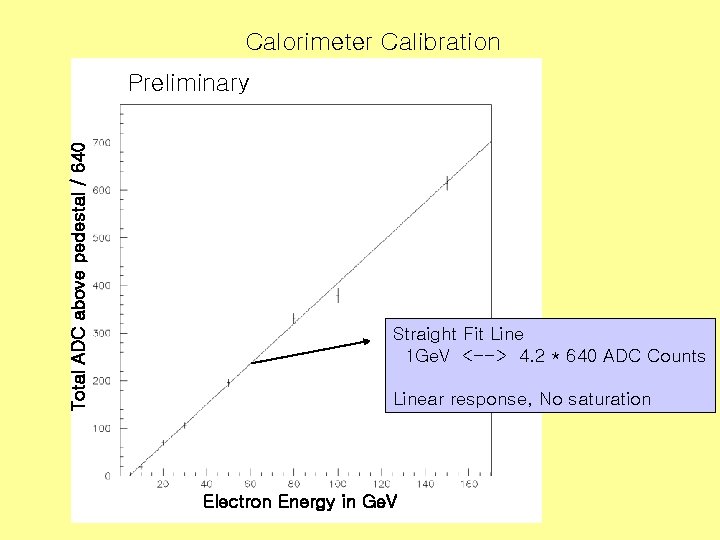
Calorimeter Calibration Total ADC above pedestal / 640 Preliminary Straight Fit Line 1 Ge. V <--> 4. 2 * 640 ADC Counts Linear response, No saturation Electron Energy in Ge. V
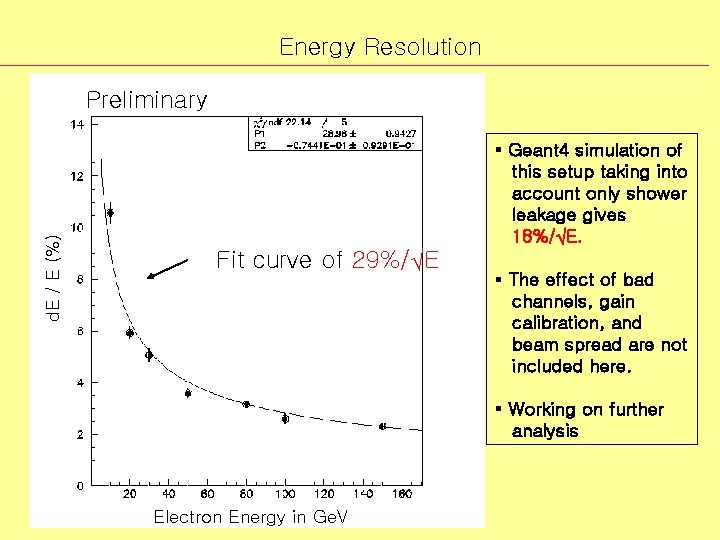
Energy Resolution d. E / E (%) Preliminary § Geant 4 simulation of this setup taking into account only shower leakage gives 18%/√E. Fit curve of 29%/√E § The effect of bad channels, gain calibration, and beam spread are not included here. § Working on further analysis Electron Energy in Ge. V
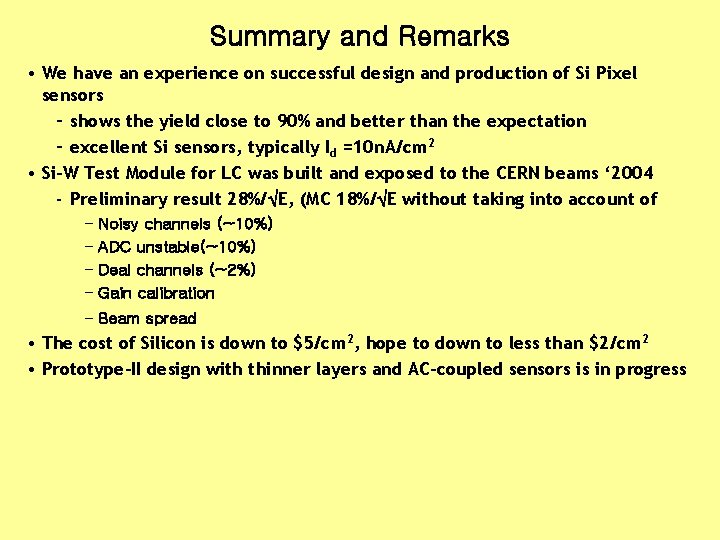
Summary and Remarks • We have an experience on successful design and production of Si Pixel sensors – shows the yield close to 90% and better than the expectation – excellent Si sensors, typically Id =10 n. A/cm 2 • Si-W Test Module for LC was built and exposed to the CERN beams ‘ 2004 - Preliminary result 28%/√E, (MC 18%/√E without taking into account of - Noisy channels (~10%) - ADC unstable(~10%) - Deal channels (~2%) - Gain calibration - Beam spread • The cost of Silicon is down to $5/cm 2, hope to down to less than $2/cm 2 • Prototype-II design with thinner layers and AC-coupled sensors is in progress
- Slides: 20