
CERN Accelerator School Budapest Hungary 7 October 2016
CERN Accelerator School Budapest, Hungary 7 October 2016 Luminosity Giulia Papotti (CERN, BE-OP-LHC) acknowledgements to: W. Herr, W. Kozanecki, J. Wenninger and with material by: X. Buffat, F. Follin, M. Hostettler
Bibliography • • • W. Herr and B. Muratori, many luminosity lectures at previous CERN Accelerator Schools. M. Ferro-Luzzi, “A novel method for measuring absolute luminosity at the LHC”, CERN-PH seminar, 29 August 2005. J. Wenninger, “Luminosity diagnostics”, CAS on Beam Diagnostics, Dourdan (France), June 2008. P. Grafstrom and W. Kozanecki, “Luminosity determination at proton colliders”, to be published in Prog. Part. Nucl. Phys. A. Chao and M. Tigner, “Handbook of accelerator physics and engineering”, World Scientific, 2002. CAS in Budapest 2016 giulia. papotti@cern. ch 2
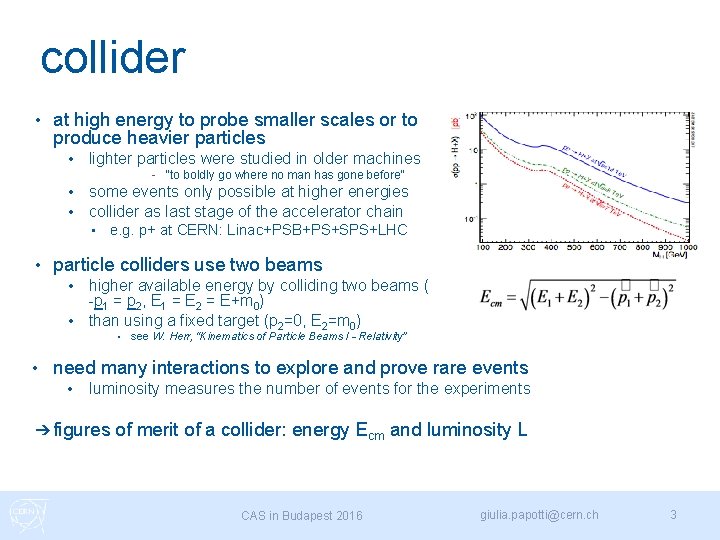
collider • at high energy to probe smaller scales or to produce heavier particles • lighter particles were studied in older machines - “to boldly go where no man has gone before” • • some events only possible at higher energies collider as last stage of the accelerator chain • • e. g. p+ at CERN: Linac+PSB+PS+SPS+LHC particle colliders use two beams higher available energy by colliding two beams ( -p 1 = p 2, E 1 = E 2 = E+m 0) • than using a fixed target (p 2=0, E 2=m 0) • • • see W. Herr, “Kinematics of Particle Beams I - Relativity” need many interactions to explore and prove rare events • luminosity measures the number of events for the experiments ➔ figures of merit of a collider: energy Ecm and luminosity L CAS in Budapest 2016 giulia. papotti@cern. ch 3
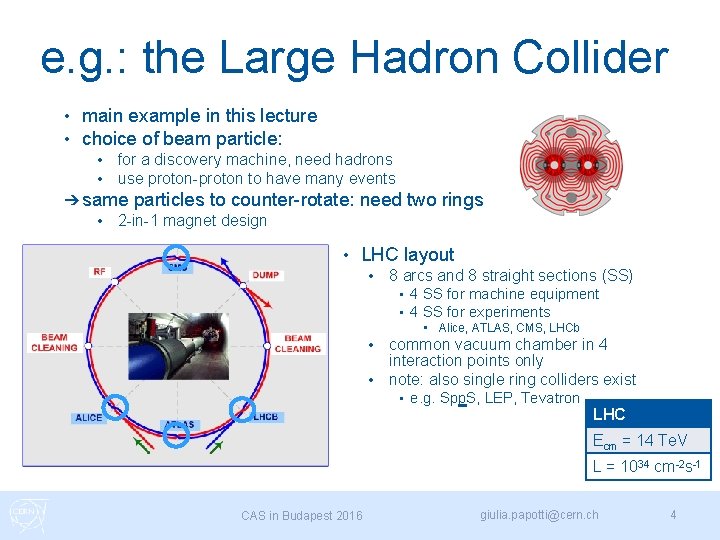
e. g. : the Large Hadron Collider • • main example in this lecture choice of beam particle: • • for a discovery machine, need hadrons use proton-proton to have many events ➔ same particles to counter-rotate: • 2 -in-1 magnet design • need two rings LHC layout • 8 arcs and 8 straight sections (SS) • 4 SS for machine equipment • 4 SS for experiments • Alice, ATLAS, CMS, LHCb common vacuum chamber in 4 interaction points only • note: also single ring colliders exist • • e. g. Spp. S, LEP, Tevatron LHC Ecm = 14 Te. V L = 1034 cm-2 s-1 CAS in Budapest 2016 giulia. papotti@cern. ch 4
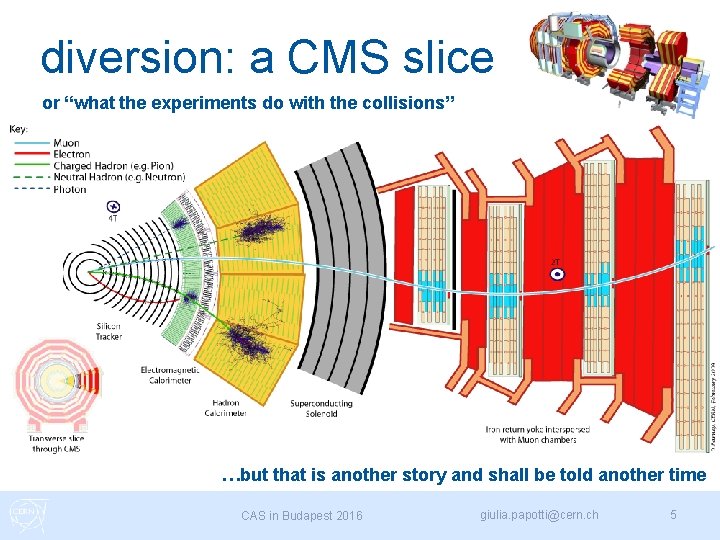
diversion: a CMS slice or “what the experiments do with the collisions” …but that is another story and shall be told another time CAS in Budapest 2016 giulia. papotti@cern. ch 5
outline • • (motivation) luminosity • definition and derivation from machine parameters • head-on and offset collisions • reduction factors • crossing angles and crab cavities, hourglass • lifetime, contributions • luminosity scans and luminosity levelling • • integrated luminosity and ideal run time measurements and optimizations • vd. M scans, high beta runs • linear colliders • • CAS in Budapest 2016 no fixed target no coasting beams giulia. papotti@cern. ch 6
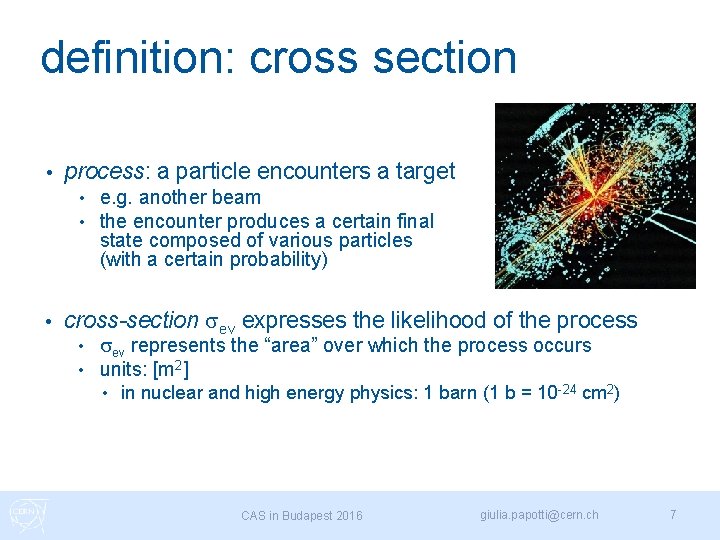
definition: cross section • process: a particle encounters a target • e. g. another beam • the encounter produces a certain final state composed of various particles (with a certain probability) • cross-section sev expresses the likelihood of the process • sev represents the “area” over which the process occurs • units: [m 2] • in nuclear and high energy physics: 1 barn (1 b = 10 -24 cm 2) CAS in Budapest 2016 giulia. papotti@cern. ch 7
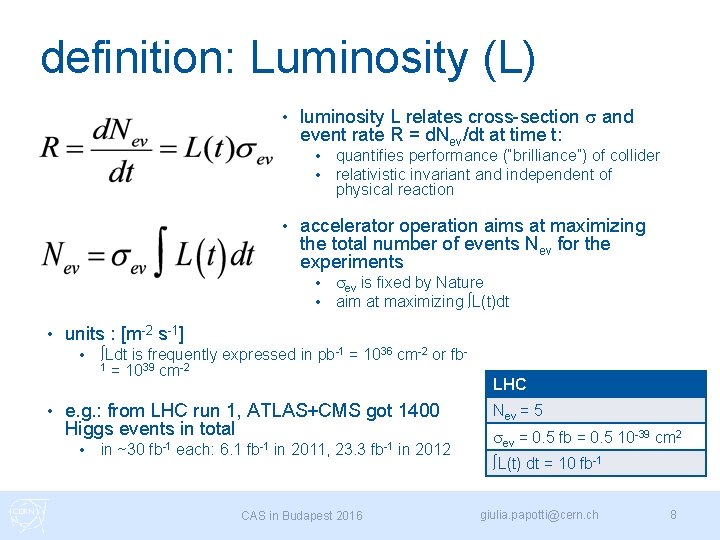
definition: Luminosity (L) • luminosity L relates cross-section s and event rate R = d. Nev/dt at time t: • • • accelerator operation aims at maximizing the total number of events Nev for the experiments • • • sev is fixed by Nature aim at maximizing ∫L(t)dt units : [m-2 s-1] • • quantifies performance (“brilliance”) of collider relativistic invariant and independent of physical reaction ∫Ldt is frequently expressed in pb-1 = 1036 cm-2 or fb 1 = 1039 cm-2 e. g. : from LHC run 1, ATLAS+CMS got 1400 Higgs events in total • in ~30 fb-1 each: 6. 1 fb-1 in 2011, 23. 3 CAS in Budapest 2016 fb-1 in 2012 LHC Nev = 5 sev = 0. 5 fb = 0. 5 10 -39 cm 2 ∫L(t) dt = 10 fb-1 giulia. papotti@cern. ch 8
![circular colliders Machine Years in operation Beam type Beam energy [Ge. V] ISR 1971](http://slidetodoc.com/presentation_image/2da7446dc16144d5ae48d830cc41dc50/image-9.jpg "circular colliders Machine Years in operation Beam type Beam energy [Ge. V] ISR 1971")
circular colliders Machine Years in operation Beam type Beam energy [Ge. V] ISR 1971 -’ 84 pp 31 >2 x 1031 LEP I 1989 -’ 95 e+ e- 45 3 x 1030 LEP II 1995 -2000 e+ e- 90 -104 1032 KEKB 1999 -2010 e+ e- 8 x 3. 5 2 x 1034 Spp. S 1981 -’ 84 p anti-p 315 (400) 6 x 1030 TEVATRON 1983 -2011 p anti-p 980 2 x 1032 LHC 2008 -? p p (Pb) 7000 1034 HL-LHC ~2026 -2037 p p (Pb) 7000 5 x 1034 FCC-hh 2040+ p p (Pb) 50000 2 -3 x 1035 FCC-ee 2040+ e+ e- 45 -175 ~1036 CAS in Budapest 2016 Luminosity [cm-2 s-1] giulia. papotti@cern. ch 9
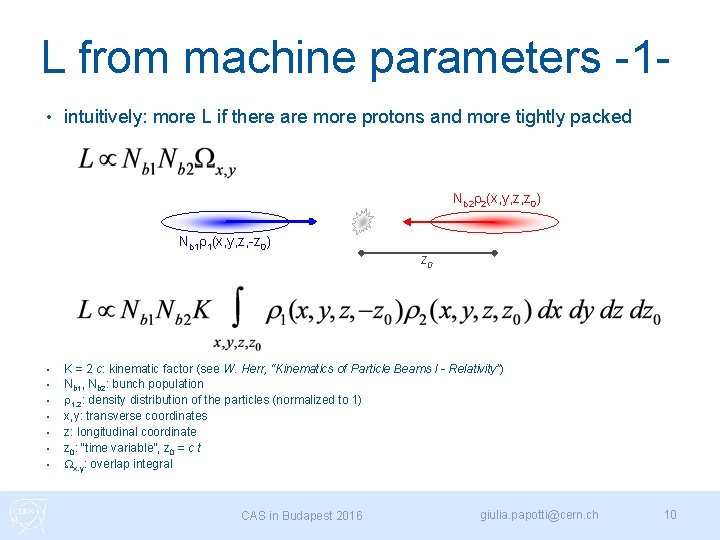
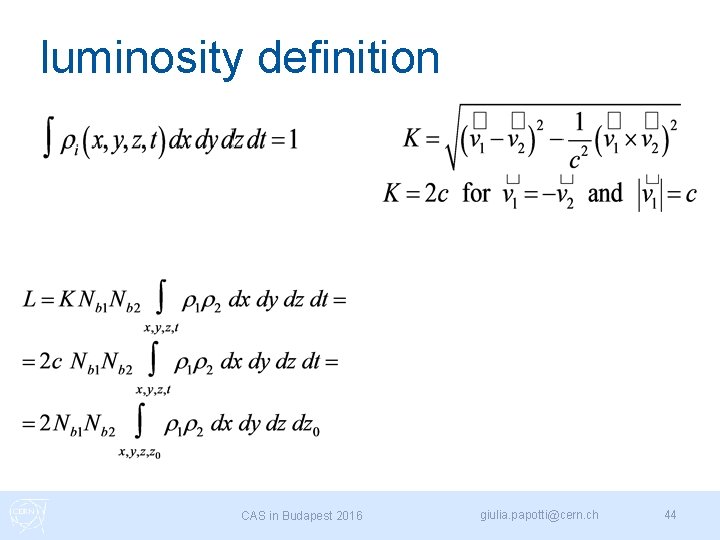
L from machine parameters -1 • intuitively: more L if there are more protons and more tightly packed Nb 2 r 2(x, y, z, z 0) Nb 1 r 1(x, y, z, -z 0) • • z 0 K = 2 c: kinematic factor (see W. Herr, “Kinematics of Particle Beams I - Relativity”) Nb 1, Nb 2: bunch population r 1, 2: density distribution of the particles (normalized to 1) x, y: transverse coordinates z: longitudinal coordinate z 0: “time variable”, z 0 = c t Wx, y: overlap integral CAS in Budapest 2016 giulia. papotti@cern. ch 10
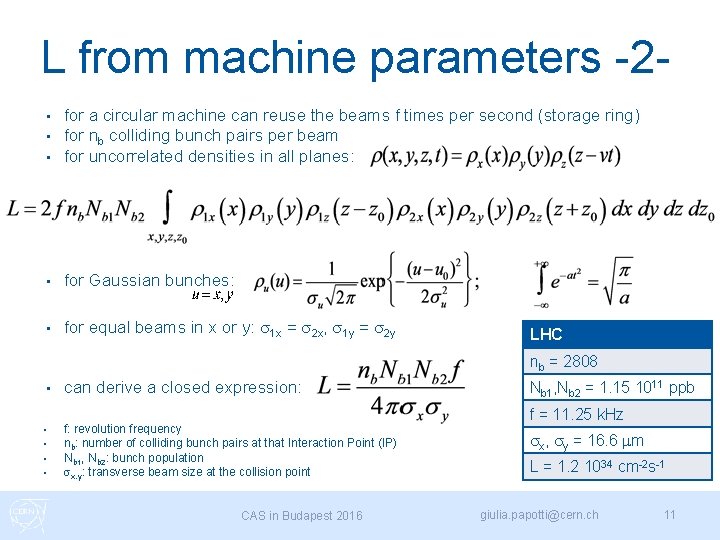
L from machine parameters -2 • • • for a circular machine can reuse the beams f times per second (storage ring) for nb colliding bunch pairs per beam for uncorrelated densities in all planes: • for Gaussian bunches: • for equal beams in x or y: s 1 x = s 2 x, s 1 y = s 2 y LHC nb = 2808 • • • can derive a closed expression: f: revolution frequency nb: number of colliding bunch pairs at that Interaction Point (IP) Nb 1, Nb 2: bunch population sx, y: transverse beam size at the collision point CAS in Budapest 2016 Nb 1, Nb 2 = 1. 15 1011 ppb f = 11. 25 k. Hz sx, sy = 16. 6 mm L = 1. 2 1034 cm-2 s-1 giulia. papotti@cern. ch 11
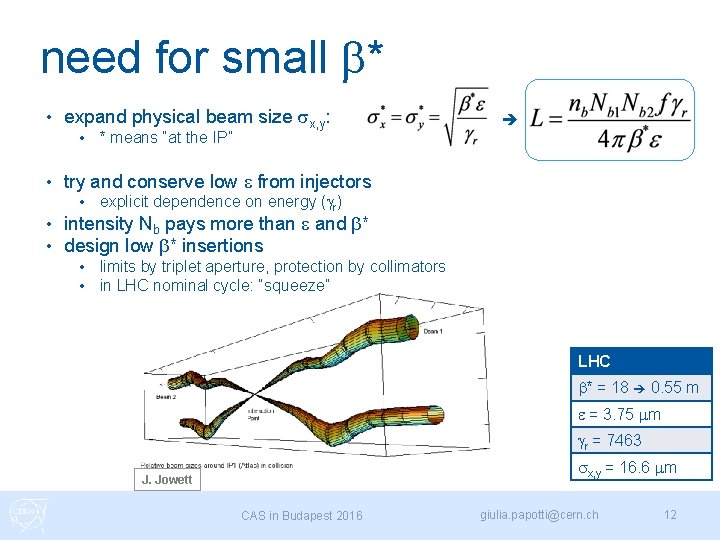
need for small b* • expand physical beam size sx, y: • • * means “at the IP” try and conserve low e from injectors • • • explicit dependence on energy (gr) intensity Nb pays more than e and b* design low b* insertions • • limits by triplet aperture, protection by collimators in LHC nominal cycle: “squeeze” LHC b* = 18 0. 55 m e = 3. 75 mm gr = 7463 sx, y = 16. 6 mm J. Jowett CAS in Budapest 2016 giulia. papotti@cern. ch 12

reduction factors (F) transverse offsets crossing angles and crab cavities hourglass effect CAS in Budapest 2016 giulia. papotti@cern. ch 13
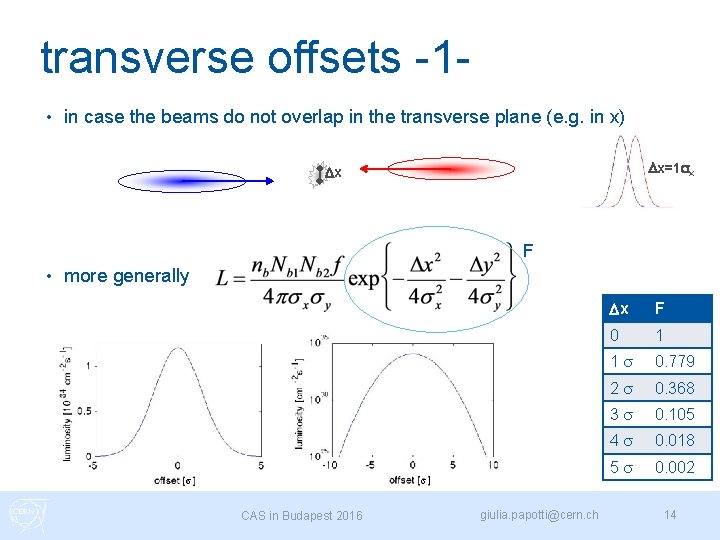
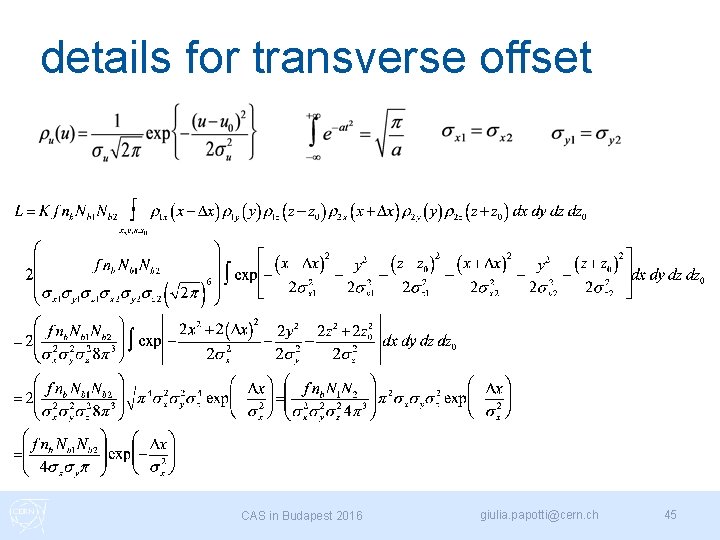
transverse offsets -1 • in case the beams do not overlap in the transverse plane (e. g. in x) Dx=1 sx Dx F • more generally s s CAS in Budapest 2016 giulia. papotti@cern. ch Dx F 0 1 1 s 0. 779 2 s 0. 368 3 s 0. 105 4 s 0. 018 5 s 0. 002 14
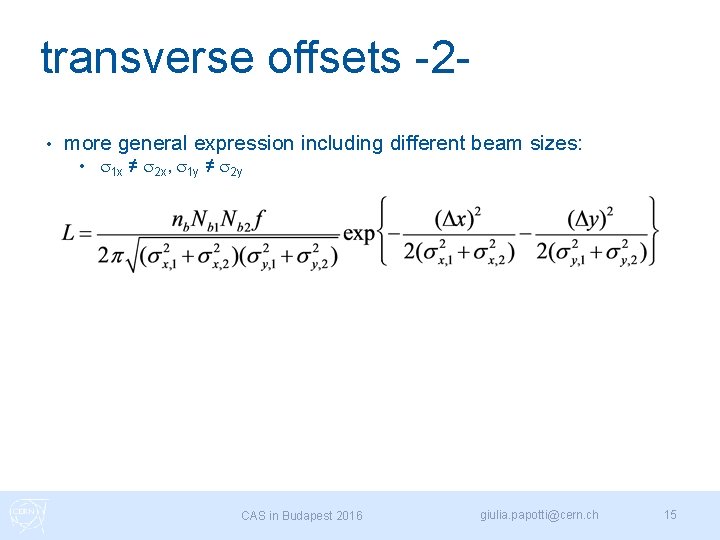
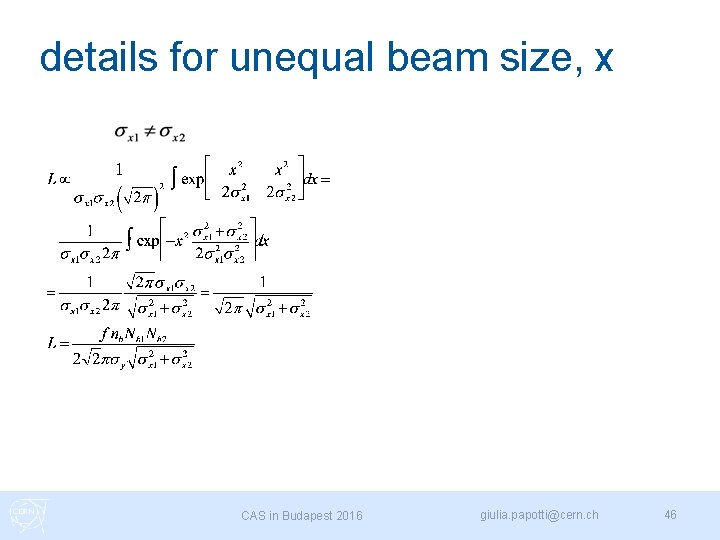
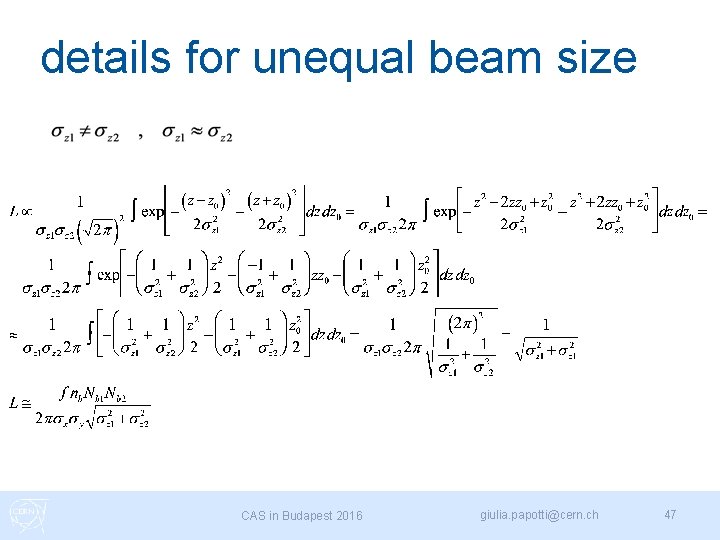
transverse offsets -2 • more general expression including different beam sizes: • s 1 x ≠ s 2 x, s 1 y ≠ s 2 y CAS in Budapest 2016 giulia. papotti@cern. ch 15
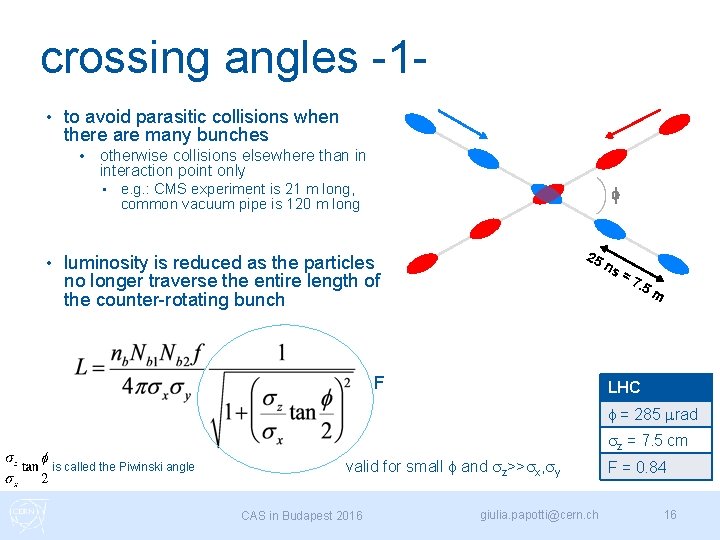
crossing angles -1 • to avoid parasitic collisions when there are many bunches • otherwise collisions elsewhere than in interaction point only • • e. g. : CMS experiment is 21 m long, common vacuum pipe is 120 m long f 25 luminosity is reduced as the particles no longer traverse the entire length of the counter-rotating bunch F ns = 7. 5 m LHC f = 285 mrad sz = 7. 5 cm is called the Piwinski angle valid for small f and sz>>sx, sy CAS in Budapest 2016 giulia. papotti@cern. ch F = 0. 84 16
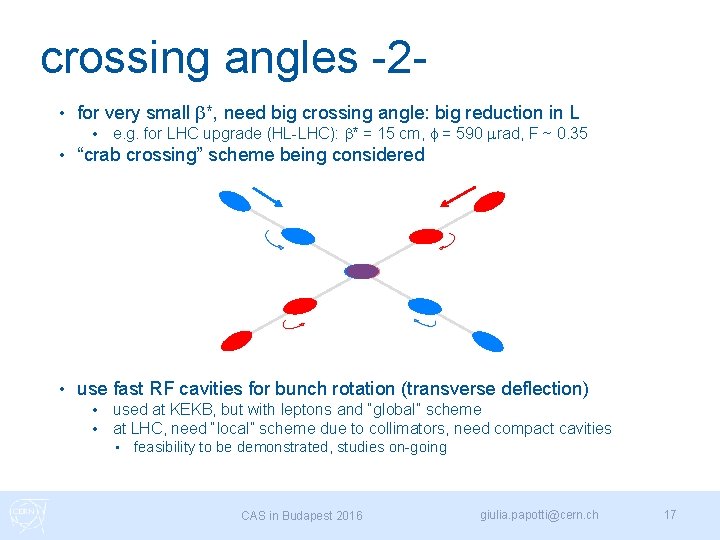
crossing angles -2 • for very small b*, need big crossing angle: big reduction in L • e. g. for LHC upgrade (HL-LHC): b* = 15 cm, f = 590 mrad, F ~ 0. 35 • “crab crossing” scheme being considered • use fast RF cavities for bunch rotation (transverse deflection) • • used at KEKB, but with leptons and “global” scheme at LHC, need “local” scheme due to collimators, need compact cavities • feasibility to be demonstrated, studies on-going CAS in Budapest 2016 giulia. papotti@cern. ch 17
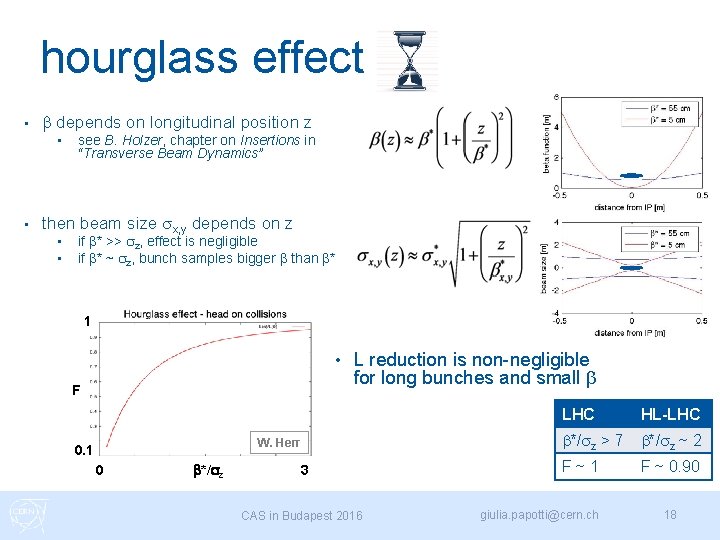
hourglass effect • b depends on longitudinal position z • • see B. Holzer, chapter on Insertions in “Transverse Beam Dynamics” then beam size sx, y depends on z • • if b* >> sz, effect is negligible if b* ~ sz, bunch samples bigger b than b* 1 • F L reduction is non-negligible for long bunches and small b W. Herr 0. 1 0 b*/sz 3 CAS in Budapest 2016 LHC HL-LHC b*/sz > 7 b*/sz ~ 2 F~1 F ~ 0. 90 giulia. papotti@cern. ch 18
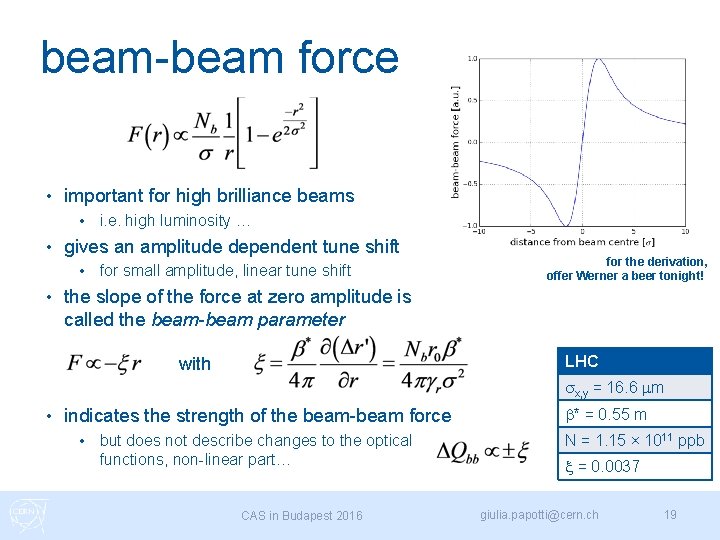
beam-beam force • important for high brilliance beams • • gives an amplitude dependent tune shift • • i. e. high luminosity … for small amplitude, linear tune shift for the derivation, offer Werner a beer tonight! the slope of the force at zero amplitude is called the beam-beam parameter LHC with sx, y = 16. 6 mm • indicates the strength of the beam-beam force • but does not describe changes to the optical functions, non-linear part… CAS in Budapest 2016 b* = 0. 55 m N = 1. 15 × 1011 ppb x = 0. 0037 giulia. papotti@cern. ch 19
![LHC parameters Parameter Nominal 2010 2011 2012 2015 2016 beam energy [Te. V] 7.](http://slidetodoc.com/presentation_image/2da7446dc16144d5ae48d830cc41dc50/image-20.jpg "LHC parameters Parameter Nominal 2010 2011 2012 2015 2016 beam energy [Te. V] 7.")
LHC parameters Parameter Nominal 2010 2011 2012 2015 2016 beam energy [Te. V] 7. 0 3. 5 4. 0 6. 5 bunch spacing [ns] 25 150 75 / 50 50 25 25 nb [no. bunches] 2808 348 1331 1368 2232 2208 Nb [1011 p/bunch] 1. 15 1. 2 1. 45 1. 65 1. 12 e [mm mrad] 3. 75 2. 4 2. 5 3. 5 2. 0 b* [m] 0. 55 3. 5 1. 5 1 0. 60 0. 80 0. 40 half crossing angle [mrad] 142. 5 100 120 145 185 140 L reduction factor 0. 84 0. 98 0. 95/0. 92 0. 80 0. 83 0. 59 L [cm-2 s-1] 1034 2 1032 3. 6 1033 7. 6 1033 5. 4 1033 1. 3/1. 5 1034 0. 0037 0. 0060 0. 0072 0. 0079 0. 0039 0. 0067 bb parameter CAS in Budapest 2016 giulia. papotti@cern. ch 20
L evolution during a fill natural decay, components luminosity levelling CAS in Budapest 2016 giulia. papotti@cern. ch 21
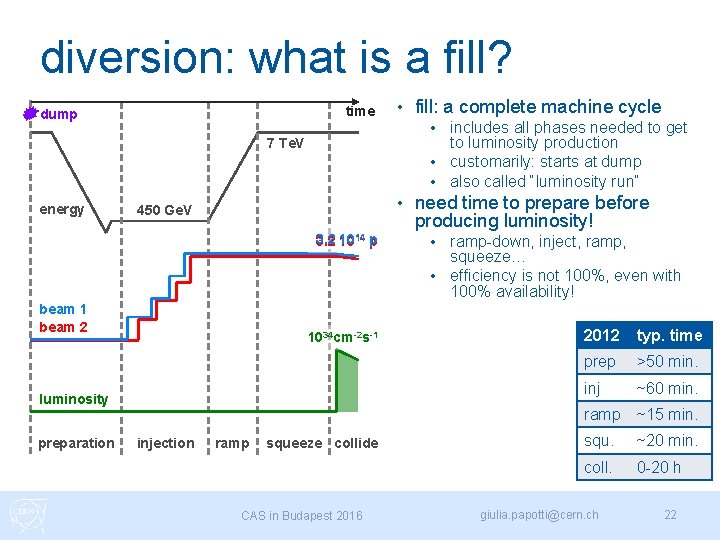
diversion: what is a fill? time dump • includes all phases needed to get to luminosity production • customarily: starts at dump • also called “luminosity run” • 7 Te. V energy • 450 Ge. V 3. 2 1014 p beam 1 beam 2 1034 cm-2 s-1 luminosity preparation injection ramp squeeze collide CAS in Budapest 2016 fill: a complete machine cycle need time to prepare before producing luminosity! ramp-down, inject, ramp, squeeze… • efficiency is not 100%, even with 100% availability! • 2012 typ. time prep >50 min. inj ~60 min. ramp ~15 min. squ. ~20 min. coll. 0 -20 h giulia. papotti@cern. ch 22
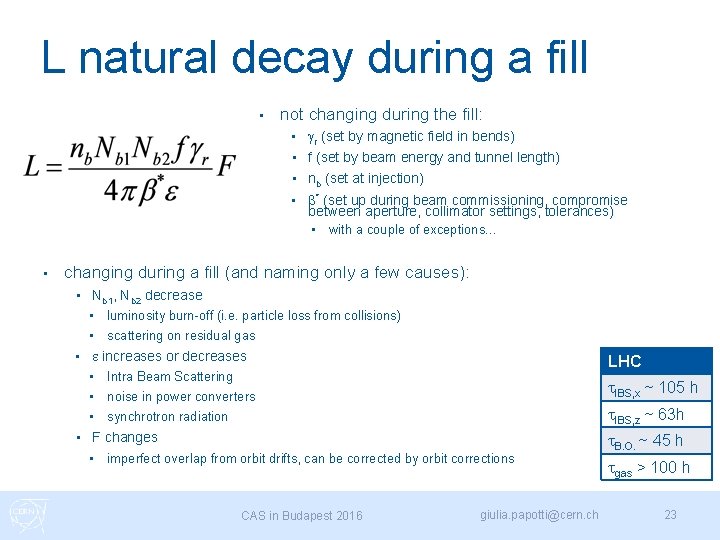
L natural decay during a fill • not changing during the fill: • gr (set by magnetic field in bends) • f (set by beam energy and tunnel length) • nb (set at injection) • b* (set up during beam commissioning, compromise between aperture, collimator settings, tolerances) • • with a couple of exceptions… changing during a fill (and naming only a few causes): • Nb 1, Nb 2 decrease • luminosity burn-off (i. e. particle loss from collisions) • scattering on residual gas • e increases or decreases • Intra Beam Scattering • noise in power converters • synchrotron radiation LHC t. IBS, x ~ 105 h t. IBS, z ~ 63 h • F changes • imperfect overlap from orbit drifts, can be corrected by orbit corrections CAS in Budapest 2016 giulia. papotti@cern. ch t. B. O. ~ 45 h tgas > 100 h 23
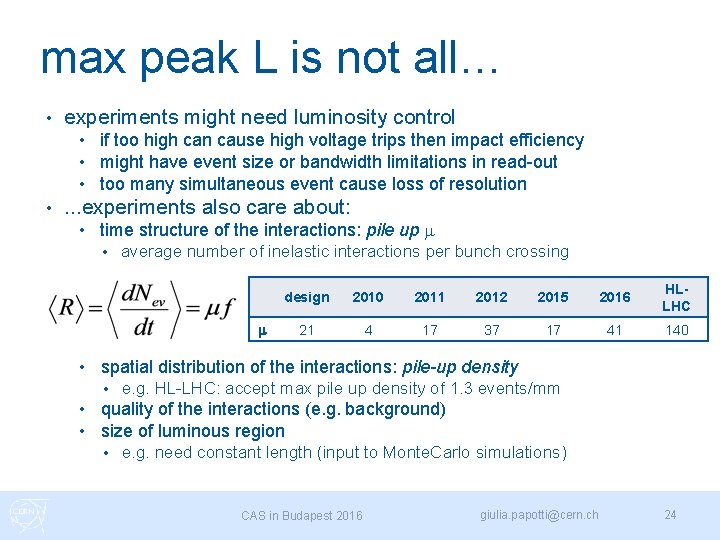
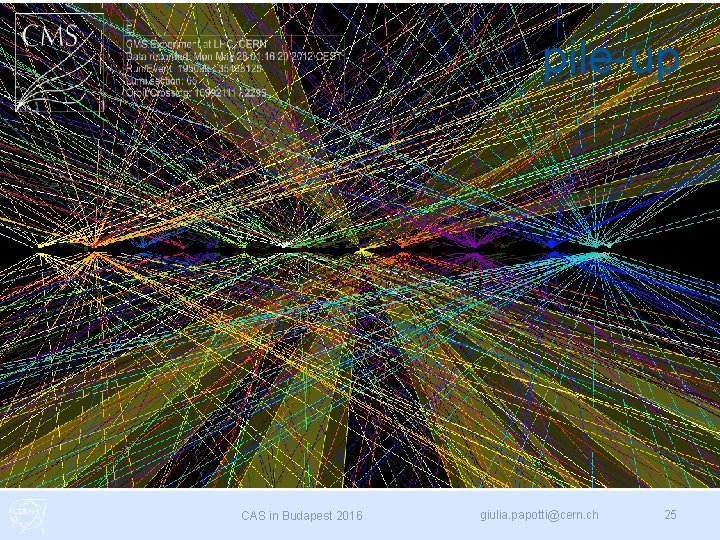
max peak L is not all… • experiments might need luminosity control • if too high can cause high voltage trips then impact efficiency • might have event size or bandwidth limitations in read-out • too many simultaneous event cause loss of resolution • . . . experiments also care about: • time structure of the interactions: pile up m • average number of inelastic interactions per bunch crossing m design 2010 2011 2012 2015 2016 HLLHC 21 4 17 37 17 41 140 • spatial distribution of the interactions: pile-up density • e. g. HL-LHC: accept max pile up density of 1. 3 events/mm • quality of the interactions (e. g. background) • size of luminous region • e. g. need constant length (input to Monte. Carlo simulations) CAS in Budapest 2016 giulia. papotti@cern. ch 24
pile-up CAS in Budapest 2016 giulia. papotti@cern. ch 25
L levelling • some experiments need to limit the pile-up • thus luminosity per bunch pair • • e. g. m < 2. 1 at LHCb in 2012 stay as long as possible at the maximum value that experiment can manage • which is lower than what the machine could provide • maintain the luminosity constant over a period of time (i. e. the fill) • possible techniques: • • • by transversely offsetting the beams at the IP by changing b* by decreasing the crossing angle by bunch length variations by partial crabbing CAS in Budapest 2016 giulia. papotti@cern. ch 26
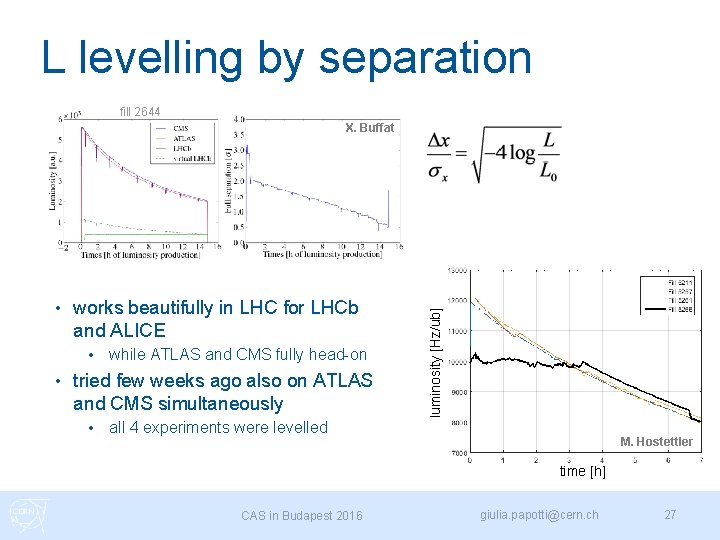
L levelling by separation fill 2644 • works beautifully in LHC for LHCb and ALICE • • while ATLAS and CMS fully head-on tried few weeks ago also on ATLAS and CMS simultaneously • luminosity [Hz/ub] X. Buffat all 4 experiments were levelled M. Hostettler time [h] CAS in Budapest 2016 giulia. papotti@cern. ch 27
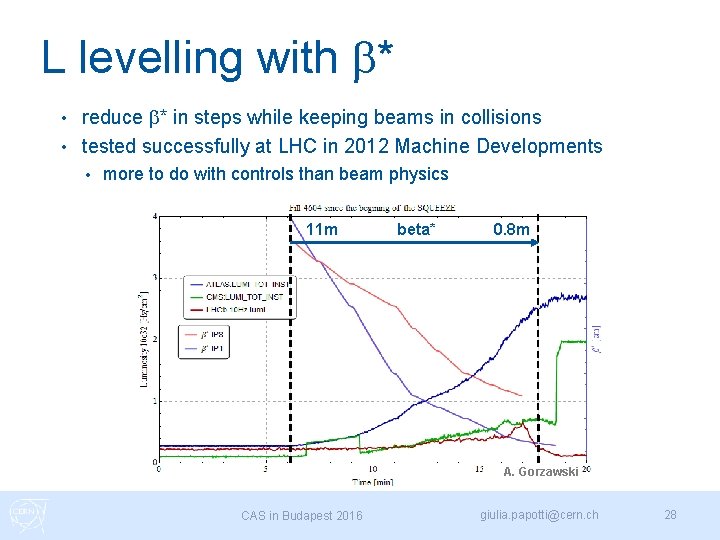
L levelling with b* reduce b* in steps while keeping beams in collisions • tested successfully at LHC in 2012 Machine Developments • • more to do with controls than beam physics 11 m beta* 0. 8 m A. Gorzawski CAS in Budapest 2016 giulia. papotti@cern. ch 28
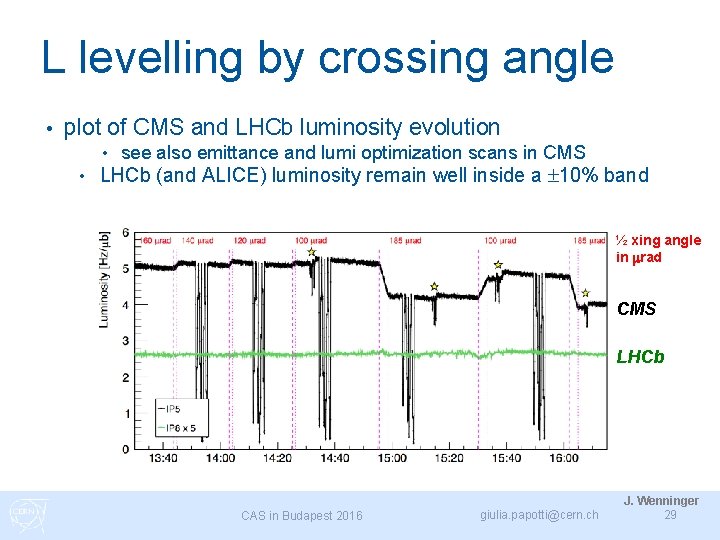
L levelling by crossing angle • plot of CMS and LHCb luminosity evolution • see also emittance and lumi optimization scans in CMS • LHCb (and ALICE) luminosity remain well inside a 10% band ½ xing angle in mrad CMS LHCb CAS in Budapest 2016 giulia. papotti@cern. ch J. Wenninger 29
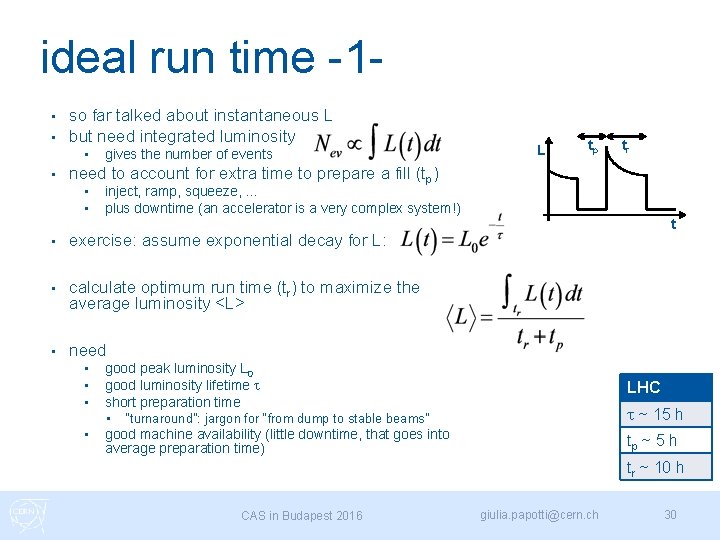
ideal run time -1 • • so far talked about instantaneous L but need integrated luminosity • • gives the number of events L tp tr need to account for extra time to prepare a fill (tp) • • inject, ramp, squeeze, . . . plus downtime (an accelerator is a very complex system!) • exercise: assume exponential decay for L: • calculate optimum run time (tr) to maximize the average luminosity <L> • need • • • good peak luminosity L 0 good luminosity lifetime t short preparation time LHC “turnaround”: jargon for “from dump to stable beams” t ~ 15 h good machine availability (little downtime, that goes into average preparation time) tp ~ 5 h • • t tr ~ 10 h CAS in Budapest 2016 giulia. papotti@cern. ch 30
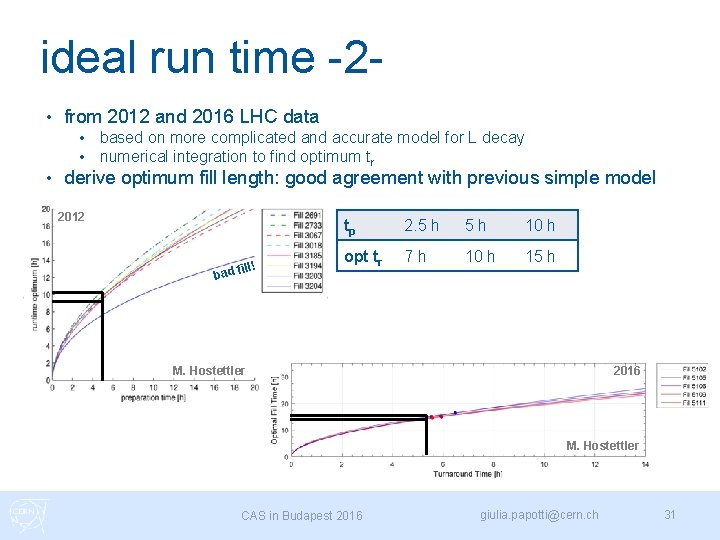
ideal run time -2 • from 2012 and 2016 LHC data • • • based on more complicated and accurate model for L decay numerical integration to find optimum tr derive optimum fill length: good agreement with previous simple model 2012 ll! ad fi tp 2. 5 h 5 h 10 h opt tr 7 h 10 h 15 h b M. Hostettler 2016 M. Hostettler CAS in Budapest 2016 giulia. papotti@cern. ch 31
L calibration van der Meer scans high beta runs Bha scattering CAS in Budapest 2016 giulia. papotti@cern. ch 32
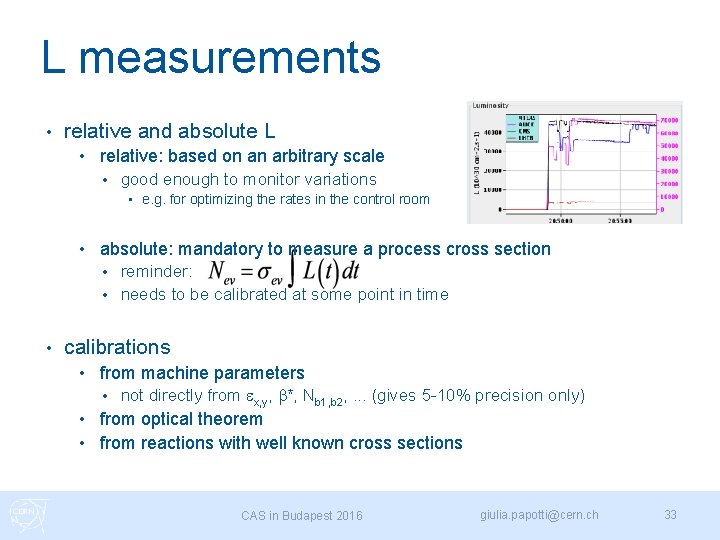
L measurements • relative and absolute L • relative: based on an arbitrary scale • good enough to monitor variations • e. g. for optimizing the rates in the control room • absolute: mandatory to measure a process cross section • reminder: • needs to be calibrated at some point in time • calibrations • from machine parameters • not directly from ex, y, b*, Nb 1, b 2, . . . (gives 5 -10% precision only) • from optical theorem • from reactions with well known cross sections CAS in Budapest 2016 giulia. papotti@cern. ch 33
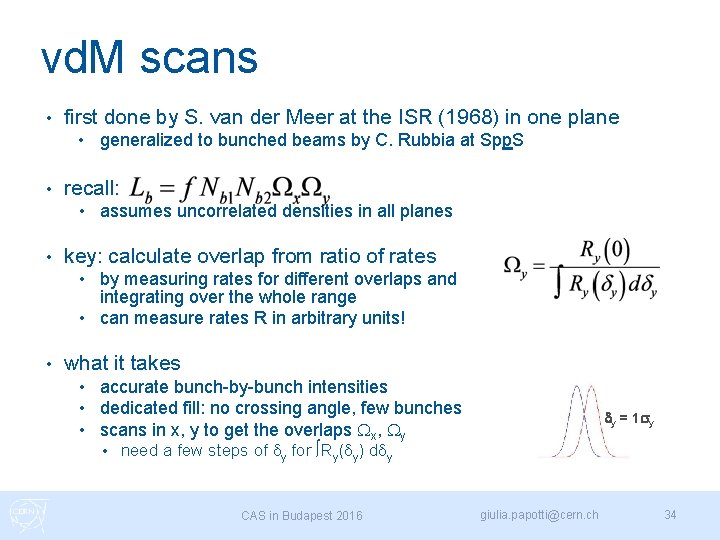
vd. M scans • first done by S. van der Meer at the ISR (1968) in one plane • generalized to bunched beams by C. Rubbia at Spp. S • recall: • assumes uncorrelated densities in all planes • key: calculate overlap from ratio of rates • by measuring rates for different overlaps and integrating over the whole range • can measure rates R in arbitrary units! • what it takes • accurate bunch-by-bunch intensities • dedicated fill: no crossing angle, few bunches • scans in x, y to get the overlaps Wx, Wy • need a few steps of dy for ∫Ry(dy) ddy CAS in Budapest 2016 dy = 1 sy giulia. papotti@cern. ch 34
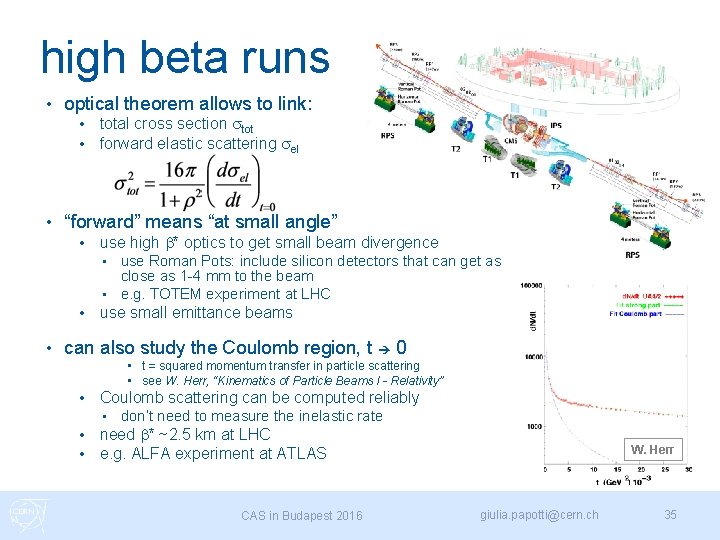
high beta runs • optical theorem allows to link: • • • total cross section stot forward elastic scattering sel “forward” means “at small angle” • use high b* optics to get small beam divergence use Roman Pots: include silicon detectors that can get as close as 1 -4 mm to the beam • e. g. TOTEM experiment at LHC • • • use small emittance beams can also study the Coulomb region, t 0 • t = squared momentum transfer in particle scattering • see W. Herr, “Kinematics of Particle Beams I - Relativity” • Coulomb scattering can be computed reliably • • • don’t need to measure the inelastic rate need b* ~2. 5 km at LHC e. g. ALFA experiment at ATLAS CAS in Budapest 2016 W. Herr giulia. papotti@cern. ch 35
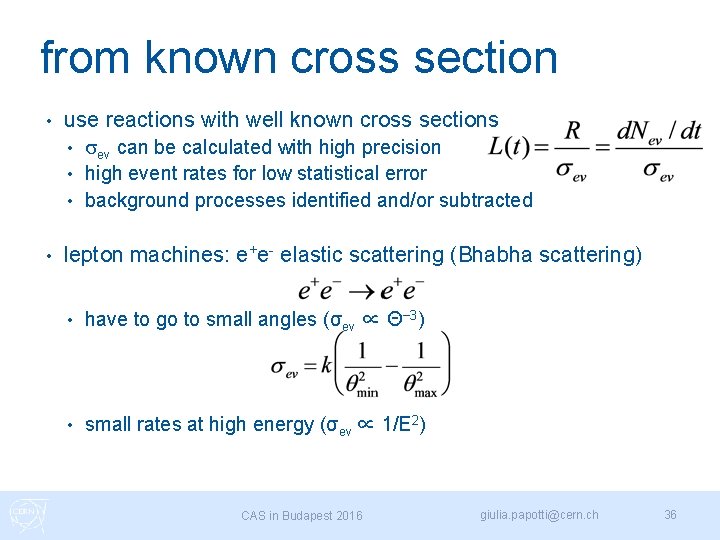
from known cross section • use reactions with well known cross sections sev can be calculated with high precision • high event rates for low statistical error • background processes identified and/or subtracted • • lepton machines: e+e- elastic scattering (Bhabha scattering) • have to go to small angles (σev ∝ Θ− 3) • small rates at high energy (σev ∝ 1/E 2) CAS in Budapest 2016 giulia. papotti@cern. ch 36
linear colliders disruption, pinch effect enhancement factor beamstrahlung CAS in Budapest 2016 giulia. papotti@cern. ch 37
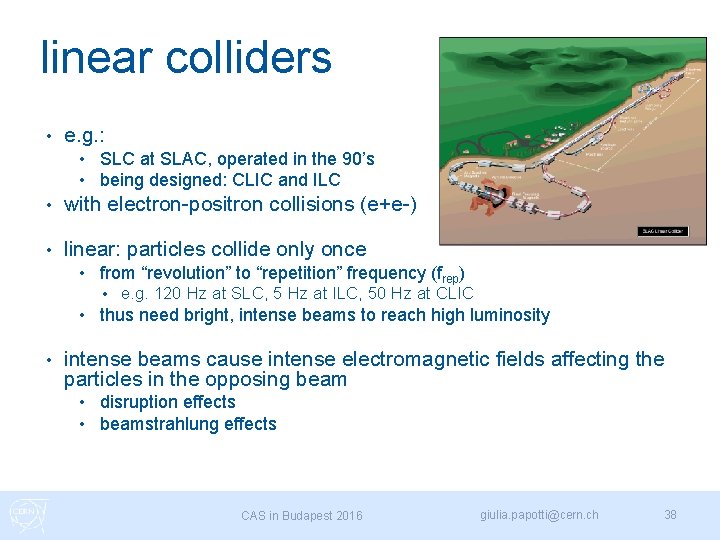
linear colliders • e. g. : • SLC at SLAC, operated in the 90’s • being designed: CLIC and ILC • with electron-positron collisions (e+e-) • linear: particles collide only once • from “revolution” to “repetition” frequency (frep) • e. g. 120 Hz at SLC, 5 Hz at ILC, 50 Hz at CLIC • thus need bright, intense beams to reach high luminosity • intense beams cause intense electromagnetic fields affecting the particles in the opposing beam • disruption effects • beamstrahlung effects CAS in Budapest 2016 giulia. papotti@cern. ch 38
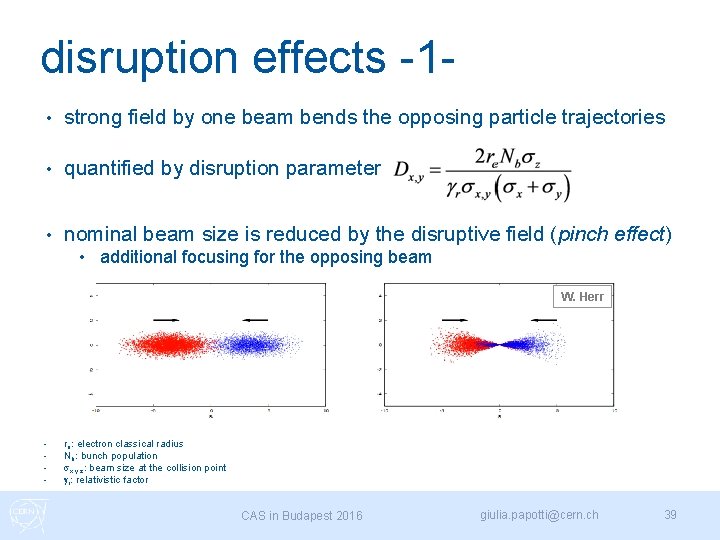
disruption effects -1 • strong field by one beam bends the opposing particle trajectories • quantified by disruption parameter • nominal beam size is reduced by the disruptive field (pinch effect) • additional focusing for the opposing beam W. Herr • • re: electron classical radius Nb: bunch population sx, y, z: beam size at the collision point gr: relativistic factor CAS in Budapest 2016 giulia. papotti@cern. ch 39
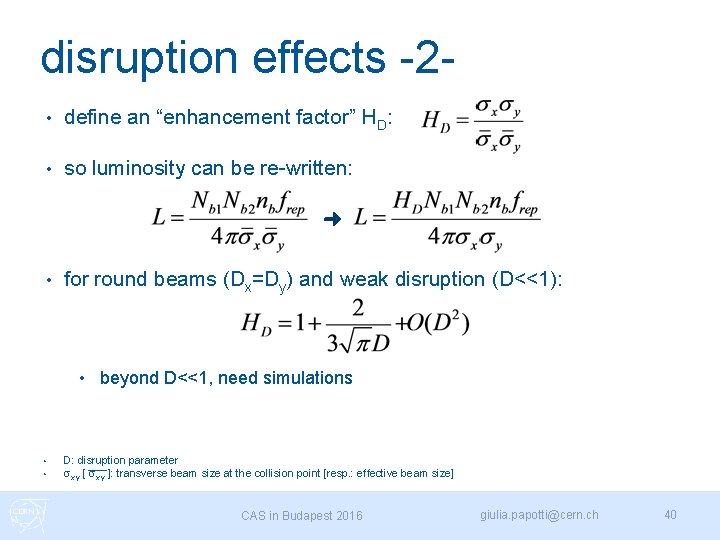
disruption effects -2 • define an “enhancement factor” HD: • so luminosity can be re-written: • for round beams (Dx=Dy) and weak disruption (D<<1): • beyond D<<1, need simulations • • D: disruption parameter sx, y [ sx, y ]: transverse beam size at the collision point [resp. : effective beam size] CAS in Budapest 2016 giulia. papotti@cern. ch 40
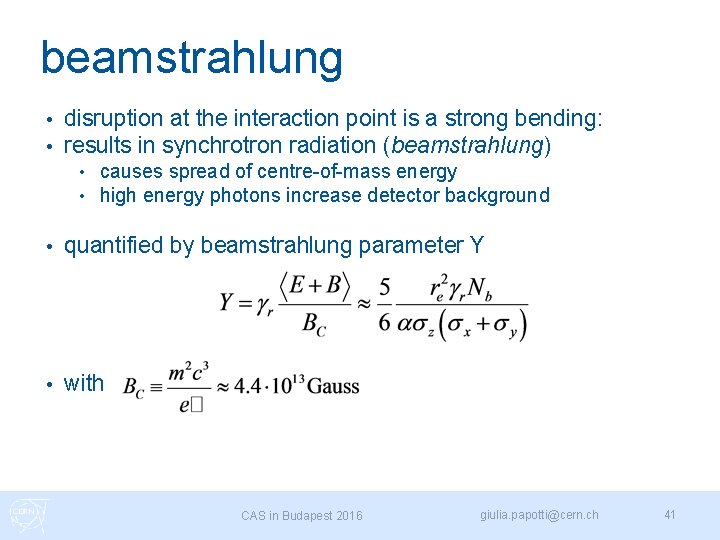
beamstrahlung • • disruption at the interaction point is a strong bending: results in synchrotron radiation (beamstrahlung) • causes spread of centre-of-mass energy • high energy photons increase detector background • quantified by beamstrahlung parameter Y • with CAS in Budapest 2016 giulia. papotti@cern. ch 41
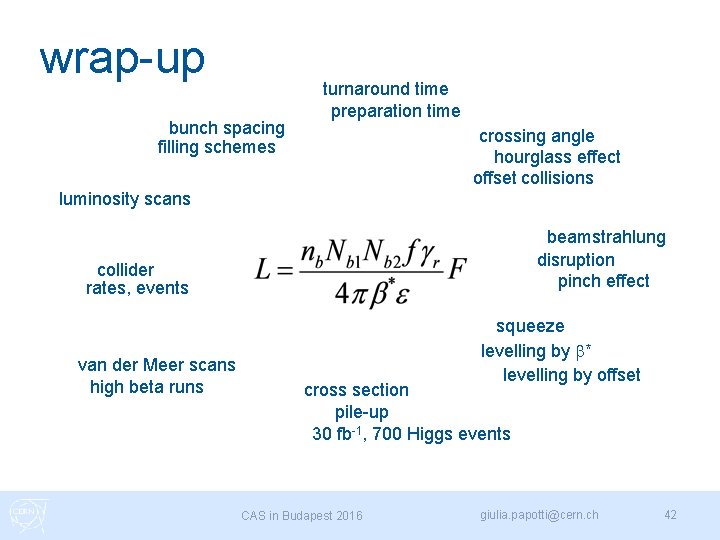
wrap-up bunch spacing filling schemes turnaround time preparation time crossing angle hourglass effect offset collisions luminosity scans beamstrahlung disruption pinch effect collider rates, events van der Meer scans high beta runs squeeze levelling by b* levelling by offset cross section pile-up 30 fb-1, 700 Higgs events CAS in Budapest 2016 giulia. papotti@cern. ch 42
spare slides derivation for luminosity with offset, unequal beam sizes, crossing angle filling schemes control room application for lumi scans parameters for LHC after LS 1 CAS in Budapest 2016 giulia. papotti@cern. ch 43
luminosity definition CAS in Budapest 2016 giulia. papotti@cern. ch 44
details for transverse offset CAS in Budapest 2016 giulia. papotti@cern. ch 45
details for unequal beam size, x CAS in Budapest 2016 giulia. papotti@cern. ch 46
details for unequal beam size CAS in Budapest 2016 giulia. papotti@cern. ch 47
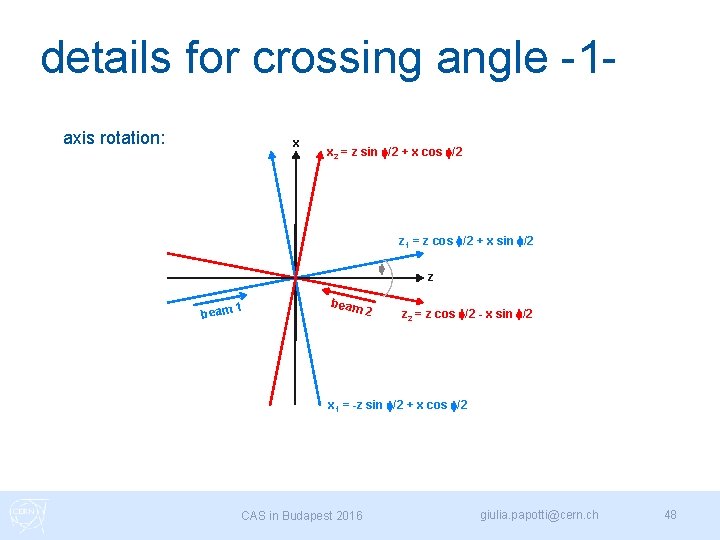
details for crossing angle -1 axis rotation: x x 2 = z sin f/2 + x cos f/2 z 1 = z cos f/2 + x sin f/2 f beam 1 beam 2 z z 2 = z cos f/2 - x sin f/2 x 1 = -z sin f/2 + x cos f/2 CAS in Budapest 2016 giulia. papotti@cern. ch 48
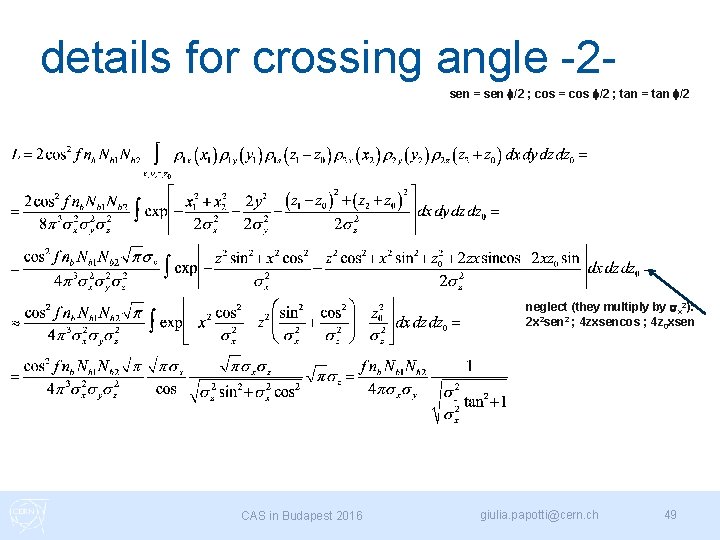
details for crossing angle -2 sen = sen f/2 ; cos = cos f/2 ; tan = tan f/2 neglect (they multiply by sx 2): 2 x 2 sen 2 ; 4 zxsencos ; 4 z 0 xsen CAS in Budapest 2016 giulia. papotti@cern. ch 49
details for vd. M scans CAS in Budapest 2016 giulia. papotti@cern. ch 50
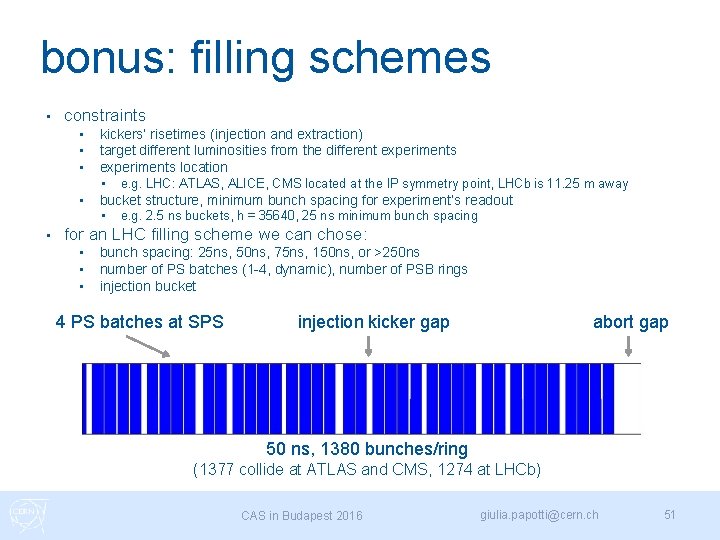
bonus: filling schemes • constraints • • • kickers’ risetimes (injection and extraction) target different luminosities from the different experiments location • • bucket structure, minimum bunch spacing for experiment’s readout • • e. g. LHC: ATLAS, ALICE, CMS located at the IP symmetry point, LHCb is 11. 25 m away e. g. 2. 5 ns buckets, h = 35640, 25 ns minimum bunch spacing for an LHC filling scheme we can chose: • • • bunch spacing: 25 ns, 50 ns, 75 ns, 150 ns, or >250 ns number of PS batches (1 -4, dynamic), number of PSB rings injection bucket 4 PS batches at SPS injection kicker gap abort gap 50 ns, 1380 bunches/ring (1377 collide at ATLAS and CMS, 1274 at LHCb) CAS in Budapest 2016 giulia. papotti@cern. ch 51
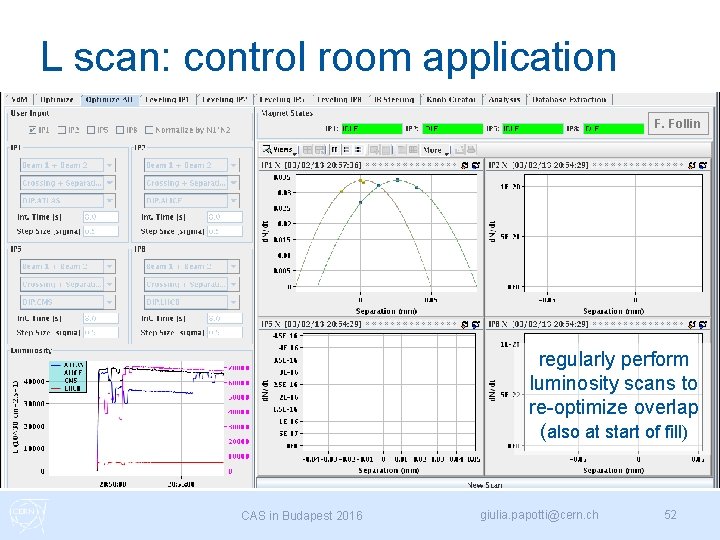
L scan: control room application F. Follin regularly perform luminosity scans to re-optimize overlap (also at start of fill) CAS in Budapest 2016 giulia. papotti@cern. ch 52
- Slides: 52