
CERN Accelerator Complex in the LHC Area GSI

- Slides: 52
CERN Accelerator Complex in the LHC Area GSI seminar 14 February 2019 Jörg Wenninger CERN Beams Department Operation Group / LHC 1
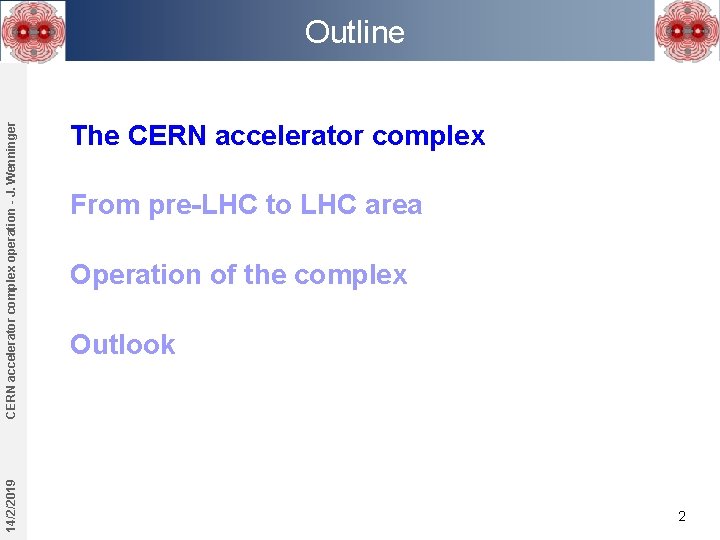
14/2/2019 CERN accelerator complex operation - J. Wenninger Outline The CERN accelerator complex From pre-LHC to LHC area Operation of the complex Outlook 2
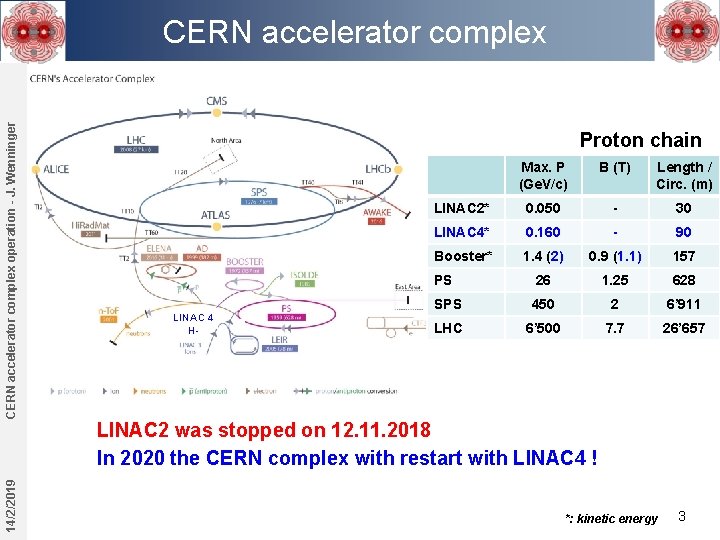
CERN accelerator complex operation - J. Wenninger CERN accelerator complex Proton chain LINAC 4 H- Max. P (Ge. V/c) B (T) Length / Circ. (m) LINAC 2* 0. 050 - 30 LINAC 4* 0. 160 - 90 Booster* 1. 4 (2) 0. 9 (1. 1) 157 PS 26 1. 25 628 SPS 450 2 6’ 911 LHC 6’ 500 7. 7 26’ 657 14/2/2019 LINAC 2 was stopped on 12. 11. 2018 In 2020 the CERN complex with restart with LINAC 4 ! *: kinetic energy 3
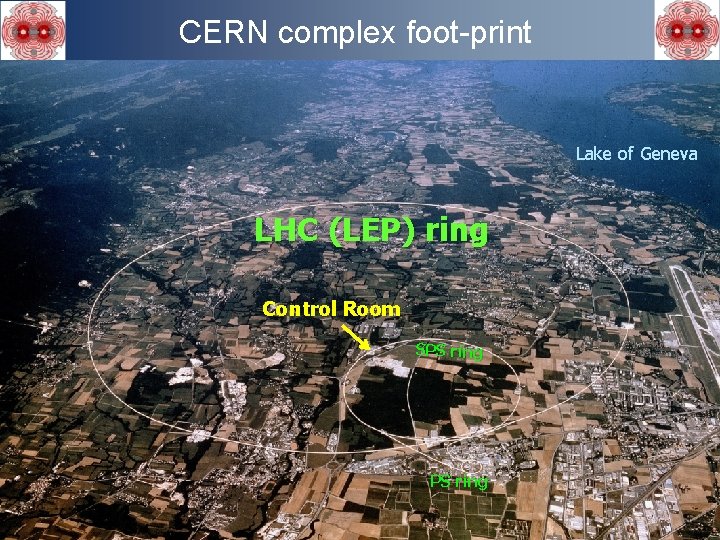
14/2/2019 CERN accelerator complex operation - J. Wenninger CERN complex foot-print Lake of Geneva LHC (LEP) ring Control Room SPS ring 4
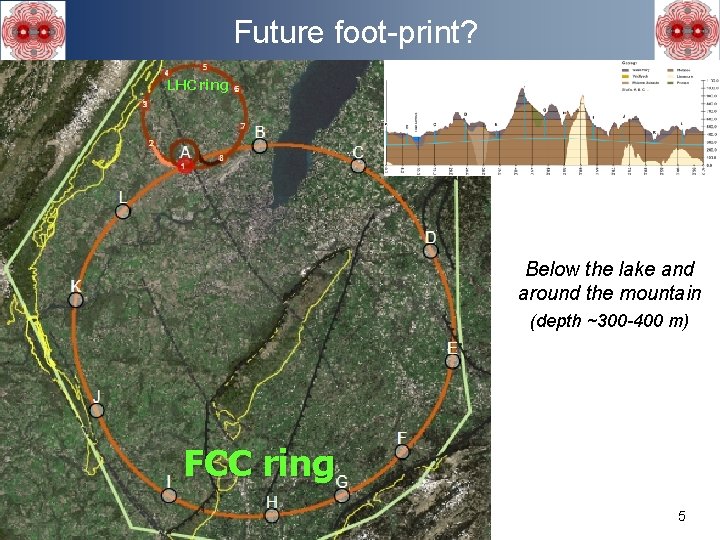
Future foot-print? 14/2/2019 CERN accelerator complex operation - J. Wenninger LHC ring Below the lake and around the mountain (depth ~300 -400 m) FCC ring 5
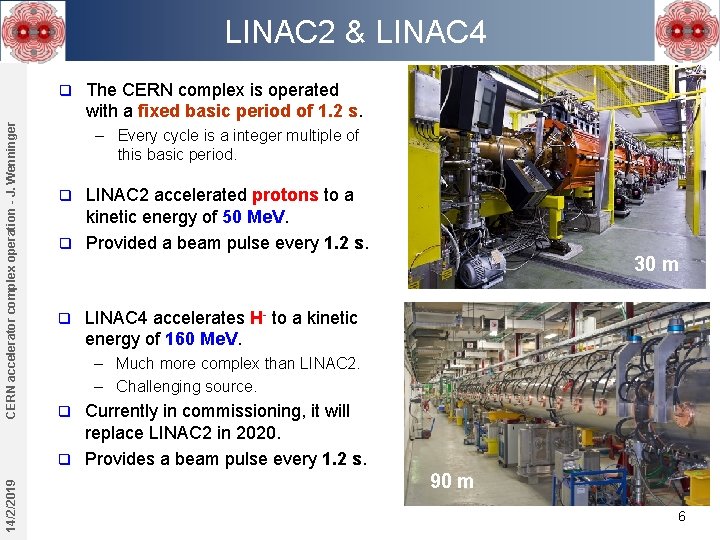
LINAC 2 & LINAC 4 14/2/2019 CERN accelerator complex operation - J. Wenninger q The CERN complex is operated with a fixed basic period of 1. 2 s. – Every cycle is a integer multiple of this basic period. LINAC 2 accelerated protons to a kinetic energy of 50 Me. V. q Provided a beam pulse every 1. 2 s. q 30 m q LINAC 4 accelerates H- to a kinetic energy of 160 Me. V. – Much more complex than LINAC 2. – Challenging source. Currently in commissioning, it will replace LINAC 2 in 2020. q Provides a beam pulse every 1. 2 s. q 90 m 6
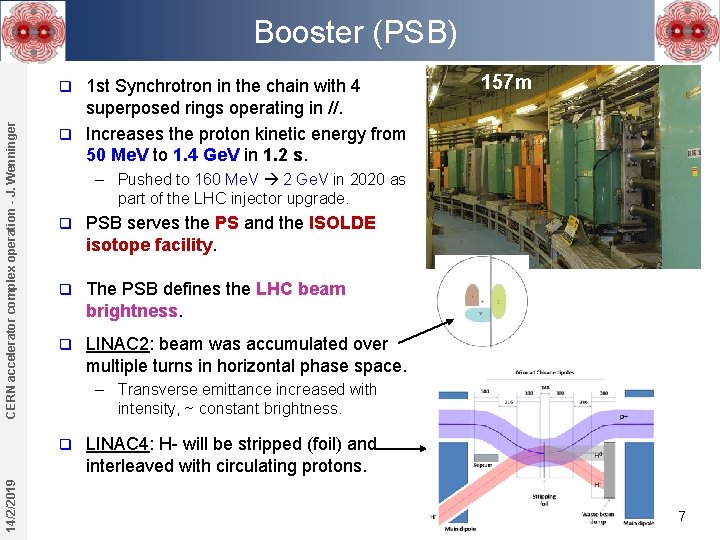
Booster (PSB) 1 st Synchrotron in the chain with 4 superposed rings operating in //. q Increases the proton kinetic energy from 50 Me. V to 1. 4 Ge. V in 1. 2 s. CERN accelerator complex operation - J. Wenninger q – Pushed to 160 Me. V 2 Ge. V in 2020 as part of the LHC injector upgrade. q PSB serves the PS and the ISOLDE isotope facility. q The PSB defines the LHC beam brightness. q LINAC 2: beam was accumulated over multiple turns in horizontal phase space. – Transverse emittance increased with intensity, ~ constant brightness. q 14/2/2019 157 m LINAC 4: H- will be stripped (foil) and interleaved with circulating protons. 7
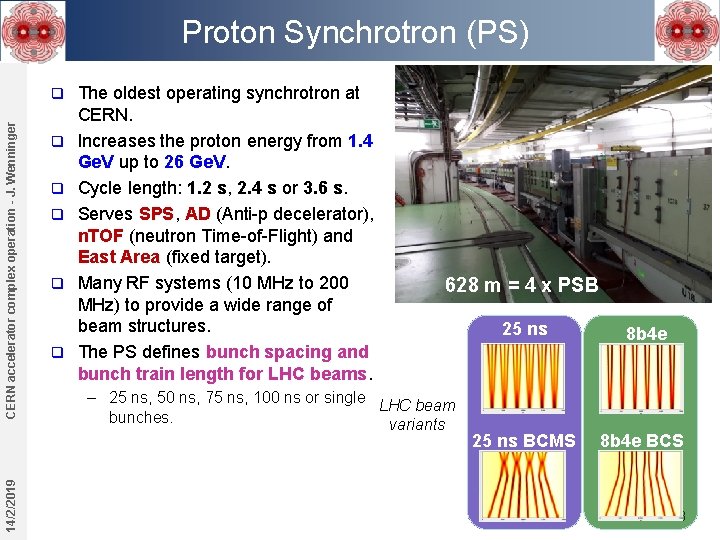
Proton Synchrotron (PS) 14/2/2019 CERN accelerator complex operation - J. Wenninger q q q The oldest operating synchrotron at CERN. Increases the proton energy from 1. 4 Ge. V up to 26 Ge. V. Cycle length: 1. 2 s, 2. 4 s or 3. 6 s. Serves SPS, AD (Anti-p decelerator), n. TOF (neutron Time-of-Flight) and East Area (fixed target). Many RF systems (10 MHz to 200 MHz) to provide a wide range of beam structures. The PS defines bunch spacing and bunch train length for LHC beams. 628 m = 4 x PSB – 25 ns, 50 ns, 75 ns, 100 ns or single LHC beam bunches. variants 25 ns 8 b 4 e 25 ns BCMS 8 b 4 e BCS 8
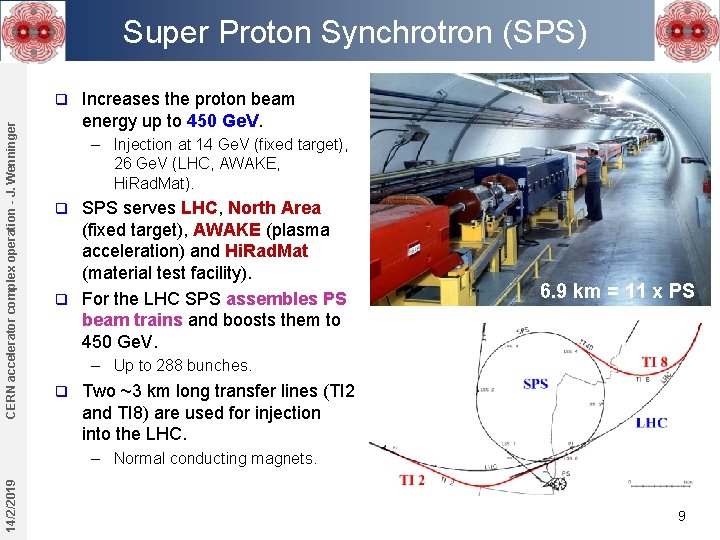
Super Proton Synchrotron (SPS) CERN accelerator complex operation - J. Wenninger q Increases the proton beam energy up to 450 Ge. V. – Injection at 14 Ge. V (fixed target), 26 Ge. V (LHC, AWAKE, Hi. Rad. Mat). SPS serves LHC, North Area (fixed target), AWAKE (plasma acceleration) and Hi. Rad. Mat (material test facility). q For the LHC SPS assembles PS beam trains and boosts them to 450 Ge. V. q 6. 9 km = 11 x PS – Up to 288 bunches. q Two ~3 km long transfer lines (TI 2 and TI 8) are used for injection into the LHC. 14/2/2019 – Normal conducting magnets. 9
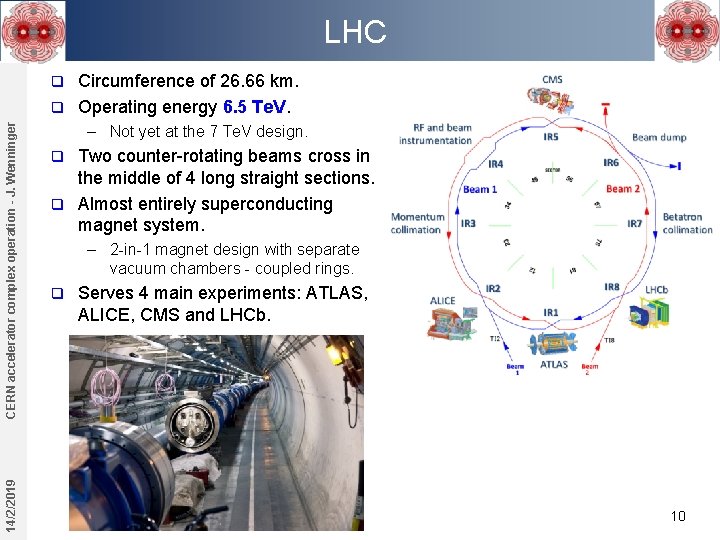
LHC Circumference of 26. 66 km. q Operating energy 6. 5 Te. V. 14/2/2019 CERN accelerator complex operation - J. Wenninger q – Not yet at the 7 Te. V design. Two counter-rotating beams cross in the middle of 4 long straight sections. q Almost entirely superconducting magnet system. q – 2 -in-1 magnet design with separate vacuum chambers - coupled rings. q Serves 4 main experiments: ATLAS, ALICE, CMS and LHCb. 10
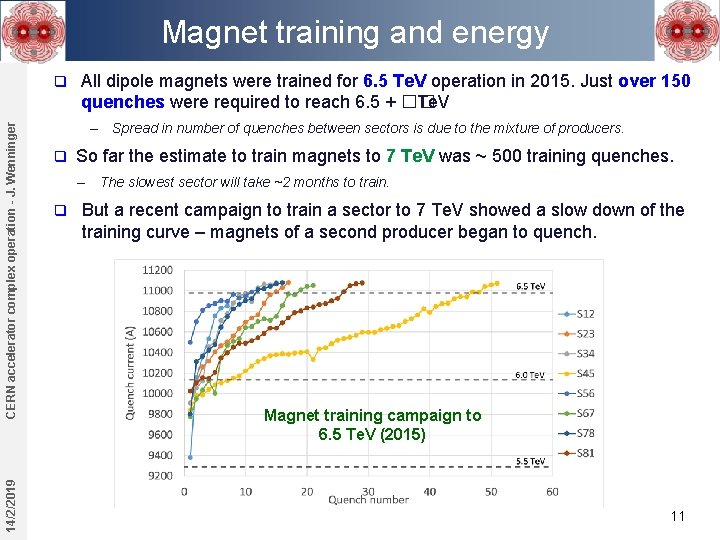
Magnet training and energy 14/2/2019 CERN accelerator complex operation - J. Wenninger q All dipole magnets were trained for 6. 5 Te. V operation in 2015. Just over 150 quenches were required to reach 6. 5 + �� Te. V – Spread in number of quenches between sectors is due to the mixture of producers. q So far the estimate to train magnets to 7 Te. V was ~ 500 training quenches. – The slowest sector will take ~2 months to train. q But a recent campaign to train a sector to 7 Te. V showed a slow down of the training curve – magnets of a second producer began to quench. Magnet training campaign to 6. 5 Te. V (2015) 11
14/2/2019 CERN accelerator complex operation - J. Wenninger Outline The CERN accelerator complex From pre-LHC to LHC area Operation of the complex Outlook 12
The CERN complex in 2000 With the exception of the LHC and the transfer lines from SPS to LHC, the key elements of the LHC-area CERN injector complex were already in place in 2000. q A first wave of changes and upgrade was applied to the machine to comply with LHC beams in 2000 -2005: 14/2/2019 CERN accelerator complex operation - J. Wenninger q – SPS ring cleaning for impedance (remove ‘obsolete’ lepton elements). – SPS extractions and transfer lines to LHC. – PS-PSB transformation for LHC: PSB from 1 Ge. V to 1. 4 Ge. V, many changes to the RF systems. q In 2006 all changes had been essentially completed, first LHC beams were ready in the injectors, waiting for the LHC to come online. 13
Accelerator organization in 2000 14/2/2019 CERN accelerator complex operation - J. Wenninger q In 2000 the CERN accelerator organization was split in two divisions, for the PS complex and for the SPS-LEP(LHC) complex. – Duplicated group structure – powering, RF, instrumentation, controls, operation etc. • With different solutions for many things. • Groups were often split geographically (offices and workshops) on the two CERN sites (Meyrin/CH & Prevessin/F). q In 2003 the accelerator sector was restructured and former PS – SPS/LEP groups were merged into single groups to rationalize the organization and remove duplication at many levels. – It took years to level out the difference in culture and in equipment (end of life of hardware and software). Traces of the old structure can still be observed at CERN. 14
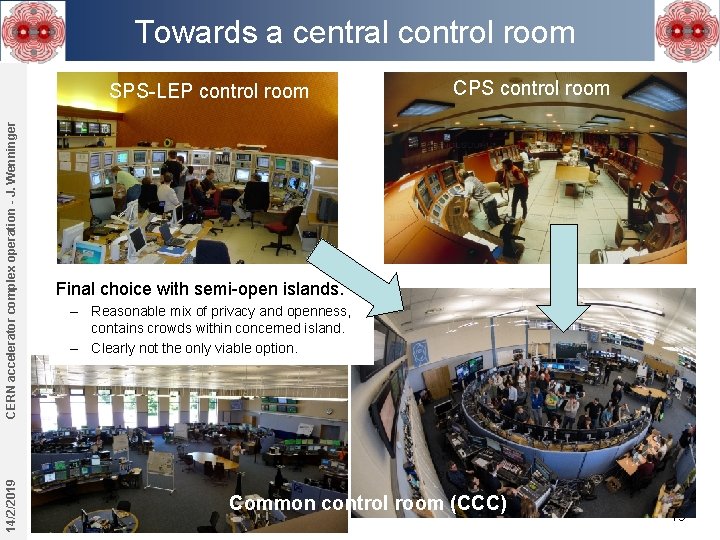
Beam operation in the LHC area 14/2/2019 CERN accelerator complex operation - J. Wenninger q Between 2003 and 2006 the operation groups were merged into a unique group and moved into a new control room. – Two controls / operation cultures coming together. – Operation of the technical infrastructure (another OP group in 2000) was merged with the beam operation group. – Operation of the cryogenic systems was moved to the same control room but remained in a separate group. q The new central control room, commissioned in 2006, helped a lot to smooth out differences, but it takes time – ongoing process in certain areas. – AD and ISOLDE are operated from local CRs. 15
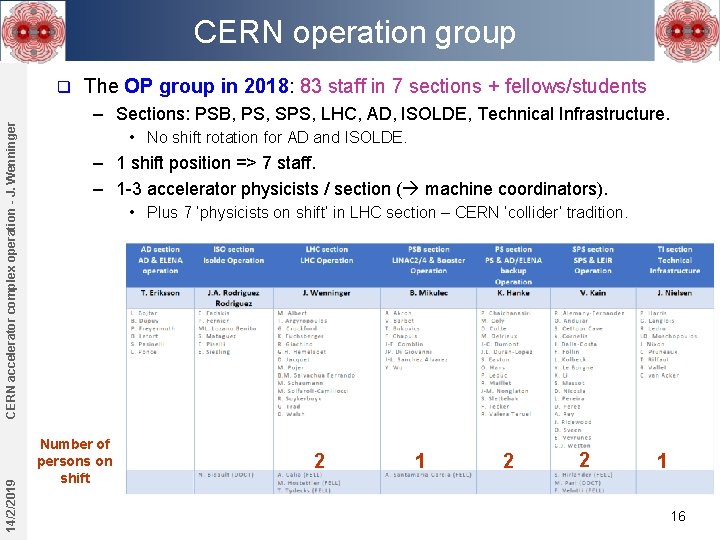
CERN operation group 14/2/2019 CERN accelerator complex operation - J. Wenninger q The OP group in 2018: 83 staff in 7 sections + fellows/students – Sections: PSB, PS, SPS, LHC, AD, ISOLDE, Technical Infrastructure. • No shift rotation for AD and ISOLDE. – 1 shift position => 7 staff. – 1 -3 accelerator physicists / section ( machine coordinators). • Plus 7 ‘physicists on shift’ in LHC section – CERN ‘collider’ tradition. Number of persons on shift 2 1 2 2 1 16
14/2/2019 CERN accelerator complex operation - J. Wenninger Beam versus user area operation q The operation sections of PSB, PS, SPS and LHC setup and operate the beams up to the targets or to experiments installed inside the ring or directly on beam lines. q User beam lines (behind targets) at PS and SPS are setup by a dedicated team (not OP) that also manages reshuffling of areas etc. – With OP support for operating the beam lines. q The ISOLDE isotope facility with targets, isotope separators, ion post accelerators is setup and operated by the OP ISOLDE section. – No shift coverage, on call intervention outside of working hours. q The anti-proton accelerator AD operates like ISOLDE, the AD OP section sets up and operates AD up to the experiments. – Overnight support by PS OP section, on call interventions if required. 17
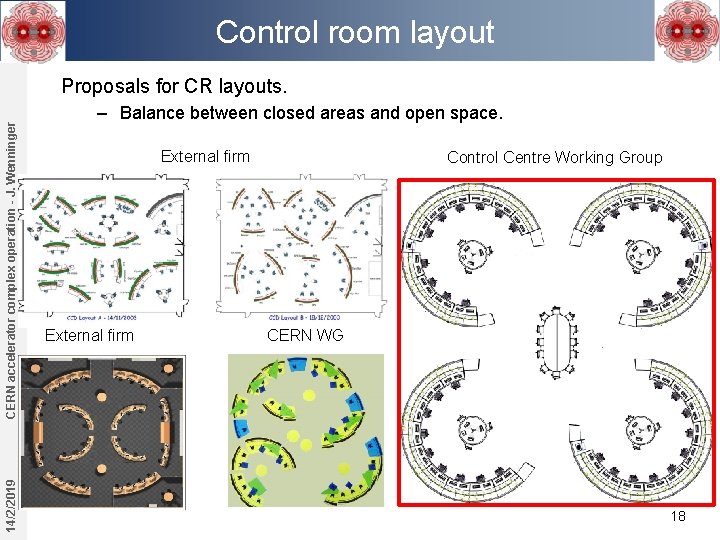
Control room layout 14/2/2019 CERN accelerator complex operation - J. Wenninger Proposals for CR layouts. – Balance between closed areas and open space. External firm Control Centre Working Group CERN WG 18
Towards a central control room 14/2/2019 CERN accelerator complex operation - J. Wenninger SPS-LEP control room CPS control room Final choice with semi-open islands. – Reasonable mix of privacy and openness, contains crowds within concerned island. – Clearly not the only viable option. Common control room (CCC) 19
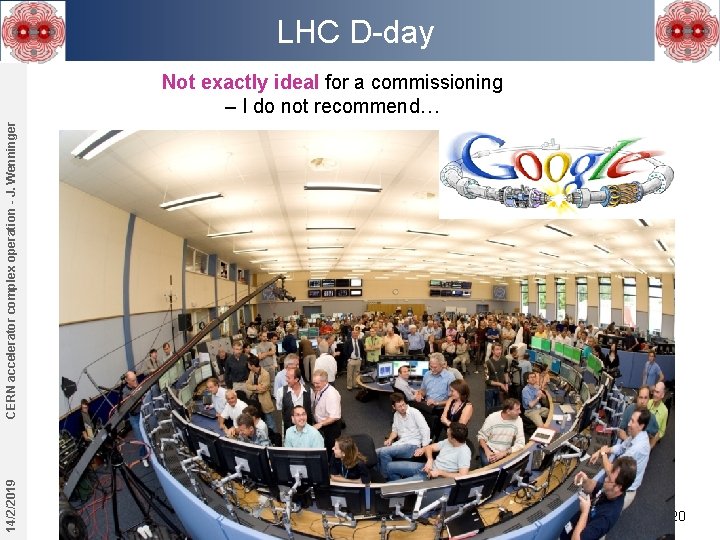
LHC D-day 14/2/2019 CERN accelerator complex operation - J. Wenninger Not exactly ideal for a commissioning – I do not recommend… 20
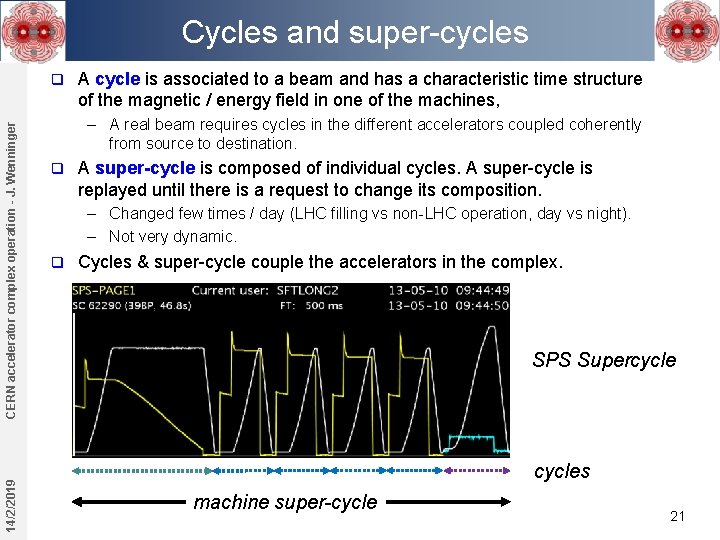
Cycles and super-cycles 14/2/2019 CERN accelerator complex operation - J. Wenninger q A cycle is associated to a beam and has a characteristic time structure of the magnetic / energy field in one of the machines, – A real beam requires cycles in the different accelerators coupled coherently from source to destination. q A super-cycle is composed of individual cycles. A super-cycle is replayed until there is a request to change its composition. – Changed few times / day (LHC filling vs non-LHC operation, day vs night). – Not very dynamic. q Cycles & super-cycle couple the accelerators in the complex. SPS Supercycles machine super-cycle 21
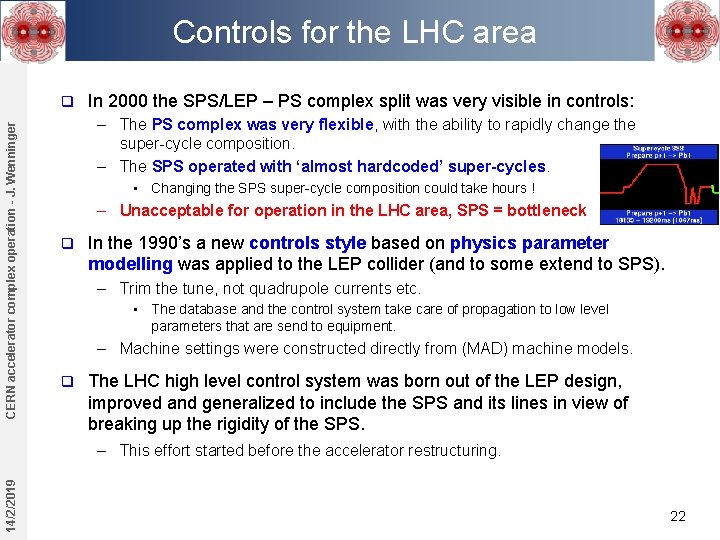
Controls for the LHC area CERN accelerator complex operation - J. Wenninger q In 2000 the SPS/LEP – PS complex split was very visible in controls: – The PS complex was very flexible, with the ability to rapidly change the super-cycle composition. – The SPS operated with ‘almost hardcoded’ super-cycles. • Changing the SPS super-cycle composition could take hours ! – Unacceptable for operation in the LHC area, SPS = bottleneck q In the 1990’s a new controls style based on physics parameter modelling was applied to the LEP collider (and to some extend to SPS). – Trim the tune, not quadrupole currents etc. • The database and the control system take care of propagation to low level parameters that are send to equipment. – Machine settings were constructed directly from (MAD) machine models. q The LHC high level control system was born out of the LEP design, improved and generalized to include the SPS and its lines in view of breaking up the rigidity of the SPS. 14/2/2019 – This effort started before the accelerator restructuring. 22
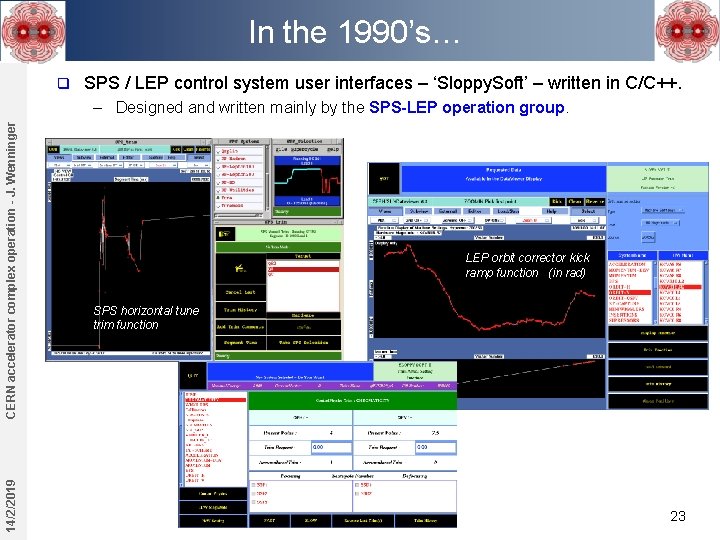
In the 1990’s… q SPS / LEP control system user interfaces – ‘Sloppy. Soft’ – written in C/C++. 14/2/2019 CERN accelerator complex operation - J. Wenninger – Designed and written mainly by the SPS-LEP operation group. LEP orbit corrector kick ramp function (in rad) SPS horizontal tune trim function 23
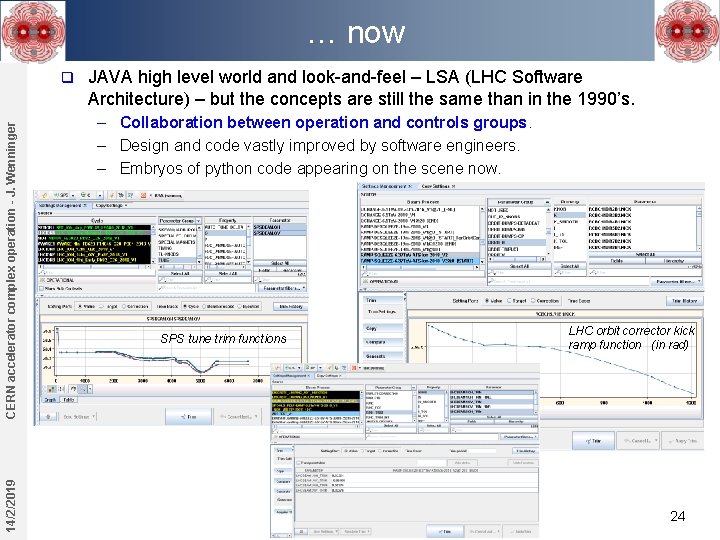
… now 14/2/2019 CERN accelerator complex operation - J. Wenninger q JAVA high level world and look-and-feel – LSA (LHC Software Architecture) – but the concepts are still the same than in the 1990’s. – Collaboration between operation and controls groups. – Design and code vastly improved by software engineers. – Embryos of python code appearing on the scene now. SPS tune trim functions LHC orbit corrector kick ramp function (in rad) 24
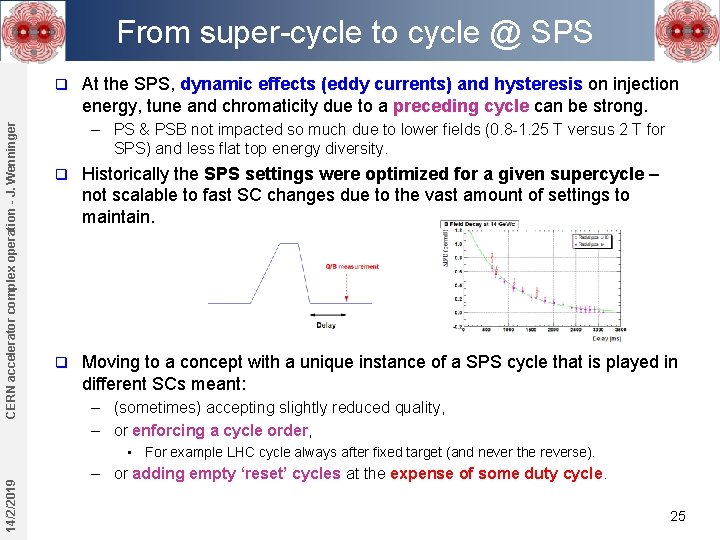
From super-cycle to cycle @ SPS CERN accelerator complex operation - J. Wenninger q At the SPS, dynamic effects (eddy currents) and hysteresis on injection energy, tune and chromaticity due to a preceding cycle can be strong. – PS & PSB not impacted so much due to lower fields (0. 8 -1. 25 T versus 2 T for SPS) and less flat top energy diversity. q Historically the SPS settings were optimized for a given supercycle – not scalable to fast SC changes due to the vast amount of settings to maintain. q Moving to a concept with a unique instance of a SPS cycle that is played in different SCs meant: – (sometimes) accepting slightly reduced quality, – or enforcing a cycle order, 14/2/2019 • For example LHC cycle always after fixed target (and never the reverse). – or adding empty ‘reset’ cycles at the expense of some duty cycle. 25
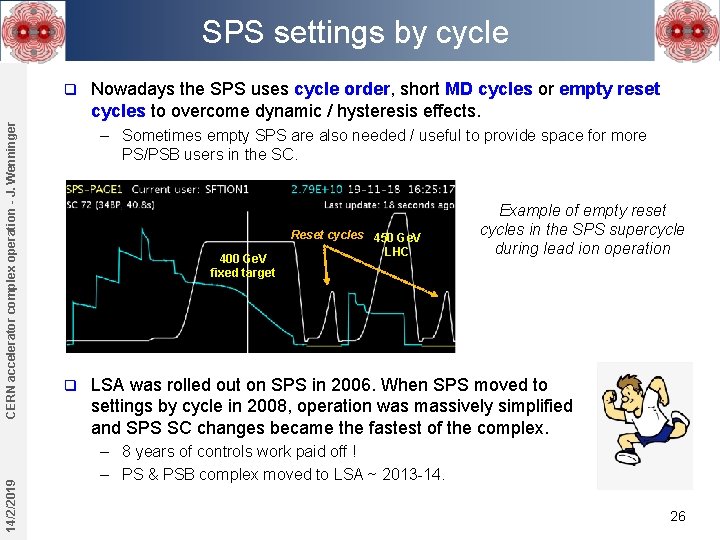
SPS settings by cycle 14/2/2019 CERN accelerator complex operation - J. Wenninger q Nowadays the SPS uses cycle order, short MD cycles or empty reset cycles to overcome dynamic / hysteresis effects. – Sometimes empty SPS are also needed / useful to provide space for more PS/PSB users in the SC. 400 Ge. V fixed target q Reset cycles 450 Ge. V LHC Example of empty reset cycles in the SPS supercycle during lead ion operation LSA was rolled out on SPS in 2006. When SPS moved to settings by cycle in 2008, operation was massively simplified and SPS SC changes became the fastest of the complex. – 8 years of controls work paid off ! – PS & PSB complex moved to LSA ~ 2013 -14. 26
14/2/2019 CERN accelerator complex operation - J. Wenninger Outline The CERN accelerator complex From pre-LHC to LHC area Operation of the complex Outlook 27
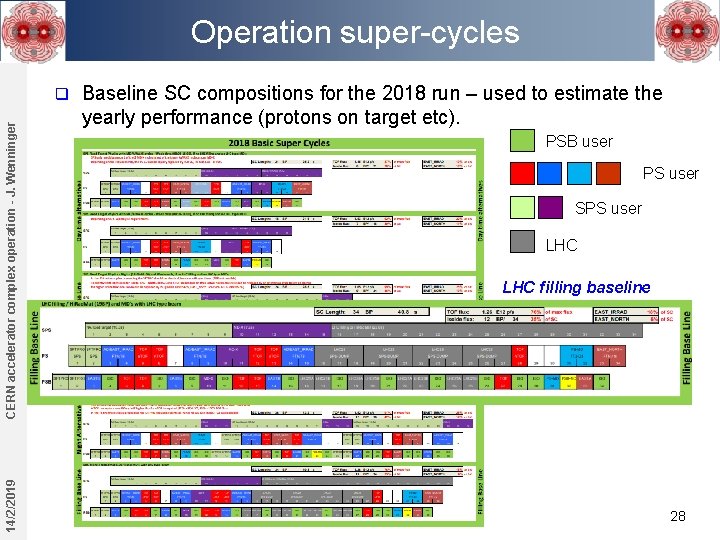
Operation super-cycles 14/2/2019 CERN accelerator complex operation - J. Wenninger q Baseline SC compositions for the 2018 run – used to estimate the yearly performance (protons on target etc). PSB user PS user SPS user LHC filling baseline 28
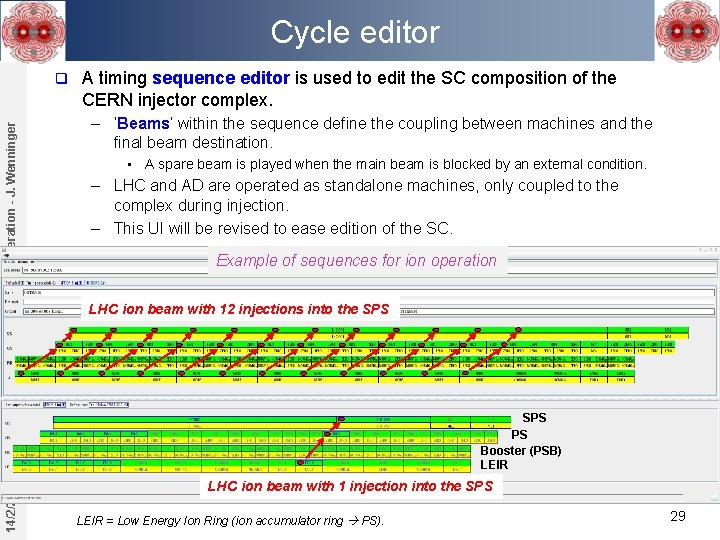
Cycle editor 14/2/2019 CERN accelerator complex operation - J. Wenninger q A timing sequence editor is used to edit the SC composition of the CERN injector complex. – ‘Beams’ within the sequence define the coupling between machines and the final beam destination. • A spare beam is played when the main beam is blocked by an external condition. – LHC and AD are operated as standalone machines, only coupled to the complex during injection. – This UI will be revised to ease edition of the SC. Example of sequences for ion operation LHC ion beam with 12 injections into the SPS PS Booster (PSB) LEIR LHC ion beam with 1 injection into the SPS LEIR = Low Energy Ion Ring (ion accumulator ring PS). 29
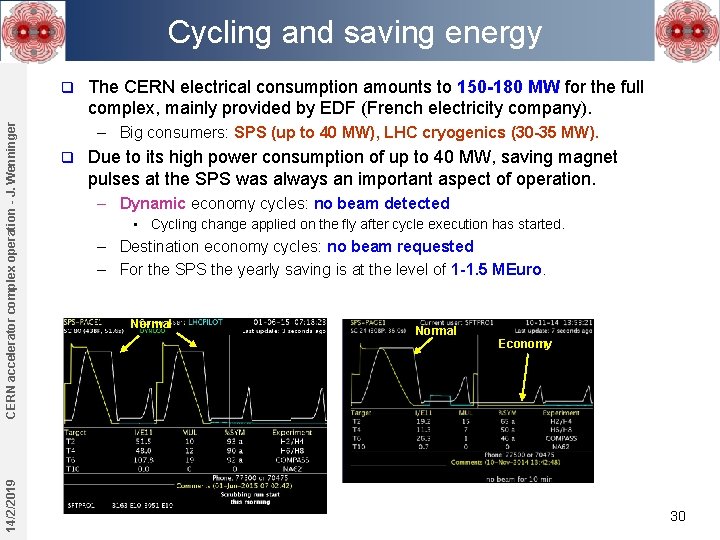
Cycling and saving energy 14/2/2019 CERN accelerator complex operation - J. Wenninger q The CERN electrical consumption amounts to 150 -180 MW for the full complex, mainly provided by EDF (French electricity company). – Big consumers: SPS (up to 40 MW), LHC cryogenics (30 -35 MW). q Due to its high power consumption of up to 40 MW, saving magnet pulses at the SPS was always an important aspect of operation. – Dynamic economy cycles: no beam detected • Cycling change applied on the fly after cycle execution has started. – Destination economy cycles: no beam requested – For the SPS the yearly saving is at the level of 1 -1. 5 MEuro. Normal Economy 30
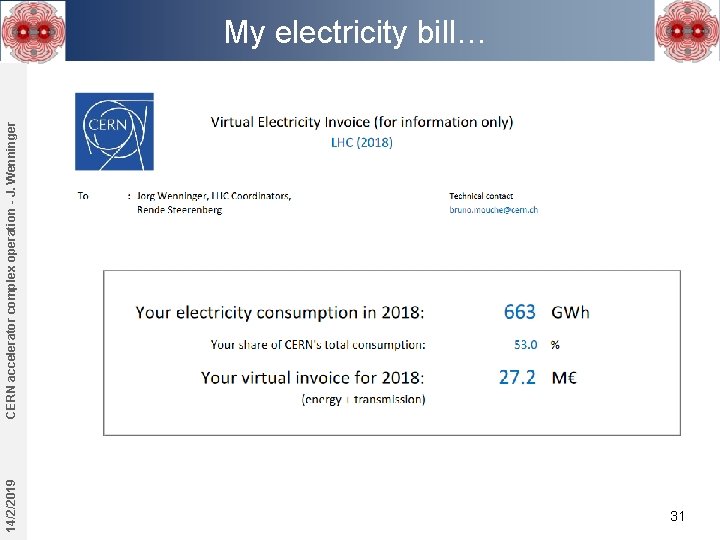
14/2/2019 CERN accelerator complex operation - J. Wenninger My electricity bill… 31
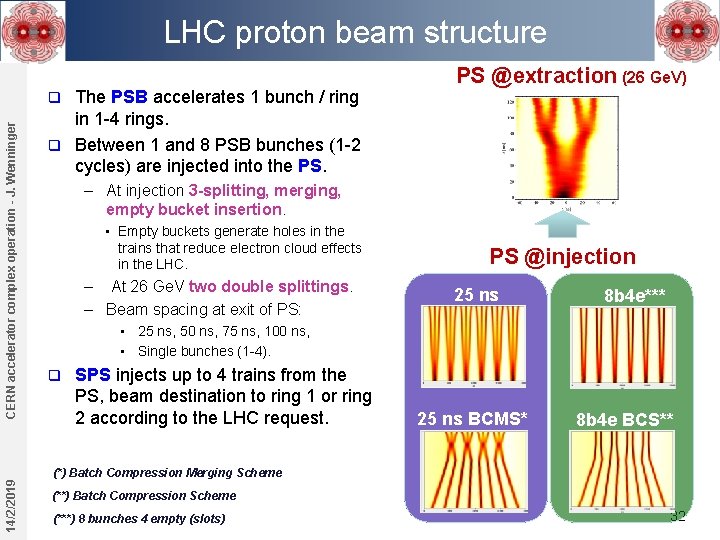
LHC proton beam structure The PSB accelerates 1 bunch / ring in 1 -4 rings. q Between 1 and 8 PSB bunches (1 -2 cycles) are injected into the PS. PS @extraction (26 Ge. V) 14/2/2019 CERN accelerator complex operation - J. Wenninger q – At injection 3 -splitting, merging, empty bucket insertion. • Empty buckets generate holes in the trains that reduce electron cloud effects in the LHC. – At 26 Ge. V two double splittings. – Beam spacing at exit of PS: PS @injection 25 ns 8 b 4 e*** • 25 ns, 50 ns, 75 ns, 100 ns, • Single bunches (1 -4). q SPS injects up to 4 trains from the PS, beam destination to ring 1 or ring 2 according to the LHC request. 25 ns BCMS* 8 b 4 e BCS** (*) Batch Compression Merging Scheme (**) Batch Compression Scheme (***) 8 bunches 4 empty (slots) 32
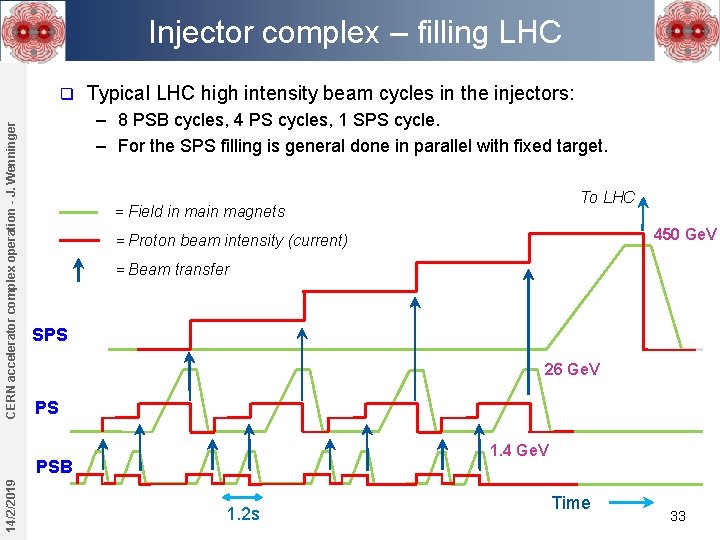
Injector complex – filling LHC CERN accelerator complex operation - J. Wenninger q Typical LHC high intensity beam cycles in the injectors: – 8 PSB cycles, 4 PS cycles, 1 SPS cycle. – For the SPS filling is general done in parallel with fixed target. = Field in magnets 450 Ge. V = Proton beam intensity (current) = Beam transfer SPS 26 Ge. V PS 1. 4 Ge. V PSB 14/2/2019 To LHC 1. 2 s Time 33
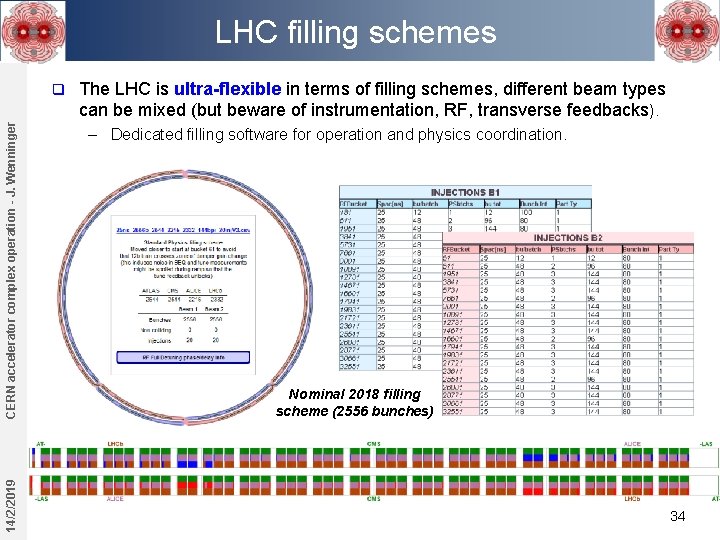
LHC filling schemes 14/2/2019 CERN accelerator complex operation - J. Wenninger q The LHC is ultra-flexible in terms of filling schemes, different beam types can be mixed (but beware of instrumentation, RF, transverse feedbacks). – Dedicated filling software for operation and physics coordination. Nominal 2018 filling scheme (2556 bunches) 34
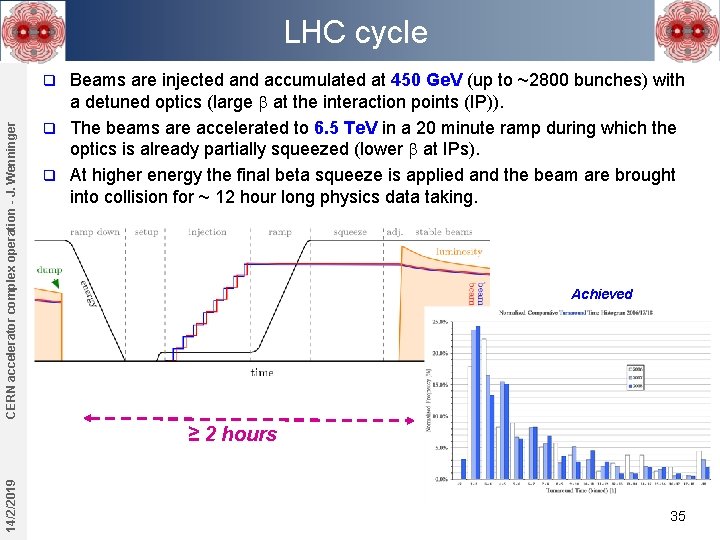
LHC cycle Beams are injected and accumulated at 450 Ge. V (up to ~2800 bunches) with a detuned optics (large b at the interaction points (IP)). q The beams are accelerated to 6. 5 Te. V in a 20 minute ramp during which the optics is already partially squeezed (lower b at IPs). q At higher energy the final beta squeeze is applied and the beam are brought into collision for ~ 12 hour long physics data taking. CERN accelerator complex operation - J. Wenninger q Achieved 14/2/2019 ≥ 2 hours 35
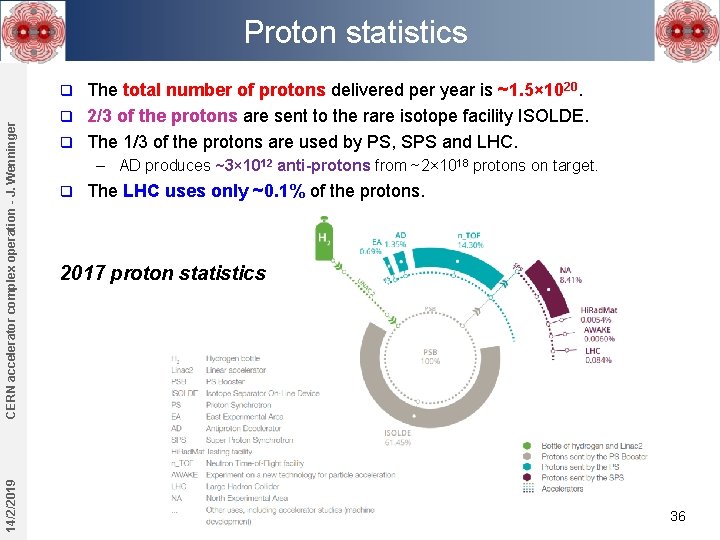
Proton statistics The total number of protons delivered per year is ~1. 5× 10²⁰. q 2/3 of the protons are sent to the rare isotope facility ISOLDE. q The 1/3 of the protons are used by PS, SPS and LHC. 14/2/2019 CERN accelerator complex operation - J. Wenninger q – AD produces ~3× 10¹² anti-protons from ~2× 10¹⁸ protons on target. q The LHC uses only ~0. 1% of the protons. 2017 proton statistics 36
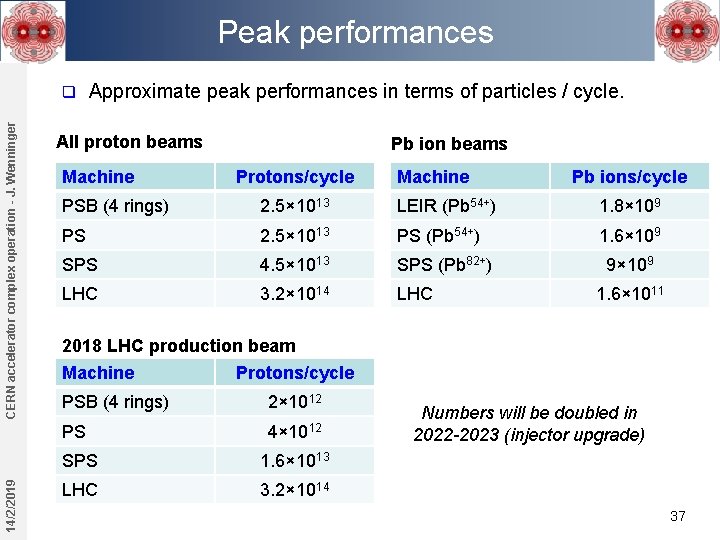
Peak performances 14/2/2019 CERN accelerator complex operation - J. Wenninger q Approximate peak performances in terms of particles / cycle. All proton beams Machine Pb ion beams Protons/cycle Machine Pb ions/cycle PSB (4 rings) 2. 5× 10¹³ LEIR (Pb 54+) 1. 8× 10⁹ PS 2. 5× 10¹³ PS (Pb 54+) 1. 6× 10⁹ SPS 4. 5× 10¹³ SPS (Pb 82+) LHC 3. 2× 10¹⁴ LHC 9× 10⁹ 1. 6× 10¹¹ 2018 LHC production beam Machine Protons/cycle PSB (4 rings) 2× 10¹² PS 4× 10¹² SPS 1. 6× 10¹³ LHC 3. 2× 10¹⁴ Numbers will be doubled in 2022 -2023 (injector upgrade) 37
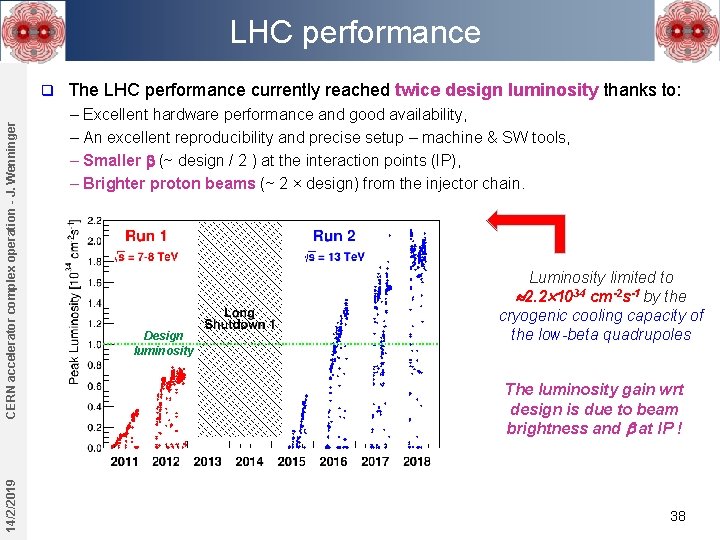
LHC performance 14/2/2019 CERN accelerator complex operation - J. Wenninger q The LHC performance currently reached twice design luminosity thanks to: – Excellent hardware performance and good availability, – An excellent reproducibility and precise setup – machine & SW tools, – Smaller b (~ design / 2 ) at the interaction points (IP), – Brighter proton beams (~ 2 × design) from the injector chain. Design luminosity Luminosity limited to 2. 2 1034 cm-2 s-1 by the cryogenic cooling capacity of the low-beta quadrupoles The luminosity gain wrt design is due to beam brightness and b at IP ! 38
Many users, never enough time 14/2/2019 CERN accelerator complex operation - J. Wenninger q Besides the main programs, there are many additional users, in particular at the SPS: – – – – q AWAKE experiment on plasma acceleration by p+ beam. Hi. Rad. Mat material resistance / damage test facility. Coast experiments for crystal extraction. Crab-cavity test assemblies for the LHC upgrade. Machine experiments users (–> accelerator physics group). Beam setup for all users. … and the LHC that tries to maintain its priority. There is a trend to be overbooked, in particular beam setup time is frequently underestimated (partly due to changing requirements). – Tensions can build up when major technical issues strike (electrical network issues, septa magnet failures etc). 39
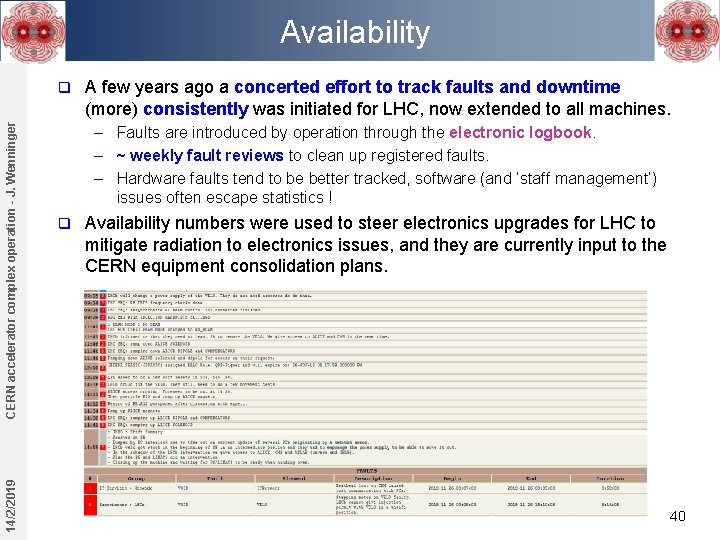
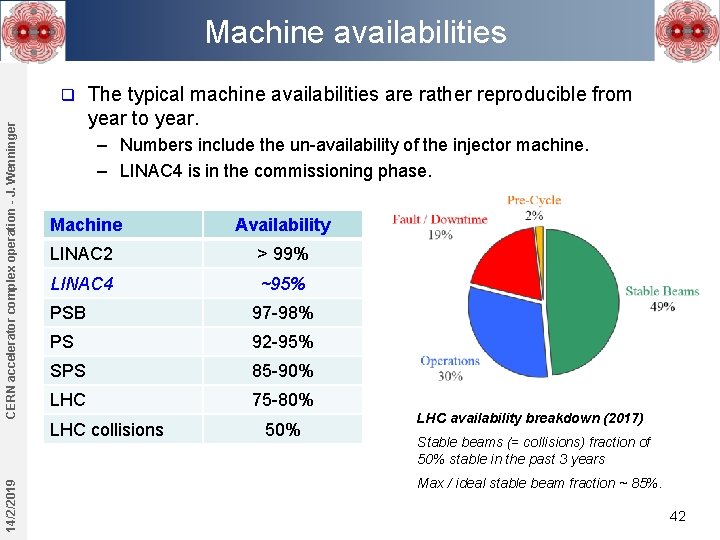
Availability 14/2/2019 CERN accelerator complex operation - J. Wenninger q A few years ago a concerted effort to track faults and downtime (more) consistently was initiated for LHC, now extended to all machines. – Faults are introduced by operation through the electronic logbook. – ~ weekly fault reviews to clean up registered faults. – Hardware faults tend to be better tracked, software (and ‘staff management’) issues often escape statistics ! q Availability numbers were used to steer electronics upgrades for LHC to mitigate radiation to electronics issues, and they are currently input to the CERN equipment consolidation plans. 40
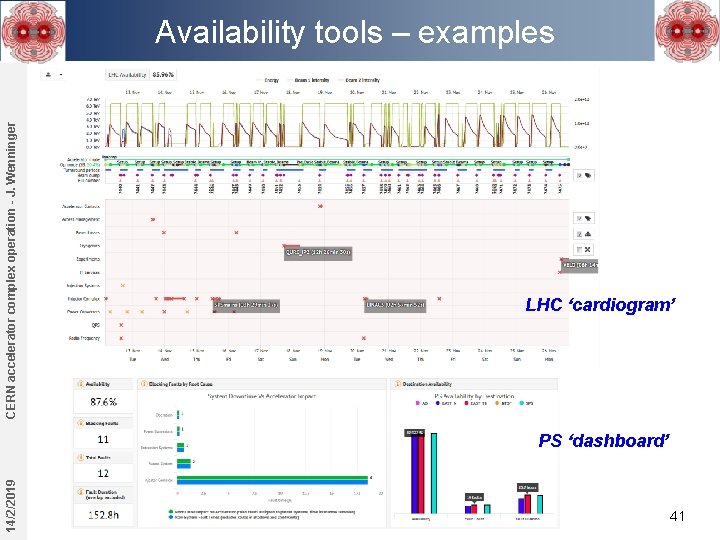
CERN accelerator complex operation - J. Wenninger Availability tools – examples LHC ‘cardiogram’ 14/2/2019 PS ‘dashboard’ 41
Machine availabilities CERN accelerator complex operation - J. Wenninger q The typical machine availabilities are rather reproducible from year to year. – Numbers include the un-availability of the injector machine. – LINAC 4 is in the commissioning phase. Machine Availability LINAC 2 > 99% LINAC 4 ~95% PSB 97 -98% PS 92 -95% SPS 85 -90% LHC 75 -80% 14/2/2019 LHC collisions 50% LHC availability breakdown (2017) Stable beams (= collisions) fraction of 50% stable in the past 3 years Max / ideal stable beam fraction ~ 85%. 42
14/2/2019 CERN accelerator complex operation - J. Wenninger Outline The CERN accelerator complex From pre-LHC to LHC area Operation of the complex Outlook 43
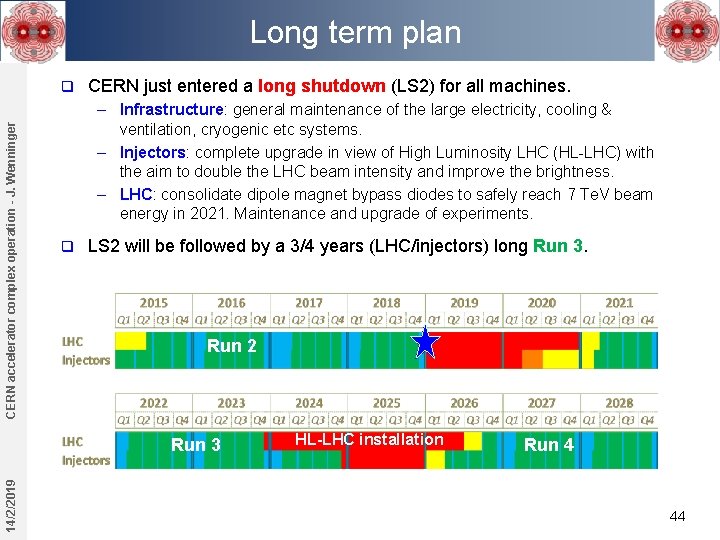
Long term plan CERN accelerator complex operation - J. Wenninger q CERN just entered a long shutdown (LS 2) for all machines. – Infrastructure: general maintenance of the large electricity, cooling & ventilation, cryogenic etc systems. – Injectors: complete upgrade in view of High Luminosity LHC (HL-LHC) with the aim to double the LHC beam intensity and improve the brightness. – LHC: consolidate dipole magnet bypass diodes to safely reach 7 Te. V beam energy in 2021. Maintenance and upgrade of experiments. q LS 2 will be followed by a 3/4 years (LHC/injectors) long Run 3. Run 2 14/2/2019 Run 3 HL-LHC installation Run 4 44
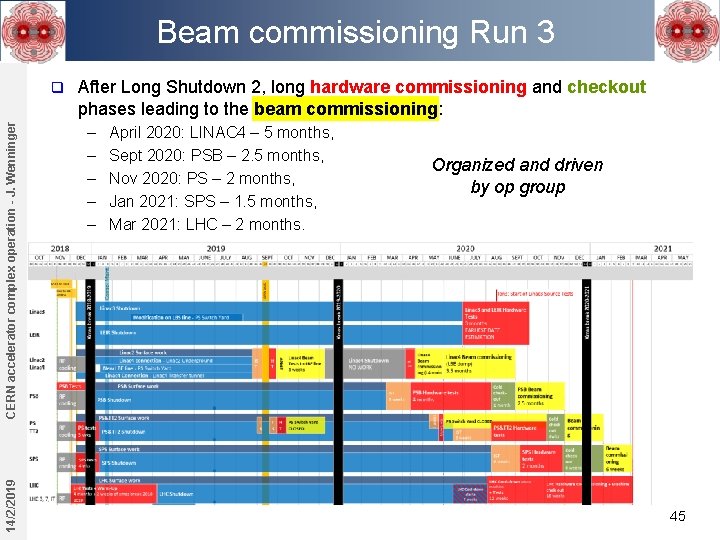
Beam commissioning Run 3 14/2/2019 CERN accelerator complex operation - J. Wenninger q After Long Shutdown 2, long hardware commissioning and checkout phases leading to the beam commissioning: – – – April 2020: LINAC 4 – 5 months, Sept 2020: PSB – 2. 5 months, Nov 2020: PS – 2 months, Jan 2021: SPS – 1. 5 months, Mar 2021: LHC – 2 months. Organized and driven by op group 45
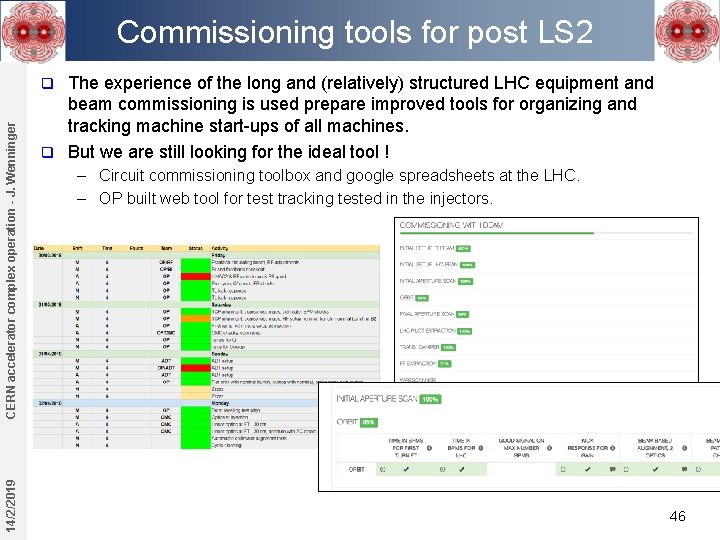
Commissioning tools for post LS 2 The experience of the long and (relatively) structured LHC equipment and beam commissioning is used prepare improved tools for organizing and tracking machine start-ups of all machines. q But we are still looking for the ideal tool ! 14/2/2019 CERN accelerator complex operation - J. Wenninger q – Circuit commissioning toolbox and google spreadsheets at the LHC. – OP built web tool for test tracking tested in the injectors. 46
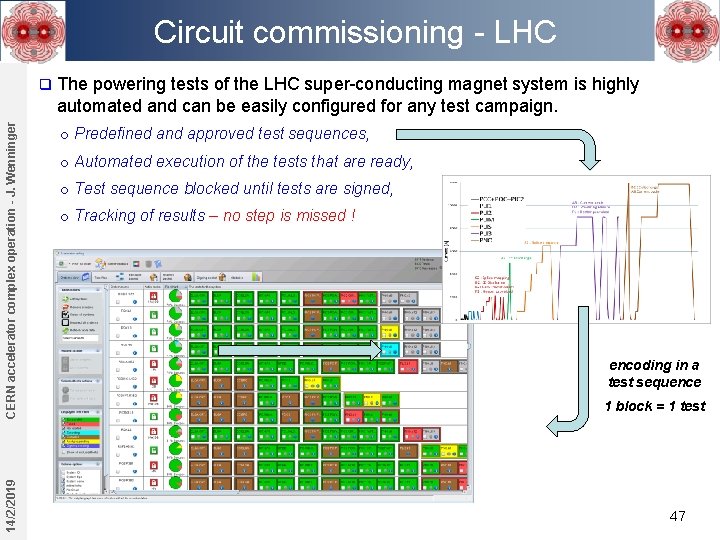
Circuit commissioning - LHC 14/2/2019 CERN accelerator complex operation - J. Wenninger q The powering tests of the LHC super-conducting magnet system is highly automated and can be easily configured for any test campaign. o Predefined and approved test sequences, o Automated execution of the tests that are ready, o Test sequence blocked until tests are signed, o Tracking of results – no step is missed ! encoding in a test sequence 1 block = 1 test 47
Evolution of operation 14/2/2019 CERN accelerator complex operation - J. Wenninger q The current CERN operation mode with 3 -4 year long runs followed by 1 -2 years long shutdowns is not ideal for the operation group. – The run periods are very dense, making it difficult to integrate operation staff into technical groups as it was one in the past. • Closer integration with technical groups provides better exit paths for OP staff. – During the long shutdowns operation staff work on controls, or must be incorporated into shutdown activities. • Many become shutdown activity or (re)commissioning coordinators. q After more than 10 years of operation in the CCC, the upcoming long shutdown is a moment to reflect on how the complex is operated. – Optimize/adapt operation of the complex in the future. • Example: the LHC has grown into a mature and highly automated machine, yet its shift crew of 1 physicist + 1 operator has not evolved. – Facilitate and encourage mobility between machines. – In parallel software development is moving from massive software creation to massive maintenance (with authors no longer in the group or at CERN) that has a significant impact on OP resources and motivation. 48
14/2/2019 CERN accelerator complex operation - J. Wenninger Thank you for listening ! LHC col lisi ons for < 200 Eur o 49
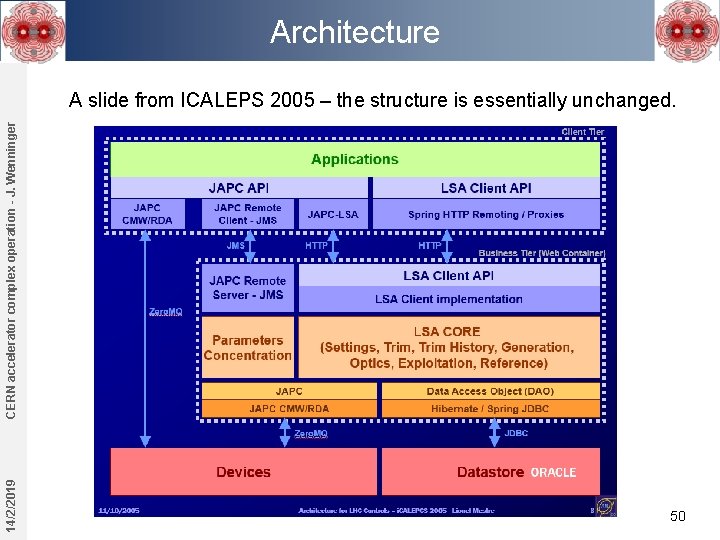
Architecture 14/2/2019 CERN accelerator complex operation - J. Wenninger A slide from ICALEPS 2005 – the structure is essentially unchanged. 50
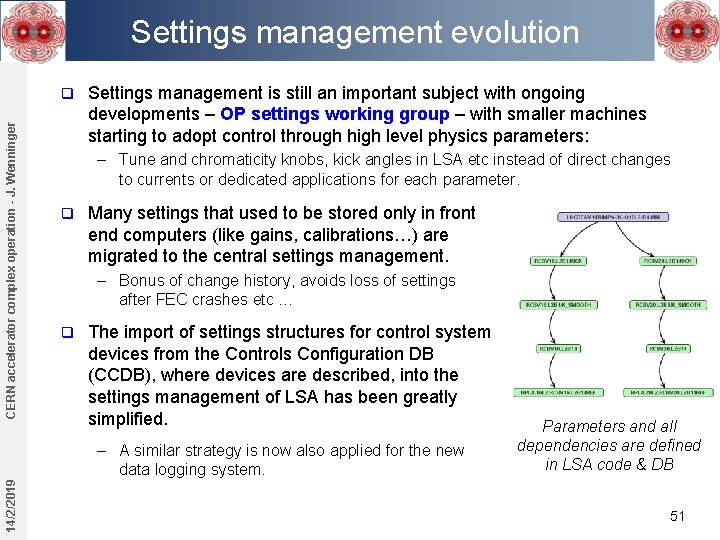
Settings management evolution CERN accelerator complex operation - J. Wenninger q Settings management is still an important subject with ongoing developments – OP settings working group – with smaller machines starting to adopt control through high level physics parameters: – Tune and chromaticity knobs, kick angles in LSA etc instead of direct changes to currents or dedicated applications for each parameter. q Many settings that used to be stored only in front end computers (like gains, calibrations…) are migrated to the central settings management. – Bonus of change history, avoids loss of settings after FEC crashes etc … q The import of settings structures for control system devices from the Controls Configuration DB (CCDB), where devices are described, into the settings management of LSA has been greatly simplified. 14/2/2019 – A similar strategy is now also applied for the new data logging system. Parameters and all dependencies are defined in LSA code & DB 51
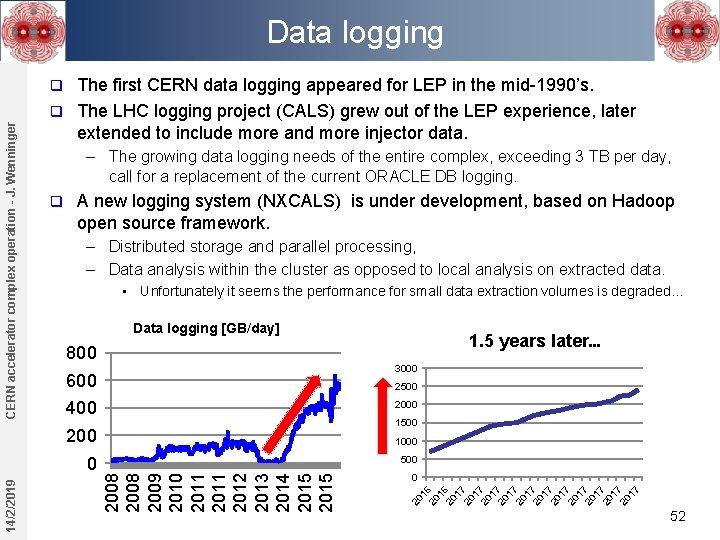
Data logging The first CERN data logging appeared for LEP in the mid-1990’s. q The LHC logging project (CALS) grew out of the LEP experience, later extended to include more and more injector data. – The growing data logging needs of the entire complex, exceeding 3 TB per day, call for a replacement of the current ORACLE DB logging. q A new logging system (NXCALS) is under development, based on Hadoop open source framework. – Distributed storage and parallel processing, – Data analysis within the cluster as opposed to local analysis on extracted data. • Unfortunately it seems the performance for small data extraction volumes is degraded… Data logging [GB/day] 800 3000 600 2500 400 2000 1500 200 1000 0 500 2008 2009 2010 2011 2012 2013 2014 2015 14/2/2019 1. 5 years later… 0 20 16 20 17 20 17 20 17 CERN accelerator complex operation - J. Wenninger q 52