
CERN 22 th November 2016 Italian teachers program
CERN, 22 th November 2016 Italian teachers program AN OUTLOOK ON LHC OPERATION AND ON FUTURE PROJECTS AND STUDIES E. Todesco HL-LHC IR magnets WP leader Magnet, Superconductors and Cryostats Group Technology Department CERN, Geneva, Switzerland E. Todesco
CONTENTS The present: LHC in the 10’s LHC energy The race towards luminosity The 20’s: the HL-LHC project Aiming at 3000 fb-1 The 30’s: FCC studies Aiming at 100 Te. V centre of mass E. Todesco LHC in the 10’s - 2
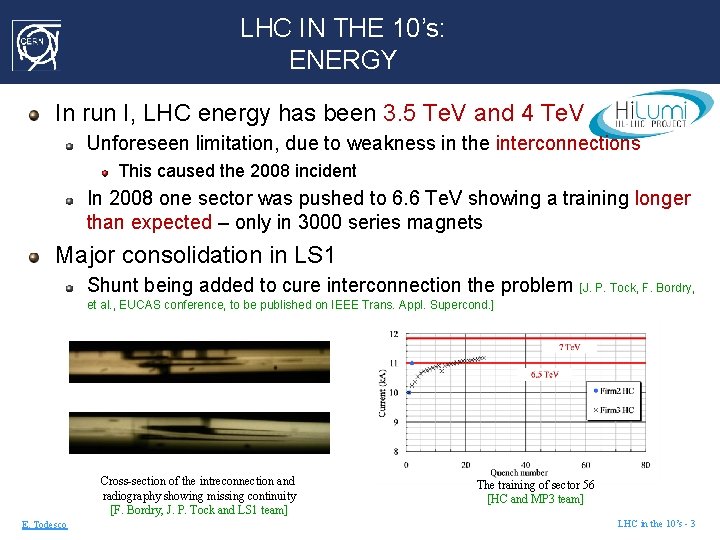
LHC IN THE 10’s: ENERGY In run I, LHC energy has been 3. 5 Te. V and 4 Te. V Unforeseen limitation, due to weakness in the interconnections This caused the 2008 incident In 2008 one sector was pushed to 6. 6 Te. V showing a training longer than expected – only in 3000 series magnets Major consolidation in LS 1 Shunt being added to cure interconnection the problem [J. P. Tock, F. Bordry, et al. , EUCAS conference, to be published on IEEE Trans. Appl. Supercond. ] Cross-section of the intreconnection and radiography showing missing continuity [F. Bordry, J. P. Tock and LS 1 team] E. Todesco The training of sector 56 [HC and MP 3 team] LHC in the 10’s - 3
LHC IN THE 10’s: ENERGY 2014: decision to train LHC at 6. 5 Te. V Compromise between time, risk and energy for physics reach 1 -2 week to train one sector, in the shadow of hardware commissioning Expected 100 quenches, we went to 6. 5 Te. V with 174 quenches A bit worse then expected, but we got there First data about the whole LHC 3000 series confirmed to be weaker (~1/3 of the magnets quenched) First data about the whole LHC: magnet production not uniform Effort sto understand what happened are ongoing In 2015 and 2016 very smooth run at 6. 5 Te. V 1200 dipoles working at 7. 7 T, with 20% margin At the end of 2016, two sector to be pushed towards 7 Te. V E. Todesco This would mean working with the dipoles at 14% margin According to these results, LHC energy may stay at 6. 5 Te. V or go towards 7 Te. V LHC in the 10’s - 4

LHC IN THE 10’S: THE RACE TOWARDS LUMINOSITY Equation for the luminosity Accelerator features Energy of the machine 7 Te. V Length of the machine 27 km Beam intensity features Nb Number of particles per bunch 1. 15 1011 nb Number of bunches ~2808 Beam geometry features Nominal luminosity: 1034 cm-2 s-1 (considered very challenging in the 90’s, pushed up to compete with SSC) E. Todesco en Size of the beam from injectors: 3. 75 mm mrad b* Squeeze of the beam in IP (LHC optics): 55 cm F: geometry reduction factor: 0. 84 LHC in the 10’s - 5
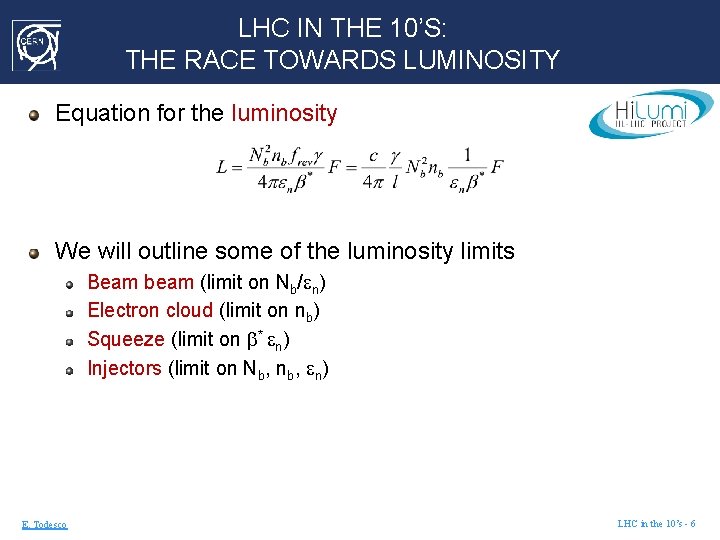
LHC IN THE 10’S: THE RACE TOWARDS LUMINOSITY Equation for the luminosity We will outline some of the luminosity limits Beam beam (limit on Nb/en) Electron cloud (limit on nb) Squeeze (limit on b* en) Injectors (limit on Nb, nb, en) E. Todesco LHC in the 10’s - 6
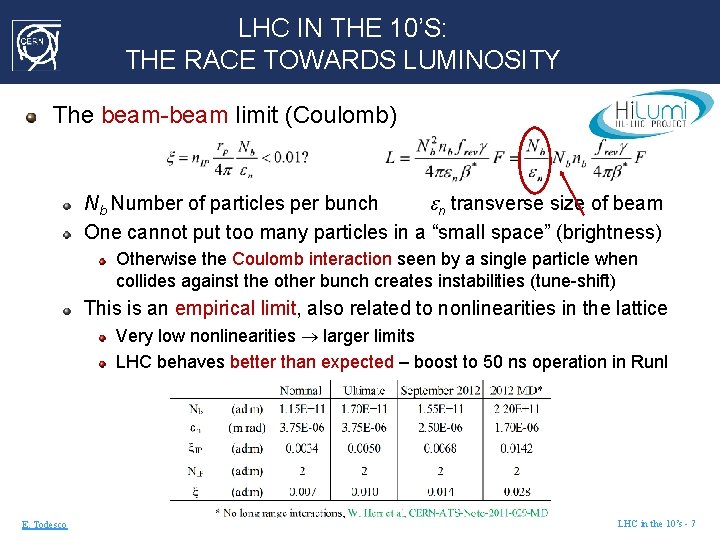
LHC IN THE 10’S: THE RACE TOWARDS LUMINOSITY The beam-beam limit (Coulomb) Nb Number of particles per bunch n transverse size of beam One cannot put too many particles in a “small space” (brightness) Otherwise the Coulomb interaction seen by a single particle when collides against the other bunch creates instabilities (tune-shift) This is an empirical limit, also related to nonlinearities in the lattice Very low nonlinearities larger limits LHC behaves better than expected – boost to 50 ns operation in Run. I E. Todesco LHC in the 10’s - 7
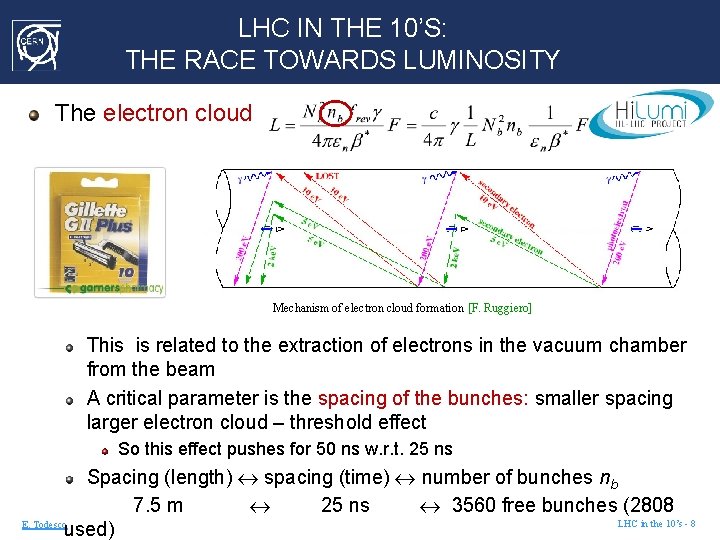
LHC IN THE 10’S: THE RACE TOWARDS LUMINOSITY The electron cloud Mechanism of electron cloud formation [F. Ruggiero] This is related to the extraction of electrons in the vacuum chamber from the beam A critical parameter is the spacing of the bunches: smaller spacing larger electron cloud – threshold effect So this effect pushes for 50 ns w. r. t. 25 ns Spacing (length) spacing (time) number of bunches nb 7. 5 m 25 ns 3560 free bunches (2808 LHC in the 10’s - 8 E. Todesco used)
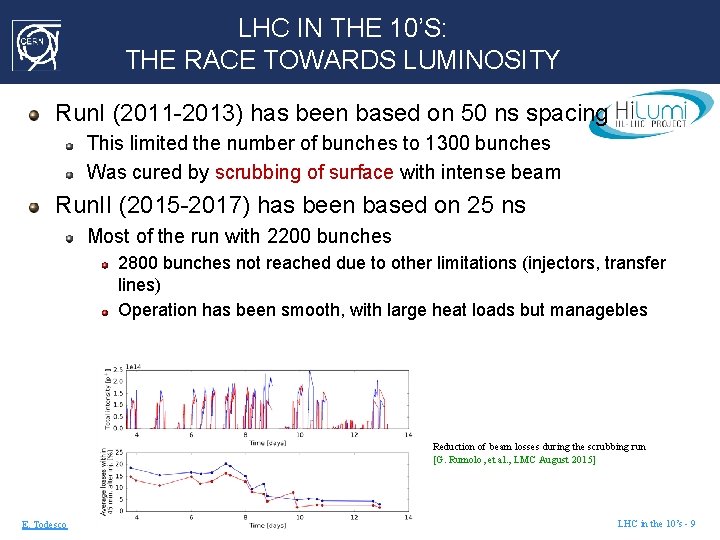
LHC IN THE 10’S: THE RACE TOWARDS LUMINOSITY Run. I (2011 -2013) has been based on 50 ns spacing This limited the number of bunches to 1300 bunches Was cured by scrubbing of surface with intense beam Run. II (2015 -2017) has been based on 25 ns Most of the run with 2200 bunches 2800 bunches not reached due to other limitations (injectors, transfer lines) Operation has been smooth, with large heat loads but managebles Reduction of beam losses during the scrubbing run [G. Rumolo, et al. , LMC August 2015] E. Todesco LHC in the 10’s - 9
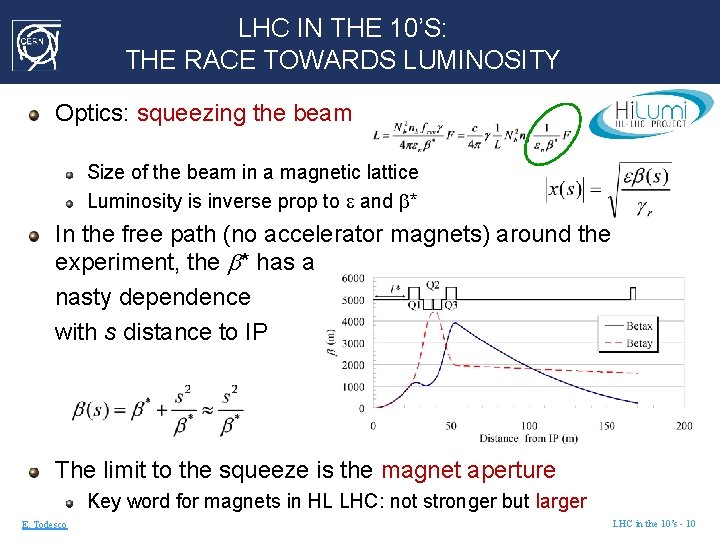
LHC IN THE 10’S: THE RACE TOWARDS LUMINOSITY Optics: squeezing the beam Size of the beam in a magnetic lattice Luminosity is inverse prop to e and b* In the free path (no accelerator magnets) around the experiment, the b* has a nasty dependence with s distance to IP The limit to the squeeze is the magnet aperture Key word for magnets in HL LHC: not stronger but larger E. Todesco LHC in the 10’s - 10
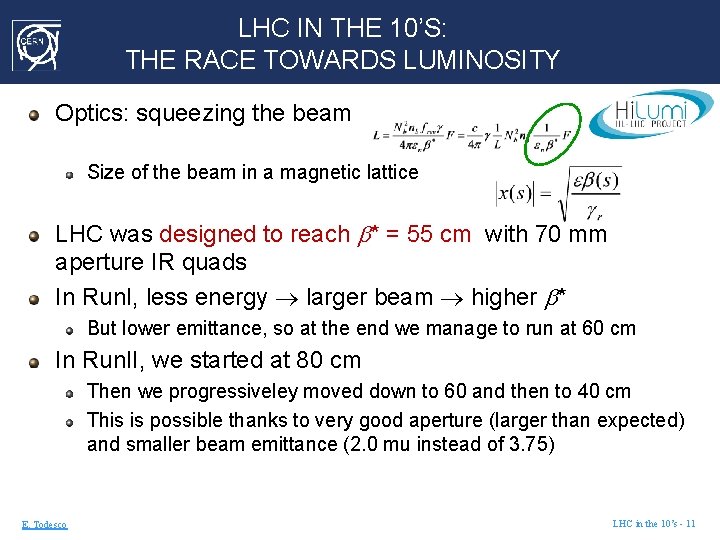
LHC IN THE 10’S: THE RACE TOWARDS LUMINOSITY Optics: squeezing the beam Size of the beam in a magnetic lattice LHC was designed to reach b* = 55 cm with 70 mm aperture IR quads In Run. I, less energy larger beam higher b* But lower emittance, so at the end we manage to run at 60 cm In Run. II, we started at 80 cm Then we progressiveley moved down to 60 and then to 40 cm This is possible thanks to very good aperture (larger than expected) and smaller beam emittance (2. 0 mu instead of 3. 75) E. Todesco LHC in the 10’s - 11
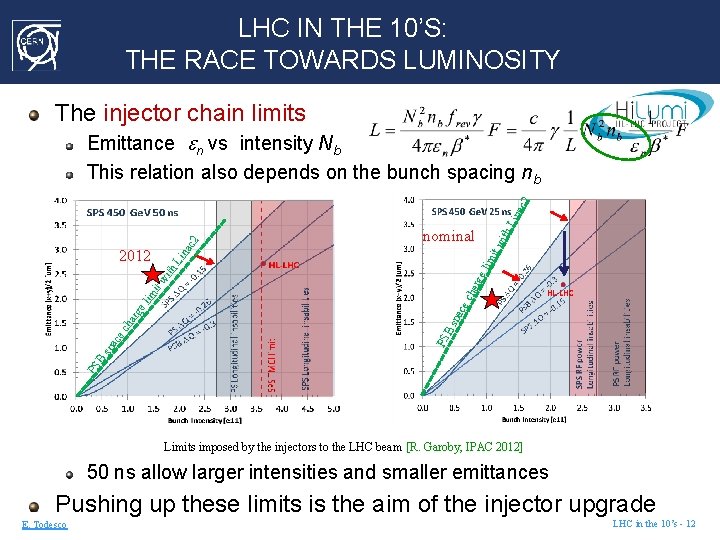
LHC IN THE 10’S: THE RACE TOWARDS LUMINOSITY The injector chain limits Lin ith ec pac Bs PS PS B sp ac e ch arg el im har it w ge ith lim Li 2012 nominal it w na c 2 ac 2 Emittance n vs intensity Nb This relation also depends on the bunch spacing nb Limits imposed by the injectors to the LHC beam [R. Garoby, IPAC 2012] 50 ns allow larger intensities and smaller emittances Pushing up these limits is the aim of the injector upgrade E. Todesco LHC in the 10’s - 12
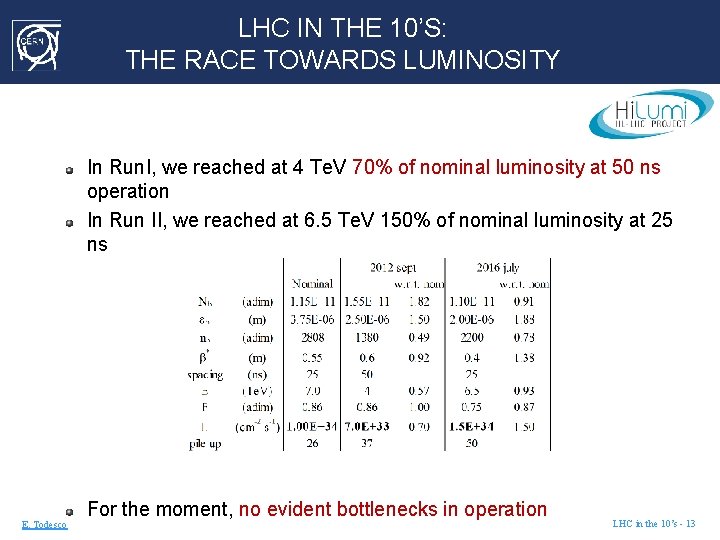
LHC IN THE 10’S: THE RACE TOWARDS LUMINOSITY In Run. I, we reached at 4 Te. V 70% of nominal luminosity at 50 ns operation In Run II, we reached at 6. 5 Te. V 150% of nominal luminosity at 25 ns E. Todesco For the moment, no evident bottlenecks in operation LHC in the 10’s - 13
CONTENTS The present: LHC in the 10’s LHC Energy The race towards luminosity The 20’s: the HL-LHC project Optics and intensity The 30’s: FCC studies Aiming at 100 Te. V centre of mass E. Todesco LHC in the 10’s - 14
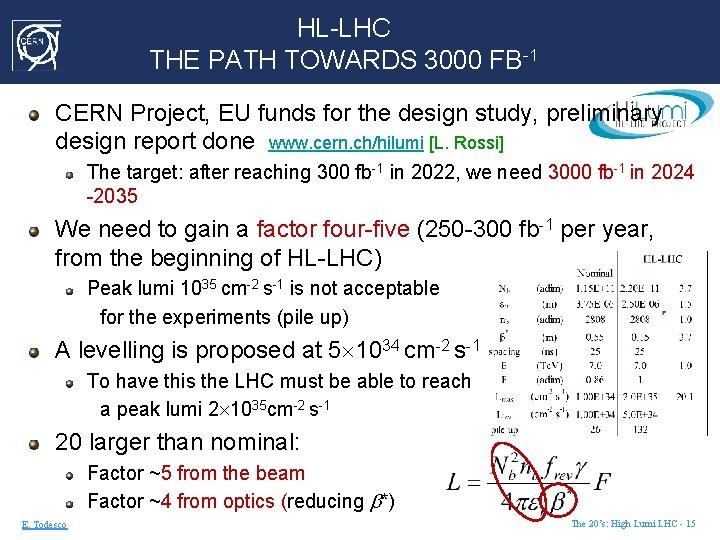
HL-LHC THE PATH TOWARDS 3000 FB-1 CERN Project, EU funds for the design study, preliminary design report done www. cern. ch/hilumi [L. Rossi] The target: after reaching 300 fb-1 in 2022, we need 3000 fb-1 in 2024 -2035 We need to gain a factor four-five (250 -300 fb-1 per year, from the beginning of HL-LHC) Peak lumi 1035 cm-2 s-1 is not acceptable for the experiments (pile up) A levelling is proposed at 5 1034 cm-2 s-1 To have this the LHC must be able to reach a peak lumi 2 1035 cm-2 s-1 20 larger than nominal: Factor ~5 from the beam Factor ~4 from optics (reducing b*) E. Todesco The 20’s: High Lumi LHC - 15
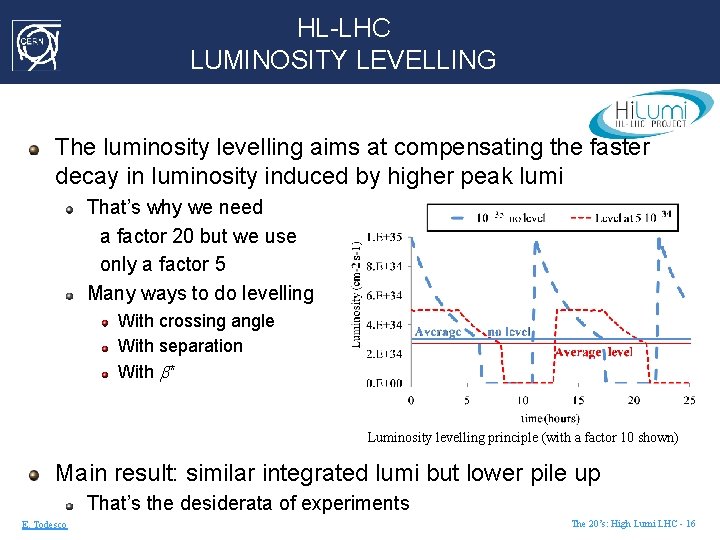
HL-LHC LUMINOSITY LEVELLING The luminosity levelling aims at compensating the faster decay in luminosity induced by higher peak lumi That’s why we need a factor 20 but we use only a factor 5 Many ways to do levelling With crossing angle With separation With b* Luminosity levelling principle (with a factor 10 shown) Main result: similar integrated lumi but lower pile up That’s the desiderata of experiments E. Todesco The 20’s: High Lumi LHC - 16
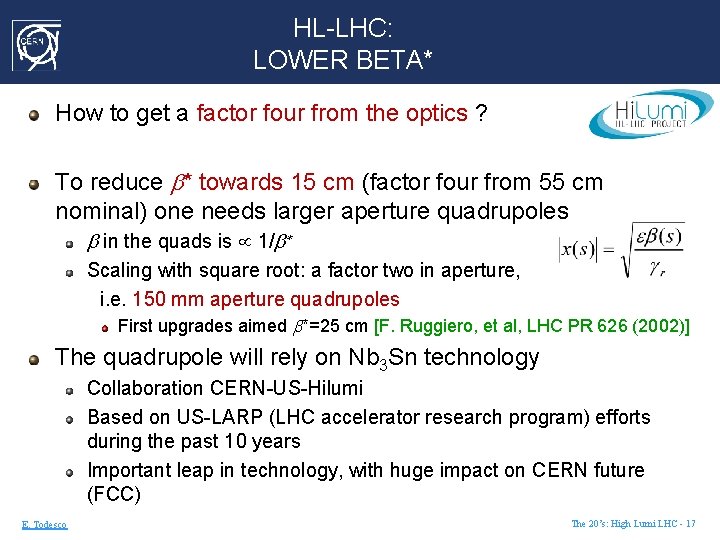
HL-LHC: LOWER BETA* How to get a factor four from the optics ? To reduce b* towards 15 cm (factor four from 55 cm nominal) one needs larger aperture quadrupoles b in the quads is 1/b* Scaling with square root: a factor two in aperture, i. e. 150 mm aperture quadrupoles First upgrades aimed b*=25 cm [F. Ruggiero, et al, LHC PR 626 (2002)] The quadrupole will rely on Nb 3 Sn technology Collaboration CERN-US-Hilumi Based on US-LARP (LHC accelerator research program) efforts during the past 10 years Important leap in technology, with huge impact on CERN future (FCC) E. Todesco The 20’s: High Lumi LHC - 17
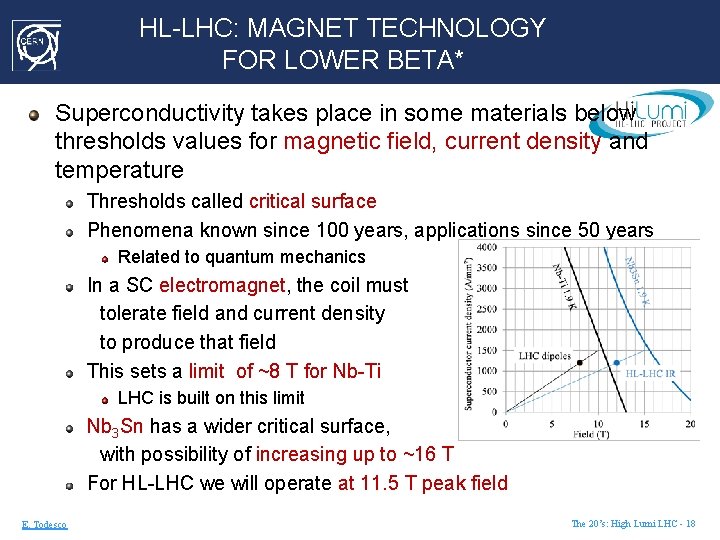
HL-LHC: MAGNET TECHNOLOGY FOR LOWER BETA* Superconductivity takes place in some materials below thresholds values for magnetic field, current density and temperature Thresholds called critical surface Phenomena known since 100 years, applications since 50 years Related to quantum mechanics In a SC electromagnet, the coil must tolerate field and current density to produce that field This sets a limit of ~8 T for Nb-Ti LHC is built on this limit Nb 3 Sn has a wider critical surface, with possibility of increasing up to ~16 T For HL-LHC we will operate at 11. 5 T peak field E. Todesco The 20’s: High Lumi LHC - 18
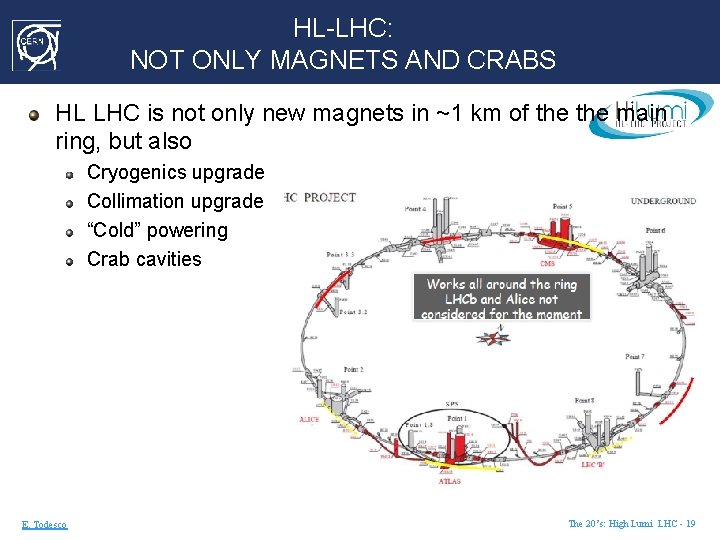
HL-LHC: NOT ONLY MAGNETS AND CRABS HL LHC is not only new magnets in ~1 km of the main ring, but also Cryogenics upgrade Collimation upgrade “Cold” powering Crab cavities E. Todesco The 20’s: High Lumi LHC - 19
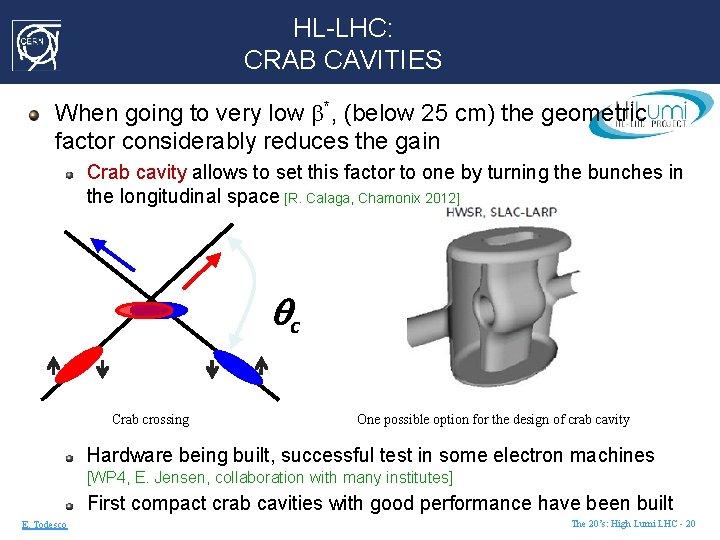
HL-LHC: CRAB CAVITIES When going to very low b*, (below 25 cm) the geometric factor considerably reduces the gain Crab cavity allows to set this factor to one by turning the bunches in the longitudinal space [R. Calaga, Chamonix 2012] qc Crab crossing One possible option for the design of crab cavity Hardware being built, successful test in some electron machines [WP 4, E. Jensen, collaboration with many institutes] First compact crab cavities with good performance have been built E. Todesco The 20’s: High Lumi LHC - 20
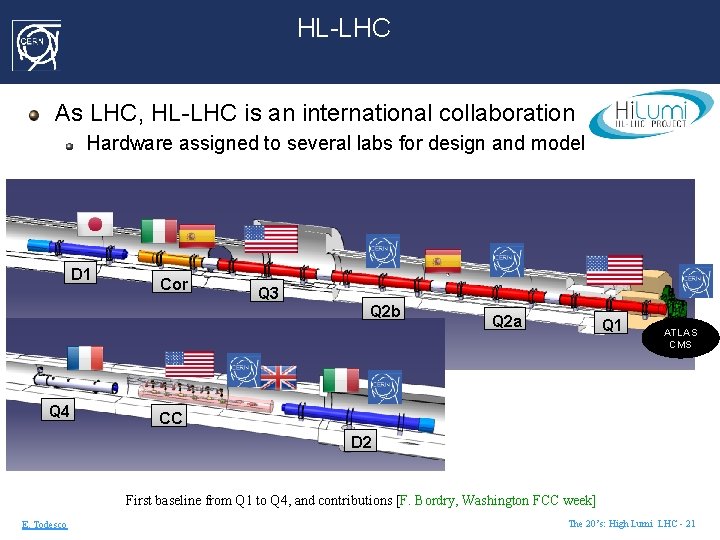
HL-LHC As LHC, HL-LHC is an international collaboration Hardware assigned to several labs for design and model D 1 Q 4 Cor Q 3 Q 2 b Q 2 a Q 1 ATLAS CMS CC D 2 First baseline from Q 1 to Q 4, and contributions [F. Bordry, Washington FCC week] E. Todesco The 20’s: High Lumi LHC - 21
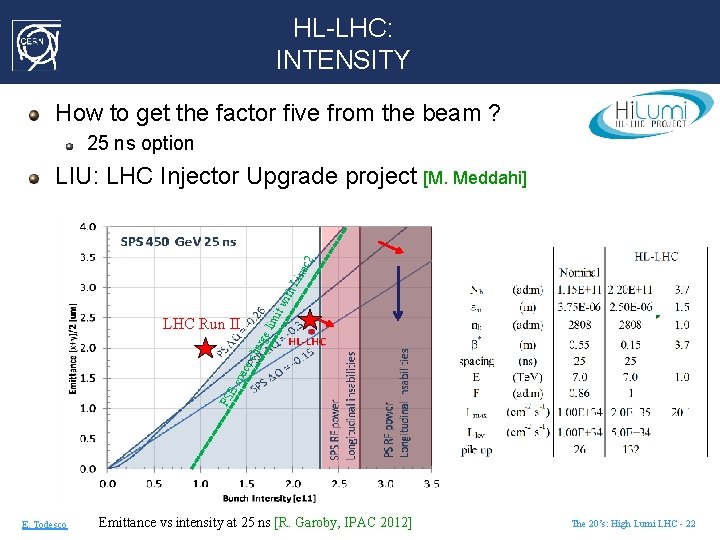
HL-LHC: INTENSITY How to get the factor five from the beam ? 25 ns option it w ith Lin ac 2 LIU: LHC Injector Upgrade project [M. Meddahi] PS Bs pac ec har ge lim LHC Run II E. Todesco Emittance vs intensity at 25 ns [R. Garoby, IPAC 2012] The 20’s: High Lumi LHC - 22
CONTENTS The present: LHC in the 10’s LHC Energy The race towards luminosity The 20’s: the HL-LHC project Optics and intensity The 30’s: FCC studies Aiming at 100 Te. V centre of mass E. Todesco The 30’s: FCC study - 23
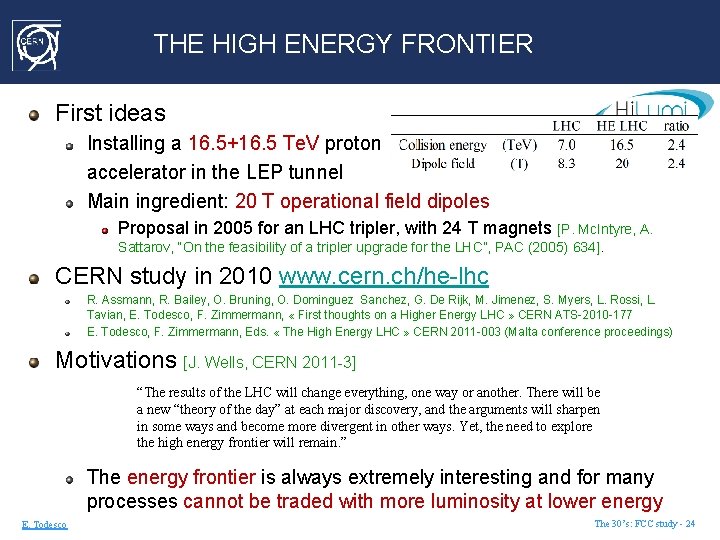
THE HIGH ENERGY FRONTIER First ideas Installing a 16. 5+16. 5 Te. V proton accelerator in the LEP tunnel Main ingredient: 20 T operational field dipoles Proposal in 2005 for an LHC tripler, with 24 T magnets [P. Mc. Intyre, A. Sattarov, “On the feasibility of a tripler upgrade for the LHC”, PAC (2005) 634]. CERN study in 2010 www. cern. ch/he-lhc R. Assmann, R. Bailey, O. Bruning, O. Dominguez Sanchez, G. De Rijk, M. Jimenez, S. Myers, L. Rossi, L. Tavian, E. Todesco, F. Zimmermann, « First thoughts on a Higher Energy LHC » CERN ATS-2010 -177 E. Todesco, F. Zimmermann, Eds. « The High Energy LHC » CERN 2011 -003 (Malta conference proceedings) Motivations [J. Wells, CERN 2011 -3] “The results of the LHC will change everything, one way or another. There will be a new “theory of the day” at each major discovery, and the arguments will sharpen in some ways and become more divergent in other ways. Yet, the need to explore the high energy frontier will remain. ” The energy frontier is always extremely interesting and for many processes cannot be traded with more luminosity at lower energy E. Todesco The 30’s: FCC study - 24
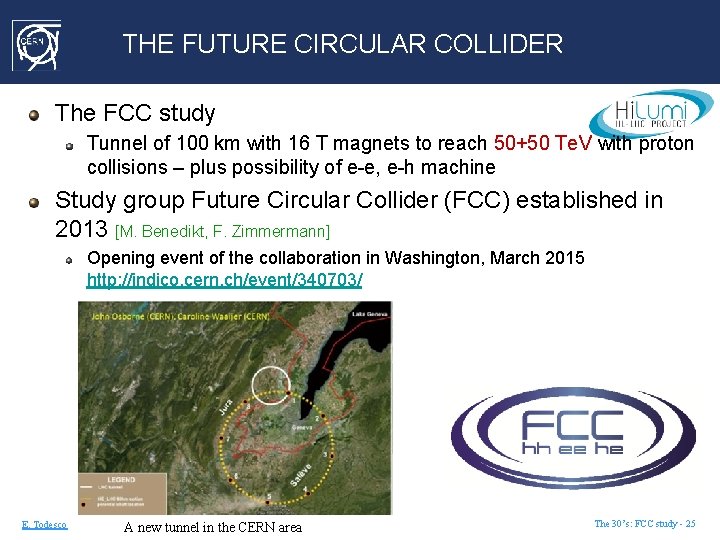
THE FUTURE CIRCULAR COLLIDER The FCC study Tunnel of 100 km with 16 T magnets to reach 50+50 Te. V with proton collisions – plus possibility of e-e, e-h machine Study group Future Circular Collider (FCC) established in 2013 [M. Benedikt, F. Zimmermann] Opening event of the collaboration in Washington, March 2015 http: //indico. cern. ch/event/340703/ E. Todesco A new tunnel in the CERN area The 30’s: FCC study - 25
![THE FUTURE CIRCULAR COLLIDER A baseline is being established [D. Schulte, Washington FCC week]](http://slidetodoc.com/presentation_image_h2/bc79ca0c3c866b573e108a0cf5c94d01/image-26.jpg "THE FUTURE CIRCULAR COLLIDER A baseline is being established [D. Schulte, Washington FCC week]")
THE FUTURE CIRCULAR COLLIDER A baseline is being established [D. Schulte, Washington FCC week] Luminosity as in HL LHC Emittance as in HL LHC Moderate bunch charge 25 ns operation b* of 1 m Pile up 50% larger than HL LHC No leveling Looks reasonable Goal of 250 fb-1 per year There is also an ultimate scenario a kind of HL FCC , very challenging parameters, especially for radiation dose There is also an option for 5 ns operation E. Todesco The 30’s: FCC study - 26
![THE FUTURE CIRCULAR COLLIDER A baseline is being established [D. Schulte WG] 16 T](http://slidetodoc.com/presentation_image_h2/bc79ca0c3c866b573e108a0cf5c94d01/image-27.jpg "THE FUTURE CIRCULAR COLLIDER A baseline is being established [D. Schulte WG] 16 T")
THE FUTURE CIRCULAR COLLIDER A baseline is being established [D. Schulte WG] 16 T magnets with Nb 3 Sn technology (about 5000 dipoles) Aperture of 50 mm Double cell length from 100 to 200 m 5 MW of synchrotron radiation on beam screen It was 7 k. W in the LHC 50 K beam screen Electrical consumption critical 100 MW only of synchrotron Shielding the magnet is essential Tungsten insert of 1 -2 cm Reason for larger aperture Radiation dose OK Becomes very critical for the ultimate Layout baseline [D. Schulte] E. Todesco The 30’s: FCC study - 27
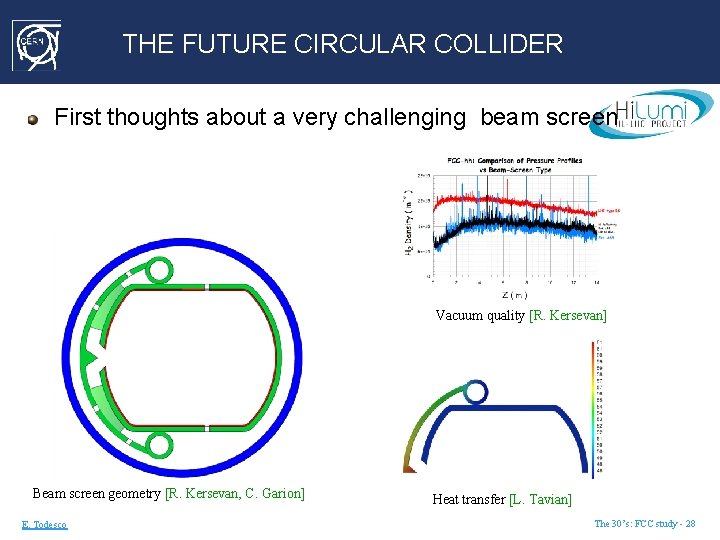
THE FUTURE CIRCULAR COLLIDER First thoughts about a very challenging beam screen Vacuum quality [R. Kersevan] Beam screen geometry [R. Kersevan, C. Garion] E. Todesco Heat transfer [L. Tavian] The 30’s: FCC study - 28
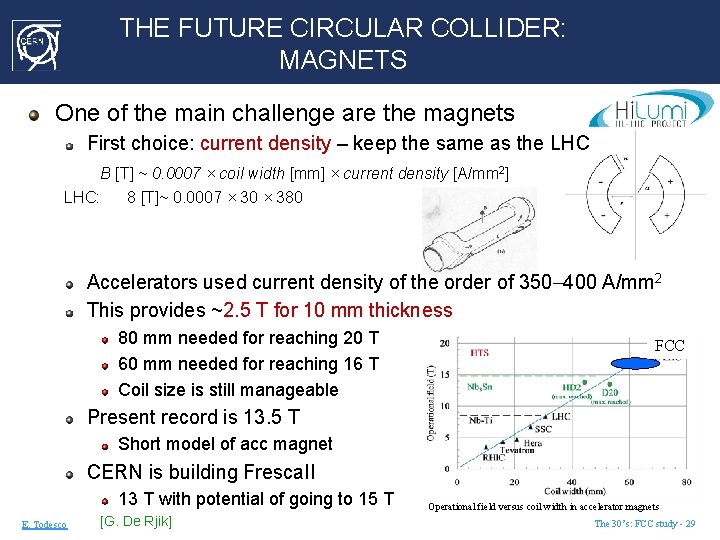
THE FUTURE CIRCULAR COLLIDER: MAGNETS One of the main challenge are the magnets First choice: current density – keep the same as the LHC B [T] ~ 0. 0007 × coil width [mm] × current density [A/mm 2] LHC: 8 [T]~ 0. 0007 × 30 × 380 Accelerators used current density of the order of 350 400 A/mm 2 This provides ~2. 5 T for 10 mm thickness 80 mm needed for reaching 20 T 60 mm needed for reaching 16 T Coil size is still manageable FCC Present record is 13. 5 T Short model of acc magnet CERN is building Fresca. II 13 T with potential of going to 15 T E. Todesco [G. De Rjik] Operational field versus coil width in accelerator magnets The 30’s: FCC study - 29
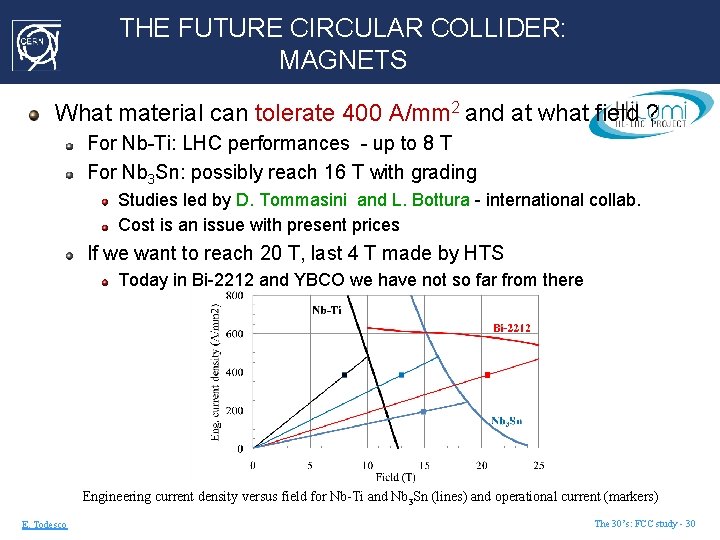
THE FUTURE CIRCULAR COLLIDER: MAGNETS What material can tolerate 400 A/mm 2 and at what field ? For Nb-Ti: LHC performances - up to 8 T For Nb 3 Sn: possibly reach 16 T with grading Studies led by D. Tommasini and L. Bottura - international collab. Cost is an issue with present prices If we want to reach 20 T, last 4 T made by HTS Today in Bi-2212 and YBCO we have not so far from there Engineering current density versus field for Nb-Ti and Nb 3 Sn (lines) and operational current (markers) E. Todesco The 30’s: FCC study - 30
CONCLUSIONS The Fathers of the LHC designed a wise machine with the potential of reaching ultimate performance At full performance one can expect 60 fb-1 per year (four times 2012), and 300 fb-1 at the horizon of the 20’s These 300 fb-1 are the lower estimate for the life of the inner triplet magnets The aperture of the triplet is a bottleneck to performance So in any case better to replace with larger aperture. This will come in ~2024 Coupled with crab cavities, larger triplet can give a factor four boost to luminosity Together with the injector upgrade, one can get another factor five from beam intensity HL LHC can provide 3000 fb-1 at the horizon of the 30’s E. Todesco 31
CONCLUSIONS HL-LHC can provide 3000 fb-1 at the horizon of the 30’s Enabling technologies: large aperture magnets and crab cavities The could be the first application of Nb 3 Sn to accelerators, pushing the operational field from 8 to 12 T With another jump of 4 T, we can go to 16 T, the ultimate of Nb 3 Sn A 100 km tunnel would allow reaching 50+50 Te. V With 100 km ne would need 16 T magnet, which is not so far from our capabilities No bottlenecks have been identified from the point of view of beam dynamics The same magnets in the LHC tunnel would make an LHC doubler E. Todesco 32
- Slides: 32