
CEREBROSPINAL FLUID CSF Formation Circulation Drainage By Prof
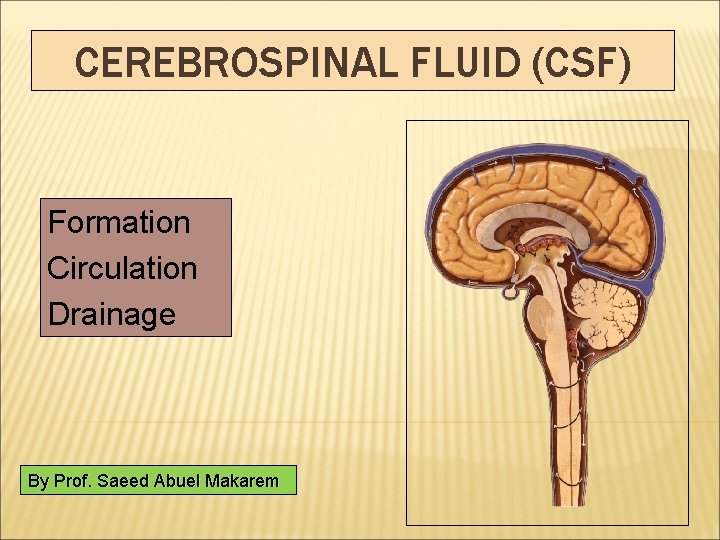
CEREBROSPINAL FLUID (CSF) Formation Circulation Drainage By Prof. Saeed Abuel Makarem
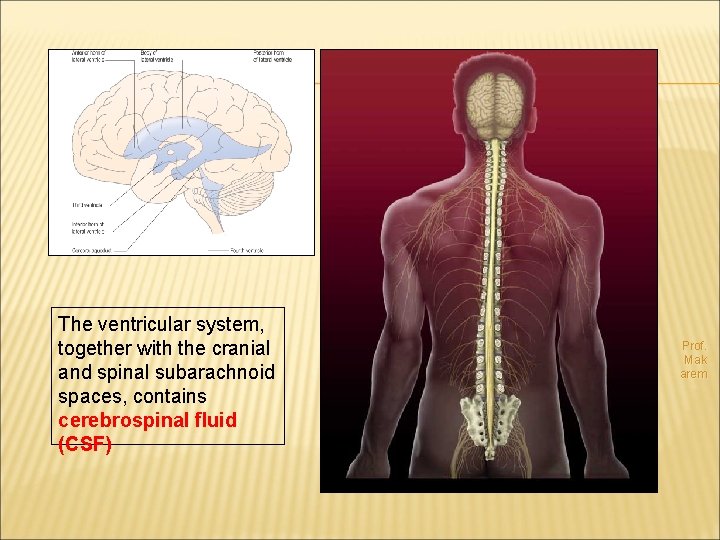
The ventricular system, together with the cranial and spinal subarachnoid spaces, contains cerebrospinal fluid (CSF) Prof. Mak arem
Prof. Makarem CASE STUDY A 6 -month-old infant is brought to the emergency, with fever (38. ) irritability The child suffers a generalized convulsion. A spinal tab demonstrates turbid CSF, With elevated WBCs, and diminished glucose. Culture sensitivity test reveled gram-positive organism. After a course of antibiotic, he was completely recovered. 3 months later he returned with developmental delay, bulging anterior fontanelle, and increasing head circumference. Ct-scanning showed ventriculomegaly. Ventricular-peritoneal shunt is inserted. At 12 months, there is complete restoration of normal milestone.
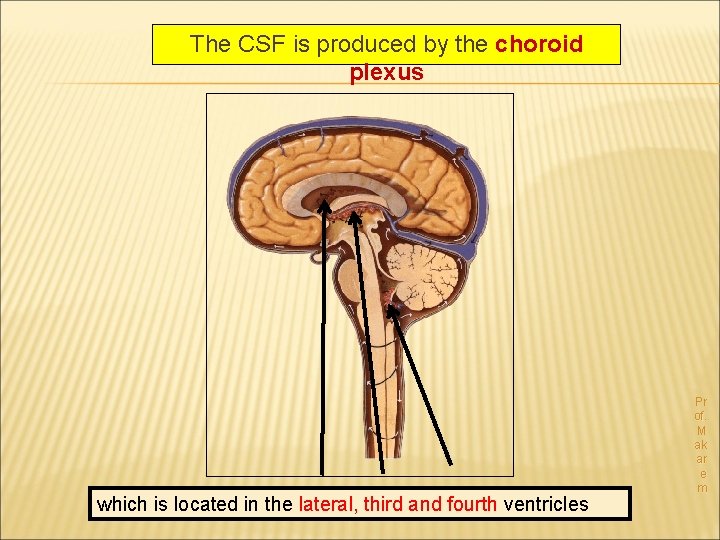
The CSF is produced by the choroid plexus which is located in the lateral, third and fourth ventricles Pr of. M ak ar e m
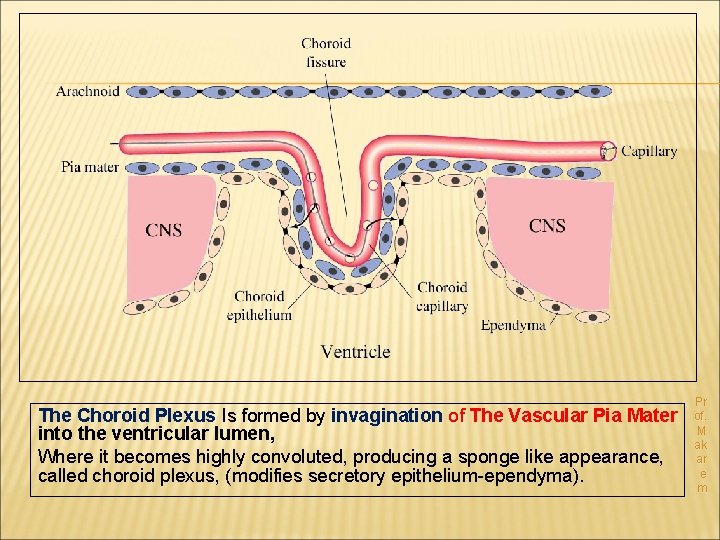
The Choroid Plexus Is formed by invagination of The Vascular Pia Mater into the ventricular lumen, Where it becomes highly convoluted, producing a sponge like appearance, called choroid plexus, (modifies secretory epithelium-ependyma). Pr of. M ak ar e m
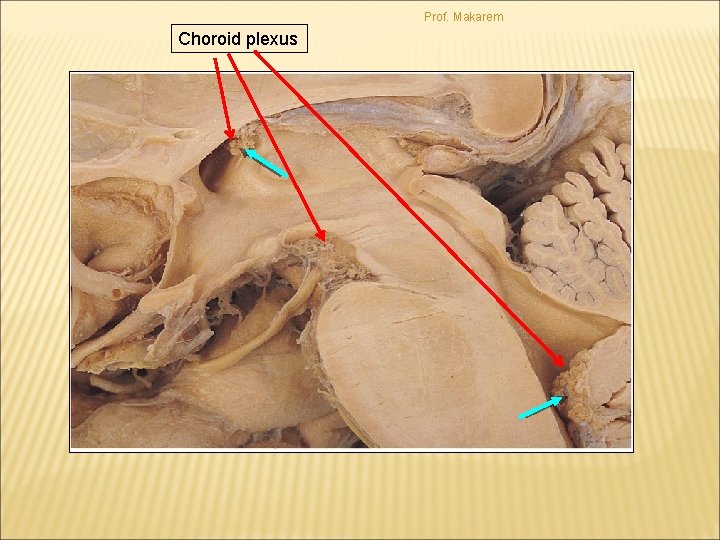
Prof. Makarem Choroid plexus
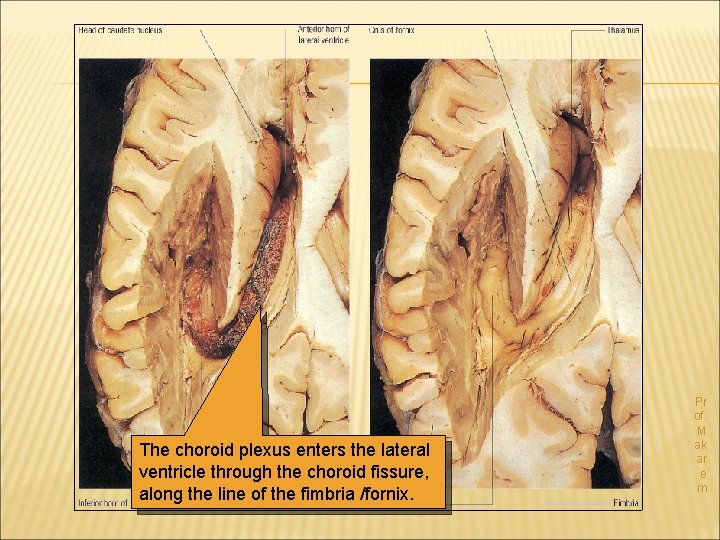
The choroid plexus enters the lateral ventricle through the choroid fissure, along the line of the fimbria /fornix. Pr of. M ak ar e m
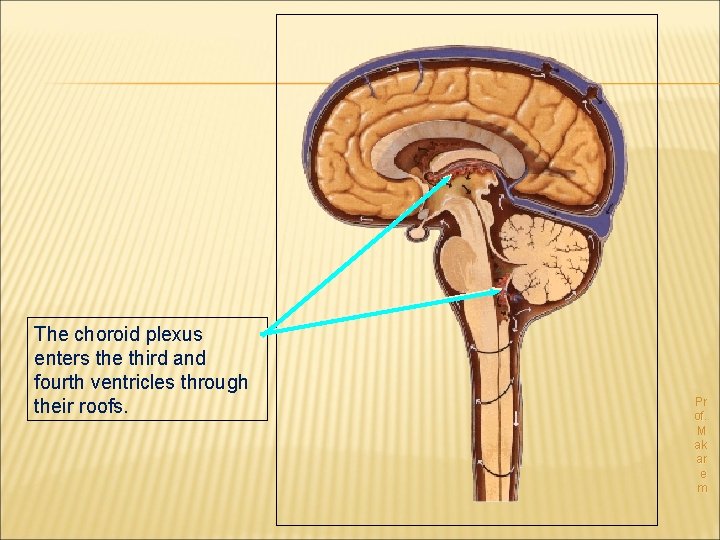
The choroid plexus enters the third and fourth ventricles through their roofs. Pr of. M ak ar e m
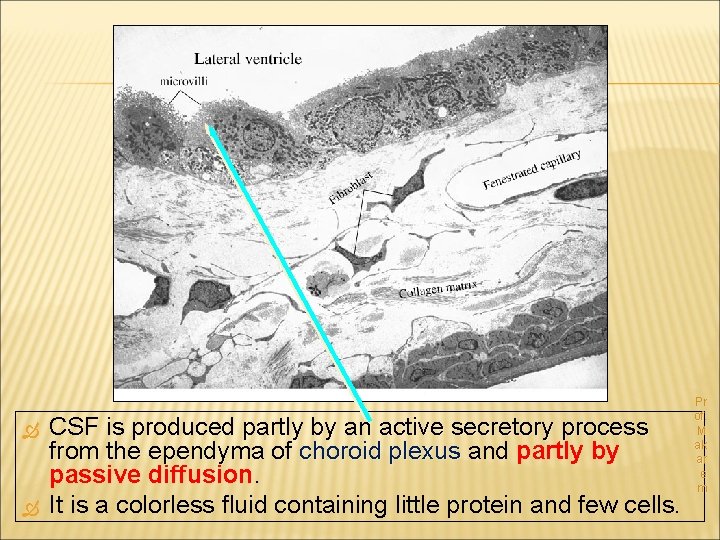
CSF is produced partly by an active secretory process from the ependyma of choroid plexus and partly by passive diffusion. It is a colorless fluid containing little protein and few cells. Pr of. M ak ar e m
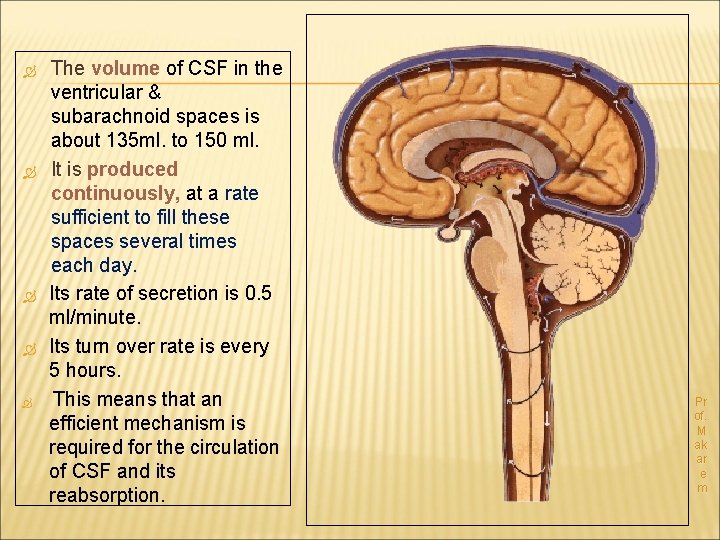
The volume of CSF in the ventricular & subarachnoid spaces is about 135 ml. to 150 ml. It is produced continuously, at a rate sufficient to fill these spaces several times each day. Its rate of secretion is 0. 5 ml/minute. Its turn over rate is every 5 hours. This means that an efficient mechanism is required for the circulation of CSF and its reabsorption. Pr of. M ak ar e m
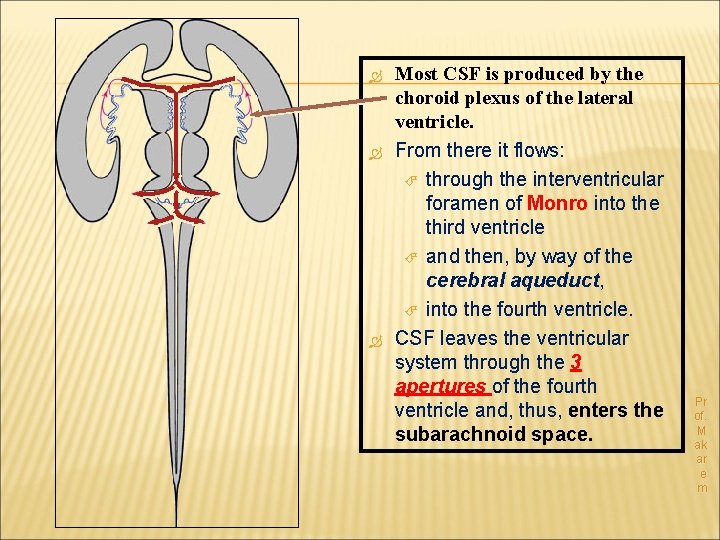
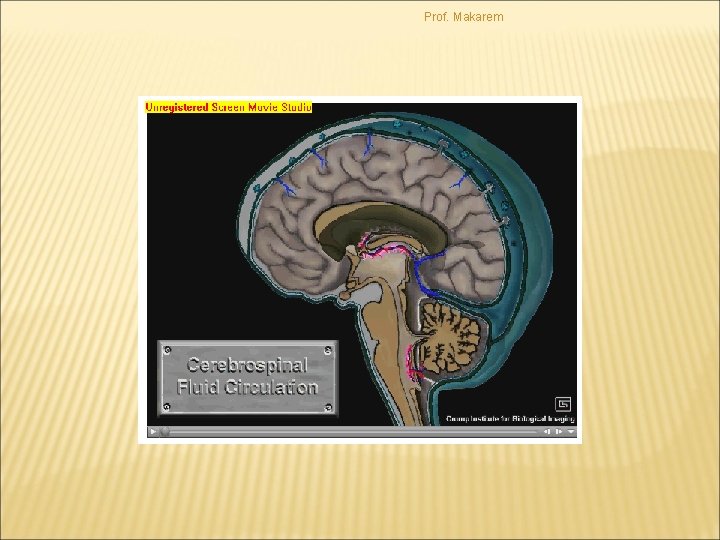
Most CSF is produced by the choroid plexus of the lateral ventricle. From there it flows: through the interventricular foramen of Monro into the third ventricle and then, by way of the cerebral aqueduct, into the fourth ventricle. CSF leaves the ventricular system through the 3 apertures of the fourth ventricle and, thus, enters the subarachnoid space. Pr of. M ak ar e m
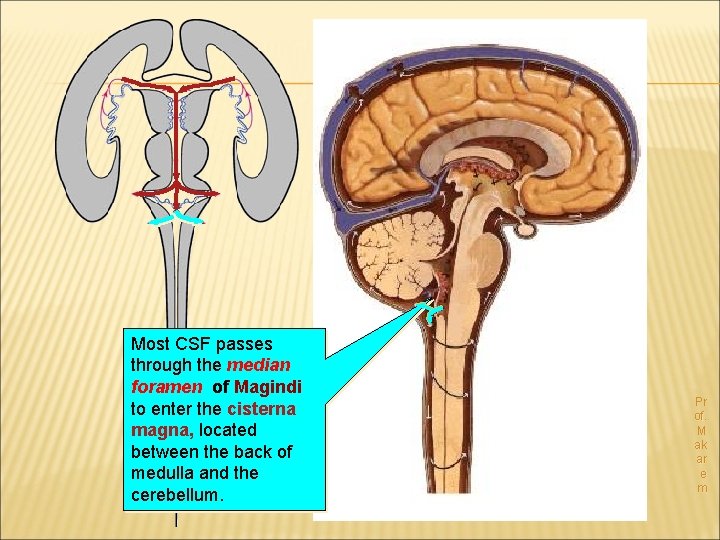
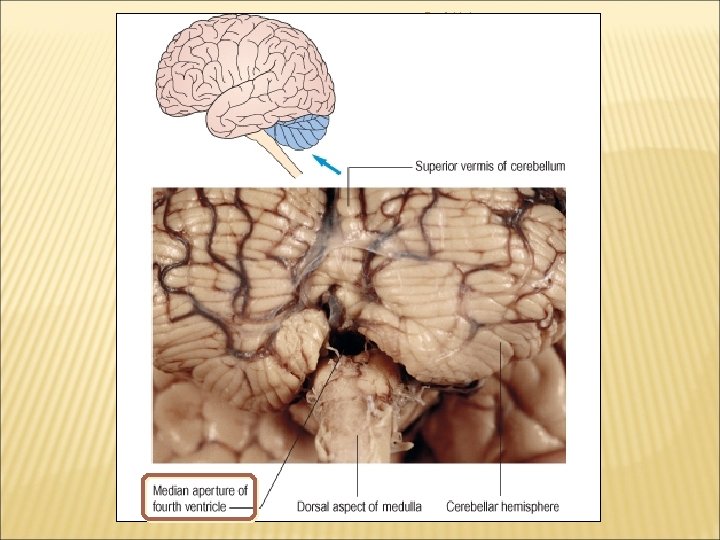
Most CSF passes through the median foramen of Magindi to enter the cisterna magna, located between the back of medulla and the cerebellum. Pr of. M ak ar e m
Prof. Makarem
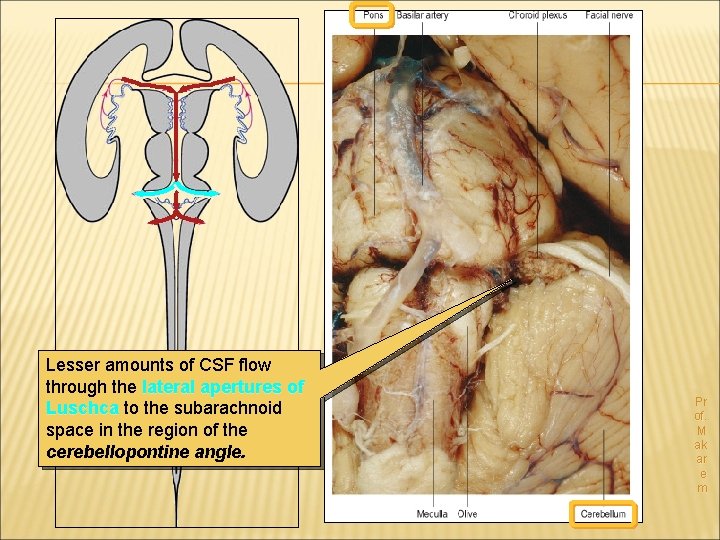
Lesser amounts of CSF flow through the lateral apertures of Luschca to the subarachnoid space in the region of the cerebellopontine angle. Pr of. M ak ar e m
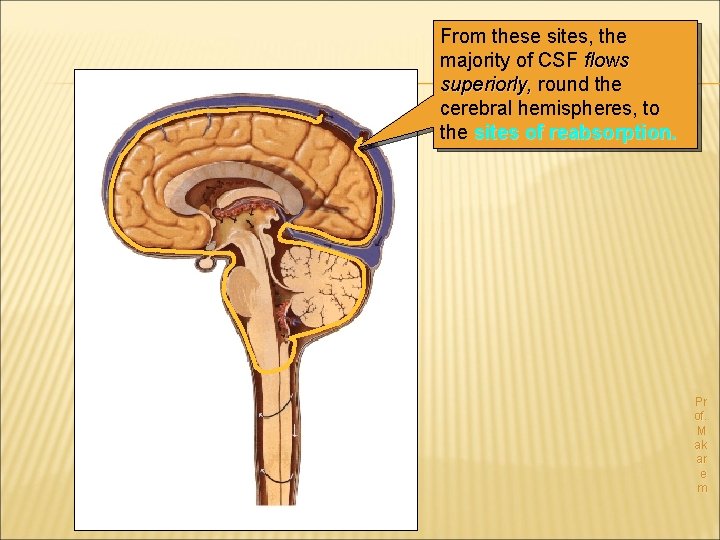
From these sites, the majority of CSF flows superiorly, round the cerebral hemispheres, to the sites of reabsorption. Pr of. M ak ar e m
Prof. Makarem
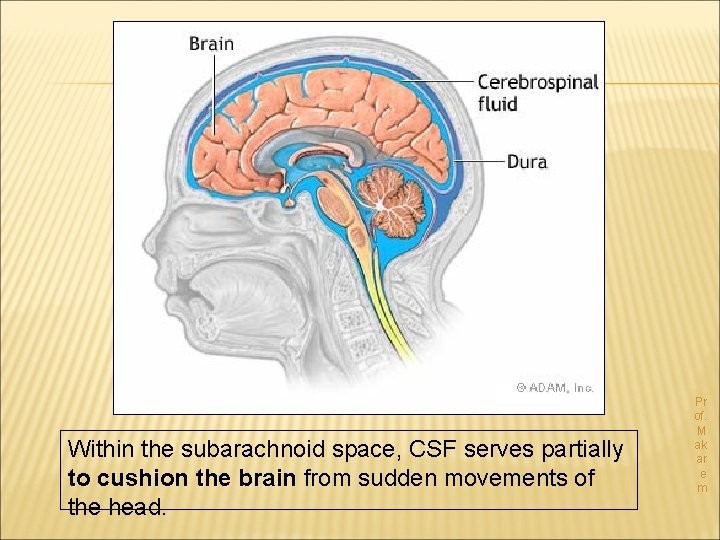
Within the subarachnoid space, CSF serves partially to cushion the brain from sudden movements of the head. Pr of. M ak ar e m
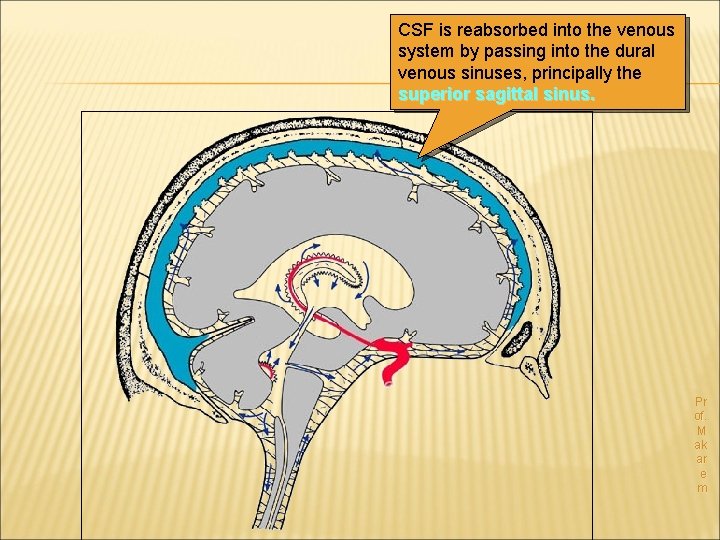
CSF is reabsorbed into the venous system by passing into the dural venous sinuses, principally the superior sagittal sinus. Pr of. M ak ar e m
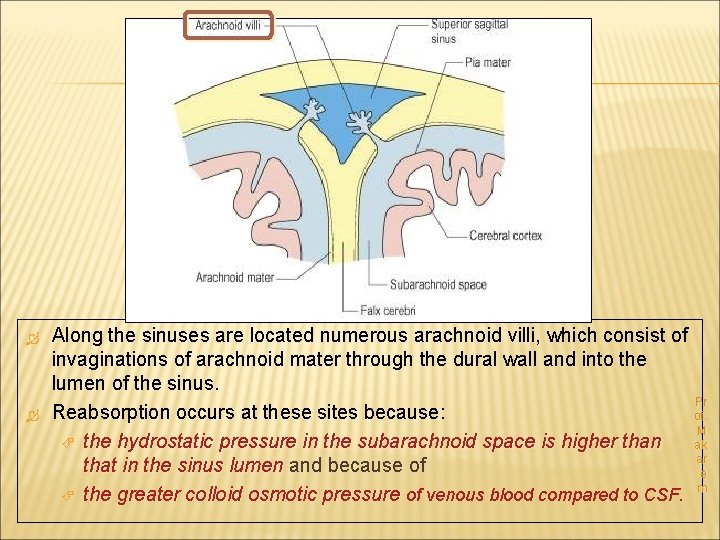
Along the sinuses are located numerous arachnoid villi, which consist of invaginations of arachnoid mater through the dural wall and into the lumen of the sinus. Pr Reabsorption occurs at these sites because: of. M the hydrostatic pressure in the subarachnoid space is higher than ak ar that in the sinus lumen and because of e m the greater colloid osmotic pressure of venous blood compared to CSF.
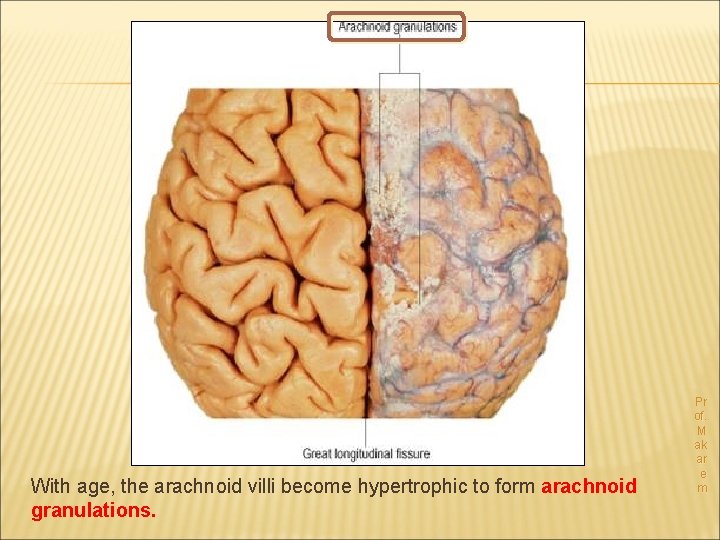
With age, the arachnoid villi become hypertrophic to form arachnoid granulations. Pr of. M ak ar e m

HYDROCEPHALUS
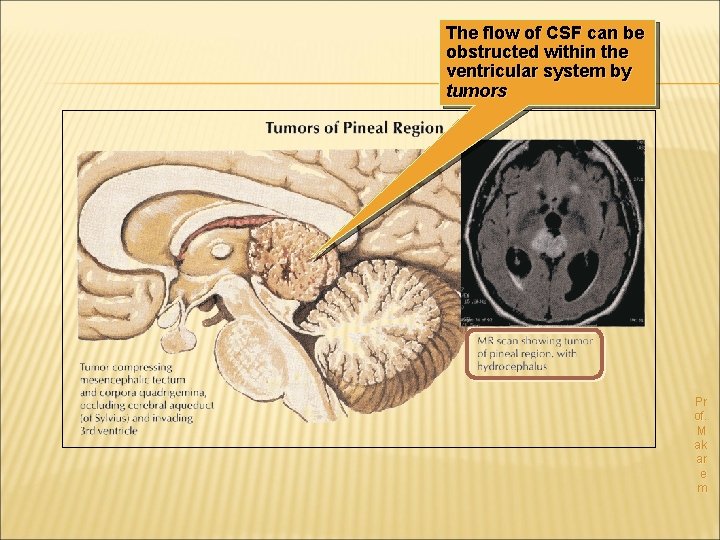
The flow of CSF can be obstructed within the ventricular system by tumors Pr of. M ak ar e m
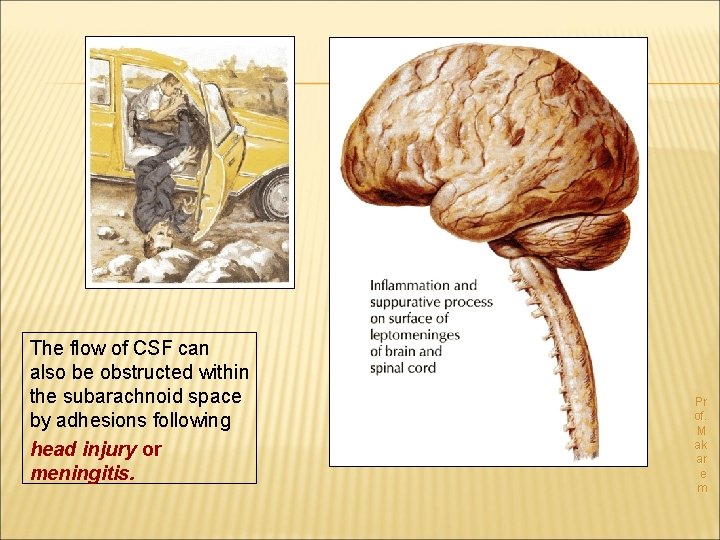
The flow of CSF can also be obstructed within the subarachnoid space by adhesions following head injury or meningitis. Pr of. M ak ar e m
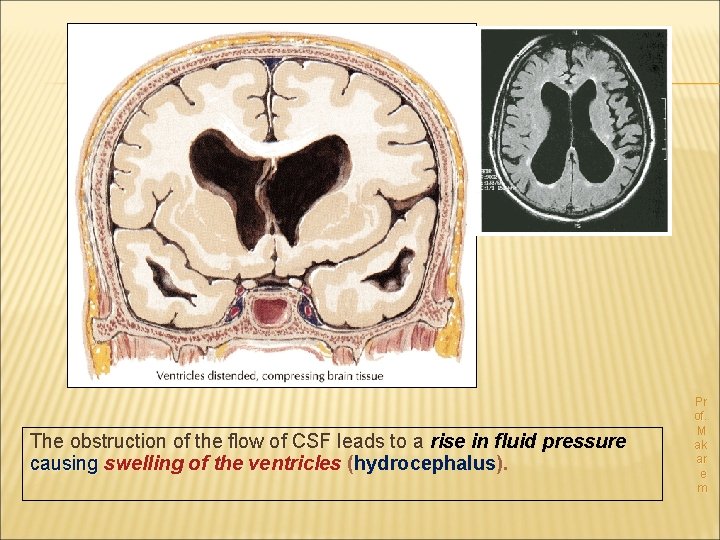
The obstruction of the flow of CSF leads to a rise in fluid pressure causing swelling of the ventricles (hydrocephalus). Pr of. M ak ar e m

Clinical picture of hydrocephalus The clinical effects are similar to those of a brain tumour and consist of headaches, unsteadiness and mental impairment. Pr of. M ak ar e m
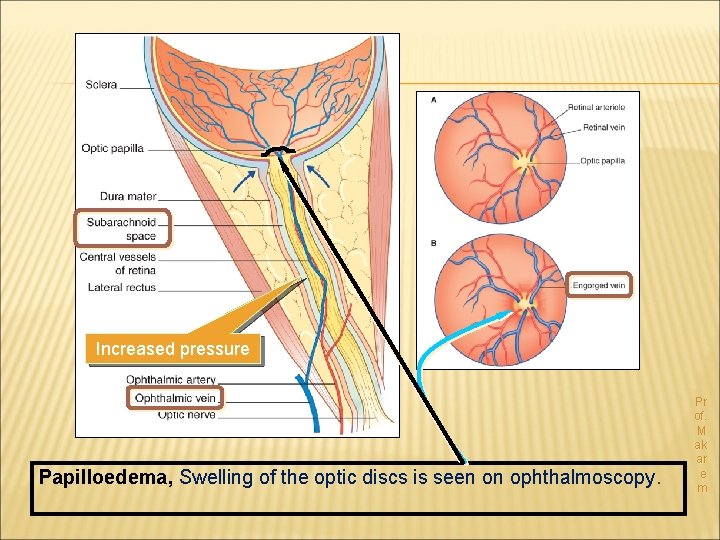
Increased pressure Papilloedema, Swelling of the optic discs is seen on ophthalmoscopy. Pr of. M ak ar e m
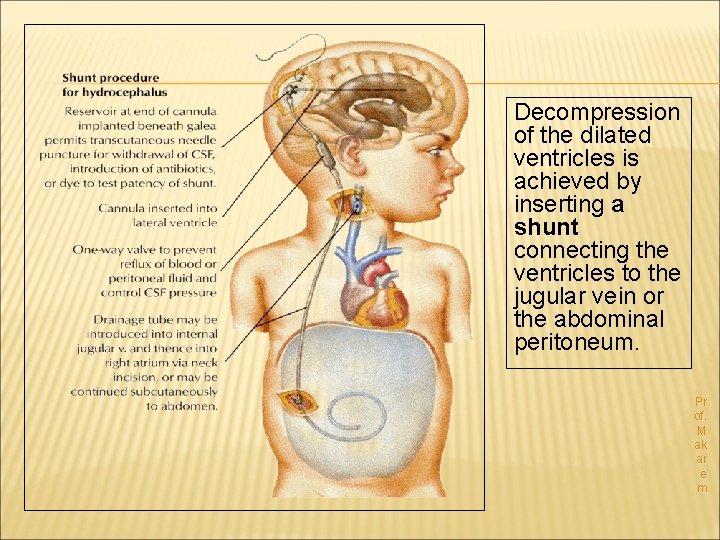
Decompression of the dilated ventricles is achieved by inserting a shunt connecting the ventricles to the jugular vein or the abdominal peritoneum. Pr of. M ak ar e m

THAN K YOU
- Slides: 28