
Cerebral Palsy Rehabilitation Dr Osama Neyaz Assistant Professor
Cerebral Palsy Rehabilitation Dr. Osama Neyaz Assistant Professor Department Of PMR
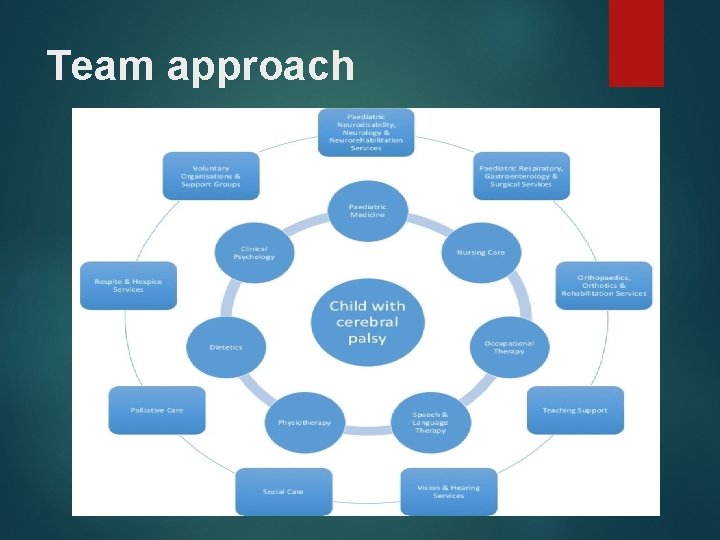
Team approach
Associate manifestations & complications Mental Retardation Epilepsy Feeding, Nutrition, and Growth Bladder Dysfunction Bowel Dysfunction Sleep Disturbances Drooling Hearing Loss Visual Abnormalities Orthopaedic Abnormalities
Goals of Rehabilitation Improve mobility level of child Prevent deformity and contractures Educate parents regarding home management of child To train child in activities of daily living (ADL) To improve social participation of affected child.
Rehabilitation plan There is no single blue print Each patient and his or her family provides a separate challenge
Prognosis Bleck(1987) has described tests for prognosis of walking in children over 1 year Neck righting reflex, asymmetrical and symmetrical tonic neck reflex, Moro reflex – all should disappear by 1 yr Children who retain more than two primitive reflexes after 1 year. Cannot sit unsupported by 4 year. Cannot walk unaided by 8 years are unlikely to ever walk independently.
NON-PHARMACOLOGICAL MANAGEMENT
Basic needs Ability to communicate with others Ability to cope with ADLs Independent mobility Basic needs for a non walking child is straight spine with level pelvis, painless hip and knee and plantigrade feet 9
Physical therapy Passive ROM exercises Stretching exercises Strength training Neurodevelopmental therapy (NDT)/ Bobath technique: aims to improve gross motor function and postural control 10 by facilitating muscle activity through key points of control assisted by therapist.
Physical therapy 11 Constraint-induced movement therapy holds promise in improvements of upper limb dysfunction Involved placing a full arm cast on the unimpaired upper limb for 21 consecutive days, accompanied by intensive training of impaired hand for 6 hours each day. Functional electrical stimulation and biofeedback can be helpful in training specific muscles
Occupational therapy 12 The primary goal is to help patient gain more independence Children work on fine motor skills by grasping and releasing toys Practice handwriting skills and hand-eye coordination Basic tasks such as bathing, dressing, brushing teeth, and eating are also addressed They also work on fitting the child for special devices that help them function. This may include utensils, dressing devices, wheelchairs, bathing seats
Orthosis 13 Goals include reduction of abnormal tone, avoidance of deformity, and facilitation of normal movement patterns AFOs are used in case of dynamic equinus setting the ankle in neutral to slight dorsiflexion promotes heel strike and limits knee recurvatum. Hinged AFOs can be used with plantar flexion stop
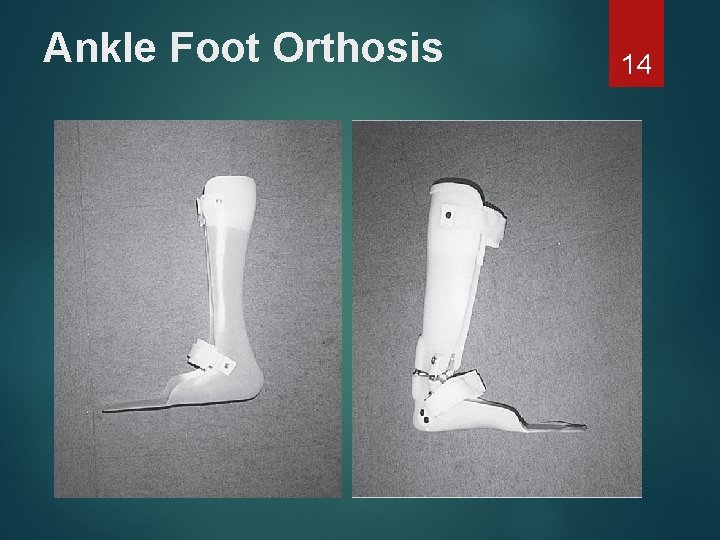
Ankle Foot Orthosis 14
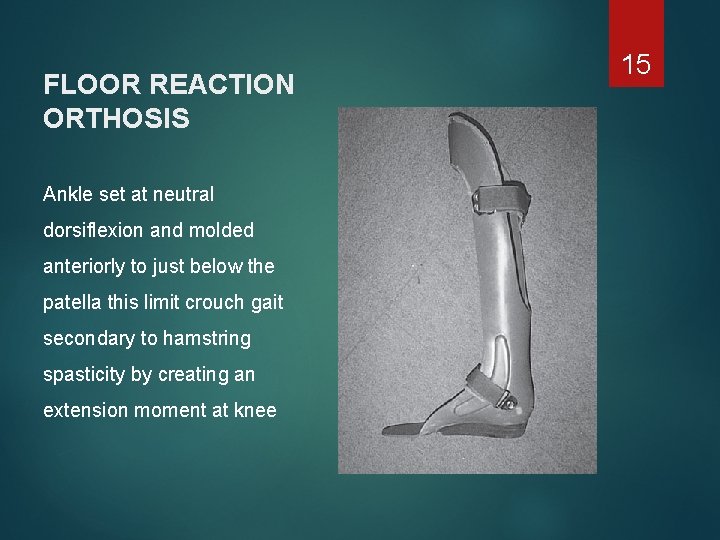
FLOOR REACTION ORTHOSIS Ankle set at neutral dorsiflexion and molded anteriorly to just below the patella this limit crouch gait secondary to hamstring spasticity by creating an extension moment at knee 15
Orthosis 16 Posterior leaf spring orthoses are thinned posteriorly to simulate push-off at the end of stance phase KAFO & HKAFO do not improve gait and they add weight to already weak muscles But they prevent deformity and facilitate standing Long leg Tone inhibiting orthosis (with abduction mechanism in c/o adductor spasticity) and serial casting help in cases of correctable deformities
Assistive technology Power wheelchairs – as young as 20 to 36 months can learn to use Posterior postural walkers Ultrasonic detectors can be incorporated for cortical blindness Augmentative communication devices 17
NON-SURGICAL MANAGEMENT OF CEREBRAL PALSY
General consideration Factors to be considered before spasticity treatment: 1. Whether to treat at all 2. Distribution (focal/ regional/global) 3. Degree of spasticity 4. Family support & ability 5. Physical access to medical care
Treatment options Oral antispasticity medications Nerve & motor point block Botulinum toxin Intrathecal baclofen
Oral medications Baclofen Diazepam Clonazepam Dantrolene Tizanidine
Baclofen MOA: Activates GABA-B & decreases excitatory neurotransmitter release. Dose: - starting dose 1 mg/kg/d (bid). 2 to 7 yr: max 40 mg, 8 to 11: max 60 mg, >12 yr: max 80 mg (divided doses). S/E: sedation, confusion, paraesthesia, weakness. Rapid withdrawal: rebound spasticity, fever, hallucination, seizure. Caution: renal& hepatic compromise.
Diazepam MOA: Acts centrally on GABA-A & facilitates GABA mediated inhibition. Dose: - <12 yr: 0. 1— 0. 8 mg/kg/d, >12 yr: 6— 30 mg/d. (divided tid or qid) S/E: sedation, memory loss. Rapid withdrawal: anxiety, insomnia, seizures. Caution: Hepatic compromise
Clonazepam MOA: Same as Diazepam Dose: - <10 yr: 0. 1— 0. 2 mg/kg/d, >10 yr: max 20 mg/d. (divided bid/tid) S/E: more sedation than Diazepam.
Tizanidine MOA: Alpha 2 agonist, facilitates action of glycine spinally & supraspinally. Dose: 0. 2— 0. 3 mg/kg/d (tid/qid). Advantage: Reduces spasm at night, helpful for sleep S/E: hypotension, drowsiness. Caution: Ciprofloxacin, hepatic compromise.
Nerve & motor point block Nerve block: Peri-neural injection targeting a motor/mixed nerve to impair its function. Motor point block: Intramuscular injection lower down the nerve trunk (below sensory branches) to create a motor block with minimum sensory involvement.
Chemical denervation agents Phenol (5 -7%): Denature protein of nerve tissue. Alcohol (45 -100%): Dehydrates nerve tissue & causes sclerosis of myelin sheath. Site: Motor nerve/point located by electrical nerve stimulator.
Disadvantage of phenol/alcohol Needs precise location of injection. Pain & dysesthesia very common. Overdose & accidental i. v injection may lead to depression, convulsion, cardiovascular collapse.
Botulinum toxin A protein and neurotoxin produced by the anaerobic bacteria Clostridium botulinum. MOA: Blocks neurotransmitter (Ach) release at the peripheral cholinergic nerve terminals Reduction in muscle tension improved passive and active range of motion, facilitates stretching techniques (casting and splinting). Dosing is based on amount of tone present, patient’s prior response to injections, residual function of the spastic muscles, and potential impact of excessive tonal reduction
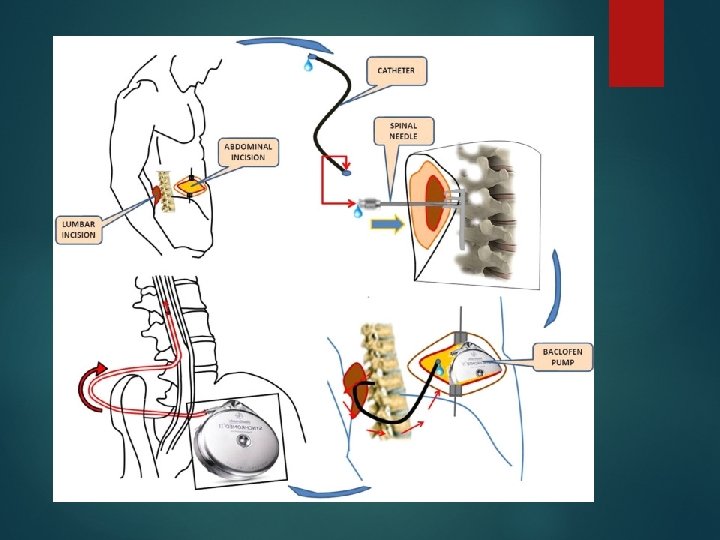
Intrathecal baclofen ITB therapy significantly reduced severe spasticity which did not respond to oral medications and botulinum toxin treatment. It might have reversible adverse effects or catheter-related complications and spasticity reduction did not always induce functional improvements.
SURGICAL MANAGEMENT
Four basic principles Although the central nervous system injury, by definition, is nonprogressive, the deformities caused by abnormal muscle forces and contractures are progressive. The treatments currently available correct the secondary deformities only and not the primary problem. The deformities typically become worse during times of rapid growth. For some patients, it may be beneficial to delay surgery until after a significant growth spurt to decrease the risk of recurrence. Operative or non-operative treatment should be done to minimize the impact it has on the patient's socialization and education.
Operative Treatment Operative treatment of deformities: (1) correct static or dynamic deformity (2) balance muscle power across a joint (3) reduce spasticity (neurectomy) (4) stabilize uncontrollable joints Often, procedures can be combined—an adductor tendon release can be done at the time of pelvic osteotomy for hip subluxation.
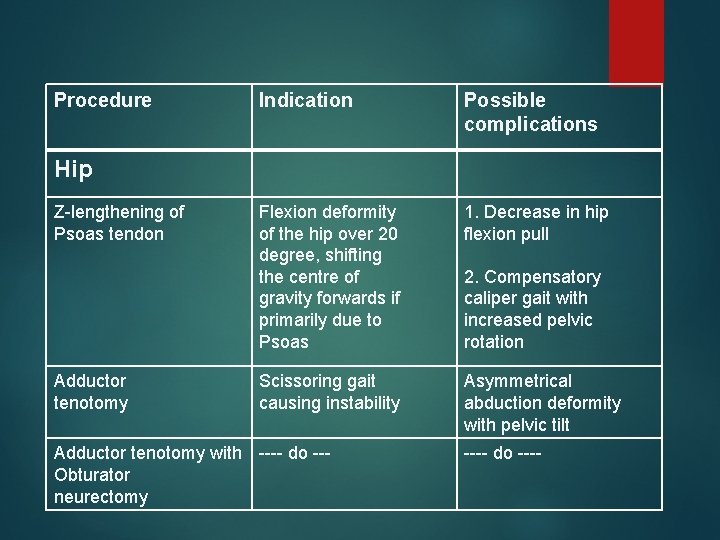
Procedure Indication Possible complications Flexion deformity of the hip over 20 degree, shifting the centre of gravity forwards if primarily due to Psoas 1. Decrease in hip flexion pull Scissoring gait causing instability Asymmetrical abduction deformity with pelvic tilt Hip Z-lengthening of Psoas tendon Adductor tenotomy with ---- do --Obturator neurectomy 2. Compensatory caliper gait with increased pelvic rotation ---- do ----
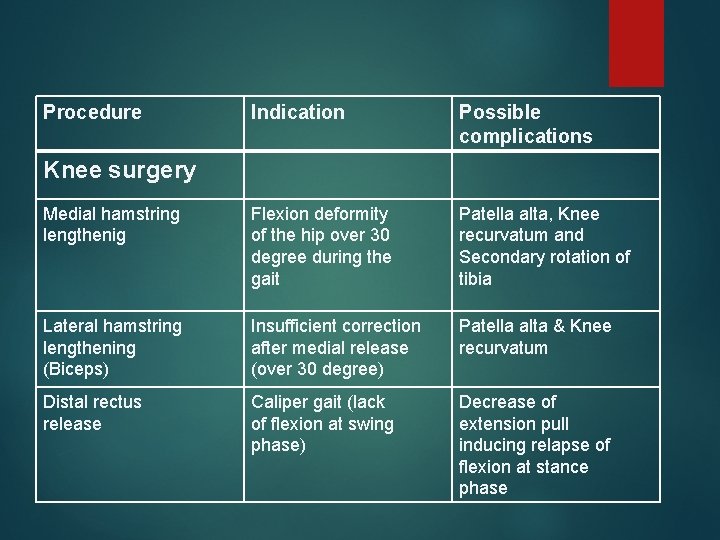
Procedure Indication Possible complications Medial hamstring lengthenig Flexion deformity of the hip over 30 degree during the gait Patella alta, Knee recurvatum and Secondary rotation of tibia Lateral hamstring lengthening (Biceps) Insufficient correction after medial release (over 30 degree) Patella alta & Knee recurvatum Distal rectus release Caliper gait (lack of flexion at swing phase) Decrease of extension pull inducing relapse of flexion at stance phase Knee surgery
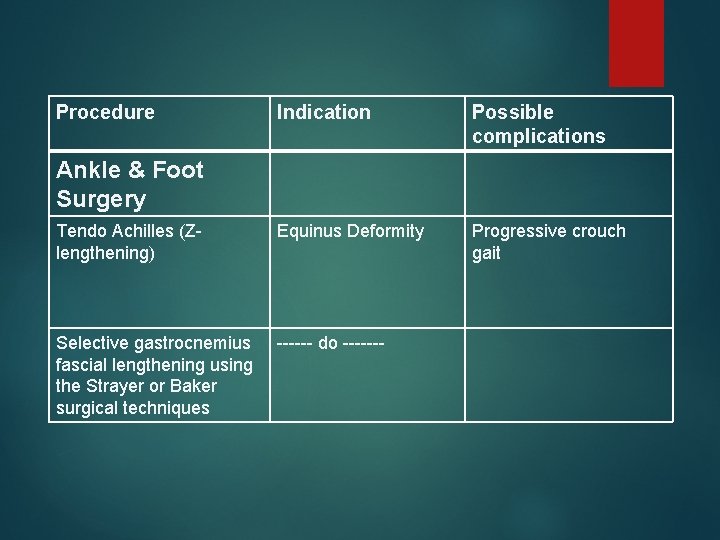
Procedure Indication Possible complications Tendo Achilles (Zlengthening) Equinus Deformity Progressive crouch gait Selective gastrocnemius fascial lengthening using the Strayer or Baker surgical techniques ------ do ------- Ankle & Foot Surgery
Thank you
- Slides: 38