
CEREBRAL PALSY DR OMAR ALI NAFI MRCPire INTRODUCTION
CEREBRAL PALSY DR OMAR ALI NAFI MRCP(ire)
INTRODUCTION
WHAT IS CEREBRAL PALSY? n DEFINITION n Is persistent (not progressive) disorder of movements and / or posture caused by a lesion to the immature brain n Although it has historically considered a STATIC ENCEPHALOPATHY this term is now inaccurate NELSON text book of pediatric 17 ed
INCIDENCE n 2/1000 n Most common and costly chronic disorder
PRENATAL 75% Intrauterine exposure to maternal infection - Rubella - cmv - toxoplasmosis -others -placental insufficiency -cerebrovascular accident -chromosomal anomalies n Brain malformation n Genetic factores n
PERINATAL 10% Collaborative perinatal project n 45 000 children were regularly monitored from pregnancy to the age of 7 years, found that most children with CP had been born at term with uncomplicated labours n Fewer than 10% of children with CP have evidence of birth asphyxia n CP prevalence is increased among low birth weight infants due to periventricular leukomalacia(PVL)
POSTNATAL 15% n Hyperbilirubinemia n Bacterial meningitis n Viral encephalitis n Shaken baby syndrome
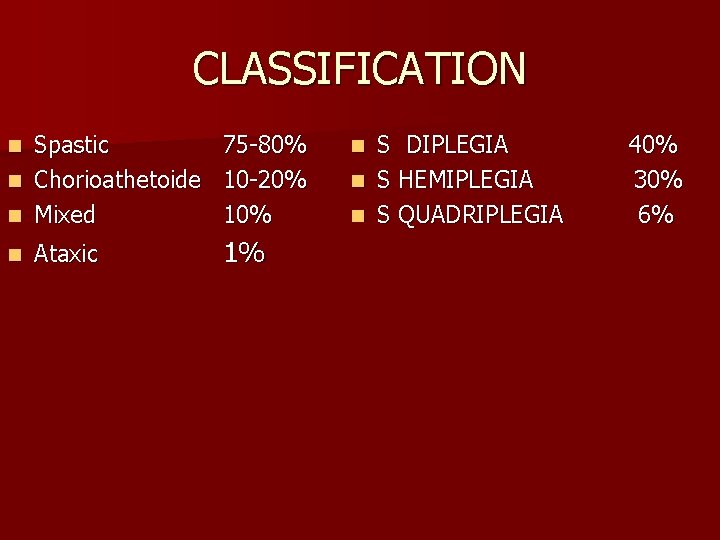
CLASSIFICATION Spastic 75 -80% n Chorioathetoide 10 -20% n Mixed 10% n n Ataxic 1% S DIPLEGIA n S HEMIPLEGIA n S QUADRIPLEGIA n 40% 30% 6%
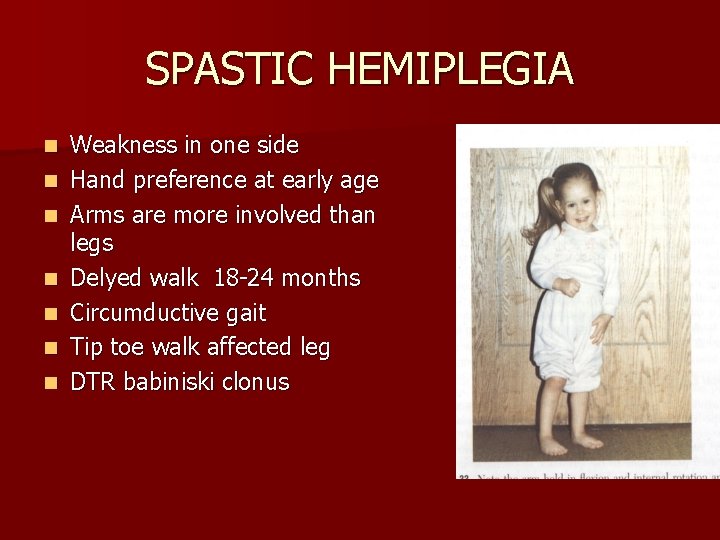
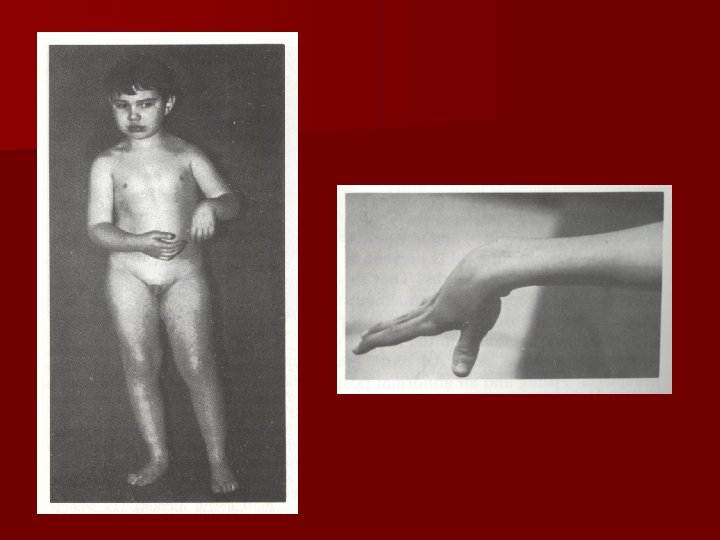
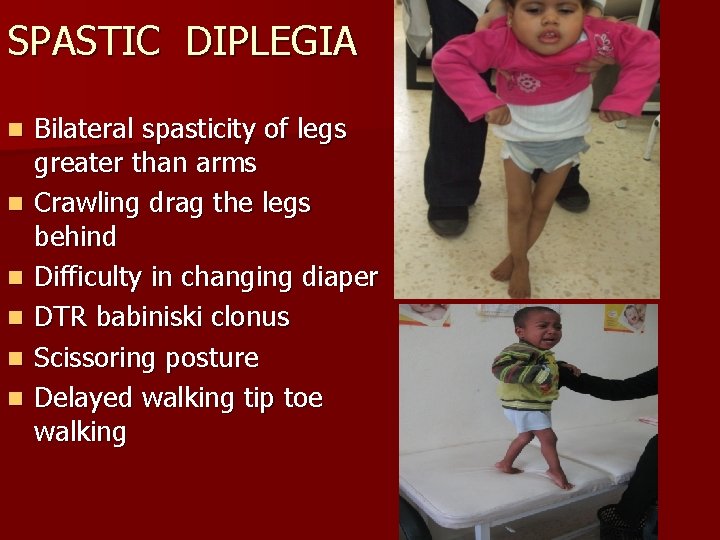
SPASTIC HEMIPLEGIA n n n n Weakness in one side Hand preference at early age Arms are more involved than legs Delyed walk 18 -24 months Circumductive gait Tip toe walk affected leg DTR babiniski clonus
SPASTIC DIPLEGIA n n n Bilateral spasticity of legs greater than arms Crawling drag the legs behind Difficulty in changing diaper DTR babiniski clonus Scissoring posture Delayed walking tip toe walking
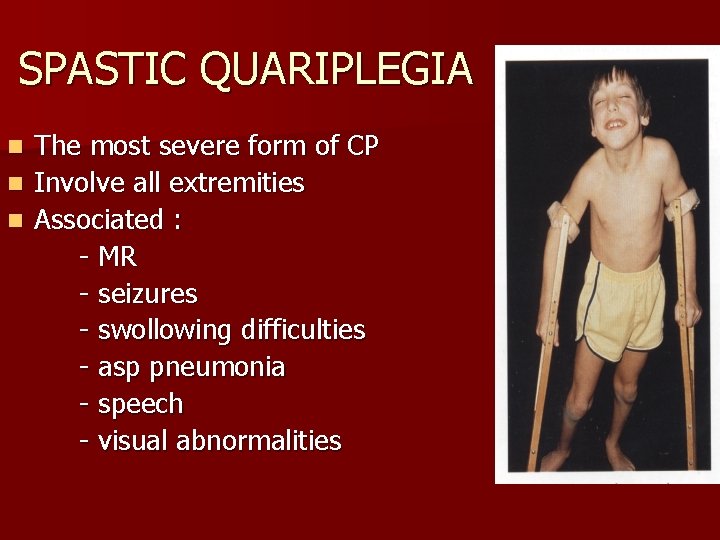
SPASTIC QUARIPLEGIA The most severe form of CP n Involve all extremities n Associated : - MR - seizures - swollowing difficulties - asp pneumonia - speech - visual abnormalities n
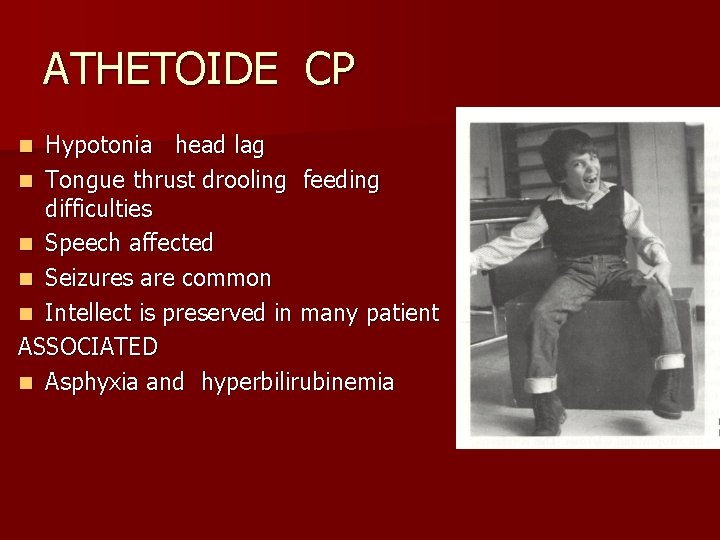
ATHETOIDE CP Hypotonia head lag n Tongue thrust drooling feeding difficulties n Speech affected n Seizures are common n Intellect is preserved in many patient ASSOCIATED n Asphyxia and hyperbilirubinemia n
ATAXIC CP 1% n Asphyxia and cong. Anomalies mainly n Acquired cases hydrocephalus n Hypotona then spasticity , DTR n Tremor titubation in sitting position n Arms ataxia n Staccato speech n Mental retardation 30%
MIXED FORMS CP n Presence of athetoide mov in one limb and hemiplegia in the other or presence of ataxia and spasticity n Functional analysis of individual patient is the bases of therapy
Diagnosis * History. * Physical examination. * Lab studies.
Diagnosis… History ■ Prenatal H. ■ Perinatal H. ■ Developmental H. ■ General medical H.
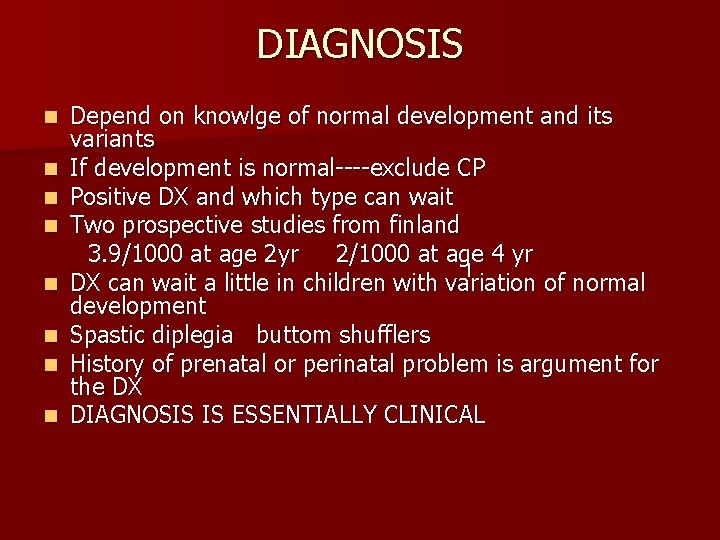
DIAGNOSIS n n n n Depend on knowlge of normal development and its variants If development is normal----exclude CP Positive DX and which type can wait Two prospective studies from finland 3. 9/1000 at age 2 yr 2/1000 at age 4 yr l DX can wait a little in children with variation of normal development Spastic diplegia buttom shufflers History of prenatal or perinatal problem is argument for the DX DIAGNOSIS IS ESSENTIALLY CLINICAL
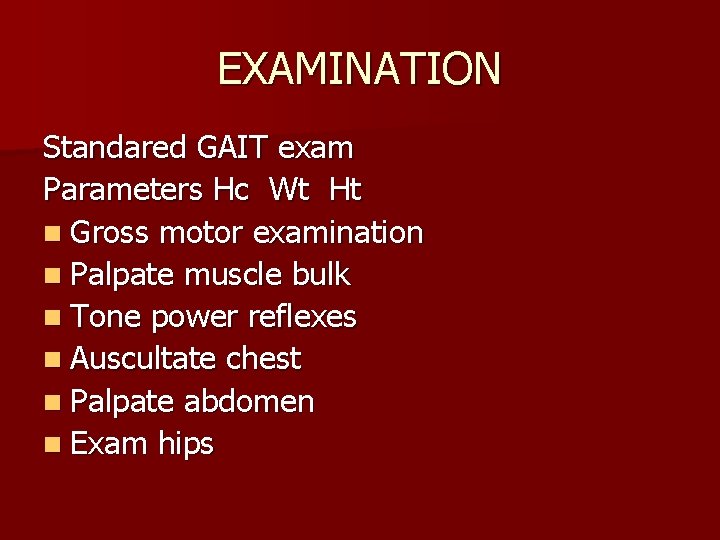
EXAMINATION Standared GAIT exam Parameters Hc Wt Ht n Gross motor examination n Palpate muscle bulk n Tone power reflexes n Auscultate chest n Palpate abdomen n Exam hips
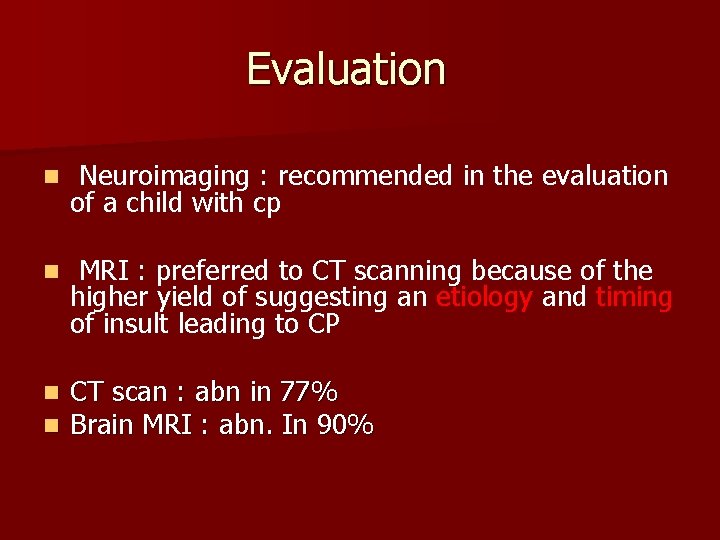
Evaluation n Neuroimaging : recommended in the evaluation of a child with cp n MRI : preferred to CT scanning because of the higher yield of suggesting an etiology and timing of insult leading to CP n n CT scan : abn in 77% Brain MRI : abn. In 90%
ASSOCIATIONS n n n Severe hearing difficulties 30% Moderete learning difficulties 30% Mental retardation Ophthalmlogical abnormalities Epilepsy 30%-45% Communication disorder Failure to thrive Feeding difficulties Gastro esophagueal reflux sandifer syndrome Behavioral problems Impaired hearing 20%
SOCIAL IMPLICATION n CHILD ADHD depression n Other sibling neglect n Parents - emotional - financial - physical
The multidisciplinary team * Paediatrician. * Neurologist. * Orthopedic. * Paediatric surgery. * Ophtalmologist. * Otorhinolaryngologist. * Physical therapist. * Occupational therapist. * Speech and language therapist. * Dentist. * Nutritionist. * Clinical psychologist. * Social worker.
Management of spasticity * Oral medication : Baclofen , Dantrolene , diazepam. * Intrathecal medication. * Botulium toxin injections into affected muscles. * Nerve blocks. * Selective dorsal rhizotomy. * Orthopedic surgery.
Management of seizures * Choose one medication that offers the best control. Generalised TC seizure Carbamazepine , Depakine Absence Ethosuximide , depakine Myoclonic Depakine Partial or simple Carbamazepine
Growth and nutrition * The GROWTH should be monitored. * HC should be measured periodically. * Attention to the nutritional status. * Obesity. * Constipation.
Gasrtrointestinal conditions Ensure adequate intake of fiber and fluids for bowel control. * Recommend upright positioning during and after feeding. * Consider small, and frequent meals. * Prescribe anti-ulcer medications.
Respiratory conditions * Monitor swallowing function. * Monitor carefully for scoliosis. * Watch closely for signs of pneumonia. * Treat pneumonia with antibiotics.
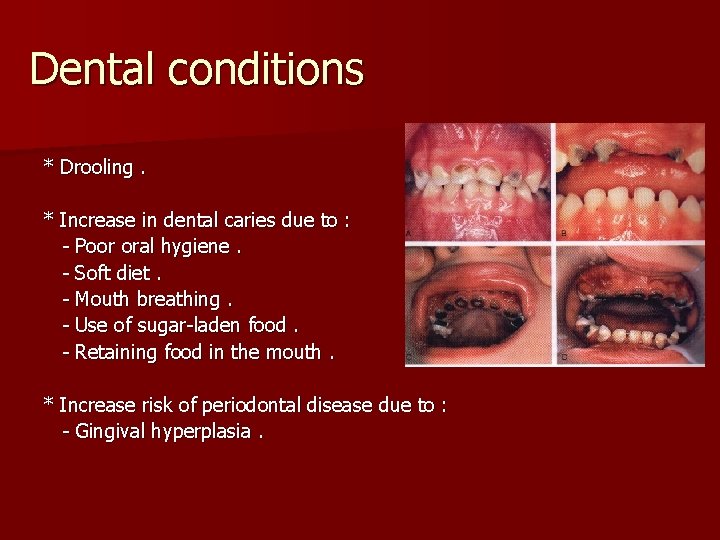
Dental conditions * Drooling. * Increase in dental caries due to : - Poor oral hygiene. - Soft diet. - Mouth breathing. - Use of sugar-laden food. - Retaining food in the mouth. * Increase risk of periodontal disease due to : - Gingival hyperplasia.
Management of cognitive, psychosocial and behavior disorder ment of ADHD , and learning disabilities. * Improve the academic performance. * Treatment of the depression.
PROGNOSIS n n n Life span some experience normal span Severe forms reduced span If not sitting up by him self by age 4 years or walking by age 8 years he will never be an independent walker Children with CP do not stop doing activities once they begun to do them loss of skills(regression) is not a charecteristic of CP Mental retardation is far more likely than CP to impair a child to function
PREVENTION n Prevent head injury - child safety seats in cars n Prevent child abuse n Treat hyperbilirubinemia n Identify Rh incompatibility n Vaccination against rubella

- Slides: 33