
Cerebral Hemisphere The medial longitudinal fissure separates the
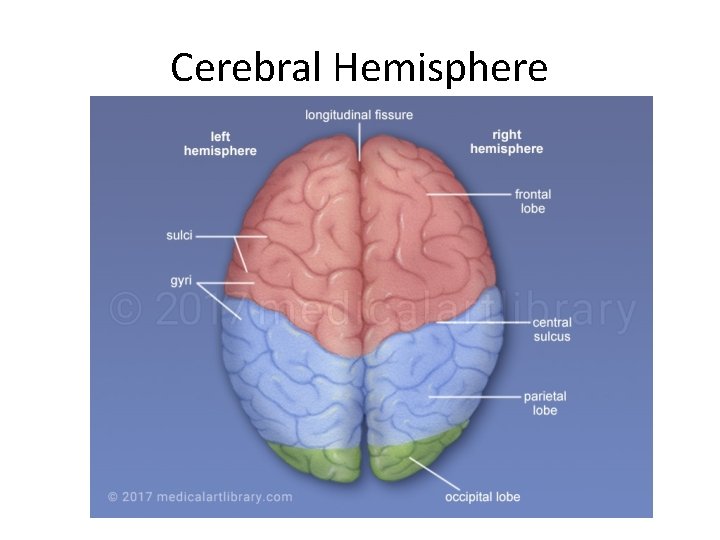
Cerebral Hemisphere
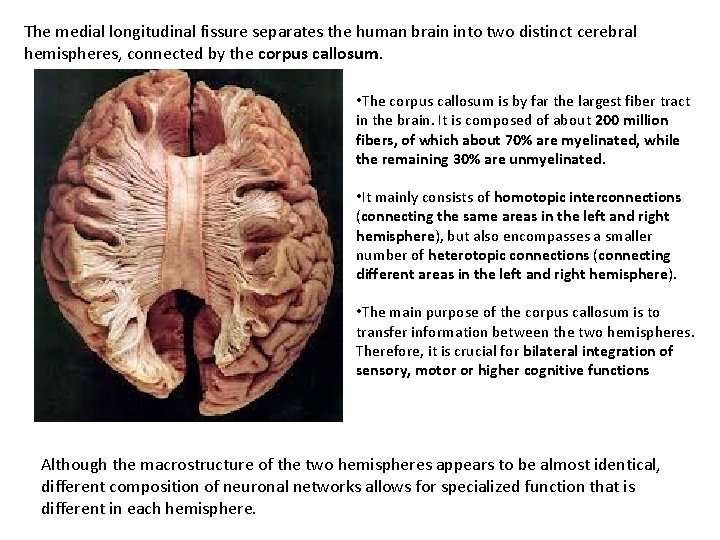
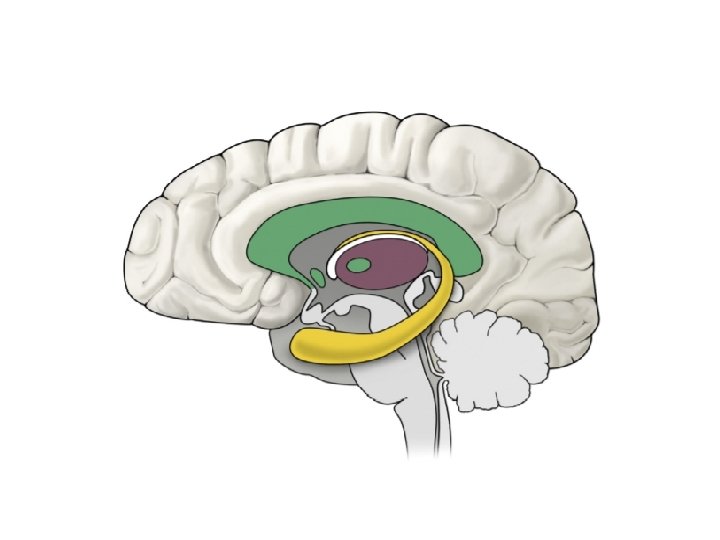
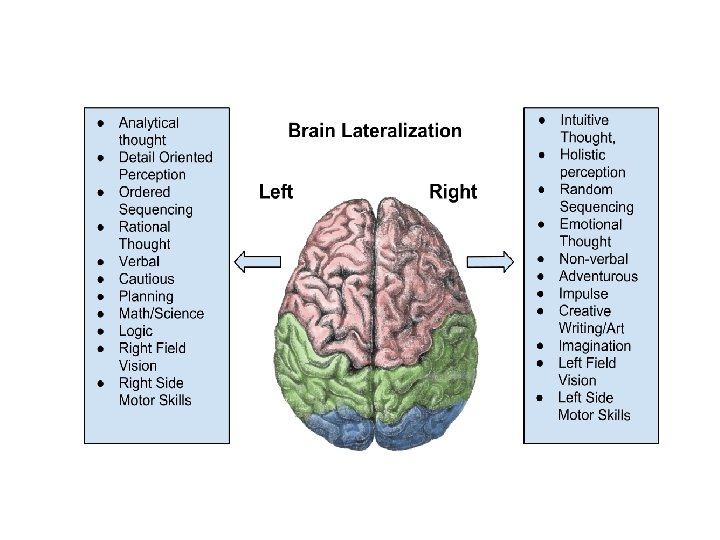
The medial longitudinal fissure separates the human brain into two distinct cerebral hemispheres, connected by the corpus callosum. • The corpus callosum is by far the largest fiber tract in the brain. It is composed of about 200 million fibers, of which about 70% are myelinated, while the remaining 30% are unmyelinated. • It mainly consists of homotopic interconnections (connecting the same areas in the left and right hemisphere), but also encompasses a smaller number of heterotopic connections (connecting different areas in the left and right hemisphere). • The main purpose of the corpus callosum is to transfer information between the two hemispheres. Therefore, it is crucial for bilateral integration of sensory, motor or higher cognitive functions Although the macrostructure of the two hemispheres appears to be almost identical, different composition of neuronal networks allows for specialized function that is different in each hemisphere.

Contralateral control
Cerebral Hemisphere • The two hemispheres cooperate each other but do not perform identical functions • Some functions are LATERALIZED – located primarily on one side of the brain • It is the tendency for some neural functions or cognitive processes to be specialized to one side of the brain or the other.
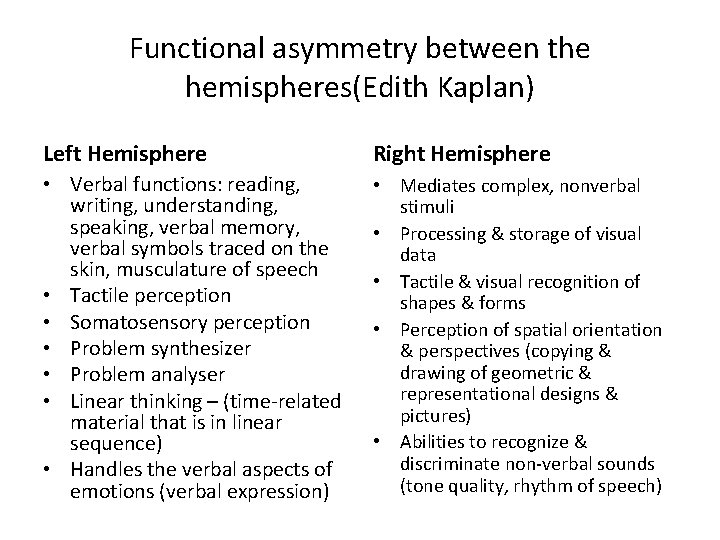
Functional asymmetry between the hemispheres(Edith Kaplan) Left Hemisphere Right Hemisphere • Verbal functions: reading, writing, understanding, speaking, verbal memory, verbal symbols traced on the skin, musculature of speech • Tactile perception • Somatosensory perception • Problem synthesizer • Problem analyser • Linear thinking – (time-related material that is in linear sequence) • Handles the verbal aspects of emotions (verbal expression) • Mediates complex, nonverbal stimuli • Processing & storage of visual data • Tactile & visual recognition of shapes & forms • Perception of spatial orientation & perspectives (copying & drawing of geometric & representational designs & pictures) • Abilities to recognize & discriminate non-verbal sounds (tone quality, rhythm of speech)
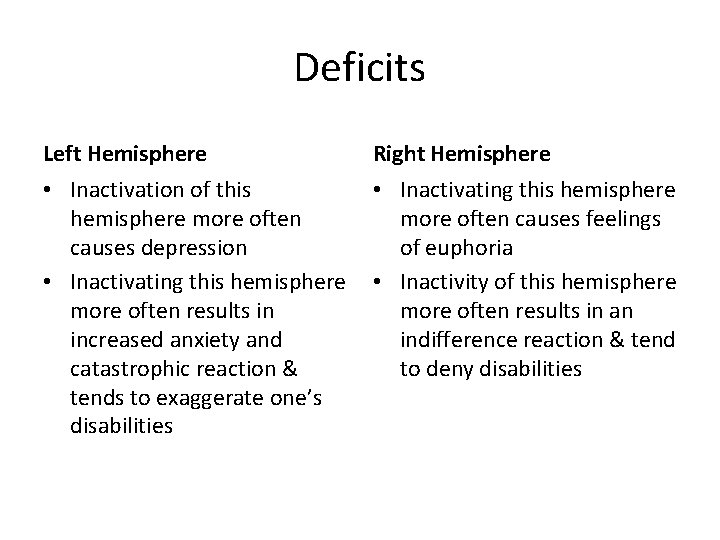
Deficits Left Hemisphere Right Hemisphere • Inactivation of this hemisphere more often causes depression • Inactivating this hemisphere more often results in increased anxiety and catastrophic reaction & tends to exaggerate one’s disabilities • Inactivating this hemisphere more often causes feelings of euphoria • Inactivity of this hemisphere more often results in an indifference reaction & tend to deny disabilities
• Damage to either the right or left hemisphere, and its resulting deficits provide insight into the function of the damaged area. Left hemisphere damage has many effects on language production and perception. Damage or lesions to the right hemisphere can result in a lack of emotional prosody or intonation when speaking. • If a specific region of the brain, or even an entire hemisphere, is injured or destroyed, its functions can sometimes be assumed by a neighboring region in the same hemisphere or the corresponding region in the other hemisphere, this process is phenomenon is known as Plasticity of the brain. • It depends upon the area damaged and the patient's age.
- Slides: 9