
Cerebral Cortex Lecture Objectives Describe the organization of
Cerebral Cortex
Lecture Objectives • Describe the organization of the cerebral cortex. • Locate the motor, sensory and other cortical areas. • Describe the cortical areas related to the written and spoken language. • Identify the components of the medial temporal lobe and the hippocampal formation. • Identify the structures in coronal, sagittal and horizontal sections of brain.
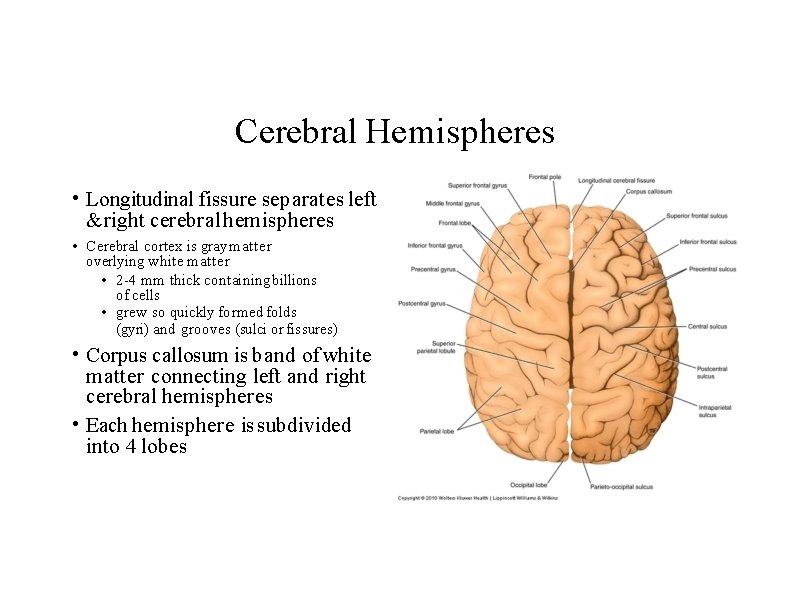
Cerebral Hemispheres • Longitudinal fissure separates left & right cerebral hemispheres • Cerebral cortex is gray matter overlying white matter • 2 -4 mm thick containing billions of cells • grew so quickly formed folds (gyri) and grooves (sulci or fissures) • Corpus callosum is band of white matter connecting left and right cerebral hemispheres • Each hemisphere is subdivided into 4 lobes
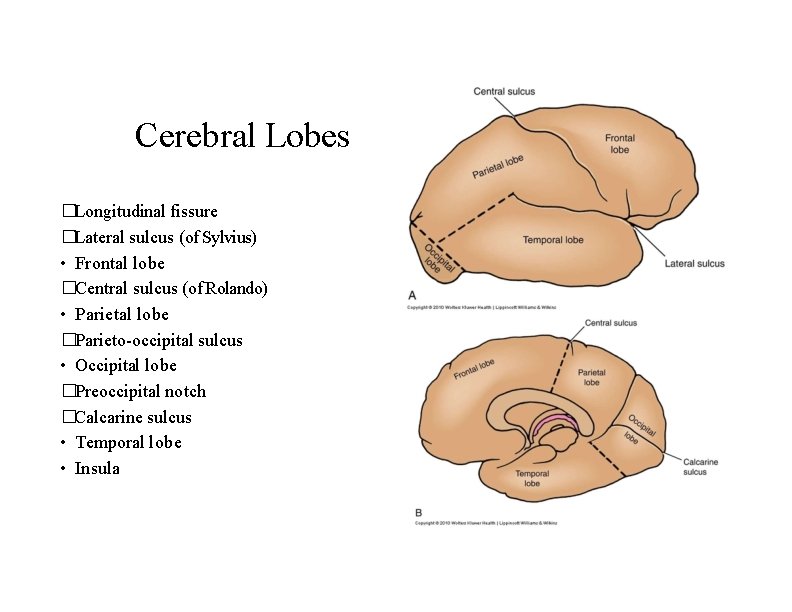
Cerebral Lobes �Longitudinal fissure �Lateral sulcus (of Sylvius) • Frontal lobe �Central sulcus (of Rolando) • Parietal lobe �Parieto-occipital sulcus • Occipital lobe �Preoccipital notch �Calcarine sulcus • Temporal lobe • Insula

Frontal Lobe: Laterally �Central Sulcus • Precentral gyrus �Precentral sulcus • Superior frontal gyrus �Superior frontal sulcus • Middle frontal gyrus �Inferior frontal sulcus • Inferior frontal gyrus

Frontal Lobe: Laterally • Inferior frontal gyrus • Orbital gyri �Anterior horizontal ramus • Triangular gyrus* �Anterior ascending ramus • Opercular gyrus* *form speak (Broca’s) area
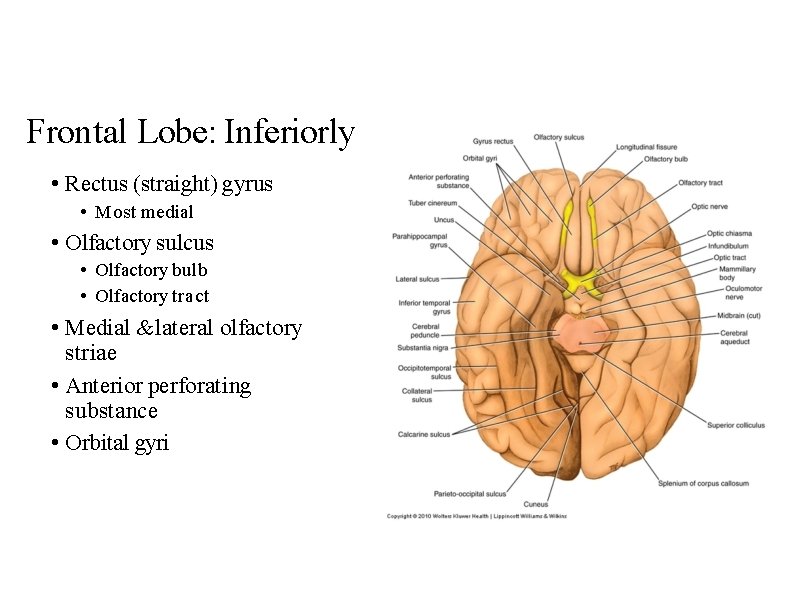
Frontal Lobe: Inferiorly • Rectus (straight) gyrus • Most medial • Olfactory sulcus • Olfactory bulb • Olfactory tract • Medial & lateral olfactory striae • Anterior perforating substance • Orbital gyri
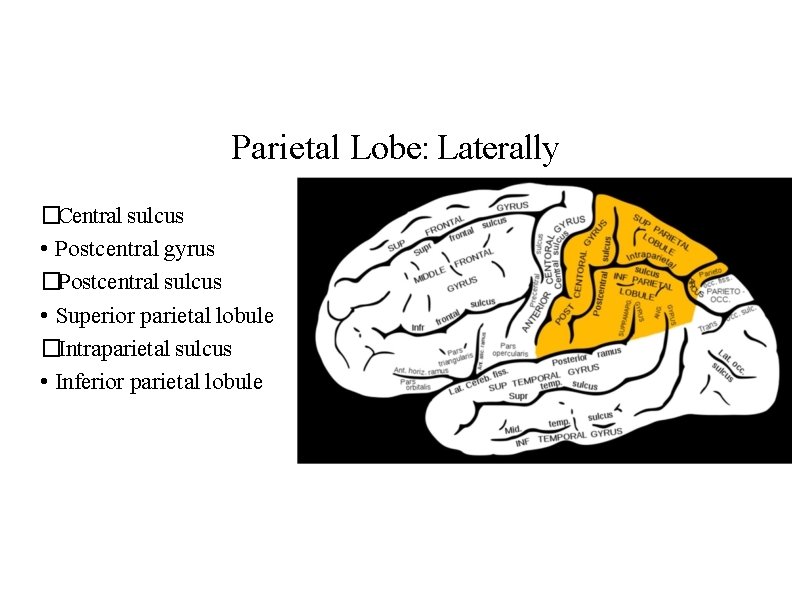
Parietal Lobe: Laterally �Central sulcus • Postcentral gyrus �Postcentral sulcus • Superior parietal lobule �Intraparietal sulcus • Inferior parietal lobule
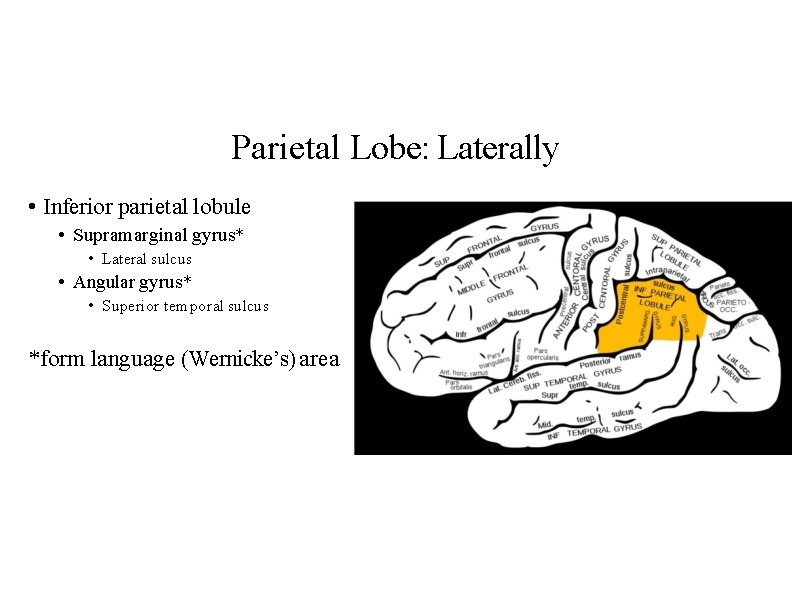
Parietal Lobe: Laterally • Inferior parietal lobule • Supramarginal gyrus* • Lateral sulcus • Angular gyrus* • Superior temporal sulcus *form language (Wernicke’s) area
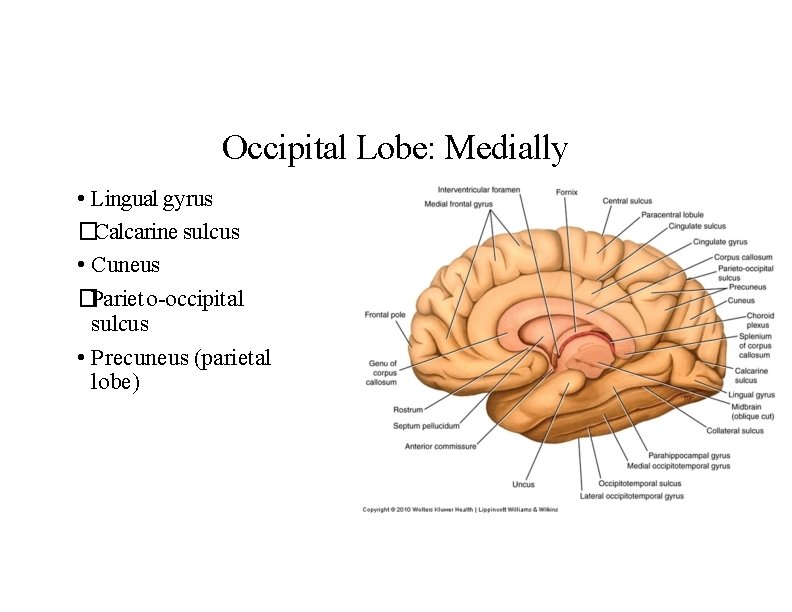
Occipital Lobe: Medially • Lingual gyrus �Calcarine sulcus • Cuneus �Parieto-occipital sulcus • Precuneus (parietal lobe)
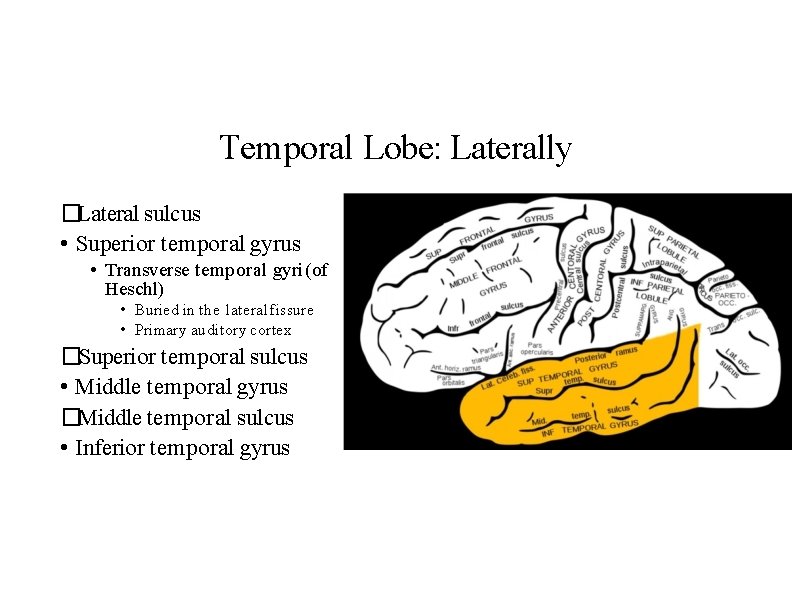
Temporal Lobe: Laterally �Lateral sulcus • Superior temporal gyrus • Transverse temporal gyri (of Heschl) • Buried in the lateral fissure • Primary auditory cortex �Superior temporal sulcus • Middle temporal gyrus �Middle temporal sulcus • Inferior temporal gyrus
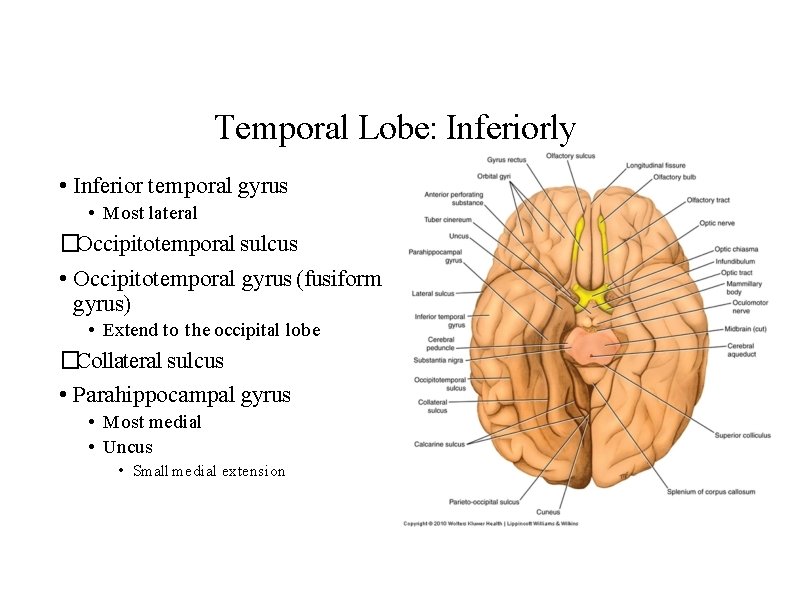
Temporal Lobe: Inferiorly • Inferior temporal gyrus • Most lateral �Occipitotemporal sulcus • Occipitotemporal gyrus (fusiform gyrus) • Extend to the occipital lobe �Collateral sulcus • Parahippocampal gyrus • Most medial • Uncus • Small medial extension
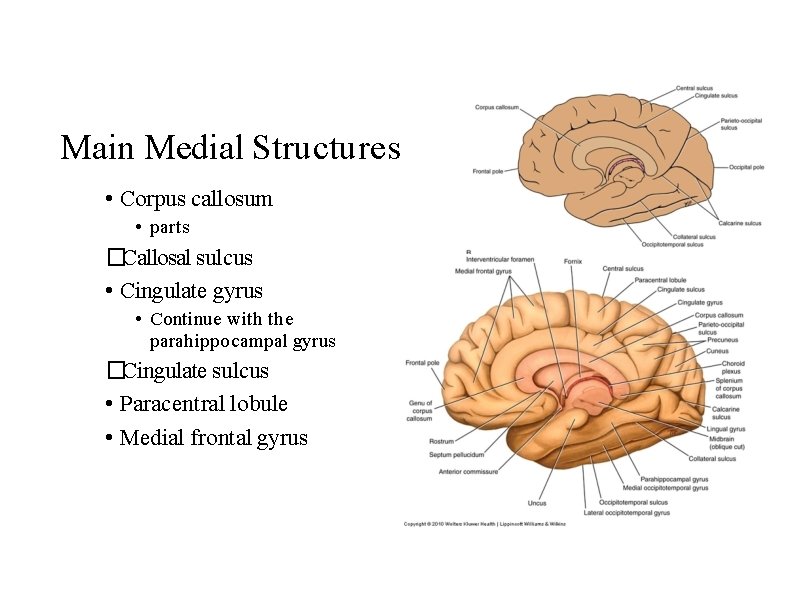
Main Medial Structures • Corpus callosum • parts �Callosal sulcus • Cingulate gyrus • Continue with the parahippocampal gyrus �Cingulate sulcus • Paracentral lobule • Medial frontal gyrus
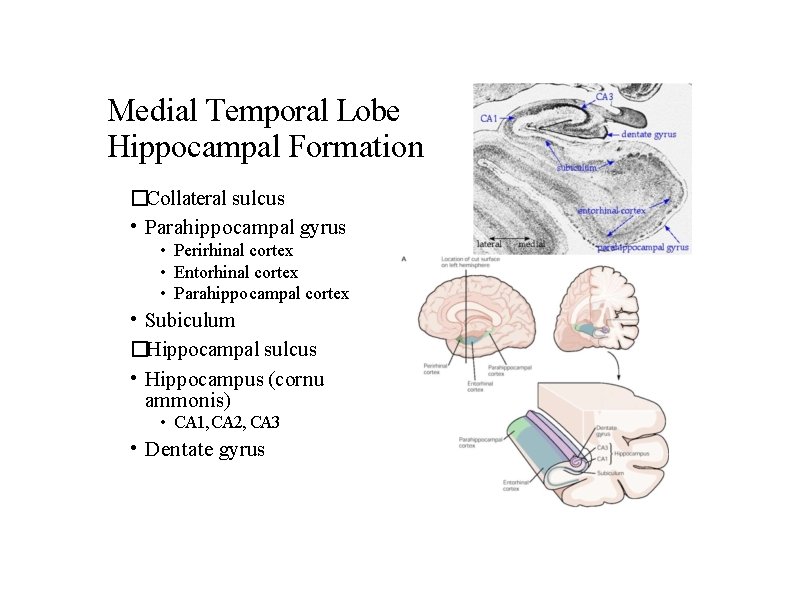
Medial Temporal Lobe Hippocampal Formation �Collateral sulcus • Parahippocampal gyrus • Perirhinal cortex • Entorhinal cortex • Parahippocampal cortex • Subiculum �Hippocampal sulcus • Hippocampus (cornu ammonis) • CA 1, CA 2, CA 3 • Dentate gyrus
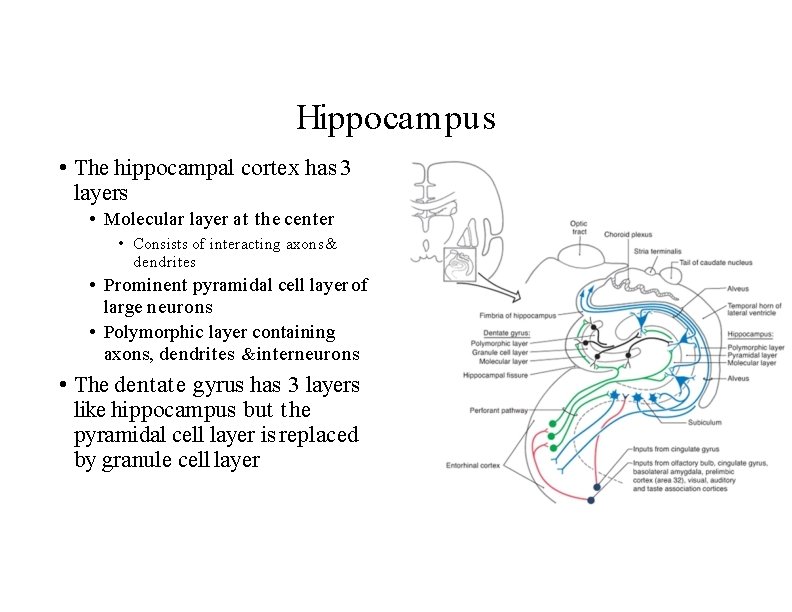
Hippocampus • The hippocampal cortex has 3 layers • Molecular layer at the center • Consists of interacting axons & dendrites • Prominent pyramidal cell layer of large neurons • Polymorphic layer containing axons, dendrites &interneurons • The dentate gyrus has 3 layers like hippocampus but the pyramidal cell layer is replaced by granule cell layer
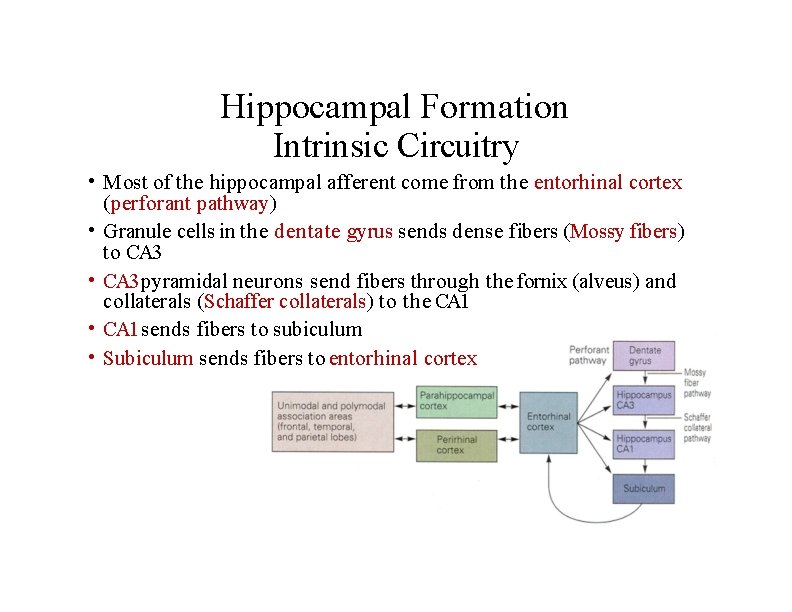
Hippocampal Formation Intrinsic Circuitry • Most of the hippocampal afferent come from the entorhinal cortex (perforant pathway) • Granule cells in the dentate gyrus sends dense fibers (Mossy fibers) to CA 3 • CA 3 pyramidal neurons send fibers through the fornix (alveus) and collaterals (Schaffer collaterals) to the CA 1 • CA 1 sends fibers to subiculum • Subiculum sends fibers to entorhinal cortex
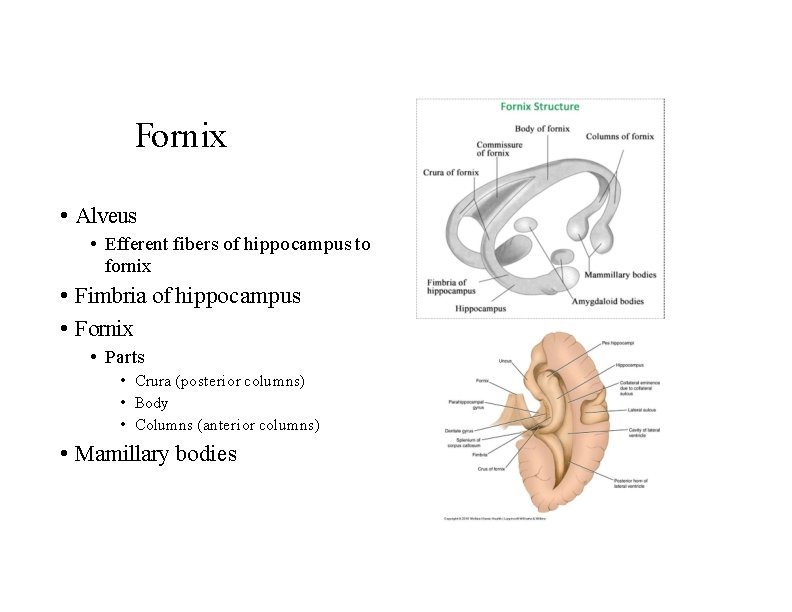
Fornix • Alveus • Efferent fibers of hippocampus to fornix • Fimbria of hippocampus • Fornix • Parts • Crura (posterior columns) • Body • Columns (anterior columns) • Mamillary bodies
Functional Organization of the Cerebral Cortex: Sensory Areas • Primary somatosensory area- postcentral gyrus. • Primary visual area- occipital lobe. • Primary auditory area- temporal lobe. • Primary gustatory area- base of the postcentral gyrus. • Primary olfactory area- temporal lobe.
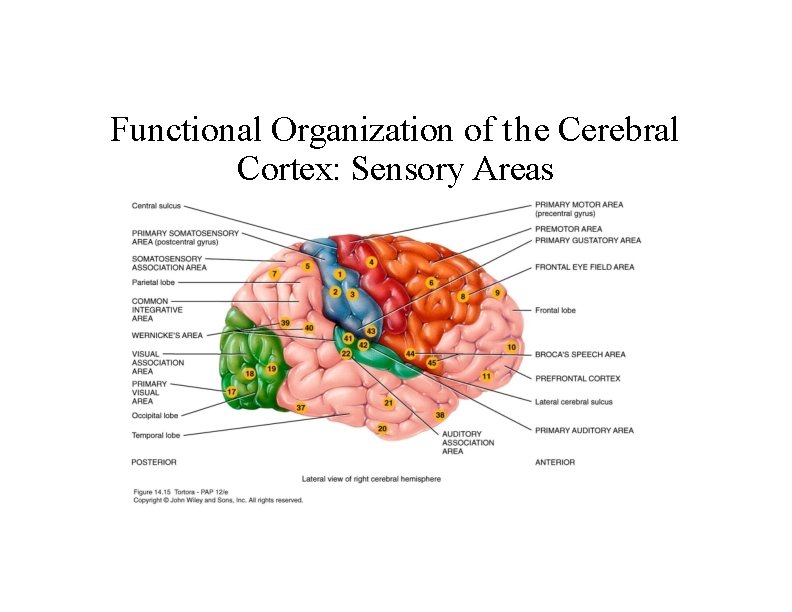
Functional Organization of the Cerebral Cortex: Sensory Areas
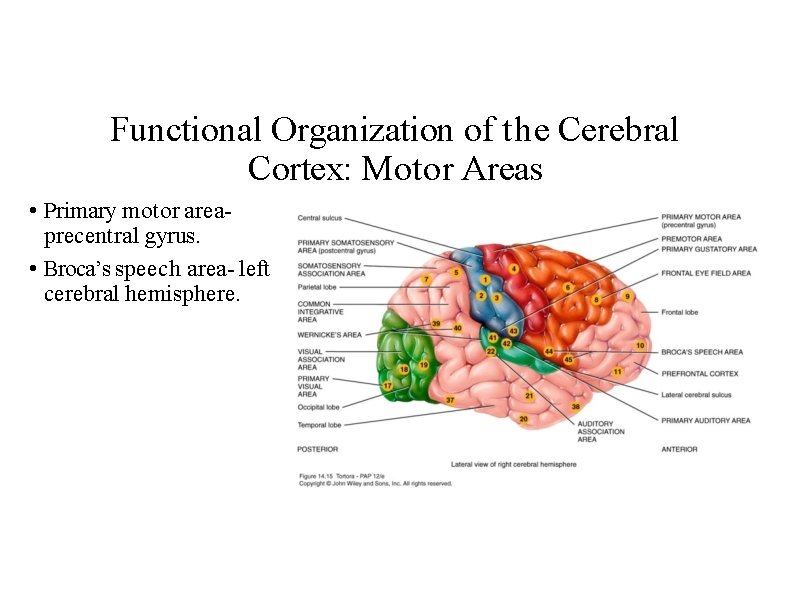
Functional Organization of the Cerebral Cortex: Motor Areas • Primary motor areaprecentral gyrus. • Broca’s speech area- left cerebral hemisphere.
Functional Organization of the Cerebral Cortex: Association Areas • Somatosensory association area- posterior to primary somatosensory area. • Visual association area- occipital lobe. • Auditory association area- temporal lobe. • Wernicke’s area- left temporal and parietal lobes. • Prefrontal cortex- anterior portion of the frontal lobe.
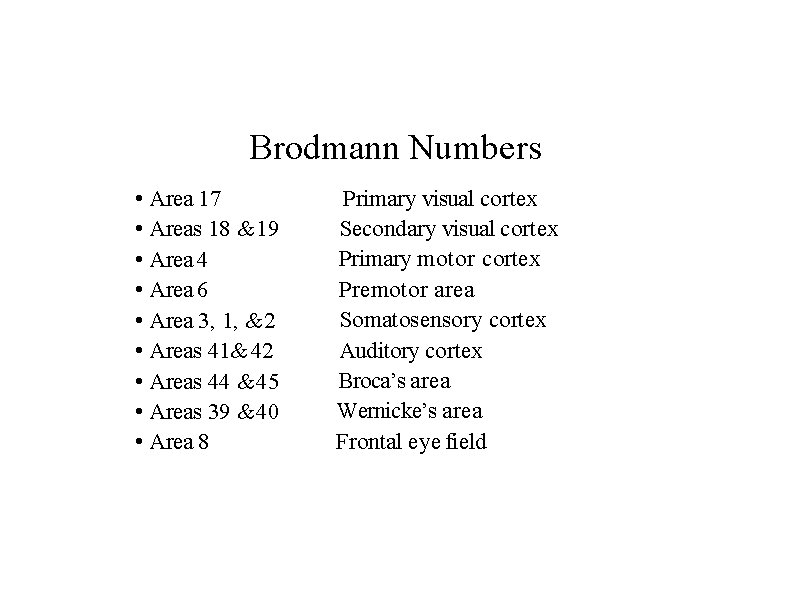
Brodmann Numbers • Area 17 • Areas 18 & 19 • Area 4 • Area 6 • Area 3, 1, & 2 • Areas 41& 42 • Areas 44 & 45 • Areas 39 & 40 • Area 8 Primary visual cortex Secondary visual cortex Primary motor cortex Premotor area Somatosensory cortex Auditory cortex Broca’s area Wernicke’s area Frontal eye field
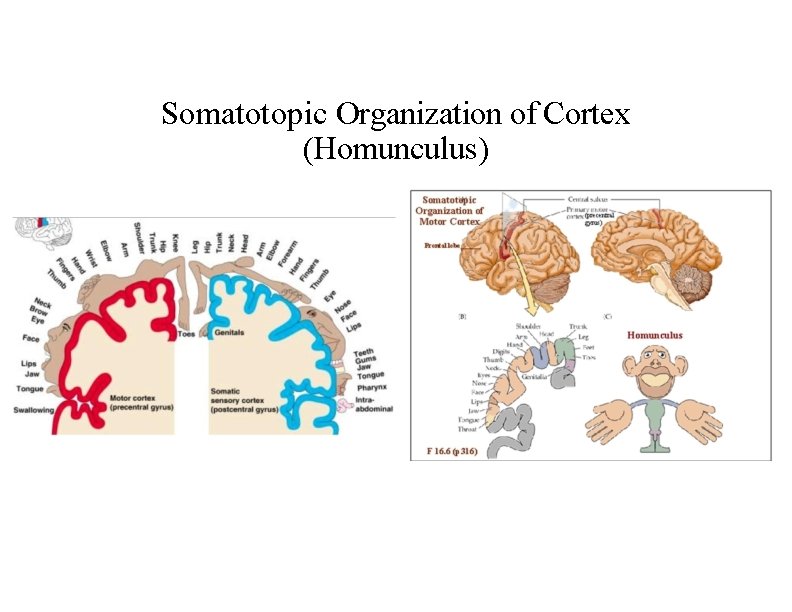
Somatotopic Organization of Cortex (Homunculus)
- Slides: 23