
Cerebral Cortex and Associated Structures HCS 2050 SLO
Cerebral Cortex and Associated Structures HCS 2050 SLO: 1. 8. 10 central and lateral sulci 1. 8. 11 basal nuclei 1. 8. 12 fibrils in the cerebral cortex 1. 8. 6 limbic system, including hippocampus and reticular formation

Central and Lateral Sulci The cortex is arranged in folds forming elevated portions known as gyri. These raised areas are separated by shallow grooves called sulci.

Central Sulcus § Lies between the frontal and parietal lobes of each hemisphere at right angles to the longitudinal fissure.

Lateral Sulcus § Curves along the side of each hemisphere and separates the temporal lobe from the frontal and parietal lobes
Cerebral Hemispheres Internally, the cerebral hemispheres are made largely of white matter and a few islands of gray matter. The white matter consists of myelinated fibers that connect the cortical areas with each other and with other parts of the nervous system.
Basal Nuclei (Basal Ganglia) § Are masses of gray matter located deep within each cerebral hemisphere. These groups of neurons work with the cerebral cortex to regulate body movement and the muscles of facial expression. The neurons of the basal nuclei secrete the neurotransmitter dopamine.
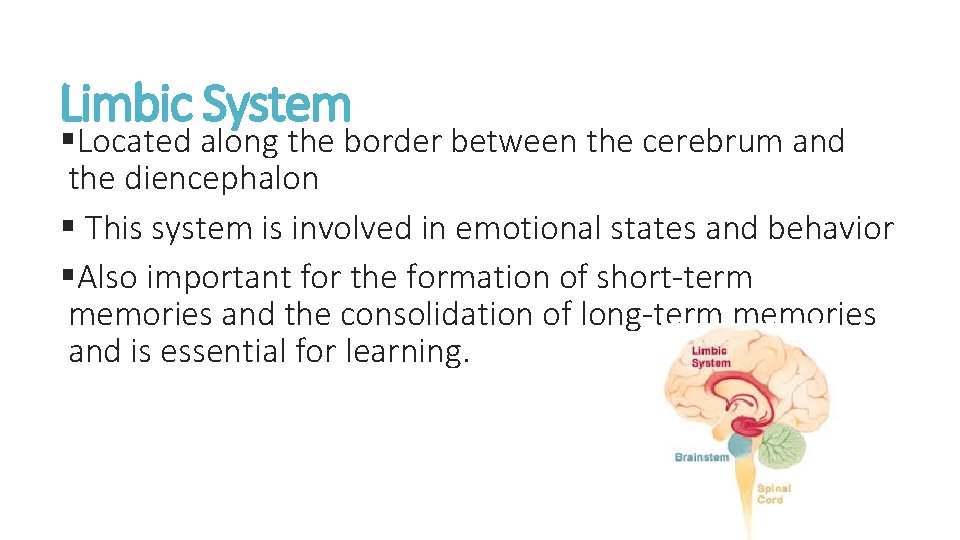
Limbic System §Located along the border between the cerebrum and the diencephalon § This system is involved in emotional states and behavior §Also important for the formation of short-term memories and the consolidation of long-term memories and is essential for learning.

Hippocampus §Included in the limbic system §Shaped like a sea horse and located under the lateral ventricles §Responsible for long term memory

Reticular Formation §A network of ascending and descending tracts that extend from the upper spinal cord through the brain stem to the diencephalon.
- Slides: 9