
Cerebellar system and diseases Balance Equilibrium Cerebellum Coordination
Cerebellar system and diseases Balance & Equilibrium
Cerebellum • • Coordination of movement Control of gait, posture (Balance ) Control of muscle tone (Motor control ) Cognitive functions – Attention – Emotions – Language
Motor coordination Cerebellum does not initiate movement It contributes to coordination, precision, and accurate timing. It receives input from sensory systems and from other parts of the brain and spinal cord, It integrates these inputs to tune fine motor activity. Because of this fine-tuning function, Cerebellar lesions produce disorders in fine movement, equilibrium, posture, and motor learning.
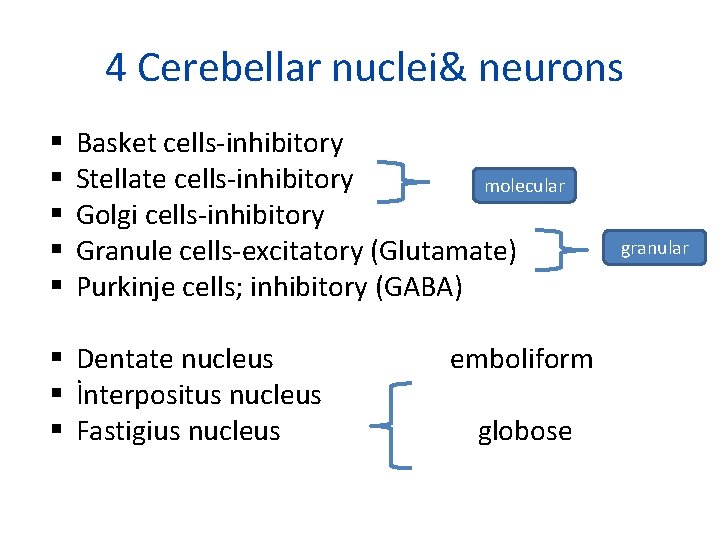
4 Cerebellar nuclei& neurons Basket cells-inhibitory Stellate cells-inhibitory molecular Golgi cells-inhibitory Granule cells-excitatory (Glutamate) Purkinje cells; inhibitory (GABA) Dentate nucleus İnterpositus nucleus Fastigius nucleus emboliform globose granular
Intrinsic Fibers – Mossy fibers These fibers carry impulses from the inferior peduncle from spinocerebellar pathways, olivocerebellar pathways. – Climbing fibers They carry impulses from the middle cerebellary peduncle. They carry impulses from the cortex and projects to the cortex.
Phylogenetically. . • Flocculo-nodulus ARCHICEREBELLUM – related with vestibular nuclei • Anterior lobes-PALEOCEREBELLUMspinocerebellar pathways • Posterior lobes- NEOCEREBELLUM – cerebellopontin pathways
Vestibulo-cerebellum • Flocculo-nodulus receives special proprioceptive impulses from the vestibular nuclei (located in pons and the bulb) Equilibrium and balance , spatial orientation. Any lesion will cause ataxia , gait disturbance, Walking difficulty
Spinocerebellum • Vermis, The medial zone of the anterior lobes • It receives proprioceptive input from the spinocerebellar tract and from visual and auditory systems. • It sends fibres to deep cerebellar nuclei that, in turn, project to both the cerebral cortex and the brain stem, thus providing modulation of descending motor systems; POSTURE, MUSCLE TONE.
Neocerebellum • Posterior lobes receive afferents from cortex through corticopontine pathways. • It projects to the cortex via the dentate nucleus. Its projections are to the cerebral cortex through nucleus ruber, thalamus. • In association with the differentiation of skeletal muscle this part is the largest in humans. It coordinates skilled movements.
• Many projections (mainly the purkinje cell) relay on deep cerebellary nuclei (mainly dentate nuclei) and then projects. • Contrary, Floculo-nodulus directly projects to vestibular nuclei.
Clinical manifestations of cerebellar dysfunction • • Muscular coordination Equilibrium Locomotion No weakness Initiation of movement delays. Relaxing delays. Contractions are irregular, intermittent. Speech disturbances
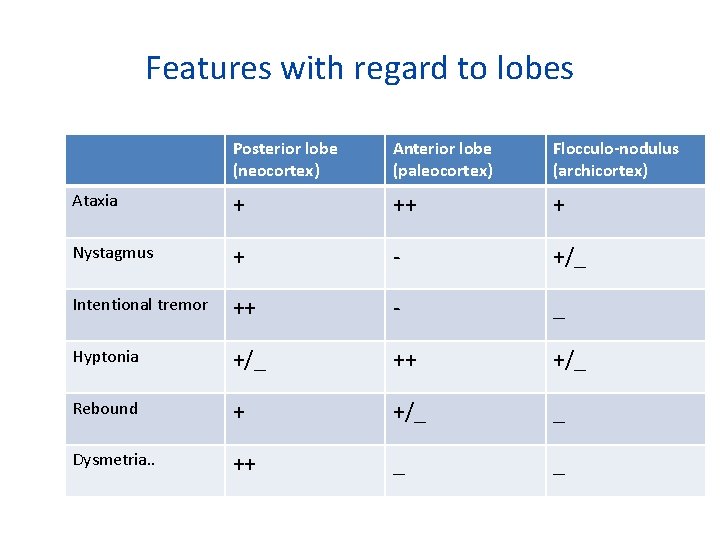
Features with regard to lobes Posterior lobe (neocortex) Anterior lobe (paleocortex) Flocculo-nodulus (archicortex) Ataxia + ++ + Nystagmus + - +/_ Intentional tremor ++ - _ Hyptonia +/_ ++ +/_ Rebound + +/_ _ Dysmetria. . ++ _ _
Dysmetria Loss of ability to gauge • the distance • Speed • Power of movement The act may be carried out with too little or too much power. The act may stop before the goal is reached or overshoot.
dysdiadokokinesia • Disturbance of reciprocal innervationcoordination of agonist-antagonist muscles. • İmpairment of rapid alternating muscles.
Hypotonia • The body parts may be extended or flexed to extreme positions as the muscle tonus is decreased (flask).
Intentional tremor • Tremor is not observed at rest, but during reaching a target tremor becomes established. Diferential diagnosis • Resting tremor (parkinsonian) • Postural tremor (essential , drugs)
Speech in cerebellar diseases • Explosive • Slurred • As if drunken
Disease Hereditary cerebellar diseases • Friedrich ataxia • Spinocerebellar ataxia’s Acquired cerebellar diseases • Vascular (Wallenberg syndrome, SCA infarct) • Degenerative (multisystem atrophies) • Demyelinating (Multipl Sclerosis) • Toxic-metabolic (Alchohol abuse, diphenyl hidantion chronic use) • Neoplastic, paraneoplastic (cerebellar neoplasms)
- Slides: 18