
Cerebellar Spiking Engine EDLUT simulator UGR with input
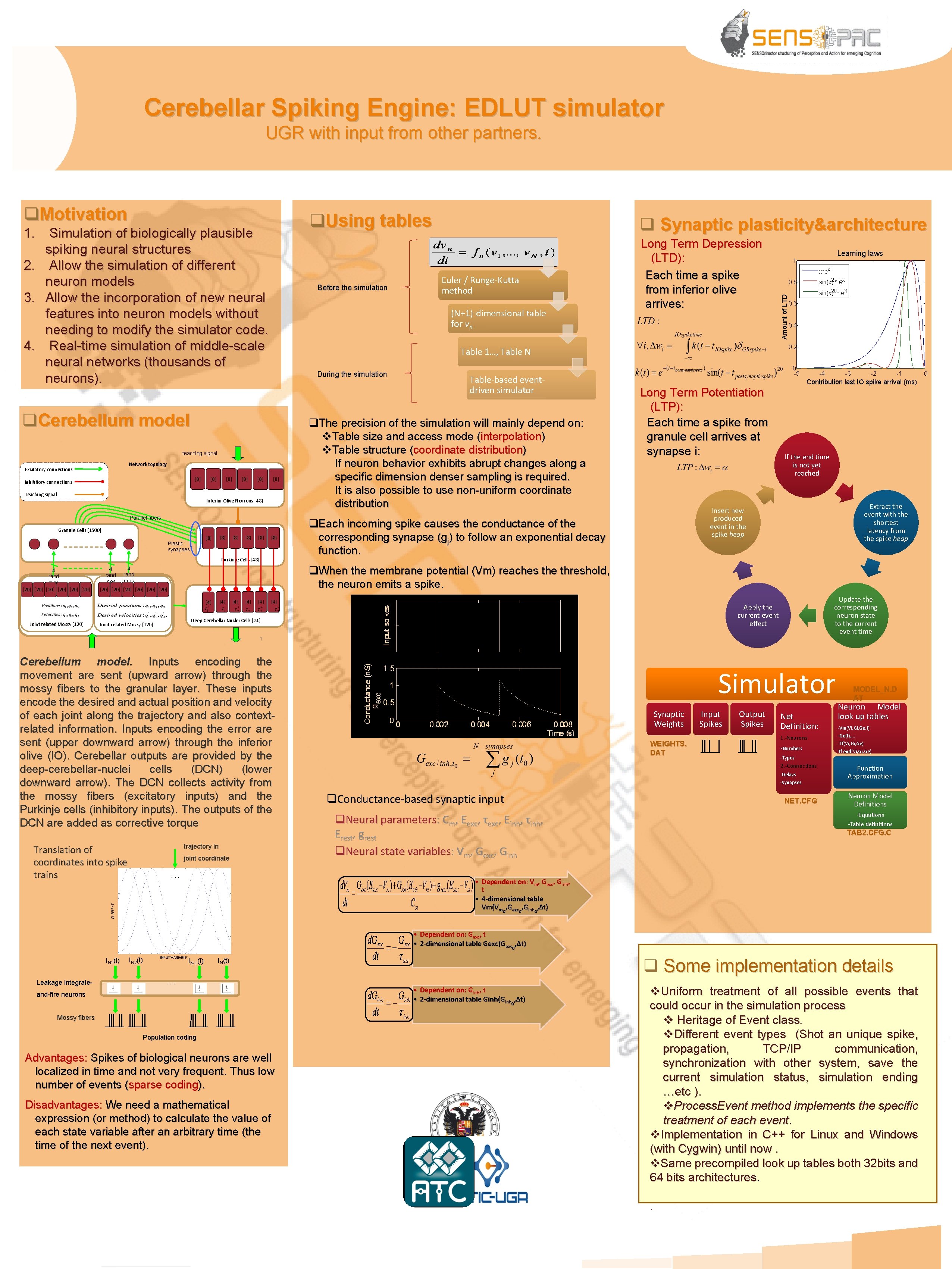
Cerebellar Spiking Engine: EDLUT simulator UGR with input from other partners. 1. 2. 3. 4. q. Using tables Simulation of biologically plausible spiking neural structures Allow the simulation of different neuron models Allow the incorporation of new neural features into neuron models without needing to modify the simulator code. Real-time simulation of middle-scale neural networks (thousands of neurons). Before the simulation During the simulation Network topology [8] Teaching signal [8] [8] [8] Inferior Olive Neurons [48] Parallel fibers Granule Cells [1500] [8] Plastic synapses [8] [8] Purkinje Cells [48] 4 rand mos sy [20] [20] Table-based eventdriven simulator q. The precision of the simulation will mainly depend on: v. Table size and access mode (interpolation) v. Table structure (coordinate distribution) If neuron behavior exhibits abrupt changes along a specific dimension denser sampling is required. It is also possible to use non-uniform coordinate distribution Learning laws 1 x*e-x sin(x)2 * e-x 0. 8 sin(x)20 * e-x 0. 6 0. 4 0. 2 0 -5 Long Term Potentiation (LTP): Each time a spike from granule cell arrives at synapse i: -4 q. Each incoming spike causes the conductance of the corresponding synapse (gj) to follow an exponential decay function. [4] [4] [4] Cerebellum model. Inputs encoding the movement are sent (upward arrow) through the mossy fibers to the granular layer. These inputs encode the desired and actual position and velocity of each joint along the trajectory and also contextrelated information. Inputs encoding the error are sent (upper downward arrow) through the inferior olive (IO). Cerebellar outputs are provided by the deep-cerebellar-nuclei cells (DCN) (lower downward arrow). The DCN collects activity from the mossy fibers (excitatory inputs) and the Purkinje cells (inhibitory inputs). The outputs of the DCN are added as corrective torque trajectory in Leakage integrate- joint coordinate. . . IN 2(t) -1 If the end time is not yet reached Extract the event with the shortest latency from the spike heap Update the corresponding neuron state to the current event time Apply the current event effect 1 IN 1(t) -2 Contribution last IO spike arrival (ms) Insert new produced event in the spike heap Deep Cerebellar Nuclei Cells [24] Joint related Mossy [120] Translation of coordinates into spike trains -3 q. When the membrane potential (Vm) reaches the threshold, the neuron emits a spike. 4 4 rand mos sy [20]sy[20] [4] Joint related Mossy [120] Long Term Depression (LTD): Each time a spike from inferior olive arrives: Table 1…, Table N teaching signal Inhibitory connections Euler / Runge-Kutta method (N+1)-dimensional table for vn q. Cerebellum model Excitatory connections q Synaptic plasticity&architecture Amount of LTD q. Motivation . . . Simulator Synaptic Weights WEIGHTS. DAT Input Spikes Output Spikes Net Definition: 1. -Neurons -Numbers -Types 2. -Connections -Delays -Synapses q. Conductance-based synaptic input NET. CFG MODEL_N. D AT Neuron Model look up tables -Vm(Vi, Ge, t) -Ge(t), . . . -Tf(Vi, Ge) Tf end(Vi, Ge) Function Approximation Neuron Model Definitions -Equations -Table definitions q. Neural parameters: Cm, Eexc, τexc, Einh, τinh, Erest, grest q. Neural state variables: variables Vm, Gexc, Ginh TAB 2. CFG. C • Dependent on: Vm, Gexc, Ginh, t • 4 -dimensional table Vm(Vm 0, Gexc 0, Ginh 0, Δt) • Dependent on: Gexc, t • 2 -dimensional table Gexc(Gexc 0, Δt) IN-1(t) q Some implementation details IN(t) . . . and-fire neurons Mossy fibers Population coding Advantages: Spikes of biological neurons are well localized in time and not very frequent. Thus low number of events (sparse coding). Disadvantages: We need a mathematical expression (or method) to calculate the value of each state variable after an arbitrary time (the time of the next event). • Dependent on: Ginh, t • 2 -dimensional table Ginh(Ginh 0, Δt) v. Uniform treatment of all possible events that could occur in the simulation process v Heritage of Event class. v. Different event types (Shot an unique spike, propagation, TCP/IP communication, synchronization with other system, save the current simulation status, simulation ending …etc ). v. Process. Event method implements the specific treatment of each event. v. Implementation in C++ for Linux and Windows (with Cygwin) until now. v. Same precompiled look up tables both 32 bits and 64 bits architectures. 0
- Slides: 1