
Cereals organic manures and soils COMS project Efficiency
- Slides: 1
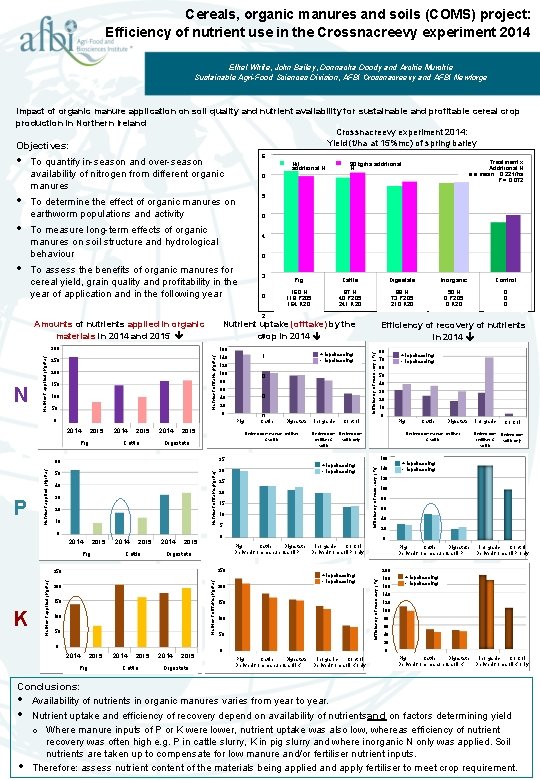
Cereals, organic manures and soils (COMS) project: Efficiency of nutrient use in the Crossnacreevy experiment 2014 Ethel White, John Bailey, Donnacha Doody and Archie Murchie Sustainable Agri-Food Sciences Division, AFBI Crossnacreevy and AFBI Newforge Impact of organic manure application on soil quality and nutrient availability for sustainable and profitable cereal crop production in Northern Ireland Crossnacreevy experiment 2014: Yield (t/ha at 15%mc) of spring barley Objectives: • 4. 0 To assess the benefits of organic manures for cereal yield, grain quality and profitability in the year of application and in the following year Nutrient offtake (kg/ha) Nutrient applied (kg/ha) 200 150 100 50 Digestate Inorganic Control 87 N 40 P 205 241 K 20 88 N 73 P 205 210 K 20 50 N 0 P 205 0 K 20 0 120 100 0 80 60 0. 40 20 Pig 2015 2014 2015 Cattle 2014 + topdressing - topdressing 1. 140 0 Pig 2015 0 Cattle Digestate Derived from manure, fertiliser & soil N Digestate Nutrient offtake (kg/ha) 50 40 30 20 10 0 2014 2015 Pig 2014 2015 Cattle 2014 25 20 10 5 Nutrient offtake (kg/ha) 100 50 0 2014 Pig 2015 2014 2015 Cattle 2014 2015 Digestate 50 40 30 20 10 0 Pig Cattle Digestate Derived from manure, fertiliser & soil N 140 Inorganic Control Derived from fertiliser & soil N only soil N + topdressing - topdressing 120 100 80 60 40 20 0 250 150 60 a 15 Pig Cattle Digestate Derived from manure & soil P 250 + topdressing - topdressing 70 Derived from fertiliser & soil N only soil N + topdressing - topdressing 30 Digestate 80 Control 0 2015 200 Inorganic Efficiency of recovery of nutrients in 2014 160 35 60 Nutrient applied (kg/ha) Cattle 160 2014 Nutrient applied (kg/ha) 0 Pig 160 N 118 P 205 164 K 20 2. 0 K 3. Nutrient uptake (offtake) by the 0 crop in 2014 300 P 0 To measure long-term effects of organic manures on soil structure and hydrological behaviour Amounts of nutrients applied in organic materials in 2014 and 2015 N 5. To determine the effect of organic manures on earthworm populations and activity 250 Treatment x Additional N s. e. mean: 0. 22 t/ha P = 0. 072 90 kg/ha additional N Efficiency of recovery (%) • Nil additional N 0 Efficiency of recovery (%) • 6. To quantify in-season and over-season availability of nitrogen from different organic manures Inorganic Control Derived from soil P only + topdressing - topdressing 200 150 Pig Cattle Digestate Derived from manure & soil P Inorganic Control Derived from soil P only 200 Efficiency of recovery (%) • 180 160 + topdressing - topdressing 140 120 a 100 50 100 80 60 40 20 0 0 Pig Cattle Digestate Derived from manure & soil K Inorganic Control Derived from soil K only Conclusions: • Availability of nutrients in organic manures varies from year to year. • Nutrient uptake and efficiency of recovery depend on availability of nutrients and on factors determining yield o Where manure inputs of P or K were lower, nutrient uptake was also low, whereas efficiency of nutrient recovery was often high e. g. P in cattle slurry, K in pig slurry and where inorganic N only was applied. Soil nutrients are taken up to compensate for low manure and/or fertiliser nutrient inputs. • Therefore: assess nutrient content of the materials being applied and apply fertiliser to meet crop requirement.