
Cereal Fortification and Blending SASFA ASA 5 th
Cereal Fortification and Blending SASFA / ASA 5 th Soyfood Conference 5/6 August 2003 Pretoria STS Henry H. Stevens President Stevens Technical Services Beaverton Oregon USA Stevens Technical Services
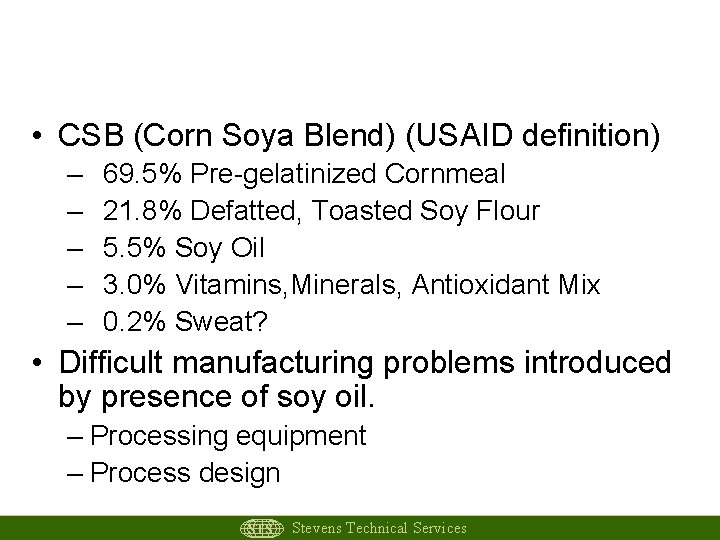
Maize / Soya Blends • CSB (Corn Soya Blend) (USAID definition) – – – 69. 5% Pre-gelatinized Cornmeal 21. 8% Defatted, Toasted Soy Flour 5. 5% Soy Oil 3. 0% Vitamins, Minerals, Antioxidant Mix 0. 2% Sweat? • Difficult manufacturing problems introduced by presence of soy oil. – Processing equipment – Process design STS Stevens Technical Services
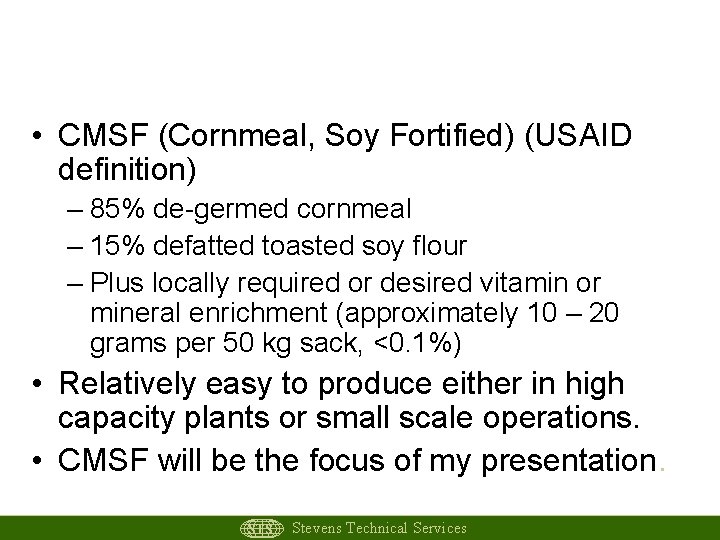
Maize / Soya Blends • CMSF (Cornmeal, Soy Fortified) (USAID definition) – 85% de-germed cornmeal – 15% defatted toasted soy flour – Plus locally required or desired vitamin or mineral enrichment (approximately 10 – 20 grams per 50 kg sack, <0. 1%) • Relatively easy to produce either in high capacity plants or small scale operations. • CMSF will be the focus of my presentation. STS Stevens Technical Services
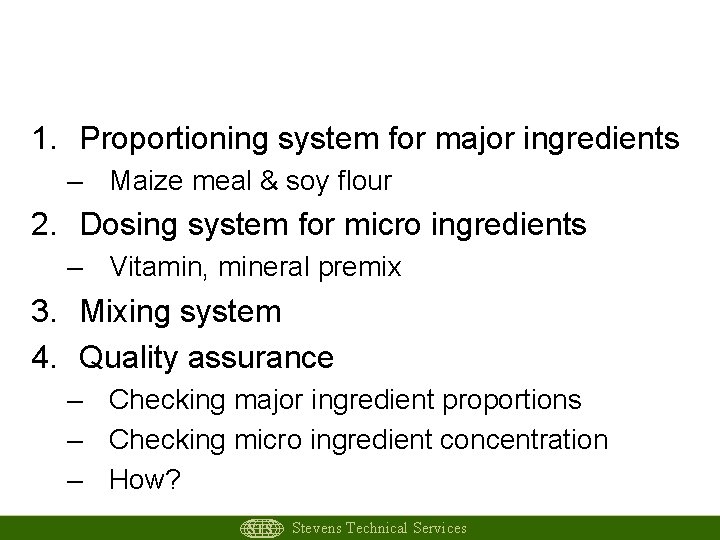
How to Produce CMSF? 1. Proportioning system for major ingredients – Maize meal & soy flour 2. Dosing system for micro ingredients – Vitamin, mineral premix 3. Mixing system 4. Quality assurance – Checking major ingredient proportions – Checking micro ingredient concentration – How? STS Stevens Technical Services
Production of CMSF • Proportioning, Dosing, Mixing, QA: – All four systems will differ depending on the size of the processing operations (and on local economics) • Large scale hi tech blending operations • small to large scale mechanized operations • Small scale lower tech operations • In most cases, CMSF production probably most economical at production facility for maize meal. STS Stevens Technical Services
Large Scale High Tech • Major ingredients most likely received in bulk form and stored in silos. • Gravimetric proportioning and dosing. • Batch blending. STS Stevens Technical Services
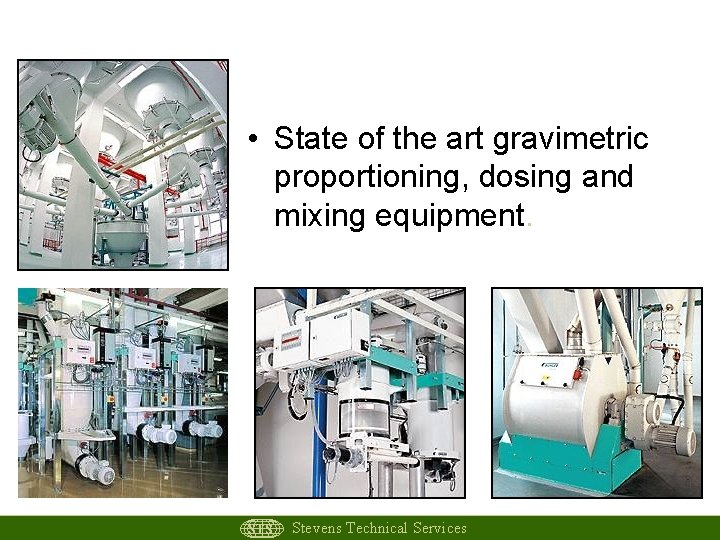
Large Scale High Tech • State of the art gravimetric proportioning, dosing and mixing equipment. STS Stevens Technical Services
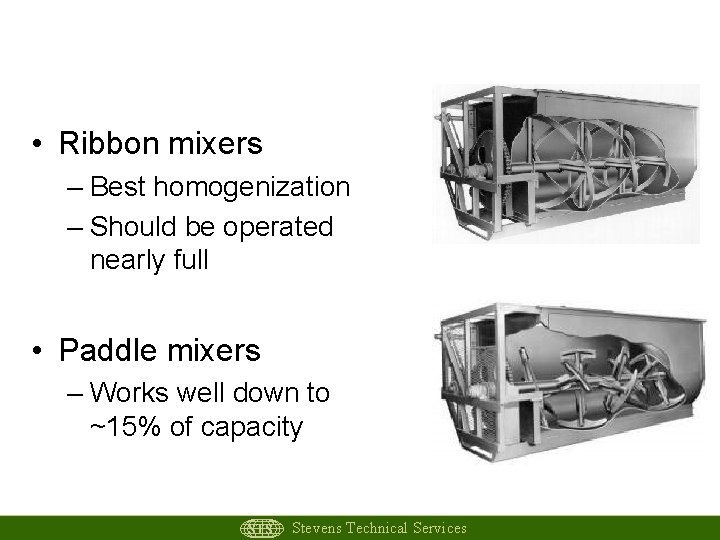
Larger Scale Batch Mixers • Ribbon mixers – Best homogenization – Should be operated nearly full • Paddle mixers – Works well down to ~15% of capacity STS Stevens Technical Services
Medium Tech CMSF Production • May receive soy flour in bags – Manual labor to empty bags into system – Rough sifter to remove paper, strings, etc. – Mechanical or pneumatic transport to silo. • Mixing may be continuous – Less control of homogenization – Less accurate • Dosing may be volumetric, especially for micro ingredients. STS Stevens Technical Services
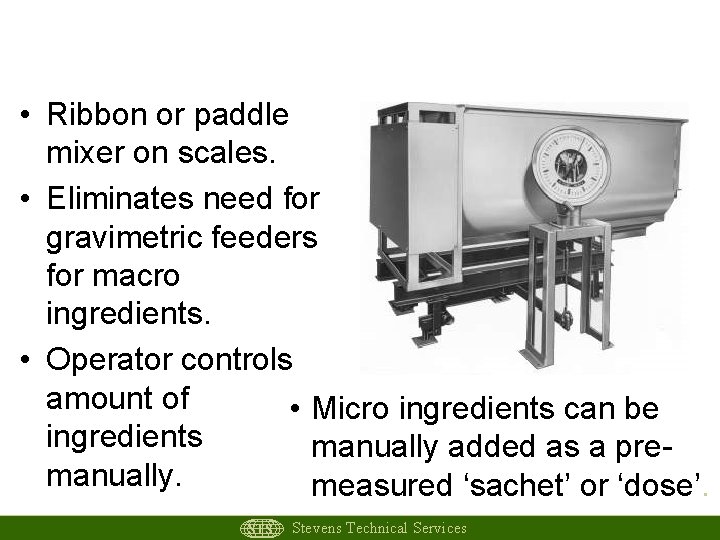
Medium Tech Batch Mixer • Ribbon or paddle mixer on scales. • Eliminates need for gravimetric feeders for macro ingredients. • Operator controls amount of • Micro ingredients can be ingredients manually added as a premanually. measured ‘sachet’ or ‘dose’. STS Stevens Technical Services
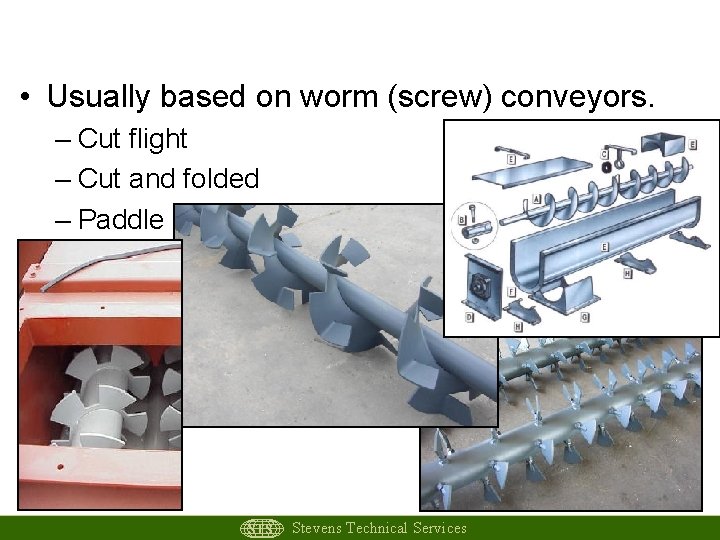
Medium Tech Continuous Mixers • Usually based on worm (screw) conveyors. – Cut flight – Cut and folded – Paddle STS Stevens Technical Services
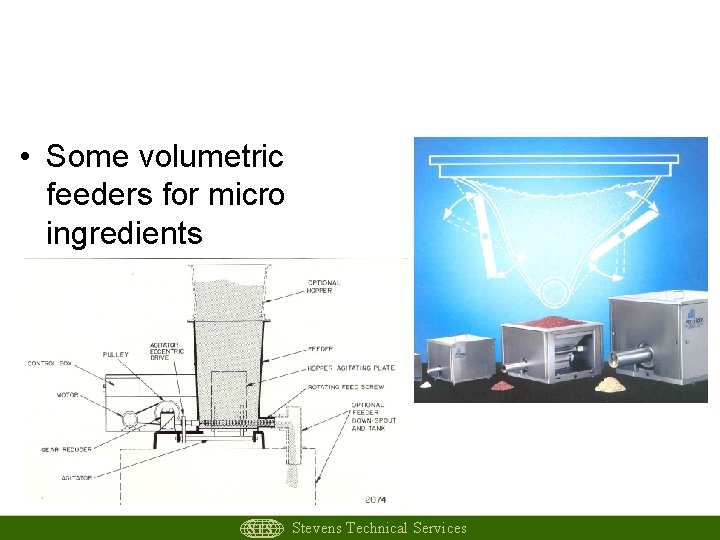
Continuous mixing allows volumetric dosing of micro ingredients • Some volumetric feeders for micro ingredients STS Stevens Technical Services
Volumetric Dosifiers • Volumetric dosifiers are much cheaper than gravimetric. • But volumetric dosifiers require frequent check weighing and re-adjustment. STS Stevens Technical Services
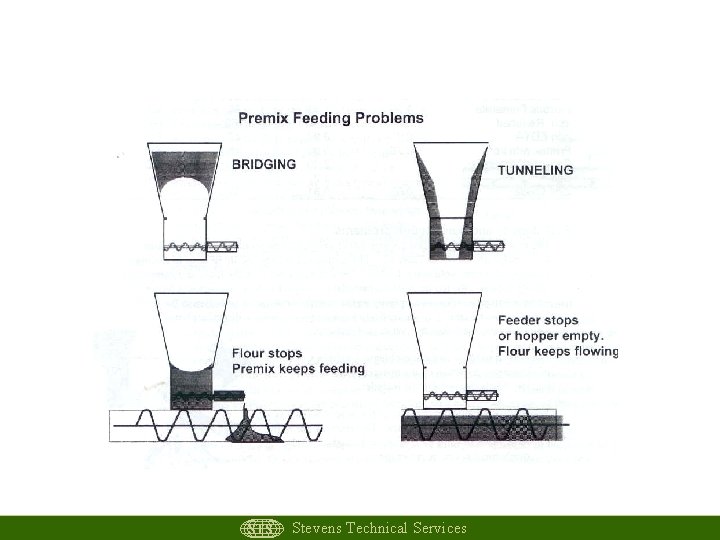
Common Problems with Dosifiers STS Stevens Technical Services
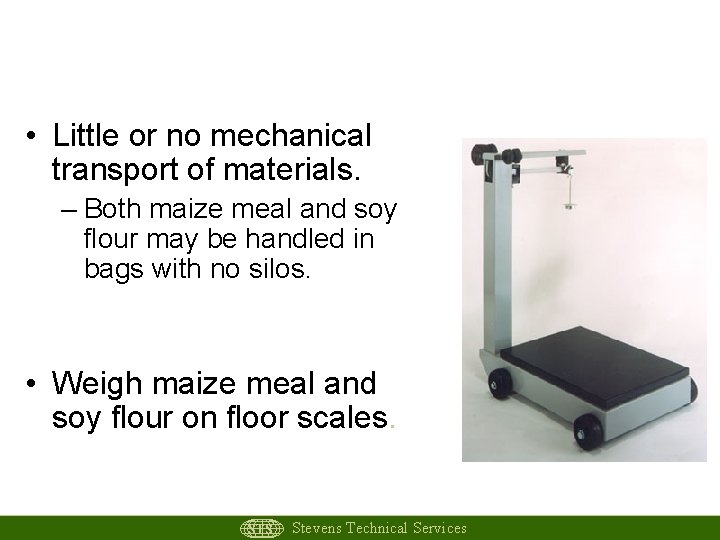
What about village level or low tech? • Little or no mechanical transport of materials. – Both maize meal and soy flour may be handled in bags with no silos. • Weigh maize meal and soy flour on floor scales. STS Stevens Technical Services
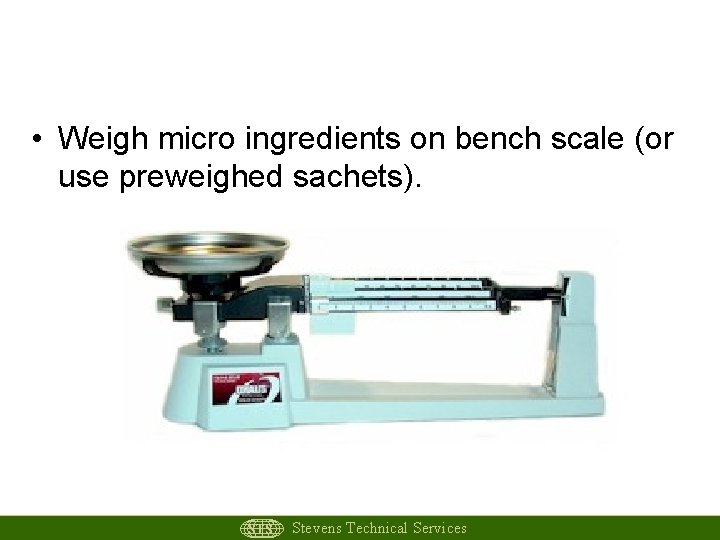
Village level or low tech • Weigh micro ingredients on bench scale (or use preweighed sachets). STS Stevens Technical Services
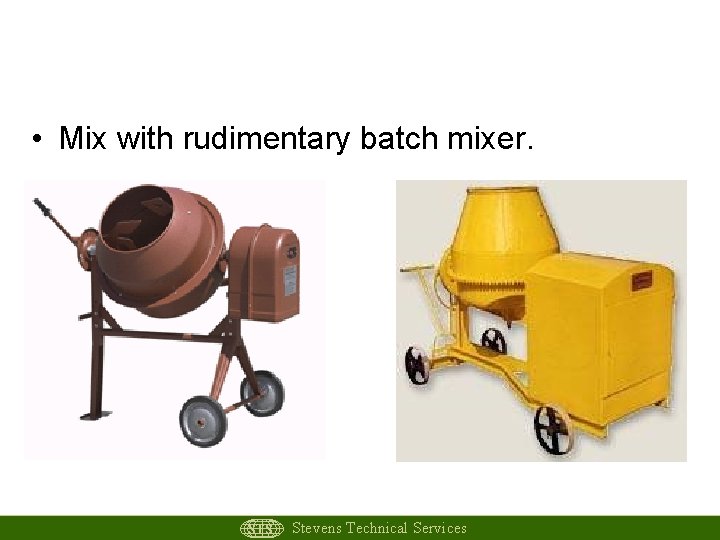
Village level or low tech • Mix with rudimentary batch mixer. STS Stevens Technical Services
Mixer Performance • Mixing times and performance depend on: – Mixer design. – The materials being mixed. • There is an optimum mixing time. – Over mixing can result in ‘de-mixing’. – Especially a problem when constituents have differing particle size (such as with meal and flour). • Extensive testing is required to determine optimum mixing time. STS Stevens Technical Services
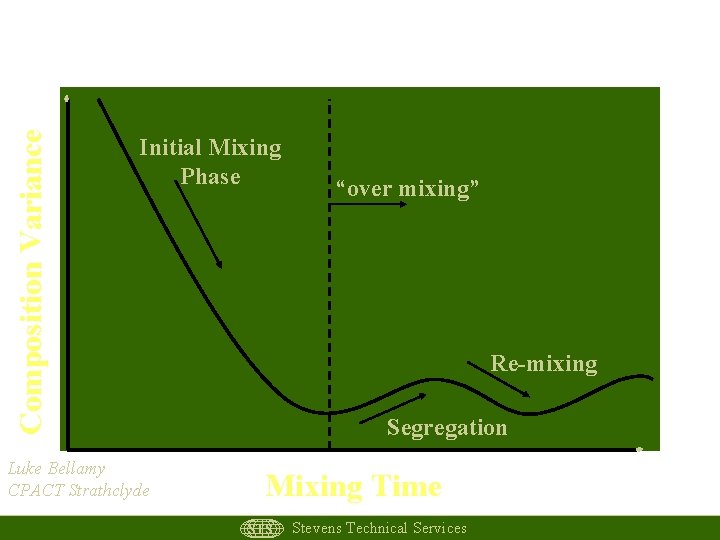
Composition Variance Ideal Mixing Profile Initial Mixing Phase Luke Bellamy CPACT Strathclyde “over mixing” Re-mixing Segregation Mixing Time STS Stevens Technical Services
Mixer Performance • Of all the mixers shown so far, the most susceptible to de-mixing when different size particles are being mixed: – The ‘cement mixer’, followed by – Cut flight screw conveyor, – Cut and folded flight screw conveyor, – Paddle mixer, – Ribbon mixer. STS Stevens Technical Services
Quality Assurance • Major component proportioning is relatively easy to verify through protein testing. • Micro ingredient dosages very difficult to verify quantitatively. – True verification requires highly specialized equipment and highly skilled technicians. – Qualitative / subjective verification possible with spot tests or fluorescence. – Qualitative tests probably good enough for internal QA, but certainly not good for regulatory compliance. STS Stevens Technical Services
Investment Strategies • Thus it makes sense to invest in equipment that allows very accurate and precise control of micronutrient dosage. • Concentrate on high accuracy and high precision for the highest cost ingredients. – The micro nutrient ingredients are very high cost per kg. • We don’t want to give it away. – The micro nutrient ingredients are the most critically important for health (and perhaps regulation). • Thus we don’t want to apply too little. STS Stevens Technical Services
Investment Strategies • Automation is ‘nice’, but … • Automation is expensive. • Most processing facilities, even in highly developed markets, use the ‘medium tech’ approach. • In the ‘low tech’ approach, the person weighing the micro ingredients will be the key to profit or loss. STS Stevens Technical Services
Conclusions • CSB, with its added soy oil is not easy and probably suitable only for mechanized processors of medium to large scale. • CMSF relatively simple to prepare: – Processing technology available for extremely sophisticated processors and for very simple batch operations. – Investment costs vary widely depending on technology level (and scale of operations). STS Stevens Technical Services
Conclusions • Highest cost item is vitamin and mineral premix. – Thus the most care and attention must be paid to this ingredient. • Internal, qualitative, subjective, QA testing on micro ingredients very cheap and easy. – Regulatory or quantitative QA very expensive and difficult. • Determination of proper mixing time important: – Over-mixing is nearly as bad as under-mixing. STS Stevens Technical Services

Thank you for your kind attention. Please visit my website at www. technicalmiller. com Henry H. Stevens Technical Services Beaverton Oregon USA hhs@technicalmiller. com (1) 503 -439 -3005 STS Stevens Technical Services
- Slides: 26