
Cerbro Vascular Accidents Prof Magdy Dahab Azhar University
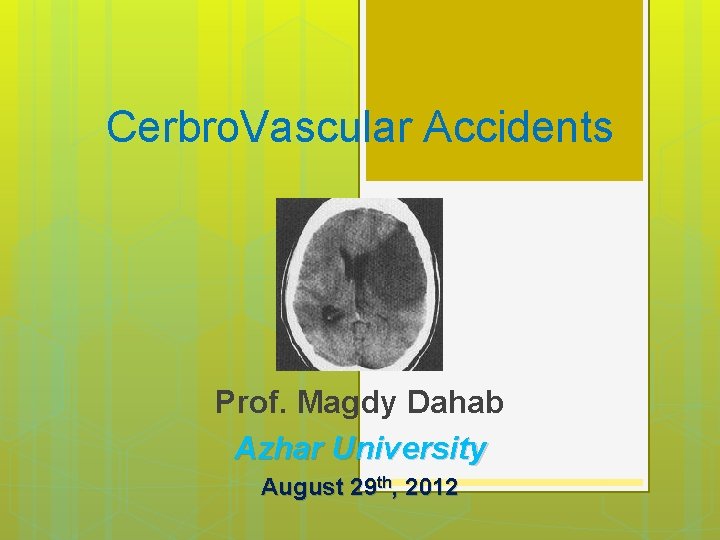
Cerbro. Vascular Accidents Prof. Magdy Dahab Azhar University August 29 th, 2012
2 Cerebro. Vascular Accidents Definition Ischemia is inadequate blood flow Brain attack (Stroke) occurs when there is ischemia to a part of the brain that results in death of brain cells M. Dahab
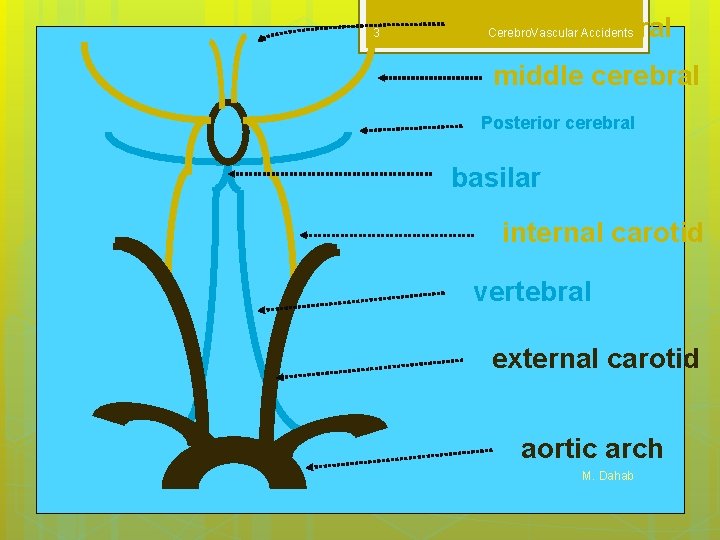
3 Cerebro. Vascular Accidents anterior cerebral middle cerebral Posterior cerebral basilar internal carotid vertebral external carotid aortic arch M. Dahab
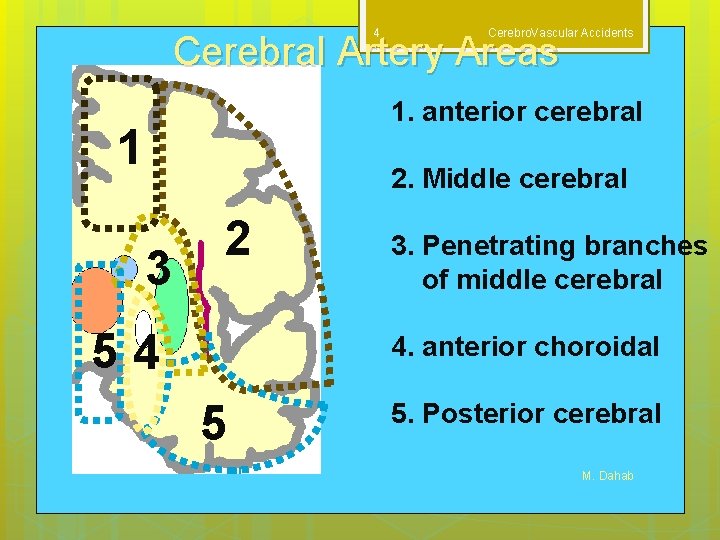
4 Cerebro. Vascular Accidents Cerebral Artery Areas 1. anterior cerebral 1 2. Middle cerebral 3 2 54 3. Penetrating branches of middle cerebral 4. anterior choroidal 5 5. Posterior cerebral M. Dahab
5 Cerebro. Vascular Accidents Anastomoses Interconnections between blood vessels overlapping blood supply safety mechanism retrograde filling e. g. , circle of Willis Others between. . . opthalmic artery & external carotid surface branches of anterior, middle, posterior ~ M. Dahab
6 Cerebro. Vascular Accidents Cerebrovascular accident third most common cause of death in the developed world common cause for physical disability in older age. CVA denotes either ischaemia from occlusion of blood vessels (producing cerebral ischaemia and infarction) or haemorrhage through their rupture. M. Dahab
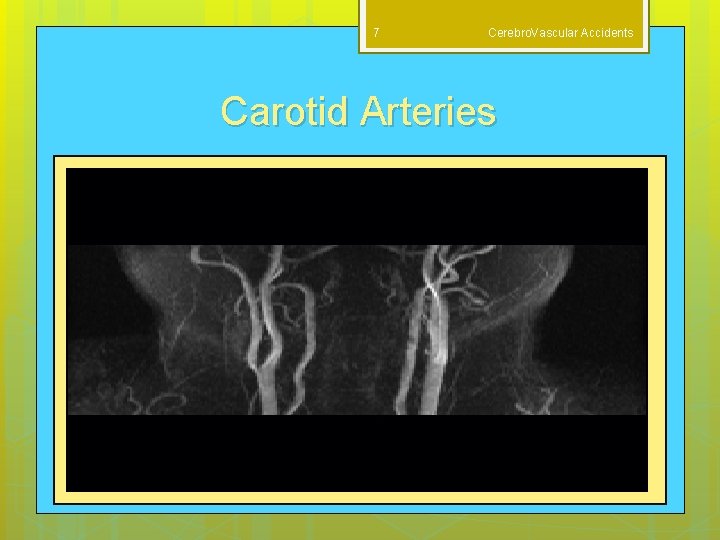
7 Cerebro. Vascular Accidents Carotid Arteries M. Dahab
8 Cerebro. Vascular Accidents CVA Some principles “Time is brain” Focal symptoms “Fit” Migraine M. Dahab
9 Cerebro. Vascular Accidents CVA Some principles Non-Focal symptoms syncope hypoglycemic “Toxic” M. Dahab
10 Cerebro. Vascular Accidents Risk Factors Non Modifiable Age Gender Race Heredity M. Dahab
11 Cerebro. Vascular Accidents Risk Factors Modifiable Obesity HTN Smoking Heavy alcohol consumption Hypercoagulability Hyperlipidemia Asymptomatic carotid stenosis Diabetes mellitus Heart disease, atrial fibrillation Oral contraceptives Physical inactivity Sickle cell disease M. Dahab
12 Cerebro. Vascular Accidents Types of CVAs Occlusive CVA: due to the closure of a blood vessel usually due to atherosclerosis & thrombosis. Hemorrhagic CVA: due to bleeding from a blood vessel usually due to either hypertension or an aneurysm. M. Dahab
13 Cerebro. Vascular Accidents Stroke: Ischemia Insufficiency of blood supply Glucose & O 2 deprivation, build-up of wastes NOT synonymous Anoxia: O 2 deprivation only Few seconds: little or no damage 6 -8 minutes ---> Infarction neurons & other cells die ~ M. Dahab
14 Cerebro. Vascular Accidents Clinical classification Transient ischemic attack (TIA) or minor stroke or transient stroke Evolving stroke Reversible ischemic neurological deficit (RIND) Completed stroke M. Dahab
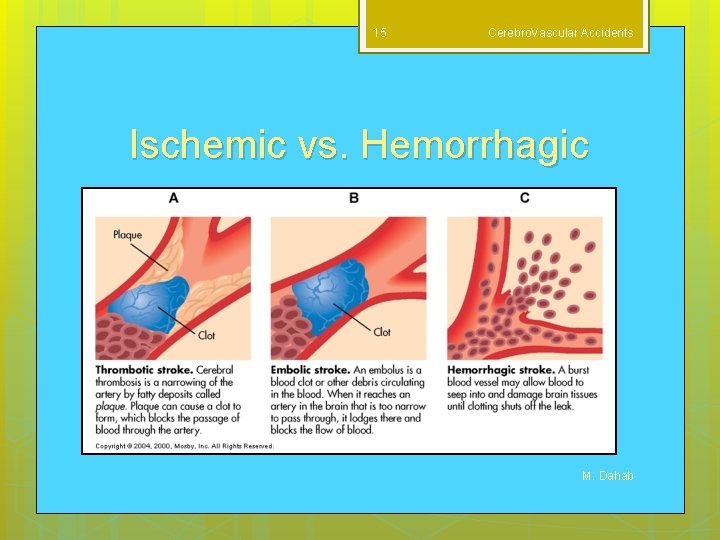
15 Cerebro. Vascular Accidents Ischemic vs. Hemorrhagic M. Dahab
16 Cerebro. Vascular Accidents Clinical features Depend on vascular territory involved. Hemisphere localized or extensive Basal ganglia level ( internal capsule and thalamus) Brainstem cerebellum Repeated small infarcts may lead to dementia or parkinsonism Hemorrhage in to the subarachnoid space may present as sudden onset severe headache associated with vomiting and neck stiffness. M. Dahab
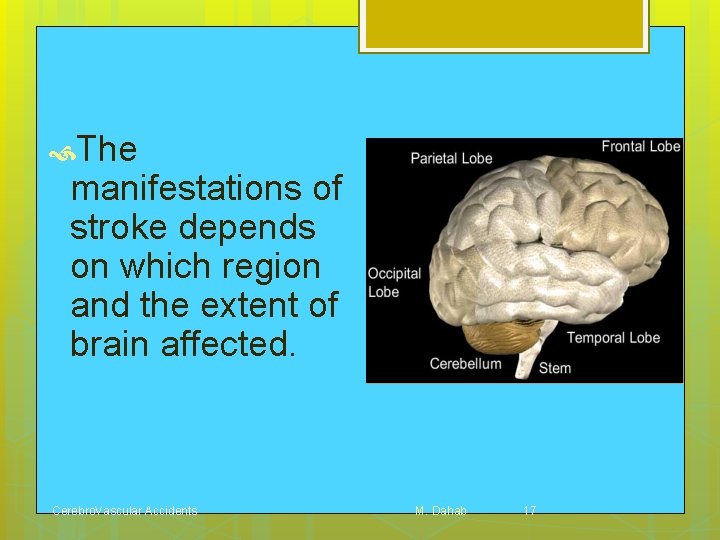
The manifestations of stroke depends on which region and the extent of brain affected. Cerebro. Vascular Accidents M. Dahab 17
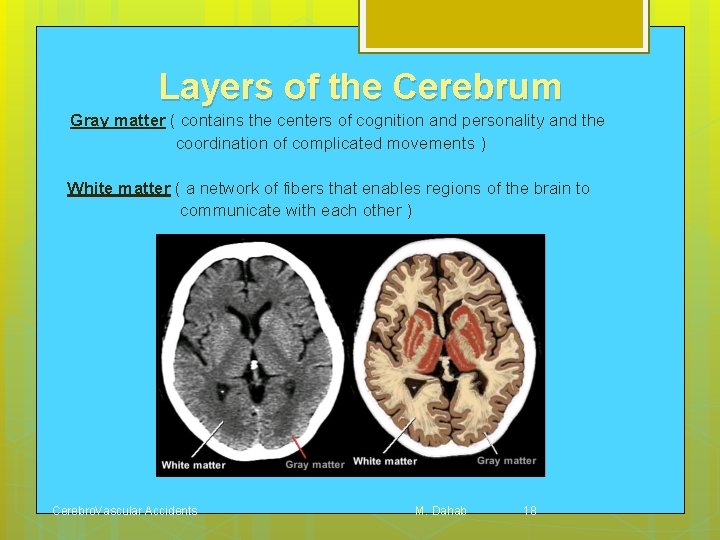
Layers of the Cerebrum Gray matter ( contains the centers of cognition and personality and the coordination of complicated movements ) White matter ( a network of fibers that enables regions of the brain to communicate with each other ) Cerebro. Vascular Accidents M. Dahab 18
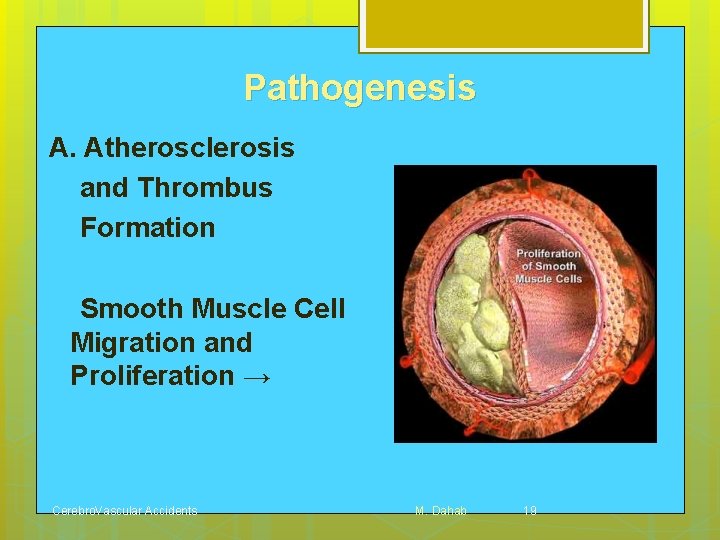
Pathogenesis A. Atherosclerosis and Thrombus Formation Smooth Muscle Cell Migration and Proliferation → Cerebro. Vascular Accidents M. Dahab 19
Cerebro. Vascular Accidents M. Dahab 20
21 Cerebro. Vascular Accidents Middle cerebral artery Most common stroke syndrome. contralateral weakness face, arm, and hand more than legs contralateral sensory loss face, arm, and hand more than legs visual field cut damage to optic radiations M. Dahab
22 Cerebro. Vascular Accidents Middle Cerebral Artery Aphasia: language disturbances more likely with L. Hemi. damage especially men Broca's: production Wernicke's: comprehension ~ M. Dahab
23 Cerebro. Vascular Accidents Middle Cerebral Artery Impaired spatial perception more likely after R. Hemi. damage spatial neglect dressing apraxia constructional apraxia topographagnosia ~ M. Dahab
24 Cerebro. Vascular Accidents Anterior cerebral artery Motor distrubance contralateral distal leg urinary incontinence speech disturbance (may be more of a motor problem) apraxia of left arm (sympathetic apraxia) if anterior corpus callosum is affected If bilateral may cause apathy, motor inertia, and muteness ~ M. Dahab
25 Cerebro. Vascular Accidents Posterior Cerebral Artery Visual disturbances contralateral (central L. homonymous hemianopsia vision is often spared) Hemi: lesions alexia (with or without agraphia) Bilateral lesions: cortical blindness patients unaware they cannot see (Anton's syndrome) Memory impairment if temporal lobe is affected ~ M. Dahab
26 Cerebro. Vascular Accidents Posterior Cerebral Artery Proximal occlusion contralateral hemisensory loss, spontaneous pain and dysesthesia if thalamus affected (thalamic pain syndrome) contralateral severe proximal chorea (hemiballism) ~ M. Dahab
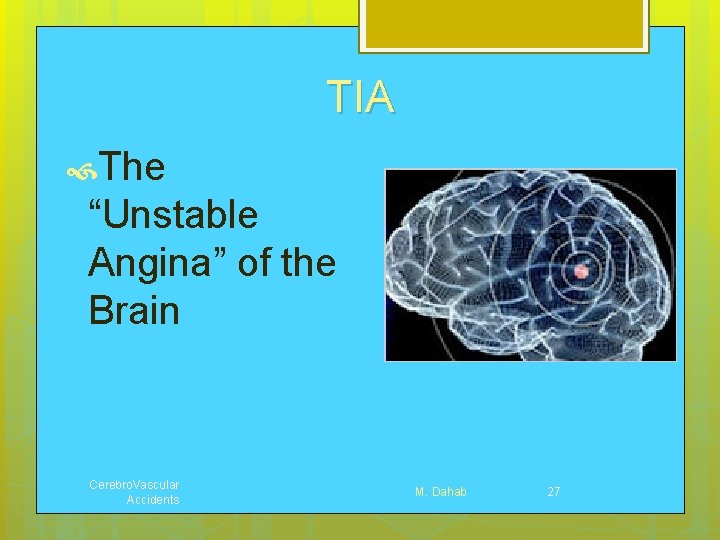
TIA The “Unstable Angina” of the Brain Cerebro. Vascular Accidents M. Dahab 27
28 Cerebro. Vascular Accidents Transient Ischemic Attack Classically a focal neurologic event lasting < 24 hours Epidemiology 180, 000 TIA/yr in US About half those experiencing TIA do not report it Pathophysiology - similar to stroke, but unknown why similar events produce TIA only M. Dahab
29 Cerebro. Vascular Accidents TIA A signal for major stroke in future Clinical features may be hemiparesis, aphasias, sensory diturbances, transient monocular blindness (amaurosis fugax), lower cranial nerve deficit etc. Brain imaging is strongly recommended to rule out small hemorrhage. Demarcates time for implementation of secondary preventive measures M. Dahab
30 Cerebro. Vascular Accidents Prognosis TIA should be considered a “strokeprone” state (SORT A) Factors increasing stroke risk after TIA Prior stroke New infarct on initial head CT Ischemic lesions on Diffusion Weighted MRI M. Dahab Johnston SC, Rothwell PM, Nguyen-Huynh MN, et al. Lancet. Jan 27 2007; 369(9558): 283 -292.
31 Cerebro. Vascular Accidents Stroke-in-evolution Can have abrupt onset, but develop in a step-by-step fashion over minutes to hours, occasionally, from days to weeks Characteristic of thrombotic stroke or slow hemorrhage M. Dahab
32 Cerebro. Vascular Accidents Completed stroke About 85% are due to infarction and remaining 15 % are due to hemorrhage. Deficit is maximum at presentation Headache vomiting, transient loss of consciousness favor hemorrhage but this distinction is arbitrary M. Dahab
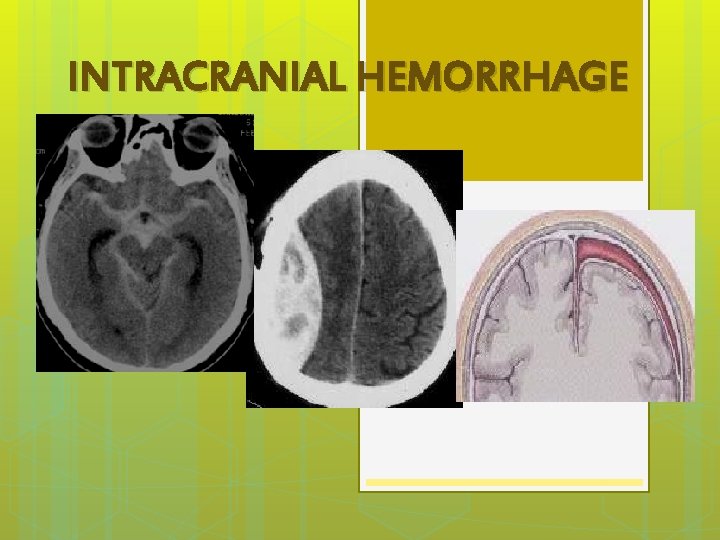
INTRACRANIAL HEMORRHAGE
34 Cerebro. Vascular Accidents 1 -Intracerebral haemorrhage 20 % of strokes Sudden onset Neuro Deficit according to the site and size of bleed , coma in up to 50% Common cause hypertension 80% 2/3 in basal ganglia Bleeding within infarction or tumor May be induced by anticoagulation M. Dahab
35 Cerebro. Vascular Accidents Treatment of intracerebral haemorrhage Lower the BP Surgical evacuation ? Surgical treatment of vascular malformation Recombinant factor VIIa decrease its growth but thromboembolism risk M. Dahab
36 Cerebro. Vascular Accidents 2 -Subarachnoid haemorrhage : SAH acute usually young severe occipital headache usually no focal sign. coma hyperreflexia, Babinski, neck stiffness due to rupture of aneurysm CT, Angio, MRI, MRA, CSF : blood, Xanthochromic M. Dahab
37 Cerebro. Vascular Accidents Treatment of SAH Initial spasm and risk of rebleeding Surgical treatment of aneurysm Medical treatment M. Dahab
38 Cerebro. Vascular Accidents Stroke Mimics Seizure (with persistent paralysis) Intracranial mass (tumor, subdural hematoma, abscess, etc. ) Migraine (with persistent signs) Meningitis/encephalitis Drug overdose Hyper- and hypoglycemia Cervical/head trauma Post cardiac arrest ischemia Hypertensive encephalopathy Psychogenic deficit (conversion disorder, catatonia, malingering, others) M. Dahab
39 Cerebro. Vascular Accidents Investigations Computed Tomographic Scans Usually demonstrates the lesion, more ever it is very useful to exclude hemorrhagic lesion. In ishemic stroke, occasionally CT may be normal in first 24 hours. Small posterior fossa or lacunar infarction may be easily missed by CT. Other imaging techniques (MRI, angiography, transcranial doppler) can be applied in selected cases. Carotid doppler ECG, echocardiogram in suspected Cardiac emboli Assessment of the risk factors for stroke: blood sugar, M. Dahab serum lipids, polycythemia
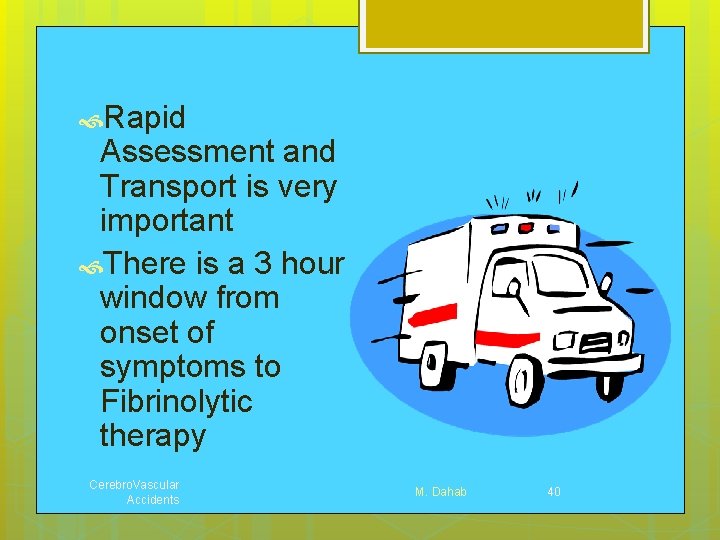
Rapid Assessment and Transport is very important There is a 3 hour window from onset of symptoms to Fibrinolytic therapy Cerebro. Vascular Accidents M. Dahab 40
41 Cerebro. Vascular Accidents Management (1) (2) (3) (4) (5) Supportive measures Antiplatelet agents Thrombolysis Anticoagulation Secondary prevention M. Dahab
42 Cerebro. Vascular Accidents Treatment Pharmacologic anticoagulants vasodilators antihypertensives steroids antagonism of excitatory amino acid neurotoxicity ~ M. Dahab
43 Cerebro. Vascular Accidents Treatment Surgery remove aneurysms remove pressure following hemorrhage Radiation to treat AVMs Embolization therapy to plug vessels of an AVM or to treat an aneurysm (direct surgery usually preferable) M. Dahab
44 Cerebro. Vascular Accidents supportive measures Treat complications of bedridden patients (pneumonia, UTI, bowel and bladder care, prevention of DVT For those who are unable to swallow or tend to regurgitate or aspirate, put a nasogastric tube and start feeding. Control of the blood pressure: Continue regular anti-hypertensive drugs Don’t treat new hypertension unless BP is >185/110 or ongoing TOD. Control of blood sugar, maintenance of hydration and M. Dahab electolyte balance
45 Anti-platelet Cerebro. Vascular Accidents agents Aspirin 325 mg per day Contraindicated in associated hemorrhage Active bleeding lesion (e. g. bleeding peptic ulcer) Anticoagulation Indicated in cardiac emboli in presence of atrial fibrillation or thrombus in left ventricle Start with heparin infusion continue with warfarin (target INR is 2 -3) M. Dahab Complication : hemorrhagic transformation
46 Cerebro. Vascular Accidents Thrombolysis Frequently associated with hemorrhagic transformation of ischemic stroke Still can be tried if patients presents within 6 hours of onset, absence of hypertension, when CT does not show excessive low density, or there are no other obvious contraindication. Drugs that can be used are streptokinase and Rt-PA. Secondary prevention Control of risk factors Antiplatelet agent ( aspirin, ticlopidine, Dipyridamole, clopidogrel) M. Dahab
47 Cerebro. Vascular Accidents Stroke – Rehabilitation Stroke rehabilitation is effective to improve outcome after stroke (SORT A) Early rehabilitation in the acute phase may be beneficial (SORT C) Optimal timing for referral and setting of rehabilitation in uncertain Pollock A, et al. Cochrane Database Syst Rev. 2007(1): CD 001920. VA/Do. D clinical practice guideline for the management of stroke rehabilitation in the M. Dahab primary care setting. Department of Veteran Affairs; 2003 Feb.
48 Cerebro. Vascular Accidents Stroke is a treatable disease Awareness Treat modifiable risk factors Primary and secondary prevention Advances in treating acute ischemic and hemorrhagic stroke. M. Dahab

Thank You www. magdydahab. com Cerebro. Vascular Accidents M. Dahab 49
- Slides: 49